Ramanjaneyulu
Rainfed Agriculture needs special dispensation

• Limitations of rainfed areas
  – Moisture
  – Soil fertility
  – infrastructure
  – Other income generating options
• Lack of public policy support
  – Technology development
  – Marketing
  – subsidies
What we should think of ….
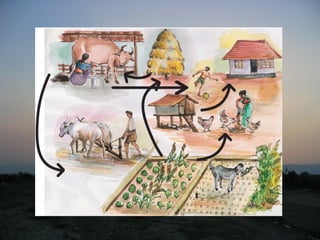
• Integrated farming systems integrating
  livestock, trees etc
• Building soil organic matter
• Conserving moisture
• Rainwater harvesting
• Locally adopted crops and varieties
• Contingence planning
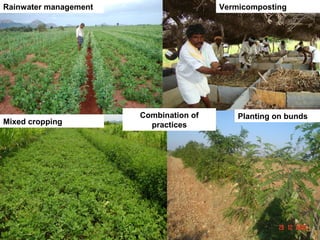
Rainwater management                    Vermicomposting


                       Combination of       Planting on bunds
Mixed cropping           practices
Soil productivity Management
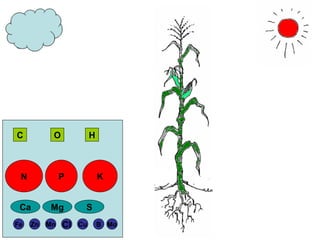
• Plants as nutrient mining systems
• Soil is understood as strata to hold plants
• Only available nutrients are measured
• External nutrient application-no measure
  of utilisation
• Soil-chemical, biological and physical
  properties
• Biomass application is also seen as
  external nutrient application…so
  measures only the content
C          O             H


 N             P             K


 Ca        Mg        S
Fe   Zn   Mn   Cl   Cu       B Mo
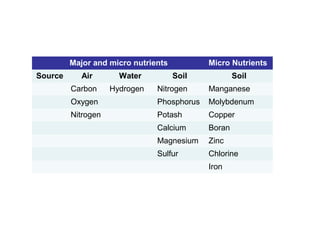
Major and micro nutrients          Micro Nutrients
Source      Air       Water          Soil           Soil
         Carbon     Hydrogen   Nitrogen     Manganese
         Oxygen                Phosphorus   Molybdenum
         Nitrogen              Potash       Copper
                               Calcium      Boran
                               Magnesium    Zinc
                               Sulfur       Chlorine
                                            Iron
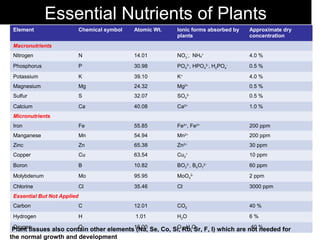
Essential Nutrients of Plants
 Element                     Chemical symbol   Atomic Wt.   Ionic forms absorbed by   Approximate dry
                                                            plants                    concentration
 Macronutrients
 Nitrogen                    N                 14.01        NO3-, NH4+                4.0 %
 Phosphorus                  P                 30.98        PO43-, HPO42-, H2PO4-     0.5 %
 Potassium                   K                 39.10        K+                        4.0 %
 Magnesium                   Mg                24.32        Mg2+                      0.5 %
 Sulfur                      S                 32.07        SO42-                     0.5 %
 Calcium                     Ca                40.08        Ca2+                      1.0 %
 Micronutrients
 Iron                        Fe                55.85        Fe2+, Fe3+                200 ppm
 Manganese                   Mn                54.94        Mn2+                      200 ppm
 Zinc                        Zn                65.38        Zn2+                      30 ppm
 Copper                      Cu                63.54        Cu2+                      10 ppm
 Boron                       B                 10.82        BO32-, B4O72-             60 ppm
 Molybdenum                  Mo                95.95        MoO42-                    2 ppm
 Chlorine                    Cl                35.46        Cl-                       3000 ppm
 Essential But Not Applied
 Carbon                      C                 12.01        CO2                       40 %
 Hydrogen                    H                 1.01         H2O                       6%

 Plant tissues also contain other elements16.00 Se, Co, Si, 2Rb,O F, I) which are not %
 Oxygen                 O                  (Na,          O , H2 Sr,                40 needed for
the normal growth and development
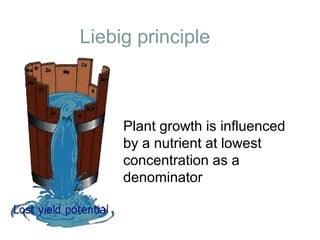
Liebig principle


     Plant growth is influenced
     by a nutrient at lowest
     concentration as a
     denominator
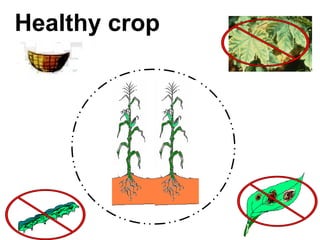
Healthy crop
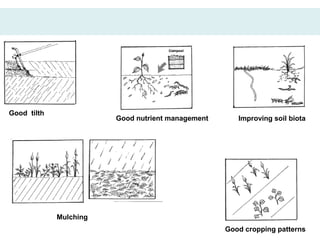
Good tilth
                        Good nutrient management      Improving soil biota


             Mulching
                                                   Good cropping patterns
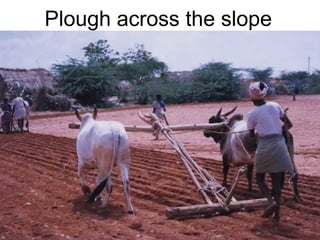
Plough across the slope
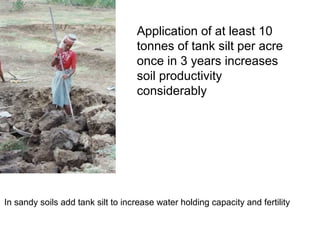
Application of at least 10
                                   tonnes of tank silt per acre
                                   once in 3 years increases
                                   soil productivity
                                   considerably


In sandy soils add tank silt to increase water holding capacity and fertility
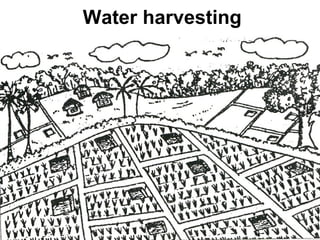
Water harvesting
Water Management

Modern agriculture: irrigation, drip,
sprinkler

Sustainable Agriculture: focuses more on
conserving soil moisture, increasing organic
matter, mulching, cover crops, cropping
patterns etc…
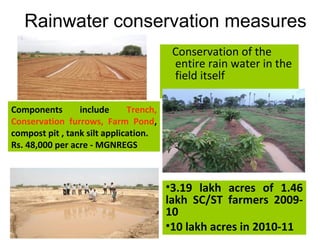
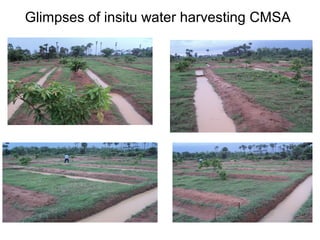
Rainwater conservation measures
                                         Conservation of the
                                         entire rain water in the
                                         field itself

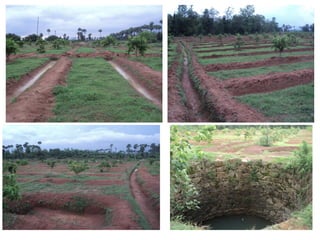
Components       include      Trench,
Conservation furrows, Farm Pond,
compost pit , tank silt application.
Rs. 48,000 per acre - MGNREGS


                                        •3.19 lakh acres of 1.46
                                        lakh SC/ST farmers 2009-
                                        10
                                        •10 lakh acres in 2010-11
Glimpses of insitu water harvesting CMSA
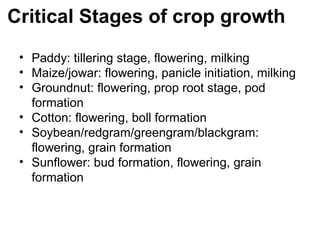
Critical Stages of crop growth
 • Paddy: tillering stage, flowering, milking
 • Maize/jowar: flowering, panicle initiation, milking
 • Groundnut: flowering, prop root stage, pod
   formation
 • Cotton: flowering, boll formation
 • Soybean/redgram/greengram/blackgram:
   flowering, grain formation
 • Sunflower: bud formation, flowering, grain
   formation
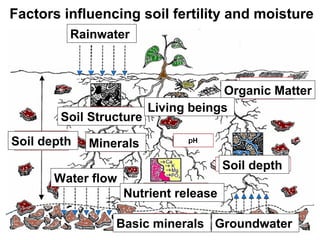
Factors influencing soil fertility and moisture
         Rainwater


                                     Organic Matter
                         Living beings
        Soil Structure
Soil depth   Minerals
                                       Soil depth
       Water flow
                    Nutrient release

                 Basic minerals Groundwater
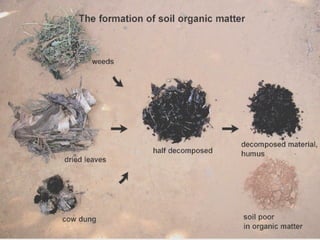
Soil Organic matter

    The soil organic matter has declined from about 1.43 and 1.21
    % in red and black soils in the 1950’s to about 0.80 to 0.86
    percent respectively at present.

    Soil organic matter performs Hydrological, Biological and
    Nutrient related functions, which are both interrelated and
    distinct.

    The OM helps tide over dry spells and in reducing runoff. Soil
    moisture and organic matter is essential even for improving the
    efficiency of biofertilisers and chemical nutrients.

    For better decomposition
    
        Maintain C:N ratio in the range of 30-40:1
    
        Application of water regularly to maintain around 60% moisture
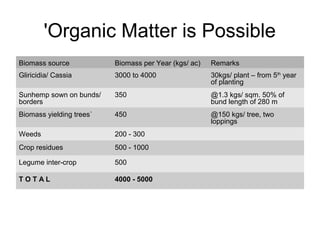
'Organic Matter is Possible
Biomass source            Biomass per Year (kgs/ ac)   Remarks
Gliricidia/ Cassia        3000 to 4000                 30kgs/ plant – from 5th year
                                                       of planting
Sunhemp sown on bunds/    350                          @1.3 kgs/ sqm. 50% of
borders                                                bund length of 280 m
Biomass yielding trees`   450                          @150 kgs/ tree, two
                                                       loppings
Weeds                     200 - 300
Crop residues             500 - 1000

Legume inter-crop         500

TOTAL                     4000 - 5000

    Green manure (legumes) crops when
    integrated as intercrops, would add about
    1.5 to 3 tons/ ha of fresh biomass in situ.

    Studies have shown that legume
    intercrops can add 0.30 to 2.4 tons of leaf
    litter per ha even in a drought year; with
    4.1 to 35.6 kg N per ha.
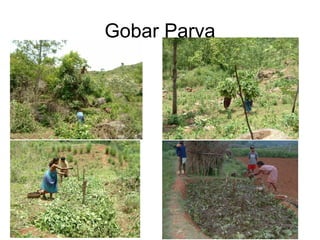
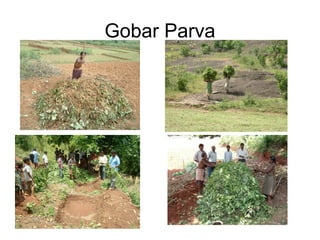
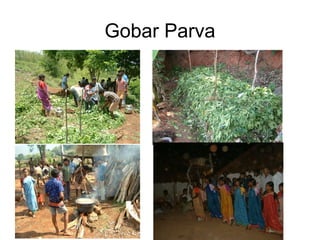
Gobar Parva
Gobar Parva
Gobar Parva
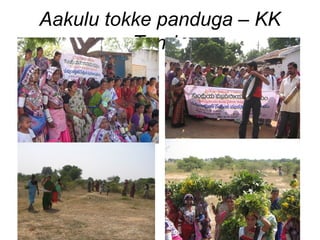
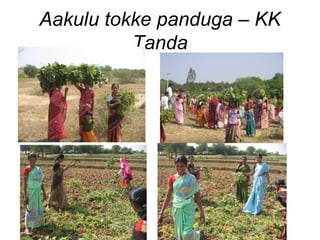
Aakulu tokke panduga – KK
          Tanda
Aakulu tokke panduga – KK
          Tanda
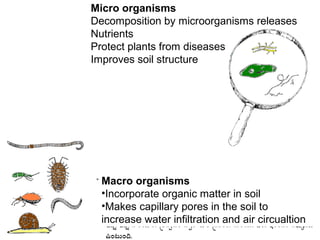
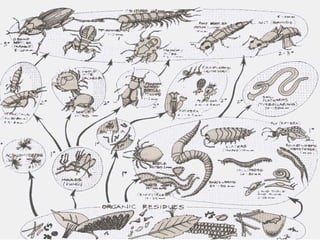
Micro organisms
Decomposition by microorganisms releases
Nutrients
Protect plants from diseases
Improves soil structure


  Macro organisms
  •Incorporate organic matter in soil
  •Makes capillary pores in the soil to
  increase water infiltration and air circualtion
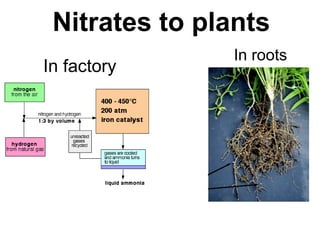
Nitrates to plants
               In roots
In factory
‘P’ for Plants
• Applied water soluble ‘P’ is, on an average, used @
  12-9-6-3% from year of application
• Considerable (70%) part of applied ‘P’ is locked in the
  soil first as tricalcium phosphate (TCP) and finally as
  apatite
• in paddies, under heavy soils, considerable part of
  applied ‘P’ gets converted into apatite
• P in TCP is unavailable but can be used by plants in
  association with Mycorrhizae and to some extent by
  Phosphobacteria
Factors limiting P availability and uptake
• Amongst the nutrients, nitrogen is universally limiting and in most trials this
  aspect is given due attention.
• But more often, the widespread Zinc deficiency is ignored and it could as
  well be a limiting factor in showing response to applied P
• At lower levels or production, the native phosphorus itself may be adequate
  and thus no response to applied P
• Some elements may become toxic (e.g. Boron). Subsoil salinity could be
  another factor
• With temporary or transient water logging or wet regime, Fe 3+ iron may be
  reduced to Fe2+ leading to possible precipitation of phosphates
• The organic acids released by the legumes (Pscidic acid from pigeonpea
  roots) would solubilise phosphates or chelate metal irons like Ca 2+, Fe2+
  liberating part of the bound phosphorus. The VAM fungi may also
  accentuate the availability of phosphorus.
• VAM and other fungal bodies associated with roots improve the availability
  of difficulty available phosphates
• Method of application is important in enhancing fertiliser P use efficiency.
  Placement, in association with ammonical nitrogen is very effective.
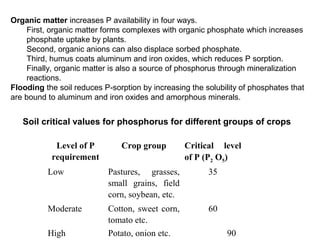
Organic matter increases P availability in four ways.
     First, organic matter forms complexes with organic phosphate which increases
     phosphate uptake by plants.
     Second, organic anions can also displace sorbed phosphate.
     Third, humus coats aluminum and iron oxides, which reduces P sorption.
     Finally, organic matter is also a source of phosphorus through mineralization
     reactions.
Flooding the soil reduces P-sorption by increasing the solubility of phosphates that
are bound to aluminum and iron oxides and amorphous minerals.


   Soil critical values for phosphorus for different groups of crops

            Level of P         Crop group        Critical level
           requirement                           of P (P2 O5)
          Low              Pastures, grasses,           35
                           small grains, field
                           corn, soybean, etc.
          Moderate         Cotton, sweet corn,          60
                           tomato etc.
          High             Potato, onion etc.                90
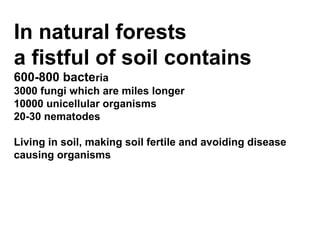
In natural forests
a fistful of soil contains
600-800 bacteria
3000 fungi which are miles longer
10000 unicellular organisms
20-30 nematodes

Living in soil, making soil fertile and avoiding disease
causing organisms
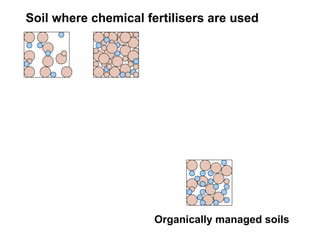
Soil where chemical fertilisers are used


                      Organically managed soils
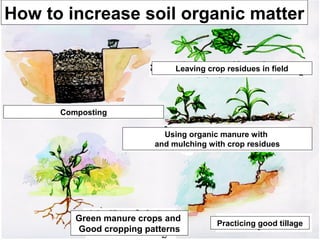
How to increase soil organic matter

                              Leaving crop residues in field


      Composting

                           Using organic manure with
                         and mulching with crop residues


         Green manure crops and
                                         Practicing good tillage
         Good cropping patterns
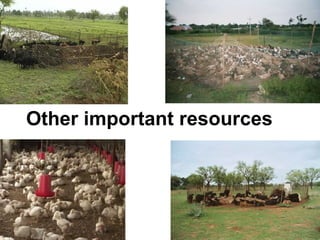
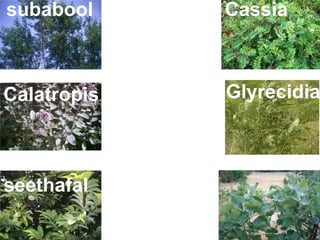
Other important resources
subabool     Cassia


Calatropis   Glyrecidia


seethafal
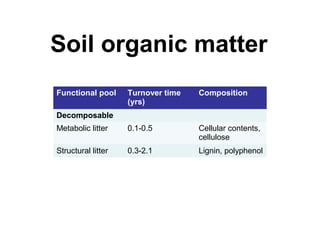
Soil organic matter
Functional pool     Turnover time   Composition
                    (yrs)
Decomposable
Metabolic litter    0.1-0.5         Cellular contents,
                                    cellulose
Structural litter   0.3-2.1         Lignin, polyphenol
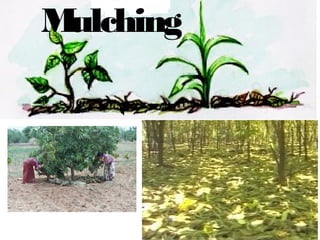
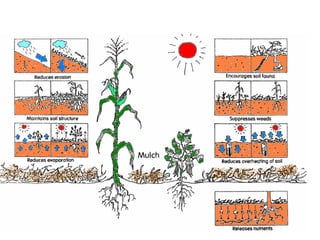
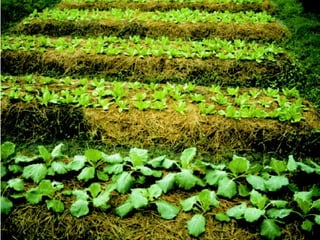
Mulching
Crop Choices
• Market demand
• Soil and growing conditions
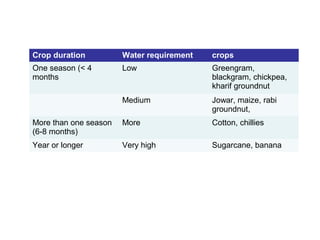
Crop duration          Water requirement   crops
One season (< 4        Low                 Greengram,
months                                     blackgram, chickpea,
                                           kharif groundnut
                       Medium              Jowar, maize, rabi
                                           groundnut,
More than one season   More                Cotton, chillies
(6-8 months)
Year or longer         Very high           Sugarcane, banana
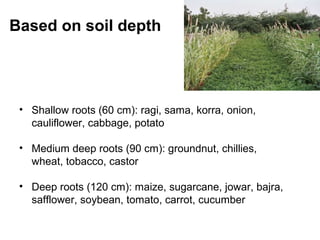
Based on soil depth


 • Shallow roots (60 cm): ragi, sama, korra, onion,
   cauliflower, cabbage, potato

 • Medium deep roots (90 cm): groundnut, chillies,
   wheat, tobacco, castor

 • Deep roots (120 cm): maize, sugarcane, jowar, bajra,
   safflower, soybean, tomato, carrot, cucumber
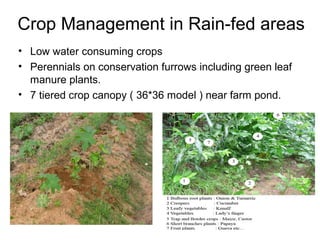
Crop Management in Rain-fed areas
• Low water consuming crops
• Perennials on conservation furrows including green leaf
  manure plants.
• 7 tiered crop canopy ( 36*36 model ) near farm pond.
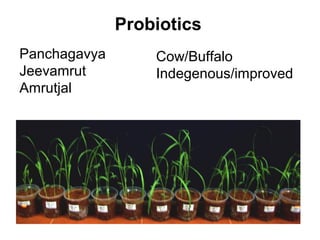
Probiotics
Panchagavya       Cow/Buffalo
Jeevamrut         Indegenous/improved
Amrutjal
ramoo.csa@gmail.com
09000699702
040-27017735
www.agrariancrisis.in
www.krishi.tv


WWW.CSA-INDIA.ORG

121217 rainfed farming

  • 1.
  • 2.
    Rainfed Agriculture needsspecial dispensation • Limitations of rainfed areas – Moisture – Soil fertility – infrastructure – Other income generating options • Lack of public policy support – Technology development – Marketing – subsidies
  • 3.
    What we shouldthink of …. • Integrated farming systems integrating livestock, trees etc • Building soil organic matter • Conserving moisture • Rainwater harvesting • Locally adopted crops and varieties • Contingence planning
  • 4.
    Rainwater management Vermicomposting Combination of Planting on bunds Mixed cropping practices
  • 5.
    Soil productivity Management •Plants as nutrient mining systems • Soil is understood as strata to hold plants • Only available nutrients are measured • External nutrient application-no measure of utilisation • Soil-chemical, biological and physical properties • Biomass application is also seen as external nutrient application…so measures only the content
  • 6.
    C O H N P K Ca Mg S Fe Zn Mn Cl Cu B Mo
  • 7.
    Major and micronutrients Micro Nutrients Source Air Water Soil Soil Carbon Hydrogen Nitrogen Manganese Oxygen Phosphorus Molybdenum Nitrogen Potash Copper Calcium Boran Magnesium Zinc Sulfur Chlorine Iron
  • 8.
    Essential Nutrients ofPlants Element Chemical symbol Atomic Wt. Ionic forms absorbed by Approximate dry plants concentration Macronutrients Nitrogen N 14.01 NO3-, NH4+ 4.0 % Phosphorus P 30.98 PO43-, HPO42-, H2PO4- 0.5 % Potassium K 39.10 K+ 4.0 % Magnesium Mg 24.32 Mg2+ 0.5 % Sulfur S 32.07 SO42- 0.5 % Calcium Ca 40.08 Ca2+ 1.0 % Micronutrients Iron Fe 55.85 Fe2+, Fe3+ 200 ppm Manganese Mn 54.94 Mn2+ 200 ppm Zinc Zn 65.38 Zn2+ 30 ppm Copper Cu 63.54 Cu2+ 10 ppm Boron B 10.82 BO32-, B4O72- 60 ppm Molybdenum Mo 95.95 MoO42- 2 ppm Chlorine Cl 35.46 Cl- 3000 ppm Essential But Not Applied Carbon C 12.01 CO2 40 % Hydrogen H 1.01 H2O 6% Plant tissues also contain other elements16.00 Se, Co, Si, 2Rb,O F, I) which are not % Oxygen O (Na, O , H2 Sr, 40 needed for the normal growth and development
  • 9.
    Liebig principle Plant growth is influenced by a nutrient at lowest concentration as a denominator
  • 11.
  • 12.
    Good tilth Good nutrient management Improving soil biota Mulching Good cropping patterns
  • 13.
  • 14.
    Application of atleast 10 tonnes of tank silt per acre once in 3 years increases soil productivity considerably In sandy soils add tank silt to increase water holding capacity and fertility
  • 15.
  • 16.
    Water Management Modern agriculture:irrigation, drip, sprinkler Sustainable Agriculture: focuses more on conserving soil moisture, increasing organic matter, mulching, cover crops, cropping patterns etc…
  • 17.
    Rainwater conservation measures Conservation of the entire rain water in the field itself Components include Trench, Conservation furrows, Farm Pond, compost pit , tank silt application. Rs. 48,000 per acre - MGNREGS •3.19 lakh acres of 1.46 lakh SC/ST farmers 2009- 10 •10 lakh acres in 2010-11
  • 18.
    Glimpses of insituwater harvesting CMSA
  • 20.
    Critical Stages ofcrop growth • Paddy: tillering stage, flowering, milking • Maize/jowar: flowering, panicle initiation, milking • Groundnut: flowering, prop root stage, pod formation • Cotton: flowering, boll formation • Soybean/redgram/greengram/blackgram: flowering, grain formation • Sunflower: bud formation, flowering, grain formation
  • 21.
    Factors influencing soilfertility and moisture Rainwater Organic Matter Living beings Soil Structure Soil depth Minerals Soil depth Water flow Nutrient release Basic minerals Groundwater
  • 22.
    Soil Organic matter  The soil organic matter has declined from about 1.43 and 1.21 % in red and black soils in the 1950’s to about 0.80 to 0.86 percent respectively at present.  Soil organic matter performs Hydrological, Biological and Nutrient related functions, which are both interrelated and distinct.  The OM helps tide over dry spells and in reducing runoff. Soil moisture and organic matter is essential even for improving the efficiency of biofertilisers and chemical nutrients.  For better decomposition  Maintain C:N ratio in the range of 30-40:1  Application of water regularly to maintain around 60% moisture
  • 23.
    'Organic Matter isPossible Biomass source Biomass per Year (kgs/ ac) Remarks Gliricidia/ Cassia 3000 to 4000 30kgs/ plant – from 5th year of planting Sunhemp sown on bunds/ 350 @1.3 kgs/ sqm. 50% of borders bund length of 280 m Biomass yielding trees` 450 @150 kgs/ tree, two loppings Weeds 200 - 300 Crop residues 500 - 1000 Legume inter-crop 500 TOTAL 4000 - 5000
  • 24.
    Green manure (legumes) crops when integrated as intercrops, would add about 1.5 to 3 tons/ ha of fresh biomass in situ.  Studies have shown that legume intercrops can add 0.30 to 2.4 tons of leaf litter per ha even in a drought year; with 4.1 to 35.6 kg N per ha.
  • 25.
  • 26.
  • 27.
  • 28.
  • 29.
  • 30.
    Micro organisms Decomposition bymicroorganisms releases Nutrients Protect plants from diseases Improves soil structure Macro organisms •Incorporate organic matter in soil •Makes capillary pores in the soil to increase water infiltration and air circualtion
  • 31.
    Nitrates to plants In roots In factory
  • 32.
    ‘P’ for Plants •Applied water soluble ‘P’ is, on an average, used @ 12-9-6-3% from year of application • Considerable (70%) part of applied ‘P’ is locked in the soil first as tricalcium phosphate (TCP) and finally as apatite • in paddies, under heavy soils, considerable part of applied ‘P’ gets converted into apatite • P in TCP is unavailable but can be used by plants in association with Mycorrhizae and to some extent by Phosphobacteria
  • 33.
    Factors limiting Pavailability and uptake • Amongst the nutrients, nitrogen is universally limiting and in most trials this aspect is given due attention. • But more often, the widespread Zinc deficiency is ignored and it could as well be a limiting factor in showing response to applied P • At lower levels or production, the native phosphorus itself may be adequate and thus no response to applied P • Some elements may become toxic (e.g. Boron). Subsoil salinity could be another factor • With temporary or transient water logging or wet regime, Fe 3+ iron may be reduced to Fe2+ leading to possible precipitation of phosphates • The organic acids released by the legumes (Pscidic acid from pigeonpea roots) would solubilise phosphates or chelate metal irons like Ca 2+, Fe2+ liberating part of the bound phosphorus. The VAM fungi may also accentuate the availability of phosphorus. • VAM and other fungal bodies associated with roots improve the availability of difficulty available phosphates • Method of application is important in enhancing fertiliser P use efficiency. Placement, in association with ammonical nitrogen is very effective.
  • 34.
    Organic matter increasesP availability in four ways. First, organic matter forms complexes with organic phosphate which increases phosphate uptake by plants. Second, organic anions can also displace sorbed phosphate. Third, humus coats aluminum and iron oxides, which reduces P sorption. Finally, organic matter is also a source of phosphorus through mineralization reactions. Flooding the soil reduces P-sorption by increasing the solubility of phosphates that are bound to aluminum and iron oxides and amorphous minerals. Soil critical values for phosphorus for different groups of crops Level of P Crop group Critical level requirement of P (P2 O5) Low Pastures, grasses, 35 small grains, field corn, soybean, etc. Moderate Cotton, sweet corn, 60 tomato etc. High Potato, onion etc. 90
  • 36.
    In natural forests afistful of soil contains 600-800 bacteria 3000 fungi which are miles longer 10000 unicellular organisms 20-30 nematodes Living in soil, making soil fertile and avoiding disease causing organisms
  • 37.
    Soil where chemicalfertilisers are used Organically managed soils
  • 39.
    How to increasesoil organic matter Leaving crop residues in field Composting Using organic manure with and mulching with crop residues Green manure crops and Practicing good tillage Good cropping patterns
  • 40.
  • 41.
    subabool Cassia Calatropis Glyrecidia seethafal
  • 42.
    Soil organic matter Functionalpool Turnover time Composition (yrs) Decomposable Metabolic litter 0.1-0.5 Cellular contents, cellulose Structural litter 0.3-2.1 Lignin, polyphenol
  • 43.
  • 47.
    Crop Choices • Marketdemand • Soil and growing conditions
  • 48.
    Crop duration Water requirement crops One season (< 4 Low Greengram, months blackgram, chickpea, kharif groundnut Medium Jowar, maize, rabi groundnut, More than one season More Cotton, chillies (6-8 months) Year or longer Very high Sugarcane, banana
  • 49.
    Based on soildepth • Shallow roots (60 cm): ragi, sama, korra, onion, cauliflower, cabbage, potato • Medium deep roots (90 cm): groundnut, chillies, wheat, tobacco, castor • Deep roots (120 cm): maize, sugarcane, jowar, bajra, safflower, soybean, tomato, carrot, cucumber
  • 50.
    Crop Management inRain-fed areas • Low water consuming crops • Perennials on conservation furrows including green leaf manure plants. • 7 tiered crop canopy ( 36*36 model ) near farm pond.
  • 52.
    Probiotics Panchagavya Cow/Buffalo Jeevamrut Indegenous/improved Amrutjal
  • 54.