Conservation
                                                    Agriculture
                                                                     Jack McHugh


Pictures and text (in part) by Dr Des McGarry
Contributions from Dr Jack Desbiolles (Ashworth et al., 2010) and Baker et al., (2007)
Mitigating Land
                  Degradation
                       &
              Improving Land and
             Environment Condition


    from Local to Global level

               via

Conservation Agriculture
         (CA)
   Farming in a natural way
                 Represents:
“a shift in our philosophy towards the land”

     “do not beat the land into submission
        - rather work in harmony with it”
What is the goal of CA?

To conserve, improve and make more
efficient use of natural resources through
integrated management of available soil,
water and biological resources combined
with external inputs.


      CA is a resource-efficient
       and resource-effective
        form of agriculture.
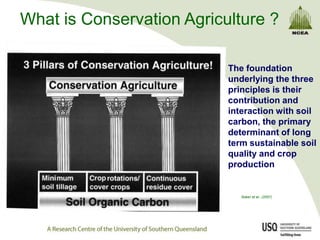
What is Conservation Agriculture ?

                           The foundation
                           underlying the three
                           principles is their
                           contribution and
                           interaction with soil
                           carbon, the primary
                           determinant of long
                           term sustainable soil
                           quality and crop
                           production


                              Baker et al., (2007)
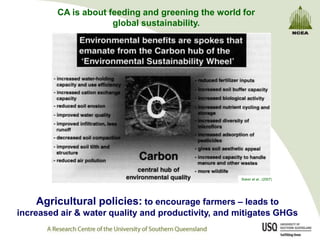
CA is about feeding and greening the world for
                      global sustainability.


                                                    Baker et al., (2007)


    Agricultural policies: to encourage farmers – leads to
increased air & water quality and productivity, and mitigates GHGs
Conservation Agriculture
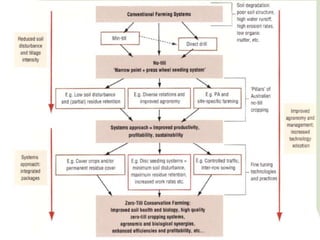
- a question of how much soil disturbance

                                                      It is a question of soil
                                                      disturbance – Reduced
                                                      tillage = Intermediate in
                                         Organic      soil quality effects.
                                         farming      They define the tillage
                        Zero till                     equipment & operation
                                  Conservation        characteristics as they
                                      tillage         relate to the soil volume
             No till            Direct                disturbed and the
                        Direct planting               degree if residue mixing.
                       Seeding
      PRB     Direct                                  True Conservation =
               drill                                  Carbon & soil moisture
                                    Ridge             Management Baker et al., (2007)
           Controlled     Mulch tillage Strip
 Precision   traffic      tillage           tillage
    Ag      farming       Minimum       Reduced
                               till       tillage
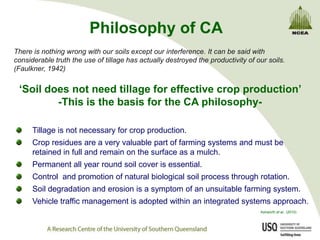
Philosophy of CA
There is nothing wrong with our soils except our interference. It can be said with
considerable truth the use of tillage has actually destroyed the productivity of our soils.
(Faulkner, 1942)


 „Soil does not need tillage for effective crop production‟
         -This is the basis for the CA philosophy-

      Tillage is not necessary for crop production.
      Crop residues are a very valuable part of farming systems and must be
      retained in full and remain on the surface as a mulch.
      Permanent all year round soil cover is essential.
      Control and promotion of natural biological soil process through rotation.
      Soil degradation and erosion is a symptom of an unsuitable farming system.
      Vehicle traffic management is adopted within an integrated systems approach.
                                                                                  Ashworth et al., (2010)
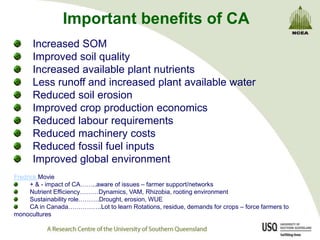
Important benefits of CA
      Increased SOM
      Improved soil quality
      Increased available plant nutrients
      Less runoff and increased plant available water
      Reduced soil erosion
      Improved crop production economics
      Reduced labour requirements
      Reduced machinery costs
      Reduced fossil fuel inputs
      Improved global environment
Fredrick Movie
      + & - impact of CA……..aware of issues – farmer support/networks
      Nutrient Efficiency………Dynamics, VAM, Rhizobia, rooting environment
      Sustainability role……….Drought, erosion, WUE
      CA in Canada…………….Lot to learn Rotations, residue, demands for crops – force farmers to
monocultures
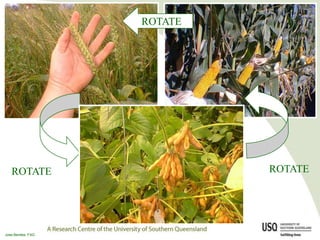
CROP ROTATIONS
 in CA - are “critical”

  - Disease control
  - Nitrogenous plants
  - Biodiversity
ROTATE


   ROTATE                    ROTATE


Jose Benites, FAO
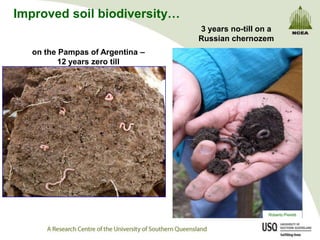
Improved soil biodiversity…
                                  3 years no-till on a
                                  Russian chernozem
   on the Pampas of Argentina –
          12 years zero till


                                                    Roberto Pieretti
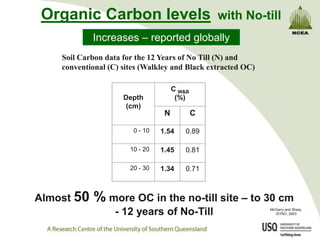
Organic Carbon levels                            with No-till
            Increases – reported globally
    Soil Carbon data for the 12 Years of No Till (N) and
    conventional (C) sites (Walkley and Black extracted OC)

                                      C W&B
                     Depth             (%)
                     (cm)
                                  N           C

                        0 - 10   1.54     0.89

                       10 - 20   1.45     0.81

                       20 - 30   1.34     0.71


Almost 50    % more OC in the no-till site – to 30 cm
                   - 12 years of No-Till                      McGarry and Sharp,
                                                                ISTRO, 2003
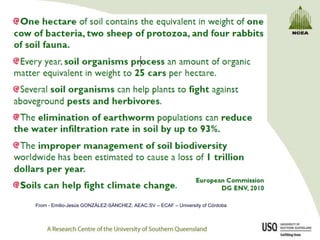
From - Emilio-Jesús GONZÁLEZ-SÁNCHEZ. AEAC.SV – ECAF – University of Córdoba
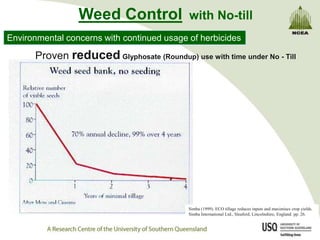
Weed Control               with No-till
Environmental concerns with continued usage of herbicides

      Proven reduced Glyphosate (Roundup) use with time under No - Till


                                            Simba (1999). ECO tillage reduces inputs and maximises crop yields.
                                            Simba International Ltd., Sleaford, Lincolnshire, England. pp. 26.
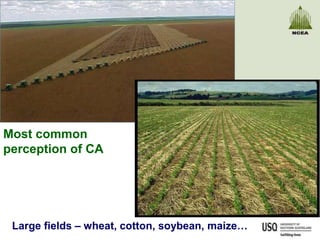
Most common
perception of CA


                                          Jose Benites, FAO


 Large fields – wheat, cotton, soybean, maize…
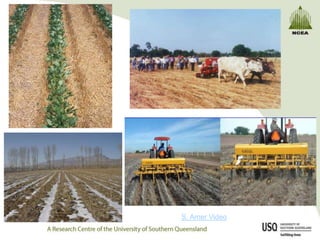
S. AmerSouth
        Video
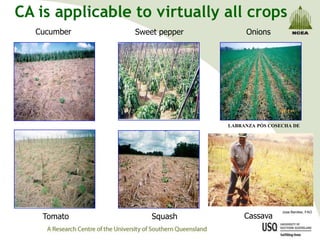
CA is applicable to virtually all crops
  Cucumber       Sweet pepper        Onions


                                LABRANZA PÓS COSECHA DE


                                     Cassava
                                                 Jose Benites, FAO
    Tomato           Squash
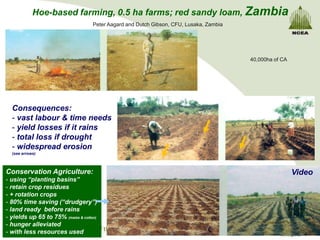
Hoe-based farming, 0.5 ha farms; red sandy loam, Zambia
                                    Peter Aagard and Dutch Gibson, CFU, Lusaka, Zambia


                                                                                         40,000ha of CA


  Consequences:
  - vast labour & time needs
  - yield losses if it rains
  - total loss if drought
  - widespread erosion
  (see arrows)


Conservation Agriculture:                                                                                 Video
- using “planting basins”
- retain crop residues
- + rotation crops
- 80% time saving (“drudgery”)
- land ready before rains
- yields up 65 to 75% (maize & cotton)
- hunger alleviated
- with less resources used
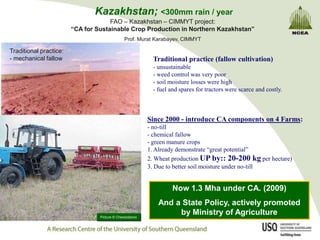
Kazakhstan; <300mm rain / year
                                     FAO – Kazakhstan – CIMMYT project:
                        “CA for Sustainable Crop Production in Northern Kazakhstan”
                                              Prof. Murat Karabayev, CIMMYT

Traditional practice:
- mechanical fallow                                       Traditional practice (fallow cultivation)
                                                          - unsustainable
                                                          - weed control was very poor
                                                          - soil moisture losses were high
                                                          - fuel and spares for tractors were scarce and costly.


                                                         Since 2000 - introduce CA components on 4 Farms:
                                                         - no-till
                                                         - chemical fallow
                                                         - green manure crops
                                                         1. Already demonstrate “great potential”
                                                         2. Wheat production UP by:: 20-200 kg per hectare)
                                                         3. Due to better soil moisture under no-till


                                                                  Now 1.3 Mha under CA. (2009)
                                                            And a State Policy, actively promoted
                                 Picture © Cherezdanov
                                                                 by Ministry of Agriculture
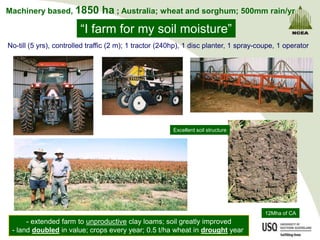
Machinery based, 1850           ha ; Australia; wheat and sorghum; 500mm rain/yr
                        “I farm for my soil moisture”
No-till (5 yrs), controlled traffic (2 m); 1 tractor (240hp), 1 disc planter, 1 spray-coupe, 1 operator


                                                        Excellent soil structure


                                                                                        12Mha of CA
      - extended farm to unproductive clay loams; soil greatly improved
 - land doubled in value; crops every year; 0.5 t/ha wheat in drought year
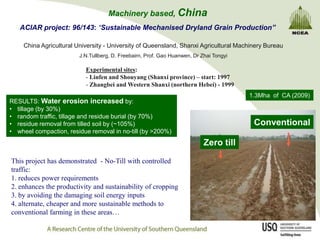
Machinery based, China
   ACIAR project: 96/143: “Sustainable Mechanised Dryland Grain Production”

    China Agricultural University - University of Queensland, Shanxi Agricultural Machinery Bureau
                        J.N.Tullberg, D. Freebairn, Prof. Gao Huanwen, Dr Zhai Tongyi

                          Experimental sites:
                          - Linfen and Shouyang (Shanxi province) – start: 1997
                          - Zhangbei and Western Shanxi (northern Hebei) - 1999
                                                                                        1.3Mha of CA (2009)
RESULTS: Water erosion increased by:
• tillage (by 30%)
• random traffic, tillage and residue burial (by 70%)
• residue removal from tilled soil by (~105%)                                            Conventional
• wheel compaction, residue removal in no-till (by >200%)
                                                                           Zero till

This project has demonstrated - No-Till with controlled
traffic:
1. reduces power requirements
2. enhances the productivity and sustainability of cropping
3. by avoiding the damaging soil energy inputs
4. alternate, cheaper and more sustainable methods to
conventional farming in these areas…
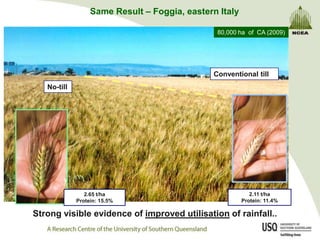
Same Result – Foggia, eastern Italy

                                                80,000 ha of CA (2009)


                                               Conventional till
   No-till


                2.65 t/ha                                  2.11 t/ha
             Protein: 15.5%                             Protein: 11.4%

Strong visible evidence of improved utilisation of rainfall..
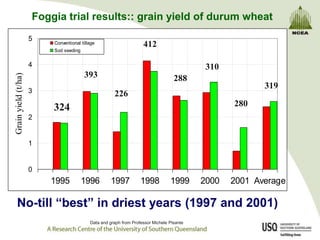
Foggia trial results:: grain yield of durum wheat
                     5
                         Conventional tillage                      412
                         Sod seeding


                     4                                                                     310
                                       393
Grain yield (t/ha)


                                                                                  288
                                                                                                        319
                     3                               226
                         324                                                                     280
                     2


                     1


                     0
                         1995          1996         1997          1998          1999      2000   2001 Average

   No-till “best” in driest years (1997 and 2001)
                                          Data and graph from Professor Michele Pisante
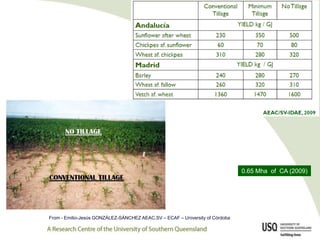
0.65 Mha of CA (2009)


From - Emilio-Jesús GONZÁLEZ-SÁNCHEZ AEAC.SV – ECAF – University of Córdoba
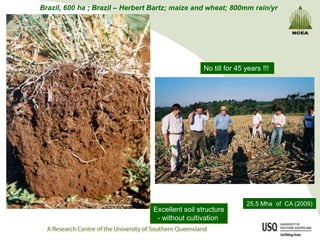
Brazil, 600 ha ; Brazil – Herbert Bartz; maize and wheat; 800mm rain/yr


                                                  No till for 45 years !!!


                                                                 25.5 Mha of CA (2009)
                                 Excellent soil structure
                                  - without cultivation
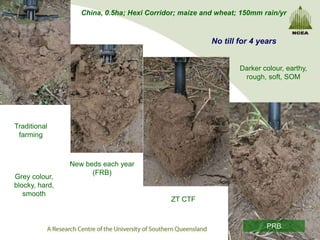
China, 0.5ha; Hexi Corridor; maize and wheat; 150mm rain/yr


                                                        No till for 4 years


                                                                Darker colour, earthy,
                                                                 rough, soft, SOM


Traditional
 farming


                New beds each year
                      (FRB)
Grey colour,
blocky, hard,
   smooth
                                            ZT CTF


                                                                        PRB
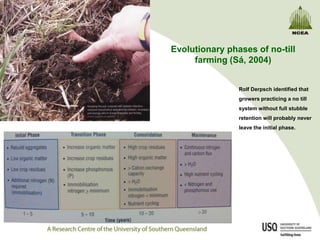
Evolutionary phases of no-till
     farming (Sá, 2004)


                Rolf Derpsch identified that
                growers practicing a no till
                system without full stubble
                retention will probably never
                leave the initial phase.
What are the issues?
Converting to CA needs higher management skills

The first years might be very difficult for the
farmers, therefore they might need support –
from other farmers or from extension services –
and perhaps even financial support to invest in
new machinery such as zero-till planters

Necessary technologies are often unavailable

Few farmers take the risk of buying new
machinery

Machinery dealers might not wish to promote CA
Extension of CA?
Training,
   Educational,
     Empowering
          Participatory activities
  courses, seminars, forums, workshops, field days,
        farm trial sites, farmer field schools

   for farmers, agronomists & technologists
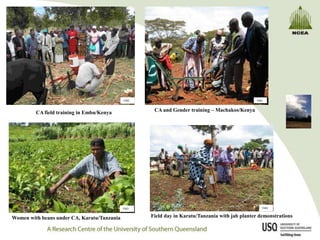
FAO                                               FAO


         CA field training in Embu/Kenya            CA and Gender training – Machakos/Kenya


                                             FAO                                                  FAO


Women with beans under CA, Karatu/Tanzania         Field day in Karatu/Tanzania with jab planter demonstrations
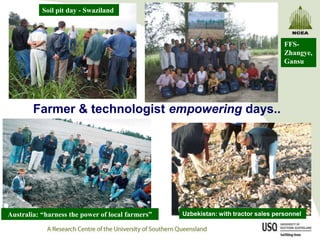
Soil pit day - Swaziland


                                                                                    FFS-
                                                                                    Zhangye,
                                                                                    Gansu


        Farmer & technologist empowering days..


Australia: “harness the power of local farmers”   Uzbekistan: with tractor sales personnel
The many attractions
              and
multiple ecosystem level benefits
 of Conservation Agriculture *

            Farm
            Communities
            Environment
            Watershed
            Global

                  * http://www.fao.org/ag/ags/AGSE/agse_e/general/OBJECT.htm
                  and John Landers (2000) – World Bank Report
Multiple ecosystem level benefits of CA
Farm – level:


  Reduction in labour, time (less drudgery), fuel and costs
  On mechanised farms:
      smaller tractors possible (up to 40% smaller)
      longer lifetime and less maintenance of tractors (life x2 or x3)
      less power and fewer passes
      hence reduced fuel consumption (up to 50%)
  Better trafficability in the field – from controlled traffic
  Earlier sowing (soil preparation eliminated)
  Increased yields with decreased inputs
  More stable yields, particularly in dry years
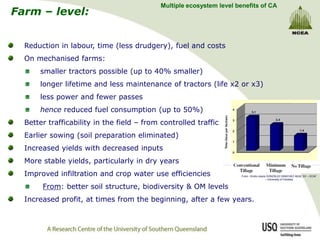
  Improved infiltration and crop water use efficiencies                From - Emilio-Jesús GONZÁLEZ-SÁNCHEZ AEAC.SV – ECAF
                                                                                          – University of Córdoba


       From: better soil structure, biodiversity & OM levels
  Increased profit, at times from the beginning, after a few years.
Multiple ecosystem level benefits of CA

Communities/Environment/Watershed:


  More constant water flows in the rivers, re-activation of wells
  Cleaner water due to less erosion
  Less flooding
  Less impact of extreme climatic situations
  Less costs for road and waterway maintenance
  Better food security
  Increased wildlife (species and populations) in fields (protected
  by retained residues; fed by increased biodiversity)
At global level:                      Multiple ecosystem level benefits of CA


Carbon sequestration (reduction of greenhouse effect):
    CA farmers could receive carbon-grant payments;
    Carbon sequestration and reduced energy (fuel) use
    could = the human-induced increase in CO2.
Less fuel use in agriculture
Reduced CO2e emissions, and heat (fossil fuel burning)
Less leaching of nutrients and chemicals into
groundwater.
Less pollution of waters (river, lake, reservoir, ocean)
Greatly reduced erosion (wind and water)
Recharge of aquifers through better infiltration
Finally…

             It is strongly possible
                       &
           very practical…to achieve

     Multiple ecosystem level
              benefits
                  with…
  Conservation Agriculture
Conservation Agriculture: Fundamentals