Finding the best fit
  cover crops on your
     organic farm

       Dr. Joel Gruver
     WIU – Agriculture
     j-gruver@wiu.edu
Historically     crop rotations


revolved around   LEGUMES
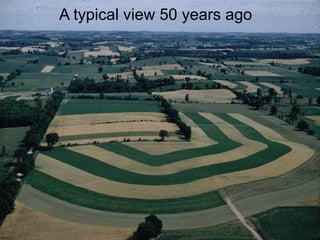
A typical view 50 years ago
Typical rural landscape
   in IA and IL today

  >90% of landsurface
   in corn or soybeans
Typical amounts of nitrogen
       fixed by legumes (lbs/ac/yr)

      Alfalfa              150-300+
    Soybeans                150-250
    Red clover               75-200
    Hairy vetch              75-200
Other annual forage
                             50-150
     legumes
Soybean seeds
normally contain
 25-50% more N
 than was fixed
   within their
    nodules
133 lbs of K/ac      52 lbs of Ca/ac


            Hairy Vetch
          3,260 lbs of DM/ac
            141 lbs of N/ac


18 lbs of P/ac         18 lbs of Mg/ac
Finding the best fit for CCs
           within a crop rotation

                     :


  http://www.ncl.ac.uk/tcoa/files/breakcrops_orgagr.pdf
Conservation      Augmentation


3 broad goals of
   ecological       Activation
 management
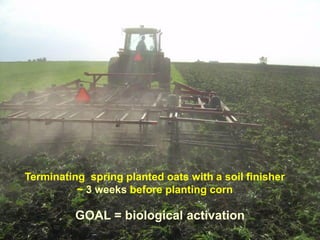
Terminating spring planted oats with a soil finisher
          ~ 3 weeks before planting corn

          GOAL = biological activation
Overview of book contents
   • Problems and opportunities for over 500 crop
                   sequences

• Characteristics of more than 60 crops and 70 weeds

  • Crop diseases hosted by over 80 weed species

• Modes of transmission for 250 diseases of 24 crops

 • Thirteen sample four- and five-year vegetable and
                    Rotations
  grain crop rotations Managing Crop Rotation Chart
                 should evolve
                 with key tasks & steps
                  not revolve
        •Sample worksheets and calculations

• Step-by-step procedure for determining crop rotation
                       plans
What to Look For in A Cover Crop

   • Fast germination and emergence
             • Competitiveness
 • Tolerance to adverse climatic & soil
                   conditions
      • Ease of suppression/residue
                 management
       • Fertility/soil quality benefits
                   • Low-cost
Cover crops have many effects!


   Feed
livestock
            Cover
            Crops


                    Adapted from Magdoff and Weil (2004)
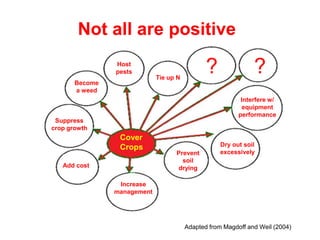
Not all are positive
                Host
                pests
                             Tie up N
                                               ?               ?
       Become
       a weed
                                                           Interfere w/
                                                            equipment
                                                          performance
 Suppress
crop growth
                 Cover
                 Crops                              Dry out soil
                                   Prevent          excessively
                                     soil
   Add cost                        drying

                 Increase
                management


                                        Adapted from Magdoff and Weil (2004)
Matching specific objectives with species
                           Grazing
 brassicas, clovers, small grains, ryegrass, sorghum-sudan

                     Nutrient Cycling
           brassicas, small grains, annual ryegrass

                         Bio-drilling
               brassicas, sugarbeet, sunflower,
             sorghum-sudan sweet clover, alfalfa

                         N-fixation
clovers, vetches, lentil, winter pea, chickling vetch, sun hemp,
                        cowpea, soybean

                Bio-activation/fumigation
       brassicas, sorghum-sudan, sun hemp, sesame
Key considerations
               How will I seed the cover crop?
What will soil temperature and moisture conditions be like?
 What weather extremes and field traffic must it tolerate?
                  Will it winterkill in my area?
           Should it winterkill to meet my goals?
            What kind of regrowth can I expect?
              How will I kill it and plant into it?
           Will I have the time to make this work?
     What’s my contingency plan—and risks—if the
 cover crop doesn’t establish or doesn’t die on schedule?
       Do I have the needed equipment and labor?

           Start planning now for next fall!
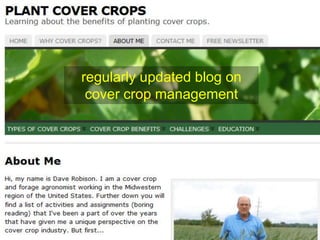
Best single source of info on cover crops is FREE!
regularly updated blog on
 cover crop management
There are lots of opportunities following small grains!
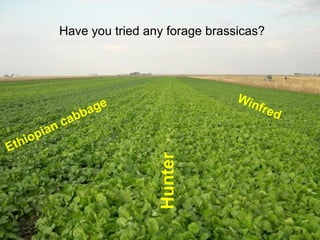
Have you tried any forage brassicas?


                 Hunter
#1
opportunity
  to make
cover crops
    pay
Hairy vetch can be successfully planted after
wheat harvest. On the two occasions (out of 18
  site-years of the WI Cropping System Trial)
  when the red clover failed to establish well,
hairy vetch produced an average of 115 lbs N/a
     providing an excellent ―back-up plan‖.


          July/August plantings of vetch or
          other cover crops are riskier than
                 frost seeding clover.
Frost-seeded clover
 the most tried and true
 cover cropping system
  in the Midwest region
Sweet
          clover


Mustard
http://calshort-lamp.cit.cornell.edu/bjorkman/covercrops/spring-mustard.php
Klaas and Mary Martens,
   organic innovators in
  Central NY State, are
reporting excellent results
     with frost-seeded
  confectionary mustard
    ahead of dry beans
Be realistic about potential
  cover crop challenges
Are you equipped to handle a situation like this?
10’ Howard Rotavator tilling ~ 3” deep with C blades
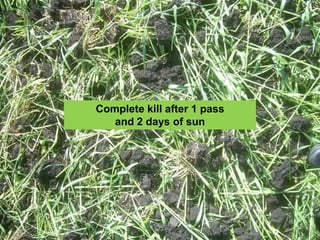
Complete kill after 1 pass
   and 2 days of sun
Typical weather in 2009/2010 :-<
Where are the soybeans??
   Traditional organic weed management
   often comes up short during wet years

 A strong stand of cereal rye was incorporated
~ 2 weeks before these soybeans were planted
Organic No-till?

                                  Less
                                weed seed
                               germination


Rodale roller


   …but few
  options for
     weed
  termination
                Cultimulcher
Early July 2009
Early August 2009
Early November 2009


Plot yields ranged from 51.6 to 58.6 bu/ac
    No significant differences between systems
November 2010


   Significant foxtail pressure
 but almost no broadleaf weeds

Plot yields ranged from 42-52 bu/ac
Soybean health experiment – 6 locations across IL
                    November 2010


                   Mustard
                  Rapeseed
                   Canola
                  Cereal rye
Bio-strip till


September 2008
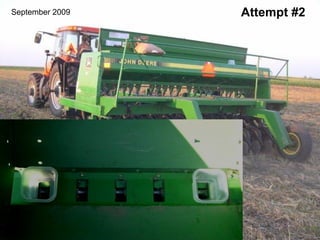
September 2009   Attempt #2
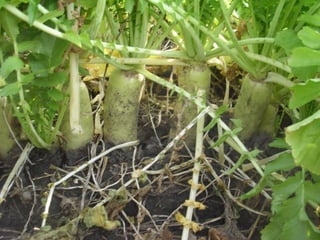
Tillage radish on 30” rows with oats on 7.5” rows
                November 2009
Radish planted on 30‖ rows using milo plates
            in mid-August 2010
Ontario, Canada
November 2010


                 Radish planted in
                volunteer cereal rye
Annual ryegrass variety trial
     November 2010
Annual ryegrass
w/crimson clover
Wheat + radish trial
 November 2010
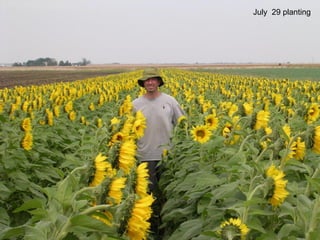
What is a cover crop cocktail??


Sunflowers + soybeans+ buckwheat
July 17 planting
July 29 planting
Cover crops generally require more management
than manure or purchased nutrient amendments
Many of the 2008
  profiles were
updated in 2010!

Finding the best fit

  • 1.
    Finding the bestfit cover crops on your organic farm Dr. Joel Gruver WIU – Agriculture j-gruver@wiu.edu
  • 2.
    Historically crop rotations revolved around LEGUMES
  • 3.
    A typical view50 years ago
  • 4.
    Typical rural landscape in IA and IL today >90% of landsurface in corn or soybeans
  • 5.
    Typical amounts ofnitrogen fixed by legumes (lbs/ac/yr) Alfalfa 150-300+ Soybeans 150-250 Red clover 75-200 Hairy vetch 75-200 Other annual forage 50-150 legumes
  • 6.
    Soybean seeds normally contain 25-50% more N than was fixed within their nodules
  • 7.
    133 lbs ofK/ac 52 lbs of Ca/ac Hairy Vetch 3,260 lbs of DM/ac 141 lbs of N/ac 18 lbs of P/ac 18 lbs of Mg/ac
  • 8.
    Finding the bestfit for CCs within a crop rotation : http://www.ncl.ac.uk/tcoa/files/breakcrops_orgagr.pdf
  • 9.
    Conservation Augmentation 3 broad goals of ecological Activation management
  • 10.
    Terminating spring plantedoats with a soil finisher ~ 3 weeks before planting corn GOAL = biological activation
  • 11.
    Overview of bookcontents • Problems and opportunities for over 500 crop sequences • Characteristics of more than 60 crops and 70 weeds • Crop diseases hosted by over 80 weed species • Modes of transmission for 250 diseases of 24 crops • Thirteen sample four- and five-year vegetable and Rotations grain crop rotations Managing Crop Rotation Chart should evolve with key tasks & steps not revolve •Sample worksheets and calculations • Step-by-step procedure for determining crop rotation plans
  • 12.
    What to LookFor in A Cover Crop • Fast germination and emergence • Competitiveness • Tolerance to adverse climatic & soil conditions • Ease of suppression/residue management • Fertility/soil quality benefits • Low-cost
  • 13.
    Cover crops havemany effects! Feed livestock Cover Crops Adapted from Magdoff and Weil (2004)
  • 14.
    Not all arepositive Host pests Tie up N ? ? Become a weed Interfere w/ equipment performance Suppress crop growth Cover Crops Dry out soil Prevent excessively soil Add cost drying Increase management Adapted from Magdoff and Weil (2004)
  • 15.
    Matching specific objectiveswith species Grazing brassicas, clovers, small grains, ryegrass, sorghum-sudan Nutrient Cycling brassicas, small grains, annual ryegrass Bio-drilling brassicas, sugarbeet, sunflower, sorghum-sudan sweet clover, alfalfa N-fixation clovers, vetches, lentil, winter pea, chickling vetch, sun hemp, cowpea, soybean Bio-activation/fumigation brassicas, sorghum-sudan, sun hemp, sesame
  • 16.
    Key considerations How will I seed the cover crop? What will soil temperature and moisture conditions be like? What weather extremes and field traffic must it tolerate? Will it winterkill in my area? Should it winterkill to meet my goals? What kind of regrowth can I expect? How will I kill it and plant into it? Will I have the time to make this work? What’s my contingency plan—and risks—if the cover crop doesn’t establish or doesn’t die on schedule? Do I have the needed equipment and labor? Start planning now for next fall!
  • 17.
    Best single sourceof info on cover crops is FREE!
  • 18.
    regularly updated blogon cover crop management
  • 19.
    There are lotsof opportunities following small grains!
  • 20.
    Have you triedany forage brassicas? Hunter
  • 21.
    #1 opportunity tomake cover crops pay
  • 22.
    Hairy vetch canbe successfully planted after wheat harvest. On the two occasions (out of 18 site-years of the WI Cropping System Trial) when the red clover failed to establish well, hairy vetch produced an average of 115 lbs N/a providing an excellent ―back-up plan‖. July/August plantings of vetch or other cover crops are riskier than frost seeding clover.
  • 23.
    Frost-seeded clover themost tried and true cover cropping system in the Midwest region
  • 24.
    Sweet clover Mustard
  • 25.
  • 26.
    Klaas and MaryMartens, organic innovators in Central NY State, are reporting excellent results with frost-seeded confectionary mustard ahead of dry beans
  • 27.
    Be realistic aboutpotential cover crop challenges
  • 28.
    Are you equippedto handle a situation like this?
  • 29.
    10’ Howard Rotavatortilling ~ 3” deep with C blades
  • 30.
    Complete kill after1 pass and 2 days of sun
  • 31.
    Typical weather in2009/2010 :-<
  • 32.
    Where are thesoybeans?? Traditional organic weed management often comes up short during wet years A strong stand of cereal rye was incorporated ~ 2 weeks before these soybeans were planted
  • 33.
    Organic No-till? Less weed seed germination Rodale roller …but few options for weed termination Cultimulcher
  • 34.
  • 35.
  • 36.
    Early November 2009 Plotyields ranged from 51.6 to 58.6 bu/ac No significant differences between systems
  • 37.
    November 2010 Significant foxtail pressure but almost no broadleaf weeds Plot yields ranged from 42-52 bu/ac
  • 38.
    Soybean health experiment– 6 locations across IL November 2010 Mustard Rapeseed Canola Cereal rye
  • 39.
  • 40.
    September 2009 Attempt #2
  • 41.
    Tillage radish on30” rows with oats on 7.5” rows November 2009
  • 42.
    Radish planted on30‖ rows using milo plates in mid-August 2010
  • 44.
  • 45.
    November 2010 Radish planted in volunteer cereal rye
  • 46.
    Annual ryegrass varietytrial November 2010
  • 47.
  • 48.
    Wheat + radishtrial November 2010
  • 49.
    What is acover crop cocktail?? Sunflowers + soybeans+ buckwheat
  • 50.
  • 51.
  • 52.
    Cover crops generallyrequire more management than manure or purchased nutrient amendments
  • 55.
    Many of the2008 profiles were updated in 2010!