Realizing sustainable agricultural mechanisation
African Conservation Tillage Network
By: Peter Kuria
1 December 2017
Pest Management in
Conservation Agriculture
Realizing sustainable agricultural mechanisation
Contents
1.Define pests, pathogens and weeds
2. Weed Management
3.Integrated weed management
4.Integrated insect and disease management
5.Weed identification exercise
Realizing sustainable agricultural mechanisation
Learning Exercises
• What are pests?
• What are pathogens?
• Give examples of pests and pathogens
• What are the damages caused by
o pests and
o pathogens
to plants?
• What are weeds? What are the damages caused by weeds to crops?
• List the insect and pathogens control methods commonly used
• List the weed control methods commonly used
Realizing sustainable agricultural mechanisation
Introduction
• What are pests
o Organisms with characteristics that farmers see as damaging or unwanted - harms agriculture - feeding or
parasitizing crops and livestock.
• What are pathogens
o Microorganisms that cause diseases in plants and animals.
o In crops pests are weeds and/or insects and pathogens are bacteria,
fungi, viruses or nematodes - damage the plant and cause disease
symptoms.
Realizing sustainable agricultural mechanisation
Introduction – Weeds
• What are weeds
o They are plants that grow where they are not wanted/intended.
• Damage by weeds
o They are thieves: They take light, water and food away from your
crops.
o They push the crops out of their living space.
o They shelter pests and diseases that attack the crop.
Realizing sustainable agricultural mechanisation
Characteristics of weeds
• long dormancy period – up to 20 years high seed scattering ability
• high genetic diversity so adapted to wide range of conditions
• high rate of reproduction
• reproduction through both seeds and vegetative material
• vigorous and rapid growth
• ability to survive and reproduce under environmentally unfriendly
conditions
Realizing sustainable agricultural mechanisation
Why controlling weeds?
• Competition reduced
• Weeds reduces crop yields and can lead to total crop failures if not
controlled on time.
• Reduce Harvest quality
• The longer you leave them, the harder they become to control. Control
them before they increase your cost of production, steal your yield
hence income!
Realizing sustainable agricultural mechanisation
A weedy maize field
Realizing sustainable agricultural mechanisation
Striga weed on ploughed land?
Realizing sustainable agricultural mechanisation
Traditional means of weed control
• Ploughing/ harrowing
• Stubble grazing
• Burning of crop residues (before ploughing)
• Hand weeding -Manual weed control is labour intensive and
therefore limits the production area
Realizing sustainable agricultural mechanisation
weeding -- increase of pest &disease incidences -- Increase cost of
production ---- low crop yield
Hand hoe weeding
Grazing
Realizing sustainable agricultural mechanisation
Approaches for weed control in CA
Preventive weed control
• clean crop seeds and irrigation water– no weed seeds
• Use clean machinery
• preventing weeds from setting seeds
• Curing manure and compost
• Edges of crop fields should be weed free
Control techniques pre and post crop planting
• Cultural methods – intercropping, crop rotations, mulching,
green manure cc,
• Physical control (mechanical and manual weeding).
• Chemical control through the use of herbicides
Realizing sustainable agricultural mechanisation
How CA reduces weeds
• It disturbs the soil less, so brings fewer buried weed seeds
to the surface where they can germinate.
• The cover on the soil (intercrops, cover crops or mulch)
smothers weeds and prevents them from growing.
• Rotating crops prevents certain types of weeds from
multiplying.
Realizing sustainable agricultural mechanisation
Minimum soil disturbance-ripping Field well covered with Lablab
Realizing sustainable agricultural mechanisation
Integrated weed control
options in CA
Usually a combination of two or more control strategies to increase
effectiveness to economic levels
• Weeding by hand (pulling) or with equipment
• Use of soil cover and crops
• Use of herbicides
Realizing sustainable agricultural mechanisation
Hand Spraying Machine for Chemicals
Realizing sustainable agricultural mechanisation
Pedestrian (Hand pulled) sprayer ZAMWIPE
Realizing sustainable agricultural mechanisation
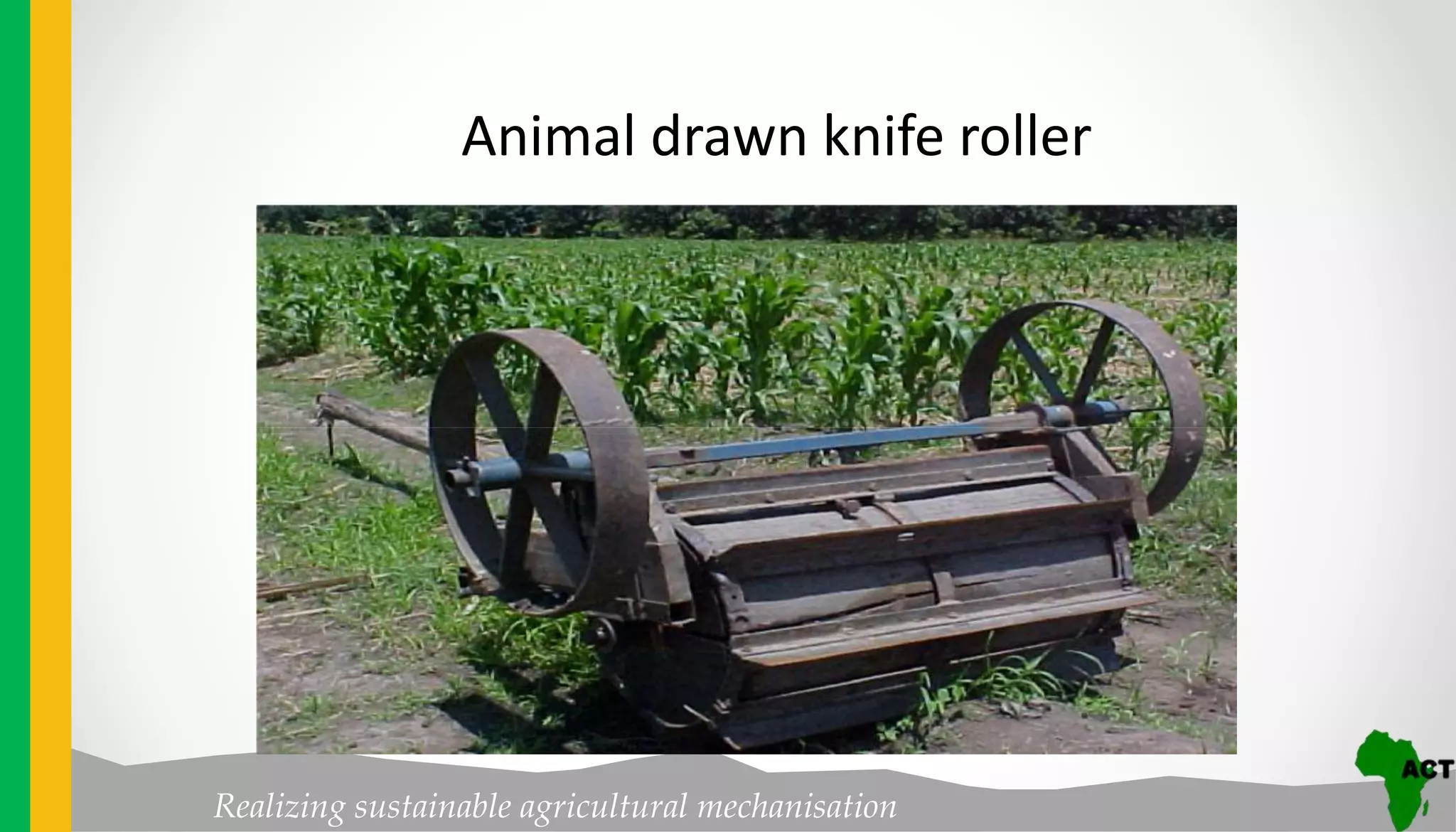
Animal drawn knife roller
Realizing sustainable agricultural mechanisation
Challenges to herbicide use
• Few farmers use herbicides.
• Profitability not established, land degradation risks not assured.
• Cash flow/liquidity constraints;
• Not easily available,
• Need special equipment and skills
Realizing sustainable agricultural mechanisation
Control of weeds under CA system: options for smallholder
farmers
1. Weeds can be a big problem when you first start using
conservation agriculture.
2. You may have to work hard in the first couple of years to
control weeds.
3. Be patient! If you do it properly, weeds will become less of a
problem later on.
4. You can manage weeds in many different ways depending
on the ecological and socio- economic circumstances of
specific H/H.
Realizing sustainable agricultural mechanisation
Control weed cont…
5. Using crops and other forms of soil cover (green manures/cover
crops and crop residues).
6. By hand pulling/weeding or using equipment to cut or crush
the weeds.
7. Using herbicides.
8. Crop rotation
9. Planting density
10. In –row slashing of weeds
11. Superficial/Shallow weeding (scrapping)
Realizing sustainable agricultural mechanisation
Weed control strategy
• A weed control strategy with the greatest potential for success, is the
one that fully integrates the many mgt options available.
• You will probably need to use a combination of these methods to
control weeds. Example;
o One can start controlling weeds by using various forms of soil cover.
o These methods are cheap and avoid disturbing the soil.
o You can then kill any weeds that do grow by using a weed scrapper or
machete, or with herbicides.
Realizing sustainable agricultural mechanisation
Mechanical weed control
• Shallow weeding, Slashing, Uprooting,
Realizing sustainable agricultural mechanisation
Biological & cultural weed control
• Crop rotations, Intercropping (spreading crops), Cover crops.
Pearl millet under Faidherbia albida
Mzee Swaleh Shaaban admiring his crop
Realizing sustainable agricultural mechanisation
01/12/2017
A well established Mucuna crop providing a good ground
Realizing sustainable agricultural mechanisation
Chemical weed control
• Is common in commercial agric
• It can also be used by smallholder farmers esp in first years
of changing from Conv to CA.
• Increasing labour shortage and cost of labour makes
chemical weed control an attractive alternative for small
farmers e.g. use of zamwipe, pedestrian sprayer, Knapsack
01/12/2017
Realizing sustainable agricultural mechanisation
When and how to control weeds – Steps
in controlling weeds
Adapt them to suit your own situation.
1. It is a good idea to slash weeds immediately after the harvest and
during the dry season to prevent them from producing seeds.
2. Before you plant, slash any plants (weeds, cover crop, stalks left over
from the previous crop) in the field. (A disadvantage with this is that
it may encourage grasses and certain other weeds to grow if it is wet.)
3. Dig planting pits with a hoe, or open planting furrows with a ripper
or Sub-soiler.
Realizing sustainable agricultural mechanisation
When and how to control weeds: steps
4. After the first rains have fallen, allow weeds to regrow or new weeds
to emerge. Wait about 2 weeks until they are growing vigorously, then
apply a post-emergence herbicide such as R/up using a Zamwipe or a
sprayer. This will kill all emerged weeds before you plant.
5. Immediately afterwards, plant the main crop.
6. Plant a cover crop between the rows of the main crop after two weeks
(depending on the cc).
7. Check for weeds every week and control them by pulling them out by
hand, scrapping the soil surface with a hand hoe/scrapper, using an
animal-drawn weeder, or using a selective herbicides.
Realizing sustainable agricultural mechanisation
Steps cont’d
8. Harvest the main crop and allow the cover crop to grow.
9. Continue checking for weeds and pull them out before they can
flower and seed.
10. Harvest the cover crop seeds.
11. Manage (bend over and crush) the mixture of crop residues and
cover crops using a sickle, machete, knife-roller or another
implement some 3 weeks before you expect the first rains to begin.
12. Cover crops that can regenerate should be slashed at 6-8 inches
height.
Realizing sustainable agricultural mechanisation
Weed control in later years
• Weeds should be easier to control in later seasons.
• It can take 3–5 years for the number of weeds in the soil to be reduced so much that
very few new weeds grow.
• Leave the soil undisturbed, and keep the soil covered so that weed seeds do not have
a chance to germinate. Any weeds that are lucky to germinate have no space or light,
so they die.
• You should still check for weeds regularly and pull out any you find.
• You may also need to use herbicides to control weeds.
But overall, weed control will be a lot less work.
Realizing sustainable agricultural mechanisation
Crop yield loss caused by delay in
weeding
Crop Time delay in weeding Expected yield loss
Cotton 6 weeks 35-40 %
Soyabean 3 weeks 25 %
Groundnuts (rainfed) 5 weeks 320-430 kg/ha
Groundnuts (irrigated) 5 weeks 45 %
Maize 4 weeks 54 %
Sorghum 3 weeks 50 %
Egg plants 2 weeks 36-84%
Realizing sustainable agricultural mechanisation
CONCLUSION
1. CA does not necessarily mean use of herbicides.
2. Biological means, such as ground cover of crop residues and cover crops
and rotation are efficient and preferred means of weed control.
3. Farmers noted that herbicides are used to overcome weed pressure
especially in the transition period from conventional to CA.
Realizing sustainable agricultural mechanisation
Conclusions cont…
4. Environmental friendly herbicides are available
5. CHEMICAL WEED CONTROL IN COMBINATION WITH COVER
CROPS AND CROP ROTATION CAN BE AN ANSWER TO
INCREASING LABOUR SHORTAGE CAUSED BY MALE OUT-
MIGRATION AND HIV/AIDS
01/12/2017
Realizing sustainable agricultural mechanisation
Pests & Diseases Control - issues
• Disruption of the soil ecosystem by soil tillage upsets the balance
between pathogens and beneficial organisms, allowing the disease-
causing organisms, which usually are more opportunistic, to become
problems.
• The residues and cover crops that are preserved on the soil surface
provide numerous habitats for insects and bacteria and fungi. In
conservation agriculture systems more insects and micro-organisms
occur as they are able to hibernate until the next crop.
Realizing sustainable agricultural mechanisation
Pests & Diseases Control - issues
• At the same time the cover provides habitats for natural enemies of
pests and diseases occurring in commercial crops.
• Thus, conservation agriculture is a more natural system in which higher
number of species occur; those that can cause damage to crops, but also
beneficial organisms that predate on disease causing organisms, like
higher parasitism on eggs of certain species.
• New balances between species are created, determined by the quantity
of residues left on the surface and the crop rotation practiced.
Realizing sustainable agricultural mechanisation
Pests & Diseases Control
How to reduce the danger of pests and diseases-:
1. Rotate the types of crops grown - food, cover and cash
crops - interrupts their food supply and disturbs their living
conditions.
2. Select cover crops that are unlikely to be attacked by
pests/diseases e.g. canavalia, mucuna.
3. Plant various different types of cover crops.
4. Consider using chemical spraying if necessary.
Realizing sustainable agricultural mechanisation
Integrated Pest and Disease
Management (IPM)
IPM is a set of strategies based on monitoring economic
thresholds and preventive tactics to determine if and when
pest treatment is best applied.
IPM follows a four-step procedure:
o setting action thresholds
o monitoring and identifying pests
o Preventing
ocontrolling
Realizing sustainable agricultural mechanisation
Learning activity
Give 2 examples of weeds that are common in your working area for each of
these categories.
Broad leaf, Grass weeds, sedges, parasitic weeds, noxious weeds.
Discussion points:
• Which weeds are associated with low soil fertility, and which ones with high
soil fertility?
• Are there weeds that remain green during the dry season – worth
considering as soil cover crops? Are all the weeds edible for humans and
livestock?
• Which weeds die naturally after one season and are easier to control? Which
ones are difficult to control?
• State suitable control methods used for each weed.
Realizing sustainable agricultural mechanisation
MLN disease in Laikipia, Kenya
Realizing sustainable agricultural mechanisation
01/12/2017
moist
soil
Example #1
Burning organic matter and losing soil water.
Men ploughing
dry
soil
Realizing sustainable agricultural mechanisation
THANK YOU
Realizing sustainable agricultural mechanisation
Our Contacts
THANK YOU FOR LISTENING
Website: www.act-africa.org
Email: info@act-africa.org
Twitter: www.twitter.com/ACTillage

Pest management in Conservation Agriculture

  • 1.
    Realizing sustainable agriculturalmechanisation African Conservation Tillage Network By: Peter Kuria 1 December 2017 Pest Management in Conservation Agriculture
  • 2.
    Realizing sustainable agriculturalmechanisation Contents 1.Define pests, pathogens and weeds 2. Weed Management 3.Integrated weed management 4.Integrated insect and disease management 5.Weed identification exercise
  • 3.
    Realizing sustainable agriculturalmechanisation Learning Exercises • What are pests? • What are pathogens? • Give examples of pests and pathogens • What are the damages caused by o pests and o pathogens to plants? • What are weeds? What are the damages caused by weeds to crops? • List the insect and pathogens control methods commonly used • List the weed control methods commonly used
  • 4.
    Realizing sustainable agriculturalmechanisation Introduction • What are pests o Organisms with characteristics that farmers see as damaging or unwanted - harms agriculture - feeding or parasitizing crops and livestock. • What are pathogens o Microorganisms that cause diseases in plants and animals. o In crops pests are weeds and/or insects and pathogens are bacteria, fungi, viruses or nematodes - damage the plant and cause disease symptoms.
  • 5.
    Realizing sustainable agriculturalmechanisation Introduction – Weeds • What are weeds o They are plants that grow where they are not wanted/intended. • Damage by weeds o They are thieves: They take light, water and food away from your crops. o They push the crops out of their living space. o They shelter pests and diseases that attack the crop.
  • 6.
    Realizing sustainable agriculturalmechanisation Characteristics of weeds • long dormancy period – up to 20 years high seed scattering ability • high genetic diversity so adapted to wide range of conditions • high rate of reproduction • reproduction through both seeds and vegetative material • vigorous and rapid growth • ability to survive and reproduce under environmentally unfriendly conditions
  • 7.
    Realizing sustainable agriculturalmechanisation Why controlling weeds? • Competition reduced • Weeds reduces crop yields and can lead to total crop failures if not controlled on time. • Reduce Harvest quality • The longer you leave them, the harder they become to control. Control them before they increase your cost of production, steal your yield hence income!
  • 8.
    Realizing sustainable agriculturalmechanisation A weedy maize field
  • 9.
    Realizing sustainable agriculturalmechanisation Striga weed on ploughed land?
  • 10.
    Realizing sustainable agriculturalmechanisation Traditional means of weed control • Ploughing/ harrowing • Stubble grazing • Burning of crop residues (before ploughing) • Hand weeding -Manual weed control is labour intensive and therefore limits the production area
  • 11.
    Realizing sustainable agriculturalmechanisation weeding -- increase of pest &disease incidences -- Increase cost of production ---- low crop yield Hand hoe weeding Grazing
  • 12.
    Realizing sustainable agriculturalmechanisation Approaches for weed control in CA Preventive weed control • clean crop seeds and irrigation water– no weed seeds • Use clean machinery • preventing weeds from setting seeds • Curing manure and compost • Edges of crop fields should be weed free Control techniques pre and post crop planting • Cultural methods – intercropping, crop rotations, mulching, green manure cc, • Physical control (mechanical and manual weeding). • Chemical control through the use of herbicides
  • 13.
    Realizing sustainable agriculturalmechanisation How CA reduces weeds • It disturbs the soil less, so brings fewer buried weed seeds to the surface where they can germinate. • The cover on the soil (intercrops, cover crops or mulch) smothers weeds and prevents them from growing. • Rotating crops prevents certain types of weeds from multiplying.
  • 14.
    Realizing sustainable agriculturalmechanisation Minimum soil disturbance-ripping Field well covered with Lablab
  • 15.
    Realizing sustainable agriculturalmechanisation Integrated weed control options in CA Usually a combination of two or more control strategies to increase effectiveness to economic levels • Weeding by hand (pulling) or with equipment • Use of soil cover and crops • Use of herbicides
  • 16.
    Realizing sustainable agriculturalmechanisation Hand Spraying Machine for Chemicals
  • 17.
    Realizing sustainable agriculturalmechanisation Pedestrian (Hand pulled) sprayer ZAMWIPE
  • 18.
    Realizing sustainable agriculturalmechanisation Animal drawn knife roller
  • 19.
    Realizing sustainable agriculturalmechanisation Challenges to herbicide use • Few farmers use herbicides. • Profitability not established, land degradation risks not assured. • Cash flow/liquidity constraints; • Not easily available, • Need special equipment and skills
  • 20.
    Realizing sustainable agriculturalmechanisation Control of weeds under CA system: options for smallholder farmers 1. Weeds can be a big problem when you first start using conservation agriculture. 2. You may have to work hard in the first couple of years to control weeds. 3. Be patient! If you do it properly, weeds will become less of a problem later on. 4. You can manage weeds in many different ways depending on the ecological and socio- economic circumstances of specific H/H.
  • 21.
    Realizing sustainable agriculturalmechanisation Control weed cont… 5. Using crops and other forms of soil cover (green manures/cover crops and crop residues). 6. By hand pulling/weeding or using equipment to cut or crush the weeds. 7. Using herbicides. 8. Crop rotation 9. Planting density 10. In –row slashing of weeds 11. Superficial/Shallow weeding (scrapping)
  • 22.
    Realizing sustainable agriculturalmechanisation Weed control strategy • A weed control strategy with the greatest potential for success, is the one that fully integrates the many mgt options available. • You will probably need to use a combination of these methods to control weeds. Example; o One can start controlling weeds by using various forms of soil cover. o These methods are cheap and avoid disturbing the soil. o You can then kill any weeds that do grow by using a weed scrapper or machete, or with herbicides.
  • 23.
    Realizing sustainable agriculturalmechanisation Mechanical weed control • Shallow weeding, Slashing, Uprooting,
  • 24.
    Realizing sustainable agriculturalmechanisation Biological & cultural weed control • Crop rotations, Intercropping (spreading crops), Cover crops. Pearl millet under Faidherbia albida Mzee Swaleh Shaaban admiring his crop
  • 25.
    Realizing sustainable agriculturalmechanisation 01/12/2017 A well established Mucuna crop providing a good ground
  • 26.
    Realizing sustainable agriculturalmechanisation Chemical weed control • Is common in commercial agric • It can also be used by smallholder farmers esp in first years of changing from Conv to CA. • Increasing labour shortage and cost of labour makes chemical weed control an attractive alternative for small farmers e.g. use of zamwipe, pedestrian sprayer, Knapsack 01/12/2017
  • 27.
    Realizing sustainable agriculturalmechanisation When and how to control weeds – Steps in controlling weeds Adapt them to suit your own situation. 1. It is a good idea to slash weeds immediately after the harvest and during the dry season to prevent them from producing seeds. 2. Before you plant, slash any plants (weeds, cover crop, stalks left over from the previous crop) in the field. (A disadvantage with this is that it may encourage grasses and certain other weeds to grow if it is wet.) 3. Dig planting pits with a hoe, or open planting furrows with a ripper or Sub-soiler.
  • 28.
    Realizing sustainable agriculturalmechanisation When and how to control weeds: steps 4. After the first rains have fallen, allow weeds to regrow or new weeds to emerge. Wait about 2 weeks until they are growing vigorously, then apply a post-emergence herbicide such as R/up using a Zamwipe or a sprayer. This will kill all emerged weeds before you plant. 5. Immediately afterwards, plant the main crop. 6. Plant a cover crop between the rows of the main crop after two weeks (depending on the cc). 7. Check for weeds every week and control them by pulling them out by hand, scrapping the soil surface with a hand hoe/scrapper, using an animal-drawn weeder, or using a selective herbicides.
  • 29.
    Realizing sustainable agriculturalmechanisation Steps cont’d 8. Harvest the main crop and allow the cover crop to grow. 9. Continue checking for weeds and pull them out before they can flower and seed. 10. Harvest the cover crop seeds. 11. Manage (bend over and crush) the mixture of crop residues and cover crops using a sickle, machete, knife-roller or another implement some 3 weeks before you expect the first rains to begin. 12. Cover crops that can regenerate should be slashed at 6-8 inches height.
  • 30.
    Realizing sustainable agriculturalmechanisation Weed control in later years • Weeds should be easier to control in later seasons. • It can take 3–5 years for the number of weeds in the soil to be reduced so much that very few new weeds grow. • Leave the soil undisturbed, and keep the soil covered so that weed seeds do not have a chance to germinate. Any weeds that are lucky to germinate have no space or light, so they die. • You should still check for weeds regularly and pull out any you find. • You may also need to use herbicides to control weeds. But overall, weed control will be a lot less work.
  • 31.
    Realizing sustainable agriculturalmechanisation Crop yield loss caused by delay in weeding Crop Time delay in weeding Expected yield loss Cotton 6 weeks 35-40 % Soyabean 3 weeks 25 % Groundnuts (rainfed) 5 weeks 320-430 kg/ha Groundnuts (irrigated) 5 weeks 45 % Maize 4 weeks 54 % Sorghum 3 weeks 50 % Egg plants 2 weeks 36-84%
  • 32.
    Realizing sustainable agriculturalmechanisation CONCLUSION 1. CA does not necessarily mean use of herbicides. 2. Biological means, such as ground cover of crop residues and cover crops and rotation are efficient and preferred means of weed control. 3. Farmers noted that herbicides are used to overcome weed pressure especially in the transition period from conventional to CA.
  • 33.
    Realizing sustainable agriculturalmechanisation Conclusions cont… 4. Environmental friendly herbicides are available 5. CHEMICAL WEED CONTROL IN COMBINATION WITH COVER CROPS AND CROP ROTATION CAN BE AN ANSWER TO INCREASING LABOUR SHORTAGE CAUSED BY MALE OUT- MIGRATION AND HIV/AIDS 01/12/2017
  • 34.
    Realizing sustainable agriculturalmechanisation Pests & Diseases Control - issues • Disruption of the soil ecosystem by soil tillage upsets the balance between pathogens and beneficial organisms, allowing the disease- causing organisms, which usually are more opportunistic, to become problems. • The residues and cover crops that are preserved on the soil surface provide numerous habitats for insects and bacteria and fungi. In conservation agriculture systems more insects and micro-organisms occur as they are able to hibernate until the next crop.
  • 35.
    Realizing sustainable agriculturalmechanisation Pests & Diseases Control - issues • At the same time the cover provides habitats for natural enemies of pests and diseases occurring in commercial crops. • Thus, conservation agriculture is a more natural system in which higher number of species occur; those that can cause damage to crops, but also beneficial organisms that predate on disease causing organisms, like higher parasitism on eggs of certain species. • New balances between species are created, determined by the quantity of residues left on the surface and the crop rotation practiced.
  • 36.
    Realizing sustainable agriculturalmechanisation Pests & Diseases Control How to reduce the danger of pests and diseases-: 1. Rotate the types of crops grown - food, cover and cash crops - interrupts their food supply and disturbs their living conditions. 2. Select cover crops that are unlikely to be attacked by pests/diseases e.g. canavalia, mucuna. 3. Plant various different types of cover crops. 4. Consider using chemical spraying if necessary.
  • 37.
    Realizing sustainable agriculturalmechanisation Integrated Pest and Disease Management (IPM) IPM is a set of strategies based on monitoring economic thresholds and preventive tactics to determine if and when pest treatment is best applied. IPM follows a four-step procedure: o setting action thresholds o monitoring and identifying pests o Preventing ocontrolling
  • 38.
    Realizing sustainable agriculturalmechanisation Learning activity Give 2 examples of weeds that are common in your working area for each of these categories. Broad leaf, Grass weeds, sedges, parasitic weeds, noxious weeds. Discussion points: • Which weeds are associated with low soil fertility, and which ones with high soil fertility? • Are there weeds that remain green during the dry season – worth considering as soil cover crops? Are all the weeds edible for humans and livestock? • Which weeds die naturally after one season and are easier to control? Which ones are difficult to control? • State suitable control methods used for each weed.
  • 39.
    Realizing sustainable agriculturalmechanisation MLN disease in Laikipia, Kenya
  • 40.
    Realizing sustainable agriculturalmechanisation 01/12/2017 moist soil Example #1 Burning organic matter and losing soil water. Men ploughing dry soil
  • 41.
    Realizing sustainable agriculturalmechanisation THANK YOU
  • 42.
    Realizing sustainable agriculturalmechanisation Our Contacts THANK YOU FOR LISTENING Website: www.act-africa.org Email: info@act-africa.org Twitter: www.twitter.com/ACTillage