Horticulture Industries Show
January 5th, 2018
Cover Cropping
for Regenerative
Agriculture
Presenter Luke Freeman
Horticulture Specialist, NCAT/ATTRA
1. Introduction
2. Benefits of cover cropping
3. Cover crop species
4. Management considerations
5. Economics of cover cropping
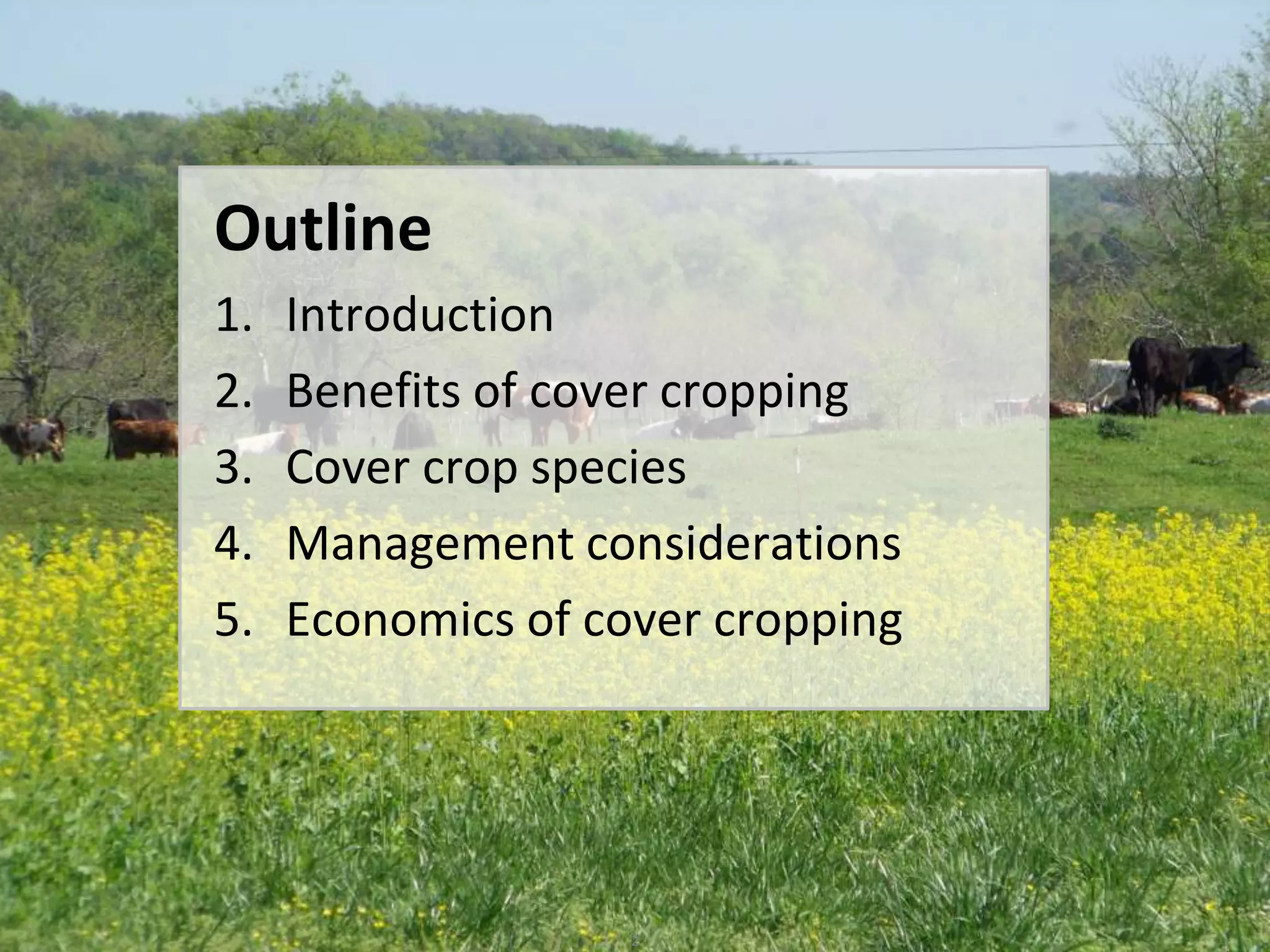
Outline
2
Regenerative Agriculture?
3
• Regenerate topsoil and increase biodiversity
• Improve water cycles
• Enhance ecosystem services
• Increase resilience to climate fluctuation
• Strengthen the health and vitality of farming
communities
What are cover crops?
4
• Grown for the benefit of the soil
• Mowed, tilled, grazed, but not harvested
Carbon Cycle
5
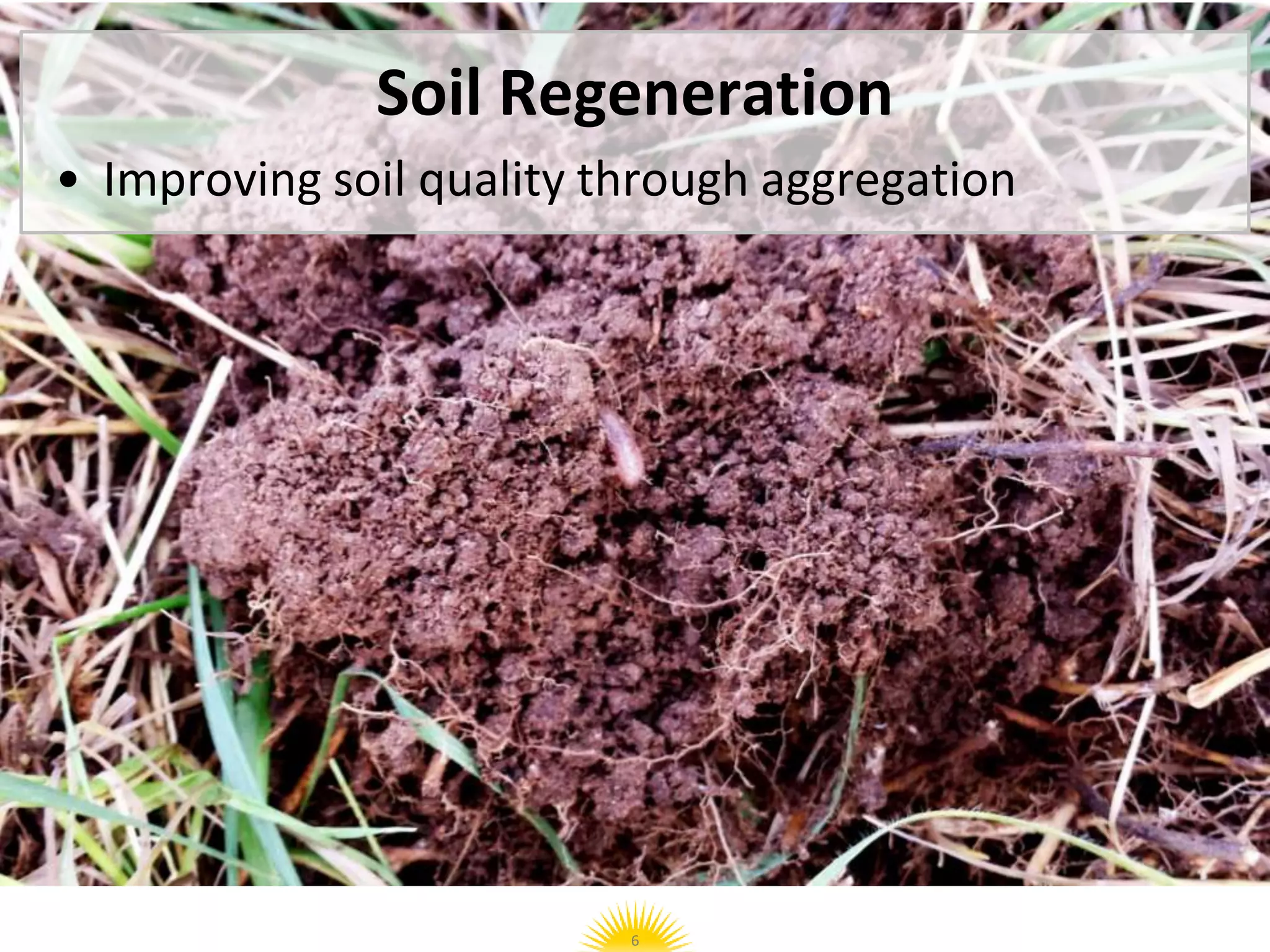
• Improving soil quality through aggregation
Soil Regeneration
6
• Building soil OM and feeding the Soil Food Web
Soil Regeneration
7
• Improving water infiltration and moisture retention
Soil Regeneration
8
So this doesn’t happen
Photos by Rex Dufour, NCAT
• Keeping soil in place and preventing erosion
Soil Preservation
9
• Smother crops and allelopathy
Chemical-free Weed Control
10
• Controlling diseases and nematodes
– Phytophthora blight
– Verticillium wilt
Chemical-free Disease Suppression
11
Bio-fumigant mustard cover crop in high tunnel.
Photo by Elena Garcia, U of AMarigold can suppress root-knot, lesion,
and reniform nematodes.
Photo attributed to Steve Groff
• Contributing Nitrogen (legumes)
• Recycling, capturing N (non-legumes)
Building Soil Fertility
12
• Attracting pollinators & beneficials
Promoting Biological Diversity
13
Summer cover crops
Cover Crop Species for AR & OK
14
Winter cover crops
Grasses
Legumes
Non-legume
broadleaves
(Brassicas)
• Sorghum-Sudangrass (Sudex)
– Seeded at 35-50 lb/a
– Weed suppression
– N scavenger
– 6+ ft tall
– 8-10k lb/a DM
– Mowed when 3-4’
– Drought-resistant
– Winter kill
Summer Grasses
15
• Pearl millet
– Seeded at 15-20 lb/a
– 4-6 ft tall
– 60-70 DTM
– Can be difficult to kill
– Also German foxtail,
and Japanese millet
Summer Grasses
16
• Cowpea (Southern pea)
– ‘Iron and Clay’
– Seeded at 40-75 lb/a
– 60-90 DTM
– Drought tolerant
– 3-4k lb/a DM
– Can fix 75 lb N/a
– Mix with Sudex or
millet
17
• Sunn hemp
(Crotalaria juncea)
– Seeded at 30 lb/a
– Weed control
– 9’ in 60 days
– 100-140 lb N/a
– Drought-tolerant
– Woody after 60 days
18
Sunn hemp terminated by
walk-behind roller-crimper.
Photo by Carolina Farm Stewardship
Association
• Buckwheat
– Seeded at 48-90 lb/a
– Fast-growing
– Flowers in 30-45 days
– 2.5’ tall
– Allelopathic
– Beneficial habitat
– Can become weedy
19
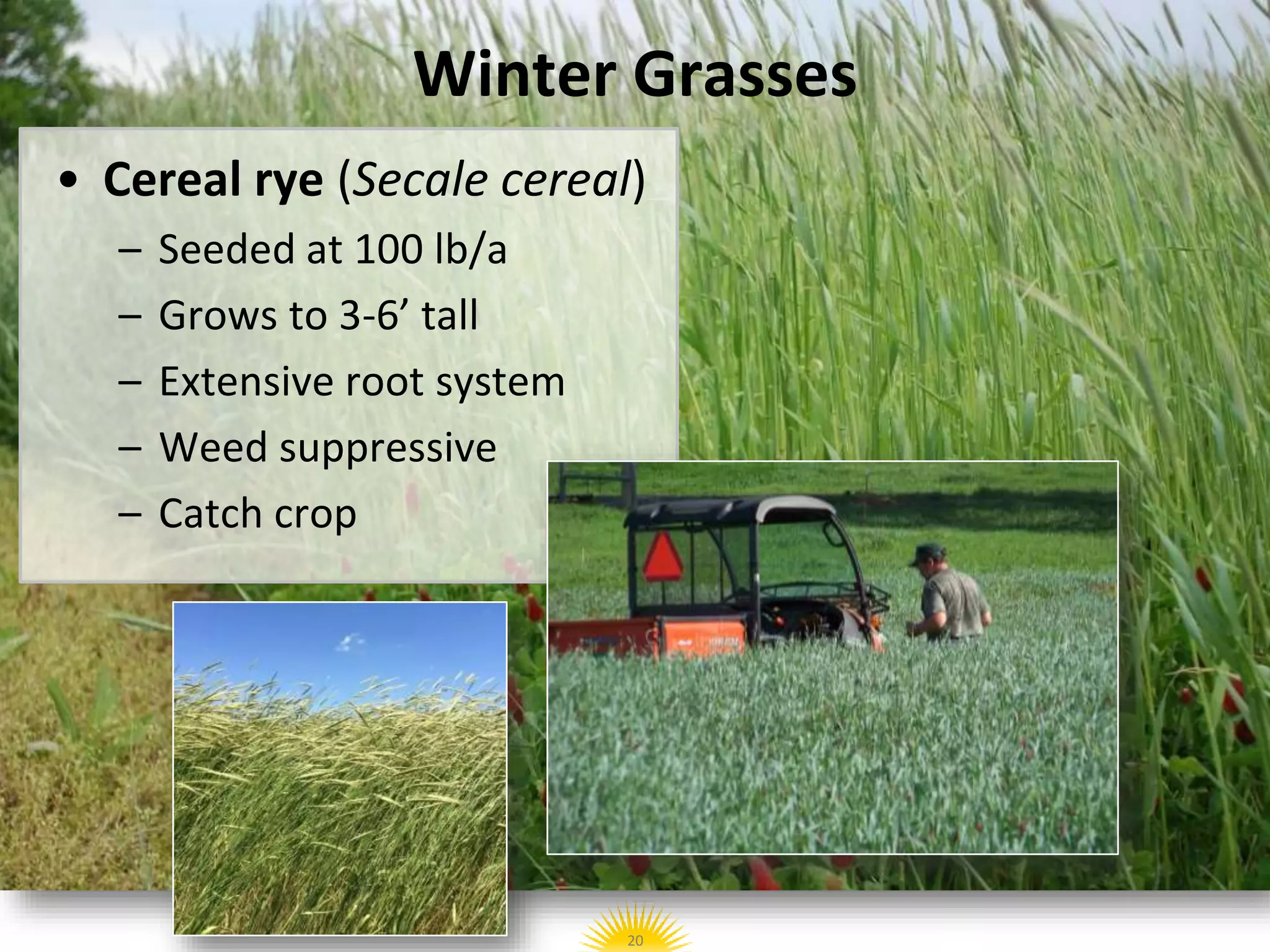
• Cereal rye (Secale cereal)
– Seeded at 100 lb/a
– Grows to 3-6’ tall
– Extensive root system
– Weed suppressive
– Catch crop
Winter Grasses
20
• Oats
– Seeded at 100 lb/a
– Nurse crop
– Rapid ground cover
– Grows 2-5’ tall
– Will winter-kill
21
Photo by Bob Bugg, University of California
Photo from the Ohio State University
• Crimson clover
– Seeded at 15-20 lb/a
– Significant growth in
spring
– Can fix 160 lbs N/a
– Can be overseeded
into fall vegetable
plots
Winter Legumes
22
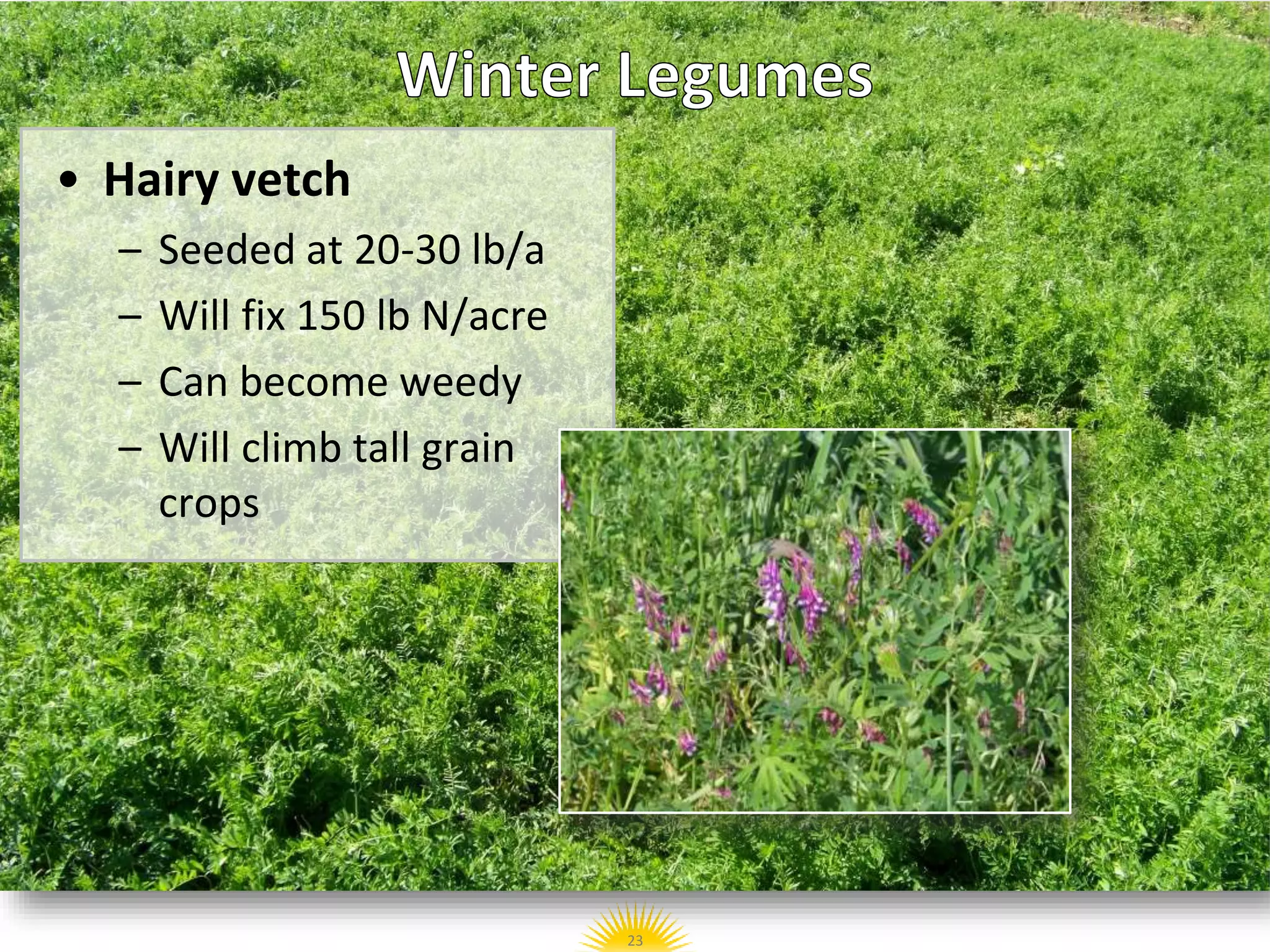
• Hairy vetch
– Seeded at 20-30 lb/a
– Will fix 150 lb N/acre
– Can become weedy
– Will climb tall grain
crops
23
• Austrian winter pea
– Seeded at 60-90 lb/a
– Sown as late as Oct.
– Will fix 130 lb N/acre
– Mixes well with rye or
wheat
24
• Tillage/Daikon radish
– Seeded at 8-20 lbs/a
– Fast growing
– Suppresses weeds
– Bio-drilling
– Winter-kills
25
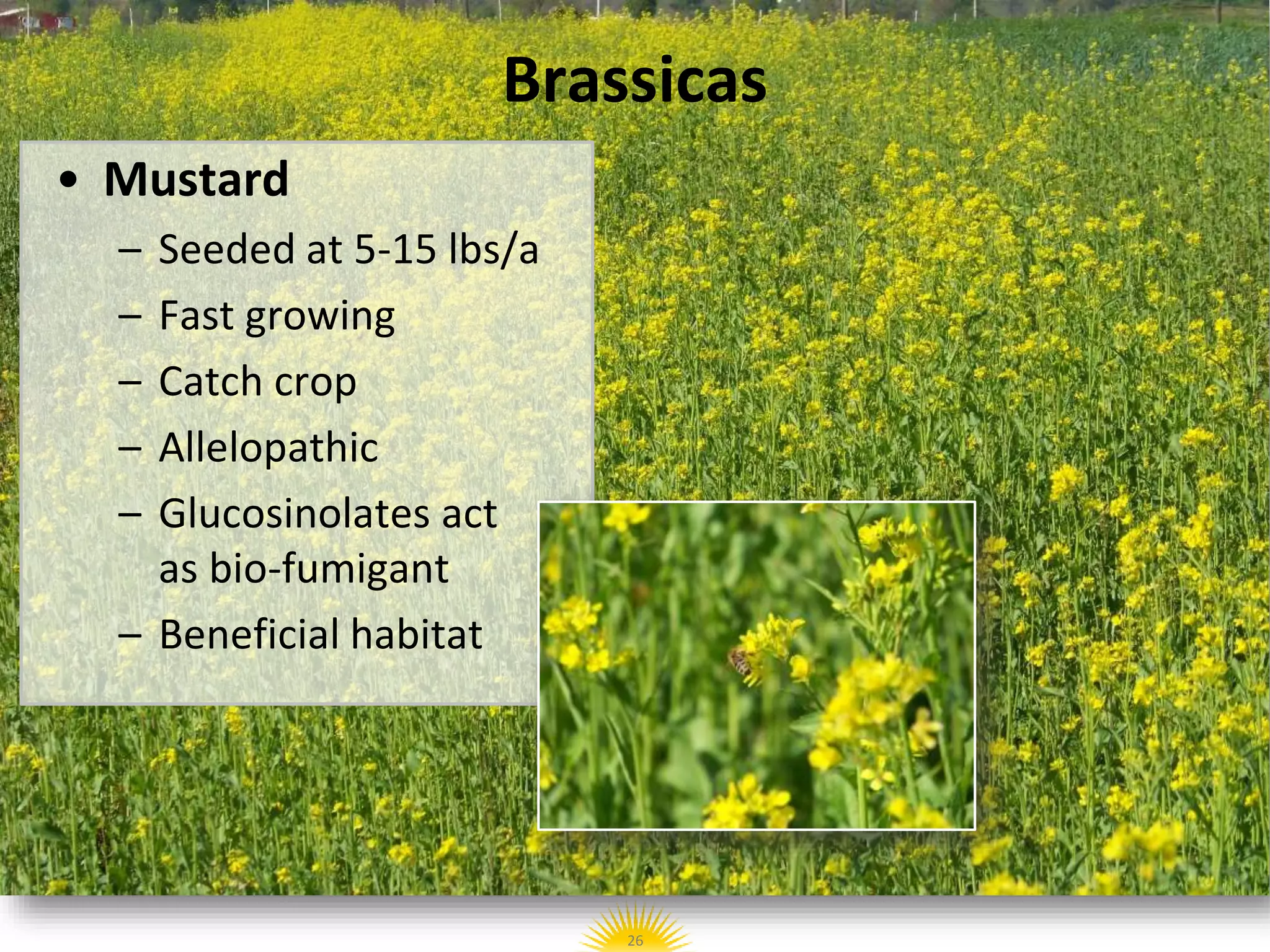
• Mustard
– Seeded at 5-15 lbs/a
– Fast growing
– Catch crop
– Allelopathic
– Glucosinolates act
as bio-fumigant
– Beneficial habitat
Brassicas
26
Multi-Species Mixes
27
• Diversity
• Grass/legume
• C/N ratio
• Height
• Rooting depth
Examples
• Rye + crimson clover
• Rye + hairy vetch
• Oats + radish +
winter peas
• Sudex + cowpeas
• Sudex + sunn hemp +
sunflower + cowpeas
Managing cover crops
28
Planting and establishment – Seed drill
29
Small-scale grain drill.
Photo by Jordan Engineering,
jordanatveng.com
Timing of
planting is key
Planting and establishment –
Broadcasting
30
Hand-crank seed
broadcaster.
Photo from
smallfarmtools.com
Planting and establishment –
Incorporating seed
31
Planting and establishment –
Irrigation?
32
Cover crop care – Irrigation & mowing
33
Termination
34
Reproductive phase: After flowering / before hard seed
Termination – WHEN?
35
Soft dough
Termination - Mowing
36
Sickle bar
Flail mower
Photo by Local Roots Farm
Bush hog
Photo by Becky Sideman, from MOFGA.org
EarthtoolsBCS.com
Termination – Small scale solutions
37
Weed eater
Scythe/sickle
Termination – Roller/crimper
38
Incorporation
39
Incorporating cover crop with disks.
Photo by Canewater Farm
Plowing in cover crop.
Photo by Mark Schonbeck, VABF
Tilling in cover crop. Photo by Butternut Valley Farm
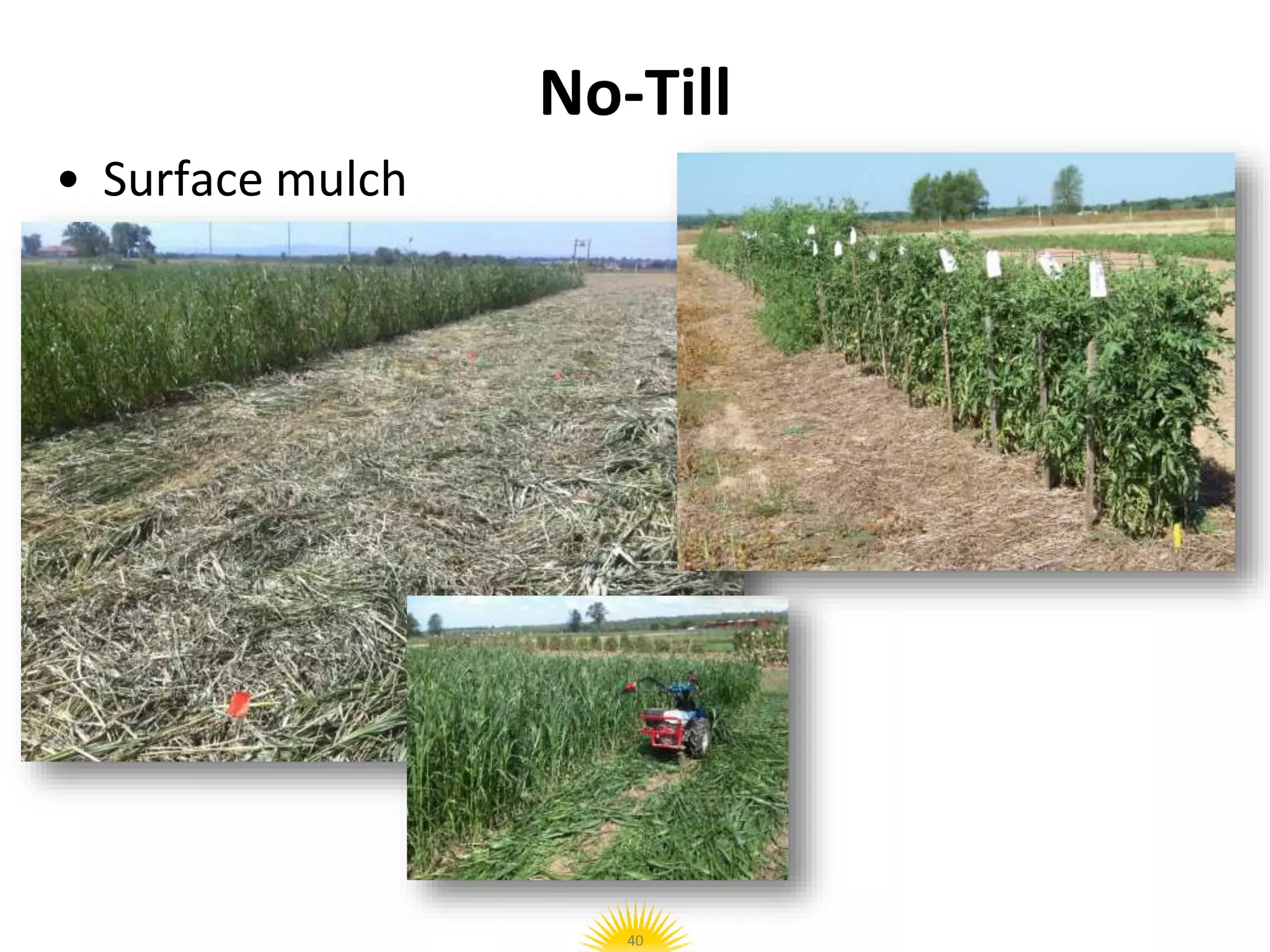
• Surface mulch
No-Till
40
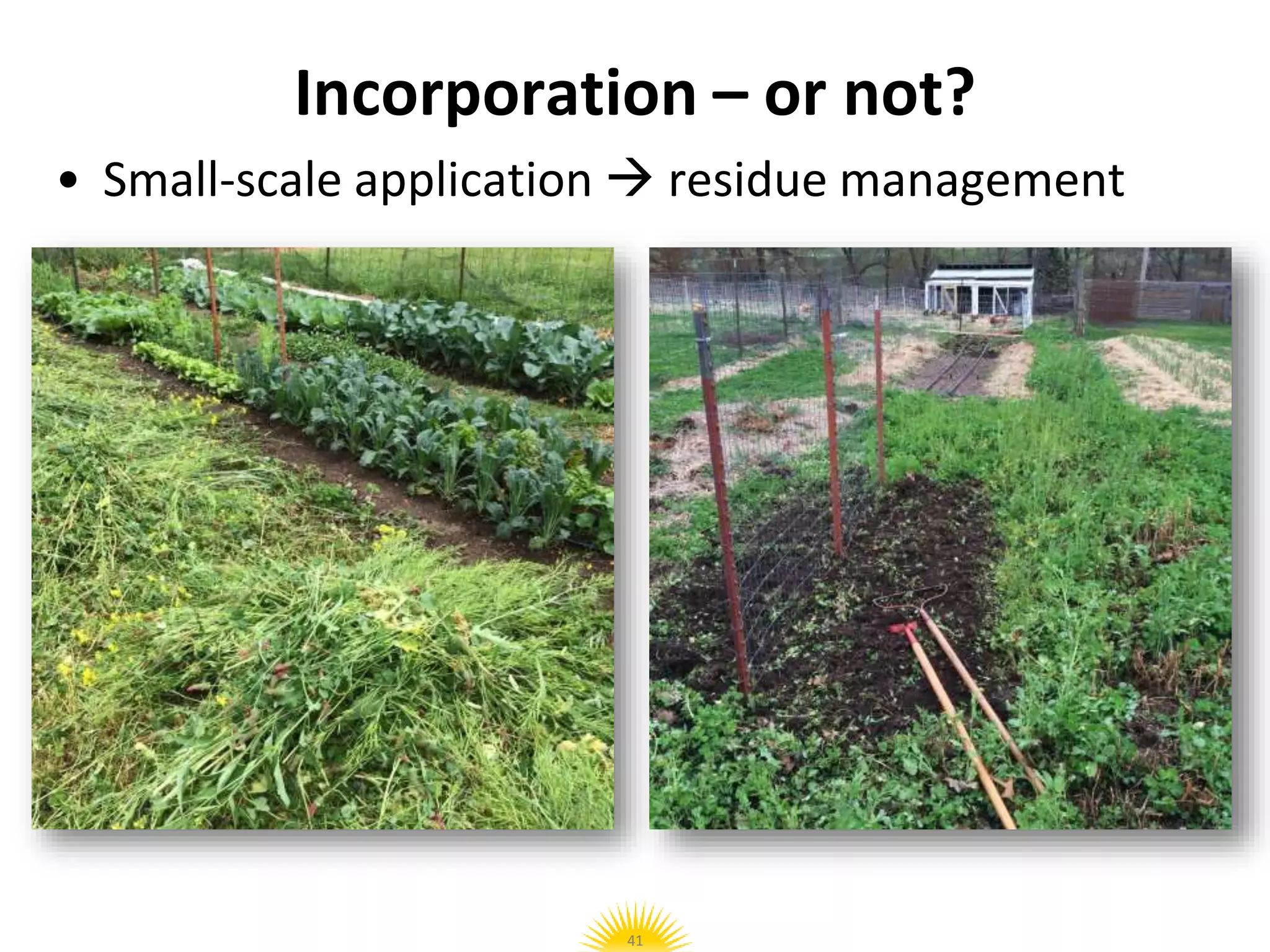
• Small-scale application  residue management
Incorporation – or not?
41
• Small-scale application  surface mulch
No-Till
42
• Planting too late
• Cover crop becoming a weed problem
• Not being able to terminate in time
• Planting delay (3 weeks after incorporation)
• C-rich biomass resulting in N tie-up
• Cold soils from cover crop mulch
Potential pitfalls
43
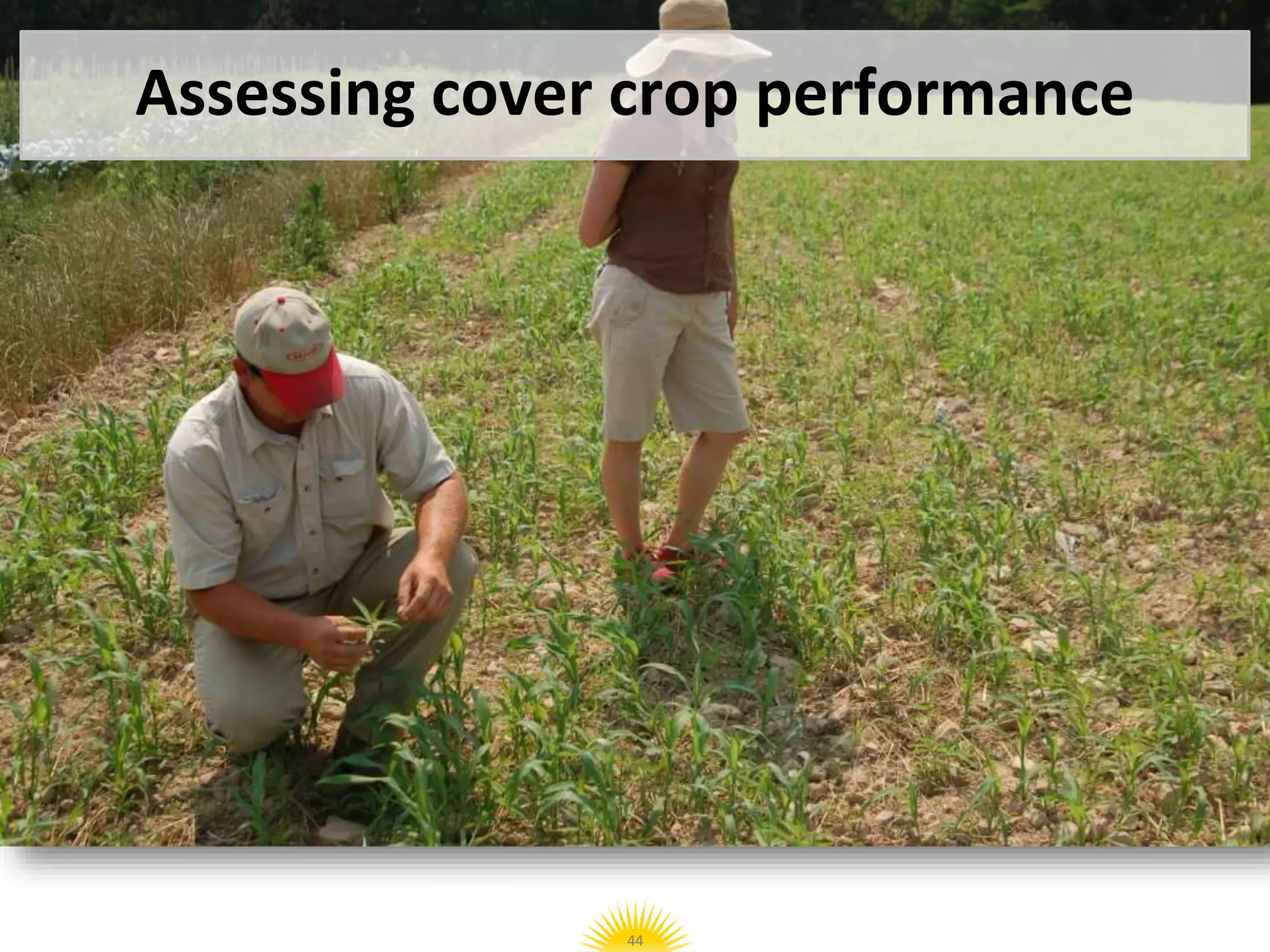
Assessing cover crop performance
44
Biomass production by height
• Rule of Thumb Estimate:
– For 100% groundcover
– 6 inches = 2,000 lb/acre DWT
– Additional in. = 150 lb/acre
• Example:
– Cover crop 5’10” = 70 in.
– (2,000 lb) + (64)(150 lb)
= 2,000 + 9,600
= 11,600 lb/acre DWT
Assessing cover crop performance
45
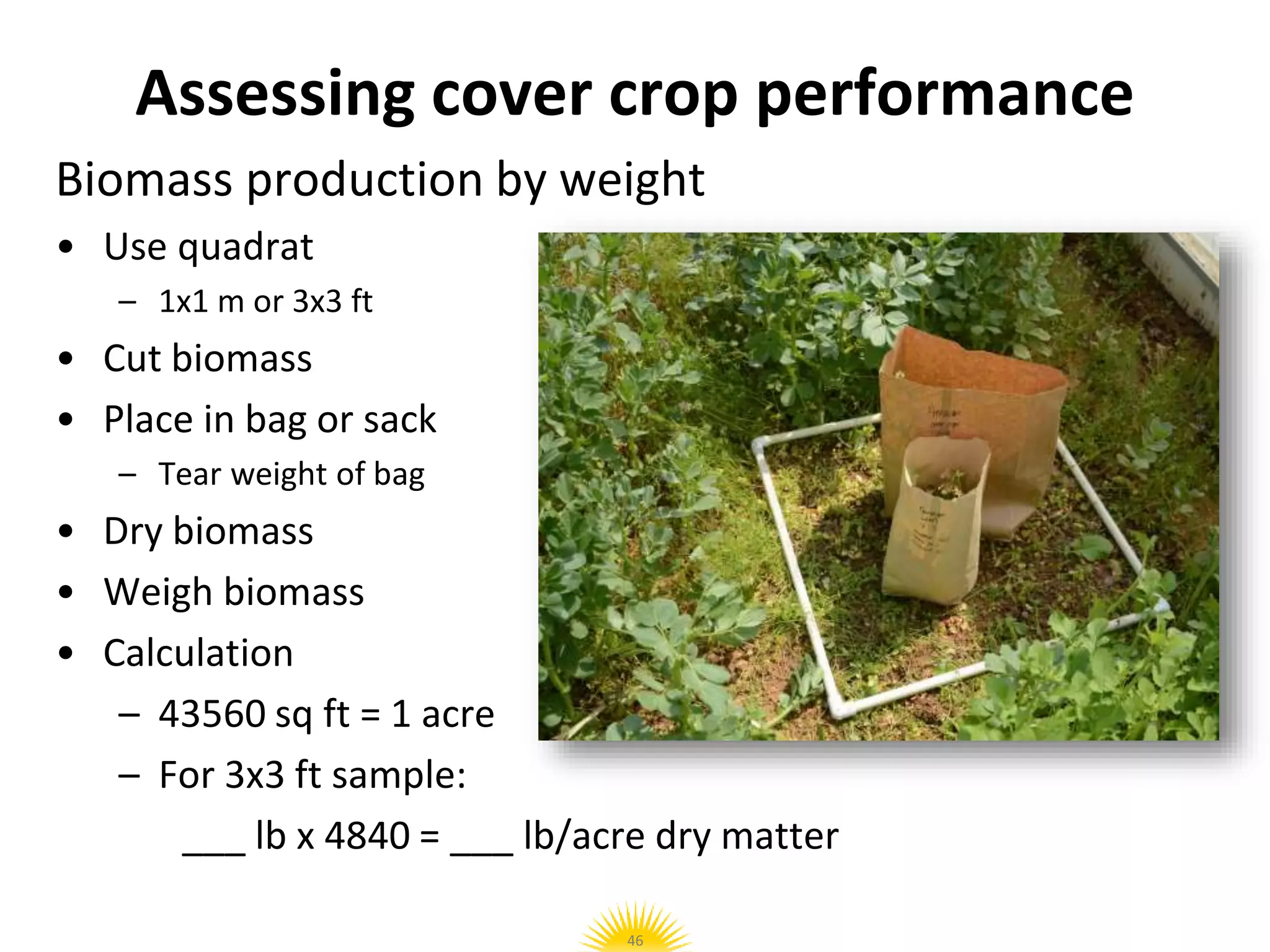
Biomass production by weight
• Use quadrat
– 1x1 m or 3x3 ft
• Cut biomass
• Place in bag or sack
– Tear weight of bag
• Dry biomass
• Weigh biomass
• Calculation
– 43560 sq ft = 1 acre
– For 3x3 ft sample:
___ lb x 4840 = ___ lb/acre dry matter
Assessing cover crop performance
46
Assessing performance – Benchmarks
47
Cover crop Dry matter (lbs/acre)
Sorghum-Sudangrass 8,000-10,000
Grain rye 3,000-10,000
Oats 2,000-10,000
Buckwheat 2,000-4,000
Mustard 3,000-9,000
Radish 4,000-7,000
Cowpea 2,500-4,500
Crimson clover 3,500-5,500
Austrian winter pea 4,000-5,000
Hairy vetch 2,300-5,000
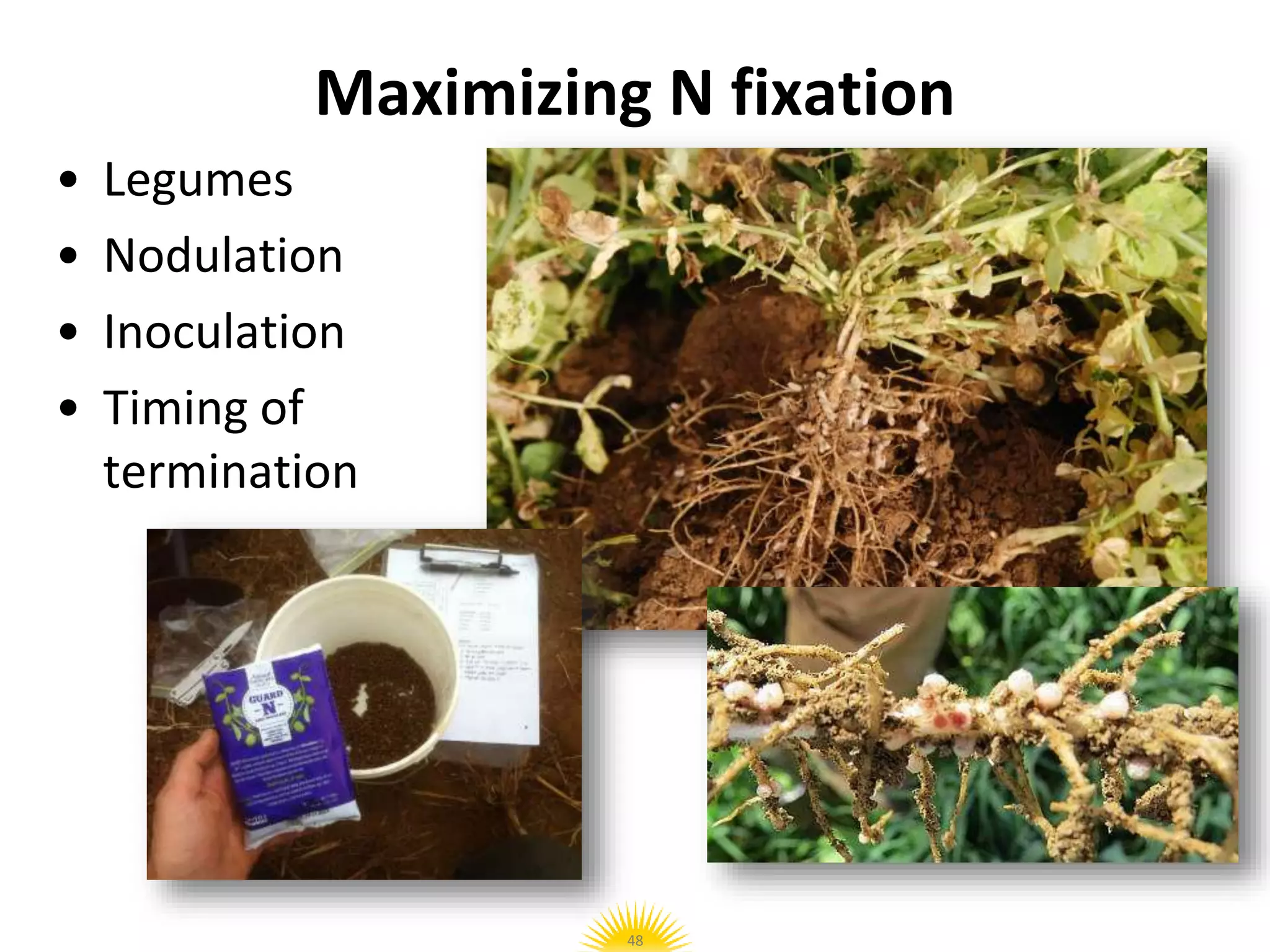
• Legumes
• Nodulation
• Inoculation
• Timing of
termination
Maximizing N fixation
48
Calculating biomass N
• N% of cover crop biomass
– Legumes: 3-4% N
– Cereals: 1.5-2.5% N
– 50/50 mix: 2.5-3% N
• Biomass N (lb/a) = N% x Dry wt biomass (lb/a)
• 50-60% of N will be plant available (PAN)
Cowpea example: 4,000 lb/a DM and 3.5% N
Biomass N = 0.035 x 4,000 x 0.5 = 70 lb/a PAN
Assessing N fixation
49
Assessing N fixation
50
Legume N content (lbs/a)
Cowpea 75-150
Sunn hemp 100
Crimson clover 70-150
Austrain winter pea 90-150
Hairy vetch 60-120*
*Studies have shown hairy vetch to contribute as much as
100 lbs/a of plant-available N
• Fertilizer N reduction with legumes
– Expect fertilizer replacement of 50-100 lb N/a
– Oregon State University study demonstrated savings of
$500/a using vetch cover crop instead of feather meal in
organic broccoli (Garrett, 2009)
https://www.uvm.edu/vtvegandberry/NMP/PANFromCoverCrops.pdf
• Cost of cover crop PAN estimated at $2-3/lb
• Cost of PAN from feather meal fertilizer $5/lb
Economics of cover cropping
51
• Fertilizer reduction
– Kansas study showed Austrian winter peas and hairy
vetch could provide enough N for muskmelons in
plasticulture system without additional fertilizer
(Singogo, 1996)
• Yield compared to fertilizer rates of 63 to 90 lbs N/a
Economics of cover cropping
52
• Oregon State University study (Luna, 2009)
– Oat-legume cover crop led to net increase of $50/a in
revenue for organic corn production
– Phacelia-vetch cover crop increased broccoli production
by 1.3 tons/a compared to fallow
• $2,370 increase in economic value per acre
– Oat-vetch cover crop increased broccoli yield when
fertilized at 90 lbs/acre
• $3,460 increase in economic value per acre
From SARE Project “Managing cover crop and conservation tillage systems to
enhance vegetable crop yields, economic returns and environmental quality”
Economics of cover cropping
53
• Reduced cost of weed control
– Biological management
– Bio-extensive system  “Weed the soil”
– Weed-suppressive killed mulch
Economics of cover cropping
54
Pumpkins planted into killed rye cover crop.
Photo by Ajay Nair, Iowa State University
Cover crops allow the Nordells to run a 6 acre
market garden with just 2 people and horses.
Photo from uvm.edu
Innovative applications
55
Cover crops for a Regenerative
Agriculture
56
• Conserving our soil resources
• Building soil with carbon fixation
• Improving biological productivity of soils
• Biological solutions to pest problems
greencoverseed.com/
Cover crop seed
57
www.deercreekseed.com/
www.johnnyseeds.com/farm-seed/
www.groworganic.com/
www.southernexposure.com/
Resources
58
• ATTRA
• www.ncat.attra.org
• SARE Cover Crops Topic Room
• http://www.sare.org/Learning-
Center/Topic-Rooms/Cover-Crops
• Managing Cover Crops Profitably
• NCSU Growing Small Farms, Cover
Crops Portal
• https://growingsmallfarms.ces.ncsu.ed
u/growingsmallfarms-covcropindex/
• UC Davis SAREP Cover Crop Database
• http://asi.ucdavis.edu/programs/sarep
/research-initiatives/are/nutrient-
mgmt/cover-crops-database1
https://www.uvm.edu/vtvegandberry/
NMP/PANFromCoverCrops.pdf
Questions?
Luke Freeman
lukef@ncat.org
479-442-9824
ATTRA Hotline
1-800-346-9140
Attra.ncat.org
www.slideshare.net/lfreeman89/

Cover Cropping for Regenerative Agriculture

  • 1.
    Horticulture Industries Show January5th, 2018 Cover Cropping for Regenerative Agriculture Presenter Luke Freeman Horticulture Specialist, NCAT/ATTRA
  • 2.
    1. Introduction 2. Benefitsof cover cropping 3. Cover crop species 4. Management considerations 5. Economics of cover cropping Outline 2
  • 3.
    Regenerative Agriculture? 3 • Regeneratetopsoil and increase biodiversity • Improve water cycles • Enhance ecosystem services • Increase resilience to climate fluctuation • Strengthen the health and vitality of farming communities
  • 4.
    What are covercrops? 4 • Grown for the benefit of the soil • Mowed, tilled, grazed, but not harvested
  • 5.
  • 6.
    • Improving soilquality through aggregation Soil Regeneration 6
  • 7.
    • Building soilOM and feeding the Soil Food Web Soil Regeneration 7
  • 8.
    • Improving waterinfiltration and moisture retention Soil Regeneration 8 So this doesn’t happen Photos by Rex Dufour, NCAT
  • 9.
    • Keeping soilin place and preventing erosion Soil Preservation 9
  • 10.
    • Smother cropsand allelopathy Chemical-free Weed Control 10
  • 11.
    • Controlling diseasesand nematodes – Phytophthora blight – Verticillium wilt Chemical-free Disease Suppression 11 Bio-fumigant mustard cover crop in high tunnel. Photo by Elena Garcia, U of AMarigold can suppress root-knot, lesion, and reniform nematodes. Photo attributed to Steve Groff
  • 12.
    • Contributing Nitrogen(legumes) • Recycling, capturing N (non-legumes) Building Soil Fertility 12
  • 13.
    • Attracting pollinators& beneficials Promoting Biological Diversity 13
  • 14.
    Summer cover crops CoverCrop Species for AR & OK 14 Winter cover crops Grasses Legumes Non-legume broadleaves (Brassicas)
  • 15.
    • Sorghum-Sudangrass (Sudex) –Seeded at 35-50 lb/a – Weed suppression – N scavenger – 6+ ft tall – 8-10k lb/a DM – Mowed when 3-4’ – Drought-resistant – Winter kill Summer Grasses 15
  • 16.
    • Pearl millet –Seeded at 15-20 lb/a – 4-6 ft tall – 60-70 DTM – Can be difficult to kill – Also German foxtail, and Japanese millet Summer Grasses 16
  • 17.
    • Cowpea (Southernpea) – ‘Iron and Clay’ – Seeded at 40-75 lb/a – 60-90 DTM – Drought tolerant – 3-4k lb/a DM – Can fix 75 lb N/a – Mix with Sudex or millet 17
  • 18.
    • Sunn hemp (Crotalariajuncea) – Seeded at 30 lb/a – Weed control – 9’ in 60 days – 100-140 lb N/a – Drought-tolerant – Woody after 60 days 18 Sunn hemp terminated by walk-behind roller-crimper. Photo by Carolina Farm Stewardship Association
  • 19.
    • Buckwheat – Seededat 48-90 lb/a – Fast-growing – Flowers in 30-45 days – 2.5’ tall – Allelopathic – Beneficial habitat – Can become weedy 19
  • 20.
    • Cereal rye(Secale cereal) – Seeded at 100 lb/a – Grows to 3-6’ tall – Extensive root system – Weed suppressive – Catch crop Winter Grasses 20
  • 21.
    • Oats – Seededat 100 lb/a – Nurse crop – Rapid ground cover – Grows 2-5’ tall – Will winter-kill 21 Photo by Bob Bugg, University of California Photo from the Ohio State University
  • 22.
    • Crimson clover –Seeded at 15-20 lb/a – Significant growth in spring – Can fix 160 lbs N/a – Can be overseeded into fall vegetable plots Winter Legumes 22
  • 23.
    • Hairy vetch –Seeded at 20-30 lb/a – Will fix 150 lb N/acre – Can become weedy – Will climb tall grain crops 23
  • 24.
    • Austrian winterpea – Seeded at 60-90 lb/a – Sown as late as Oct. – Will fix 130 lb N/acre – Mixes well with rye or wheat 24
  • 25.
    • Tillage/Daikon radish –Seeded at 8-20 lbs/a – Fast growing – Suppresses weeds – Bio-drilling – Winter-kills 25
  • 26.
    • Mustard – Seededat 5-15 lbs/a – Fast growing – Catch crop – Allelopathic – Glucosinolates act as bio-fumigant – Beneficial habitat Brassicas 26
  • 27.
    Multi-Species Mixes 27 • Diversity •Grass/legume • C/N ratio • Height • Rooting depth Examples • Rye + crimson clover • Rye + hairy vetch • Oats + radish + winter peas • Sudex + cowpeas • Sudex + sunn hemp + sunflower + cowpeas
  • 28.
  • 29.
    Planting and establishment– Seed drill 29 Small-scale grain drill. Photo by Jordan Engineering, jordanatveng.com Timing of planting is key
  • 30.
    Planting and establishment– Broadcasting 30 Hand-crank seed broadcaster. Photo from smallfarmtools.com
  • 31.
    Planting and establishment– Incorporating seed 31
  • 32.
    Planting and establishment– Irrigation? 32
  • 33.
    Cover crop care– Irrigation & mowing 33
  • 34.
  • 35.
    Reproductive phase: Afterflowering / before hard seed Termination – WHEN? 35 Soft dough
  • 36.
    Termination - Mowing 36 Sicklebar Flail mower Photo by Local Roots Farm Bush hog Photo by Becky Sideman, from MOFGA.org EarthtoolsBCS.com
  • 37.
    Termination – Smallscale solutions 37 Weed eater Scythe/sickle
  • 38.
  • 39.
    Incorporation 39 Incorporating cover cropwith disks. Photo by Canewater Farm Plowing in cover crop. Photo by Mark Schonbeck, VABF Tilling in cover crop. Photo by Butternut Valley Farm
  • 40.
  • 41.
    • Small-scale application residue management Incorporation – or not? 41
  • 42.
    • Small-scale application surface mulch No-Till 42
  • 43.
    • Planting toolate • Cover crop becoming a weed problem • Not being able to terminate in time • Planting delay (3 weeks after incorporation) • C-rich biomass resulting in N tie-up • Cold soils from cover crop mulch Potential pitfalls 43
  • 44.
    Assessing cover cropperformance 44
  • 45.
    Biomass production byheight • Rule of Thumb Estimate: – For 100% groundcover – 6 inches = 2,000 lb/acre DWT – Additional in. = 150 lb/acre • Example: – Cover crop 5’10” = 70 in. – (2,000 lb) + (64)(150 lb) = 2,000 + 9,600 = 11,600 lb/acre DWT Assessing cover crop performance 45
  • 46.
    Biomass production byweight • Use quadrat – 1x1 m or 3x3 ft • Cut biomass • Place in bag or sack – Tear weight of bag • Dry biomass • Weigh biomass • Calculation – 43560 sq ft = 1 acre – For 3x3 ft sample: ___ lb x 4840 = ___ lb/acre dry matter Assessing cover crop performance 46
  • 47.
    Assessing performance –Benchmarks 47 Cover crop Dry matter (lbs/acre) Sorghum-Sudangrass 8,000-10,000 Grain rye 3,000-10,000 Oats 2,000-10,000 Buckwheat 2,000-4,000 Mustard 3,000-9,000 Radish 4,000-7,000 Cowpea 2,500-4,500 Crimson clover 3,500-5,500 Austrian winter pea 4,000-5,000 Hairy vetch 2,300-5,000
  • 48.
    • Legumes • Nodulation •Inoculation • Timing of termination Maximizing N fixation 48
  • 49.
    Calculating biomass N •N% of cover crop biomass – Legumes: 3-4% N – Cereals: 1.5-2.5% N – 50/50 mix: 2.5-3% N • Biomass N (lb/a) = N% x Dry wt biomass (lb/a) • 50-60% of N will be plant available (PAN) Cowpea example: 4,000 lb/a DM and 3.5% N Biomass N = 0.035 x 4,000 x 0.5 = 70 lb/a PAN Assessing N fixation 49
  • 50.
    Assessing N fixation 50 LegumeN content (lbs/a) Cowpea 75-150 Sunn hemp 100 Crimson clover 70-150 Austrain winter pea 90-150 Hairy vetch 60-120* *Studies have shown hairy vetch to contribute as much as 100 lbs/a of plant-available N
  • 51.
    • Fertilizer Nreduction with legumes – Expect fertilizer replacement of 50-100 lb N/a – Oregon State University study demonstrated savings of $500/a using vetch cover crop instead of feather meal in organic broccoli (Garrett, 2009) https://www.uvm.edu/vtvegandberry/NMP/PANFromCoverCrops.pdf • Cost of cover crop PAN estimated at $2-3/lb • Cost of PAN from feather meal fertilizer $5/lb Economics of cover cropping 51
  • 52.
    • Fertilizer reduction –Kansas study showed Austrian winter peas and hairy vetch could provide enough N for muskmelons in plasticulture system without additional fertilizer (Singogo, 1996) • Yield compared to fertilizer rates of 63 to 90 lbs N/a Economics of cover cropping 52
  • 53.
    • Oregon StateUniversity study (Luna, 2009) – Oat-legume cover crop led to net increase of $50/a in revenue for organic corn production – Phacelia-vetch cover crop increased broccoli production by 1.3 tons/a compared to fallow • $2,370 increase in economic value per acre – Oat-vetch cover crop increased broccoli yield when fertilized at 90 lbs/acre • $3,460 increase in economic value per acre From SARE Project “Managing cover crop and conservation tillage systems to enhance vegetable crop yields, economic returns and environmental quality” Economics of cover cropping 53
  • 54.
    • Reduced costof weed control – Biological management – Bio-extensive system  “Weed the soil” – Weed-suppressive killed mulch Economics of cover cropping 54 Pumpkins planted into killed rye cover crop. Photo by Ajay Nair, Iowa State University Cover crops allow the Nordells to run a 6 acre market garden with just 2 people and horses. Photo from uvm.edu
  • 55.
  • 56.
    Cover crops fora Regenerative Agriculture 56 • Conserving our soil resources • Building soil with carbon fixation • Improving biological productivity of soils • Biological solutions to pest problems
  • 57.
  • 58.
    Resources 58 • ATTRA • www.ncat.attra.org •SARE Cover Crops Topic Room • http://www.sare.org/Learning- Center/Topic-Rooms/Cover-Crops • Managing Cover Crops Profitably • NCSU Growing Small Farms, Cover Crops Portal • https://growingsmallfarms.ces.ncsu.ed u/growingsmallfarms-covcropindex/ • UC Davis SAREP Cover Crop Database • http://asi.ucdavis.edu/programs/sarep /research-initiatives/are/nutrient- mgmt/cover-crops-database1 https://www.uvm.edu/vtvegandberry/ NMP/PANFromCoverCrops.pdf
  • 59.