Connected speech
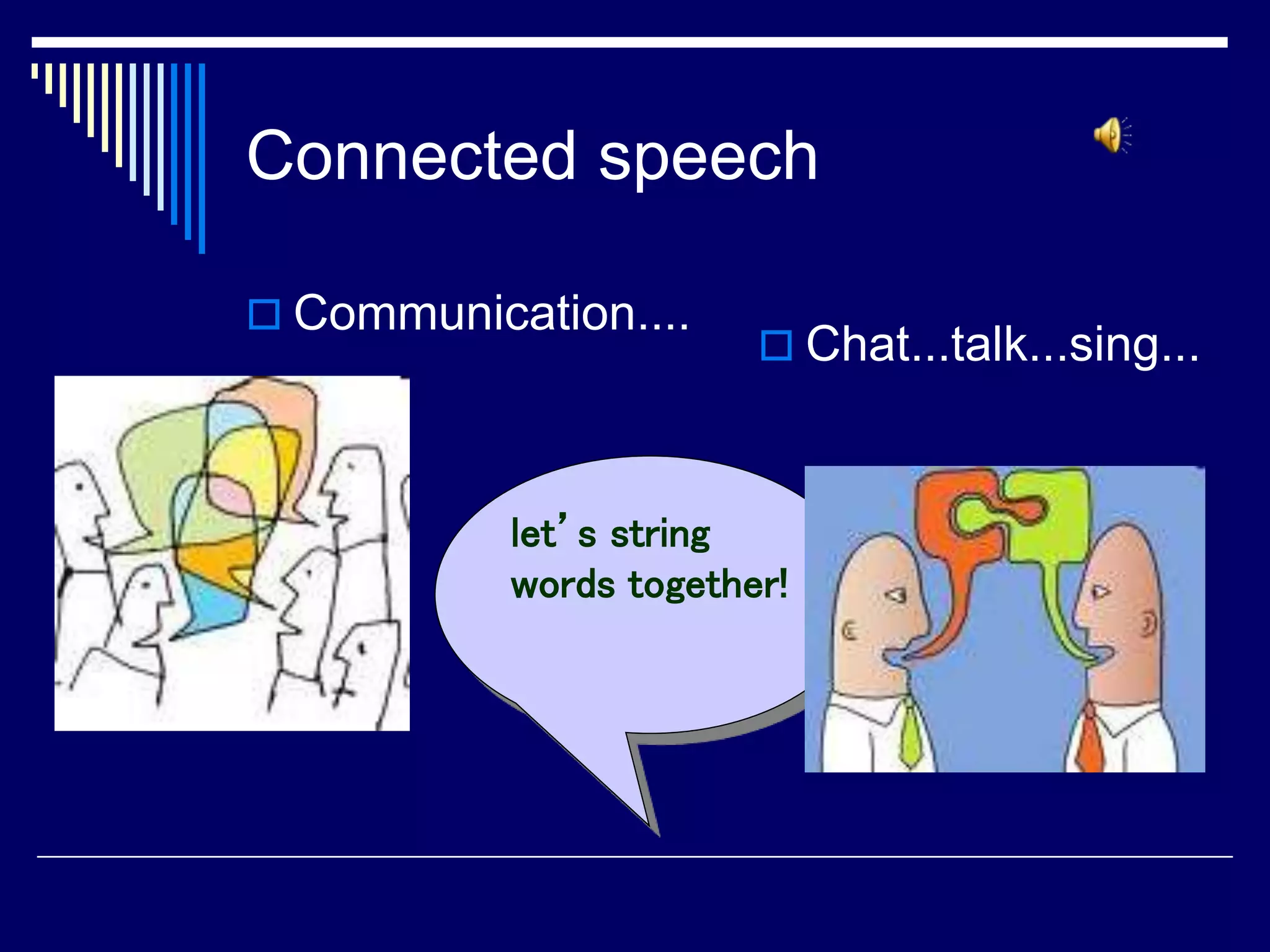
 Communication....
 Chat...talk...sing...
let’s string
words together!
What is connected speech?
 Fluent speech flows with a rhythm and the
words bump into each other.
 To make speech flow smoothly the way we
pronounce the end and beginning of some
words can change depending on the sounds at
the beginning and end of those words.
Features of connected speech
Linking sounds
 Consonant to vowel linking – when the first word ends
with a consonant sound and the second word begins
with a vowel sound. E.g. Fried egg / a box oveggs /
cupov tea /doyer? We change the sounds to make it
flow!
 Vowel to vowel linking –when the first word ends in a
vowel and the next words begins with a vowel sound.
We add a ‘w’ or ‘y’ sound.E.g.’ go in’ / say it/do it/two
eggs/ hiya! / cudyer?
 Consonant to consonant linking – when the first word
ends in a consonant and the next one begins with a
consonant sound. We don’t hear both separately, we
just hear one. E.g. We only hear one /t/ E.g. A bit tired
/lot to do
Features of connected speech
Disappearing sounds
 In rapid speech the /t/ or the /g/ sound at the end of the word
often disappears completely if there are consonant sounds
either side. e.g. next week / can’t swim/ going for .
 This also happens with the /d/ sound. e.g. sandwich –
san(d)wich. Fish and chips – fish an chips/bread an cheese.
 The /h/ sound is often deleted. E.g. You shouldn’t (h)ave told
(h)im/ We could (h)ave.
 The unstressed schwa(ɘ) is often lost. E.g. t(o)night/ got
t(o)ave.
Features of connected speech
 Weak sounds
 There are a large number of words in English which can
have a ‘full’ form or a ‘weak’ form. This is because
English is a stress timed language, and in trying to make
the intervals between stressed syllables equal, to give us
rhythm, we tend to swallow non-essential words. Thus,
we lose pronouns, conjunctions, prepositions, auxiliaries
and articles. E.g.
 And – a table ‘n chair
 Can – She c/ɘ/n speak English
 Of – A cup ov coffee
 Have – Av you finished?
 Should – You sh/ɘ/d av told me.
 The verb ‘to be’ – I’m He’s
Features of connected speech
 Changing Sounds
 Listen to two words said individually, then listen to them in a
sentence – Can you hear the difference?
 Sometimes the sound at the end of the first word takes on the
quality of the sound at the beginning of the second word. e.g.
She’s a good girl.
 This is to do with the place in the mouth where we make the
sounds. E.g. When we say /b/ or /p/ we can feel that both your
lips are pressed together.
 When we say /t/ or /d/ or /n/ we can feel that our tongue is
touching above our top teeth.
 When you say /k/ or /g/ or the –ng sound, we can feel the back
of our tongue touching the roof of our mouth.
Examples:
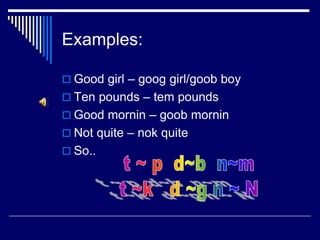
 Good girl – goog girl/goob boy
 Ten pounds – tem pounds
 Good mornin – goob mornin
 Not quite – nok quite
 So..
To sum up....
 Connected speech
consists of:
 Linking sounds
 Disappearing sounds
 Weak sounds
 Changing sounds
 So let’s connect and
chat!!!
Practice and patience!
Helpful websites to chat and
practice!
 www.bbclearningenglish.com
 www.englishcentral.com
 www.elllo.org/
 www.cambridgeenglishonline.com/Phon
etics_Focus/
Bibliography
 Books
 Underhill, A. (2005). Sound foundations. Oxford. Macmillan
Publishers Ltd.
 Internet sites
 Talk about English (July 2005). Retrieved 5 June 2010 from
 www.bbclearningenglish.com
 Connected speech.(2006). Retrieved from
 www.eslsite.com/rd/Pronounciation/connected_speech.html
 Learning English – I would like to buy a hamburger. Retrieved
from www.youtube.com

connected_speech_features.ppt

  • 1.
    Connected speech  Communication.... Chat...talk...sing... let’s string words together!
  • 2.
    What is connectedspeech?  Fluent speech flows with a rhythm and the words bump into each other.  To make speech flow smoothly the way we pronounce the end and beginning of some words can change depending on the sounds at the beginning and end of those words.
  • 3.
    Features of connectedspeech Linking sounds  Consonant to vowel linking – when the first word ends with a consonant sound and the second word begins with a vowel sound. E.g. Fried egg / a box oveggs / cupov tea /doyer? We change the sounds to make it flow!  Vowel to vowel linking –when the first word ends in a vowel and the next words begins with a vowel sound. We add a ‘w’ or ‘y’ sound.E.g.’ go in’ / say it/do it/two eggs/ hiya! / cudyer?  Consonant to consonant linking – when the first word ends in a consonant and the next one begins with a consonant sound. We don’t hear both separately, we just hear one. E.g. We only hear one /t/ E.g. A bit tired /lot to do
  • 4.
    Features of connectedspeech Disappearing sounds  In rapid speech the /t/ or the /g/ sound at the end of the word often disappears completely if there are consonant sounds either side. e.g. next week / can’t swim/ going for .  This also happens with the /d/ sound. e.g. sandwich – san(d)wich. Fish and chips – fish an chips/bread an cheese.  The /h/ sound is often deleted. E.g. You shouldn’t (h)ave told (h)im/ We could (h)ave.  The unstressed schwa(ɘ) is often lost. E.g. t(o)night/ got t(o)ave.
  • 5.
    Features of connectedspeech  Weak sounds  There are a large number of words in English which can have a ‘full’ form or a ‘weak’ form. This is because English is a stress timed language, and in trying to make the intervals between stressed syllables equal, to give us rhythm, we tend to swallow non-essential words. Thus, we lose pronouns, conjunctions, prepositions, auxiliaries and articles. E.g.  And – a table ‘n chair  Can – She c/ɘ/n speak English  Of – A cup ov coffee  Have – Av you finished?  Should – You sh/ɘ/d av told me.  The verb ‘to be’ – I’m He’s
  • 6.
    Features of connectedspeech  Changing Sounds  Listen to two words said individually, then listen to them in a sentence – Can you hear the difference?  Sometimes the sound at the end of the first word takes on the quality of the sound at the beginning of the second word. e.g. She’s a good girl.  This is to do with the place in the mouth where we make the sounds. E.g. When we say /b/ or /p/ we can feel that both your lips are pressed together.  When we say /t/ or /d/ or /n/ we can feel that our tongue is touching above our top teeth.  When you say /k/ or /g/ or the –ng sound, we can feel the back of our tongue touching the roof of our mouth.
  • 7.
    Examples:  Good girl– goog girl/goob boy  Ten pounds – tem pounds  Good mornin – goob mornin  Not quite – nok quite  So..
  • 8.
    To sum up.... Connected speech consists of:  Linking sounds  Disappearing sounds  Weak sounds  Changing sounds  So let’s connect and chat!!!
  • 9.
  • 10.
    Helpful websites tochat and practice!  www.bbclearningenglish.com  www.englishcentral.com  www.elllo.org/  www.cambridgeenglishonline.com/Phon etics_Focus/
  • 11.
    Bibliography  Books  Underhill,A. (2005). Sound foundations. Oxford. Macmillan Publishers Ltd.  Internet sites  Talk about English (July 2005). Retrieved 5 June 2010 from  www.bbclearningenglish.com  Connected speech.(2006). Retrieved from  www.eslsite.com/rd/Pronounciation/connected_speech.html  Learning English – I would like to buy a hamburger. Retrieved from www.youtube.com