MS. Towar Shilshi
CONJUNCTIVITIS
OBJECTIVES
• At the end of the presentation the audience will have an idea about;
• What is conjunctivitis
• Types of conjunctivitis
• Microbial conjunctivitis
• Allergic conjunctivitis
• Toxic conjunctivitis
• Sign and symptoms
• Medical management
• Nursing management
• Prevention
• Home remedies to treat conjunctivitis
INTRODUCTION
The membrane that lines the eyelids and the white part of the eye
(sclera) is called the conjunctiva. When the small blood vessels in the
conjunctiva are inflamed, they swell and become more visible, which
causes the eyes to appear reddish. That’s why conjunctivitis is often
called pink eye or red eye.
DEFINITION
Conjunctivitis is an inflammation
of the conjunctiva. which makes the
white of the eye appear red.
Risk factors
• Exposure to something for which the person have an
allergy (allergic conjunctivitis)
• Exposure to someone infected with the viral or
bacterial form of conjunctivitis
• Using contact lenses
ETIOLOGY / CAUSES
Allergic conditions.
Bacterial.
S.aureus.
streptococcus pneumonia.
H. influenza.
Viral
Topical medication.
Chemical.
Wind.
Smoke.
Ultraviolet light.
Fungal eye.
TYPES OF CONJUNCTIVITIS
• Microbial conjunctivitis
• Allergic conjunctivitis
• Toxic conjunctivitis
MICROBIAL CONJUNCTIVITIS
• Bacterial conjunctivitis is one of the most
commonly encountered eye problems in medicine.
• Most cases are acute, self-limited, and not a major
cause of morbidity.
• However, because of its high prevalence, it has a large
societal impact in terms of missed days of school or
work.
• Antibiotics can hasten the resolution of symptoms and
microbial eradication and are therefore typically used
to allow patients to return to their daily activities faster
and to decrease the spread of disease.
ALLERGIC CONJUNCTIVITIS
• Allergic conjunctivitis is an eye inflammation caused by an allergic
reaction to substances like pollen or mold spores.
• The inside of your eyelids and the covering of your eyeball have a
membrane called the conjunctiva.
• The conjunctiva is susceptible to irritation from allergens, especially during
hay fever season.
Allergic conjunctivitis
TOXIC CONJUNCTIVITIS
• Toxic conjunctivitis typically occurs with protracted use of topical ocular
medications .
• The reaction may take days to years to develop. There also appears to be a
dose-response effect with regard to the preservative concentration and total
amount of preservative-containing medications used
• It implies direct damage to ocular tissues from an offending agent, usually a
preservative or medication.
Pathophysiology
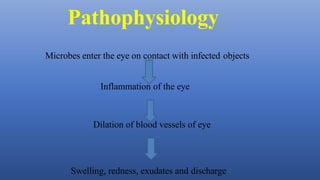
Microbes enter the eye on contact with infected objects
Inflammation of the eye
Dilation of blood vessels of eye
Swelling, redness, exudates and discharge
SIGN AND SYMPTOMS
• Tenderness of the eye, or pain (which can be severe in the cases of
irritant conjunctivitis)
• Itchiness
• Body aches
• Photophobia
• Discomfort in the eye
• Redness of the eye or inner eyelids
• Discharge and teariness
• Discharge may cause eyelids to crust and stick together while sleeping
• Swelling of the eyelids
• Infection usually begins with one eye, but can quickly spread to other
eye in cases of viral or bacterial conjunctivitis
DIAGNOSTIC EVALUATION.
• By examine signs and symptoms.
• To determine whether the patient have pink eye, the doctor will
examine the eyes.
• The doctor may also take a sample of eye secretions from the
conjunctiva for laboratory analysis if the patient have a very severe
case of conjunctivitis, if the corneas are affected or if the person have
had repeated infections that aren't responding to treatment.
MANAGEMENT
PREVENTION
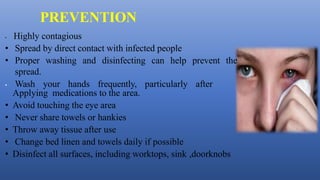
• Highly contagious
• Spread by direct contact with infected people
• Proper washing and disinfecting can help prevent the
spread.
• Wash your hands frequently, particularly after
Applying medications to the area.
• Avoid touching the eye area
• Never share towels or hankies
• Throw away tissue after use
• Change bed linen and towels daily if possible
• Disinfect all surfaces, including worktops, sink ,doorknobs
Treatments and drugs
Treatment for bacterial conjunctivitis
• If the infection is bacterial, the doctor may prescribe antibiotic eyedrops as pink eye treatment, and the
infection should go away within several days.
• Antibiotic eye ointment, in place of eyedrops, is sometimes prescribed for treating bacterial pink eye
in children.
• An ointment is often easier to administer to an infant or young child than are eyedrops,
though the ointment may blur vision for up to 20 minutes after application.
• With either form of medication, expect signs and symptoms to start getting better in a few days.
• Follow the doctor's instructions and use the antibiotics for the complete period prescribed to prevent
recurrence of the infection.
Treatment for viral conjunctivitis
• There is no treatment for most cases of viral conjunctivitis. Instead, the virus
needs time to run its course — up to two or three weeks. Viral conjunctivitis
often begins in one eye and then infects the other eye within a few days. The
signs and symptoms should gradually clear on their own.
• Antiviral medications may be an option if the doctor determines that
the viral conjunctivitis is caused by the herpes simplex virus.
Treatment for allergic conjunctivitis
• If the irritation is allergic conjunctivitis, the doctor may prescribe one of many
different types of eye drops for people with allergies.
• These may include medications that help control allergic reactions, such as
antihistamines or drugs that help control inflammation, such as steroids and anti-
inflammatory drops.
• The patient may also reduce the severity of allergic conjunctivitis symptoms by
avoiding whatever causes the allergies when possible.
NURSING MANAGEMENT
• Eye will look red and will have watery discharge and lids will be swollen
for about a week.
• Will experience eye pain, a sandy sensation in the eye, and sensitivity to
light
• Symptoms will resolve after about 1 week
• May use light cold compresses over the eye for about 10 minutes four to
five times a day to soothe the pain
• May use artificial tears for the sandy sensation in the eye and mild pain
medications such as acetaminophen
• Need to stay at home. Children must not play outside. May return to
work or school after 7 days when the redness and discharge have cleared.
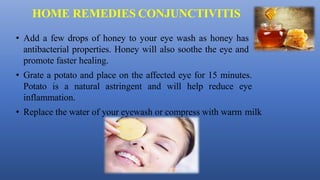
HOME REMEDIES CONJUNCTIVITIS
• Add a few drops of honey to your eye wash as honey has
antibacterial properties. Honey will also soothe the eye and
promote faster healing.
• Grate a potato and place on the affected eye for 15 minutes.
Potato is a natural astringent and will help reduce eye
inflammation.
• Replace the water of your eyewash or compress with warm milk
THANK YOU

Conjunctivitis

  • 1.
  • 2.
    OBJECTIVES • At theend of the presentation the audience will have an idea about; • What is conjunctivitis • Types of conjunctivitis • Microbial conjunctivitis • Allergic conjunctivitis • Toxic conjunctivitis • Sign and symptoms • Medical management • Nursing management • Prevention • Home remedies to treat conjunctivitis
  • 3.
    INTRODUCTION The membrane thatlines the eyelids and the white part of the eye (sclera) is called the conjunctiva. When the small blood vessels in the conjunctiva are inflamed, they swell and become more visible, which causes the eyes to appear reddish. That’s why conjunctivitis is often called pink eye or red eye.
  • 4.
    DEFINITION Conjunctivitis is aninflammation of the conjunctiva. which makes the white of the eye appear red.
  • 5.
    Risk factors • Exposureto something for which the person have an allergy (allergic conjunctivitis) • Exposure to someone infected with the viral or bacterial form of conjunctivitis • Using contact lenses
  • 6.
    ETIOLOGY / CAUSES Allergicconditions. Bacterial. S.aureus. streptococcus pneumonia. H. influenza. Viral Topical medication. Chemical. Wind. Smoke. Ultraviolet light. Fungal eye.
  • 7.
    TYPES OF CONJUNCTIVITIS •Microbial conjunctivitis • Allergic conjunctivitis • Toxic conjunctivitis
  • 8.
    MICROBIAL CONJUNCTIVITIS • Bacterialconjunctivitis is one of the most commonly encountered eye problems in medicine. • Most cases are acute, self-limited, and not a major cause of morbidity. • However, because of its high prevalence, it has a large societal impact in terms of missed days of school or work. • Antibiotics can hasten the resolution of symptoms and microbial eradication and are therefore typically used to allow patients to return to their daily activities faster and to decrease the spread of disease.
  • 9.
    ALLERGIC CONJUNCTIVITIS • Allergicconjunctivitis is an eye inflammation caused by an allergic reaction to substances like pollen or mold spores. • The inside of your eyelids and the covering of your eyeball have a membrane called the conjunctiva. • The conjunctiva is susceptible to irritation from allergens, especially during hay fever season.
  • 10.
  • 11.
    TOXIC CONJUNCTIVITIS • Toxicconjunctivitis typically occurs with protracted use of topical ocular medications . • The reaction may take days to years to develop. There also appears to be a dose-response effect with regard to the preservative concentration and total amount of preservative-containing medications used • It implies direct damage to ocular tissues from an offending agent, usually a preservative or medication.
  • 12.
    Pathophysiology Microbes enter theeye on contact with infected objects Inflammation of the eye Dilation of blood vessels of eye Swelling, redness, exudates and discharge
  • 13.
    SIGN AND SYMPTOMS •Tenderness of the eye, or pain (which can be severe in the cases of irritant conjunctivitis) • Itchiness • Body aches • Photophobia • Discomfort in the eye • Redness of the eye or inner eyelids • Discharge and teariness • Discharge may cause eyelids to crust and stick together while sleeping • Swelling of the eyelids • Infection usually begins with one eye, but can quickly spread to other eye in cases of viral or bacterial conjunctivitis
  • 14.
    DIAGNOSTIC EVALUATION. • Byexamine signs and symptoms. • To determine whether the patient have pink eye, the doctor will examine the eyes. • The doctor may also take a sample of eye secretions from the conjunctiva for laboratory analysis if the patient have a very severe case of conjunctivitis, if the corneas are affected or if the person have had repeated infections that aren't responding to treatment.
  • 15.
  • 16.
    PREVENTION • Highly contagious •Spread by direct contact with infected people • Proper washing and disinfecting can help prevent the spread. • Wash your hands frequently, particularly after Applying medications to the area. • Avoid touching the eye area • Never share towels or hankies • Throw away tissue after use • Change bed linen and towels daily if possible • Disinfect all surfaces, including worktops, sink ,doorknobs
  • 17.
    Treatments and drugs Treatmentfor bacterial conjunctivitis • If the infection is bacterial, the doctor may prescribe antibiotic eyedrops as pink eye treatment, and the infection should go away within several days. • Antibiotic eye ointment, in place of eyedrops, is sometimes prescribed for treating bacterial pink eye in children. • An ointment is often easier to administer to an infant or young child than are eyedrops, though the ointment may blur vision for up to 20 minutes after application. • With either form of medication, expect signs and symptoms to start getting better in a few days. • Follow the doctor's instructions and use the antibiotics for the complete period prescribed to prevent recurrence of the infection.
  • 18.
    Treatment for viralconjunctivitis • There is no treatment for most cases of viral conjunctivitis. Instead, the virus needs time to run its course — up to two or three weeks. Viral conjunctivitis often begins in one eye and then infects the other eye within a few days. The signs and symptoms should gradually clear on their own. • Antiviral medications may be an option if the doctor determines that the viral conjunctivitis is caused by the herpes simplex virus.
  • 19.
    Treatment for allergicconjunctivitis • If the irritation is allergic conjunctivitis, the doctor may prescribe one of many different types of eye drops for people with allergies. • These may include medications that help control allergic reactions, such as antihistamines or drugs that help control inflammation, such as steroids and anti- inflammatory drops. • The patient may also reduce the severity of allergic conjunctivitis symptoms by avoiding whatever causes the allergies when possible.
  • 20.
    NURSING MANAGEMENT • Eyewill look red and will have watery discharge and lids will be swollen for about a week. • Will experience eye pain, a sandy sensation in the eye, and sensitivity to light • Symptoms will resolve after about 1 week • May use light cold compresses over the eye for about 10 minutes four to five times a day to soothe the pain • May use artificial tears for the sandy sensation in the eye and mild pain medications such as acetaminophen • Need to stay at home. Children must not play outside. May return to work or school after 7 days when the redness and discharge have cleared.
  • 21.
    HOME REMEDIES CONJUNCTIVITIS •Add a few drops of honey to your eye wash as honey has antibacterial properties. Honey will also soothe the eye and promote faster healing. • Grate a potato and place on the affected eye for 15 minutes. Potato is a natural astringent and will help reduce eye inflammation. • Replace the water of your eyewash or compress with warm milk
  • 22.