Conjunctivitis and its
Management
PRESENTED BY
MRS.SULAKSHA DESSAI
DEPT. OF MEDICAL SURGICAL NURSING ,
INE, BAMBOLIM ,Goa.
END OF CLASS OBJECTIVE:
Student will be able to identify the problems of the patients
based on disease condition, plan and implement care and
impart incidental and discharge health education to patient
to help him recover from conjunctivitis without causing
any complication to self and others .
INSTRUCTIONAL OBJECTIVES
The student will be able to-
1. Review the applied anatomy and physiology of conjunctiva.
2. Define conjunctivitis and describe its incidences.
3. Identify the causes and classify conjunctivitis.
4. Describe different types of conjunctivitis
5. Explain the pathophysiology of conjunctivitis.
6. Identify the clinical manifestation of conjunctivitis.
7. List down various investigations used to diagnose conjunctivitis.
8. Enumerate the various treatment modalities used in the management of conjunctivitis.
9. List down the general nursing diagnosis of conjunctivitis.
10.Discuss about patient education directed towards infection control
Anatomy and physiology of conjunctiva:
Anatomy:
The conjunctiva is a thin, transparent, vascularized
mucous membrane that covers the posterior surface
of the eyelids, reflects forwards on the eye at the
fornix, to cover the anterior sclera. Anatomically,
the conjunctiva is composed of a bulbar and a
palpebral component.
Physiology:
The conjunctiva helps lubricate the eye by
producing mucus and tears, although a smaller
volume of tears than the lacrimal gland. It also
contributes to immune surveillance and helps to
prevent the entrance of microbes into the eye.
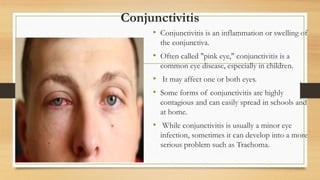
Conjunctivitis
• Conjunctivitis is an inflammation or swelling of
the conjunctiva.
• Often called "pink eye," conjunctivitis is a
common eye disease, especially in children.
• It may affect one or both eyes.
• Some forms of conjunctivitis are highly
contagious and can easily spread in schools and
at home.
• While conjunctivitis is usually a minor eye
infection, sometimes it can develop into a more
serious problem such as Trachoma.
Causes and types of conjunctivitis
The cause of conjunctivitis varies depending on the type. There are four main types of
conjunctivitis:
1. Allergic conjunctivitis:
2. Infectious conjunctivitis:
3. Mechanical conjunctivitis: and
4. Conjunctivitis associated with skin diseases
Allergic Conjunctivitis
Conjunctivitis may also be caused by allergens such as pollen,
perfumes, cosmetics, smoke, dust mites, Balsam of Peru, and eye
drops.
Types :
1)simple allergic Conjunctivitis :caused by sensitization to
allergens both exogenous & endogenous.
2)spring catarrh/vernal catarrh :conjunctivitis that recur during
warm weather &disappear entirely or to some extent in winter
3)Phlyctenular disease: represents a sensitivity or allergic reaction
to an endogenous toxin associated with the tuberculous infection
Infectious Conjunctivitis
• May be bacterial, viral or parasitic
• Highly contagious &extensive epidemics occurs in school and institution.
• Spread through infected hands ,towels ,handkerchiefs etc.
Types of Bacterial conjunctivitis :
a)Mucopurulent :pneumococcus, staphylococcus or kokh-
weeks bacillus infections
b)Purulent: results from gram negative niesseria
gonorrhea.
Adult form acquired from genitals or indirectly from
contaminated towels or clothes.
 Ophthalmia neonatorum acquired during parturition
or after birth from contaminated clothes & nurses hands
:
These are cases of bacterial conjunctivitis that involve the production of membranes or
pseudo membranes and is caused by Neisseria gonorrhoeae, β-hemolytic streptococci, and
Corynebacterium diphtheriae
d)Inclusion conjunctivitis :
Affects sexually active people who have genital Chlamydial infection. Transmitted by oral-
genital sex, hand to eye, or while swimming.
e)Trachoma
• A chronic follicular conjunctivitis caused by Chlamydia trachomatis which causes
scarring of the eyelid, conjunctiva, and cornea
• A leading global cause of preventable blindness in children younger than 10 years of
age
Viral conjunctivitis
• Viral conjunctivitis is often associated with an infection of
the upper respiratory tract, a common cold, or a sore throat.
Its symptoms include excessive watering and itching.
• Adenoviruses is the most common cause of viral
conjunctivitis .
• Acute hemorrhagic conjunctivitis is a highly contagious
disease caused by either , Enterovirus 70 and Coxsackievirus
A24.
Mechanical conjunctivitis :
• Again of two types:
I)Injuries –foreign body in the eye, thermal, electrical or Chemical eye injury
due to either an acidic or alkali substance .
II)Ultra violet light conjunctivitis : excessive exposure to UV light on the
eye
Conjunctivitis associated with certain systemic
infection & skin diseases
• Conjunctivitis is part of the triad of reactive arthritis, which is thought to be
caused by autoimmune cross-reactivity following certain bacterial infections.
Common exanthemata such as measles, chickenpox, etc can also cause
conjunctivitis.
PATHOPHYSIOLOGY
• Irritation of the conjunctiva from any cause.
• Congestion of superficial blood vessels & some edema of the sub epithelial layer.
• continued irritation causes formation of new blood vessels specially in tarsal
conjunctiva which protrude as vascular tufts.
• Growth of elastic tissue from the sub epithelium around these vessels form papillae.
• Hyperplasia of lymphoid tissue, hypertrophy of epithelium and increased
desquamation of superficial layer.
• Mucopurulent discharge are other changes of chronic irritation.
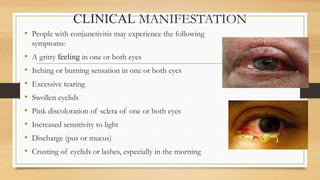
CLINICAL MANIFESTATION
• People with conjunctivitis may experience the following
symptoms:
• A gritty feeling in one or both eyes
• Itching or burning sensation in one or both eyes
• Excessive tearing
• Swollen eyelids
• Pink discoloration of sclera of one or both eyes
• Increased sensitivity to light
• Discharge (pus or mucus)
• Crusting of eyelids or lashes, especially in the morning
Diagnosis
• Patient history and physical examination
• Conjunctival scrapes for cytology
• Swabs for bacterial culture
• A patch test is used to identify the causative allergen in the case where
conjunctivitis is caused by allergy.
• Conjunctival incisional biopsy is occasionally done when granulomatous
diseases (e.g., sarcoidosis) or dysplasia are suspected.
Management
• Increase patient comfort.
• Reduce or lessen the course of the
infection or inflammation.
• Prevent the spread of the infection in
contagious forms of conjunctivitis .
Treating conjunctivitis has three main goals
Management of conjunctivitis
• The appropriate treatment for conjunctivitis depends on its
cause / type.
• Most types of mild and viral conjunctivitis are self-limiting.
• Severe cases require topical antibiotic eye drops or ointment as
prescribed.
• Gonococcal conjunctivitis require urgent antibiotic therapy to
prevent complications.
• Acute bacterial conjunctivitis is self-limiting and symptoms
resolve within 2 weeks or may last for few days if treated with
antibiotic.
Management of conjunctivitis
• Epidemic keratoconjunctivitis is a highly contagious viral
conjunctivitis. Though self-limiting, inform patient to
emphasize on hand washing and avoid sharing hand towels,
face towels and eye drops to prevent cross infection.
• Allergic conjunctivitis treatment:
 avoid the irritant, if possible.
Give Cold compresses and artificial tears.
Non-steroidal anti-inflammatory medications and
antihistamines
 Topical steroid eye drops.
Management of conjunctivitis
• Avoid nosocominal infection by Frequent hand hygiene ,
environmental cleaning and disinfection of equipment used for eye
examination.
• All forms of tonometry avoided unless medically indicated
• Infected employees and others must not be allowed to work or
attend school until symptoms have resolved which, can take 3 to 7
days.
• Use of vasoconstrictors such as topical epinephrine solution , cold
compresses, ice packs and cool ventilation usually provide comfort
by decreasing swelling.
Management of conjunctivitis
• Stratagy used for the treatment of Trachoma is
called "SAFE"
A WHO-developed strategy to prevent blindness- a
combination of interventions known by the acronym
"SAFE" which stands for Surgery For Trichiasis (eyelashes
turned inwards), Antibiotics (topical and systemic), Facial
Cleanliness and Environmental Improvement.
Management of conjunctivitis
• Adult inclusion conjunctivitis requires 1 week course of antibiotics and
treatment of STDs .
• Staphylococcal conjunctivitis respond well to chloramphenicol 1% ointment.
• Phlyctenular conjunctivitis patient is treated with nutritious diet, ultraviolet
light exposure, cod liver oil and iron preparation
Management of conjunctivitis
• Chemical conjunctivitis. Careful flushing of the eyes with saline
is a standard treatment for chemical conjunctivitis.
• People with chemical conjunctivitis also may need to use topical
steroids.
• Severe chemical injuries, particularly alkali burns, are medical
emergencies and can lead to scarring, damage to the eye or the
sight, or even loss of the eye.
• Incase of chemical spills in eye, flush the eye for several minutes
with a lot of water before seeing the medical provider.
Nursing Diagnosis for Conjunctivitis
Acute pain related to inflammation of the conjunctiva.
• Anxiety related to lack of knowledge about the disease process.
• Risk of spread of infection associated with infectious and contageous
processes.
• Impaired self-concept (body image decreases) related to the change of the
eyelids (swelling / edema).
• Risk for injury related to limited vision.
PATIENTS EDUCATION ABOUT CONJUNCTIVITIS
• Don't touch your eyes with your hands.
• Wash your hands thoroughly and frequently.
• Change your towel and washcloth daily, and don't share them with others.
• Discard eye cosmetics, particularly mascara.
• Don't use anyone else's eye cosmetics or personal eye-care items.
• Follow your eye doctor's instructions on proper contact lens care.
• Explain that the symptoms will resolve within a week
PATIENTS EDUCATION ABOUT CONJUNCTIVITIS
• Encourage client to use light cold compresses over the eyes for about 10 min.
four to five times a day.
• Advice artificial tears for sandy sensation in eye and mild pain medication like
acetaminophen.
• Advice patient to remain away from school or office for seven days or until the
redness or discharge clears off.
• Wear dark glasses if bright light bothers you.
References
• Lyle, T. K. , Cross, A. G., Cook, C. A. G.(1985) May and Worth’s Diseases of the
eye(13th ed.) New Delhi: CBS Publishers & Distributers. 141-178.
• Chatterjee, B.M. (2004) Handbook of Ophthalmology(6th ed.) New Delhi:CBS
Publishers & Distributers, 41-84
• Black, M. J., Hawks, J. H. (2010). Medical Surgical Nursing; Clinical Management for Positive
Outcomes Vol. 2. (8th ed). New Delhi: Elsevier India Private Ltd. . 1715
• Chintamani, Mani, M., Goyal, H., Sharma, A.,US Editors Lewis, S. L., Heitkemper,
M. M. ,Dirksen, S. R.,et.al.(2011). Lewis’s Medical Surgical Nursing: Assessment and
Management of Clinical Problems; Adapted for South Asian Curriculum. Kundli, Haryana,
India: Replika Press (P) Ltd. 418.
• Smeltzer, S. C., Bare, B.G., Hinkle, J. L., Cheever, K. H. (2010). Brunner & Suddharth’s
Textbook of Medical Surgical Nursing. (12TH ed.) Gurgaon: Wolters Kluwer India Pvt.
Ltd. . 1787-1789

conjunctivitis.pptx

  • 1.
    Conjunctivitis and its Management PRESENTEDBY MRS.SULAKSHA DESSAI DEPT. OF MEDICAL SURGICAL NURSING , INE, BAMBOLIM ,Goa.
  • 2.
    END OF CLASSOBJECTIVE: Student will be able to identify the problems of the patients based on disease condition, plan and implement care and impart incidental and discharge health education to patient to help him recover from conjunctivitis without causing any complication to self and others .
  • 3.
    INSTRUCTIONAL OBJECTIVES The studentwill be able to- 1. Review the applied anatomy and physiology of conjunctiva. 2. Define conjunctivitis and describe its incidences. 3. Identify the causes and classify conjunctivitis. 4. Describe different types of conjunctivitis 5. Explain the pathophysiology of conjunctivitis. 6. Identify the clinical manifestation of conjunctivitis. 7. List down various investigations used to diagnose conjunctivitis. 8. Enumerate the various treatment modalities used in the management of conjunctivitis. 9. List down the general nursing diagnosis of conjunctivitis. 10.Discuss about patient education directed towards infection control
  • 4.
    Anatomy and physiologyof conjunctiva: Anatomy: The conjunctiva is a thin, transparent, vascularized mucous membrane that covers the posterior surface of the eyelids, reflects forwards on the eye at the fornix, to cover the anterior sclera. Anatomically, the conjunctiva is composed of a bulbar and a palpebral component. Physiology: The conjunctiva helps lubricate the eye by producing mucus and tears, although a smaller volume of tears than the lacrimal gland. It also contributes to immune surveillance and helps to prevent the entrance of microbes into the eye.
  • 5.
    Conjunctivitis • Conjunctivitis isan inflammation or swelling of the conjunctiva. • Often called "pink eye," conjunctivitis is a common eye disease, especially in children. • It may affect one or both eyes. • Some forms of conjunctivitis are highly contagious and can easily spread in schools and at home. • While conjunctivitis is usually a minor eye infection, sometimes it can develop into a more serious problem such as Trachoma.
  • 6.
    Causes and typesof conjunctivitis The cause of conjunctivitis varies depending on the type. There are four main types of conjunctivitis: 1. Allergic conjunctivitis: 2. Infectious conjunctivitis: 3. Mechanical conjunctivitis: and 4. Conjunctivitis associated with skin diseases
  • 7.
    Allergic Conjunctivitis Conjunctivitis mayalso be caused by allergens such as pollen, perfumes, cosmetics, smoke, dust mites, Balsam of Peru, and eye drops. Types : 1)simple allergic Conjunctivitis :caused by sensitization to allergens both exogenous & endogenous. 2)spring catarrh/vernal catarrh :conjunctivitis that recur during warm weather &disappear entirely or to some extent in winter 3)Phlyctenular disease: represents a sensitivity or allergic reaction to an endogenous toxin associated with the tuberculous infection
  • 8.
    Infectious Conjunctivitis • Maybe bacterial, viral or parasitic • Highly contagious &extensive epidemics occurs in school and institution. • Spread through infected hands ,towels ,handkerchiefs etc.
  • 9.
    Types of Bacterialconjunctivitis : a)Mucopurulent :pneumococcus, staphylococcus or kokh- weeks bacillus infections b)Purulent: results from gram negative niesseria gonorrhea. Adult form acquired from genitals or indirectly from contaminated towels or clothes.  Ophthalmia neonatorum acquired during parturition or after birth from contaminated clothes & nurses hands
  • 10.
    : These are casesof bacterial conjunctivitis that involve the production of membranes or pseudo membranes and is caused by Neisseria gonorrhoeae, β-hemolytic streptococci, and Corynebacterium diphtheriae d)Inclusion conjunctivitis : Affects sexually active people who have genital Chlamydial infection. Transmitted by oral- genital sex, hand to eye, or while swimming. e)Trachoma • A chronic follicular conjunctivitis caused by Chlamydia trachomatis which causes scarring of the eyelid, conjunctiva, and cornea • A leading global cause of preventable blindness in children younger than 10 years of age
  • 11.
    Viral conjunctivitis • Viralconjunctivitis is often associated with an infection of the upper respiratory tract, a common cold, or a sore throat. Its symptoms include excessive watering and itching. • Adenoviruses is the most common cause of viral conjunctivitis . • Acute hemorrhagic conjunctivitis is a highly contagious disease caused by either , Enterovirus 70 and Coxsackievirus A24.
  • 12.
    Mechanical conjunctivitis : •Again of two types: I)Injuries –foreign body in the eye, thermal, electrical or Chemical eye injury due to either an acidic or alkali substance . II)Ultra violet light conjunctivitis : excessive exposure to UV light on the eye
  • 13.
    Conjunctivitis associated withcertain systemic infection & skin diseases • Conjunctivitis is part of the triad of reactive arthritis, which is thought to be caused by autoimmune cross-reactivity following certain bacterial infections. Common exanthemata such as measles, chickenpox, etc can also cause conjunctivitis.
  • 14.
    PATHOPHYSIOLOGY • Irritation ofthe conjunctiva from any cause. • Congestion of superficial blood vessels & some edema of the sub epithelial layer. • continued irritation causes formation of new blood vessels specially in tarsal conjunctiva which protrude as vascular tufts. • Growth of elastic tissue from the sub epithelium around these vessels form papillae. • Hyperplasia of lymphoid tissue, hypertrophy of epithelium and increased desquamation of superficial layer. • Mucopurulent discharge are other changes of chronic irritation.
  • 15.
    CLINICAL MANIFESTATION • Peoplewith conjunctivitis may experience the following symptoms: • A gritty feeling in one or both eyes • Itching or burning sensation in one or both eyes • Excessive tearing • Swollen eyelids • Pink discoloration of sclera of one or both eyes • Increased sensitivity to light • Discharge (pus or mucus) • Crusting of eyelids or lashes, especially in the morning
  • 16.
    Diagnosis • Patient historyand physical examination • Conjunctival scrapes for cytology • Swabs for bacterial culture • A patch test is used to identify the causative allergen in the case where conjunctivitis is caused by allergy. • Conjunctival incisional biopsy is occasionally done when granulomatous diseases (e.g., sarcoidosis) or dysplasia are suspected.
  • 17.
    Management • Increase patientcomfort. • Reduce or lessen the course of the infection or inflammation. • Prevent the spread of the infection in contagious forms of conjunctivitis . Treating conjunctivitis has three main goals
  • 18.
    Management of conjunctivitis •The appropriate treatment for conjunctivitis depends on its cause / type. • Most types of mild and viral conjunctivitis are self-limiting. • Severe cases require topical antibiotic eye drops or ointment as prescribed. • Gonococcal conjunctivitis require urgent antibiotic therapy to prevent complications. • Acute bacterial conjunctivitis is self-limiting and symptoms resolve within 2 weeks or may last for few days if treated with antibiotic.
  • 19.
    Management of conjunctivitis •Epidemic keratoconjunctivitis is a highly contagious viral conjunctivitis. Though self-limiting, inform patient to emphasize on hand washing and avoid sharing hand towels, face towels and eye drops to prevent cross infection. • Allergic conjunctivitis treatment:  avoid the irritant, if possible. Give Cold compresses and artificial tears. Non-steroidal anti-inflammatory medications and antihistamines  Topical steroid eye drops.
  • 20.
    Management of conjunctivitis •Avoid nosocominal infection by Frequent hand hygiene , environmental cleaning and disinfection of equipment used for eye examination. • All forms of tonometry avoided unless medically indicated • Infected employees and others must not be allowed to work or attend school until symptoms have resolved which, can take 3 to 7 days. • Use of vasoconstrictors such as topical epinephrine solution , cold compresses, ice packs and cool ventilation usually provide comfort by decreasing swelling.
  • 21.
    Management of conjunctivitis •Stratagy used for the treatment of Trachoma is called "SAFE" A WHO-developed strategy to prevent blindness- a combination of interventions known by the acronym "SAFE" which stands for Surgery For Trichiasis (eyelashes turned inwards), Antibiotics (topical and systemic), Facial Cleanliness and Environmental Improvement.
  • 22.
    Management of conjunctivitis •Adult inclusion conjunctivitis requires 1 week course of antibiotics and treatment of STDs . • Staphylococcal conjunctivitis respond well to chloramphenicol 1% ointment. • Phlyctenular conjunctivitis patient is treated with nutritious diet, ultraviolet light exposure, cod liver oil and iron preparation
  • 23.
    Management of conjunctivitis •Chemical conjunctivitis. Careful flushing of the eyes with saline is a standard treatment for chemical conjunctivitis. • People with chemical conjunctivitis also may need to use topical steroids. • Severe chemical injuries, particularly alkali burns, are medical emergencies and can lead to scarring, damage to the eye or the sight, or even loss of the eye. • Incase of chemical spills in eye, flush the eye for several minutes with a lot of water before seeing the medical provider.
  • 24.
    Nursing Diagnosis forConjunctivitis Acute pain related to inflammation of the conjunctiva. • Anxiety related to lack of knowledge about the disease process. • Risk of spread of infection associated with infectious and contageous processes. • Impaired self-concept (body image decreases) related to the change of the eyelids (swelling / edema). • Risk for injury related to limited vision.
  • 25.
    PATIENTS EDUCATION ABOUTCONJUNCTIVITIS • Don't touch your eyes with your hands. • Wash your hands thoroughly and frequently. • Change your towel and washcloth daily, and don't share them with others. • Discard eye cosmetics, particularly mascara. • Don't use anyone else's eye cosmetics or personal eye-care items. • Follow your eye doctor's instructions on proper contact lens care. • Explain that the symptoms will resolve within a week
  • 26.
    PATIENTS EDUCATION ABOUTCONJUNCTIVITIS • Encourage client to use light cold compresses over the eyes for about 10 min. four to five times a day. • Advice artificial tears for sandy sensation in eye and mild pain medication like acetaminophen. • Advice patient to remain away from school or office for seven days or until the redness or discharge clears off. • Wear dark glasses if bright light bothers you.
  • 27.
    References • Lyle, T.K. , Cross, A. G., Cook, C. A. G.(1985) May and Worth’s Diseases of the eye(13th ed.) New Delhi: CBS Publishers & Distributers. 141-178. • Chatterjee, B.M. (2004) Handbook of Ophthalmology(6th ed.) New Delhi:CBS Publishers & Distributers, 41-84 • Black, M. J., Hawks, J. H. (2010). Medical Surgical Nursing; Clinical Management for Positive Outcomes Vol. 2. (8th ed). New Delhi: Elsevier India Private Ltd. . 1715 • Chintamani, Mani, M., Goyal, H., Sharma, A.,US Editors Lewis, S. L., Heitkemper, M. M. ,Dirksen, S. R.,et.al.(2011). Lewis’s Medical Surgical Nursing: Assessment and Management of Clinical Problems; Adapted for South Asian Curriculum. Kundli, Haryana, India: Replika Press (P) Ltd. 418. • Smeltzer, S. C., Bare, B.G., Hinkle, J. L., Cheever, K. H. (2010). Brunner & Suddharth’s Textbook of Medical Surgical Nursing. (12TH ed.) Gurgaon: Wolters Kluwer India Pvt. Ltd. . 1787-1789