

CATARACT
DEFINITION
• A medical condition in which the lens of the eye becomes progressively opaque,
resulting in blurred vision.
RISK FACTORS
• Increasing age
• Diabetes
• Excessive exposure to sunlight
• Smoking
• Obesity
• High blood pressure
• Previous eye injury or inflammation
• Previous eye surgery
• Prolonged use of corticosteroid medications
• Drinking excessive amounts of alcohol
AETIOLOGY
• Aging
• Hereditary
• Injury
TYPES OF CATARACT
• Nuclear
• Cortical
• Posterior subcapsular
• Congenital
CLINICAL FEATURES
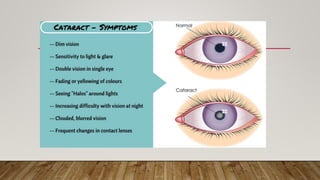
Signs and symptoms of cataracts include:
• Clouded, blurred or dim vision
• Increasing difficulty with vision at night
• Sensitivity to light and glare
• Need for brighter light for reading and other activities
• Seeing "halos" around lights
• Frequent changes in eyeglass or contact lens prescription
• Fading or yellowing of colors
• Double vision in a single eye
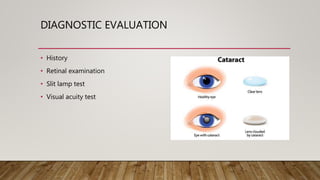
DIAGNOSTIC EVALUATION
• History
• Retinal examination
• Slit lamp test
• Visual acuity test
MANAGEMENT
• Intracapsular Extraction (removal of the whole lens)
• Extracapsular Extraction (leaving the lens capsule behind to support
the remaining lens tissue)
• Cryosurgery ( Pensile like instrument with a metal tip is
supercooled(-35C))
• Phacoemulsification (the mechanical breaking up of the lens by the
hollow needle vibrating at ultrasonic speed)
THANK YOU…

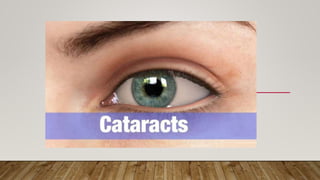
Cataract

  • 1.
  • 2.
    DEFINITION • A medicalcondition in which the lens of the eye becomes progressively opaque, resulting in blurred vision.
  • 3.
    RISK FACTORS • Increasingage • Diabetes • Excessive exposure to sunlight • Smoking • Obesity • High blood pressure • Previous eye injury or inflammation • Previous eye surgery • Prolonged use of corticosteroid medications • Drinking excessive amounts of alcohol
  • 4.
  • 5.
    TYPES OF CATARACT •Nuclear • Cortical • Posterior subcapsular • Congenital
  • 7.
    CLINICAL FEATURES Signs andsymptoms of cataracts include: • Clouded, blurred or dim vision • Increasing difficulty with vision at night • Sensitivity to light and glare • Need for brighter light for reading and other activities • Seeing "halos" around lights • Frequent changes in eyeglass or contact lens prescription • Fading or yellowing of colors • Double vision in a single eye
  • 9.
    DIAGNOSTIC EVALUATION • History •Retinal examination • Slit lamp test • Visual acuity test
  • 10.
    MANAGEMENT • Intracapsular Extraction(removal of the whole lens) • Extracapsular Extraction (leaving the lens capsule behind to support the remaining lens tissue) • Cryosurgery ( Pensile like instrument with a metal tip is supercooled(-35C)) • Phacoemulsification (the mechanical breaking up of the lens by the hollow needle vibrating at ultrasonic speed)
  • 13.