It has full of holes but still
holds water. What am I?
SPONGE
Which month has 28 days?
All of them of course
If I have it , I don’t share it. If
I share it, I don’t have it.
A SECRET
What goes up but never
comes down?
AGE
I’m tall when I’m young I’m short
when I’m old. What am I?
CANDLE
Each morning I appear to lie at
your feet, all day I will follow no
matter how fast you run, yet I
nearly perish in the midday sun.
What am I?
SHADOW
You heard me before, yet you hear
me again , then I die, ‘till you call
me again. What am I ?
ECHO
My thunder comes before
the lightning. My lightning
comes before the clouds.
My rain dries all the land it
touches. What am I?
VOLCANO
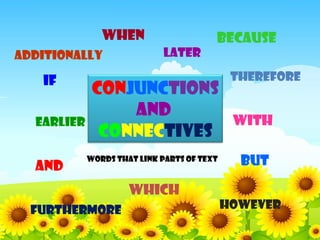
when
additionally

if
earlier

and

later

because

Conjunctions
and
Connectives
Words that link parts of text

which
furthermore

therefore

with
but
however
• A conjunction is a joiner, a
word that connects parts of a
sentence.
There are three basic types of
conjunctions.
– coordinating conjunctions used to
connect two independent clauses,
– subordinating conjunctions used to
connect the dependent clause and the
rest of the sentence, and
– correlative conjunctions which always
travel in pairs, and join sentence parts
that should be treated as equal.
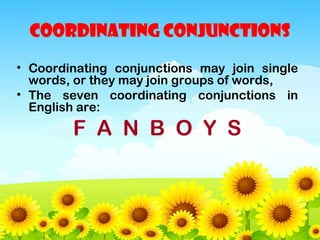
COORDINATING CONJUNCTIONS
• Coordinating conjunctions may join single
words, or they may join groups of words,
• The seven coordinating conjunctions in
English are:

F A N B O Y S
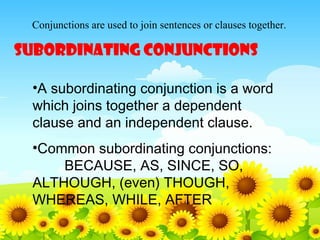
Conjunctions are used to join sentences or clauses together.

SUBORDINATING CONJUNCTIONS
•A subordinating conjunction is a word
which joins together a dependent
clause and an independent clause.
•Common subordinating conjunctions:
BECAUSE, AS, SINCE, SO,
ALTHOUGH, (even) THOUGH,
WHEREAS, WHILE, AFTER
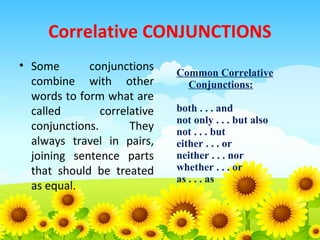
Correlative CONJUNCTIONS
• Some
conjunctions
combine with other
words to form what are
called
correlative
conjunctions.
They
always travel in pairs,
joining sentence parts
that should be treated
as equal.

Common Correlative
Conjunctions:
both . . . and
not only . . . but also
not . . . but
either . . . or
neither . . . nor
whether . . . or
as . . . as
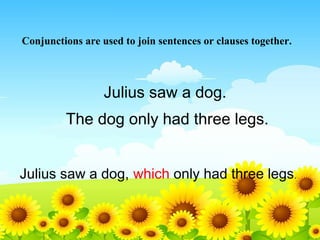
Conjunctions are used to join sentences or clauses together.

Julius saw a dog.
The dog only had three legs.
Julius saw a dog, which only had three legs.
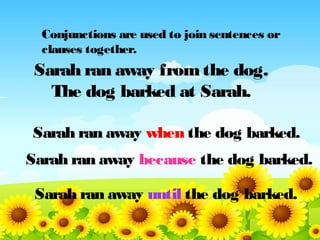
Conjunctions are used to join sentences or
clauses together.

Sarah ran away from the dog.
The dog barked at Sarah.
Sarah ran away when the dog barked.
Sarah ran away because the dog barked.
Sarah ran away until the dog barked.

Conjunctions (1)

  • 2.
    It has fullof holes but still holds water. What am I?
  • 3.
  • 4.
  • 5.
    All of themof course
  • 6.
    If I haveit , I don’t share it. If I share it, I don’t have it.
  • 7.
  • 8.
    What goes upbut never comes down?
  • 9.
  • 10.
    I’m tall whenI’m young I’m short when I’m old. What am I?
  • 11.
  • 12.
    Each morning Iappear to lie at your feet, all day I will follow no matter how fast you run, yet I nearly perish in the midday sun. What am I?
  • 13.
  • 14.
    You heard mebefore, yet you hear me again , then I die, ‘till you call me again. What am I ?
  • 15.
  • 16.
    My thunder comesbefore the lightning. My lightning comes before the clouds. My rain dries all the land it touches. What am I?
  • 17.
  • 21.
  • 22.
    • A conjunctionis a joiner, a word that connects parts of a sentence.
  • 23.
    There are threebasic types of conjunctions. – coordinating conjunctions used to connect two independent clauses, – subordinating conjunctions used to connect the dependent clause and the rest of the sentence, and – correlative conjunctions which always travel in pairs, and join sentence parts that should be treated as equal.
  • 24.
    COORDINATING CONJUNCTIONS • Coordinatingconjunctions may join single words, or they may join groups of words, • The seven coordinating conjunctions in English are: F A N B O Y S
  • 25.
    Conjunctions are usedto join sentences or clauses together. SUBORDINATING CONJUNCTIONS •A subordinating conjunction is a word which joins together a dependent clause and an independent clause. •Common subordinating conjunctions: BECAUSE, AS, SINCE, SO, ALTHOUGH, (even) THOUGH, WHEREAS, WHILE, AFTER
  • 26.
    Correlative CONJUNCTIONS • Some conjunctions combinewith other words to form what are called correlative conjunctions. They always travel in pairs, joining sentence parts that should be treated as equal. Common Correlative Conjunctions: both . . . and not only . . . but also not . . . but either . . . or neither . . . nor whether . . . or as . . . as
  • 27.
    Conjunctions are usedto join sentences or clauses together. Julius saw a dog. The dog only had three legs. Julius saw a dog, which only had three legs.
  • 28.
    Conjunctions are usedto join sentences or clauses together. Sarah ran away from the dog. The dog barked at Sarah. Sarah ran away when the dog barked. Sarah ran away because the dog barked. Sarah ran away until the dog barked.