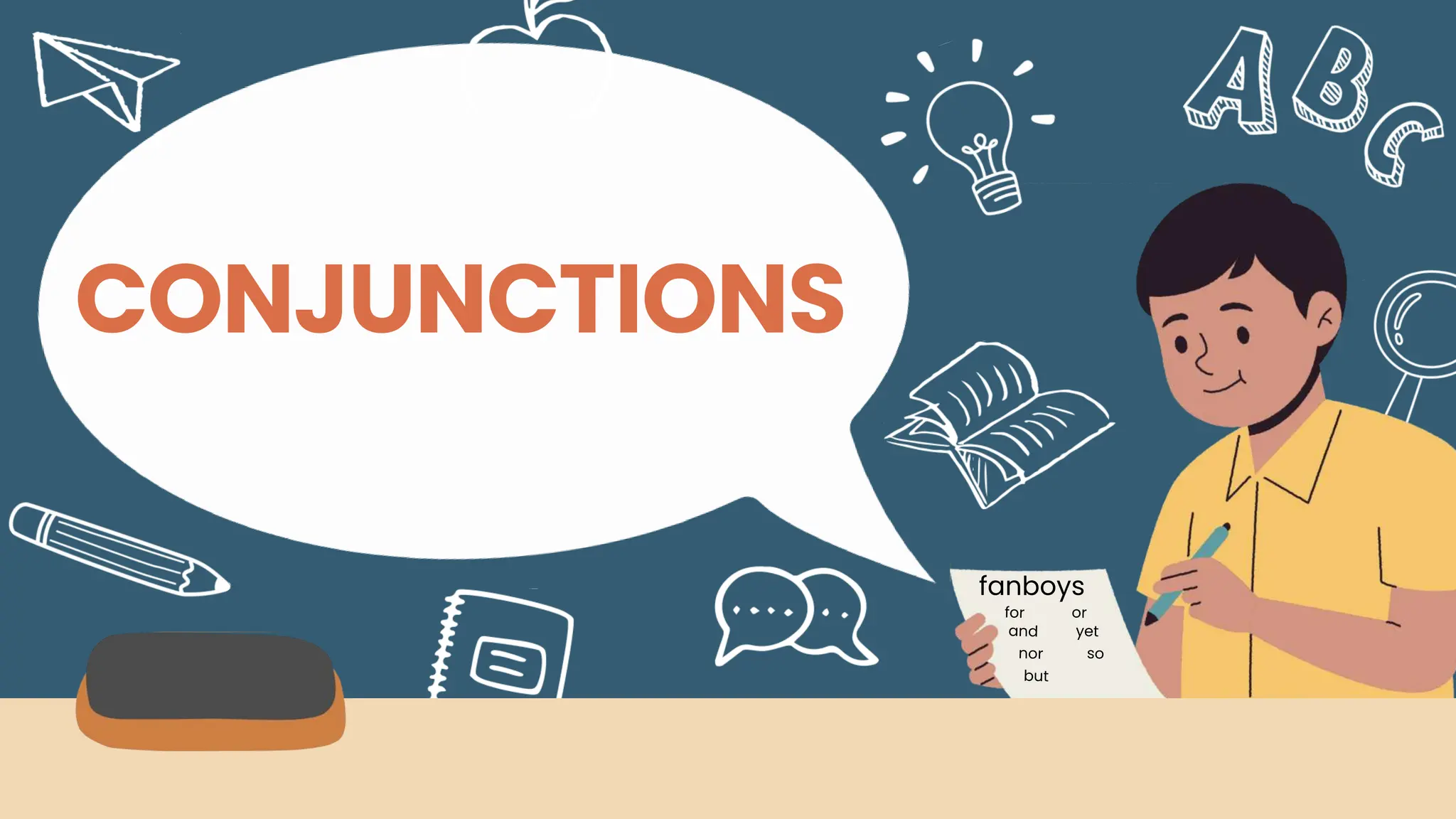
CONJUNCTIONS
fanboys
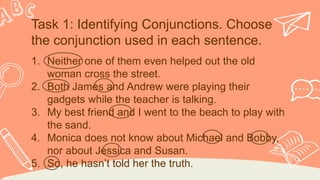
Task 1: Identifying Conjunctions. Choose
the conjunction used in each sentence.
1. Neither one of them even helped out the old
woman cross the street.
2. Both James and Andrew were playing their
gadgets while the teacher is talking.
3. My best friend and I went to the beach to play with
the sand.
4. Monica does not know about Michael and Bobby,
nor about Jessica and Susan.
5. So, he hasn’t told her the truth.
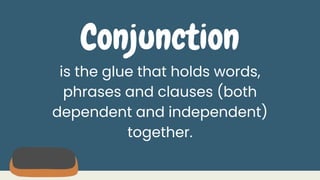
Conjunction
is the glue that holds words,
phrases and clauses (both
dependent and independent)
together.
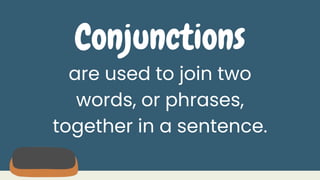
Conjunctions
are used to join two
words, or phrases,
together in a sentence.
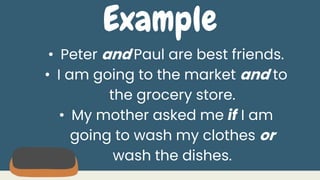
Example
• Peter and Paul are best friends.
• I am going to the market and to
the grocery store.
• My mother asked me if I am
going to wash my clothes or
wash the dishes.
TYPES OF
CONJUNCTION
Coordinating
Conjunctions
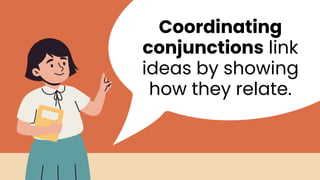
Coordinating
conjunctions link
ideas by showing
how they relate.
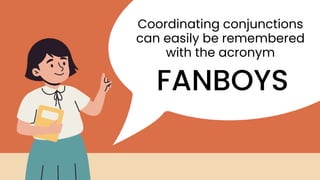
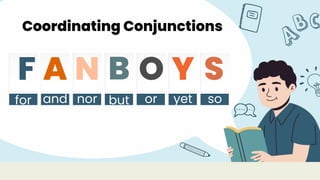
Coordinating conjunctions
can easily be remembered
with the acronym
FANBOYS
F A N B O Y S
for and nor but or yet so
Coordinating Conjunctions
shows reason or purpose
Example:
FOR
The pupils focused on their project for they
had to beat the deadline.
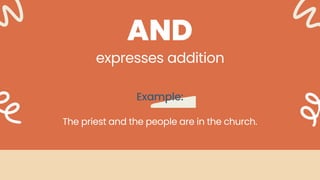
expresses addition
Example:
AND
The priest and the people are in the church.
Example:
NOR
They did not see a movie nor watched a TV show.
connects non contrasting
negative ideas
shows contrast
Example:
BUT
We did not win the grand prize but we won something
more than money couldn't buy.
expresses choice
Example:
Karen is in the kitchen or in the restroom.
OR
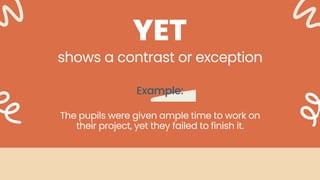
Example:
YET
shows a contrast or exception
The pupils were given ample time to work on
their project, yet they failed to finish it.
can be used to refer to the
reason for something.
Example:
It is raining again, so we will have to
cancel the trip.
SO
Correlative
Conjunctions
Correlative
conjunctions join
elements within a
sentence, indicating
the two are of equal
importance.
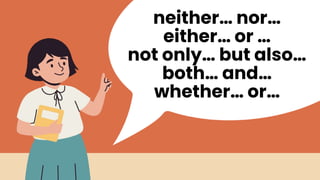
neither… nor…
either… or …
not only… but also…
both… and…
whether… or…
Example:
I like neither
carrots nor
celery.
NEITHER… NOR
A negative correlative conjunction that connects
two or more parts in a series.
Neither refers to “two things or people that are
not the case” or “not one or the other.” It is often
used in conjunction with the word nor.
Examples:
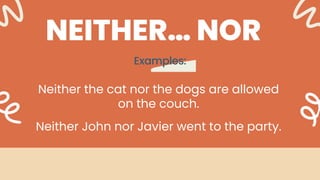
NEITHER… NOR
Neither the cat nor the dogs are allowed
on the couch.
Neither John nor Javier went to the party.
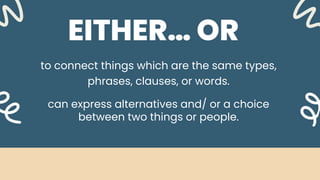
EITHER… OR
to connect things which are the same types,
phrases, clauses, or words.
can express alternatives and/ or a choice
between two things or people.
Examples:
EITHER… OR
Either my father or my brothers are
coming.
Either you leave now, or I call the police!
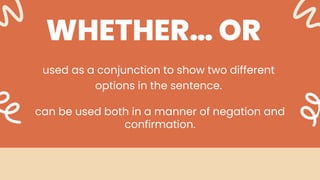
WHETHER… OR
used as a conjunction to show two different
options in the sentence.
can be used both in a manner of negation and
confirmation.
Examples:
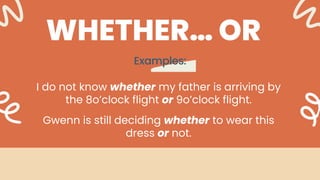
WHETHER… OR
I do not know whether my father is arriving by
the 8o’clock flight or 9o’clock flight.
Gwenn is still deciding whether to wear this
dress or not.
BOTH… AND
connect two elements in a sentence,
emphasizing their joint presence or action.
express the idea of two or more things
happening or being true simultaneously.
Examples:
BOTH… AND
She enjoys both swimming and
running.
Both the dog and cat are playful.
NOT ONLY… BUT ALSO
connect and emphasize 2 words or 2 phrases at
the same position.
give a little extra emphasis to the second thing
because it’s even better, or even worse, or more
surprising, or more impressive, or more shocking
than the first thing.
Examples:
She not only plays well but also writes
music.
Not only you but also I am planning to go.
NOT ONLY… BUT ALSO
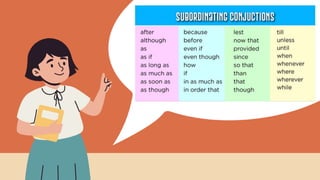
Subordinating
Conjunctions
A subordinating
conjunction
indicates that one
idea depends on
another.
Subordinating
conjunctions
connect independent
clauses to dependent
clauses.
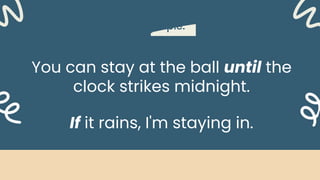
Example:
You can stay at the ball until the
clock strikes midnight.
If it rains, I'm staying in.
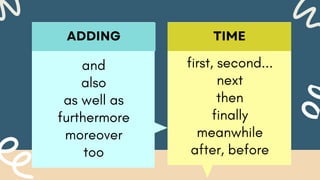
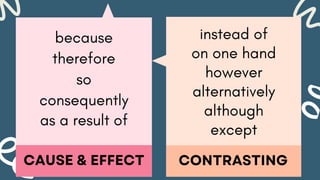
Conjunctions or
connectors
Conjunctions or
connectors signal to the
reader the relationship
between ideas in a
paragraph or even
between paragraphs
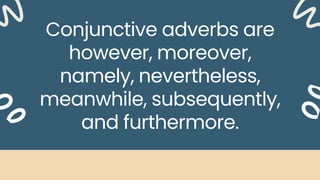
Conjunctive adverbs are
however, moreover,
namely, nevertheless,
meanwhile, subsequently,
and furthermore.
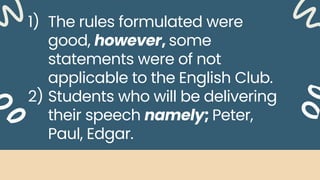
1) The rules formulated were
good, however, some
statements were of not
applicable to the English Club.
2) Students who will be delivering
their speech namely; Peter,
Paul, Edgar.
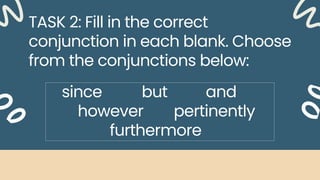
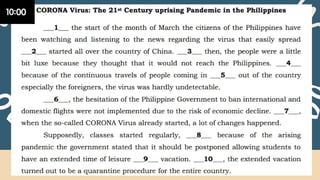
TASK 2: Fill in the correct
conjunction in each blank. Choose
from the conjunctions below:
since but and
however pertinently
furthermore
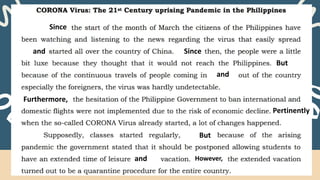
Since
and Since
But
and
Furthermore,
Pertinently
But
and However,

Q2_MELC2_CONJUNCTION.pptx