Conjunctions
QUARTER 4 MODULE 1
ENGLISH MATERIAL GRADE 8
Activity: Think to Connect
Directions: Choose the best connectives to
complete each sentences below. Write
your answer on a separate sheet of paper.
1. My dog messed me up_________ I need
to take a shower. (and, but, for, so)
2. She needs to rest _________ she is not
feeling well. (and, for, yet, nor)
3. I want to travel _________ I am not
allowed. (and, or, so, but)
4. Our pet Mishka is lovely _________
active. (yet, but, and, so)
5. Don’t prick _________ pinch the
balloons. (or, nor, for, so)
6. The activities are challenging _____ my
older brother helps me (but, and, so, for)
7. Watching movies _________ drawing
are her hobbies (and, or, nor, yet)
8. Are you going _________not? (so, for,
and, or)
9. It is so hot today __________ we
bought ice cream. (but, and, or, so)
10. Annie passed the exam ____ she
reviewed her notes. (so, but, because, and)
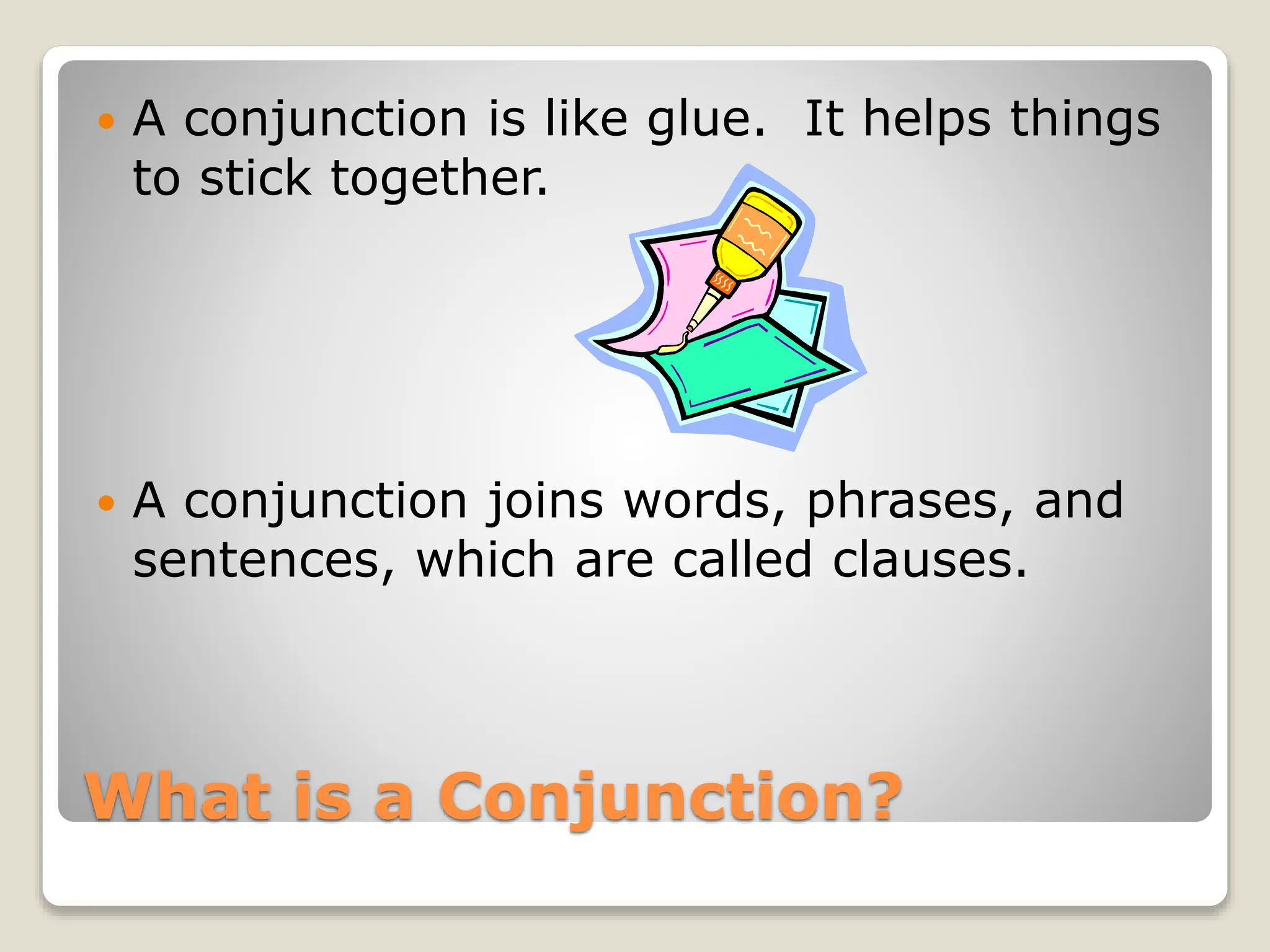
What is a Conjunction?
 A conjunction is like glue. It helps things
to stick together.
 A conjunction joins words, phrases, and
sentences, which are called clauses.
What is a Conjunction?
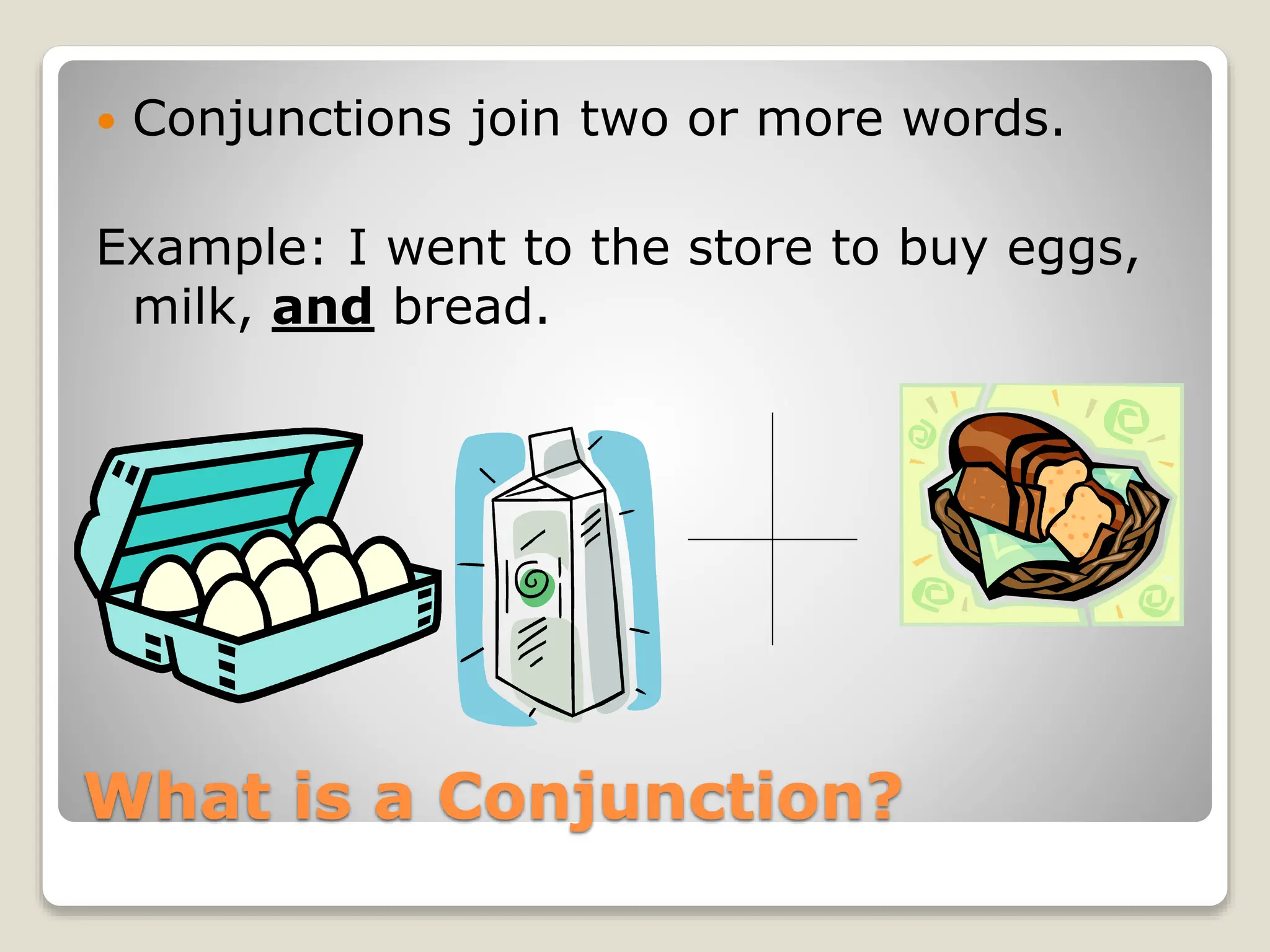
 Conjunctions join two or more words.
Example: I went to the store to buy eggs,
milk, and bread.
What is a Conjunction?
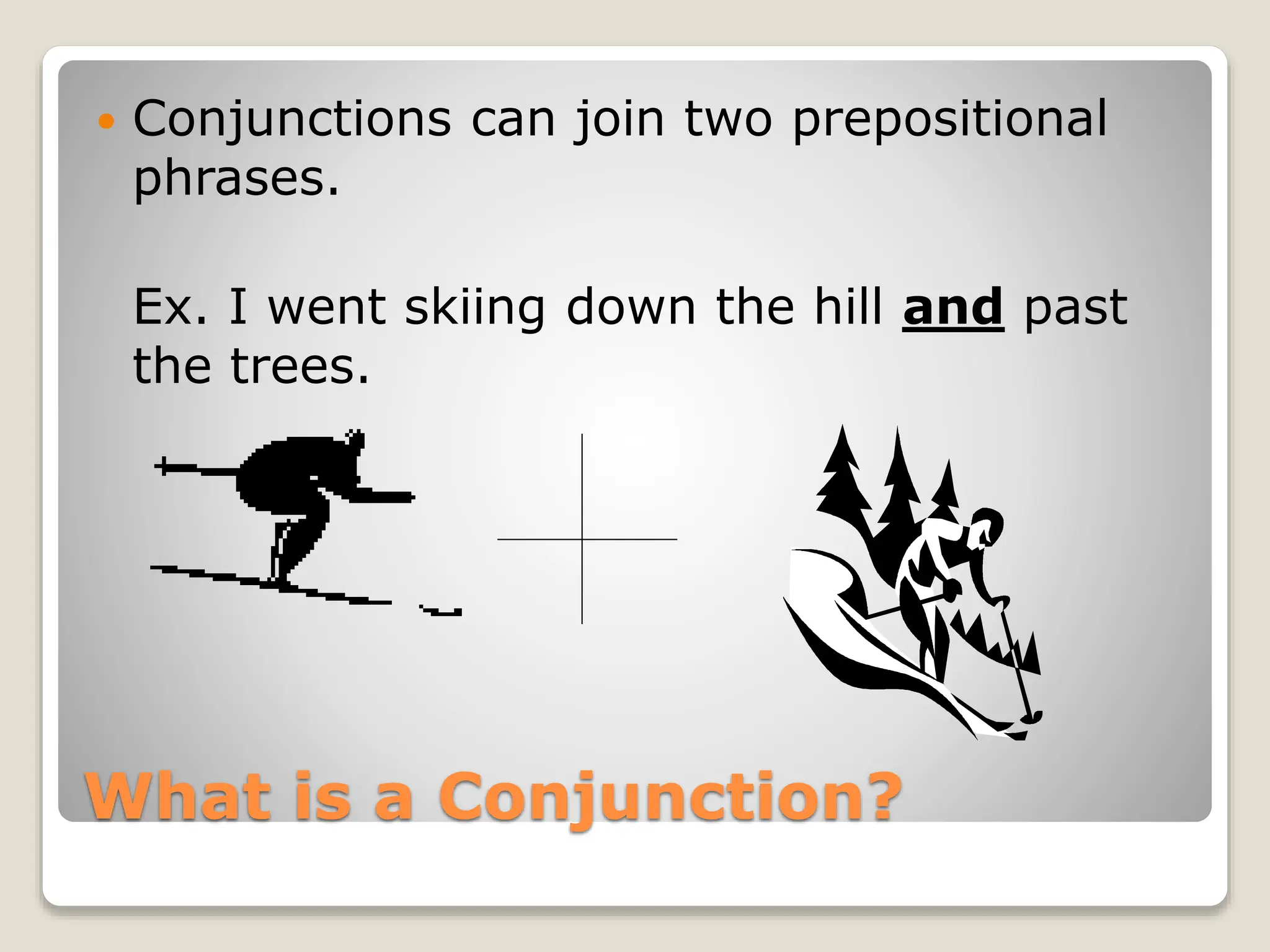
 Conjunctions can join two prepositional
phrases.
Ex. I went skiing down the hill and past
the trees.
What is a Conjunction?
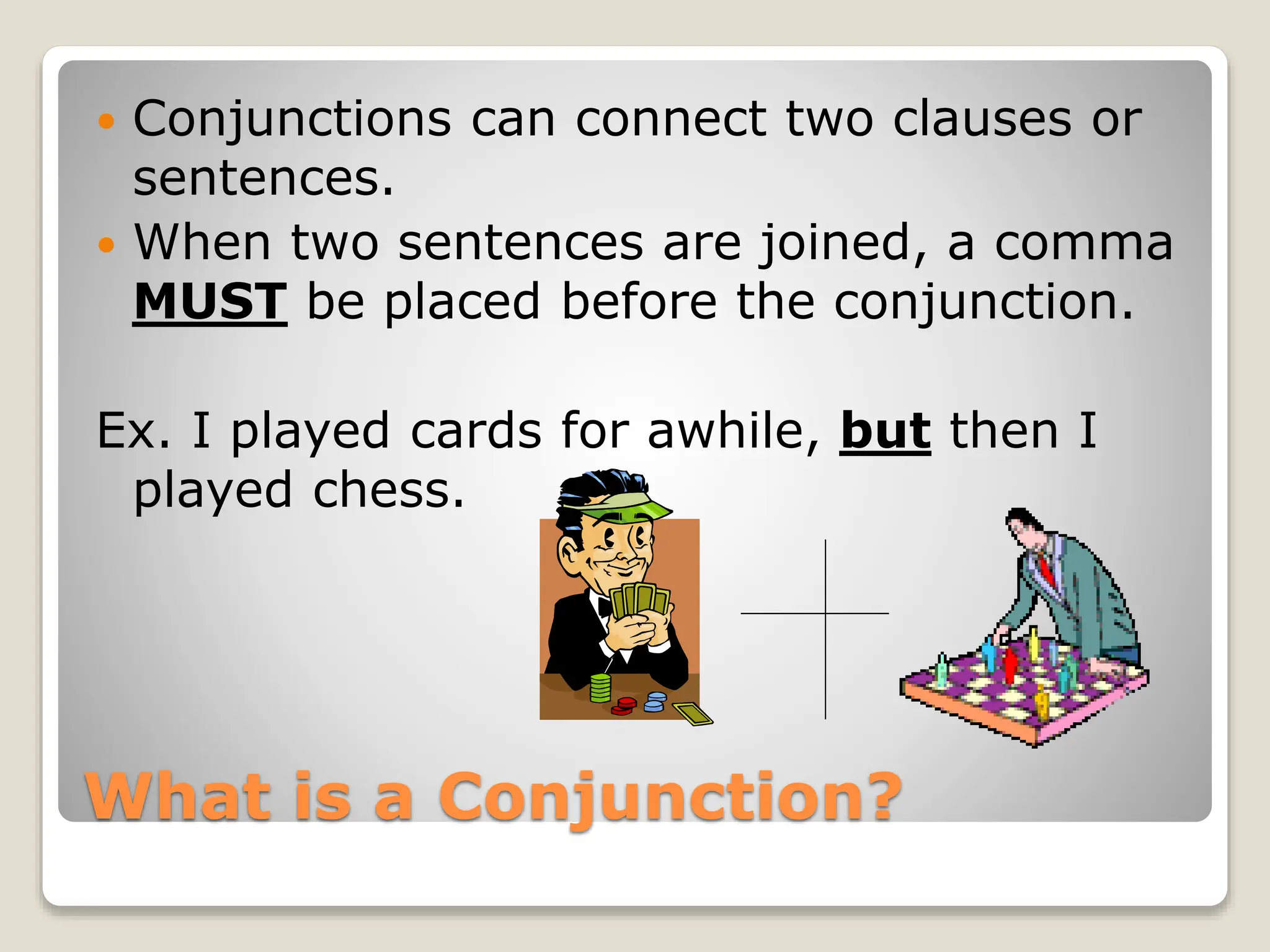
 Conjunctions can connect two clauses or
sentences.
 When two sentences are joined, a comma
MUST be placed before the conjunction.
Ex. I played cards for awhile, but then I
played chess.
Types of Conjunctions
 One type of conjunction is the
coordinating conjunction.
 They connect words, phrases, and
clauses, which are sentences.
 They connect things of equal value.
(This means that they would connect a noun
with another noun or a prepositional phrase with
another prepositional phrase.)
Types of Conjunctions
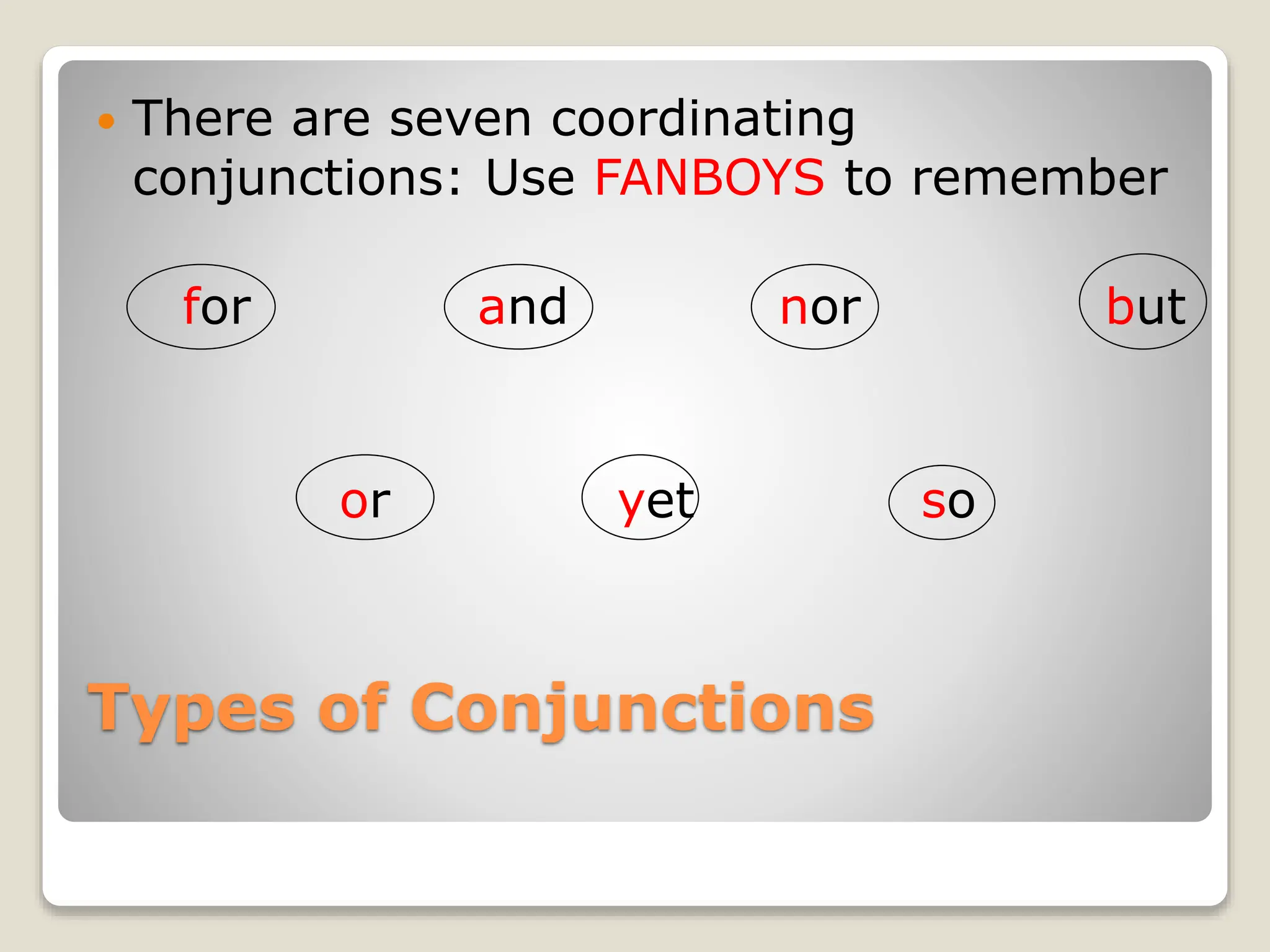
 There are seven coordinating
conjunctions: Use FANBOYS to remember
for and nor but
or yet so
Types of Conjunctions
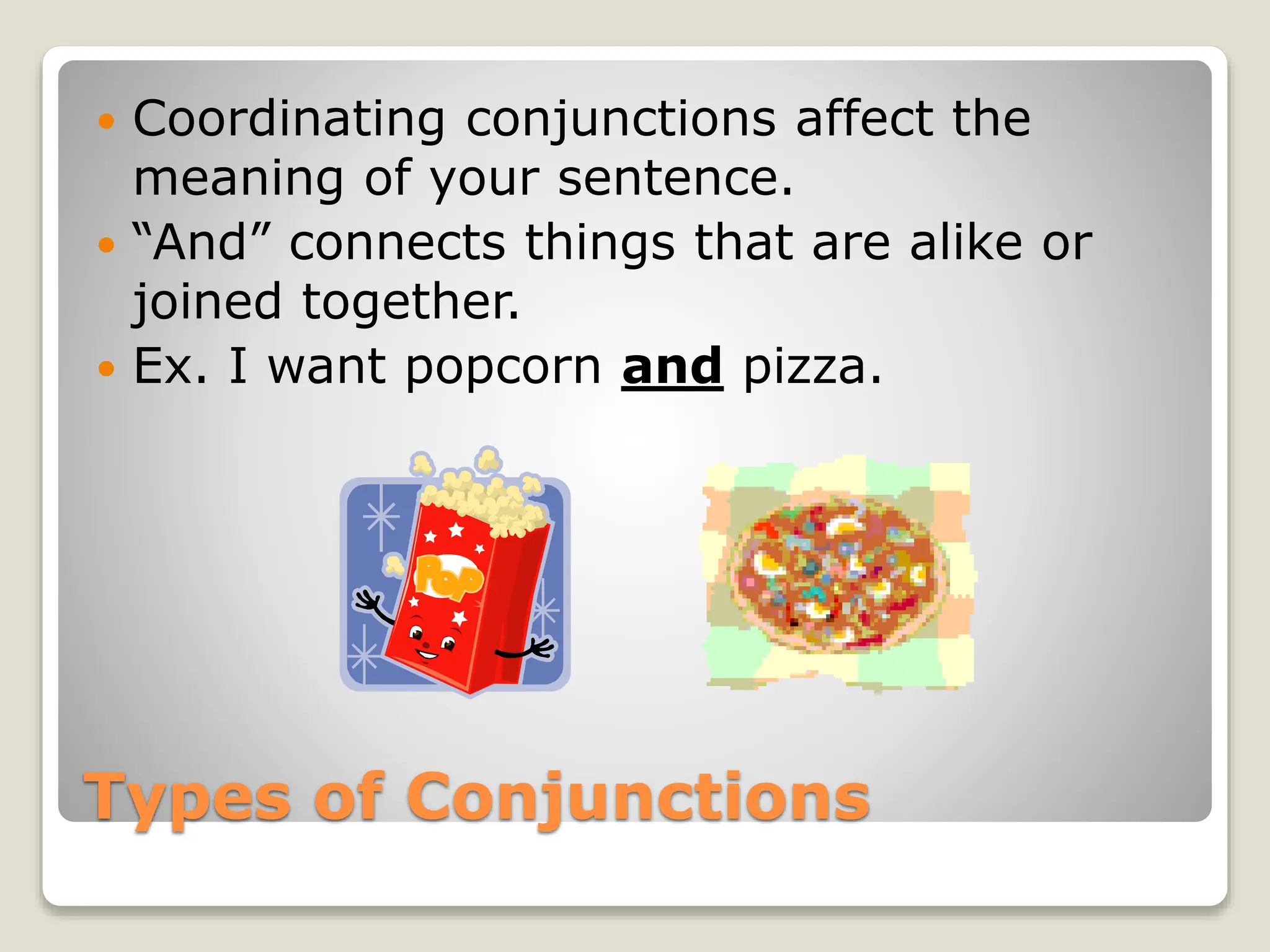
 Coordinating conjunctions affect the
meaning of your sentence.
 “And” connects things that are alike or
joined together.
 Ex. I want popcorn and pizza.
Types of Conjunctions
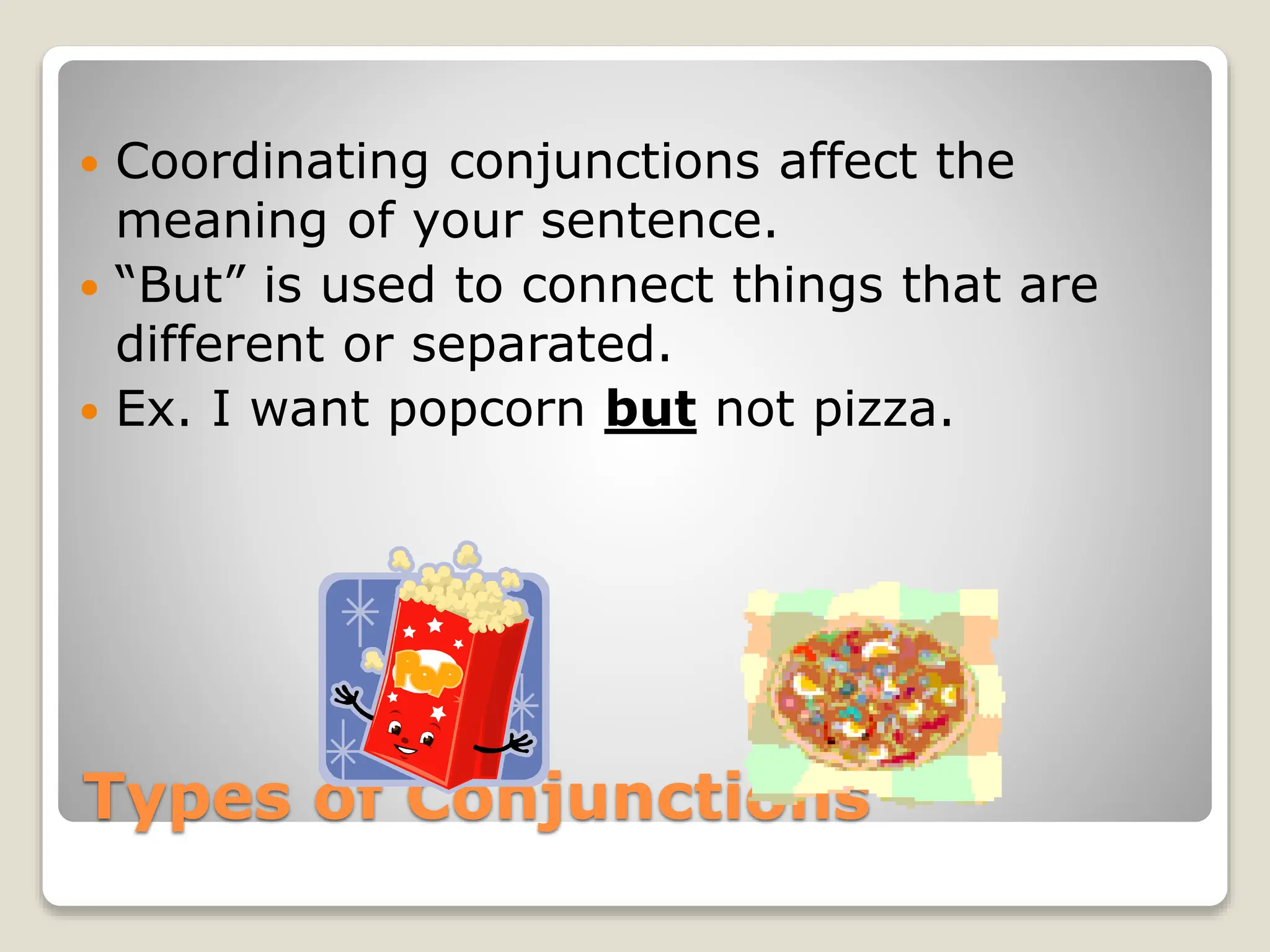
 Coordinating conjunctions affect the
meaning of your sentence.
 “But” is used to connect things that are
different or separated.
 Ex. I want popcorn but not pizza.
Types of Conjunctions
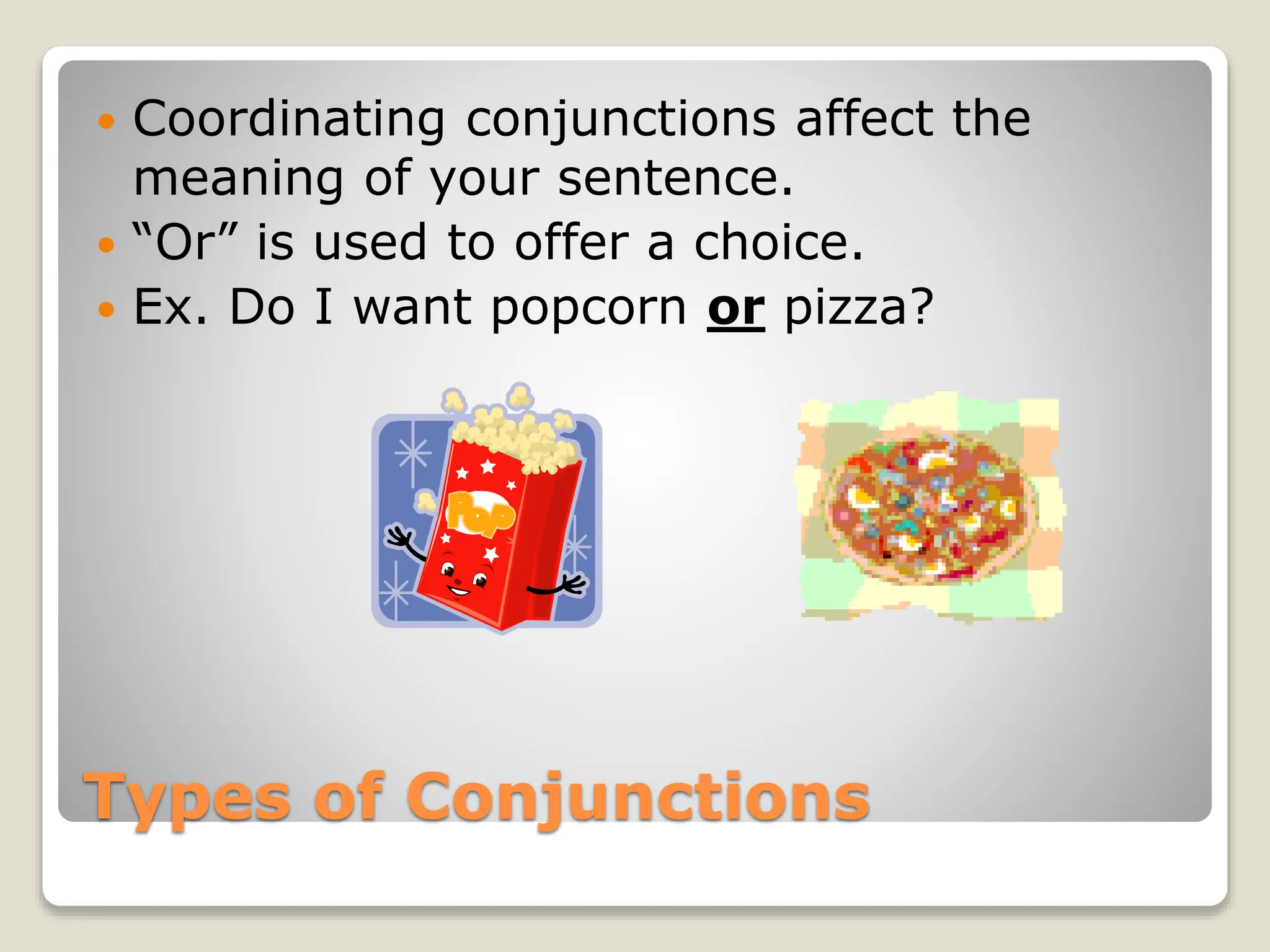
 Coordinating conjunctions affect the
meaning of your sentence.
 “Or” is used to offer a choice.
 Ex. Do I want popcorn or pizza?
Types of Conjunctions
 Coordinating conjunctions affect the
meaning of your sentence.
 “Nor” is used to offer a negative choice.
 Ex. I do not want popcorn nor pizza.
Types of Conjunctions
 Coordinating conjunctions affect the
meaning of your sentence.
 “Yet” is used to show a change. When it
is used to combine two sentences, you
must put a comma before it.
 Ex. I want popcorn, yet I also want
pizza.
Types of Conjunctions
 Coordinating conjunctions affect the
meaning of your sentence.
 “So” is used to show a relationship
between things. When it is used to
combine two sentences, you must put a
comma before it.
 Ex. I want popcorn, so I made some.
Types of Conjunctions
 Coordinating conjunctions affect the
meaning of your sentence.
 “For” is also used to show a relationship
between things. When it is used to
combine two sentences, you must put a
comma before it.
 Ex. I ordered a pizza, for I was hungry.
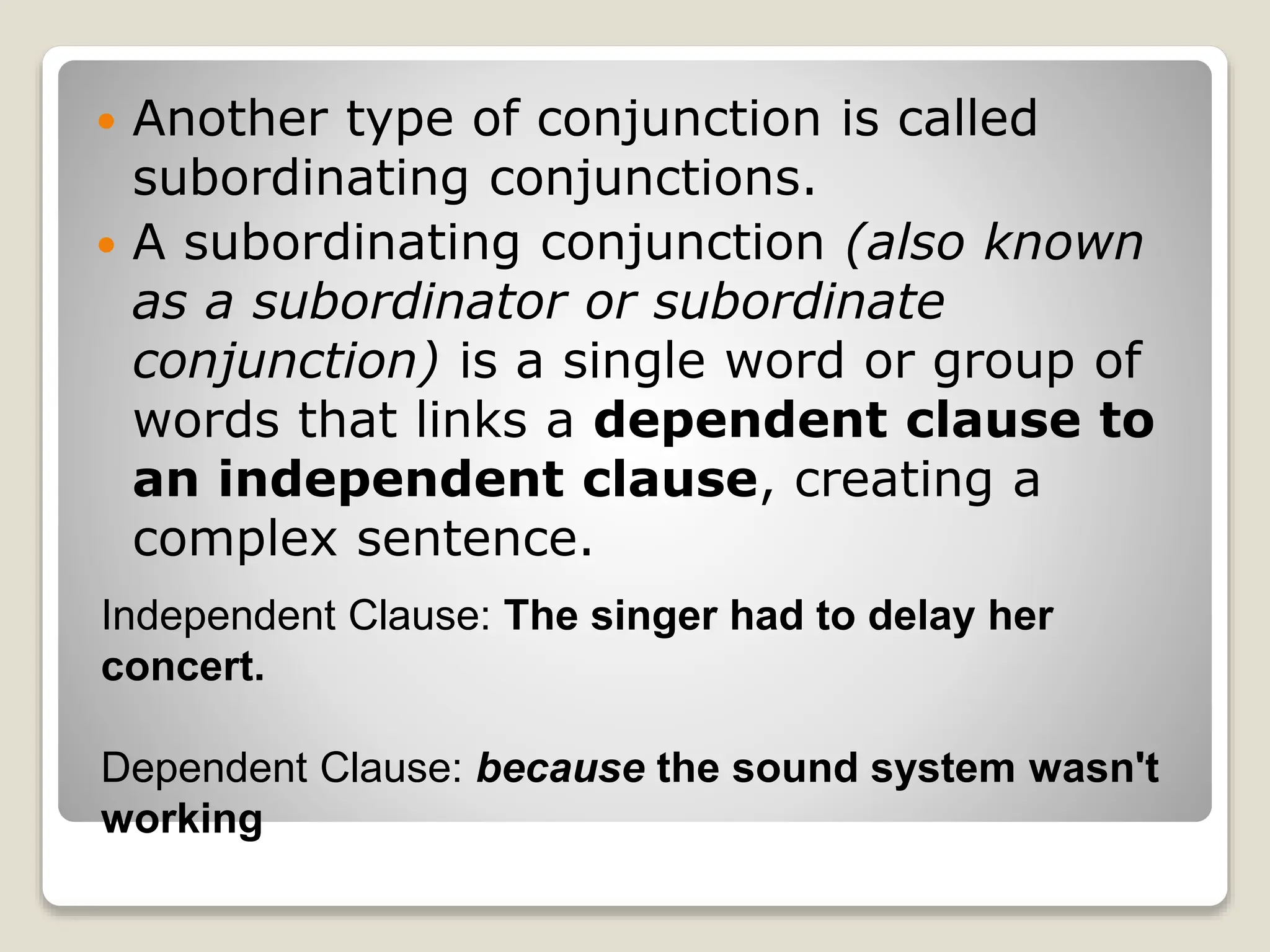
 Another type of conjunction is called
subordinating conjunctions.
 A subordinating conjunction (also known
as a subordinator or subordinate
conjunction) is a single word or group of
words that links a dependent clause to
an independent clause, creating a
complex sentence.
Independent Clause: The singer had to delay her
concert.
Dependent Clause: because the sound system wasn't
working
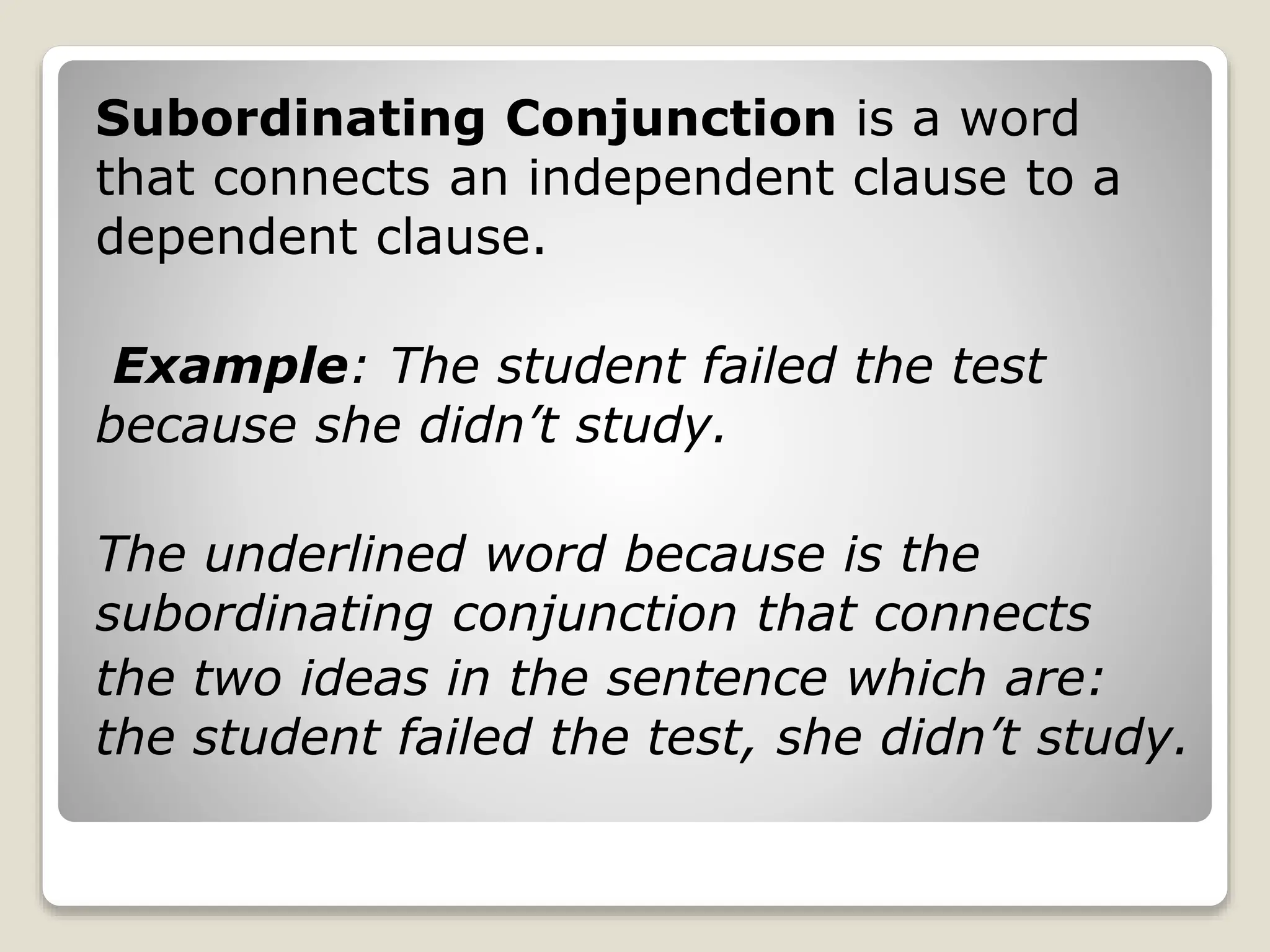
Subordinating Conjunction is a word
that connects an independent clause to a
dependent clause.
Example: The student failed the test
because she didn’t study.
The underlined word because is the
subordinating conjunction that connects
the two ideas in the sentence which are:
the student failed the test, she didn’t study.
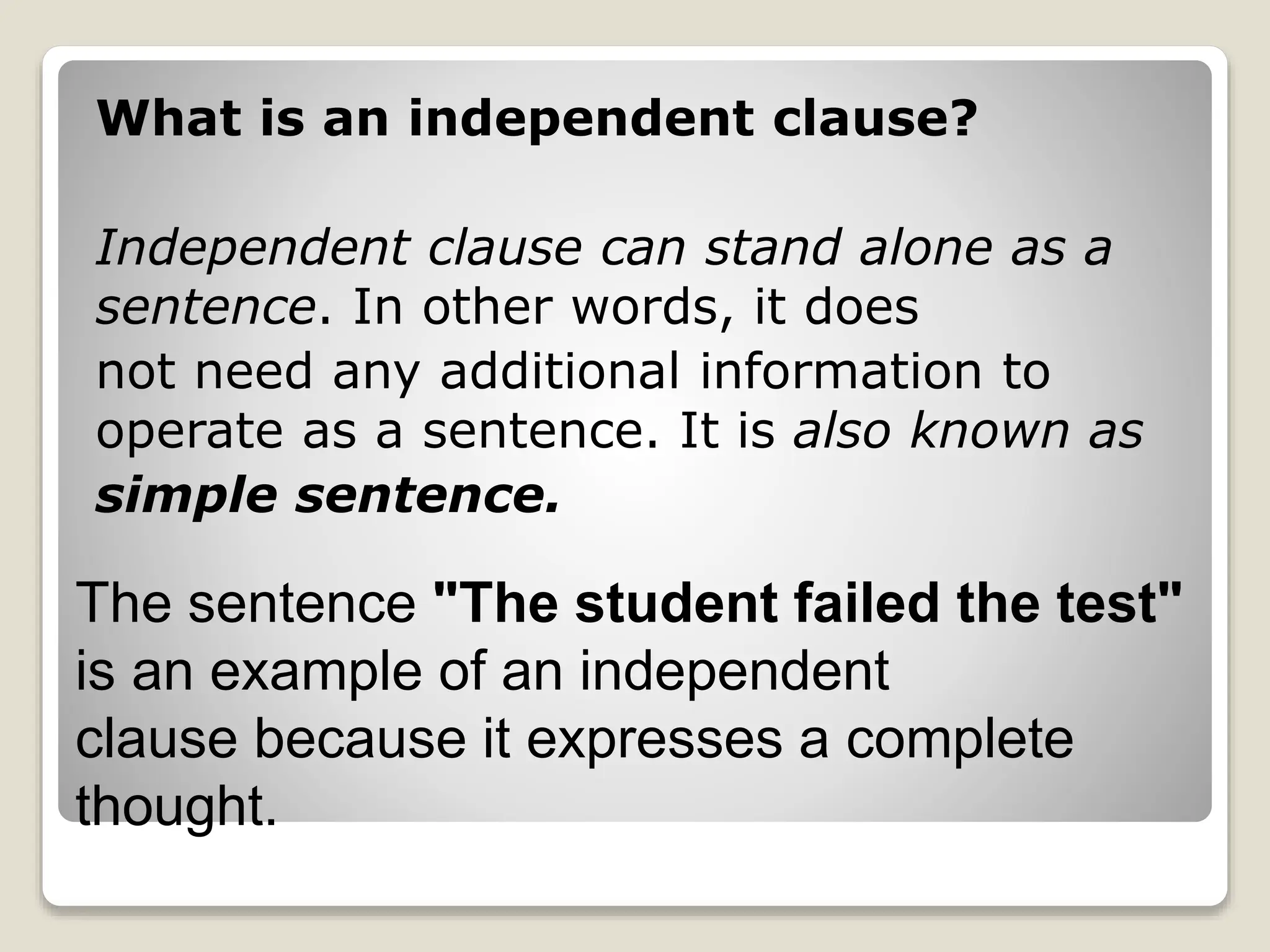
What is an independent clause?
Independent clause can stand alone as a
sentence. In other words, it does
not need any additional information to
operate as a sentence. It is also known as
simple sentence.
The sentence "The student failed the test"
is an example of an independent
clause because it expresses a complete
thought.
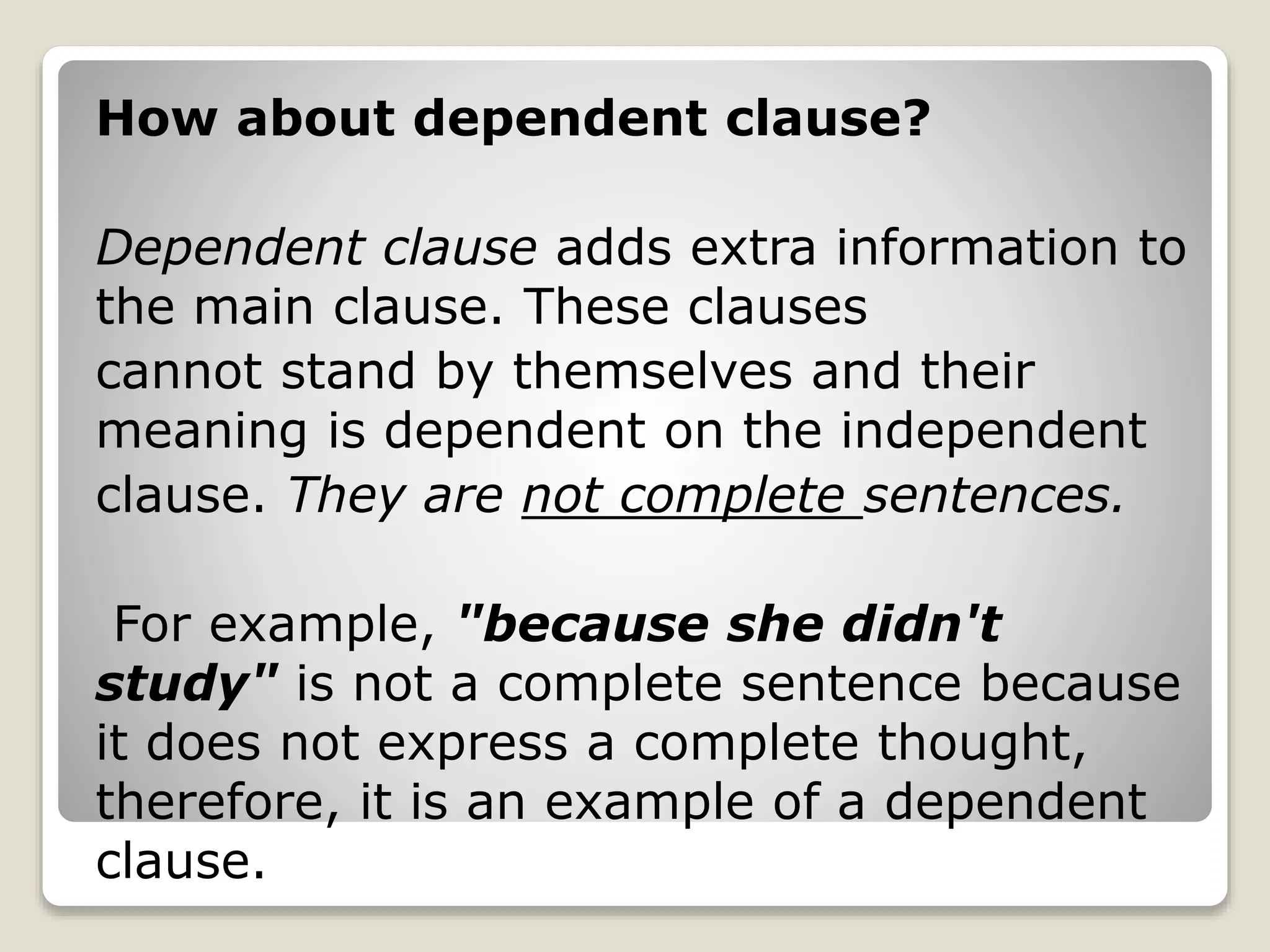
How about dependent clause?
Dependent clause adds extra information to
the main clause. These clauses
cannot stand by themselves and their
meaning is dependent on the independent
clause. They are not complete sentences.
For example, "because she didn't
study" is not a complete sentence because
it does not express a complete thought,
therefore, it is an example of a dependent
clause.
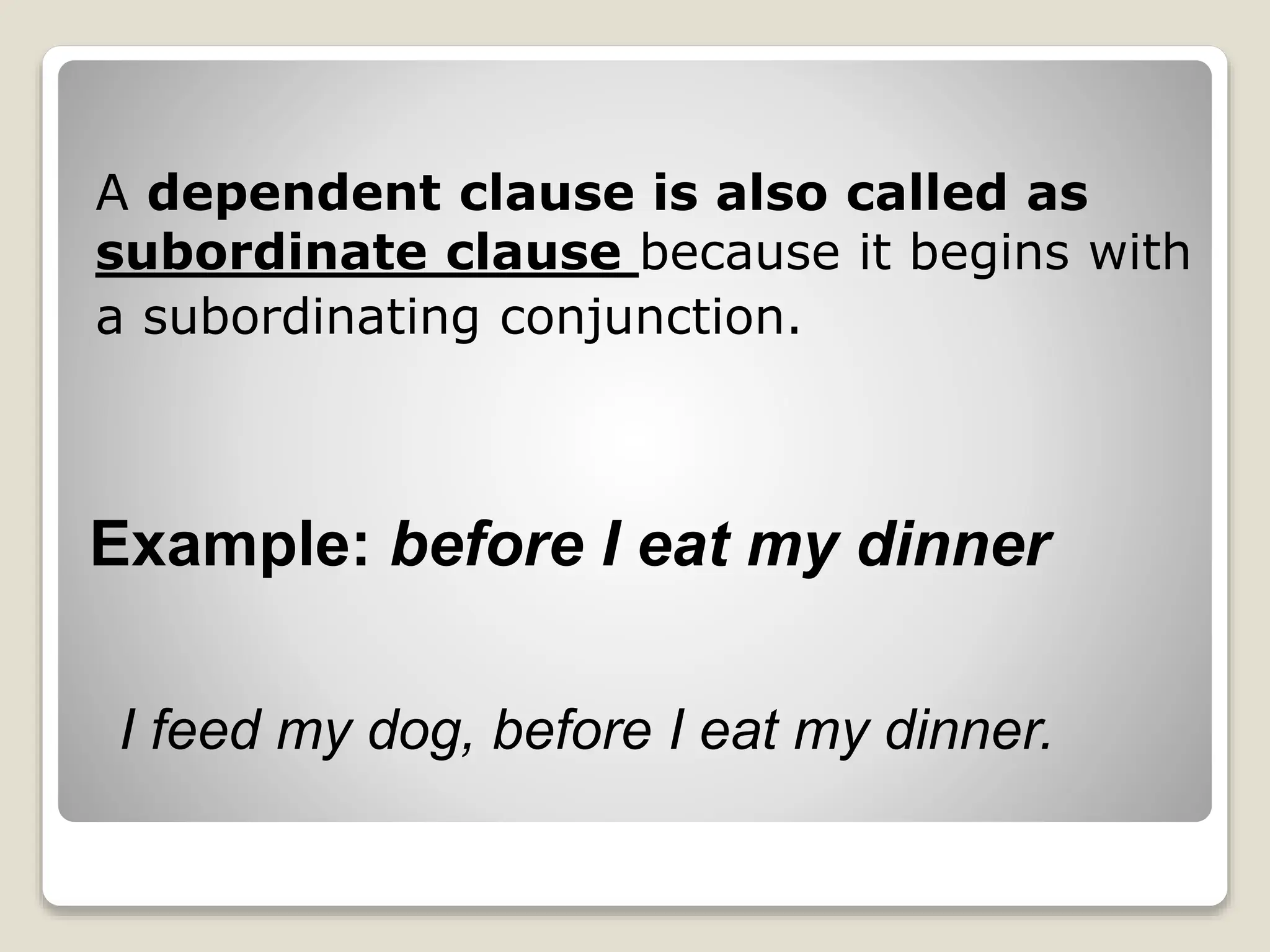
A dependent clause is also called as
subordinate clause because it begins with
a subordinating conjunction.
Example: before I eat my dinner
I feed my dog, before I eat my dinner.
Types of subordinating conjunctions
There are seven main categories of
subordinating conjunctions:
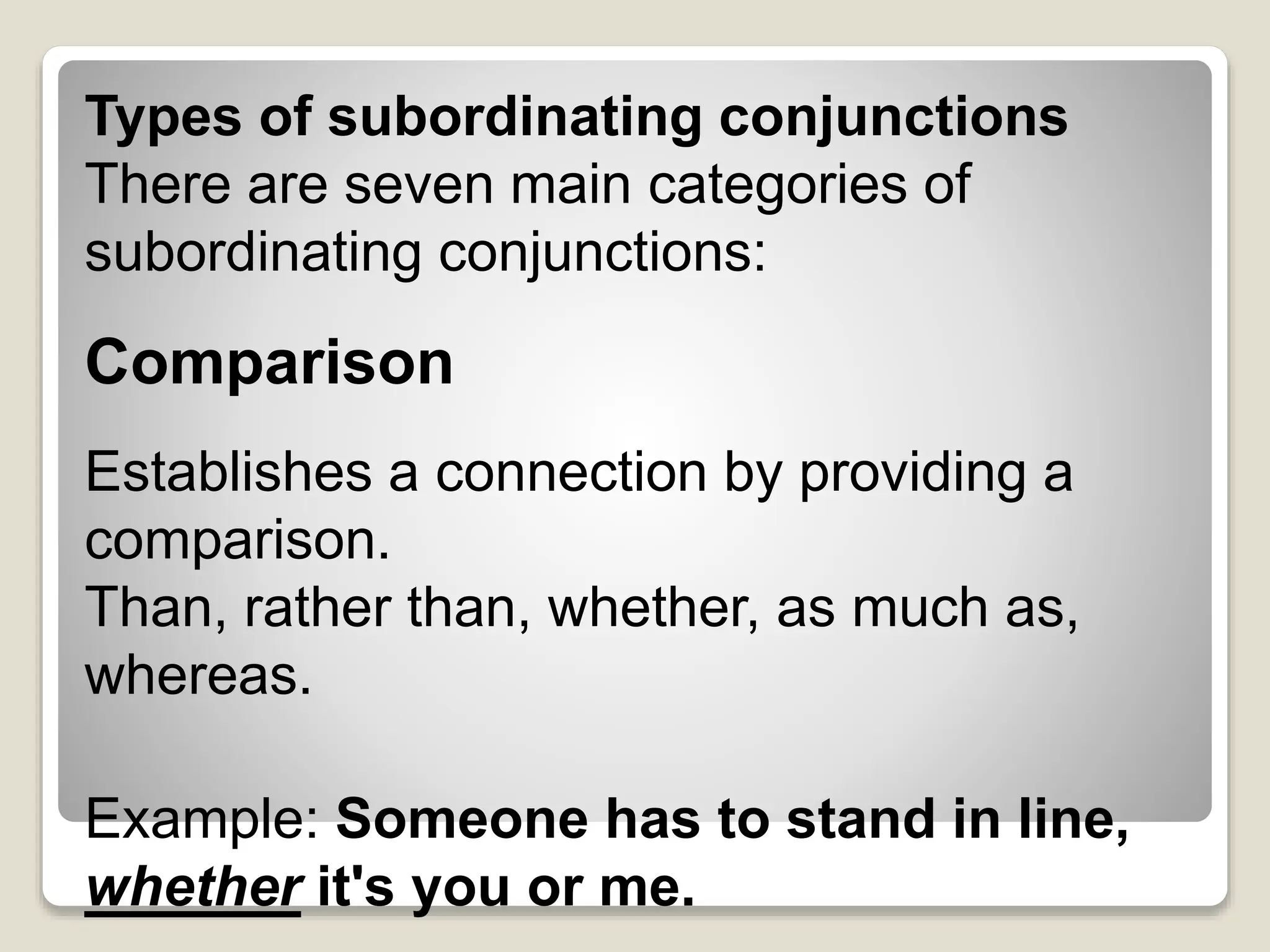
Comparison
Establishes a connection by providing a
comparison.
Than, rather than, whether, as much as,
whereas.
Example: Someone has to stand in line,
whether it's you or me.
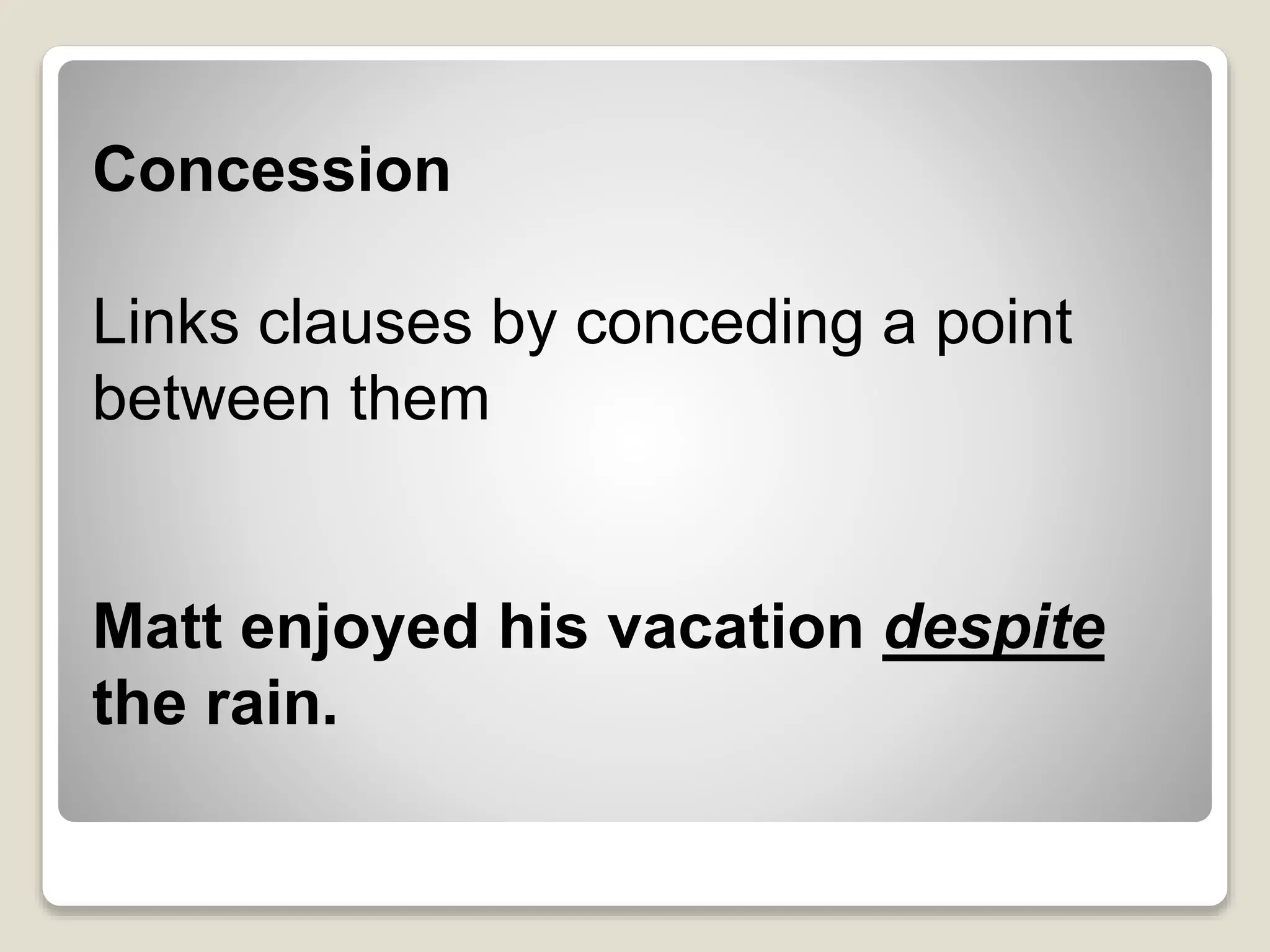
Concession
Links clauses by conceding a point
between them
Matt enjoyed his vacation despite
the rain.
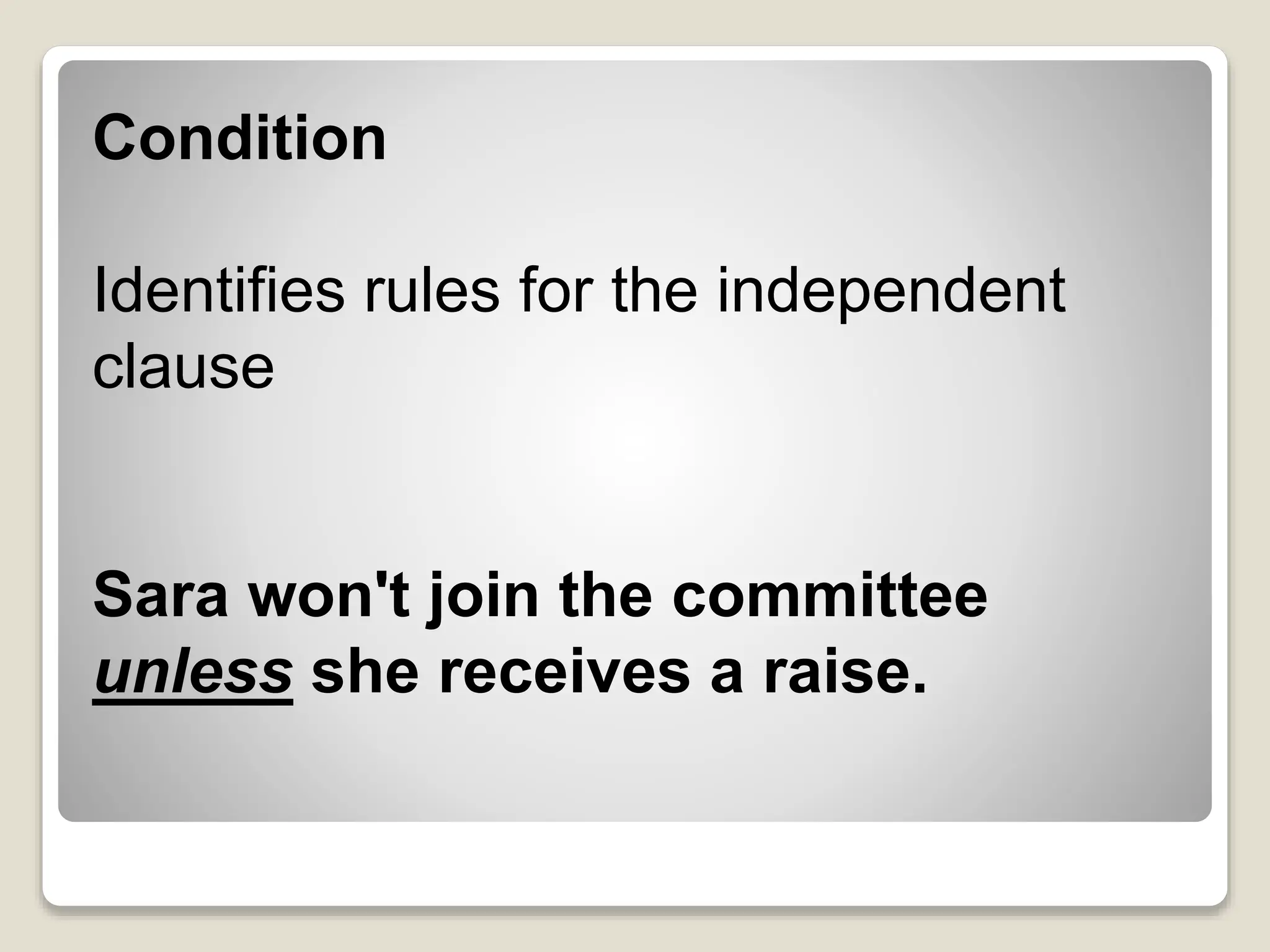
Condition
Identifies rules for the independent
clause
Sara won't join the committee
unless she receives a raise.
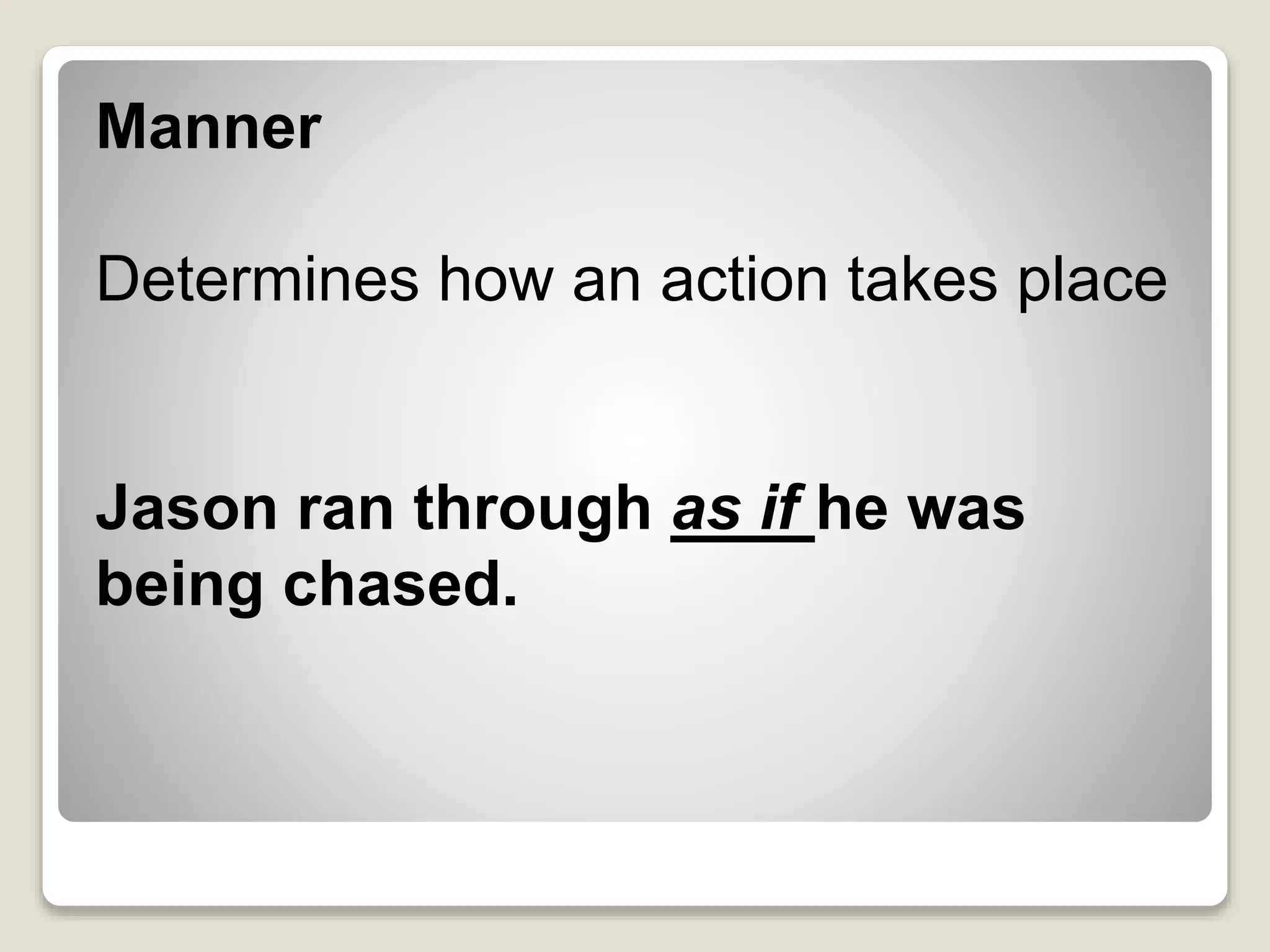
Manner
Determines how an action takes place
Jason ran through as if he was
being chased.
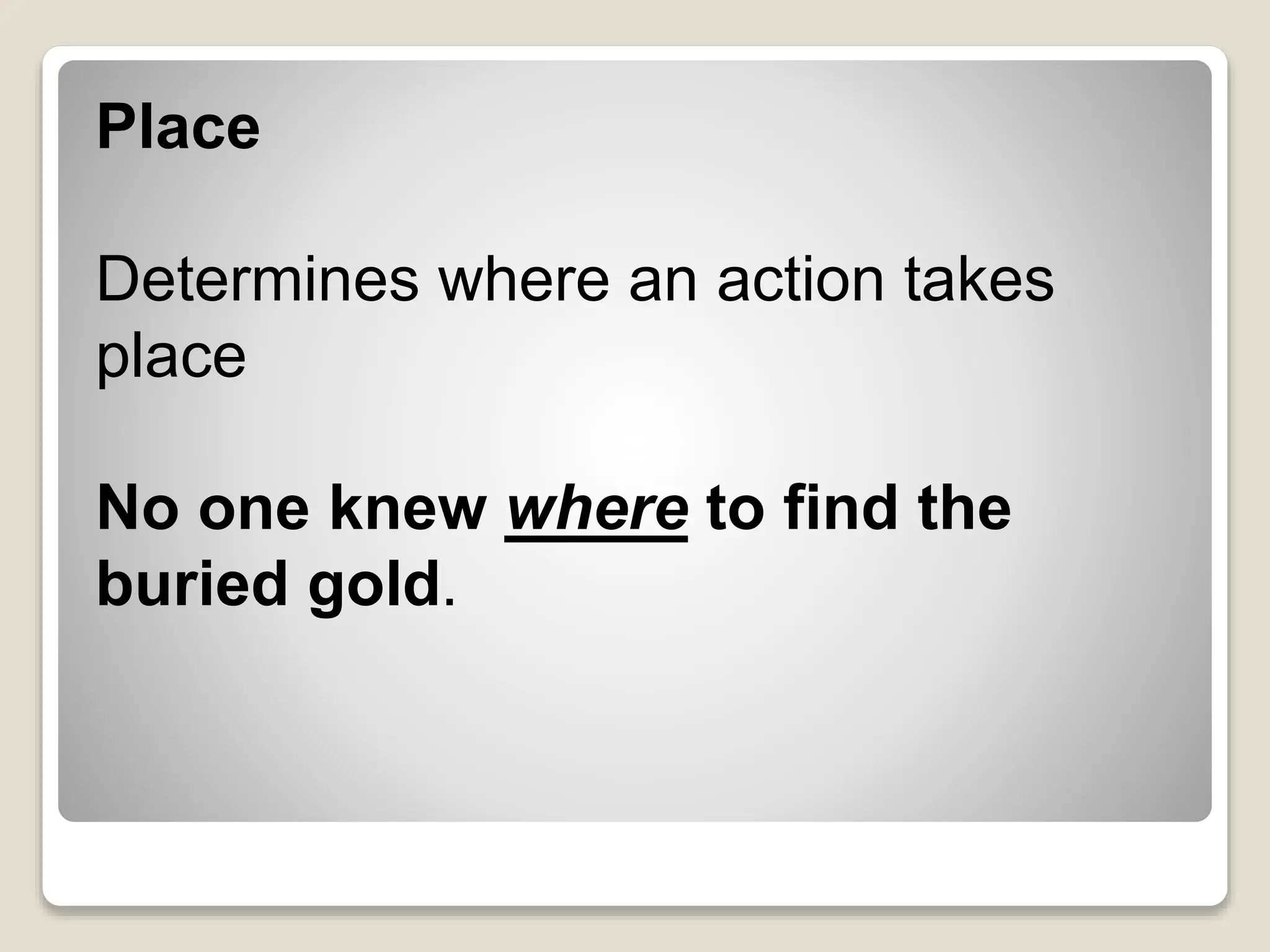
Place
Determines where an action takes
place
No one knew where to find the
buried gold.
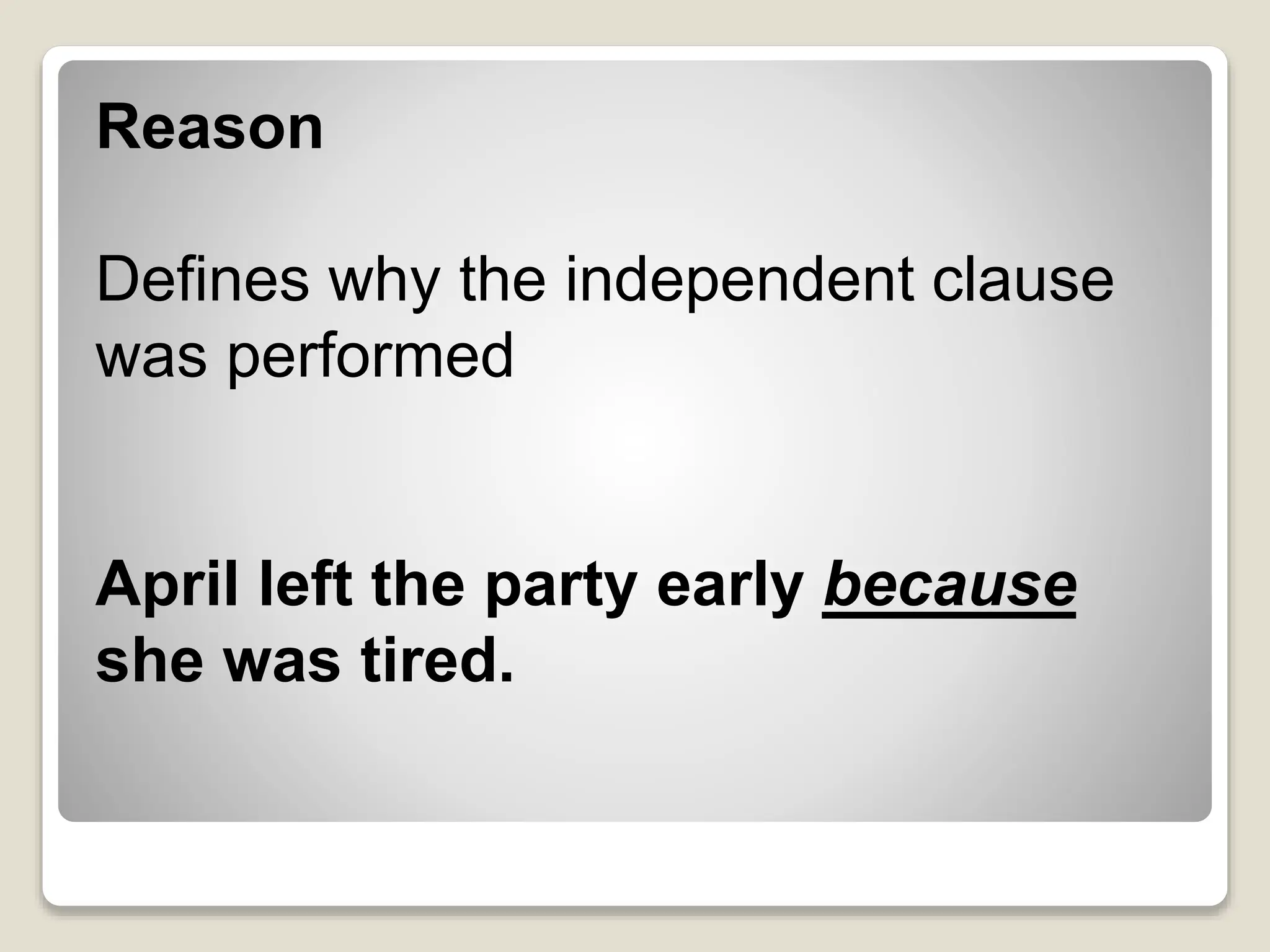
Reason
Defines why the independent clause
was performed
April left the party early because
she was tired.
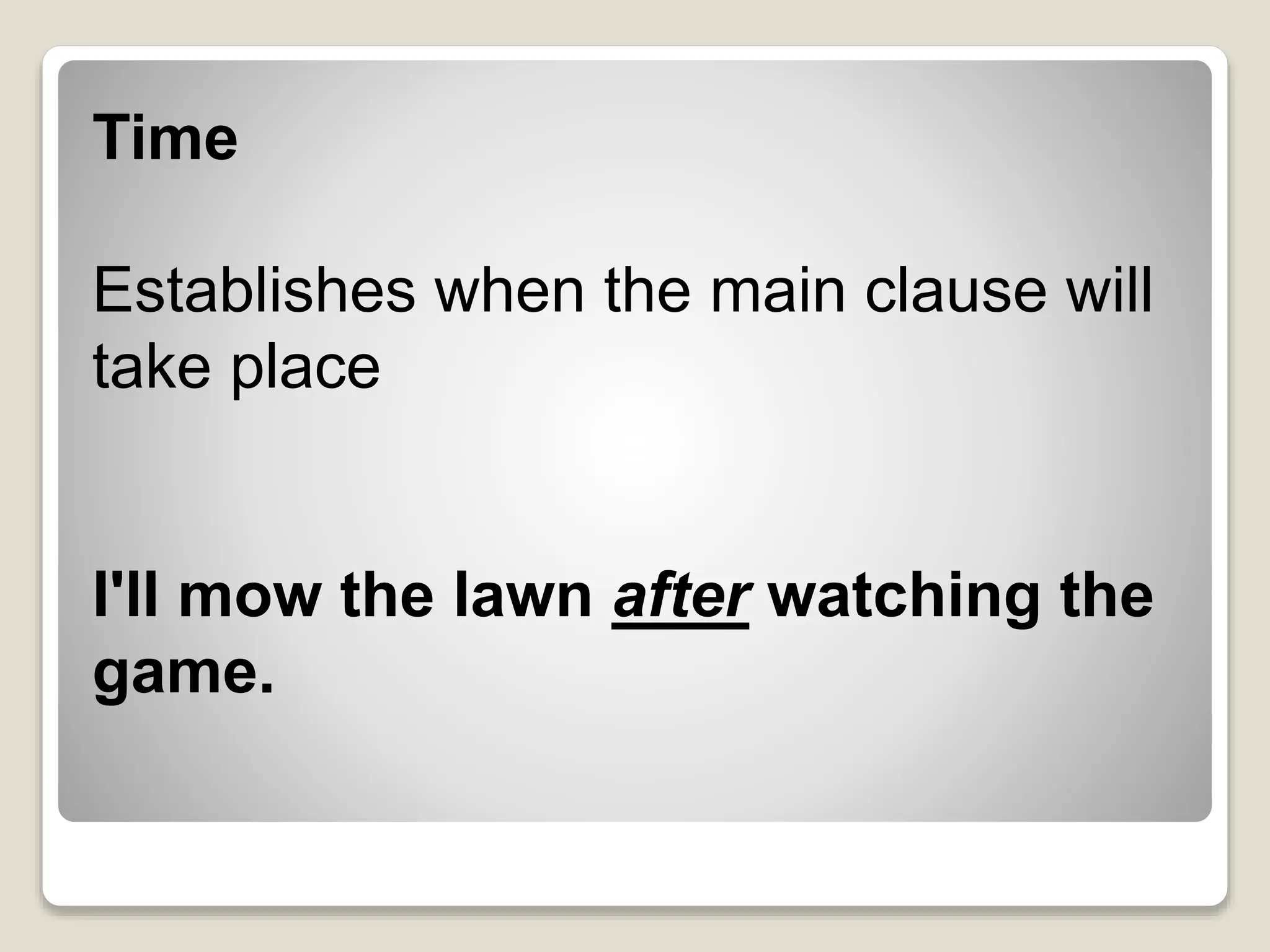
Time
Establishes when the main clause will
take place
I'll mow the lawn after watching the
game.
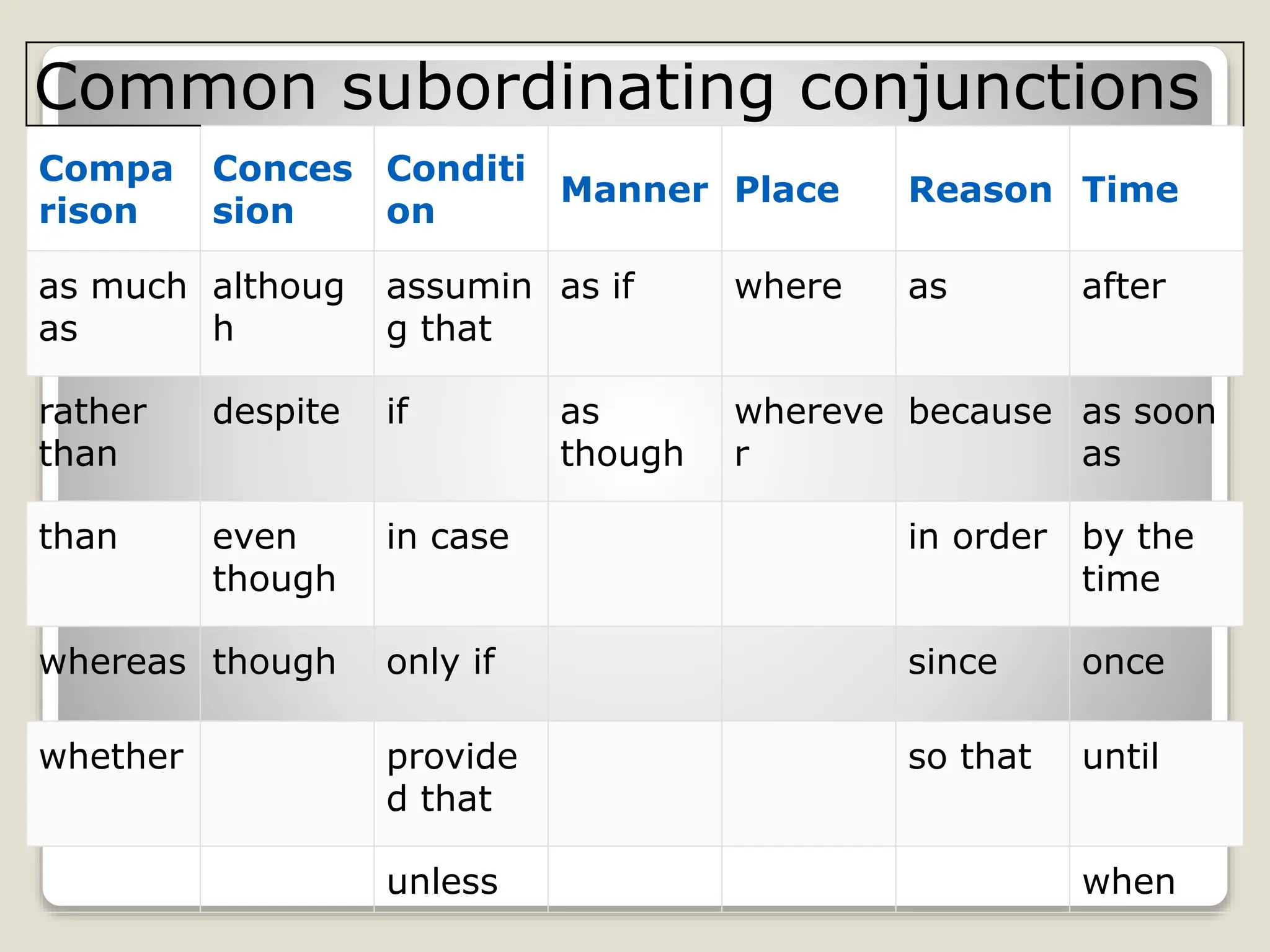
Common subordinating conjunctions
Compa
rison
Conces
sion
Conditi
on
Manner Place Reason Time
as much
as
althoug
h
assumin
g that
as if where as after
rather
than
despite if as
though
whereve
r
because as soon
as
than even
though
in case in order by the
time
whereas though only if since once
whether provide
d that
so that until
unless when
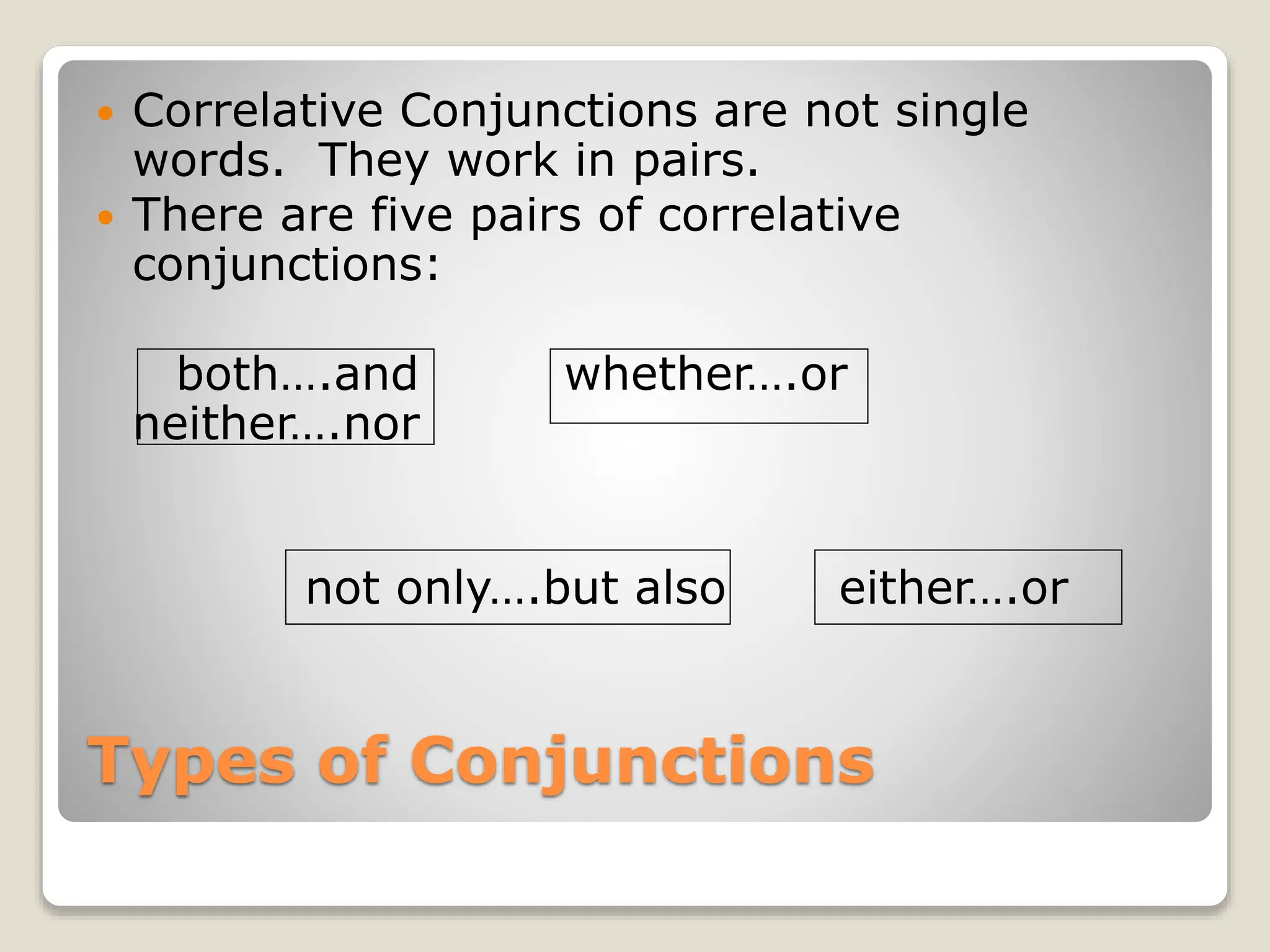
Types of Conjunctions
 Correlative Conjunctions are not single
words. They work in pairs.
 There are five pairs of correlative
conjunctions:
both….and whether….or
neither….nor
not only….but also either….or
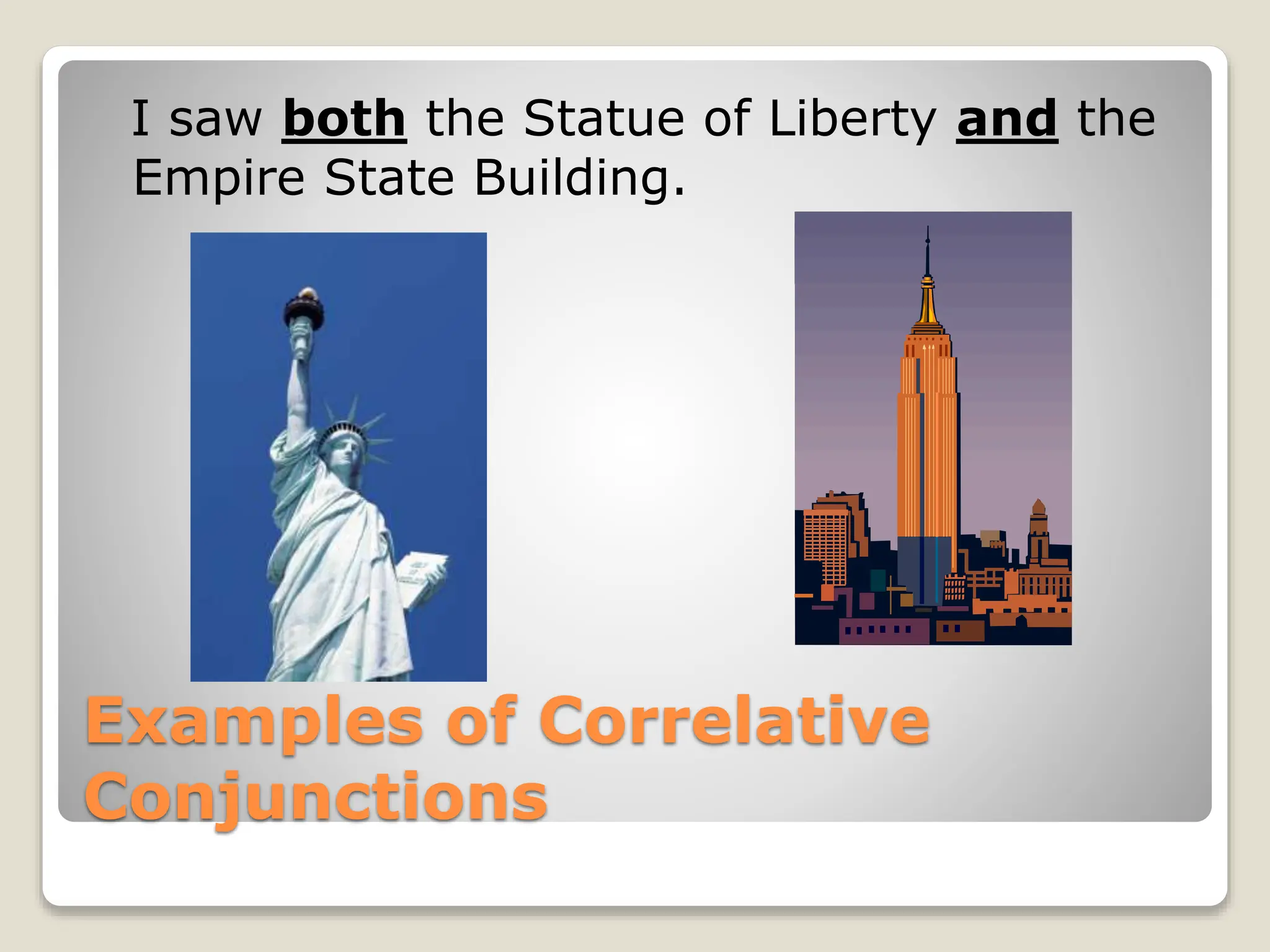
Examples of Correlative
Conjunctions
I saw both the Statue of Liberty and the
Empire State Building.
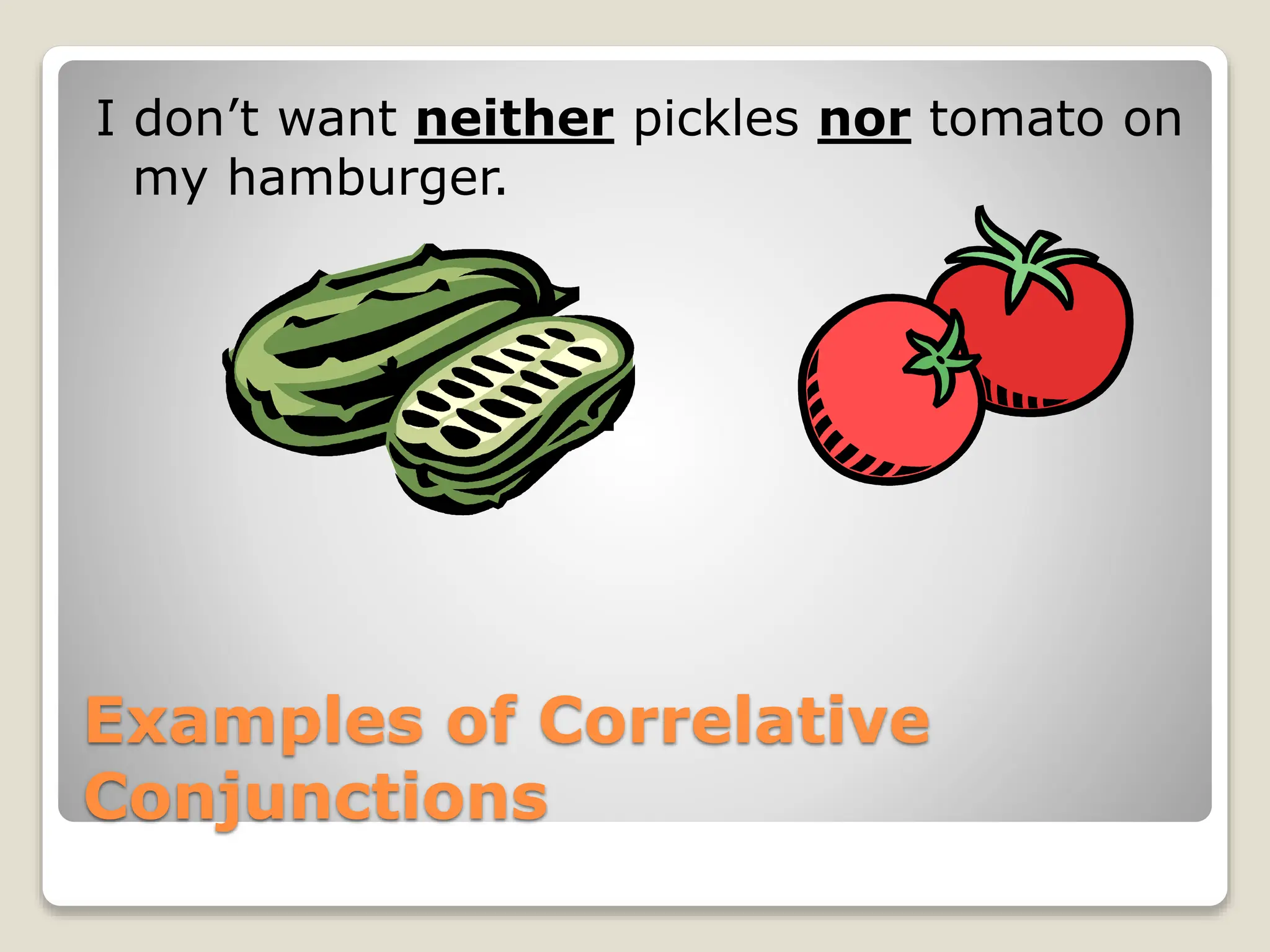
Examples of Correlative
Conjunctions
I don’t want neither pickles nor tomato on
my hamburger.
Examples of Correlative
Conjunctions
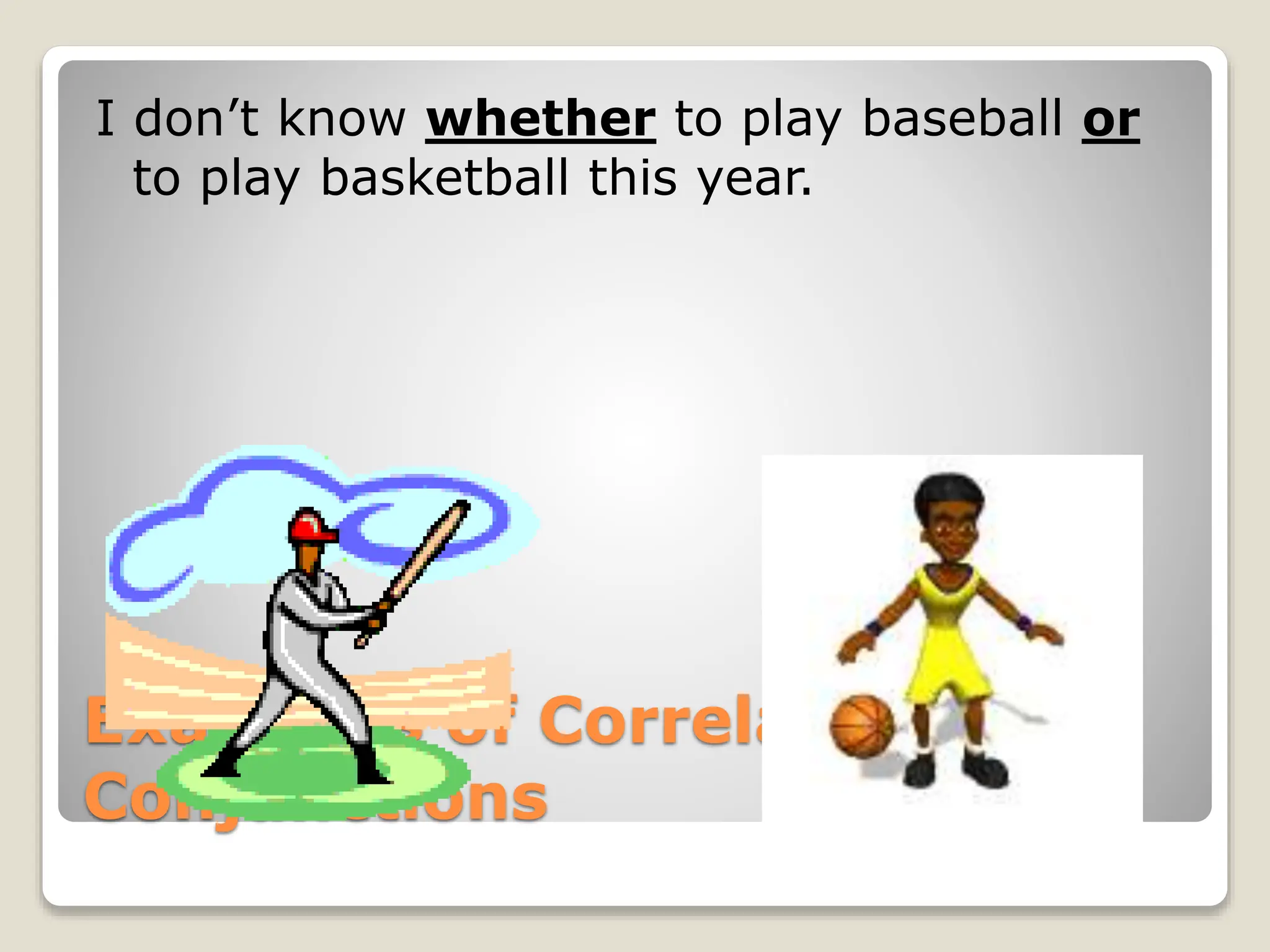
I don’t know whether to play baseball or
to play basketball this year.
Examples of Correlative
Conjunctions
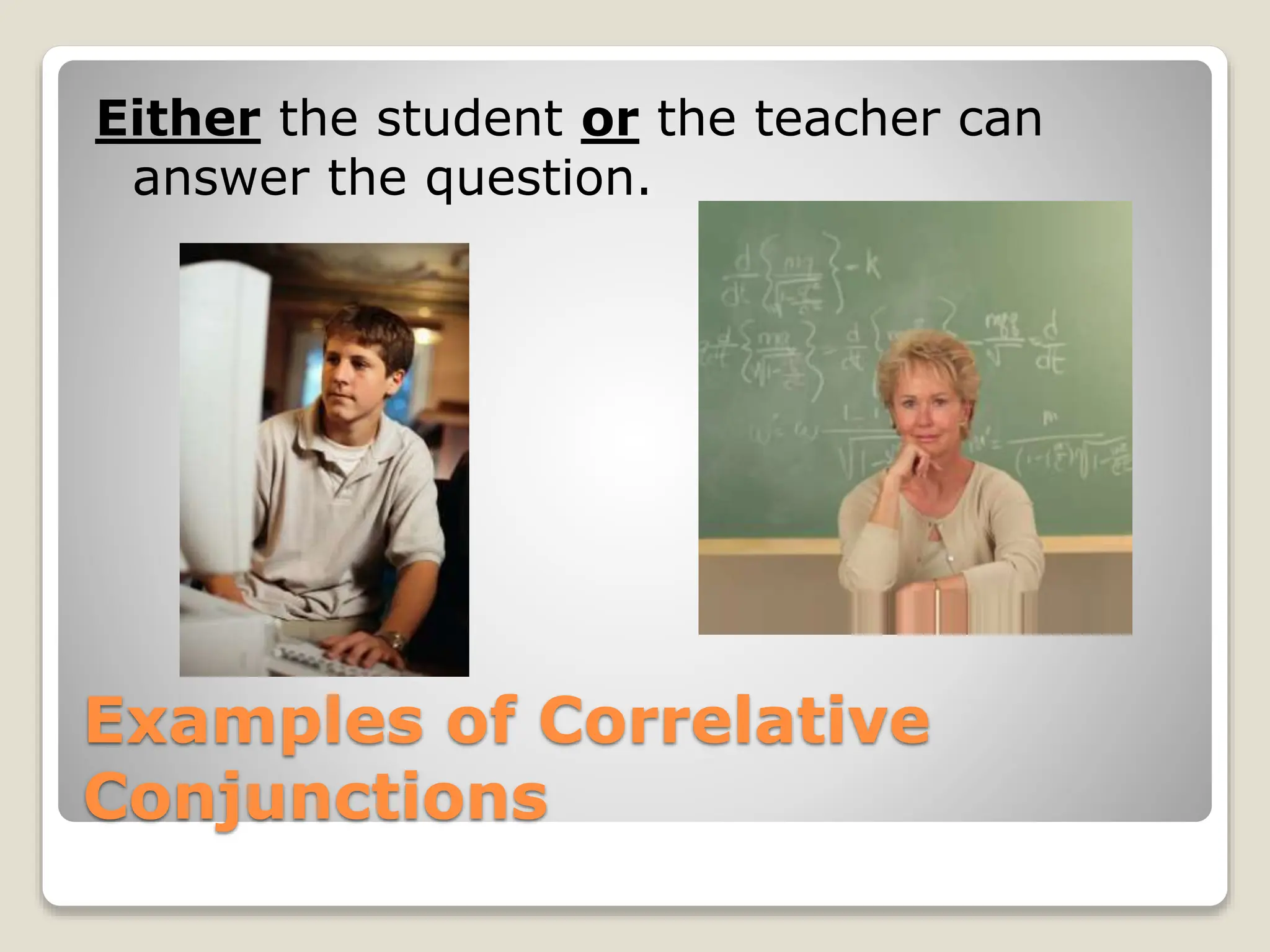
Either the student or the teacher can
answer the question.
Examples of Correlative
Conjunctions
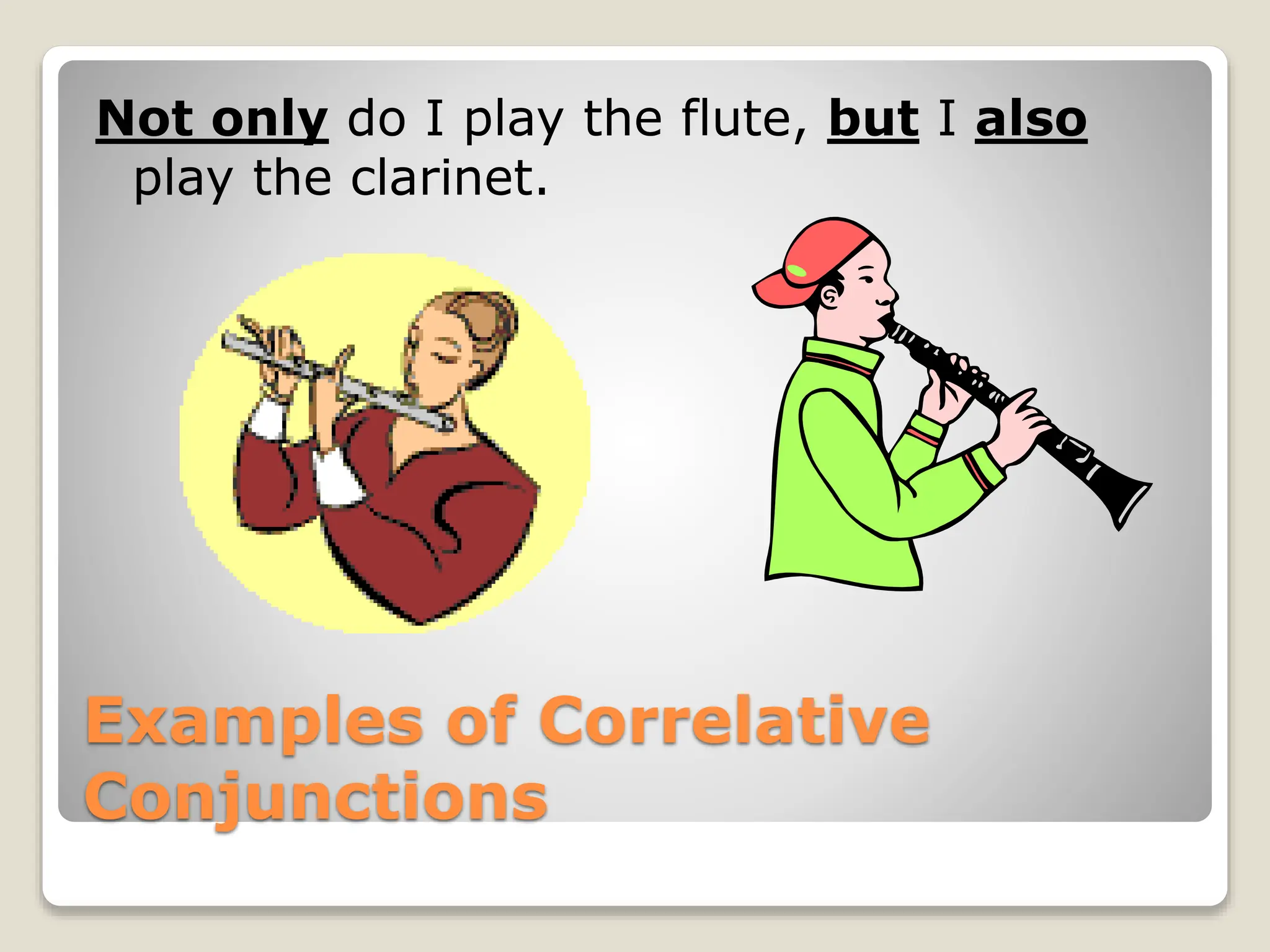
Not only do I play the flute, but I also
play the clarinet.
What is an Interjection?
 An interjection is something that
interrupts a sentence.
 It is something that also expresses your
emotions like happiness, fear, anger, or
pain.
 Some examples of interjections are:
ouch, wow, uh oh, oh no, gosh, shhhh
Punctuating Interjections
 If an interjection is spoken calmly, simply
put a comma after it and continue the
sentence.
Ex. Shhh, the baby is sleeping.
Ex. Oh my, I dropped my pencil.
Punctuating Interjections
 If an interjection is spoken with more
emotion, it is followed by an exclamation
point. The next word is then capitalized.
Ex. Ouch! I just cut my finger.
Ex. He scored the winning touchdown.
Wow!

CONJUNCTIONS Quarter 1 Module 4 English 8

  • 1.
    Conjunctions QUARTER 4 MODULE1 ENGLISH MATERIAL GRADE 8
  • 2.
    Activity: Think toConnect Directions: Choose the best connectives to complete each sentences below. Write your answer on a separate sheet of paper. 1. My dog messed me up_________ I need to take a shower. (and, but, for, so) 2. She needs to rest _________ she is not feeling well. (and, for, yet, nor) 3. I want to travel _________ I am not allowed. (and, or, so, but) 4. Our pet Mishka is lovely _________ active. (yet, but, and, so)
  • 3.
    5. Don’t prick_________ pinch the balloons. (or, nor, for, so) 6. The activities are challenging _____ my older brother helps me (but, and, so, for) 7. Watching movies _________ drawing are her hobbies (and, or, nor, yet) 8. Are you going _________not? (so, for, and, or) 9. It is so hot today __________ we bought ice cream. (but, and, or, so) 10. Annie passed the exam ____ she reviewed her notes. (so, but, because, and)
  • 4.
    What is aConjunction?  A conjunction is like glue. It helps things to stick together.  A conjunction joins words, phrases, and sentences, which are called clauses.
  • 5.
    What is aConjunction?  Conjunctions join two or more words. Example: I went to the store to buy eggs, milk, and bread.
  • 6.
    What is aConjunction?  Conjunctions can join two prepositional phrases. Ex. I went skiing down the hill and past the trees.
  • 7.
    What is aConjunction?  Conjunctions can connect two clauses or sentences.  When two sentences are joined, a comma MUST be placed before the conjunction. Ex. I played cards for awhile, but then I played chess.
  • 8.
    Types of Conjunctions One type of conjunction is the coordinating conjunction.  They connect words, phrases, and clauses, which are sentences.  They connect things of equal value. (This means that they would connect a noun with another noun or a prepositional phrase with another prepositional phrase.)
  • 9.
    Types of Conjunctions There are seven coordinating conjunctions: Use FANBOYS to remember for and nor but or yet so
  • 10.
    Types of Conjunctions Coordinating conjunctions affect the meaning of your sentence.  “And” connects things that are alike or joined together.  Ex. I want popcorn and pizza.
  • 11.
    Types of Conjunctions Coordinating conjunctions affect the meaning of your sentence.  “But” is used to connect things that are different or separated.  Ex. I want popcorn but not pizza.
  • 12.
    Types of Conjunctions Coordinating conjunctions affect the meaning of your sentence.  “Or” is used to offer a choice.  Ex. Do I want popcorn or pizza?
  • 13.
    Types of Conjunctions Coordinating conjunctions affect the meaning of your sentence.  “Nor” is used to offer a negative choice.  Ex. I do not want popcorn nor pizza.
  • 14.
    Types of Conjunctions Coordinating conjunctions affect the meaning of your sentence.  “Yet” is used to show a change. When it is used to combine two sentences, you must put a comma before it.  Ex. I want popcorn, yet I also want pizza.
  • 15.
    Types of Conjunctions Coordinating conjunctions affect the meaning of your sentence.  “So” is used to show a relationship between things. When it is used to combine two sentences, you must put a comma before it.  Ex. I want popcorn, so I made some.
  • 16.
    Types of Conjunctions Coordinating conjunctions affect the meaning of your sentence.  “For” is also used to show a relationship between things. When it is used to combine two sentences, you must put a comma before it.  Ex. I ordered a pizza, for I was hungry.
  • 17.
     Another typeof conjunction is called subordinating conjunctions.  A subordinating conjunction (also known as a subordinator or subordinate conjunction) is a single word or group of words that links a dependent clause to an independent clause, creating a complex sentence. Independent Clause: The singer had to delay her concert. Dependent Clause: because the sound system wasn't working
  • 18.
    Subordinating Conjunction isa word that connects an independent clause to a dependent clause. Example: The student failed the test because she didn’t study. The underlined word because is the subordinating conjunction that connects the two ideas in the sentence which are: the student failed the test, she didn’t study.
  • 19.
    What is anindependent clause? Independent clause can stand alone as a sentence. In other words, it does not need any additional information to operate as a sentence. It is also known as simple sentence. The sentence "The student failed the test" is an example of an independent clause because it expresses a complete thought.
  • 20.
    How about dependentclause? Dependent clause adds extra information to the main clause. These clauses cannot stand by themselves and their meaning is dependent on the independent clause. They are not complete sentences. For example, "because she didn't study" is not a complete sentence because it does not express a complete thought, therefore, it is an example of a dependent clause.
  • 21.
    A dependent clauseis also called as subordinate clause because it begins with a subordinating conjunction. Example: before I eat my dinner I feed my dog, before I eat my dinner.
  • 22.
    Types of subordinatingconjunctions There are seven main categories of subordinating conjunctions: Comparison Establishes a connection by providing a comparison. Than, rather than, whether, as much as, whereas. Example: Someone has to stand in line, whether it's you or me.
  • 23.
    Concession Links clauses byconceding a point between them Matt enjoyed his vacation despite the rain.
  • 24.
    Condition Identifies rules forthe independent clause Sara won't join the committee unless she receives a raise.
  • 25.
    Manner Determines how anaction takes place Jason ran through as if he was being chased.
  • 26.
    Place Determines where anaction takes place No one knew where to find the buried gold.
  • 27.
    Reason Defines why theindependent clause was performed April left the party early because she was tired.
  • 28.
    Time Establishes when themain clause will take place I'll mow the lawn after watching the game.
  • 29.
    Common subordinating conjunctions Compa rison Conces sion Conditi on MannerPlace Reason Time as much as althoug h assumin g that as if where as after rather than despite if as though whereve r because as soon as than even though in case in order by the time whereas though only if since once whether provide d that so that until unless when
  • 30.
    Types of Conjunctions Correlative Conjunctions are not single words. They work in pairs.  There are five pairs of correlative conjunctions: both….and whether….or neither….nor not only….but also either….or
  • 31.
    Examples of Correlative Conjunctions Isaw both the Statue of Liberty and the Empire State Building.
  • 32.
    Examples of Correlative Conjunctions Idon’t want neither pickles nor tomato on my hamburger.
  • 33.
    Examples of Correlative Conjunctions Idon’t know whether to play baseball or to play basketball this year.
  • 34.
    Examples of Correlative Conjunctions Eitherthe student or the teacher can answer the question.
  • 35.
    Examples of Correlative Conjunctions Notonly do I play the flute, but I also play the clarinet.
  • 36.
    What is anInterjection?  An interjection is something that interrupts a sentence.  It is something that also expresses your emotions like happiness, fear, anger, or pain.  Some examples of interjections are: ouch, wow, uh oh, oh no, gosh, shhhh
  • 37.
    Punctuating Interjections  Ifan interjection is spoken calmly, simply put a comma after it and continue the sentence. Ex. Shhh, the baby is sleeping. Ex. Oh my, I dropped my pencil.
  • 38.
    Punctuating Interjections  Ifan interjection is spoken with more emotion, it is followed by an exclamation point. The next word is then capitalized. Ex. Ouch! I just cut my finger. Ex. He scored the winning touchdown. Wow!