What is aConjunction?
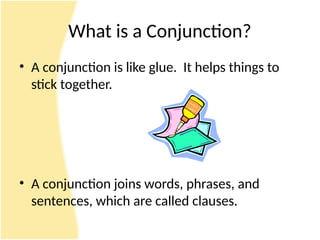
• A conjunction is like glue. It helps things to
stick together.
• A conjunction joins words, phrases, and
sentences, which are called clauses.
3.
List of Conjunctions
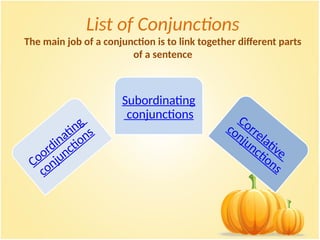
Themain job of a conjunction is to link together different parts
of a sentence
Coordinating
conjunctions
Subordinating
conjunctions Correlative
conjunctions
4.
Coordinating Conjunctions
They makethings go together.
They can join together words, phrases and independent clauses.
There are 7 coordinating conjunctions FANBOYS
• For - Explains reason or purpose (just like “because”)
I go to the park every Sunday, for I love to watch the ducks on the lake.
• And - Adds one thing to another
I go to the park every Sunday to watch the ducks on the lake and feed
them.
• Nor - Used to present an alternative negative idea to an already stated
negative idea.
I don’t go for the fresh air nor really for the ducks. Honestly, I just like the
soccer.
• Yet - is used to show a change. When it is used to combine two sentences,
you must put a comma before it.
I want popcorn, yet I also want pizza.
5.
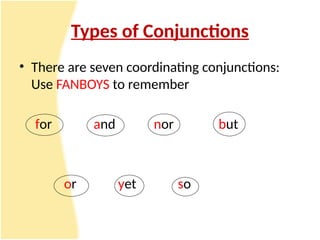
Types of Conjunctions
•There are seven coordinating conjunctions:
Use FANBOYS to remember
for and nor but
or yet so
6.
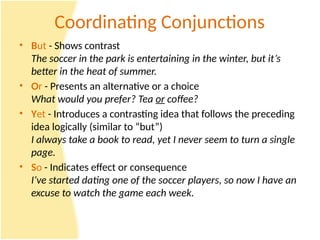
Coordinating Conjunctions
• But- Shows contrast
The soccer in the park is entertaining in the winter, but it’s
better in the heat of summer.
• Or - Presents an alternative or a choice
What would you prefer? Tea or coffee?
• Yet - Introduces a contrasting idea that follows the preceding
idea logically (similar to “but”)
I always take a book to read, yet I never seem to turn a single
page.
• So - Indicates effect or consequence
I’ve started dating one of the soccer players, so now I have an
excuse to watch the game each week.
7.
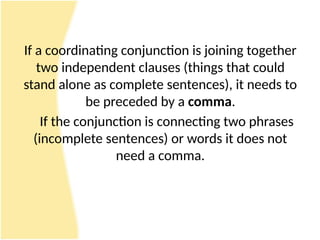
If a coordinatingconjunction is joining together
two independent clauses (things that could
stand alone as complete sentences), it needs to
be preceded by a comma.
If the conjunction is connecting two phrases
(incomplete sentences) or words it does not
need a comma.
8.
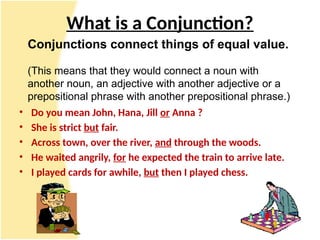
What is aConjunction?
• Do you mean John, Hana, Jill or Anna ?
• She is strict but fair.
• Across town, over the river, and through the woods.
• He waited angrily, for he expected the train to arrive late.
• I played cards for awhile, but then I played chess.
Conjunctions connect things of equal value.
(This means that they would connect a noun with
another noun, an adjective with another adjective or a
prepositional phrase with another prepositional phrase.)
9.
What is aConjunction?
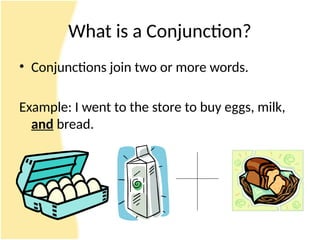
• Conjunctions join two or more words.
Example: I went to the store to buy eggs, milk,
and bread.
10.
What is aConjunction?
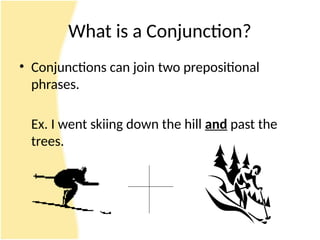
• Conjunctions can join two prepositional
phrases.
Ex. I went skiing down the hill and past the
trees.
11.
Subordinating Conjunctions
• Asubordinating conjunction always introduces
a dependent clause, tying it to an
independent clause. The clauses can go in any
order; that is, the independent or the
dependent clause can come first in the
sentence, but in either order, the first word of
the dependent (or subordinate) clause will be
the subordinating conjunction.
13.
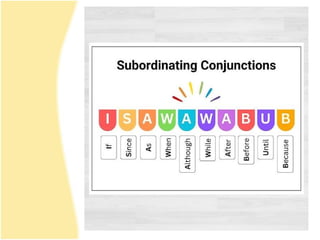
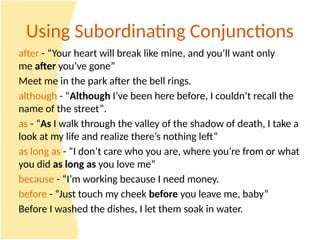
Using Subordinating Conjunctions
after- “Your heart will break like mine, and you’ll want only
me after you’ve gone”
Meet me in the park after the bell rings.
although - “Although I’ve been here before, I couldn’t recall the
name of the street”.
as - “As I walk through the valley of the shadow of death, I take a
look at my life and realize there’s nothing left”
as long as - “I don’t care who you are, where you’re from or what
you did as long as you love me”
because - “I’m working because I need money.
before - “Just touch my cheek before you leave me, baby”
Before I washed the dishes, I let them soak in water.
14.
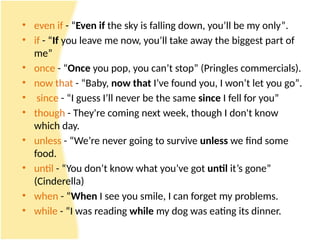
• even if- “Even if the sky is falling down, you’ll be my only”.
• if - “If you leave me now, you’ll take away the biggest part of
me”
• once - “Once you pop, you can’t stop” (Pringles commercials).
• now that - “Baby, now that I’ve found you, I won’t let you go”.
• since - “I guess I’ll never be the same since I fell for you”
• though - They're coming next
week, though I don't
know
which
day.
• unless - “We’re never going to survive unless we find some
food.
• until - “You don’t know what you’ve got until it’s gone”
(Cinderella)
• when - “When I see you smile, I can forget my problems.
• while - “I was reading while my dog was eating its dinner.
15.
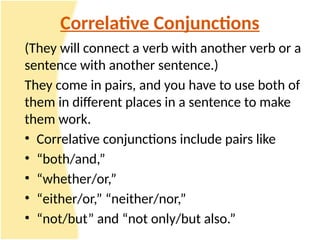
Correlative Conjunctions
(They willconnect a verb with another verb or a
sentence with another sentence.)
They come in pairs, and you have to use both of
them in different places in a sentence to make
them work.
• Correlative conjunctions include pairs like
• “both/and,”
• “whether/or,”
• “either/or,” “neither/nor,”
• “not/but” and “not only/but also.”
16.
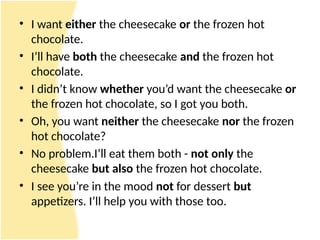
• I wanteither the cheesecake or the frozen hot
chocolate.
• I’ll have both the cheesecake and the frozen hot
chocolate.
• I didn’t know whether you’d want the cheesecake or
the frozen hot chocolate, so I got you both.
• Oh, you want neither the cheesecake nor the frozen
hot chocolate?
• No problem.I’ll eat them both - not only the
cheesecake but also the frozen hot chocolate.
• I see you’re in the mood not for dessert but
appetizers. I’ll help you with those too.
17.
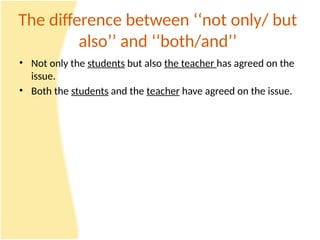
The difference between‘‘not only/ but
also’’ and ‘‘both/and’’
• Not only the students but also the teacher has agreed on the
issue.
• Both the students and the teacher have agreed on the issue.
18.
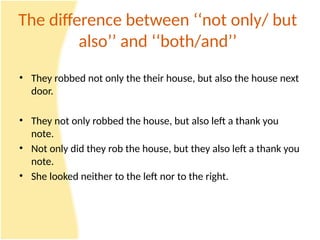
The difference between‘‘not only/ but
also’’ and ‘‘both/and’’
• They robbed not only the their house, but also the house next
door.
• They not only robbed the house, but also left a thank you
note.
• Not only did they rob the house, but they also left a thank you
note.
• She looked neither to the left nor to the right.
19.
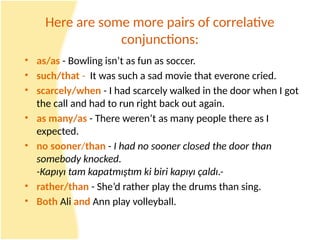
Here are somemore pairs of correlative
conjunctions:
• as/as - Bowling isn’t as fun as soccer.
• such/that - It was such a sad movie that everone cried.
• scarcely/when - I had scarcely walked in the door when I got
the call and had to run right back out again.
• as many/as - There weren’t as many people there as I
expected.
• no sooner/than - I had no sooner closed the door than
somebody knocked.
-Kapıyı tam kapatmıştım ki biri kapıyı çaldı.-
• rather/than - She’d rather play the drums than sing.
• Both Ali and Ann play volleyball.
20.
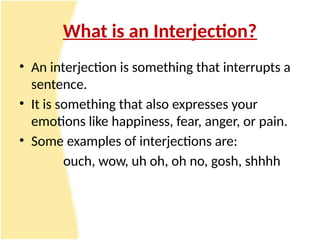
What is anInterjection?
• An interjection is something that interrupts a
sentence.
• It is something that also expresses your
emotions like happiness, fear, anger, or pain.
• Some examples of interjections are:
ouch, wow, uh oh, oh no, gosh, shhhh
21.
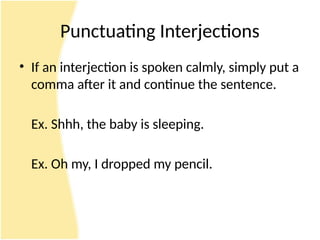
Punctuating Interjections
• Ifan interjection is spoken calmly, simply put a
comma after it and continue the sentence.
Ex. Shhh, the baby is sleeping.
Ex. Oh my, I dropped my pencil.
22.
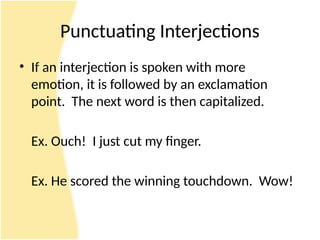
Punctuating Interjections
• Ifan interjection is spoken with more
emotion, it is followed by an exclamation
point. The next word is then capitalized.
Ex. Ouch! I just cut my finger.
Ex. He scored the winning touchdown. Wow!