MASTERING
CONJUNCTIONS
ENGLISH YEAR 9
WHAT ARE
CONJUNCTIONS?
Conjunctions are words that
connect other words,
phrases, or clauses in a
sentence, helping to link
ideas and create smoother,
more coherent sentences.
TYPES OF
CONJUNCTIONS
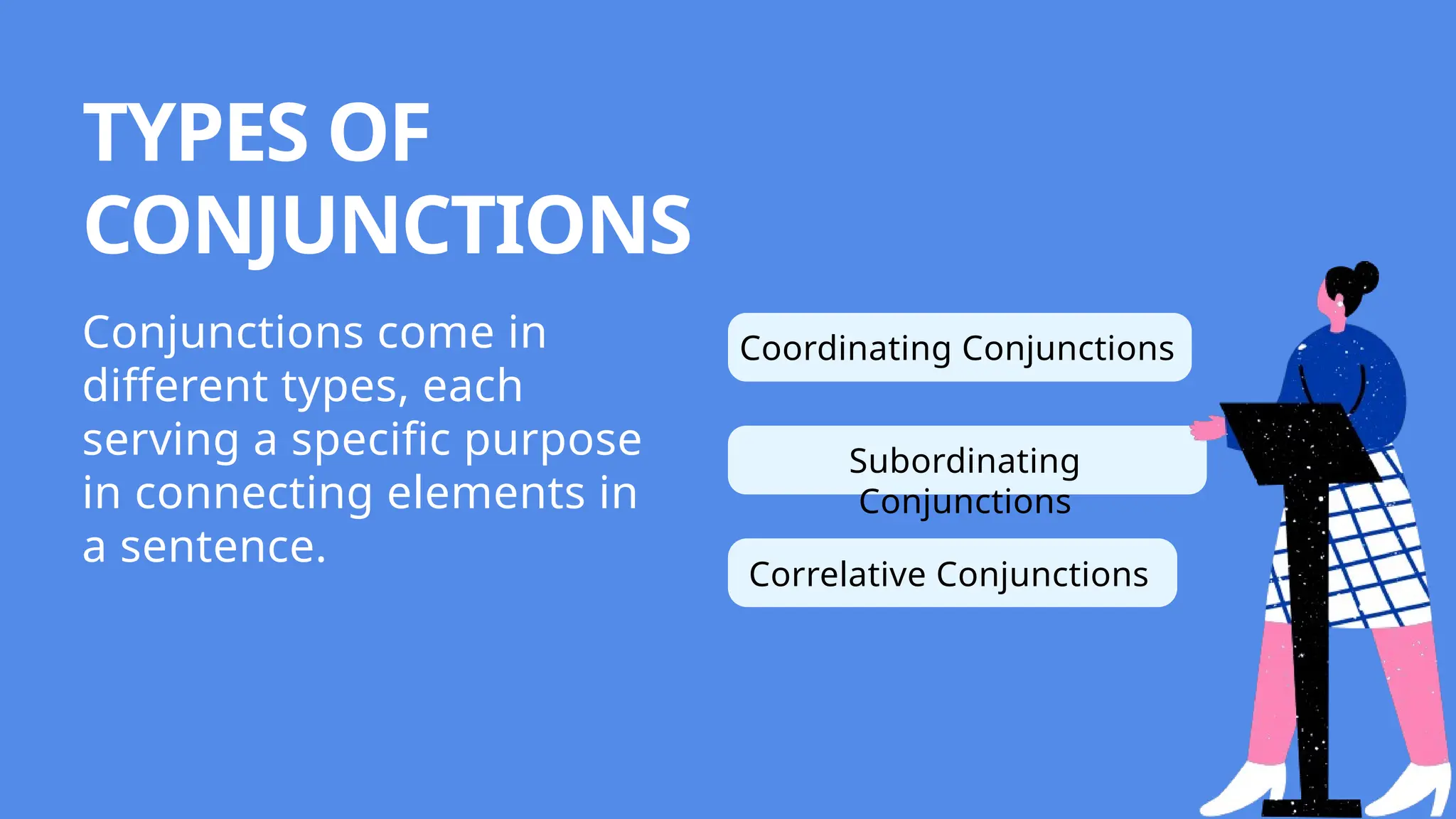
Conjunctions come in
different types, each
serving a specific purpose
in connecting elements in
a sentence.
Coordinating Conjunctions
Correlative Conjunctions
Subordinating
Conjunctions
COORDINATING
CONJUNCTIONS
Coordinating conjunctions like
'and,' 'but,' 'or,' 'so,' 'yet,' and
'for' are used to connect equal
sentence elements, such as
words, phrases, or clauses.
"I wanted to go to the movies, but I had to
finish my homework."
EXAMPLE
In this example, "but" is a coordinating
conjunction that joins two independent
clauses.
Subordinating conjunctions
like 'although,' 'because,' and
'while' connect dependent
clauses to independent
clauses.
SUBORDINATING
CONJUNCTIONS
EXAMPLE
Because it was raining, they decided to stay
indoors."
Here, "because" is a subordinating
conjunction that introduces a dependent
clause and connects it to the independent
clause.
CORRELATIVE
CONJUNCTIONS
Correlative conjunctions like
'either...or,' 'neither...nor,' and
'both...and' work in pairs to
connect similar sentence elements.
EXAMPLE
"Either you can choose the blue shirt, or
you can pick the red one."
In this sentence, "either...or" is a pair of
correlative conjunctions that work together
to connect two choices
• They improve your writing by making it clearer
and more interesting.
• They show different relationships between ideas
in your sentences.
Why are conjunctions
important?
Types of
Conjunctions
• Coordinating conjunctions connect items
of equal importance.
• Remember them with the handy acronym
FANBOYS
1. Coordinating
Conjunctions
Examples: I like pizza, but I also enjoy
pasta.
Coordinating
Conjunctions
FANBOYS
For
And
Nor
But
Or
Yet
So
Introduces an additional reason or explanation.
Shows that things happen together or in
sequence.
Offers a choice or alternative.
Connects contrasting ideas, often with a surprising
twist.
Shows a consequence or result of the first
clause.
Used for negative choices or options.
Introduces a contrast or opposing idea.
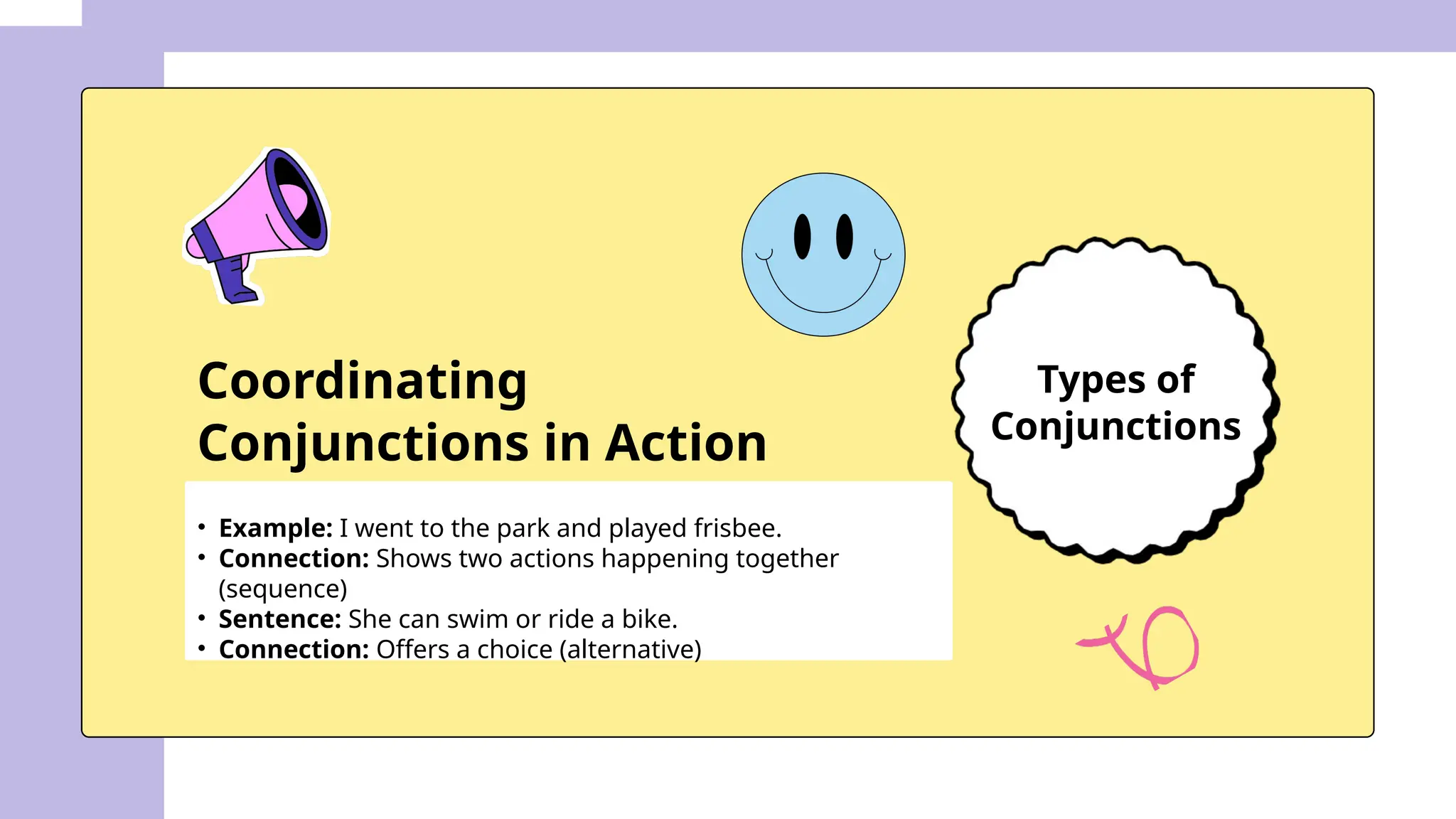
Coordinating
Conjunctions in Action
• Example: I went to the park and played frisbee.
• Connection: Shows two actions happening together
(sequence)
• Sentence: She can swim or ride a bike.
• Connection: Offers a choice (alternative)
Types of
Conjunctions
Subordinating conjunctions introduce
dependent clauses, which rely on the main
clause for meaning.
2.Subordinating
Conjunctions
Examples: Since it was raining, we stayed
inside.
**Because, since, although, while, if, unless,
before, after, until
Subordinating
Conjunctions
in Action
Example: If you study hard, you will get a good
grade.
Connection: Introduces a condition (conditional)
Example: We went for a walk after dinner.
Connection: Shows the order of events (time)
Time: Before, after, since, until, when, whenever
Example: We ate lunch before we went to the movies.
Cause & Effect: because, since, so, therefore, as a result
Example: I studied hard, so I got a good grade.
Conjunctions for Different
Relationships
1
2
Conjunctions for
Different Relationships
Contrast: But, yet, however, although, while
Example: I love pizza, but I don't like pineapple on it.
Condition: If, unless, whether
Example: If you finish your homework, you can play video
games.
Coordinating conjunctions (FANBOYS)
connect ideas of equal importance.
Subordinating conjunctions introduce
dependent clauses that rely on the main
clause for meaning.
Conclusion

CONJUNCTIONS POWERPOINT PRESENTATION).pptx