Attachment and Learning
Session 3 – Strategies
Emotion Coaching
The Emotion Coaching Project
• Research aim:
‘To support the development of resilience and
community well-being by integrating emotion
coaching into everyday practice in work with
children and young people’
EMOTION COACHING
• Part 1
Why do we need it?
• Part 2
What is it?
• Part 3
How do we do it?
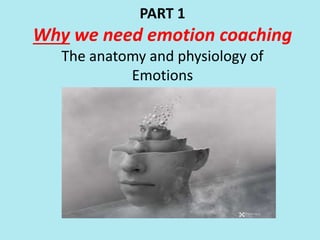
PART 1
Why we need emotion coaching
The anatomy and physiology of
Emotions
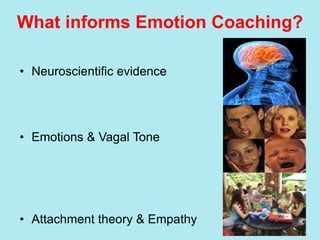
What informs Emotion Coaching?
• Neuroscientific evidence
• Emotions & Vagal Tone
• Attachment theory & Empathy
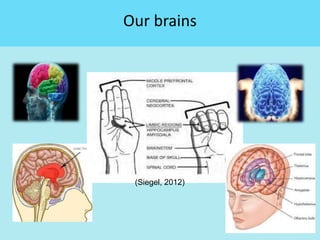
(Siegel, 2012)
Our brains
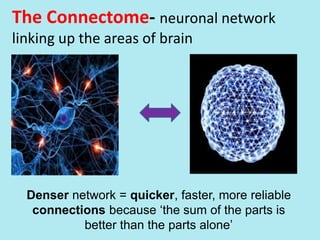
The Connectome- neuronal network
linking up the areas of brain
Denser network = quicker, faster, more reliable
connections because ‘the sum of the parts is
better than the parts alone’
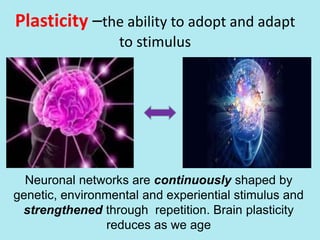
Plasticity –the ability to adopt and adapt
to stimulus
Neuronal networks are continuously shaped by
genetic, environmental and experiential stimulus and
strengthened through repetition. Brain plasticity
reduces as we age
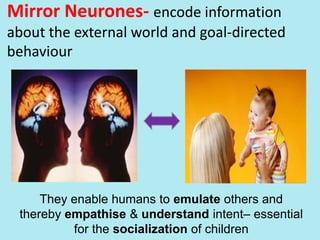
Mirror Neurones- encode information
about the external world and goal-directed
behaviour
They enable humans to emulate others and
thereby empathise & understand intent– essential
for the socialization of children
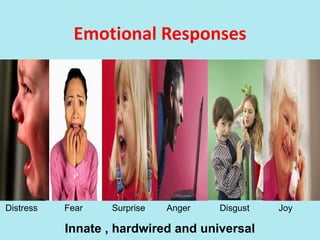
Emotional Responses
Distress Fear Surprise Anger Disgust Joy
Innate , hardwired and universal
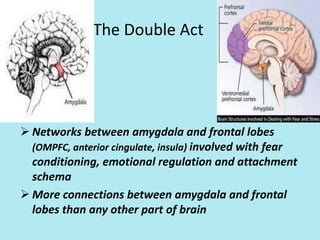
The Double Act
 Networks between amygdala and frontal lobes
(OMPFC, anterior cingulate, insula) involved with fear
conditioning, emotional regulation and attachment
schema
 More connections between amygdala and frontal
lobes than any other part of brain
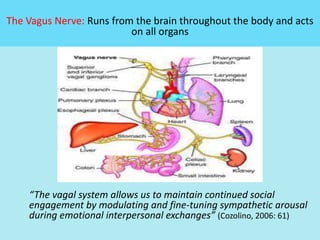
“The vagal system allows us to maintain continued social
engagement by modulating and fine-tuning sympathetic arousal
during emotional interpersonal exchanges” (Cozolino, 2006: 61)
The Vagus Nerve: Runs from the brain throughout the body and acts
on all organs
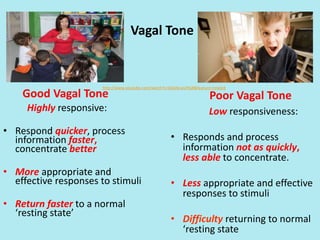
Vagal Tone
http://www.youtube.com/watch?v=6GdALwuYtG8&feature=related
Good Vagal Tone
Highly responsive:
• Respond quicker, process
information faster,
concentrate better
• More appropriate and
effective responses to stimuli
• Return faster to a normal
‘resting state’
Poor Vagal Tone
Low responsiveness:
• Responds and process
information not as quickly,
less able to concentrate.
• Less appropriate and effective
responses to stimuli
• Difficulty returning to normal
‘resting state
How does Emotion Coaching work with the
brain and body?
1. Provides a stimulus for triggering the
vagus nerve
2. Triggers an empathic mirror system
3. Helps child to feel safe and calm down
4. Provides a narrative for connecting
emotional and cognitive processes
5. Stimulates neural connections
between amygdala/limbic system and
frontal lobes (especially OMPFC and
corpus callosum)
6. Creates a process of co-regulation and
‘repair’ (helping implicit memories
become explicit)
 Helps child to learn to self-
sooth
 Helps child to learn to self-
regulate
 Helps child to learn to resolve
problems
 Helps child to learn they can
survive adversity (or thwarted
wishes/desires/needs)
 Helps child to learn about
empathy and pro-social
behaviour
PART 2
What is emotion coaching?
• Based on research by John Gottman (1997) in
America
• CLIP - http://www.gottman.com/48995/Parenting.html
• Research suggests it is a key to happy, resilient, and
well-adjusted children and young people
Emotion coaching is helping children and young
people to understand the different emotions
they experience, why they occur, and how to
handle them
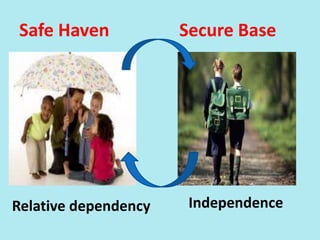
Safe Haven Secure Base
Relative dependency Independence
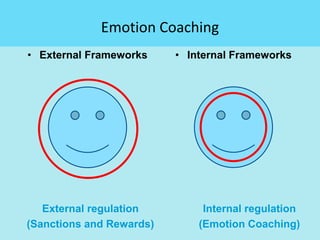
• External Frameworks
External regulation
(Sanctions and Rewards)
• Internal Frameworks
Internal regulation
(Emotion Coaching)
Emotion Coaching
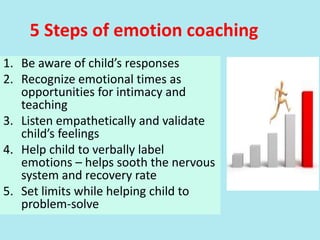
5 Steps of emotion coaching
1. Be aware of child’s responses
2. Recognize emotional times as
opportunities for intimacy and
teaching
3. Listen empathetically and validate
child’s feelings
4. Help child to verbally label
emotions – helps sooth the nervous
system and recovery rate
5. Set limits while helping child to
problem-solve
What this means in practice
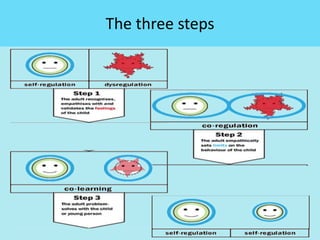
STEP 1
Recognising, empathising, validating the feelings
and labelling them
STEP 2 (if needed)
Setting limits on behaviour
STEP 3
Problem-solving with the child/young person
Emotion coaching involves:
• Teaching children/young people
about the world of emotion ‘in the
moment’
• Giving children strategies to deal
with ups and downs
• Accepting negative emotions as
normal
• Using moments of negative
behaviour to as opportunities for
teaching
• Building trusting and respectful
relationships with children/young
people
Emotion coaching is a set of processes
that includes . . .
talking to the child about the emotions
helping the child to verbally label the emotions
being felt
respecting and accepting the child’s emotions
discussing the situations that elicited the
emotions
 having goals and strategies for coping with
these situations (Gottman, 1997)
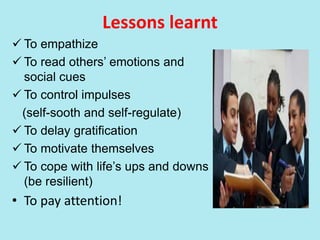
Lessons learnt
 To empathize
 To read others’ emotions and
social cues
 To control impulses
(self-sooth and self-regulate)
 To delay gratification
 To motivate themselves
 To cope with life’s ups and downs
(be resilient)
• To pay attention!
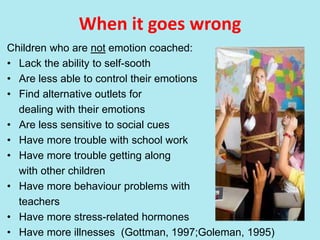
When it goes wrong
Children who are not emotion coached:
• Lack the ability to self-sooth
• Are less able to control their emotions
• Find alternative outlets for
dealing with their emotions
• Are less sensitive to social cues
• Have more trouble with school work
• Have more trouble getting along
with other children
• Have more behaviour problems with
teachers
• Have more stress-related hormones
• Have more illnesses (Gottman, 1997;Goleman, 1995)
How schools can help
• “Schools are becoming emotional buffering
zones for the growing number of children hurt
by divorce, poverty, and neglect” (Goleman,
1995)
• Neurological resilience to self-sooth is fostered
by the emotional climate in the classroom
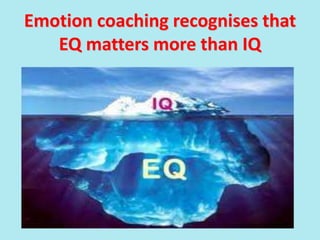
Emotion coaching recognises that
EQ matters more than IQ
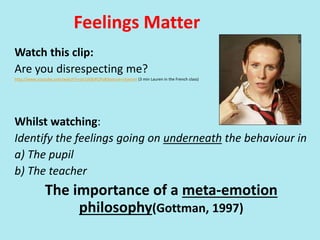
Feelings Matter
Watch this clip:
Are you disrespecting me?
http://www.youtube.com/watch?v=zV1zK8zRCPo&feature=channel (3 min Lauren in the French class)
Whilst watching:
Identify the feelings going on underneath the behaviour in
a) The pupil
b) The teacher
The importance of a meta-emotion
philosophy(Gottman, 1997)
Emotion Coaching Style
“Much of today’s popular advice
ignores the world of emotions.
Instead, it relies on child-rearing
theories that address the children’s
behaviour, but disregard the
feelings that underlie that
behaviour” (Gottman, 1997)
Building a Power Base
“Proposing solutions before empathising is like
trying to build the frame of a house before you lay a
firm foundation” (Gottman)
•Emotional first aid is needed first
•In this way, emotion coaching builds a power base
that is an emotional bond
•This creates a safe haven, a place of trust, a place of
respect, a place of acceptance, a sense of self etc.
•This in turn leads to children and young people giving
back respect, acceptance of boundaries etc.
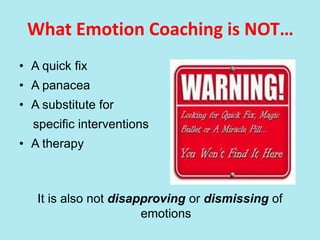
What Emotion Coaching is NOT…
• A quick fix
• A panacea
• A substitute for
specific interventions
• A therapy
It is also not disapproving or dismissing of
emotions
Disapproving style
• Disapproves of negative emotions – viewed as
a sign of weakness, lack of control, unconstructive
• Lacks empathy, noticeably critical and intolerant
• Tries to get rid of negative emotions via discipline,
reprimand, punishment
• Focuses on the behaviour rather than the emotions
generating the behaviour
• More likely to view negative emotional displays as a
form of manipulation, lack of obedience, sign of bad
character
• Often motivated by need to control and regain power
and/or to ‘toughen up’ child
Dismissing style
• Despite good intentions (wants to make child feel
better) but is uncomfortable with negative emotions
• Views negative emotions as toxic and so must be
‘got over quickly’
• Considers paying attention to such emotions will make them worse,
prolong them
• Tries to stop negative emotions by reducing/ minimising/ making
light of their importance/significance
e.g. it’s no big deal, don’t worry about it, be a big girl, that’s
life, you’ll be fine
• Often motivated by need to rescue and make things better, fix
the problem e.g. have a biscuit, I’ll buy a new one, you need to do
this
• Focuses on getting rid of the emotion with logic or distraction
rather than understanding the feelings
What we think about disapproving and
dismissing messages to child….
“It works so it must be good!”
BUT the actual message is…..
•What you are feeling is not right, your assessment of the problem is
wrong, you must not feel this way
•Child does not learn to trust own feelings affecting decision-making
•Not given opportunities to experience emotions and deal with them
effectively so grow up unprepared for life’s challenges
•Not given opportunities to self-regulate or problem-solve
•Can lead to suppression of natural emotions, less or lack of self-
regulation, reliance on distraction to get rid of emotion
•Generates more negative feelings - resentment, guilt, shame, anger
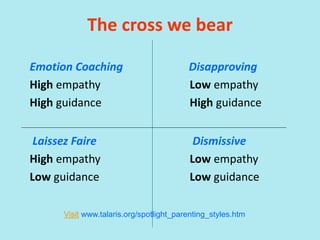
The cross we bear
Emotion Coaching Disapproving
High empathy Low empathy
High guidance High guidance
Laissez Faire Dismissive
High empathy Low empathy
Low guidance Low guidance
Visit www.talaris.org/spotlight_parenting_styles.htm
Emotion Coaching messages
• We all have feelings and need to recognize them in
ourselves as well as others
• We are not alone and we are accepted, supported,
valid, cared about, understood, trustworthy and
respected – this is then returned
• We are empowered and it’s safe to engage in problem-
solving
• All feelings are normal but need to be regulated and
expressed constructively
• Problems and conflicts can be resolved
peacefully!
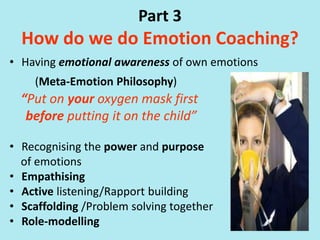
Part 3
How do we do Emotion Coaching?
• Having emotional awareness of own emotions
(Meta-Emotion Philosophy)
“Put on your oxygen mask first
before putting it on the child”
• Recognising the power and purpose
of emotions
• Empathising
• Active listening/Rapport building
• Scaffolding /Problem solving together
• Role-modelling
Emotion Coaching
STEP 1
Recognising, empathising, validating the feelings
and labelling them
STEP 2 (if needed)
Setting limits on behaviour
STEP 3
Problem-solving with the child/young person
The three steps
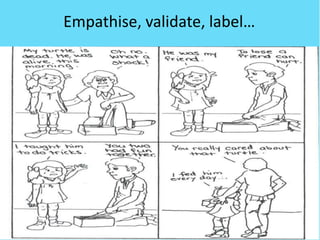
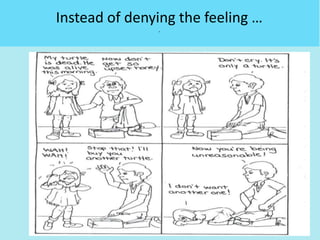
Instead of denying the feeling …
.
Empathise, validate, label…
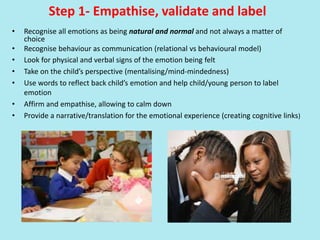
Step 1- Empathise, validate and label
• Recognise all emotions as being natural and normal and not always a matter of
choice
• Recognise behaviour as communication (relational vs behavioural model)
• Look for physical and verbal signs of the emotion being felt
• Take on the child’s perspective (mentalising/mind-mindedness)
• Use words to reflect back child’s emotion and help child/young person to label
emotion
• Affirm and empathise, allowing to calm down
• Provide a narrative/translation for the emotional experience (creating cognitive links)
Emotion Coaching Scripts
• ‘I can see that you get angry when that happens. I
would feel angry if that happened to me. It’s normal to
feel like that’
• ‘I can see you’re frowning and you’re kicking the wall
and you’re expressing a lot of energy. I would be feeling
like that too if I didn’t want to do something’
• ‘I noticed you looking around at the other who are
working on their projects. I think you might be feeling
nervous right now about whether your work will be ok.
Have I got that right?’
Step 1: Examples
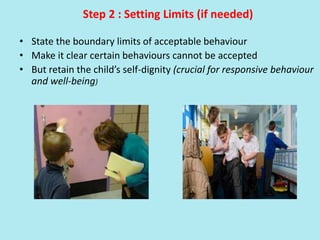
Step 2 : Setting Limits (if needed)
• State the boundary limits of acceptable behaviour
• Make it clear certain behaviours cannot be accepted
• But retain the child’s self-dignity (crucial for responsive behaviour
and well-being)
Emotion Coaching Scripts
Step 2: Examples
• ‘These are the rules that we have to follow.
Doing that is not ok’
• ‘We can’t behave like that even though you are
feeling annoyed because it is not safe’
• ‘You didn’t put the ball away as we agreed.
You’re probably angry that you can’t play with
Billy now because you have to stop now’
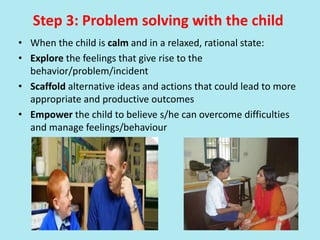
Step 3: Problem solving with the child
• When the child is calm and in a relaxed, rational state:
• Explore the feelings that give rise to the
behavior/problem/incident
• Scaffold alternative ideas and actions that could lead to more
appropriate and productive outcomes
• Empower the child to believe s/he can overcome difficulties
and manage feelings/behaviour
Emotion Coaching Scripts
Step 3: Examples
• ‘This is not a safe place to be angry. Let’s go to a
safe place and then we can talk’
• ‘Next time you’re feeling like this, what could you
do? How do you think you will react next time or if
this happens again’
• ‘You need to sit either by Ruth or sit by
your key adult in front of me – which
do you want to do?’
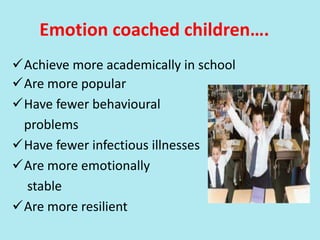
Emotion coached children….
Achieve more academically in school
Are more popular
Have fewer behavioural
problems
Have fewer infectious illnesses
Are more emotionally
stable
Are more resilient
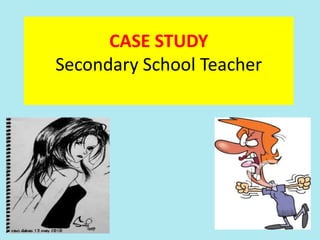
CASE STUDY
Secondary School Teacher
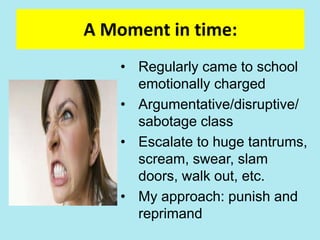
A Moment in time:
• Regularly came to school
emotionally charged
• Argumentative/disruptive/
sabotage class
• Escalate to huge tantrums,
scream, swear, slam
doors, walk out, etc.
• My approach: punish and
reprimand
My ‘Teacher’ Perspective
‘I felt the need to punish
negative behaviour because
my own experiences of school
taught me that that regains control
and establishes authority’.
Research shows teachers perceive a need to be punitive
in an attempt to stop problematic behaviour
(Liljequist & Renk, 2007)
My Teacher Perspective
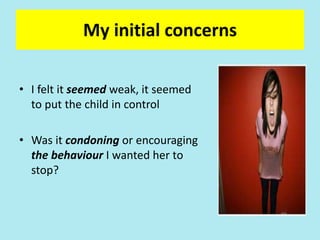
My initial concerns
• I felt it seemed weak, it seemed
to put the child in control
• Was it condoning or encouraging
the behaviour I wanted her to
stop?
Gottman’s Coaching
• “Negative feelings dissipate when children
can talk about their emotions, label them and
feel understood”
• “Children need to understand that their
feelings are not the problem, their behaviour
is”
Happy ever after …
• Once I adopted an emotion coaching approach she
started to slowly change her behaviour
• She no longer has so many tantrums
• She got on better with her peers and staff
• She cooperated more in the classroom
• She developed her own strategies for calming herself
down and was able to talk about how
she was feeling instead of resorting
to disruptive behaviour .
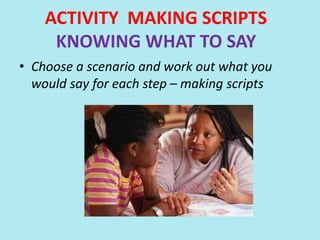
ACTIVITY MAKING SCRIPTS
KNOWING WHAT TO SAY
• Choose a scenario and work out what you
would say for each step – making scripts
DOES IT REALLY WORK?
PERSPECTIVES OF IMPACT
23 generalised positive statements
Emotion coaching…
• “is a useful tool
• helps children to regulate, improve and take ownership of their
behaviour
• helps children to calm down
• helps children to better understand their emotions
• makes practitioners more sensitive to children’s needs
• helps to create more consistent responses to children’s behaviour
• helps practitioners to feel more ‘in control’ during incidents
• provides practitioners with a ‘script’
• makes practitioners less dismissive of children’s feelings
• has become embedded into practice and will continue
• should be used by all practitioners”
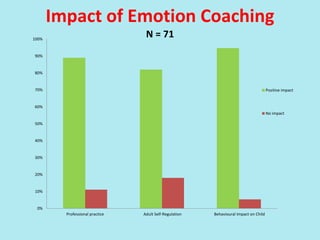
0%
10%
20%
30%
40%
50%
60%
70%
80%
90%
100%
Professional practice Adult Self-Regulation Behavioural Impact on Child
Impact of Emotion Coaching
N = 71
Positive impact
No impact
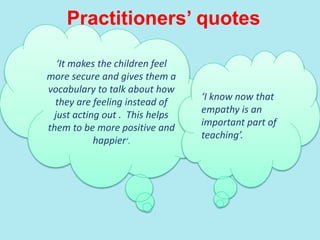
Practitioners’ quotes
‘It makes the children feel
more secure and gives them a
vocabulary to talk about how
they are feeling instead of
just acting out . This helps
them to be more positive and
happier’.
‘I know now that
empathy is an
important part of
teaching’.
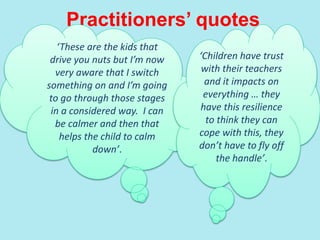
Practitioners’ quotes
‘These are the kids that
drive you nuts but I’m now
very aware that I switch
something on and I’m going
to go through those stages
in a considered way. I can
be calmer and then that
helps the child to calm
down’.
‘Children have trust
with their teachers
and it impacts on
everything … they
have this resilience
to think they can
cope with this, they
don’t have to fly off
the handle’.
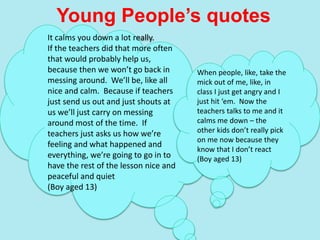
Young People’s quotes
It calms you down a lot really.
If the teachers did that more often
that would probably help us,
because then we won’t go back in
messing around. We’ll be, like all
nice and calm. Because if teachers
just send us out and just shouts at
us we’ll just carry on messing
around most of the time. If
teachers just asks us how we’re
feeling and what happened and
everything, we’re going to go in to
have the rest of the lesson nice and
peaceful and quiet
(Boy aged 13)
When people, like, take the
mick out of me, like, in
class I just get angry and I
just hit ‘em. Now the
teachers talks to me and it
calms me down – the
other kids don’t really pick
on me now because they
know that I don’t react
(Boy aged 13)
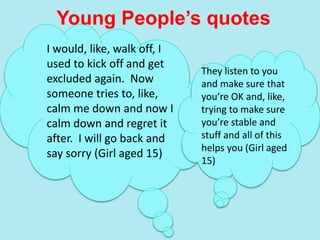
Young People’s quotes
I would, like, walk off, I
used to kick off and get
excluded again. Now
someone tries to, like,
calm me down and now I
calm down and regret it
after. I will go back and
say sorry (Girl aged 15)
They listen to you
and make sure that
you’re OK and, like,
trying to make sure
you’re stable and
stuff and all of this
helps you (Girl aged
15)
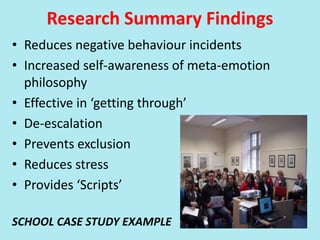
Research Summary Findings
• Reduces negative behaviour incidents
• Increased self-awareness of meta-emotion
philosophy
• Effective in ‘getting through’
• De-escalation
• Prevents exclusion
• Reduces stress
• Provides ‘Scripts’
SCHOOL CASE STUDY EXAMPLE
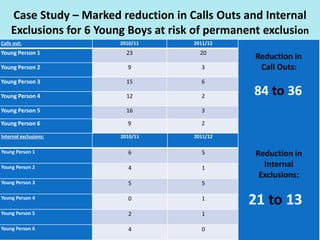
Case Study – Marked reduction in Calls Outs and Internal
Exclusions for 6 Young Boys at risk of permanent exclusion
Internal exclusions: 2010/11 2011/12
Young Person 1 6 5
Young Person 2 4 1
Young Person 3 5 5
Young Person 4 0 1
Young Person 5 2 1
Young Person 6 4 0
Calls out: 2010/11 2011/12
Young Person 1 23 20
Young Person 2 9 3
Young Person 3 15 6
Young Person 4 12 2
Young Person 5 16 3
Young Person 6 9 2
Reduction in
Call Outs:
84 to 36
Reduction in
Internal
Exclusions:
21 to 13
ACTIVITY
Applying Emotion Coaching in your
practice
Brainstorm with your group:
•What aspects of EC do you think you already apply in
your practice?
•Can you see how EC might be applied in your practice?
•Can you think of an incident that has occurred when EC
could have been used?
•Can you see any possible challenges?
THE END
Any Questions ?
References
• Arthur, M. W., Hawkins, J. D., Pollard, J. A., Catalano, R. F., & Baglioni, A. J., Jr. (2002). Measuring risk and protective factors for substance
use, delinquency, and other adolescent problem behaviors: The Communities That Care Youth Survey. Evaluation Review, 26.6, 575-601
• Bergin , C. and Bergin, D. (2009) Attachment in the classroom. Educational Pyschology Review, 21, 141-70
• Bomber, L.M. (2007) Inside I’m hurting: Practical strategies for supporting children with attachment difficulties in schools. London:
Worth.
• Blakemore, S.J. & Frith, U. (2005) The learning brain: lessons for education: a precis. Developmental Science 8.6, 459–465.
• Decety, J. & Meyer,M. (2008) From emotion resonance to empathic understanding: A social developmental neuroscience account.
Development and Psychopathology, 20.4, 1053-1080.
• Geake, J. (2009) The Brain at School: Educational neuroscience in the classroom. Maidenhead: Open UP.
• Goleman, D. (1995). Emotional Intelligence: Why It Can Matter More Than IQ. New York: Bantam Books.
• Gottman, J. (with DeClaire) (1997) The Heart of Parenting: How to raise and emotionally intelligent child. New York: Simon & Shuster.
• Gottman, J. et al (1996) Parental meta-emotional philosophy and the emotional life of families: Theoretical models and preliminary data.
Journal of Family Psychology, 10.3, 243-68.
• Havighurst, S. et al (2010) Tuning into kids: Improving emotion socialisation practices in parents of pre-school children. Journal of Child
Psychology and Psychiatry, 51: 12, 1342-1350.
• Immordino-Yang, M.H. & Damasio, A. (2007), We feel, therefore we learn: The relevance of affective and social neuroscience to
education. Mind, Brain, and Education, 1.1, 3-10.
• Katz, L. F. et al (1996) Meta-Emotion Philosophy and Family Functioning: Reply to Cowan (1996) and Eisenberg (1996). Journal of Family
Psychology. 10.3, 284-291.
• Liljequist, L., & Renk, K. (2007). The relationships among teachers’ perceptions of student behaviour, teachers’ characteristics, and ratings
of students’ emotional and behavioural problems. Educational Psychology: An International Journal of Experimental Educational
Psychology, 27 .4, 557-571.
• Pask, R. & Joy, B. (2007) Mentoring-Coaching: A guide for education professionals. Maidenhead: Open UP.
• Rogers, C. R. (1961) On Becoming a Person. A therapist's view of psychotherapy. Boston: Houghton Mifflin.
• Salovey, P. & Sluyter, E.J. (1997) Emotional development and emotional intelligence: Educational implications. New York: Basic Books
Summary of references on EC
• Chen, F.M., Hsiao, S.L. and Chun, H.L. (2011) The Role of Emotion in Parent-Child Relationships: Children’s Emotionality, Maternal Meta-Emotion,
and Children’s Attachment Security. Journal of Child and Family Studies, 21, 403-410.
• Cunningham, J. N., Kliewer, W., & Garnder, P. W. (2009). Emotion socialization, child emotion understanding and regulation, and adjustment in
urban African American families: Differential associations across child gender. Development and Psychopathology, 21, 261-283.
• Gilbert, L., Rose, J. and McGuire-Sniekus, R. (forthcoming). In Thomas, M. (ed) ‘Promoting children’s well-being and sustainable citizenship through
emotion coaching’ A Child’s World: Working together for a better future. Aberystwyth Press.
• Gottman, J.M., Katz, L.F. and Hooven, C. (1996) Parental meta-emotion philosophy and the emotional life of families: theoretical models and
preliminary data. Journal of Family Psychology, 10 (3), 243-68
• Gottman, J.M., Katz, L.F. and Hooven, C. (1997) Meta-emotion: how families communicate emotionally. Mahwah, NJ: Lawrence Erlbaum Associates.
• Gottman, J.M. and Declaire, J. ( 1997) Raising an Emotionally Intelligent Child: The heart of parenting. New York: Fireside.
• Havighurst, S. S., Harley, A. E., & Prior, M. R. (2004). Building preschool children's emotional competence: A parenting program. Early Education &
Development, 15, 423-447.
• Havighurst, S. S., Wilson, K. R., Harley, A. E., & Prior, M. R. (2009). Tuning in to Kids: An emotion-focused parenting program--initial findings from a
community trial. Journal of Community Psychology, 37, 1008-1023.
• Havighurst, S. S., Wilson, K. R., Harley, A. E., Prior, M. R., & Kehoe, C. (2010). Tuning in to Kids: Improving emotion socialization practices in parents
of preschool children—findings from a community trial. Journal of Child Psychology and Psychiatry, 51, 1342-1350.
• Havighurst, S.S., Wilson, K.R., Harley, A.E., Kehoe, C., Efron, D. and Prior, M.R. (2012) ‘‘Tuning into Kids’’: Reducing Young Children’s Behavior
Problems Using an Emotion Coaching Parenting Program. Journal of Child Psychiatry and Human Development, 43.4, online.
• Hooven, C., Gottman, J.M. and Katz, L.F. (1995) Parental meta-emotion structure predicts family and child outcomes. Cognition and Emotion, 9, 229-
64.
• Katz, L.F., Maliken, A.C. and Stettler, N.M. (2012) Parental Meta-Emotion Philosophy: A Review of Research and Theoretical Framework. Child
Development Perspectives, 6.4, 417-422.
• Katz, L.F., Gottman, J.M. and Hooven, C. (1996) Meta-emotion philosophy and family functioning: reply to Cowan (1996) and Eisenberg (1996).
Journal of Family Psychology. 10 (3), 284-91.
• Katz, L. F., Gottman, J. M., & Hooven, C. (1996). Meta-emotion philosophy and family functioning: Reply to Cowan (1996) and Eisenberg (1996).
Journal of Family Psychology, 10, 284-291.
• Katz, L.F. and Hunter, E.C. (2007). Maternal meta-emotion philosophy and adolescent depressive symptomatology. Social Development, 16, 343–
360.
• Katz, L.F. and Windecker-Nelson, B. (2004) Parental meta-emotion philosophy in families with conduct-problem children: Links with peer
relations. Journal of Abnormal Child Psychology, 32 (4), 385-98.
• Katz, L.F. and Windecker-Nelson (2006) Domestic Violence, Emotion Coaching, and Child Adjustment. Journal of Family Psychology. 20.1, 50-67.
Summary of references on EC
• Katz, L.F., Hunter, E. and Klowden, A. (2008) Intimate partner violence and children’s reaction to peer provocation; The moderating role of
emotion coaching. Journal of Family Psychology, 22 (4), 614-21.
• Lagace-Seguin, D.G. and d’Entremont, M-R. L., ( 2006) The role of child negative affect in the relations between parenting styles and play, Early
Child Development and Care, 176 (5), 461-77.
• Lagace-Seguin, D.G. and Coplan, R. (2005) Maternal emotional styles and child social adjustment: assessment, correlates, outcomes and
goodness of fit in early childhood. Journal of Social Development, 14, 613–636.
• Lunkenheimer, E. S., Shields, A. M., & Cortina, K. S. (2007). Parental emotion coaching and dismissing in family interaction. Social Development,
16, 232-248.
• Murphy, J., Havighurst, S. and Kehoe, C. (forthcoming) ‘Trauma-focused Tuning in to Kids’, Journal of Traumatic Stress.
• Ramsden, S. R., & Hubbard, J. A. (2002). Family expressiveness and parental emotion coaching: Their role in children's ER and aggression. Journal
of Abnormal Child Psychology, 30, 657-667.
• Richter, L. (2004) The Importance of Caregiver-Child Interactions for the Survival and Healthy Development of Young Children: A Review. Geneva,
Switzerland; Dept of Child and Adolescent Health and Development, World Health Organisation.
• Rose, J., Gilbert, L., McGuire-Sniekus, R. (forthcoming) Emotion Coaching - a new strategy for schools, early years settings and youth centres to
promote behavioural self-regulation in children and young people: A pilot study. International Journal of Pastoral Care and Education.
• Rose, J., Gilbert, L. & Smith, H. (2012) ‘Affective teaching and the affective dimensions of learning’. In Ward, S. (ed) A Student’s Guide to
Education Studies. London: Routledge.
• Schwartz, J.P. , Thigpen, S.E. and Montgomery, J.K. (2006) Examination of parenting styles of processing emotions and differentiation of self.
Family Journal, 14 (1), 41-48.
• Shortt, J.W., Stoolmiller, M, Smith-Shine, J.N., Eddy, J.M. and Sheeber, L. (2010) Maternal emotion coaching, adolescent anger regulation, and
siblings’ externatlizing symptons. Journal of Child Psychology and Psychiatry, 51 (7), 799-808.
• Sheeber, L., Shortt, J.W., Low, S., & Katz, L.F. (2010). Emotion coaching as a unique predictor of adolescent internalizing problems. Paper
presented at the annual meeting of the Society for Research in Psychopathology, Seattle, WA.
• Shipman, K. L., Schneider, R., Fitzgerald, M. M., Sims, C., Swisher, L., & Edwards, A. (2007). Maternal emotion socialization in maltreating and non-
maltreating families: Implications for children's ER. Social Development, 16, 268-285.
• Wilson, B.J., Berg, J.L., Surawski, M.E. and King, K.K. (2013) Autism and externalizing behaivours: Buffering effects of parental emotion coaching.
Research in Austism Spectrum Disorders, 7, 767-776.
• Wilson, K.R., Havighurst, S.S. and Harley, A. E. (2012) Tuning in to Kids: An effectiveness trial of a parenting program targeting emotion
socialization of preschoolers. Journal of Family Psychology, 26.1, 56-65.
• Yap, M.B.H., Allen, N.B., Leve, C. and Katz, L.F (2008) Maternal meta-emotion philosophy and socialization of adolescent affect: The moderating
role of adolescent temperament. Journal of Family Psychology, 22(5), 688-700
• Young, S.L. (2009) The function of parental communication patterns: Reflection-enhancing and reflection-discouraging
approaches. Communication Quarterly, 57 (4), 379-9.

Session 3 Emotion Coaching Strategies

  • 1.
    Attachment and Learning Session3 – Strategies Emotion Coaching
  • 2.
    The Emotion CoachingProject • Research aim: ‘To support the development of resilience and community well-being by integrating emotion coaching into everyday practice in work with children and young people’
  • 3.
    EMOTION COACHING • Part1 Why do we need it? • Part 2 What is it? • Part 3 How do we do it?
  • 4.
    PART 1 Why weneed emotion coaching The anatomy and physiology of Emotions
  • 5.
    What informs EmotionCoaching? • Neuroscientific evidence • Emotions & Vagal Tone • Attachment theory & Empathy
  • 6.
  • 7.
    The Connectome- neuronalnetwork linking up the areas of brain Denser network = quicker, faster, more reliable connections because ‘the sum of the parts is better than the parts alone’
  • 8.
    Plasticity –the abilityto adopt and adapt to stimulus Neuronal networks are continuously shaped by genetic, environmental and experiential stimulus and strengthened through repetition. Brain plasticity reduces as we age
  • 9.
    Mirror Neurones- encodeinformation about the external world and goal-directed behaviour They enable humans to emulate others and thereby empathise & understand intent– essential for the socialization of children
  • 10.
    Emotional Responses Distress FearSurprise Anger Disgust Joy Innate , hardwired and universal
  • 11.
    The Double Act Networks between amygdala and frontal lobes (OMPFC, anterior cingulate, insula) involved with fear conditioning, emotional regulation and attachment schema  More connections between amygdala and frontal lobes than any other part of brain
  • 12.
    “The vagal systemallows us to maintain continued social engagement by modulating and fine-tuning sympathetic arousal during emotional interpersonal exchanges” (Cozolino, 2006: 61) The Vagus Nerve: Runs from the brain throughout the body and acts on all organs
  • 13.
    Vagal Tone http://www.youtube.com/watch?v=6GdALwuYtG8&feature=related Good VagalTone Highly responsive: • Respond quicker, process information faster, concentrate better • More appropriate and effective responses to stimuli • Return faster to a normal ‘resting state’ Poor Vagal Tone Low responsiveness: • Responds and process information not as quickly, less able to concentrate. • Less appropriate and effective responses to stimuli • Difficulty returning to normal ‘resting state
  • 14.
    How does EmotionCoaching work with the brain and body? 1. Provides a stimulus for triggering the vagus nerve 2. Triggers an empathic mirror system 3. Helps child to feel safe and calm down 4. Provides a narrative for connecting emotional and cognitive processes 5. Stimulates neural connections between amygdala/limbic system and frontal lobes (especially OMPFC and corpus callosum) 6. Creates a process of co-regulation and ‘repair’ (helping implicit memories become explicit)  Helps child to learn to self- sooth  Helps child to learn to self- regulate  Helps child to learn to resolve problems  Helps child to learn they can survive adversity (or thwarted wishes/desires/needs)  Helps child to learn about empathy and pro-social behaviour
  • 15.
    PART 2 What isemotion coaching? • Based on research by John Gottman (1997) in America • CLIP - http://www.gottman.com/48995/Parenting.html • Research suggests it is a key to happy, resilient, and well-adjusted children and young people Emotion coaching is helping children and young people to understand the different emotions they experience, why they occur, and how to handle them
  • 16.
    Safe Haven SecureBase Relative dependency Independence
  • 17.
    • External Frameworks Externalregulation (Sanctions and Rewards) • Internal Frameworks Internal regulation (Emotion Coaching) Emotion Coaching
  • 18.
    5 Steps ofemotion coaching 1. Be aware of child’s responses 2. Recognize emotional times as opportunities for intimacy and teaching 3. Listen empathetically and validate child’s feelings 4. Help child to verbally label emotions – helps sooth the nervous system and recovery rate 5. Set limits while helping child to problem-solve
  • 19.
    What this meansin practice STEP 1 Recognising, empathising, validating the feelings and labelling them STEP 2 (if needed) Setting limits on behaviour STEP 3 Problem-solving with the child/young person
  • 20.
    Emotion coaching involves: •Teaching children/young people about the world of emotion ‘in the moment’ • Giving children strategies to deal with ups and downs • Accepting negative emotions as normal • Using moments of negative behaviour to as opportunities for teaching • Building trusting and respectful relationships with children/young people
  • 21.
    Emotion coaching isa set of processes that includes . . . talking to the child about the emotions helping the child to verbally label the emotions being felt respecting and accepting the child’s emotions discussing the situations that elicited the emotions  having goals and strategies for coping with these situations (Gottman, 1997)
  • 22.
    Lessons learnt  Toempathize  To read others’ emotions and social cues  To control impulses (self-sooth and self-regulate)  To delay gratification  To motivate themselves  To cope with life’s ups and downs (be resilient) • To pay attention!
  • 23.
    When it goeswrong Children who are not emotion coached: • Lack the ability to self-sooth • Are less able to control their emotions • Find alternative outlets for dealing with their emotions • Are less sensitive to social cues • Have more trouble with school work • Have more trouble getting along with other children • Have more behaviour problems with teachers • Have more stress-related hormones • Have more illnesses (Gottman, 1997;Goleman, 1995)
  • 24.
    How schools canhelp • “Schools are becoming emotional buffering zones for the growing number of children hurt by divorce, poverty, and neglect” (Goleman, 1995) • Neurological resilience to self-sooth is fostered by the emotional climate in the classroom
  • 25.
    Emotion coaching recognisesthat EQ matters more than IQ
  • 26.
    Feelings Matter Watch thisclip: Are you disrespecting me? http://www.youtube.com/watch?v=zV1zK8zRCPo&feature=channel (3 min Lauren in the French class) Whilst watching: Identify the feelings going on underneath the behaviour in a) The pupil b) The teacher The importance of a meta-emotion philosophy(Gottman, 1997)
  • 27.
    Emotion Coaching Style “Muchof today’s popular advice ignores the world of emotions. Instead, it relies on child-rearing theories that address the children’s behaviour, but disregard the feelings that underlie that behaviour” (Gottman, 1997)
  • 28.
    Building a PowerBase “Proposing solutions before empathising is like trying to build the frame of a house before you lay a firm foundation” (Gottman) •Emotional first aid is needed first •In this way, emotion coaching builds a power base that is an emotional bond •This creates a safe haven, a place of trust, a place of respect, a place of acceptance, a sense of self etc. •This in turn leads to children and young people giving back respect, acceptance of boundaries etc.
  • 29.
    What Emotion Coachingis NOT… • A quick fix • A panacea • A substitute for specific interventions • A therapy It is also not disapproving or dismissing of emotions
  • 30.
    Disapproving style • Disapprovesof negative emotions – viewed as a sign of weakness, lack of control, unconstructive • Lacks empathy, noticeably critical and intolerant • Tries to get rid of negative emotions via discipline, reprimand, punishment • Focuses on the behaviour rather than the emotions generating the behaviour • More likely to view negative emotional displays as a form of manipulation, lack of obedience, sign of bad character • Often motivated by need to control and regain power and/or to ‘toughen up’ child
  • 31.
    Dismissing style • Despitegood intentions (wants to make child feel better) but is uncomfortable with negative emotions • Views negative emotions as toxic and so must be ‘got over quickly’ • Considers paying attention to such emotions will make them worse, prolong them • Tries to stop negative emotions by reducing/ minimising/ making light of their importance/significance e.g. it’s no big deal, don’t worry about it, be a big girl, that’s life, you’ll be fine • Often motivated by need to rescue and make things better, fix the problem e.g. have a biscuit, I’ll buy a new one, you need to do this • Focuses on getting rid of the emotion with logic or distraction rather than understanding the feelings
  • 32.
    What we thinkabout disapproving and dismissing messages to child…. “It works so it must be good!” BUT the actual message is….. •What you are feeling is not right, your assessment of the problem is wrong, you must not feel this way •Child does not learn to trust own feelings affecting decision-making •Not given opportunities to experience emotions and deal with them effectively so grow up unprepared for life’s challenges •Not given opportunities to self-regulate or problem-solve •Can lead to suppression of natural emotions, less or lack of self- regulation, reliance on distraction to get rid of emotion •Generates more negative feelings - resentment, guilt, shame, anger
  • 33.
    The cross webear Emotion Coaching Disapproving High empathy Low empathy High guidance High guidance Laissez Faire Dismissive High empathy Low empathy Low guidance Low guidance Visit www.talaris.org/spotlight_parenting_styles.htm
  • 34.
    Emotion Coaching messages •We all have feelings and need to recognize them in ourselves as well as others • We are not alone and we are accepted, supported, valid, cared about, understood, trustworthy and respected – this is then returned • We are empowered and it’s safe to engage in problem- solving • All feelings are normal but need to be regulated and expressed constructively • Problems and conflicts can be resolved peacefully!
  • 35.
    Part 3 How dowe do Emotion Coaching? • Having emotional awareness of own emotions (Meta-Emotion Philosophy) “Put on your oxygen mask first before putting it on the child” • Recognising the power and purpose of emotions • Empathising • Active listening/Rapport building • Scaffolding /Problem solving together • Role-modelling
  • 36.
    Emotion Coaching STEP 1 Recognising,empathising, validating the feelings and labelling them STEP 2 (if needed) Setting limits on behaviour STEP 3 Problem-solving with the child/young person
  • 37.
  • 38.
    Instead of denyingthe feeling … .
  • 39.
  • 40.
    Step 1- Empathise,validate and label • Recognise all emotions as being natural and normal and not always a matter of choice • Recognise behaviour as communication (relational vs behavioural model) • Look for physical and verbal signs of the emotion being felt • Take on the child’s perspective (mentalising/mind-mindedness) • Use words to reflect back child’s emotion and help child/young person to label emotion • Affirm and empathise, allowing to calm down • Provide a narrative/translation for the emotional experience (creating cognitive links)
  • 41.
    Emotion Coaching Scripts •‘I can see that you get angry when that happens. I would feel angry if that happened to me. It’s normal to feel like that’ • ‘I can see you’re frowning and you’re kicking the wall and you’re expressing a lot of energy. I would be feeling like that too if I didn’t want to do something’ • ‘I noticed you looking around at the other who are working on their projects. I think you might be feeling nervous right now about whether your work will be ok. Have I got that right?’ Step 1: Examples
  • 42.
    Step 2 :Setting Limits (if needed) • State the boundary limits of acceptable behaviour • Make it clear certain behaviours cannot be accepted • But retain the child’s self-dignity (crucial for responsive behaviour and well-being)
  • 43.
    Emotion Coaching Scripts Step2: Examples • ‘These are the rules that we have to follow. Doing that is not ok’ • ‘We can’t behave like that even though you are feeling annoyed because it is not safe’ • ‘You didn’t put the ball away as we agreed. You’re probably angry that you can’t play with Billy now because you have to stop now’
  • 44.
    Step 3: Problemsolving with the child • When the child is calm and in a relaxed, rational state: • Explore the feelings that give rise to the behavior/problem/incident • Scaffold alternative ideas and actions that could lead to more appropriate and productive outcomes • Empower the child to believe s/he can overcome difficulties and manage feelings/behaviour
  • 45.
    Emotion Coaching Scripts Step3: Examples • ‘This is not a safe place to be angry. Let’s go to a safe place and then we can talk’ • ‘Next time you’re feeling like this, what could you do? How do you think you will react next time or if this happens again’ • ‘You need to sit either by Ruth or sit by your key adult in front of me – which do you want to do?’
  • 46.
    Emotion coached children…. Achievemore academically in school Are more popular Have fewer behavioural problems Have fewer infectious illnesses Are more emotionally stable Are more resilient
  • 47.
  • 48.
    A Moment intime: • Regularly came to school emotionally charged • Argumentative/disruptive/ sabotage class • Escalate to huge tantrums, scream, swear, slam doors, walk out, etc. • My approach: punish and reprimand
  • 49.
    My ‘Teacher’ Perspective ‘Ifelt the need to punish negative behaviour because my own experiences of school taught me that that regains control and establishes authority’. Research shows teachers perceive a need to be punitive in an attempt to stop problematic behaviour (Liljequist & Renk, 2007) My Teacher Perspective
  • 50.
    My initial concerns •I felt it seemed weak, it seemed to put the child in control • Was it condoning or encouraging the behaviour I wanted her to stop?
  • 51.
    Gottman’s Coaching • “Negativefeelings dissipate when children can talk about their emotions, label them and feel understood” • “Children need to understand that their feelings are not the problem, their behaviour is”
  • 52.
    Happy ever after… • Once I adopted an emotion coaching approach she started to slowly change her behaviour • She no longer has so many tantrums • She got on better with her peers and staff • She cooperated more in the classroom • She developed her own strategies for calming herself down and was able to talk about how she was feeling instead of resorting to disruptive behaviour .
  • 53.
    ACTIVITY MAKING SCRIPTS KNOWINGWHAT TO SAY • Choose a scenario and work out what you would say for each step – making scripts
  • 54.
  • 55.
    PERSPECTIVES OF IMPACT 23generalised positive statements Emotion coaching… • “is a useful tool • helps children to regulate, improve and take ownership of their behaviour • helps children to calm down • helps children to better understand their emotions • makes practitioners more sensitive to children’s needs • helps to create more consistent responses to children’s behaviour • helps practitioners to feel more ‘in control’ during incidents • provides practitioners with a ‘script’ • makes practitioners less dismissive of children’s feelings • has become embedded into practice and will continue • should be used by all practitioners”
  • 56.
    0% 10% 20% 30% 40% 50% 60% 70% 80% 90% 100% Professional practice AdultSelf-Regulation Behavioural Impact on Child Impact of Emotion Coaching N = 71 Positive impact No impact
  • 57.
    Practitioners’ quotes ‘It makesthe children feel more secure and gives them a vocabulary to talk about how they are feeling instead of just acting out . This helps them to be more positive and happier’. ‘I know now that empathy is an important part of teaching’.
  • 58.
    Practitioners’ quotes ‘These arethe kids that drive you nuts but I’m now very aware that I switch something on and I’m going to go through those stages in a considered way. I can be calmer and then that helps the child to calm down’. ‘Children have trust with their teachers and it impacts on everything … they have this resilience to think they can cope with this, they don’t have to fly off the handle’.
  • 59.
    Young People’s quotes Itcalms you down a lot really. If the teachers did that more often that would probably help us, because then we won’t go back in messing around. We’ll be, like all nice and calm. Because if teachers just send us out and just shouts at us we’ll just carry on messing around most of the time. If teachers just asks us how we’re feeling and what happened and everything, we’re going to go in to have the rest of the lesson nice and peaceful and quiet (Boy aged 13) When people, like, take the mick out of me, like, in class I just get angry and I just hit ‘em. Now the teachers talks to me and it calms me down – the other kids don’t really pick on me now because they know that I don’t react (Boy aged 13)
  • 60.
    Young People’s quotes Iwould, like, walk off, I used to kick off and get excluded again. Now someone tries to, like, calm me down and now I calm down and regret it after. I will go back and say sorry (Girl aged 15) They listen to you and make sure that you’re OK and, like, trying to make sure you’re stable and stuff and all of this helps you (Girl aged 15)
  • 61.
    Research Summary Findings •Reduces negative behaviour incidents • Increased self-awareness of meta-emotion philosophy • Effective in ‘getting through’ • De-escalation • Prevents exclusion • Reduces stress • Provides ‘Scripts’ SCHOOL CASE STUDY EXAMPLE
  • 62.
    Case Study –Marked reduction in Calls Outs and Internal Exclusions for 6 Young Boys at risk of permanent exclusion Internal exclusions: 2010/11 2011/12 Young Person 1 6 5 Young Person 2 4 1 Young Person 3 5 5 Young Person 4 0 1 Young Person 5 2 1 Young Person 6 4 0 Calls out: 2010/11 2011/12 Young Person 1 23 20 Young Person 2 9 3 Young Person 3 15 6 Young Person 4 12 2 Young Person 5 16 3 Young Person 6 9 2 Reduction in Call Outs: 84 to 36 Reduction in Internal Exclusions: 21 to 13
  • 63.
    ACTIVITY Applying Emotion Coachingin your practice Brainstorm with your group: •What aspects of EC do you think you already apply in your practice? •Can you see how EC might be applied in your practice? •Can you think of an incident that has occurred when EC could have been used? •Can you see any possible challenges?
  • 64.
  • 65.
    References • Arthur, M.W., Hawkins, J. D., Pollard, J. A., Catalano, R. F., & Baglioni, A. J., Jr. (2002). Measuring risk and protective factors for substance use, delinquency, and other adolescent problem behaviors: The Communities That Care Youth Survey. Evaluation Review, 26.6, 575-601 • Bergin , C. and Bergin, D. (2009) Attachment in the classroom. Educational Pyschology Review, 21, 141-70 • Bomber, L.M. (2007) Inside I’m hurting: Practical strategies for supporting children with attachment difficulties in schools. London: Worth. • Blakemore, S.J. & Frith, U. (2005) The learning brain: lessons for education: a precis. Developmental Science 8.6, 459–465. • Decety, J. & Meyer,M. (2008) From emotion resonance to empathic understanding: A social developmental neuroscience account. Development and Psychopathology, 20.4, 1053-1080. • Geake, J. (2009) The Brain at School: Educational neuroscience in the classroom. Maidenhead: Open UP. • Goleman, D. (1995). Emotional Intelligence: Why It Can Matter More Than IQ. New York: Bantam Books. • Gottman, J. (with DeClaire) (1997) The Heart of Parenting: How to raise and emotionally intelligent child. New York: Simon & Shuster. • Gottman, J. et al (1996) Parental meta-emotional philosophy and the emotional life of families: Theoretical models and preliminary data. Journal of Family Psychology, 10.3, 243-68. • Havighurst, S. et al (2010) Tuning into kids: Improving emotion socialisation practices in parents of pre-school children. Journal of Child Psychology and Psychiatry, 51: 12, 1342-1350. • Immordino-Yang, M.H. & Damasio, A. (2007), We feel, therefore we learn: The relevance of affective and social neuroscience to education. Mind, Brain, and Education, 1.1, 3-10. • Katz, L. F. et al (1996) Meta-Emotion Philosophy and Family Functioning: Reply to Cowan (1996) and Eisenberg (1996). Journal of Family Psychology. 10.3, 284-291. • Liljequist, L., & Renk, K. (2007). The relationships among teachers’ perceptions of student behaviour, teachers’ characteristics, and ratings of students’ emotional and behavioural problems. Educational Psychology: An International Journal of Experimental Educational Psychology, 27 .4, 557-571. • Pask, R. & Joy, B. (2007) Mentoring-Coaching: A guide for education professionals. Maidenhead: Open UP. • Rogers, C. R. (1961) On Becoming a Person. A therapist's view of psychotherapy. Boston: Houghton Mifflin. • Salovey, P. & Sluyter, E.J. (1997) Emotional development and emotional intelligence: Educational implications. New York: Basic Books
  • 66.
    Summary of referenceson EC • Chen, F.M., Hsiao, S.L. and Chun, H.L. (2011) The Role of Emotion in Parent-Child Relationships: Children’s Emotionality, Maternal Meta-Emotion, and Children’s Attachment Security. Journal of Child and Family Studies, 21, 403-410. • Cunningham, J. N., Kliewer, W., & Garnder, P. W. (2009). Emotion socialization, child emotion understanding and regulation, and adjustment in urban African American families: Differential associations across child gender. Development and Psychopathology, 21, 261-283. • Gilbert, L., Rose, J. and McGuire-Sniekus, R. (forthcoming). In Thomas, M. (ed) ‘Promoting children’s well-being and sustainable citizenship through emotion coaching’ A Child’s World: Working together for a better future. Aberystwyth Press. • Gottman, J.M., Katz, L.F. and Hooven, C. (1996) Parental meta-emotion philosophy and the emotional life of families: theoretical models and preliminary data. Journal of Family Psychology, 10 (3), 243-68 • Gottman, J.M., Katz, L.F. and Hooven, C. (1997) Meta-emotion: how families communicate emotionally. Mahwah, NJ: Lawrence Erlbaum Associates. • Gottman, J.M. and Declaire, J. ( 1997) Raising an Emotionally Intelligent Child: The heart of parenting. New York: Fireside. • Havighurst, S. S., Harley, A. E., & Prior, M. R. (2004). Building preschool children's emotional competence: A parenting program. Early Education & Development, 15, 423-447. • Havighurst, S. S., Wilson, K. R., Harley, A. E., & Prior, M. R. (2009). Tuning in to Kids: An emotion-focused parenting program--initial findings from a community trial. Journal of Community Psychology, 37, 1008-1023. • Havighurst, S. S., Wilson, K. R., Harley, A. E., Prior, M. R., & Kehoe, C. (2010). Tuning in to Kids: Improving emotion socialization practices in parents of preschool children—findings from a community trial. Journal of Child Psychology and Psychiatry, 51, 1342-1350. • Havighurst, S.S., Wilson, K.R., Harley, A.E., Kehoe, C., Efron, D. and Prior, M.R. (2012) ‘‘Tuning into Kids’’: Reducing Young Children’s Behavior Problems Using an Emotion Coaching Parenting Program. Journal of Child Psychiatry and Human Development, 43.4, online. • Hooven, C., Gottman, J.M. and Katz, L.F. (1995) Parental meta-emotion structure predicts family and child outcomes. Cognition and Emotion, 9, 229- 64. • Katz, L.F., Maliken, A.C. and Stettler, N.M. (2012) Parental Meta-Emotion Philosophy: A Review of Research and Theoretical Framework. Child Development Perspectives, 6.4, 417-422. • Katz, L.F., Gottman, J.M. and Hooven, C. (1996) Meta-emotion philosophy and family functioning: reply to Cowan (1996) and Eisenberg (1996). Journal of Family Psychology. 10 (3), 284-91. • Katz, L. F., Gottman, J. M., & Hooven, C. (1996). Meta-emotion philosophy and family functioning: Reply to Cowan (1996) and Eisenberg (1996). Journal of Family Psychology, 10, 284-291. • Katz, L.F. and Hunter, E.C. (2007). Maternal meta-emotion philosophy and adolescent depressive symptomatology. Social Development, 16, 343– 360. • Katz, L.F. and Windecker-Nelson, B. (2004) Parental meta-emotion philosophy in families with conduct-problem children: Links with peer relations. Journal of Abnormal Child Psychology, 32 (4), 385-98. • Katz, L.F. and Windecker-Nelson (2006) Domestic Violence, Emotion Coaching, and Child Adjustment. Journal of Family Psychology. 20.1, 50-67.
  • 67.
    Summary of referenceson EC • Katz, L.F., Hunter, E. and Klowden, A. (2008) Intimate partner violence and children’s reaction to peer provocation; The moderating role of emotion coaching. Journal of Family Psychology, 22 (4), 614-21. • Lagace-Seguin, D.G. and d’Entremont, M-R. L., ( 2006) The role of child negative affect in the relations between parenting styles and play, Early Child Development and Care, 176 (5), 461-77. • Lagace-Seguin, D.G. and Coplan, R. (2005) Maternal emotional styles and child social adjustment: assessment, correlates, outcomes and goodness of fit in early childhood. Journal of Social Development, 14, 613–636. • Lunkenheimer, E. S., Shields, A. M., & Cortina, K. S. (2007). Parental emotion coaching and dismissing in family interaction. Social Development, 16, 232-248. • Murphy, J., Havighurst, S. and Kehoe, C. (forthcoming) ‘Trauma-focused Tuning in to Kids’, Journal of Traumatic Stress. • Ramsden, S. R., & Hubbard, J. A. (2002). Family expressiveness and parental emotion coaching: Their role in children's ER and aggression. Journal of Abnormal Child Psychology, 30, 657-667. • Richter, L. (2004) The Importance of Caregiver-Child Interactions for the Survival and Healthy Development of Young Children: A Review. Geneva, Switzerland; Dept of Child and Adolescent Health and Development, World Health Organisation. • Rose, J., Gilbert, L., McGuire-Sniekus, R. (forthcoming) Emotion Coaching - a new strategy for schools, early years settings and youth centres to promote behavioural self-regulation in children and young people: A pilot study. International Journal of Pastoral Care and Education. • Rose, J., Gilbert, L. & Smith, H. (2012) ‘Affective teaching and the affective dimensions of learning’. In Ward, S. (ed) A Student’s Guide to Education Studies. London: Routledge. • Schwartz, J.P. , Thigpen, S.E. and Montgomery, J.K. (2006) Examination of parenting styles of processing emotions and differentiation of self. Family Journal, 14 (1), 41-48. • Shortt, J.W., Stoolmiller, M, Smith-Shine, J.N., Eddy, J.M. and Sheeber, L. (2010) Maternal emotion coaching, adolescent anger regulation, and siblings’ externatlizing symptons. Journal of Child Psychology and Psychiatry, 51 (7), 799-808. • Sheeber, L., Shortt, J.W., Low, S., & Katz, L.F. (2010). Emotion coaching as a unique predictor of adolescent internalizing problems. Paper presented at the annual meeting of the Society for Research in Psychopathology, Seattle, WA. • Shipman, K. L., Schneider, R., Fitzgerald, M. M., Sims, C., Swisher, L., & Edwards, A. (2007). Maternal emotion socialization in maltreating and non- maltreating families: Implications for children's ER. Social Development, 16, 268-285. • Wilson, B.J., Berg, J.L., Surawski, M.E. and King, K.K. (2013) Autism and externalizing behaivours: Buffering effects of parental emotion coaching. Research in Austism Spectrum Disorders, 7, 767-776. • Wilson, K.R., Havighurst, S.S. and Harley, A. E. (2012) Tuning in to Kids: An effectiveness trial of a parenting program targeting emotion socialization of preschoolers. Journal of Family Psychology, 26.1, 56-65. • Yap, M.B.H., Allen, N.B., Leve, C. and Katz, L.F (2008) Maternal meta-emotion philosophy and socialization of adolescent affect: The moderating role of adolescent temperament. Journal of Family Psychology, 22(5), 688-700 • Young, S.L. (2009) The function of parental communication patterns: Reflection-enhancing and reflection-discouraging approaches. Communication Quarterly, 57 (4), 379-9.