Skill: Directives, Suggestions and
Information Giving
• Directives, suggestions and information are
influencing skills that can introduce clients to
new possibilities, highlight alternatives and
inspire new ways of approaching old problems
to help clients make specific changes.
• Directives encourage clients to change the way
they think or act. Appropriateness for use of
directives is based on the counselor’s clinical
judgment, with agreement by client that these
are in the client’s best interest.
May 2011 Revised
Skill: Directives, Suggestions and Information
giving
• When using directives the counselor takes
professional responsibility for assessing what client
change is desirable and empowers and facilitates
to client to make the necessary changes.
• These skills work best when positive rapport is
established and there is a collaborative relationship
between the counselor and client. (Sommers-
Flanagan and Sommers-Flanagan, p.90).
• Example: “We’ve talked about A, B and C, but let’s
now consider X, Y and Z…”
May 2011 Revised
Activity
• Your client recently disclosed that he has been the victim
of domestic violence. He is fearful of what may happen if
he returns home and wants to leave. He has no idea
how to coordinate he move and believes that most
resources are directed toward aiding women. He wants
you “advice” and does not want you to simply refer him
to a social worker because he trusts you and it took him
a long time to even disclose this information at all.
• What do you say? How do you help him?
May 2011 Revised
Skill: Logical Consequences
• Logical Consequences may manifest as the negative
predictable outcomes of behaviors which can and should
be foreseen by the client, but sometimes are not.
• Counselors help clients identify, consider and visualize
both positive and negative outcomes and logical
consequences of their actions take facilitate taking steps
to focusing on avoiding negative consequences and
achieving positive results.
• Example: “ You know that if you don’t make some effort
to change, things are not going to improve…”
May 2011 Revised
Skill: Reframing
• Reframing is an influencing skill to help a client forage a
healthy and positive perspective about a concern in order to
take an effective action. Reframing involves using a different
frame of reference towards a problem.
• Example:
– Cl: “I am worn out. All I ever do is take care of people. I get breakfast
together every morning. I pack lunches before work and school. I
pick out clothes. I get backpacks ready. I work all day long and then
have to come home and do housework and fix supper!”
– Co: “I am impressed with your ability to manage so many things at
one time.”
May 2011 Revised
Skill: Interpretation
• Facilitates clarification between account of the client and
understanding for the counselor.
• Interpretation by counselor is most effective when
supported by evidence from client, other treatment
professionals, reports and/ or supervisors.
• Counselors seeking ongoing supervision of interpretation
increases effectiveness and accuracy.
• Example:
– “Could it be that you are reacting to your children just as your
parents reacted to you when they we upset with your
behavior….?”
May 2011 Revised
Activity
• Your client looks at you, sighs, and holds her
face in her lap. She says to you that she
understands how silly it is to be so sad about a
pet dog dying but she feels devastated because
he was so much more than “just the dog”. He
was her best friend and accepted her, no matter
what. Now she wonders what she will she do.
• How do you interpret this? What might you say?
May 2011 Revised
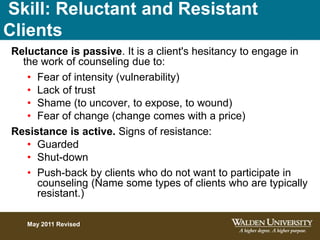
Skill: Reluctant and Resistant
Clients
Reluctance is passive. It is a client's hesitancy to engage in
the work of counseling due to:
• Fear of intensity (vulnerability)
• Lack of trust
• Shame (to uncover, to expose, to wound)
• Fear of change (change comes with a price)
Resistance is active. Signs of resistance:
• Guarded
• Shut-down
• Push-back by clients who do not want to participate in
counseling (Name some types of clients who are typically
resistant.)
May 2011 Revised
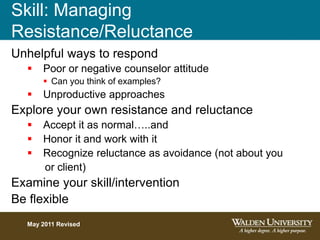
Skill: Managing
Resistance/Reluctance
Unhelpful ways to respond
 Poor or negative counselor attitude
 Can you think of examples?
 Unproductive approaches
Explore your own resistance and reluctance
 Accept it as normal…..and
 Honor it and work with it
 Recognize reluctance as avoidance (not about you
or client)
Examine your skill/intervention
Be flexible
May 2011 Revised
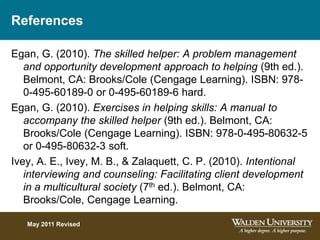
References
Egan, G. (2010). The skilled helper: A problem management
and opportunity development approach to helping (9th ed.).
Belmont, CA: Brooks/Cole (Cengage Learning). ISBN: 978-
0-495-60189-0 or 0-495-60189-6 hard.
Egan, G. (2010). Exercises in helping skills: A manual to
accompany the skilled helper (9th ed.). Belmont, CA:
Brooks/Cole (Cengage Learning). ISBN: 978-0-495-80632-5
or 0-495-80632-3 soft.
Ivey, A. E., Ivey, M. B., & Zalaquett, C. P. (2010). Intentional
interviewing and counseling: Facilitating client development
in a multicultural society (7th ed.). Belmont, CA:
Brooks/Cole, Cengage Learning.
May 2011 Revised

INFORMATION GIVING.PPT

  • 1.
    Skill: Directives, Suggestionsand Information Giving • Directives, suggestions and information are influencing skills that can introduce clients to new possibilities, highlight alternatives and inspire new ways of approaching old problems to help clients make specific changes. • Directives encourage clients to change the way they think or act. Appropriateness for use of directives is based on the counselor’s clinical judgment, with agreement by client that these are in the client’s best interest. May 2011 Revised
  • 2.
    Skill: Directives, Suggestionsand Information giving • When using directives the counselor takes professional responsibility for assessing what client change is desirable and empowers and facilitates to client to make the necessary changes. • These skills work best when positive rapport is established and there is a collaborative relationship between the counselor and client. (Sommers- Flanagan and Sommers-Flanagan, p.90). • Example: “We’ve talked about A, B and C, but let’s now consider X, Y and Z…” May 2011 Revised
  • 3.
    Activity • Your clientrecently disclosed that he has been the victim of domestic violence. He is fearful of what may happen if he returns home and wants to leave. He has no idea how to coordinate he move and believes that most resources are directed toward aiding women. He wants you “advice” and does not want you to simply refer him to a social worker because he trusts you and it took him a long time to even disclose this information at all. • What do you say? How do you help him? May 2011 Revised
  • 4.
    Skill: Logical Consequences •Logical Consequences may manifest as the negative predictable outcomes of behaviors which can and should be foreseen by the client, but sometimes are not. • Counselors help clients identify, consider and visualize both positive and negative outcomes and logical consequences of their actions take facilitate taking steps to focusing on avoiding negative consequences and achieving positive results. • Example: “ You know that if you don’t make some effort to change, things are not going to improve…” May 2011 Revised
  • 5.
    Skill: Reframing • Reframingis an influencing skill to help a client forage a healthy and positive perspective about a concern in order to take an effective action. Reframing involves using a different frame of reference towards a problem. • Example: – Cl: “I am worn out. All I ever do is take care of people. I get breakfast together every morning. I pack lunches before work and school. I pick out clothes. I get backpacks ready. I work all day long and then have to come home and do housework and fix supper!” – Co: “I am impressed with your ability to manage so many things at one time.” May 2011 Revised
  • 6.
    Skill: Interpretation • Facilitatesclarification between account of the client and understanding for the counselor. • Interpretation by counselor is most effective when supported by evidence from client, other treatment professionals, reports and/ or supervisors. • Counselors seeking ongoing supervision of interpretation increases effectiveness and accuracy. • Example: – “Could it be that you are reacting to your children just as your parents reacted to you when they we upset with your behavior….?” May 2011 Revised
  • 7.
    Activity • Your clientlooks at you, sighs, and holds her face in her lap. She says to you that she understands how silly it is to be so sad about a pet dog dying but she feels devastated because he was so much more than “just the dog”. He was her best friend and accepted her, no matter what. Now she wonders what she will she do. • How do you interpret this? What might you say? May 2011 Revised
  • 8.
    Skill: Reluctant andResistant Clients Reluctance is passive. It is a client's hesitancy to engage in the work of counseling due to: • Fear of intensity (vulnerability) • Lack of trust • Shame (to uncover, to expose, to wound) • Fear of change (change comes with a price) Resistance is active. Signs of resistance: • Guarded • Shut-down • Push-back by clients who do not want to participate in counseling (Name some types of clients who are typically resistant.) May 2011 Revised
  • 9.
    Skill: Managing Resistance/Reluctance Unhelpful waysto respond  Poor or negative counselor attitude  Can you think of examples?  Unproductive approaches Explore your own resistance and reluctance  Accept it as normal…..and  Honor it and work with it  Recognize reluctance as avoidance (not about you or client) Examine your skill/intervention Be flexible May 2011 Revised
  • 10.
    References Egan, G. (2010).The skilled helper: A problem management and opportunity development approach to helping (9th ed.). Belmont, CA: Brooks/Cole (Cengage Learning). ISBN: 978- 0-495-60189-0 or 0-495-60189-6 hard. Egan, G. (2010). Exercises in helping skills: A manual to accompany the skilled helper (9th ed.). Belmont, CA: Brooks/Cole (Cengage Learning). ISBN: 978-0-495-80632-5 or 0-495-80632-3 soft. Ivey, A. E., Ivey, M. B., & Zalaquett, C. P. (2010). Intentional interviewing and counseling: Facilitating client development in a multicultural society (7th ed.). Belmont, CA: Brooks/Cole, Cengage Learning. May 2011 Revised