BY Mr. SIMUSAMBA
RN, BSc-NRS
TUTOR
SIMS 2021
INTRODUCTION
 Conflict management is a systematic process to find a satisfying
outcome between conflicted parties.
 When a person is opposed by another because his needs and goals
are different, he faces conflict.
 Feelings of anger, frustration, hurt, anxiety or fear almost always
accompany conflict.
 Conflict management identifies and handles the conflict using effective
communicating, problem-solving and understanding each person's
interest to negotiate fairly
SIMS 2021
DEFITION
Conflict can be defined as an expressed struggle
between at least two interdependent parties who
perceive that incompatible goals, scarce resources, or
interference from others are preventing them from
achieving their goals (Wilmot & Hocker, 2001).
Conflict is any personal divergence of interests
between groups or individuals
Conflict is a struggle or contest between people with
opposing needs, ideas, beliefs, values or goals (
Algert and Watson, 2002).
SIMS 2021
Conflict management:
Is the process of limiting the negative aspects of
conflict while increasing the positive aspect of
conflict to achieve the organizational goal.
Is the process by which disputes are resolved,
where negative results are minimized and positive
results are prioritized for better outcome of
interpersonal relationship.
SIMS 2021
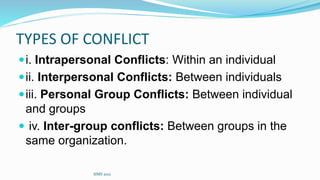
TYPES OF CONFLICT
i. Intrapersonal Conflicts: Within an individual
ii. Interpersonal Conflicts: Between individuals
iii. Personal Group Conflicts: Between individual
and groups
 iv. Inter-group conflicts: Between groups in the
same organization.
SIMS 2021
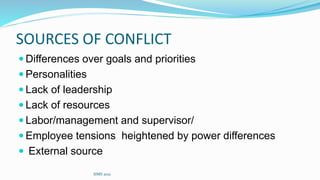
SOURCES OF CONFLICT
 Differences over goals and priorities
 Personalities
 Lack of leadership
 Lack of resources
 Labor/management and supervisor/
 Employee tensions heightened by power differences
 External source
SIMS 2021
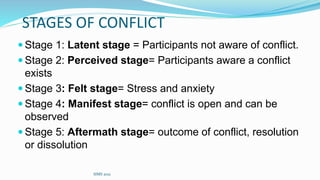
STAGES OF CONFLICT
 Stage 1: Latent stage = Participants not aware of conflict.
 Stage 2: Perceived stage= Participants aware a conflict
exists
 Stage 3: Felt stage= Stress and anxiety
 Stage 4: Manifest stage= conflict is open and can be
observed
 Stage 5: Aftermath stage= outcome of conflict, resolution
or dissolution
SIMS 2021
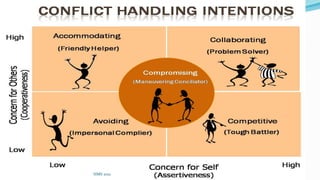
HOW TO HUNDLE CONFLICTS (STYLES OF
CONFLIC RESOLUTION)
Different types of conflict handling behaviour
include
1. Competing- has high concern for personal goals
and low concern for relationships.
2. Collaborating- is the search for a mutually
satisfactory solution. It involves high cooperation
and low confrontation.
SIMS 2021
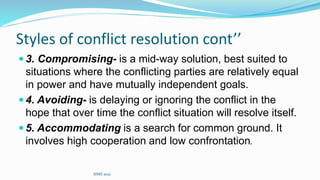
Styles of conflict resolution cont’’
 3. Compromising- is a mid-way solution, best suited to
situations where the conflicting parties are relatively equal
in power and have mutually independent goals.
 4. Avoiding- is delaying or ignoring the conflict in the
hope that over time the conflict situation will resolve itself.
 5. Accommodating is a search for common ground. It
involves high cooperation and low confrontation.
SIMS 2021
SIMS 2021
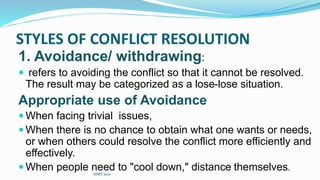
STYLES OF CONFLICT RESOLUTION
1. Avoidance/ withdrawing:
 refers to avoiding the conflict so that it cannot be resolved.
The result may be categorized as a lose-lose situation.
Appropriate use of Avoidance
 When facing trivial issues,
 When there is no chance to obtain what one wants or needs,
or when others could resolve the conflict more efficiently and
effectively.
 When people need to "cool down," distance themselves.
SIMS 2021
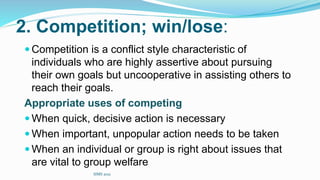
2. Competition; win/lose:
 Competition is a conflict style characteristic of
individuals who are highly assertive about pursuing
their own goals but uncooperative in assisting others to
reach their goals.
Appropriate uses of competing
 When quick, decisive action is necessary
 When important, unpopular action needs to be taken
 When an individual or group is right about issues that
are vital to group welfare
SIMS 2021
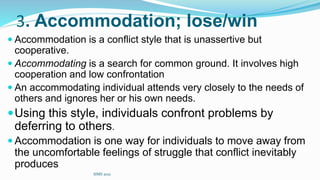
3. Accommodation; lose/win
 Accommodation is a conflict style that is unassertive but
cooperative.
 Accommodating is a search for common ground. It involves high
cooperation and low confrontation
 An accommodating individual attends very closely to the needs of
others and ignores her or his own needs.
Using this style, individuals confront problems by
deferring to others.
 Accommodation is one way for individuals to move away from
the uncomfortable feelings of struggle that conflict inevitably
produces
SIMS 2021
Appropriate Uses of Accommodation
 When other people's ideas and solutions appear to be
better or when you have made a mistake
 When you see that accommodating now "builds up some
important credits" for later issues
SIMS 2021
4. Compromise/ Negotiate; (win
some/lose some)
Compromise occurs midway between avoidance
and collaboration.
This means that persons using this approach do not
completely ignore confrontations but neither do they
struggle with problems to the fullest degree.
SIMS 2021
Appropriate uses of compromise
When two powerful sides are committed strongly to
perceive mutually exclusive goals
When temporary solutions to complex issues need
to be implemented
When time pressures people to expedite a
workable solution
When collaborating and competing fail
SIMS 2021
5. Collaboration; win/win
Collaboration, the most preferred of the conflict styles,
requires both assertiveness and cooperation.
It involves attending fully to others’ concerns while not
sacrificing or suppressing one’s own concerns.
Although collaboration is the most preferred style, it is
the hardest to achieve.
SIMS 2021
Appropriate uses for collaboration
When seeking creative, integrative solutions where
both sides' goals and needs are important, thus
developing group commitment and a consensual
decision
SIMS 2021
OTHER METHODS OR TERMS USED IN
CONFLICT RESOLUTION
 Arbitration: is the procedure in which a dispute is
submitted, by agreement of the parties to one or more
arbitrators who make a binding decision on the dispute.
Arbitration is consensual and the matter can be settled in
court or outside the court.
 Negotiation: is a discussion aimed at reaching an
agreement to settle the differences. It is a process by
which compromise or agreement is reached while
avoiding arguments and disputes
SIMS 2021
Mediation
Is the process by which a neutral third party called
Mediator helps people in conflict negotiate a
mutually acceptable agreement.
Unlike court or Arbitration, no one is imposes a
solution on a party.
If all of the parties do not agree to the results, the
dispute remains unresolved.
SIMS 2021
MEASURES OF CONFLIC RESOLUTION IN AN ORGANIZATION
 i. Restructuring the organization. The authority-
responsibility relationships should be clarified when the
structure is changed.
 ii. Rearrangements of tasks and work allocation
 iii. Human resource policies and procedures can be made
more equitable and attention paid to the possibilities of non-
monetary rewards.
 iv. Development of staff interpersonal/group process skills
 v. Bringing in „outsiders‟ to an organization who have
different values and styles.
SIMS 2021
BENEFITS OF PRODUCTIVE CONFLICT
There are two theories of conflict management.
Traditional theory: Considers people involved in
conflict situations as trouble makers.
Modern theory: Considers conflict as a natural and
inevitable outcome of human interaction. Conflict
situations often lead to the generation of new ideas
and change
SIMS 2021
Benefits of productive conflict cont’’
Better solutions to problems.
More cooperation among people as they learn more
about one another.
Greater acceptance and understanding of others.
Higher team performance.
Greater innovation and new ideas
SIMS 2021
Benefits of productive conflict cont’’
Diffuse more serious conflicts
Stimulate search for new facts or solutions
Enhance relationships
Increase cohesiveness
SIMS 2021
Disadvantages of conflict
 Poor workplace relationship
 Decreased motivation within the organization
 Health issues, such as stress and depression, affecting
attendance and performance
 Poor performance and reduced output
 Increased staff turnover
 Problems in recruiting staff
 Damage to the reputation of the organization
SIMS 2021
CHAPWA..!!
THANKYOU FOR YOUR ATTENTION
SIMS
SIMS 2021

CONFLICT MANAGEMENT BY SIMUSAMBA.pptx

  • 1.
    BY Mr. SIMUSAMBA RN,BSc-NRS TUTOR SIMS 2021
  • 2.
    INTRODUCTION  Conflict managementis a systematic process to find a satisfying outcome between conflicted parties.  When a person is opposed by another because his needs and goals are different, he faces conflict.  Feelings of anger, frustration, hurt, anxiety or fear almost always accompany conflict.  Conflict management identifies and handles the conflict using effective communicating, problem-solving and understanding each person's interest to negotiate fairly SIMS 2021
  • 3.
    DEFITION Conflict can bedefined as an expressed struggle between at least two interdependent parties who perceive that incompatible goals, scarce resources, or interference from others are preventing them from achieving their goals (Wilmot & Hocker, 2001). Conflict is any personal divergence of interests between groups or individuals Conflict is a struggle or contest between people with opposing needs, ideas, beliefs, values or goals ( Algert and Watson, 2002). SIMS 2021
  • 4.
    Conflict management: Is theprocess of limiting the negative aspects of conflict while increasing the positive aspect of conflict to achieve the organizational goal. Is the process by which disputes are resolved, where negative results are minimized and positive results are prioritized for better outcome of interpersonal relationship. SIMS 2021
  • 5.
    TYPES OF CONFLICT i.Intrapersonal Conflicts: Within an individual ii. Interpersonal Conflicts: Between individuals iii. Personal Group Conflicts: Between individual and groups  iv. Inter-group conflicts: Between groups in the same organization. SIMS 2021
  • 6.
    SOURCES OF CONFLICT Differences over goals and priorities  Personalities  Lack of leadership  Lack of resources  Labor/management and supervisor/  Employee tensions heightened by power differences  External source SIMS 2021
  • 7.
    STAGES OF CONFLICT Stage 1: Latent stage = Participants not aware of conflict.  Stage 2: Perceived stage= Participants aware a conflict exists  Stage 3: Felt stage= Stress and anxiety  Stage 4: Manifest stage= conflict is open and can be observed  Stage 5: Aftermath stage= outcome of conflict, resolution or dissolution SIMS 2021
  • 8.
    HOW TO HUNDLECONFLICTS (STYLES OF CONFLIC RESOLUTION) Different types of conflict handling behaviour include 1. Competing- has high concern for personal goals and low concern for relationships. 2. Collaborating- is the search for a mutually satisfactory solution. It involves high cooperation and low confrontation. SIMS 2021
  • 9.
    Styles of conflictresolution cont’’  3. Compromising- is a mid-way solution, best suited to situations where the conflicting parties are relatively equal in power and have mutually independent goals.  4. Avoiding- is delaying or ignoring the conflict in the hope that over time the conflict situation will resolve itself.  5. Accommodating is a search for common ground. It involves high cooperation and low confrontation. SIMS 2021
  • 10.
  • 11.
    STYLES OF CONFLICTRESOLUTION 1. Avoidance/ withdrawing:  refers to avoiding the conflict so that it cannot be resolved. The result may be categorized as a lose-lose situation. Appropriate use of Avoidance  When facing trivial issues,  When there is no chance to obtain what one wants or needs, or when others could resolve the conflict more efficiently and effectively.  When people need to "cool down," distance themselves. SIMS 2021
  • 12.
    2. Competition; win/lose: Competition is a conflict style characteristic of individuals who are highly assertive about pursuing their own goals but uncooperative in assisting others to reach their goals. Appropriate uses of competing  When quick, decisive action is necessary  When important, unpopular action needs to be taken  When an individual or group is right about issues that are vital to group welfare SIMS 2021
  • 13.
    3. Accommodation; lose/win Accommodation is a conflict style that is unassertive but cooperative.  Accommodating is a search for common ground. It involves high cooperation and low confrontation  An accommodating individual attends very closely to the needs of others and ignores her or his own needs. Using this style, individuals confront problems by deferring to others.  Accommodation is one way for individuals to move away from the uncomfortable feelings of struggle that conflict inevitably produces SIMS 2021
  • 14.
    Appropriate Uses ofAccommodation  When other people's ideas and solutions appear to be better or when you have made a mistake  When you see that accommodating now "builds up some important credits" for later issues SIMS 2021
  • 15.
    4. Compromise/ Negotiate;(win some/lose some) Compromise occurs midway between avoidance and collaboration. This means that persons using this approach do not completely ignore confrontations but neither do they struggle with problems to the fullest degree. SIMS 2021
  • 16.
    Appropriate uses ofcompromise When two powerful sides are committed strongly to perceive mutually exclusive goals When temporary solutions to complex issues need to be implemented When time pressures people to expedite a workable solution When collaborating and competing fail SIMS 2021
  • 17.
    5. Collaboration; win/win Collaboration,the most preferred of the conflict styles, requires both assertiveness and cooperation. It involves attending fully to others’ concerns while not sacrificing or suppressing one’s own concerns. Although collaboration is the most preferred style, it is the hardest to achieve. SIMS 2021
  • 18.
    Appropriate uses forcollaboration When seeking creative, integrative solutions where both sides' goals and needs are important, thus developing group commitment and a consensual decision SIMS 2021
  • 19.
    OTHER METHODS ORTERMS USED IN CONFLICT RESOLUTION  Arbitration: is the procedure in which a dispute is submitted, by agreement of the parties to one or more arbitrators who make a binding decision on the dispute. Arbitration is consensual and the matter can be settled in court or outside the court.  Negotiation: is a discussion aimed at reaching an agreement to settle the differences. It is a process by which compromise or agreement is reached while avoiding arguments and disputes SIMS 2021
  • 20.
    Mediation Is the processby which a neutral third party called Mediator helps people in conflict negotiate a mutually acceptable agreement. Unlike court or Arbitration, no one is imposes a solution on a party. If all of the parties do not agree to the results, the dispute remains unresolved. SIMS 2021
  • 21.
    MEASURES OF CONFLICRESOLUTION IN AN ORGANIZATION  i. Restructuring the organization. The authority- responsibility relationships should be clarified when the structure is changed.  ii. Rearrangements of tasks and work allocation  iii. Human resource policies and procedures can be made more equitable and attention paid to the possibilities of non- monetary rewards.  iv. Development of staff interpersonal/group process skills  v. Bringing in „outsiders‟ to an organization who have different values and styles. SIMS 2021
  • 22.
    BENEFITS OF PRODUCTIVECONFLICT There are two theories of conflict management. Traditional theory: Considers people involved in conflict situations as trouble makers. Modern theory: Considers conflict as a natural and inevitable outcome of human interaction. Conflict situations often lead to the generation of new ideas and change SIMS 2021
  • 23.
    Benefits of productiveconflict cont’’ Better solutions to problems. More cooperation among people as they learn more about one another. Greater acceptance and understanding of others. Higher team performance. Greater innovation and new ideas SIMS 2021
  • 24.
    Benefits of productiveconflict cont’’ Diffuse more serious conflicts Stimulate search for new facts or solutions Enhance relationships Increase cohesiveness SIMS 2021
  • 25.
    Disadvantages of conflict Poor workplace relationship  Decreased motivation within the organization  Health issues, such as stress and depression, affecting attendance and performance  Poor performance and reduced output  Increased staff turnover  Problems in recruiting staff  Damage to the reputation of the organization SIMS 2021
  • 26.
    CHAPWA..!! THANKYOU FOR YOURATTENTION SIMS SIMS 2021