




TEAM WORK & PERFORMANCE
A THOUGHT
There are two ways of spreading light
to be the candle
or
the mirror that reflects it
Edith Wharton
TEAMWORK DEFINITION
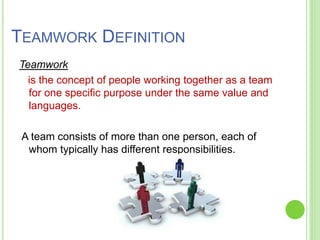
Teamwork
is the concept of people working together as a team
for one specific purpose under the same value and
languages.
A team consists of more than one person, each of
whom typically has different responsibilities.
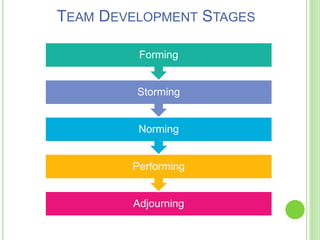
TEAM DEVELOPMENT STAGES
Adjourning
Performing
Norming
Storming
Forming
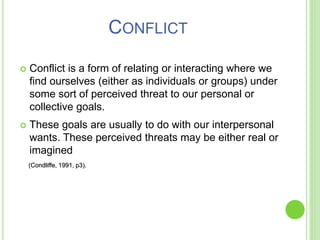
 Conflict is a form of relating or interacting where we
find ourselves (either as individuals or groups) under
some sort of perceived threat to our personal or
collective goals.
 These goals are usually to do with our interpersonal
wants. These perceived threats may be either real or
imagined
(Condliffe, 1991, p3).
CONFLICT
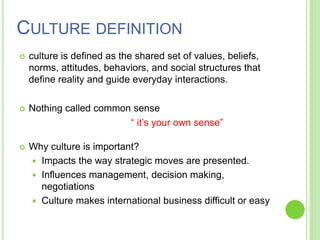
CULTURE DEFINITION
 culture is defined as the shared set of values, beliefs,
norms, attitudes, behaviors, and social structures that
define reality and guide everyday interactions.
 Nothing called common sense
“ it’s your own sense”
 Why culture is important?
 Impacts the way strategic moves are presented.
 Influences management, decision making,
negotiations
 Culture makes international business difficult or easy
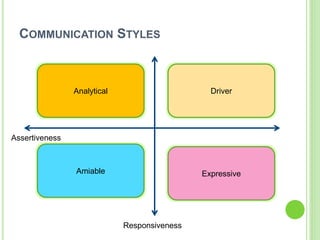
COMMUNICATION STYLES
Driver
Analytical
Expressive
Amiable
Assertiveness
Responsiveness
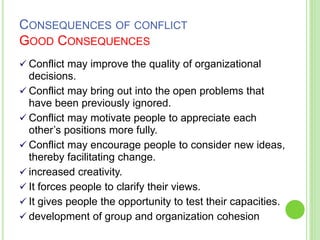
CONSEQUENCES OF CONFLICT
GOOD CONSEQUENCES
 Conflict may improve the quality of organizational
decisions.
 Conflict may bring out into the open problems that
have been previously ignored.
 Conflict may motivate people to appreciate each
other’s positions more fully.
 Conflict may encourage people to consider new ideas,
thereby facilitating change.
 increased creativity.
 It forces people to clarify their views.
 It gives people the opportunity to test their capacities.
 development of group and organization cohesion
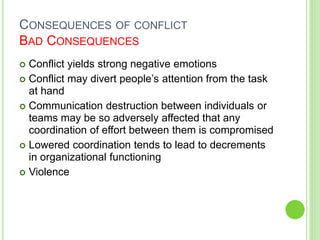
CONSEQUENCES OF CONFLICT
BAD CONSEQUENCES
 Conflict yields strong negative emotions
 Conflict may divert people’s attention from the task
at hand
 Communication destruction between individuals or
teams may be so adversely affected that any
coordination of effort between them is compromised
 Lowered coordination tends to lead to decrements
in organizational functioning
 Violence
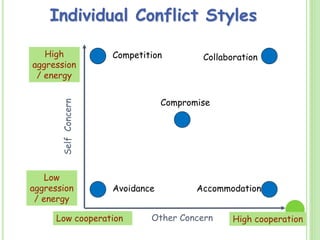
Competition Collaboration
Compromise
Avoidance Accommodation
Other Concern
Self
Concern
Low cooperation High cooperation
Low
aggression
/ energy
High
aggression
/ energy
Individual Conflict Styles
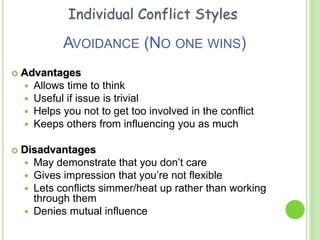
AVOIDANCE (NO ONE WINS)
 Advantages
 Allows time to think
 Useful if issue is trivial
 Helps you not to get too involved in the conflict
 Keeps others from influencing you as much
 Disadvantages
 May demonstrate that you don’t care
 Gives impression that you’re not flexible
 Lets conflicts simmer/heat up rather than working
through them
 Denies mutual influence
Individual Conflict Styles
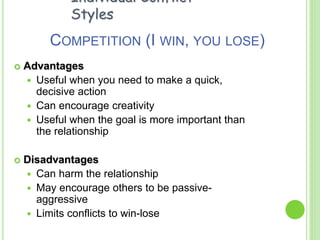
COMPETITION (I WIN, YOU LOSE)
 Advantages
 Useful when you need to make a quick,
decisive action
 Can encourage creativity
 Useful when the goal is more important than
the relationship
 Disadvantages
 Can harm the relationship
 May encourage others to be passive-
aggressive
 Limits conflicts to win-lose
Individual Conflict
Styles
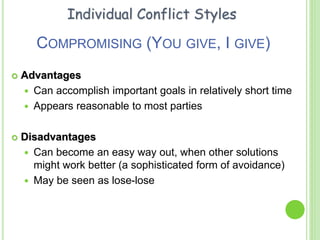
COMPROMISING (YOU GIVE, I GIVE)
 Advantages
 Can accomplish important goals in relatively short time
 Appears reasonable to most parties
 Disadvantages
 Can become an easy way out, when other solutions
might work better (a sophisticated form of avoidance)
 May be seen as lose-lose
Individual Conflict Styles
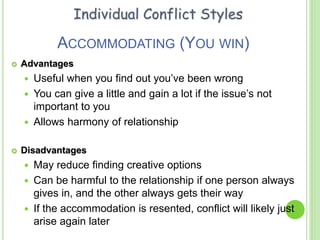
ACCOMMODATING (YOU WIN)
 Advantages
 Useful when you find out you’ve been wrong
 You can give a little and gain a lot if the issue’s not
important to you
 Allows harmony of relationship
 Disadvantages
 May reduce finding creative options
 Can be harmful to the relationship if one person always
gives in, and the other always gets their way
 If the accommodation is resented, conflict will likely just
arise again later
Individual Conflict Styles
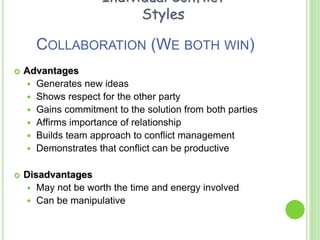
COLLABORATION (WE BOTH WIN)
 Advantages
 Generates new ideas
 Shows respect for the other party
 Gains commitment to the solution from both parties
 Affirms importance of relationship
 Builds team approach to conflict management
 Demonstrates that conflict can be productive
 Disadvantages
 May not be worth the time and energy involved
 Can be manipulative
Individual Conflict
Styles
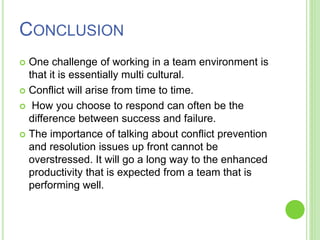
CONCLUSION
 One challenge of working in a team environment is
that it is essentially multi cultural.
 Conflict will arise from time to time.
 How you choose to respond can often be the
difference between success and failure.
 The importance of talking about conflict prevention
and resolution issues up front cannot be
overstressed. It will go a long way to the enhanced
productivity that is expected from a team that is
performing well.
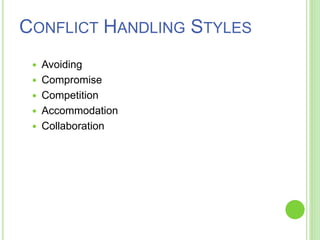
CONFLICT HANDLING STYLES
 Avoiding
 Compromise
 Competition
 Accommodation
 Collaboration
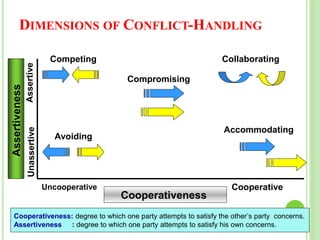
DIMENSIONS OF CONFLICT-HANDLING
Collaborating
Compromising
Avoiding
Accommodating
Competing
Uncooperative
Assertive
Unassertive
Cooperative
Cooperativeness
Assertiveness
Cooperativeness: degree to which one party attempts to satisfy the other’s party concerns.
Assertiveness : degree to which one party attempts to satisfy his own concerns.
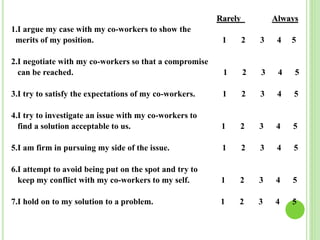
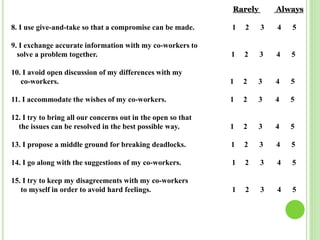
Rarely Always
1.I argue my case with my co-workers to show the
merits of my position. 1 2 3 4 5
2.I negotiate with my co-workers so that a compromise
can be reached. 1 2 3 4 5
3.I try to satisfy the expectations of my co-workers. 1 2 3 4 5
4.I try to investigate an issue with my co-workers to
find a solution acceptable to us. 1 2 3 4 5
5.I am firm in pursuing my side of the issue. 1 2 3 4 5
6.I attempt to avoid being put on the spot and try to
keep my conflict with my co-workers to my self. 1 2 3 4 5
7.I hold on to my solution to a problem. 1 2 3 4 5
Rarely Always
8. I use give-and-take so that a compromise can be made. 1 2 3 4 5
9. I exchange accurate information with my co-workers to
solve a problem together. 1 2 3 4 5
10. I avoid open discussion of my differences with my
co-workers. 1 2 3 4 5
11. I accommodate the wishes of my co-workers. 1 2 3 4 5
12. I try to bring all our concerns out in the open so that
the issues can be resolved in the best possible way. 1 2 3 4 5
13. I propose a middle ground for breaking deadlocks. 1 2 3 4 5
14. I go along with the suggestions of my co-workers. 1 2 3 4 5
15. I try to keep my disagreements with my co-workers
to myself in order to avoid hard feelings. 1 2 3 4 5
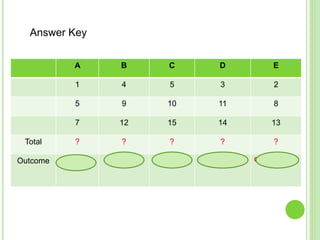
A B C D E
1 4 5 3 2
5 9 10 11 8
7 12 15 14 13
Total ? ? ? ? ?
Outcome Competing Collaborating Avoiding Accommodating Compromising
Answer Key
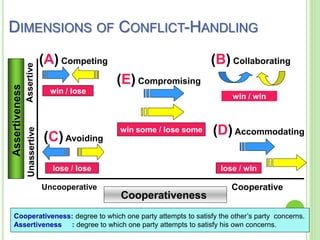
DIMENSIONS OF CONFLICT-HANDLING
(B) Collaborating
(E) Compromising
(C)Avoiding
(D)Accommodating
(A) Competing
Uncooperative
Assertive
Unassertive
Cooperative
Cooperativeness
Assertiveness
Cooperativeness: degree to which one party attempts to satisfy the other’s party concerns.
Assertiveness : degree to which one party attempts to satisfy his own concerns.
lose / lose lose / win
win / lose
win some / lose some
win / win
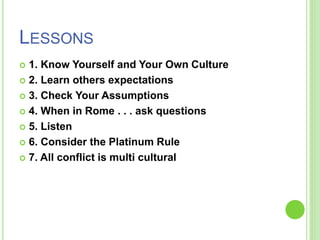
LESSONS
 1. Know Yourself and Your Own Culture
 2. Learn others expectations
 3. Check Your Assumptions
 4. When in Rome . . . ask questions
 5. Listen
 6. Consider the Platinum Rule
 7. All conflict is multi cultural
1. KNOW YOURSELF AND YOUR OWN
CULTURE
Starting with yourself:
 Examine your own beliefs, values, bases, and
prejudices.
 How do you behave? What are your hot buttons?
 Locate your individual culture in the context of your
family, regional, and national cultures.
 What is the social, political and economic context
of the day? Being aware of our own cultures helps
us to be open to different ideas.
 We are able to compare and contrast different
approaches without being threatened.
2. LEARN OTHERS EXPECTATIONS
 Expect different expectations.” Don’t Assume “
 The only way we will know what our team members
expect is to have an explicit conversation about the nature
of conflict and how we prefer to deal with it when it arises.
 This should lead to a more general conversation that
addresses how the team wants to work together. The
sooner this happens the better.
 We can also read books and watch movies to understand
others culture. Learning about a new culture takes time.
Some liken culture to an iceberg where over nine tenths is
out of sight. So it is with culture. There is the surface
culture, and then there is that which is hidden-deep
culture.
3. CHECK YOUR ASSUMPTIONS
 Nothing called common sense
“ it’s your own sense”
 We should develop acceptable communication protocols to check
out the basis of our perceptions. Failure to do so leads to
inaccurate stereotypes and may foster negative feelings of
hostility.
 One approach is to give specific feedback on the behavior you
observed ("I noticed that you avoided eye contact when we were
discussing the situation.") and to seek clarification of your
interpretations. ("I suppose you could have been bored. Can you
tell me what was going on?")
 Be open to various interpretations. Your first interpretation is not
necessarily correct.
 Give feedback on how you felt when the specified behavior
occurred. ("I felt ignored when you avoided eye contact during
our discussion. Can you tell me what was going on?") It
sometimes helps to list all the possible interpretations you have
thought of almost as if brainstorming.
4. WHEN IN ROME . . .
ASK QUESTIONS
 Does the old saying-When in Rome, do as the Romans-
still have currency? (learn about other cultures)
"When we join a team that already exists we should
learn and be respectful of the existing culture, just as we
would when we travel."
 The danger of this adage, not only in a team
environment, is that it supports the prevailing/dominant
culture and a rigidity that is counter productive to
creativity and growth.
 The reformulation of the adage to encourage questions
reflects an attitude of inquiry. Rather than assuming you
know, you ask to clarify why things are being done
differently. Open ended questions are generally less
threatening, but close ended questions will often
eliminate confusion on a particular aspect of culture.
5. LISTEN
 Listening is widely acknowledged as a key conflict
prevention and resolution skill.
 Care should be taken not to impose an approach to
listening that causes discomfort. Not all cultures are
comfortable expressing feelings in public.
 Used in a team environment effective listening
enables new norms to emerge that reflect a deep
knowledge for one another's 'ways.’
Third party – compromise solution
6. CONSIDER THE PLATINUM RULE
 Encourages us to treat our team members as they
would like to be treated rather than the way we like
to be treated
It is similar to the difference between sympathy and
empathy. Empathy is not about "walking a mile in
his moccasins" but imagining "how he feels walking
in his moccasins." Problems with the platinum rule
arise when your way and the others way clash.
7. ALL CONFLICT IS MULTI CULTURAL
 There is as much diversity within a culture as
between cultures.
 use our cross cultural communication skills when
we communicate between different cultural groups,
we should assume that all communications are
essentially cross cultural.
 It helps to remember that men and women form the
two largest cultural groups.
SOLUTION
 Emotional intelligent training.
 Team must have good consequences of conflicts.
 Increasing team norms by team activities.
(Sports Day out)
 Social ceremonies.
 Resolving any conflict in right time.
 Captured photos of success stories
(hanged on the wall )
 Giving a prize of the most performing team with
less conflicts.
 Individual assessment before and after
Team work & performance

Team work & performance

  • 1.
    TEAM WORK &PERFORMANCE
  • 2.
    A THOUGHT There aretwo ways of spreading light to be the candle or the mirror that reflects it Edith Wharton
  • 3.
    TEAMWORK DEFINITION Teamwork is theconcept of people working together as a team for one specific purpose under the same value and languages. A team consists of more than one person, each of whom typically has different responsibilities.
  • 4.
  • 5.
     Conflict isa form of relating or interacting where we find ourselves (either as individuals or groups) under some sort of perceived threat to our personal or collective goals.  These goals are usually to do with our interpersonal wants. These perceived threats may be either real or imagined (Condliffe, 1991, p3). CONFLICT
  • 6.
    CULTURE DEFINITION  cultureis defined as the shared set of values, beliefs, norms, attitudes, behaviors, and social structures that define reality and guide everyday interactions.  Nothing called common sense “ it’s your own sense”  Why culture is important?  Impacts the way strategic moves are presented.  Influences management, decision making, negotiations  Culture makes international business difficult or easy
  • 9.
  • 10.
    CONSEQUENCES OF CONFLICT GOODCONSEQUENCES  Conflict may improve the quality of organizational decisions.  Conflict may bring out into the open problems that have been previously ignored.  Conflict may motivate people to appreciate each other’s positions more fully.  Conflict may encourage people to consider new ideas, thereby facilitating change.  increased creativity.  It forces people to clarify their views.  It gives people the opportunity to test their capacities.  development of group and organization cohesion
  • 11.
    CONSEQUENCES OF CONFLICT BADCONSEQUENCES  Conflict yields strong negative emotions  Conflict may divert people’s attention from the task at hand  Communication destruction between individuals or teams may be so adversely affected that any coordination of effort between them is compromised  Lowered coordination tends to lead to decrements in organizational functioning  Violence
  • 12.
    Competition Collaboration Compromise Avoidance Accommodation OtherConcern Self Concern Low cooperation High cooperation Low aggression / energy High aggression / energy Individual Conflict Styles
  • 13.
    AVOIDANCE (NO ONEWINS)  Advantages  Allows time to think  Useful if issue is trivial  Helps you not to get too involved in the conflict  Keeps others from influencing you as much  Disadvantages  May demonstrate that you don’t care  Gives impression that you’re not flexible  Lets conflicts simmer/heat up rather than working through them  Denies mutual influence Individual Conflict Styles
  • 14.
    COMPETITION (I WIN,YOU LOSE)  Advantages  Useful when you need to make a quick, decisive action  Can encourage creativity  Useful when the goal is more important than the relationship  Disadvantages  Can harm the relationship  May encourage others to be passive- aggressive  Limits conflicts to win-lose Individual Conflict Styles
  • 15.
    COMPROMISING (YOU GIVE,I GIVE)  Advantages  Can accomplish important goals in relatively short time  Appears reasonable to most parties  Disadvantages  Can become an easy way out, when other solutions might work better (a sophisticated form of avoidance)  May be seen as lose-lose Individual Conflict Styles
  • 16.
    ACCOMMODATING (YOU WIN) Advantages  Useful when you find out you’ve been wrong  You can give a little and gain a lot if the issue’s not important to you  Allows harmony of relationship  Disadvantages  May reduce finding creative options  Can be harmful to the relationship if one person always gives in, and the other always gets their way  If the accommodation is resented, conflict will likely just arise again later Individual Conflict Styles
  • 17.
    COLLABORATION (WE BOTHWIN)  Advantages  Generates new ideas  Shows respect for the other party  Gains commitment to the solution from both parties  Affirms importance of relationship  Builds team approach to conflict management  Demonstrates that conflict can be productive  Disadvantages  May not be worth the time and energy involved  Can be manipulative Individual Conflict Styles
  • 18.
    CONCLUSION  One challengeof working in a team environment is that it is essentially multi cultural.  Conflict will arise from time to time.  How you choose to respond can often be the difference between success and failure.  The importance of talking about conflict prevention and resolution issues up front cannot be overstressed. It will go a long way to the enhanced productivity that is expected from a team that is performing well.
  • 19.
    CONFLICT HANDLING STYLES Avoiding  Compromise  Competition  Accommodation  Collaboration
  • 20.
    DIMENSIONS OF CONFLICT-HANDLING Collaborating Compromising Avoiding Accommodating Competing Uncooperative Assertive Unassertive Cooperative Cooperativeness Assertiveness Cooperativeness:degree to which one party attempts to satisfy the other’s party concerns. Assertiveness : degree to which one party attempts to satisfy his own concerns.
  • 21.
    Rarely Always 1.I arguemy case with my co-workers to show the merits of my position. 1 2 3 4 5 2.I negotiate with my co-workers so that a compromise can be reached. 1 2 3 4 5 3.I try to satisfy the expectations of my co-workers. 1 2 3 4 5 4.I try to investigate an issue with my co-workers to find a solution acceptable to us. 1 2 3 4 5 5.I am firm in pursuing my side of the issue. 1 2 3 4 5 6.I attempt to avoid being put on the spot and try to keep my conflict with my co-workers to my self. 1 2 3 4 5 7.I hold on to my solution to a problem. 1 2 3 4 5
  • 22.
    Rarely Always 8. Iuse give-and-take so that a compromise can be made. 1 2 3 4 5 9. I exchange accurate information with my co-workers to solve a problem together. 1 2 3 4 5 10. I avoid open discussion of my differences with my co-workers. 1 2 3 4 5 11. I accommodate the wishes of my co-workers. 1 2 3 4 5 12. I try to bring all our concerns out in the open so that the issues can be resolved in the best possible way. 1 2 3 4 5 13. I propose a middle ground for breaking deadlocks. 1 2 3 4 5 14. I go along with the suggestions of my co-workers. 1 2 3 4 5 15. I try to keep my disagreements with my co-workers to myself in order to avoid hard feelings. 1 2 3 4 5
  • 23.
    A B CD E 1 4 5 3 2 5 9 10 11 8 7 12 15 14 13 Total ? ? ? ? ? Outcome Competing Collaborating Avoiding Accommodating Compromising Answer Key
  • 24.
    DIMENSIONS OF CONFLICT-HANDLING (B)Collaborating (E) Compromising (C)Avoiding (D)Accommodating (A) Competing Uncooperative Assertive Unassertive Cooperative Cooperativeness Assertiveness Cooperativeness: degree to which one party attempts to satisfy the other’s party concerns. Assertiveness : degree to which one party attempts to satisfy his own concerns. lose / lose lose / win win / lose win some / lose some win / win
  • 26.
    LESSONS  1. KnowYourself and Your Own Culture  2. Learn others expectations  3. Check Your Assumptions  4. When in Rome . . . ask questions  5. Listen  6. Consider the Platinum Rule  7. All conflict is multi cultural
  • 27.
    1. KNOW YOURSELFAND YOUR OWN CULTURE Starting with yourself:  Examine your own beliefs, values, bases, and prejudices.  How do you behave? What are your hot buttons?  Locate your individual culture in the context of your family, regional, and national cultures.  What is the social, political and economic context of the day? Being aware of our own cultures helps us to be open to different ideas.  We are able to compare and contrast different approaches without being threatened.
  • 28.
    2. LEARN OTHERSEXPECTATIONS  Expect different expectations.” Don’t Assume “  The only way we will know what our team members expect is to have an explicit conversation about the nature of conflict and how we prefer to deal with it when it arises.  This should lead to a more general conversation that addresses how the team wants to work together. The sooner this happens the better.  We can also read books and watch movies to understand others culture. Learning about a new culture takes time. Some liken culture to an iceberg where over nine tenths is out of sight. So it is with culture. There is the surface culture, and then there is that which is hidden-deep culture.
  • 29.
    3. CHECK YOURASSUMPTIONS  Nothing called common sense “ it’s your own sense”  We should develop acceptable communication protocols to check out the basis of our perceptions. Failure to do so leads to inaccurate stereotypes and may foster negative feelings of hostility.  One approach is to give specific feedback on the behavior you observed ("I noticed that you avoided eye contact when we were discussing the situation.") and to seek clarification of your interpretations. ("I suppose you could have been bored. Can you tell me what was going on?")  Be open to various interpretations. Your first interpretation is not necessarily correct.  Give feedback on how you felt when the specified behavior occurred. ("I felt ignored when you avoided eye contact during our discussion. Can you tell me what was going on?") It sometimes helps to list all the possible interpretations you have thought of almost as if brainstorming.
  • 30.
    4. WHEN INROME . . . ASK QUESTIONS  Does the old saying-When in Rome, do as the Romans- still have currency? (learn about other cultures) "When we join a team that already exists we should learn and be respectful of the existing culture, just as we would when we travel."  The danger of this adage, not only in a team environment, is that it supports the prevailing/dominant culture and a rigidity that is counter productive to creativity and growth.  The reformulation of the adage to encourage questions reflects an attitude of inquiry. Rather than assuming you know, you ask to clarify why things are being done differently. Open ended questions are generally less threatening, but close ended questions will often eliminate confusion on a particular aspect of culture.
  • 31.
    5. LISTEN  Listeningis widely acknowledged as a key conflict prevention and resolution skill.  Care should be taken not to impose an approach to listening that causes discomfort. Not all cultures are comfortable expressing feelings in public.  Used in a team environment effective listening enables new norms to emerge that reflect a deep knowledge for one another's 'ways.’ Third party – compromise solution
  • 32.
    6. CONSIDER THEPLATINUM RULE  Encourages us to treat our team members as they would like to be treated rather than the way we like to be treated It is similar to the difference between sympathy and empathy. Empathy is not about "walking a mile in his moccasins" but imagining "how he feels walking in his moccasins." Problems with the platinum rule arise when your way and the others way clash.
  • 33.
    7. ALL CONFLICTIS MULTI CULTURAL  There is as much diversity within a culture as between cultures.  use our cross cultural communication skills when we communicate between different cultural groups, we should assume that all communications are essentially cross cultural.  It helps to remember that men and women form the two largest cultural groups.
  • 35.
    SOLUTION  Emotional intelligenttraining.  Team must have good consequences of conflicts.  Increasing team norms by team activities. (Sports Day out)  Social ceremonies.  Resolving any conflict in right time.  Captured photos of success stories (hanged on the wall )  Giving a prize of the most performing team with less conflicts.  Individual assessment before and after