Introduction
 With the origin of the complex societies there came into being
the different social groups that are significant for the human
or individual welfare
 A group comes into being when there is need to achieve the
wants of the members. In the course of interaction the
members develop a group ideology which regulates their
attitudes/actions and influence their satisfaction
 Human beings have to learn to function effectively in groups
 Nurse has to create conducive atmosphere for group
interaction
 In a group, all members influence each other and work
towards common goal
Definition
 Group: It is a collection of people who interact with one
another, accept rights and obligations as members and
who share a common identity
 Group: It refers to 2 or more individuals interacting and
interdependent who have come together to achieve
particular objective
 Group dynamics: A study of forces operating within a
group
 Group dynamics: It refers to changes which take place
within groups and is concerned with the interaction and
forces obtained between group members in social
settings
Need for joining group
 Stability: People often join groups as it gives the members
a stability and enhances their achievement capacity
 Security: Enables the person to reduce a sense of
insecurity and have stronger feeling with few self-doubts
and more resistant to threats
 Self esteem: Help a person develop a sense of “to –
belong”, feelings of self- worth, develops confidence
 Affiliation: Groups can fulfill social needs. People enjoy
the regular interaction that comes with the group
membership
Need for joining group
 Status: Group members can be easily recognized and a
status is achieved by them is viewed as important &
provides recognition
 Goal achievement: Goal can be achieved more easily when
a group effort is present
 Power: Power is derived on the strength of closeness of the
group members with greater power achieved when in group
Characteristics of a group
 Common goal
 Reciprocal relationships
 Sense of unity
 Sense of belongingness
 Common interest
 Group norms
 Degree of participation
 Definite membership
 Interdependence
 Interaction
 Communication
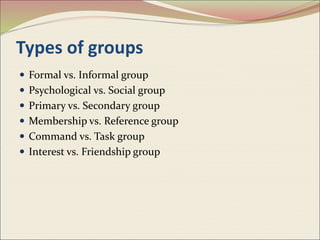
Types of groups
 Formal vs. Informal group
 Psychological vs. Social group
 Primary vs. Secondary group
 Membership vs. Reference group
 Command vs. Task group
 Interest vs. Friendship group
Formal vs. Informal group
 Formal groups refer to those which are established under
the legal or formal authority with the view to achieve a
particular end result. The group is designated by the
organizational structure, having work assignments
establishing tasks (airline flight crew, health care team,
trade unions)
 Informal groups refers to the aggregate of the personal
contacts/interaction and the network of relationships
among individuals
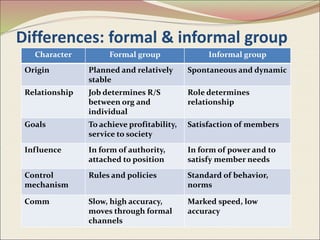
Differences: formal & informal group
Character Formal group Informal group
Origin Planned and relatively
stable
Spontaneous and dynamic
Relationship Job determines R/S
between org and
individual
Role determines
relationship
Goals To achieve profitability,
service to society
Satisfaction of members
Influence In form of authority,
attached to position
In form of power and to
satisfy member needs
Control
mechanism
Rules and policies Standard of behavior,
norms
Comm Slow, high accuracy,
moves through formal
channels
Marked speed, low
accuracy
Psychological vs. Social group
 Psychological group: One in which the two or more persons who
are interdependent as each members nature influences every
other person, members share an ideology and have common
tasks. These include families, friendship circles, political clubs,
work, educational, religious, neighborhood, and recreational
groups
 Social group: Integrated system of interrelated psychological
groups formed to accomplish a defined function or objective. A
political party with its many local political clubs , friendship
circles are the social organizations
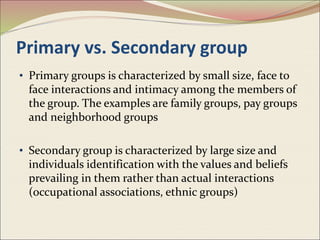
Primary vs. Secondary group
• Primary groups is characterized by small size, face to
face interactions and intimacy among the members of
the group. The examples are family groups, pay groups
and neighborhood groups
• Secondary group is characterized by large size and
individuals identification with the values and beliefs
prevailing in them rather than actual interactions
(occupational associations, ethnic groups)
Membership vs. Reference
• Membership group is those where the individual
actually belongs
• Reference group is one in which they would like to
belong
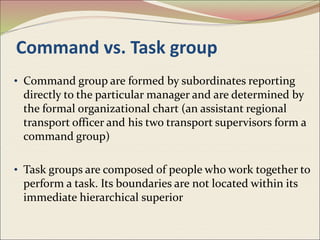
Command vs. Task group
• Command group are formed by subordinates reporting
directly to the particular manager and are determined by
the formal organizational chart (an assistant regional
transport officer and his two transport supervisors form a
command group)
• Task groups are composed of people who work together to
perform a task. Its boundaries are not located within its
immediate hierarchical superior
Interest vs. Friendship group
 Interest group involves people who come together to
accomplish a particular goal with which they are concerned
Office employees joining hands to go to vacation or get
vacation schedule changed form an interest group. This
includes people who may or may not be aligned to a common
command and may affiliate to attain a specific objective
 Friendship group is formed by people having one or more
common features . These often develop because individual
members have 1 or more common characteristics (people
supporting same candidate)
Functions of a group
 Formal organizational functions: These relates to basic mission
attainment by the organization. The group completes the work,
creates ideas and embraces all activities for which they are
accountable
 Psychological Personal functions: The group formation facilitates
psychological functioning, satisfaction of the needs, outlet for
affiliation and helps in getting stability and enhancing the
achievements
 Mixed or Multiple functions: The formal as well as informal both
kinds of roles are taken up by the members of the group. The formal
group can try to fulfill various psychological roles and leading to
increased loyalty, commitment and energy for effective attainment of
the administrative and organizational goals
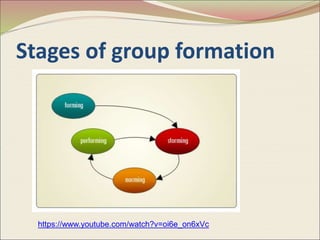
Stages of group formation
https://www.youtube.com/watch?v=oi6e_on6xVc
Stages of group formation
1. Forming: characterized by great deal of uncertainty about
group’s purpose, structure, leadership, members are
testing matters
1. Storming: members accept existence of group but resist
the constraints the group imposes on members. Conflict
on who will control the group
Stages of group formation
3. Norming: development of close relationships, strong
sense of group identity, group structure solidifies
4. Performing: structure is fully functional and accepted.
Member are performing the tasks
5. Adjourning: this is for temporary committees, teams,
task force. Members prepare for disbandment, winding
up activities
Group dynamics
 GD is that division of social psychology that investigates the
formation and change in the structure and functions of the
psychological grouping of people into self-directing wholes
 Refers to changes that take place within the group
 GD is concerned with interrelation between group members in
a social situation, it is concerned with gaining knowledge
about group, how they develop, their effect on individual
members
 It reveals how a group should be organized and conducted,
members participation and overall cooperation
https://www.youtube.com/watch?v=fUXdrl9
ch_Q
Concept of GD
 Founded by Kurt Lewin in 1945 at the Massachusetts Institute,
USA
 The underlying assumption was that the laws of the group
behavior can be established independently of the goals or
specific activities of group irrespective of the structure of the
group
 GD is a technique of fostering the conciliation between
individuals and groups with an idea to formulate principles
which underlie group behavior, and devise principles of group
decisions and actions
Features of GD
 Individuals interact and members are continuously changing and
adjusting relationship with respect to each other
 Continuous change: introduction of the new members, leaders, rules,
norms
 Rigidity/flexibility: If the members get along well there is smooth
sailing for the group and if there is conflict it leads to problems. A
rigid group may not change and lacks adaptability to change
 Group organization: It leads to greater group effectiveness,
participation, cooperation and a constructive morale
 It is a continuous process of restructuring, adjusting and readjusting
members to one another for the purpose of reducing the tensions ,
eliminating the conflicts and solving the problems which its members
have in common
Factors influencing group effectiveness/participation
 Leadership style: any style appropriate according to group
and situation
 Common ideology: all must agree to work towards
common ideology
 Task completion: time target must be known to all
members to complete the task
 Role behavior of group members: each member should
take on the group assigned role
Factors influencing group effectiveness/participation
 Communication pattern among members: depends on
situation and leadership style
 Feeling status of members: all members to feel good
while working together most of the time
 Level of member satisfaction: all members feel they have
contributed and gained something in group activity
 Familiarity
 Physical and psychological atmosphere
Principles of GD
 Sense of belongingness: members must have a strong sense
of belonging to the group
 Cohesiveness: The more attraction members have, greater
influence on its members
 The greater the prestige of the group member in the eyes of
the member in the eyes of the members, the grater influence
he would exercise on the theme
 Implementing change in subparts
Principles of GD
 Rationalize need for change

 Reduce change related stress by bringing about
readjustments in the related parts
 The groups arise and function owing to common motives
 The groups survive by pacing the members into functional
hierarchy and facilitating the action towards the goal
Principles of GD
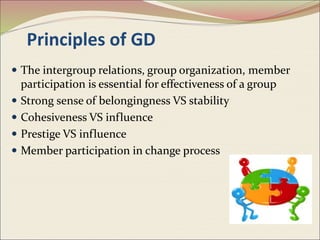
 The intergroup relations, group organization, member
participation is essential for effectiveness of a group
 Strong sense of belongingness VS stability
 Cohesiveness VS influence
 Prestige VS influence
 Member participation in change process
Facilitating a group
 A group cannot automatically function effectively, it needs to
be facilitated
 Facilitation can be described as a conscious process of assisting
a group to successfully achieve its task while functioning as a
group. Facilitation can be performed by members themselves,
or with the help of an outsider
 To facilitate effectively the facilitator needs to
- Understand what is happening within the group
- Be aware of his/her own personality
- Know how to facilitate
Conclusion
 Groups operate on a common task and common attitudes
 GD is concerned with the interaction between the group
members in a social situation
 This is concerned with the gaining in the knowledge of the
group, how they develop and their effect on the individual
members and the organization in which they function
 GD is essential to study since it helps to find how the
relationships are made within a group and how the forces act
within the group members in a social setting
 This helps to recognize the formation of group and how a
group should be organized, lead and promoted

GROUP DYNAMICS.ppt

  • 2.
    Introduction  With theorigin of the complex societies there came into being the different social groups that are significant for the human or individual welfare  A group comes into being when there is need to achieve the wants of the members. In the course of interaction the members develop a group ideology which regulates their attitudes/actions and influence their satisfaction  Human beings have to learn to function effectively in groups  Nurse has to create conducive atmosphere for group interaction  In a group, all members influence each other and work towards common goal
  • 3.
    Definition  Group: Itis a collection of people who interact with one another, accept rights and obligations as members and who share a common identity  Group: It refers to 2 or more individuals interacting and interdependent who have come together to achieve particular objective  Group dynamics: A study of forces operating within a group  Group dynamics: It refers to changes which take place within groups and is concerned with the interaction and forces obtained between group members in social settings
  • 4.
    Need for joininggroup  Stability: People often join groups as it gives the members a stability and enhances their achievement capacity  Security: Enables the person to reduce a sense of insecurity and have stronger feeling with few self-doubts and more resistant to threats  Self esteem: Help a person develop a sense of “to – belong”, feelings of self- worth, develops confidence  Affiliation: Groups can fulfill social needs. People enjoy the regular interaction that comes with the group membership
  • 5.
    Need for joininggroup  Status: Group members can be easily recognized and a status is achieved by them is viewed as important & provides recognition  Goal achievement: Goal can be achieved more easily when a group effort is present  Power: Power is derived on the strength of closeness of the group members with greater power achieved when in group
  • 6.
    Characteristics of agroup  Common goal  Reciprocal relationships  Sense of unity  Sense of belongingness  Common interest  Group norms  Degree of participation  Definite membership  Interdependence  Interaction  Communication
  • 7.
    Types of groups Formal vs. Informal group  Psychological vs. Social group  Primary vs. Secondary group  Membership vs. Reference group  Command vs. Task group  Interest vs. Friendship group
  • 8.
    Formal vs. Informalgroup  Formal groups refer to those which are established under the legal or formal authority with the view to achieve a particular end result. The group is designated by the organizational structure, having work assignments establishing tasks (airline flight crew, health care team, trade unions)  Informal groups refers to the aggregate of the personal contacts/interaction and the network of relationships among individuals
  • 9.
    Differences: formal &informal group Character Formal group Informal group Origin Planned and relatively stable Spontaneous and dynamic Relationship Job determines R/S between org and individual Role determines relationship Goals To achieve profitability, service to society Satisfaction of members Influence In form of authority, attached to position In form of power and to satisfy member needs Control mechanism Rules and policies Standard of behavior, norms Comm Slow, high accuracy, moves through formal channels Marked speed, low accuracy
  • 10.
    Psychological vs. Socialgroup  Psychological group: One in which the two or more persons who are interdependent as each members nature influences every other person, members share an ideology and have common tasks. These include families, friendship circles, political clubs, work, educational, religious, neighborhood, and recreational groups  Social group: Integrated system of interrelated psychological groups formed to accomplish a defined function or objective. A political party with its many local political clubs , friendship circles are the social organizations
  • 11.
    Primary vs. Secondarygroup • Primary groups is characterized by small size, face to face interactions and intimacy among the members of the group. The examples are family groups, pay groups and neighborhood groups • Secondary group is characterized by large size and individuals identification with the values and beliefs prevailing in them rather than actual interactions (occupational associations, ethnic groups)
  • 12.
    Membership vs. Reference •Membership group is those where the individual actually belongs • Reference group is one in which they would like to belong
  • 13.
    Command vs. Taskgroup • Command group are formed by subordinates reporting directly to the particular manager and are determined by the formal organizational chart (an assistant regional transport officer and his two transport supervisors form a command group) • Task groups are composed of people who work together to perform a task. Its boundaries are not located within its immediate hierarchical superior
  • 14.
    Interest vs. Friendshipgroup  Interest group involves people who come together to accomplish a particular goal with which they are concerned Office employees joining hands to go to vacation or get vacation schedule changed form an interest group. This includes people who may or may not be aligned to a common command and may affiliate to attain a specific objective  Friendship group is formed by people having one or more common features . These often develop because individual members have 1 or more common characteristics (people supporting same candidate)
  • 15.
    Functions of agroup  Formal organizational functions: These relates to basic mission attainment by the organization. The group completes the work, creates ideas and embraces all activities for which they are accountable  Psychological Personal functions: The group formation facilitates psychological functioning, satisfaction of the needs, outlet for affiliation and helps in getting stability and enhancing the achievements  Mixed or Multiple functions: The formal as well as informal both kinds of roles are taken up by the members of the group. The formal group can try to fulfill various psychological roles and leading to increased loyalty, commitment and energy for effective attainment of the administrative and organizational goals
  • 16.
    Stages of groupformation https://www.youtube.com/watch?v=oi6e_on6xVc
  • 17.
    Stages of groupformation 1. Forming: characterized by great deal of uncertainty about group’s purpose, structure, leadership, members are testing matters 1. Storming: members accept existence of group but resist the constraints the group imposes on members. Conflict on who will control the group
  • 18.
    Stages of groupformation 3. Norming: development of close relationships, strong sense of group identity, group structure solidifies 4. Performing: structure is fully functional and accepted. Member are performing the tasks 5. Adjourning: this is for temporary committees, teams, task force. Members prepare for disbandment, winding up activities
  • 19.
    Group dynamics  GDis that division of social psychology that investigates the formation and change in the structure and functions of the psychological grouping of people into self-directing wholes  Refers to changes that take place within the group  GD is concerned with interrelation between group members in a social situation, it is concerned with gaining knowledge about group, how they develop, their effect on individual members  It reveals how a group should be organized and conducted, members participation and overall cooperation https://www.youtube.com/watch?v=fUXdrl9 ch_Q
  • 20.
    Concept of GD Founded by Kurt Lewin in 1945 at the Massachusetts Institute, USA  The underlying assumption was that the laws of the group behavior can be established independently of the goals or specific activities of group irrespective of the structure of the group  GD is a technique of fostering the conciliation between individuals and groups with an idea to formulate principles which underlie group behavior, and devise principles of group decisions and actions
  • 21.
    Features of GD Individuals interact and members are continuously changing and adjusting relationship with respect to each other  Continuous change: introduction of the new members, leaders, rules, norms  Rigidity/flexibility: If the members get along well there is smooth sailing for the group and if there is conflict it leads to problems. A rigid group may not change and lacks adaptability to change  Group organization: It leads to greater group effectiveness, participation, cooperation and a constructive morale  It is a continuous process of restructuring, adjusting and readjusting members to one another for the purpose of reducing the tensions , eliminating the conflicts and solving the problems which its members have in common
  • 22.
    Factors influencing groupeffectiveness/participation  Leadership style: any style appropriate according to group and situation  Common ideology: all must agree to work towards common ideology  Task completion: time target must be known to all members to complete the task  Role behavior of group members: each member should take on the group assigned role
  • 23.
    Factors influencing groupeffectiveness/participation  Communication pattern among members: depends on situation and leadership style  Feeling status of members: all members to feel good while working together most of the time  Level of member satisfaction: all members feel they have contributed and gained something in group activity  Familiarity  Physical and psychological atmosphere
  • 24.
    Principles of GD Sense of belongingness: members must have a strong sense of belonging to the group  Cohesiveness: The more attraction members have, greater influence on its members  The greater the prestige of the group member in the eyes of the member in the eyes of the members, the grater influence he would exercise on the theme  Implementing change in subparts
  • 25.
    Principles of GD Rationalize need for change   Reduce change related stress by bringing about readjustments in the related parts  The groups arise and function owing to common motives  The groups survive by pacing the members into functional hierarchy and facilitating the action towards the goal
  • 26.
    Principles of GD The intergroup relations, group organization, member participation is essential for effectiveness of a group  Strong sense of belongingness VS stability  Cohesiveness VS influence  Prestige VS influence  Member participation in change process
  • 27.
    Facilitating a group A group cannot automatically function effectively, it needs to be facilitated  Facilitation can be described as a conscious process of assisting a group to successfully achieve its task while functioning as a group. Facilitation can be performed by members themselves, or with the help of an outsider  To facilitate effectively the facilitator needs to - Understand what is happening within the group - Be aware of his/her own personality - Know how to facilitate
  • 28.
    Conclusion  Groups operateon a common task and common attitudes  GD is concerned with the interaction between the group members in a social situation  This is concerned with the gaining in the knowledge of the group, how they develop and their effect on the individual members and the organization in which they function  GD is essential to study since it helps to find how the relationships are made within a group and how the forces act within the group members in a social setting  This helps to recognize the formation of group and how a group should be organized, lead and promoted