12-1 Level Of Conflict In Organizational Behavior 
Macro 
Micro 
Organizational 
Intergroup 
Interpersonal 
Intra-individual 
CONFLICT 
McGraw-Hill/Irwin © 2002 The McGraw-Hill Companies, Inc., All Rights Reserved.
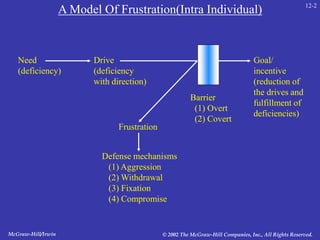
12-2 A Model Of Frustration(Intra Individual) 
Need 
(deficiency) 
Drive 
(deficiency 
with direction) 
Frustration 
Barrier 
(1) Overt 
(2) Covert 
Defense mechanisms 
(1) Aggression 
(2) Withdrawal 
(3) Fixation 
(4) Compromise 
Goal/ 
incentive 
(reduction of 
the drives and 
fulfillment of 
deficiencies) 
McGraw-Hill/Irwin © 2002 The McGraw-Hill Companies, Inc., All Rights Reserved.
12-3 Sources Of Interpersonal Conflict 
Interpersonal 
Conflict 
Information 
deficiency 
Environmental 
stress 
Personal 
differences 
Role 
incompatibility 
McGraw-Hill/Irwin © 2002 The McGraw-Hill Companies, Inc., All Rights Reserved.
Inter personal 
• Personal difference: every one has a unique background 
because of his upbringing, cultural and family 
traditions and socialization processes. Disagreements 
stemming from the differences due to individual 
preferences. Example bitter argument over who is 
morally right. 
• Information deficiency: This source of conflicts results 
from communication breakdown in the organization. It 
may be that the two people in conflict are using 
different information or that one or both have 
misinformation. This source of conflict is not 
emotionally charged and once corrected , there is little 
resentment. 
12-4 
McGraw-Hill/Irwin © 2002 The McGraw-Hill Companies, Inc., All Rights Reserved.
Inter personal 
12-5 
• Role incompatibility: This type of interpersonal 
conflict draws from both intra individual role 
conflict and intergroup conflict.example 
production manager and sales manager have 
interdependent functions one supports the other. 
However the role of production manager is to 
cut cost by keeping low inventory levels whereas 
the sales manager requires a high finished goods 
at hand to meet demands created by him. This 
causes a conflict from role incompatibility. 
McGraw-Hill/Irwin © 2002 The McGraw-Hill Companies, Inc., All Rights Reserved.
Inter personal 
• Environmental stress: This is caused by stressful 
environment created due to shrinking market, 
downsizing, competitive pressures & high 
degree of uncertainty. 
12-6 
McGraw-Hill/Irwin © 2002 The McGraw-Hill Companies, Inc., All Rights Reserved.
12-7 
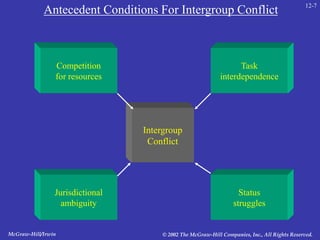
Antecedent Conditions For Intergroup Conflict 
Intergroup 
Conflict 
Task 
interdependence 
Status 
struggles 
Competition 
for resources 
Jurisdictional 
ambiguity 
McGraw-Hill/Irwin © 2002 The McGraw-Hill Companies, Inc., All Rights Reserved.
Intergroup Conflict 
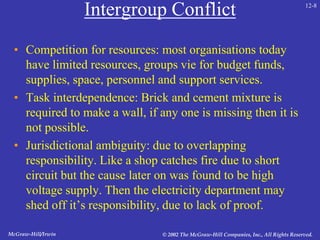
• Competition for resources: most organisations today 
have limited resources, groups vie for budget funds, 
supplies, space, personnel and support services. 
• Task interdependence: Brick and cement mixture is 
required to make a wall, if any one is missing then it is 
not possible. 
• Jurisdictional ambiguity: due to overlapping 
responsibility. Like a shop catches fire due to short 
circuit but the cause later on was found to be high 
voltage supply. Then the electricity department may 
shed off it’s responsibility, due to lack of proof. 
12-8 
McGraw-Hill/Irwin © 2002 The McGraw-Hill Companies, Inc., All Rights Reserved.
Intergroup Conflict 
• Status struggles: this conflict occurs when one 
group attempts to improve its status and another 
group views this as a threat to its place in the 
status hierarchy. 
12-9 
McGraw-Hill/Irwin © 2002 The McGraw-Hill Companies, Inc., All Rights Reserved.
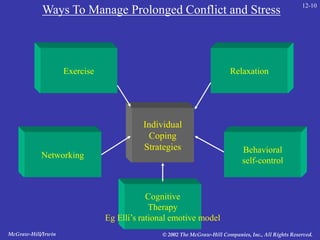
12-10 Ways To Manage Prolonged Conflict and Stress 
Exercise Relaxation 
Individual 
Coping 
Strategies Behavioral 
self-control 
Networking 
Cognitive 
Therapy 
Eg Elli’s rational emotive model 
McGraw-Hill/Irwin © 2002 The McGraw-Hill Companies, Inc., All Rights Reserved.
12-11 Contemporary Negotiation Techniques 
Low-Risk Techniques High-Risk Techniques 
Flattery 
Addressing the easy point first 
Silence 
Inflated opening position 
“Oh, poor me” 
Unexpected temper losses 
High-bailing 
Boulewarism (“take it or leave 
it”) 
Waiting until the last moment 
McGraw-Hill/Irwin © 2002 The McGraw-Hill Companies, Inc., All Rights Reserved.
CONFLICT 
12-12 
McGraw-Hill/Irwin © 2002 The McGraw-Hill Companies, Inc., All Rights Reserved.
Syllabus 
• Meaning and Process of conflict, 
• Causes, sources, consequences of conflict 
• Conflict resolution strategies 
12-13 
McGraw-Hill/Irwin © 2002 The McGraw-Hill Companies, Inc., All Rights Reserved.
Definition 
12-14 
• Chung and Megginson define conflict as the 
struggle between incompatible or opposing 
needs, wishes, ideas, interest or people. Conflicts 
arises when individual or groups encounter goals 
that both parties cannot obtain satisfactorily. 
McGraw-Hill/Irwin © 2002 The McGraw-Hill Companies, Inc., All Rights Reserved.
A necessary evil 
Conflict is… 
• a normal, inescapable part of life 
• a periodic occurrence in any relationship 
• an opportunity to understand opposing 
preferences and values 
• ENERGY 
12-15 
McGraw-Hill/Irwin © 2002 The McGraw-Hill Companies, Inc., All Rights Reserved.
Cognitive Vs affective conflict 
• Cognitive conflict refers to differences in 
perspectives or judgments about issues. It leads 
to legitimate differences of opinion and develop 
better ideas and solution to problems. 
• Affective conflict is emotional and directed at 
other people , which leads to anger, bitterness, 
goal displacement and poor decisions. 
12-16 
McGraw-Hill/Irwin © 2002 The McGraw-Hill Companies, Inc., All Rights Reserved.
Functional and 
Dysfunctional Conflict 
12-17 
• Functional conflict: works toward the goals of 
an organization or group 
• Dysfunctional conflict: blocks an organi-zation 
or group from reaching its goals 
– Dysfunctionally high conflict: what you typically 
think about conflict 
– Dysfunctionally low conflict: an atypical view 
– Levels vary among groups 
McGraw-Hill/Irwin © 2002 The McGraw-Hill Companies, Inc., All Rights Reserved.
Functional and 
Dysfunctional Conflict (Cont.) 
• Functional conflict 
– “Constructive Conflict”--Mary Parker Follett (1925) 
– Increases information and ideas 
– Encourages innovative thinking 
– Unshackles different points of view 
– Reduces stagnation 
12-18 
McGraw-Hill/Irwin © 2002 The McGraw-Hill Companies, Inc., All Rights Reserved.
Functional and 
Dysfunctional Conflict (Cont.) 
• Dysfunctionally high conflict 
– Tension, anxiety, stress 
– Drives out low conflict tolerant people 
– Reduced trust 
– Poor decisions because of withheld or distorted 
information 
– Excessive management focus on the conflict 
12-19 
McGraw-Hill/Irwin © 2002 The McGraw-Hill Companies, Inc., All Rights Reserved.
Functional and 
Dysfunctional Conflict (Cont.) 
• Dysfunctionally low conflict 
– Few new ideas 
– Poor decisions from lack of innovation and 
information 
– Stagnation 
– Business as usual 
12-20 
McGraw-Hill/Irwin © 2002 The McGraw-Hill Companies, Inc., All Rights Reserved.
Process of Conflict 
12-21 
McGraw-Hill/Irwin © 2002 The McGraw-Hill Companies, Inc., All Rights Reserved.
• (1) Stage I: Potential Opposition 
• In the first stage of conflict process, those 
conditions are created due to which conflict 
arises. The different sources of conflicts can be 
divided into three categories: 
• (a) Communication 
• (b) Structure 
• (C) Personal variable 
12-22 
McGraw-Hill/Irwin © 2002 The McGraw-Hill Companies, Inc., All Rights Reserved.
• (a) Communication: In a research , it was 
found that differing words like connotations, 
jargons, noise, insufficient information as well 
as all other barriers acts as a source of conflict 
• Communication as a source of conflict means 
those opposing forces which arise from 
misunderstanding, semantic problems etc. 
• Conflict increases when there is too little 
communication or too much communication 
12-23 
McGraw-Hill/Irwin © 2002 The McGraw-Hill Companies, Inc., All Rights Reserved.
12-24 
• (b) Structure: Structure of the organisation is 
another source of conflict. It includes variables such 
as size, degree of specialization, clarity of authority 
and responsibility, leadership style, reward system 
and the degree of dependence among the group. 
More the size of the group, more the specialization 
in the organisation. This leads to increase in 
conflict. A close style of leadership (tight and 
continuous observation) leads to increase in conflict 
• (c) Personal Variables: It acts as a major source of 
conflict. It includes personality, attitude, value, 
perception and knowledge. 
McGraw-Hill/Irwin © 2002 The McGraw-Hill Companies, Inc., All Rights Reserved.
12-25 
• (2) Stage II: Cognition & Personalization 
• If the conditions stated in stage I, negatively affects 
the party about what he cares then the probability 
for opposition or incompatibility is found. In this 
stage, there can be two types of conflict: 
• (a) Perceived conflict 
• (b) Felt conflict 
• (a) Perceived conflict: It means the conflict is not 
personalized. In other words, “A” may be aware 
that “A” & “B” are in serious disagreement but “A” 
may not be tensed or anxious. 
McGraw-Hill/Irwin © 2002 The McGraw-Hill Companies, Inc., All Rights Reserved.
12-26 
• (b) Felt conflict means those conflicts which 
arise when individuals become emotionally 
involved i.e. becomes tensed, frustrated, anxious 
etc. 
• Some type of pattern prevails between two 
groups as well as two departments in 
organisation 
McGraw-Hill/Irwin © 2002 The McGraw-Hill Companies, Inc., All Rights Reserved.
• (3) Stage III: Conflict handling situation Or 
• Intentions 
12-27 
• Intentions mean decisions to act in a given way. Intention 
means difference between the perception and emotions of 
people and their behaviour. Intention is taken as a 
different stage because it helps us to know how to 
respond in result of others behaviour. There are a lot of 
conflicts which increase due to wrong intentions. There 
can be five different conflict handling intensions 
• (a) Competing 
• (b) Collaborating 
• . 
McGraw-Hill/Irwin © 2002 The McGraw-Hill Companies, Inc., All Rights Reserved.
• (c) Avoiding 
• (d) Compromising 
• (e) Accommodation 
• (a) Competing: A desire to satisfy one’s interest 
irrespective of impact on other party during 
conflict. In simple words, achieving our goal at 
sacrifice of other goal 
12-28 
McGraw-Hill/Irwin © 2002 The McGraw-Hill Companies, Inc., All Rights Reserved.
• (b) Collaborating: It is a situation or intension in which 
both the parties desires to satisfy the need of all the 
parties by clarifying differences. They discuss with each 
other in search of cooperation. 
• (c) Avoiding: Avoiding is the intention to withdraw from 
a conflict i.e. trying to ignore the conflict 
• (d) Compromising: Compromising is a situation or 
intention where both the parties are willing to give up 
something. In such kind of situation, there is no clear 
winner or looser. 
• (e) Accommodating: It means willingness of one party to 
place the opponents interest above his own interest. This 
is also known as self sacrificing intention in order to 
maintain the relationship with the other parties 
12-29 
McGraw-Hill/Irwin © 2002 The McGraw-Hill Companies, Inc., All Rights Reserved.
• (4) Stage IV: Manifest Conflict Or Overt 
12-30 
Behaviour 
• This is the stage where conflict is out in the open 
i.e. it is visible. This stage is known as Behavioral 
stage and it includes the statements, actions and 
reaction made by the parties involved in the 
conflict. Bring the intention into action. 
• Overt conflict covers full range of behaviour from 
direct and indirect form of interference violence and 
uncontrolled struggle at individual as well as group 
level. At organizational level, strikes and lockouts 
may be the result. 
McGraw-Hill/Irwin © 2002 The McGraw-Hill Companies, Inc., All Rights Reserved.
12-31 
• (5) Stage V: Outcomes 
• The conflict finally results in an outcome which 
may be functional (good) or dysfunctional (bad). 
If the conflict is handled properly, there will be 
increase in group performance. Such conflict is 
said to be functional conflict. If the conflict is 
mismanaged and due to it the group performance 
decreases then it is said to be dysfunctional 
conflict. 
McGraw-Hill/Irwin © 2002 The McGraw-Hill Companies, Inc., All Rights Reserved.
12-32 
McGraw-Hill/Irwin © 2002 The McGraw-Hill Companies, Inc., All Rights Reserved.
Causes of Conflict 
• Conflict due to frustation 
12-33 
McGraw-Hill/Irwin © 2002 The McGraw-Hill Companies, Inc., All Rights Reserved.
Causes of conflict 
• About the Eight Causes 
• According to psychologists Art Bell and Brett Hart, there are 
eight common causes of conflict in the workplace. Bell and 
Hart identified these common causes in separate articles on 
workplace conflict in 2000 and 2002. 
• The eight causes are: 
• Conflicting resources. 
• Conflicting styles. 
• Conflicting perceptions. 
• Conflicting goals. 
• Conflicting pressures. 
• Conflicting roles. 
• Different personal values. 
• Unpredictable policies. 
12-34 
McGraw-Hill/Irwin © 2002 The McGraw-Hill Companies, Inc., All Rights Reserved.
• Types of change, identification of the problem 
and 
• Implementation of change, resistance to change, 
overcoming resistance to change. 
12-35 
McGraw-Hill/Irwin © 2002 The McGraw-Hill Companies, Inc., All Rights Reserved.

Conflict

  • 1.
    12-1 Level OfConflict In Organizational Behavior Macro Micro Organizational Intergroup Interpersonal Intra-individual CONFLICT McGraw-Hill/Irwin © 2002 The McGraw-Hill Companies, Inc., All Rights Reserved.
  • 2.
    12-2 A ModelOf Frustration(Intra Individual) Need (deficiency) Drive (deficiency with direction) Frustration Barrier (1) Overt (2) Covert Defense mechanisms (1) Aggression (2) Withdrawal (3) Fixation (4) Compromise Goal/ incentive (reduction of the drives and fulfillment of deficiencies) McGraw-Hill/Irwin © 2002 The McGraw-Hill Companies, Inc., All Rights Reserved.
  • 3.
    12-3 Sources OfInterpersonal Conflict Interpersonal Conflict Information deficiency Environmental stress Personal differences Role incompatibility McGraw-Hill/Irwin © 2002 The McGraw-Hill Companies, Inc., All Rights Reserved.
  • 4.
    Inter personal •Personal difference: every one has a unique background because of his upbringing, cultural and family traditions and socialization processes. Disagreements stemming from the differences due to individual preferences. Example bitter argument over who is morally right. • Information deficiency: This source of conflicts results from communication breakdown in the organization. It may be that the two people in conflict are using different information or that one or both have misinformation. This source of conflict is not emotionally charged and once corrected , there is little resentment. 12-4 McGraw-Hill/Irwin © 2002 The McGraw-Hill Companies, Inc., All Rights Reserved.
  • 5.
    Inter personal 12-5 • Role incompatibility: This type of interpersonal conflict draws from both intra individual role conflict and intergroup conflict.example production manager and sales manager have interdependent functions one supports the other. However the role of production manager is to cut cost by keeping low inventory levels whereas the sales manager requires a high finished goods at hand to meet demands created by him. This causes a conflict from role incompatibility. McGraw-Hill/Irwin © 2002 The McGraw-Hill Companies, Inc., All Rights Reserved.
  • 6.
    Inter personal •Environmental stress: This is caused by stressful environment created due to shrinking market, downsizing, competitive pressures & high degree of uncertainty. 12-6 McGraw-Hill/Irwin © 2002 The McGraw-Hill Companies, Inc., All Rights Reserved.
  • 7.
    12-7 Antecedent ConditionsFor Intergroup Conflict Intergroup Conflict Task interdependence Status struggles Competition for resources Jurisdictional ambiguity McGraw-Hill/Irwin © 2002 The McGraw-Hill Companies, Inc., All Rights Reserved.
  • 8.
    Intergroup Conflict •Competition for resources: most organisations today have limited resources, groups vie for budget funds, supplies, space, personnel and support services. • Task interdependence: Brick and cement mixture is required to make a wall, if any one is missing then it is not possible. • Jurisdictional ambiguity: due to overlapping responsibility. Like a shop catches fire due to short circuit but the cause later on was found to be high voltage supply. Then the electricity department may shed off it’s responsibility, due to lack of proof. 12-8 McGraw-Hill/Irwin © 2002 The McGraw-Hill Companies, Inc., All Rights Reserved.
  • 9.
    Intergroup Conflict •Status struggles: this conflict occurs when one group attempts to improve its status and another group views this as a threat to its place in the status hierarchy. 12-9 McGraw-Hill/Irwin © 2002 The McGraw-Hill Companies, Inc., All Rights Reserved.
  • 10.
    12-10 Ways ToManage Prolonged Conflict and Stress Exercise Relaxation Individual Coping Strategies Behavioral self-control Networking Cognitive Therapy Eg Elli’s rational emotive model McGraw-Hill/Irwin © 2002 The McGraw-Hill Companies, Inc., All Rights Reserved.
  • 11.
    12-11 Contemporary NegotiationTechniques Low-Risk Techniques High-Risk Techniques Flattery Addressing the easy point first Silence Inflated opening position “Oh, poor me” Unexpected temper losses High-bailing Boulewarism (“take it or leave it”) Waiting until the last moment McGraw-Hill/Irwin © 2002 The McGraw-Hill Companies, Inc., All Rights Reserved.
  • 12.
    CONFLICT 12-12 McGraw-Hill/Irwin© 2002 The McGraw-Hill Companies, Inc., All Rights Reserved.
  • 13.
    Syllabus • Meaningand Process of conflict, • Causes, sources, consequences of conflict • Conflict resolution strategies 12-13 McGraw-Hill/Irwin © 2002 The McGraw-Hill Companies, Inc., All Rights Reserved.
  • 14.
    Definition 12-14 •Chung and Megginson define conflict as the struggle between incompatible or opposing needs, wishes, ideas, interest or people. Conflicts arises when individual or groups encounter goals that both parties cannot obtain satisfactorily. McGraw-Hill/Irwin © 2002 The McGraw-Hill Companies, Inc., All Rights Reserved.
  • 15.
    A necessary evil Conflict is… • a normal, inescapable part of life • a periodic occurrence in any relationship • an opportunity to understand opposing preferences and values • ENERGY 12-15 McGraw-Hill/Irwin © 2002 The McGraw-Hill Companies, Inc., All Rights Reserved.
  • 16.
    Cognitive Vs affectiveconflict • Cognitive conflict refers to differences in perspectives or judgments about issues. It leads to legitimate differences of opinion and develop better ideas and solution to problems. • Affective conflict is emotional and directed at other people , which leads to anger, bitterness, goal displacement and poor decisions. 12-16 McGraw-Hill/Irwin © 2002 The McGraw-Hill Companies, Inc., All Rights Reserved.
  • 17.
    Functional and DysfunctionalConflict 12-17 • Functional conflict: works toward the goals of an organization or group • Dysfunctional conflict: blocks an organi-zation or group from reaching its goals – Dysfunctionally high conflict: what you typically think about conflict – Dysfunctionally low conflict: an atypical view – Levels vary among groups McGraw-Hill/Irwin © 2002 The McGraw-Hill Companies, Inc., All Rights Reserved.
  • 18.
    Functional and DysfunctionalConflict (Cont.) • Functional conflict – “Constructive Conflict”--Mary Parker Follett (1925) – Increases information and ideas – Encourages innovative thinking – Unshackles different points of view – Reduces stagnation 12-18 McGraw-Hill/Irwin © 2002 The McGraw-Hill Companies, Inc., All Rights Reserved.
  • 19.
    Functional and DysfunctionalConflict (Cont.) • Dysfunctionally high conflict – Tension, anxiety, stress – Drives out low conflict tolerant people – Reduced trust – Poor decisions because of withheld or distorted information – Excessive management focus on the conflict 12-19 McGraw-Hill/Irwin © 2002 The McGraw-Hill Companies, Inc., All Rights Reserved.
  • 20.
    Functional and DysfunctionalConflict (Cont.) • Dysfunctionally low conflict – Few new ideas – Poor decisions from lack of innovation and information – Stagnation – Business as usual 12-20 McGraw-Hill/Irwin © 2002 The McGraw-Hill Companies, Inc., All Rights Reserved.
  • 21.
    Process of Conflict 12-21 McGraw-Hill/Irwin © 2002 The McGraw-Hill Companies, Inc., All Rights Reserved.
  • 22.
    • (1) StageI: Potential Opposition • In the first stage of conflict process, those conditions are created due to which conflict arises. The different sources of conflicts can be divided into three categories: • (a) Communication • (b) Structure • (C) Personal variable 12-22 McGraw-Hill/Irwin © 2002 The McGraw-Hill Companies, Inc., All Rights Reserved.
  • 23.
    • (a) Communication:In a research , it was found that differing words like connotations, jargons, noise, insufficient information as well as all other barriers acts as a source of conflict • Communication as a source of conflict means those opposing forces which arise from misunderstanding, semantic problems etc. • Conflict increases when there is too little communication or too much communication 12-23 McGraw-Hill/Irwin © 2002 The McGraw-Hill Companies, Inc., All Rights Reserved.
  • 24.
    12-24 • (b)Structure: Structure of the organisation is another source of conflict. It includes variables such as size, degree of specialization, clarity of authority and responsibility, leadership style, reward system and the degree of dependence among the group. More the size of the group, more the specialization in the organisation. This leads to increase in conflict. A close style of leadership (tight and continuous observation) leads to increase in conflict • (c) Personal Variables: It acts as a major source of conflict. It includes personality, attitude, value, perception and knowledge. McGraw-Hill/Irwin © 2002 The McGraw-Hill Companies, Inc., All Rights Reserved.
  • 25.
    12-25 • (2)Stage II: Cognition & Personalization • If the conditions stated in stage I, negatively affects the party about what he cares then the probability for opposition or incompatibility is found. In this stage, there can be two types of conflict: • (a) Perceived conflict • (b) Felt conflict • (a) Perceived conflict: It means the conflict is not personalized. In other words, “A” may be aware that “A” & “B” are in serious disagreement but “A” may not be tensed or anxious. McGraw-Hill/Irwin © 2002 The McGraw-Hill Companies, Inc., All Rights Reserved.
  • 26.
    12-26 • (b)Felt conflict means those conflicts which arise when individuals become emotionally involved i.e. becomes tensed, frustrated, anxious etc. • Some type of pattern prevails between two groups as well as two departments in organisation McGraw-Hill/Irwin © 2002 The McGraw-Hill Companies, Inc., All Rights Reserved.
  • 27.
    • (3) StageIII: Conflict handling situation Or • Intentions 12-27 • Intentions mean decisions to act in a given way. Intention means difference between the perception and emotions of people and their behaviour. Intention is taken as a different stage because it helps us to know how to respond in result of others behaviour. There are a lot of conflicts which increase due to wrong intentions. There can be five different conflict handling intensions • (a) Competing • (b) Collaborating • . McGraw-Hill/Irwin © 2002 The McGraw-Hill Companies, Inc., All Rights Reserved.
  • 28.
    • (c) Avoiding • (d) Compromising • (e) Accommodation • (a) Competing: A desire to satisfy one’s interest irrespective of impact on other party during conflict. In simple words, achieving our goal at sacrifice of other goal 12-28 McGraw-Hill/Irwin © 2002 The McGraw-Hill Companies, Inc., All Rights Reserved.
  • 29.
    • (b) Collaborating:It is a situation or intension in which both the parties desires to satisfy the need of all the parties by clarifying differences. They discuss with each other in search of cooperation. • (c) Avoiding: Avoiding is the intention to withdraw from a conflict i.e. trying to ignore the conflict • (d) Compromising: Compromising is a situation or intention where both the parties are willing to give up something. In such kind of situation, there is no clear winner or looser. • (e) Accommodating: It means willingness of one party to place the opponents interest above his own interest. This is also known as self sacrificing intention in order to maintain the relationship with the other parties 12-29 McGraw-Hill/Irwin © 2002 The McGraw-Hill Companies, Inc., All Rights Reserved.
  • 30.
    • (4) StageIV: Manifest Conflict Or Overt 12-30 Behaviour • This is the stage where conflict is out in the open i.e. it is visible. This stage is known as Behavioral stage and it includes the statements, actions and reaction made by the parties involved in the conflict. Bring the intention into action. • Overt conflict covers full range of behaviour from direct and indirect form of interference violence and uncontrolled struggle at individual as well as group level. At organizational level, strikes and lockouts may be the result. McGraw-Hill/Irwin © 2002 The McGraw-Hill Companies, Inc., All Rights Reserved.
  • 31.
    12-31 • (5)Stage V: Outcomes • The conflict finally results in an outcome which may be functional (good) or dysfunctional (bad). If the conflict is handled properly, there will be increase in group performance. Such conflict is said to be functional conflict. If the conflict is mismanaged and due to it the group performance decreases then it is said to be dysfunctional conflict. McGraw-Hill/Irwin © 2002 The McGraw-Hill Companies, Inc., All Rights Reserved.
  • 32.
    12-32 McGraw-Hill/Irwin ©2002 The McGraw-Hill Companies, Inc., All Rights Reserved.
  • 33.
    Causes of Conflict • Conflict due to frustation 12-33 McGraw-Hill/Irwin © 2002 The McGraw-Hill Companies, Inc., All Rights Reserved.
  • 34.
    Causes of conflict • About the Eight Causes • According to psychologists Art Bell and Brett Hart, there are eight common causes of conflict in the workplace. Bell and Hart identified these common causes in separate articles on workplace conflict in 2000 and 2002. • The eight causes are: • Conflicting resources. • Conflicting styles. • Conflicting perceptions. • Conflicting goals. • Conflicting pressures. • Conflicting roles. • Different personal values. • Unpredictable policies. 12-34 McGraw-Hill/Irwin © 2002 The McGraw-Hill Companies, Inc., All Rights Reserved.
  • 35.
    • Types ofchange, identification of the problem and • Implementation of change, resistance to change, overcoming resistance to change. 12-35 McGraw-Hill/Irwin © 2002 The McGraw-Hill Companies, Inc., All Rights Reserved.