Indian Education System
Efforts by:
Vibhor Agarwal
Education In India
• Education in India is provided by the public sector as well as the private
sector, with control and funding coming from three levels: central, state,
and local. Under various articles of the Indian Constitution, free and
compulsory education is provided as a fundamental right to children
between the ages of 6 and 14.
• India has made progress in terms of increasing the primary education
attendance rate and expanding literacy to approximately three-quarters of
the population in the 7–10 age group, by 2011. India's improved education
system is often cited as one of the main contributors to its economic
development.
• Much of the progress, especially in higher education and scientific
research, has been credited to various public institutions.
• While enrolment in higher education has increased steadily over the past
decade, reaching a Gross Enrolment Ratio of 24% in 2013
• At the primary and secondary level, India has a large private school
system complementing the government run schools, with 29% of students
receiving private education in the 6 to 14 age group
• As per the Annual Status of Education Report (ASER) 2012, 96.5% of all
rural children between the ages of 6-14 were enrolled in school. This is the
fourth annual survey to report enrolment above 96%.
• Another report from 2013 stated that there were 22.9 crore students
enrolled in different accredited urban and rural schools of India, from
Class I to XII, representing an increase of 23 lakh students over 2002 total
enrolment, and a 19% increase in girl's enrolment
FIGURES And DATA
The Education System in India
In the Beginning
• In ancient times, India had the Gurukula system of education in which
anyone who wished to study went to a teacher's (Guru) house and
requested to be taught. If accepted as a student by the guru, he would
then stay at the guru's place and help in all activities at home. This not
only created a strong tie between the teacher and the student, but also
taught the student everything about running a house.
• The guru taught everything the child wanted to learn, from Sanskrit to
the holy scriptures and from Mathematics to Metaphysics. The student
stayed as long as she wished or until the guru felt that he had taught
everything he could teach. All learning was closely linked to nature and
to life, and not confined to memorizing some information.
Modern Education System
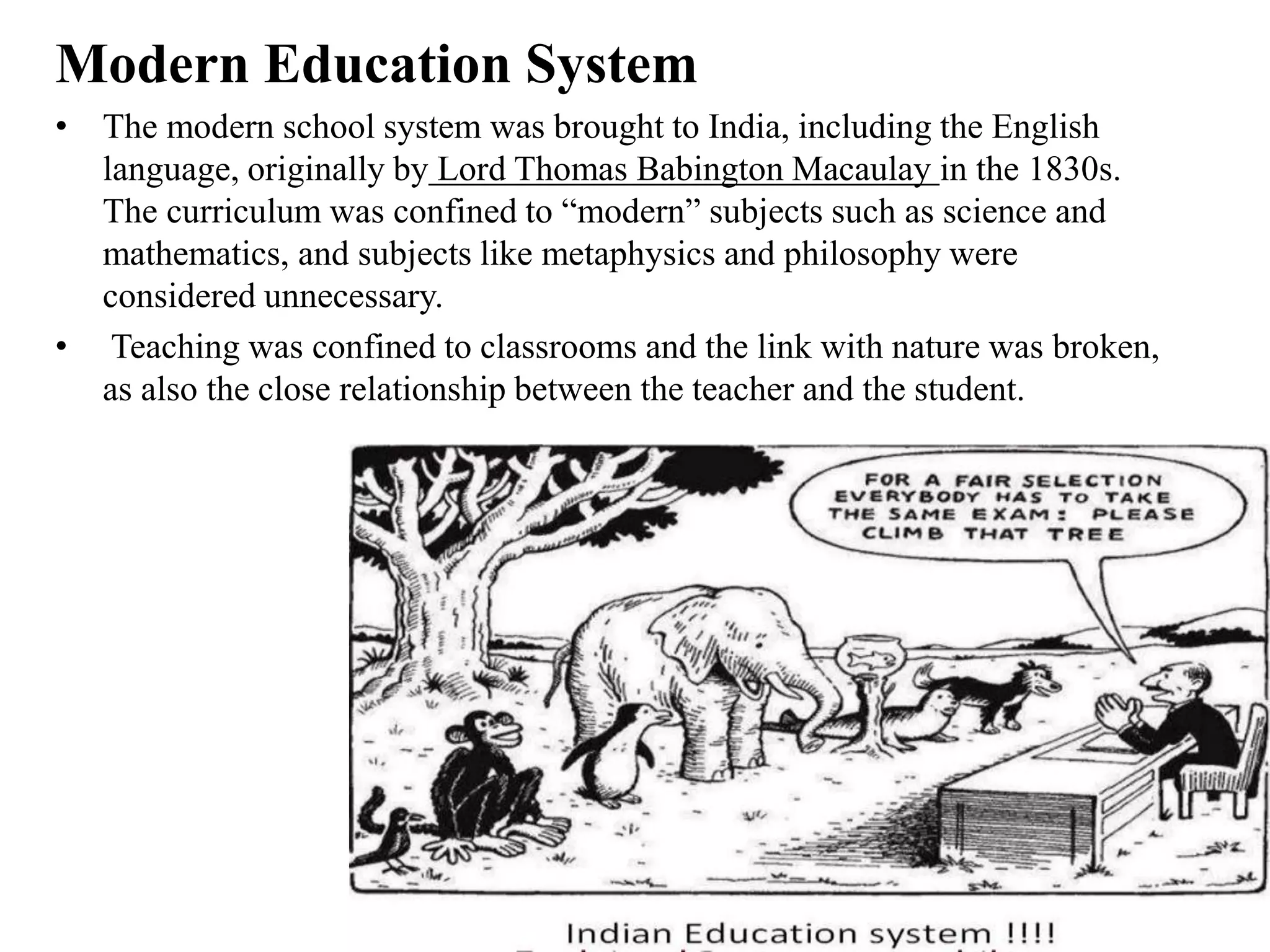
• The modern school system was brought to India, including the English
language, originally by Lord Thomas Babington Macaulay in the 1830s.
The curriculum was confined to “modern” subjects such as science and
mathematics, and subjects like metaphysics and philosophy were
considered unnecessary.
• Teaching was confined to classrooms and the link with nature was broken,
as also the close relationship between the teacher and the student.
The School System
• India is divided into 28 states and 7 so-called “Union Territories”. The
states have their own elected governments while the Union Territories are
ruled directly by the Government of India, with the President of India
appointing an administrator for each Union Territory.
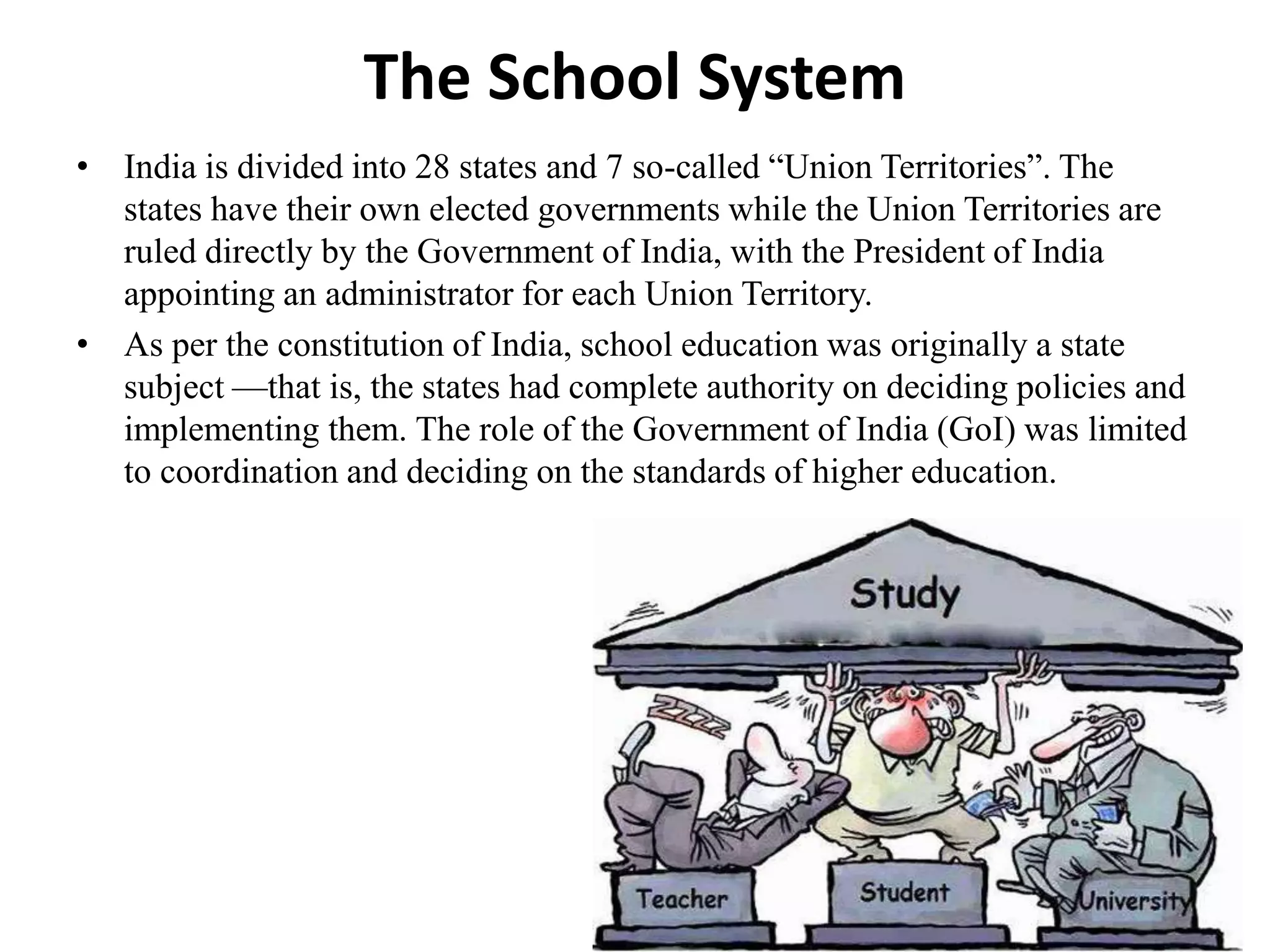
• As per the constitution of India, school education was originally a state
subject —that is, the states had complete authority on deciding policies and
implementing them. The role of the Government of India (GoI) was limited
to coordination and deciding on the standards of higher education.
Primary Education
• Primary and Middle (lower primary (Standards I to V) and upper primary
(Standards VI to VIII)) education is compulsory and free in India. Primary
education begins at age 6 with Middle/Upper Primary school education
ending at age 14. Schooling is offered at state-run and private schools,
however, private schools often have poorer facilities and infrastructure than
government schools. The regional language is the medium of instruction
for most primary schools and English as a second language generally
begins by grade 3.
Secondary Education
• Secondary education begins in grade 9 and lasts until grade 12. The
secondary stage is broken into two, two year cycles, generally referred to as
General/Lower Secondary School, or ‘Standard X’, and Upper/Senior
Secondary School, or ‘Standard XII’. Education continues to be free at
government schools, although private education is more common at the
secondary level..
Thank You

Indian education system

  • 1.
  • 2.
    Education In India •Education in India is provided by the public sector as well as the private sector, with control and funding coming from three levels: central, state, and local. Under various articles of the Indian Constitution, free and compulsory education is provided as a fundamental right to children between the ages of 6 and 14. • India has made progress in terms of increasing the primary education attendance rate and expanding literacy to approximately three-quarters of the population in the 7–10 age group, by 2011. India's improved education system is often cited as one of the main contributors to its economic development.
  • 3.
    • Much ofthe progress, especially in higher education and scientific research, has been credited to various public institutions. • While enrolment in higher education has increased steadily over the past decade, reaching a Gross Enrolment Ratio of 24% in 2013 • At the primary and secondary level, India has a large private school system complementing the government run schools, with 29% of students receiving private education in the 6 to 14 age group • As per the Annual Status of Education Report (ASER) 2012, 96.5% of all rural children between the ages of 6-14 were enrolled in school. This is the fourth annual survey to report enrolment above 96%. • Another report from 2013 stated that there were 22.9 crore students enrolled in different accredited urban and rural schools of India, from Class I to XII, representing an increase of 23 lakh students over 2002 total enrolment, and a 19% increase in girl's enrolment FIGURES And DATA
  • 4.
    The Education Systemin India In the Beginning • In ancient times, India had the Gurukula system of education in which anyone who wished to study went to a teacher's (Guru) house and requested to be taught. If accepted as a student by the guru, he would then stay at the guru's place and help in all activities at home. This not only created a strong tie between the teacher and the student, but also taught the student everything about running a house. • The guru taught everything the child wanted to learn, from Sanskrit to the holy scriptures and from Mathematics to Metaphysics. The student stayed as long as she wished or until the guru felt that he had taught everything he could teach. All learning was closely linked to nature and to life, and not confined to memorizing some information.
  • 5.
    Modern Education System •The modern school system was brought to India, including the English language, originally by Lord Thomas Babington Macaulay in the 1830s. The curriculum was confined to “modern” subjects such as science and mathematics, and subjects like metaphysics and philosophy were considered unnecessary. • Teaching was confined to classrooms and the link with nature was broken, as also the close relationship between the teacher and the student.
  • 6.
    The School System •India is divided into 28 states and 7 so-called “Union Territories”. The states have their own elected governments while the Union Territories are ruled directly by the Government of India, with the President of India appointing an administrator for each Union Territory. • As per the constitution of India, school education was originally a state subject —that is, the states had complete authority on deciding policies and implementing them. The role of the Government of India (GoI) was limited to coordination and deciding on the standards of higher education.
  • 7.
    Primary Education • Primaryand Middle (lower primary (Standards I to V) and upper primary (Standards VI to VIII)) education is compulsory and free in India. Primary education begins at age 6 with Middle/Upper Primary school education ending at age 14. Schooling is offered at state-run and private schools, however, private schools often have poorer facilities and infrastructure than government schools. The regional language is the medium of instruction for most primary schools and English as a second language generally begins by grade 3.
  • 8.
    Secondary Education • Secondaryeducation begins in grade 9 and lasts until grade 12. The secondary stage is broken into two, two year cycles, generally referred to as General/Lower Secondary School, or ‘Standard X’, and Upper/Senior Secondary School, or ‘Standard XII’. Education continues to be free at government schools, although private education is more common at the secondary level..
  • 10.