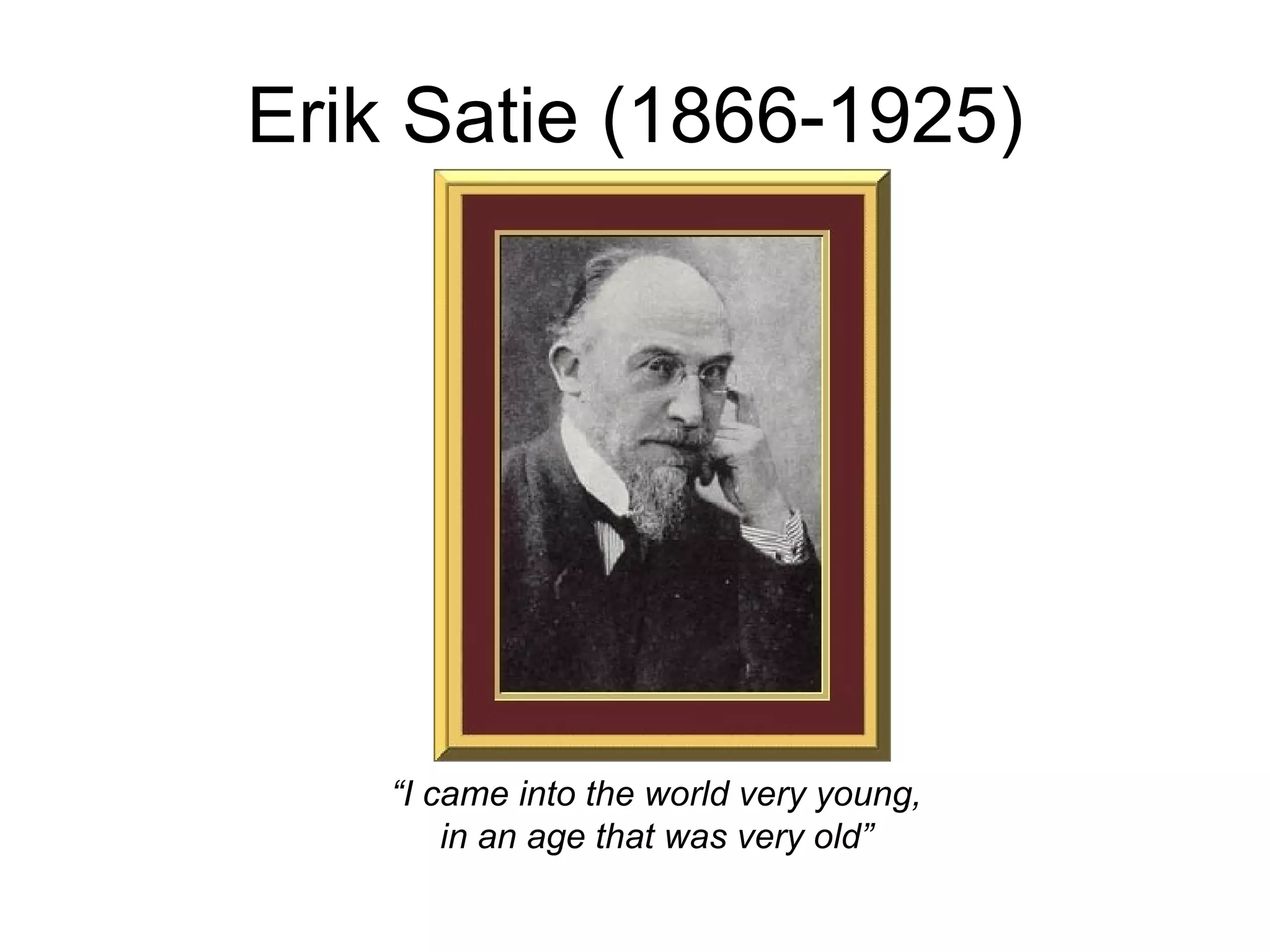
Erik Satie (1866-1925) “ I came into the world very young, in an age that was very old”
Satie in a nutshell Turn of the century French composer Worked with Pablo Picasso Anticipated many later  avant-garde  trends Has been claimed by many 20 th  century movements
Family background A family of sailors Shipbrokers in Normandy Mother of Scottish lineage Father and Uncle both shipbrokers Father described as studious and steady. Uncle as wild and undisciplined. An eccentric.
Early stages of Development Born in Honfleur in 1866 Had a younger brother and 2 younger sisters. Little is known of his mother’s personality Erik’s mother died when he was 6. He and his brother, Conrad, were then sent to live with their grandparents. Had been baptized as Anglican, but were rebaptized Catholic.
Industry vs. Inferiority Entered in school Became very close with his eccentric Uncle Began studying music at age 10 under an organist named Vinot.  Became familiar with Gregorian plainsong through Vinot. Greatly influenced his later compositional style
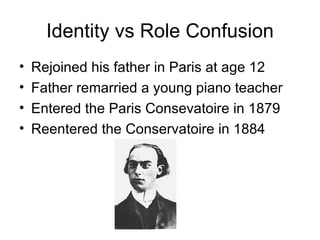
Identity vs Role Confusion Rejoined his father in Paris at age 12 Father remarried a young piano teacher Entered the Paris Consevatoire in 1879 Reentered the Conservatoire in 1884
Intimacy vs Isolation First musical publications in 1886 In the same year leaves for voluntary military service Escapes the service by purposefully contracting bronchitis. Hospitalized for 2 months. Publishes his most famous work, the  Gymnopedies , in 1887
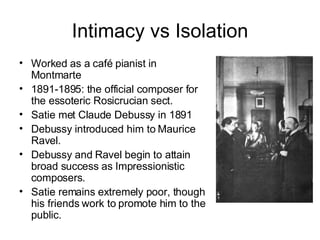
Intimacy vs Isolation Worked as a café pianist in Montmarte 1891-1895: the official composer for the essoteric Rosicrucian sect. Satie met Claude Debussy in 1891 Debussy introduced him to Maurice Ravel. Debussy and Ravel begin to attain broad success as Impressionistic composers. Satie remains extremely poor, though his friends work to promote him to the public.
Intimacy vs Isolation
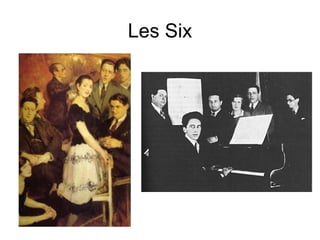
Relationships Conrad Satie (brother) Claude Debussy & Maurice Ravel (peers) Suzanne Valadon (romantic) Les Six (students/admirers) Georges Auric Louis Durey Arthur Honegger Darius Milhaud Frances Poulenc Germaine Talleferre
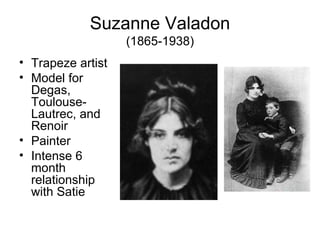
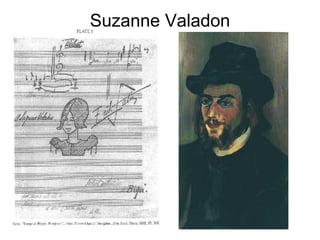
Suzanne Valadon (1865-1938) Trapeze artist Model for Degas, Toulouse-Lautrec, and Renoir Painter Intense 6 month relationship with Satie
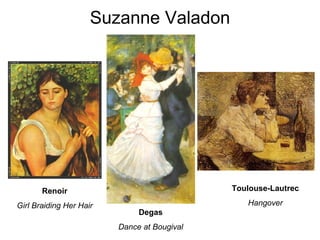
Suzanne Valadon Renoir Girl Braiding Her Hair Degas Dance at Bougival Toulouse-Lautrec Hangover
Suzanne Valadon
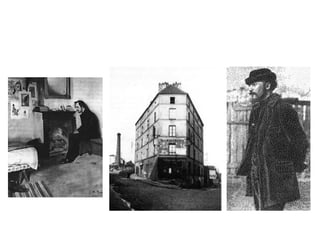
Forced to move to an industrial suburb in 1898 for economic reasons. In 1900 produces several first rate café songs and music hall pieces.
 
Les Six
Satie’s 1 bedroom apartment 7 of 12 identical grey velvet suits on an empty dresser Two pianos stacked on top of each other 100 umbrellas 84 identical handkerchiefs Newspaper clippings Unopened mail and unsent letters Innumerable musical & literary jottings
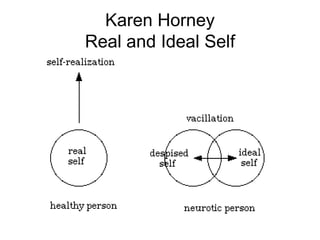
Karen Horney Real and Ideal Self
Karen Horney:  Neurotic Needs or Trends Primary modes of relating: 1.) Moving toward (compliance) Orientation: self-effacing solution An appeal to be loved 2.) Moving against (hostility) Orientation: self-expansive solution An attempt at mastery 3.) Moving away (detachment) Orientation: resignation solution Desire to be free of others
Satie’s resignation solution Left the Catholic church to join the esoteric Rosicrucian sect. Later started his own religion, of which he was only member. Pushed away most of his friends, family, and professional relationships. Joined the Socialist party. Later became a communist. Left the city for a working class suburb in Paris. Moved away from the current trends in music and art.
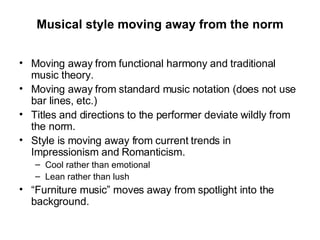
Musical style moving away from the norm Moving away from functional harmony and traditional music theory. Moving away from standard music notation (does not use bar lines, etc.) Titles and directions to the performer deviate wildly from the norm. Style is moving away from current trends in Impressionism and Romanticism. Cool rather than emotional Lean rather than lush “ Furniture music” moves away from spotlight into the background.
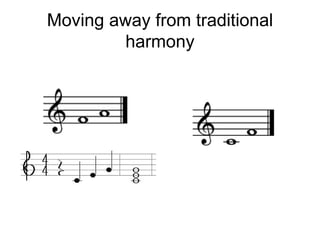
Moving away from traditional harmony
1893
 
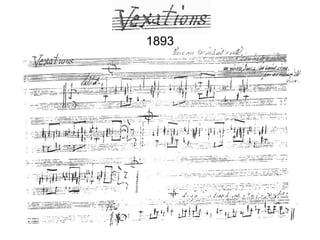
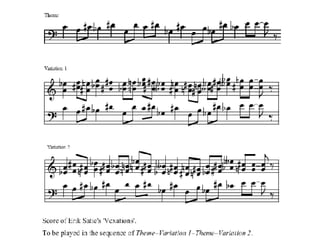
Vexations 840 repetitions of a 1 minute motif 18 hours 40 minutes to perform First performance organized by John Cage in 1963 – 10 performers rotated 2 hour shifts One of the first compositions of truly organized chromaticism Use of Lucas number series (similar to Fibonacci sequence) 2, 1, 3, 4, 7, 11, 18… Both performers and audiences have reported trance states and disturbing effects An Australian pianist abandoned an attempt in 1970 at repetition 595. Complained of hallucinations and animals peering at him from behind the score.
Erikson: Identity Individuality:  conscious sense of uniqueness and existence as a separate, unique entity. Wholeness/synthesis:  sense of personal cohesiveness Sameness/continuity Social solidarity:  feelings of support & validation
Erikson: Identity Confusion Difficulty going to bed Trouble waking up and facing the next day Lack of concentration and difficulty focusing Moody absorption, fantasizing, daydreaming Pronounced feeling of being an outcast or wanderer

Erik Satie

  • 1.
    Erik Satie (1866-1925)“ I came into the world very young, in an age that was very old”
  • 2.
    Satie in anutshell Turn of the century French composer Worked with Pablo Picasso Anticipated many later avant-garde trends Has been claimed by many 20 th century movements
  • 3.
    Family background Afamily of sailors Shipbrokers in Normandy Mother of Scottish lineage Father and Uncle both shipbrokers Father described as studious and steady. Uncle as wild and undisciplined. An eccentric.
  • 4.
    Early stages ofDevelopment Born in Honfleur in 1866 Had a younger brother and 2 younger sisters. Little is known of his mother’s personality Erik’s mother died when he was 6. He and his brother, Conrad, were then sent to live with their grandparents. Had been baptized as Anglican, but were rebaptized Catholic.
  • 5.
    Industry vs. InferiorityEntered in school Became very close with his eccentric Uncle Began studying music at age 10 under an organist named Vinot. Became familiar with Gregorian plainsong through Vinot. Greatly influenced his later compositional style
  • 6.
    Identity vs RoleConfusion Rejoined his father in Paris at age 12 Father remarried a young piano teacher Entered the Paris Consevatoire in 1879 Reentered the Conservatoire in 1884
  • 7.
    Intimacy vs IsolationFirst musical publications in 1886 In the same year leaves for voluntary military service Escapes the service by purposefully contracting bronchitis. Hospitalized for 2 months. Publishes his most famous work, the Gymnopedies , in 1887
  • 8.
    Intimacy vs IsolationWorked as a café pianist in Montmarte 1891-1895: the official composer for the essoteric Rosicrucian sect. Satie met Claude Debussy in 1891 Debussy introduced him to Maurice Ravel. Debussy and Ravel begin to attain broad success as Impressionistic composers. Satie remains extremely poor, though his friends work to promote him to the public.
  • 9.
  • 10.
    Relationships Conrad Satie(brother) Claude Debussy & Maurice Ravel (peers) Suzanne Valadon (romantic) Les Six (students/admirers) Georges Auric Louis Durey Arthur Honegger Darius Milhaud Frances Poulenc Germaine Talleferre
  • 11.
    Suzanne Valadon (1865-1938)Trapeze artist Model for Degas, Toulouse-Lautrec, and Renoir Painter Intense 6 month relationship with Satie
  • 12.
    Suzanne Valadon RenoirGirl Braiding Her Hair Degas Dance at Bougival Toulouse-Lautrec Hangover
  • 13.
  • 14.
    Forced to moveto an industrial suburb in 1898 for economic reasons. In 1900 produces several first rate café songs and music hall pieces.
  • 15.
  • 16.
  • 17.
    Satie’s 1 bedroomapartment 7 of 12 identical grey velvet suits on an empty dresser Two pianos stacked on top of each other 100 umbrellas 84 identical handkerchiefs Newspaper clippings Unopened mail and unsent letters Innumerable musical & literary jottings
  • 18.
    Karen Horney Realand Ideal Self
  • 19.
    Karen Horney: Neurotic Needs or Trends Primary modes of relating: 1.) Moving toward (compliance) Orientation: self-effacing solution An appeal to be loved 2.) Moving against (hostility) Orientation: self-expansive solution An attempt at mastery 3.) Moving away (detachment) Orientation: resignation solution Desire to be free of others
  • 20.
    Satie’s resignation solutionLeft the Catholic church to join the esoteric Rosicrucian sect. Later started his own religion, of which he was only member. Pushed away most of his friends, family, and professional relationships. Joined the Socialist party. Later became a communist. Left the city for a working class suburb in Paris. Moved away from the current trends in music and art.
  • 21.
    Musical style movingaway from the norm Moving away from functional harmony and traditional music theory. Moving away from standard music notation (does not use bar lines, etc.) Titles and directions to the performer deviate wildly from the norm. Style is moving away from current trends in Impressionism and Romanticism. Cool rather than emotional Lean rather than lush “ Furniture music” moves away from spotlight into the background.
  • 22.
    Moving away fromtraditional harmony
  • 23.
  • 24.
  • 25.
    Vexations 840 repetitionsof a 1 minute motif 18 hours 40 minutes to perform First performance organized by John Cage in 1963 – 10 performers rotated 2 hour shifts One of the first compositions of truly organized chromaticism Use of Lucas number series (similar to Fibonacci sequence) 2, 1, 3, 4, 7, 11, 18… Both performers and audiences have reported trance states and disturbing effects An Australian pianist abandoned an attempt in 1970 at repetition 595. Complained of hallucinations and animals peering at him from behind the score.
  • 26.
    Erikson: Identity Individuality: conscious sense of uniqueness and existence as a separate, unique entity. Wholeness/synthesis: sense of personal cohesiveness Sameness/continuity Social solidarity: feelings of support & validation
  • 27.
    Erikson: Identity ConfusionDifficulty going to bed Trouble waking up and facing the next day Lack of concentration and difficulty focusing Moody absorption, fantasizing, daydreaming Pronounced feeling of being an outcast or wanderer