VERB TENSES
SIMPLE PRESENT Events or situations that exist always, usually, habitually. They exist now, have existed in the past, and probably will exist in the future. It expresses general statement of fact and timeless truths. It expresses habitual or everyday activities. It snows in Alaska.
SIMPLE PAST Things that happened at one particular time in the past. Something that began and ended in the past. It snowed yesterday.
SIMPLE FUTURE At one particular time I n the future, this will happen. It will snow tomorrow.
PROGRESSIVE TENSES They give the idea that the action is in progress during a particular time.
PRESENT PROGRESSIVE The action is in progress at the present time, and probably will continue. Something generally in progress this week, this month, this year. Tom is sleeping right now.
PAST PROGRESSIVE The action was in progress at a particular time in the past. Tom was sleeping when I arrived.
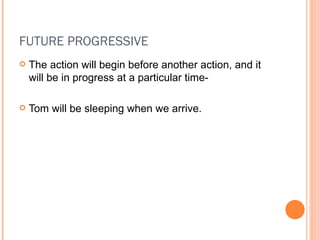
FUTURE PROGRESSIVE The action will begin before another action, and it will be in progress at a particular time- Tom will be sleeping when we arrive.
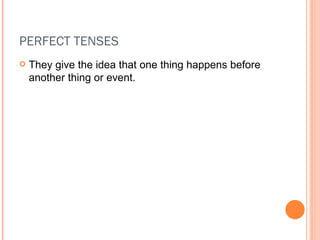
PERFECT TENSES They give the idea that one thing happens before another thing or event.
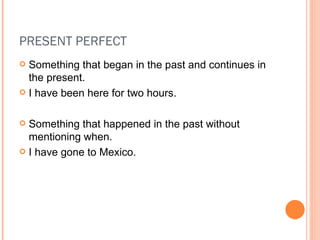
PRESENT PERFECT Something that began in the past and continues in the present. I have been here for two hours. Something that happened in the past without mentioning when. I have gone to Mexico.
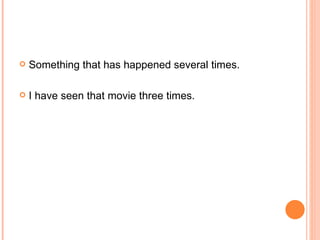
Something that has happened several times. I have seen that movie three times.
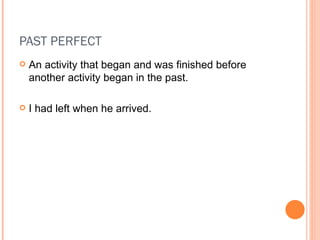
PAST PERFECT An activity that began and was finished before another activity began in the past. I had left when he arrived.
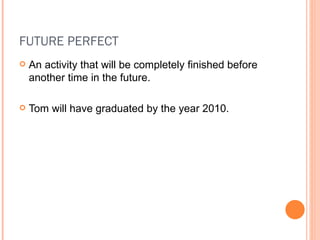
FUTURE PERFECT An activity that will be completely finished before another time in the future. Tom will have graduated by the year 2010.
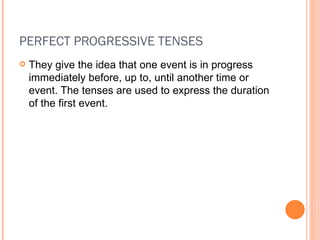
PERFECT PROGRESSIVE TENSES They give the idea that one event is in progress immediately before, up to, until another time or event. The tenses are used to express the duration of the first event.
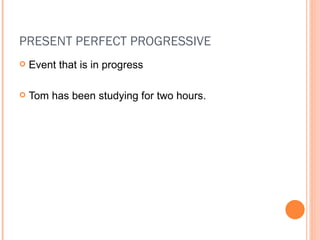
PRESENT PERFECT PROGRESSIVE Event that is in progress Tom has been studying for two hours.
PAST PERFECT PROGRESSIVE Event was in progress Tom had been studying for two hours before his friend came.
FUTURE PERFECT PROGRESSIVE Event will be in progress  before another event in the future. Tom will  have been studying for two hours by the time his friend arrives.
SPELLING OF ING AND ED FORMS 1. verbs that end in a consonant and e: Drop e and add ing. Hope hoping hoped Date dating dated Injure injuring injured
ONE-SYLLABLE VERBS 1. consonant-vowel-consonant: double consonant Stop stopping stopped Rob robbing robbed Beg begging begged
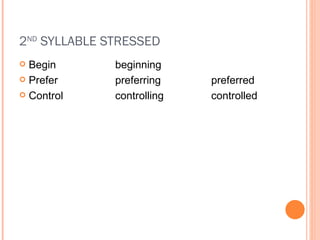
2 ND  SYLLABLE STRESSED Begin beginning Prefer preferring preferred Control controlling controlled
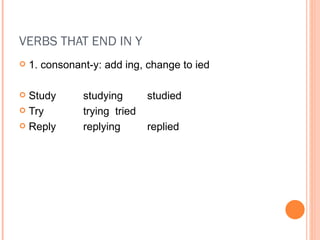
VERBS THAT END IN Y 1. consonant-y: add ing, change to ied Study studying studied Try trying tried Reply replying replied
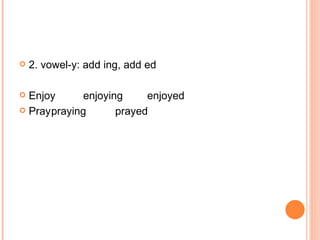
2. vowel-y: add ing, add ed Enjoy enjoying enjoyed Pray praying prayed
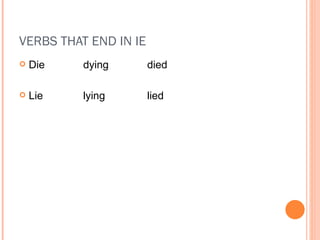
VERBS THAT END IN IE Die dying died Lie lying lied
STATIVE VERBS They describe states, conditions or situations that exist. They are not used I n progressive tenses. The food tastes good. Exception: The chef is tasting the food.
VERBS WITH STATIVE MEANING Mental state : Know need Realize desire Understand Recognize Believe Feel Suppose
STATIVE AND PROGRESSIVE Think Imagine Doubt Remember Forget Want Mean
EMOTIONAL STATE love like appreciate please prefer hate dislike fear envy mind care astonish amaze surprise
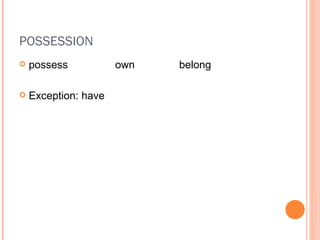
POSSESSION possess own belong Exception: have
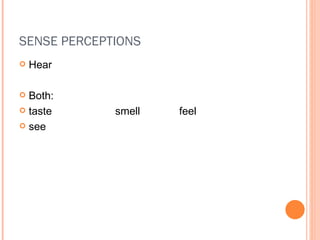
SENSE PERCEPTIONS Hear Both: taste smell feel see
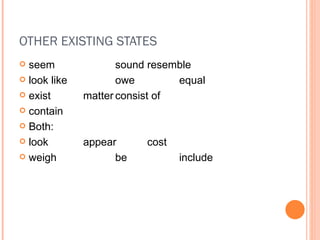
OTHER EXISTING STATES seem sound resemble look like owe equal exist matter consist of contain Both: look appear cost weigh be include
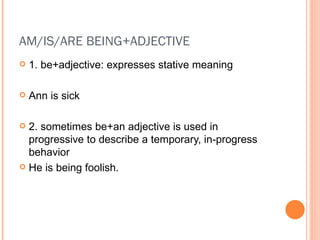
AM/IS/ARE BEING+ADJECTIVE 1. be+adjective: expresses stative meaning Ann is sick 2. sometimes be+an adjective is used in progressive to describe a temporary, in-progress behavior He is being foolish.
ADJECTIVES THAT CAN BE USED WITH AM/IS/ARE BEING bad careful cruel fair foolish funny generous good illogical impolite irresponsible kind lazy logical loud nice noisy patient pleasant polite quiet responsible rude serious silly unfair unkind unpleasant
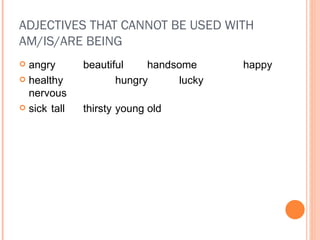
ADJECTIVES THAT CANNOT BE USED WITH AM/IS/ARE BEING angry beautiful handsome happy healthy hungry lucky nervous sick tall thirsty young old
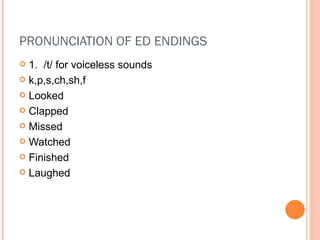
PRONUNCIATION OF ED ENDINGS 1.  /t/ for voiceless sounds k,p,s,ch,sh,f Looked Clapped Missed Watched Finished Laughed
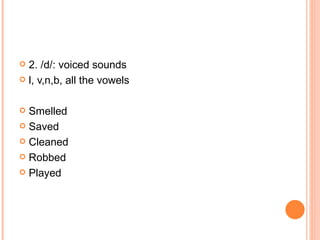
2. /d/: voiced sounds l, v,n,b, all the vowels Smelled Saved Cleaned Robbed Played
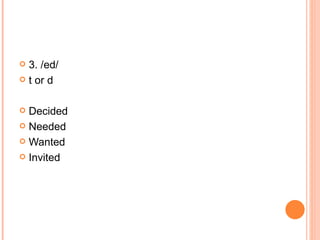
3. /ed/ t or d Decided Needed Wanted Invited
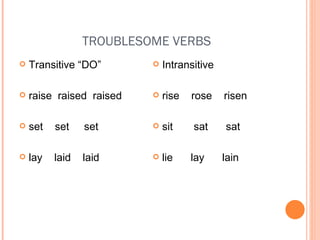
TROUBLESOME VERBS Transitive “DO” raise  raised  raised set  set  set  lay  laid  laid Intransitive rise  rose  risen sit  sat  sat lie  lay  lain
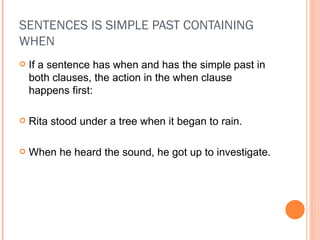
SENTENCES IS SIMPLE PAST CONTAINING WHEN If a sentence has when and has the simple past in both clauses, the action in the when clause happens first: Rita stood under a tree when it began to rain. When he heard the sound, he got up to investigate.
PAST PROGRESSIVE AND SIMPLE PAST I was walking down the street when it began to rain. The progressive action happened first.
PROGRESSIVE VERBS WITH ALWAYS TO COMPLAIN He is always leaving his dirty clothes on the floor. Expresses annoyance and anger always, forever, constantly
USE OF AFTER AND BEFORE WITH PAST PERFECT Past perfect is not necessary Sam had left before Ann arrived. Sam left before Ann arrived. After the guests had left, I went to bed. After the guests left, I when to bed.

Verb tenses

  • 1.
  • 2.
    SIMPLE PRESENT Eventsor situations that exist always, usually, habitually. They exist now, have existed in the past, and probably will exist in the future. It expresses general statement of fact and timeless truths. It expresses habitual or everyday activities. It snows in Alaska.
  • 3.
    SIMPLE PAST Thingsthat happened at one particular time in the past. Something that began and ended in the past. It snowed yesterday.
  • 4.
    SIMPLE FUTURE Atone particular time I n the future, this will happen. It will snow tomorrow.
  • 5.
    PROGRESSIVE TENSES Theygive the idea that the action is in progress during a particular time.
  • 6.
    PRESENT PROGRESSIVE Theaction is in progress at the present time, and probably will continue. Something generally in progress this week, this month, this year. Tom is sleeping right now.
  • 7.
    PAST PROGRESSIVE Theaction was in progress at a particular time in the past. Tom was sleeping when I arrived.
  • 8.
    FUTURE PROGRESSIVE Theaction will begin before another action, and it will be in progress at a particular time- Tom will be sleeping when we arrive.
  • 9.
    PERFECT TENSES Theygive the idea that one thing happens before another thing or event.
  • 10.
    PRESENT PERFECT Somethingthat began in the past and continues in the present. I have been here for two hours. Something that happened in the past without mentioning when. I have gone to Mexico.
  • 11.
    Something that hashappened several times. I have seen that movie three times.
  • 12.
    PAST PERFECT Anactivity that began and was finished before another activity began in the past. I had left when he arrived.
  • 13.
    FUTURE PERFECT Anactivity that will be completely finished before another time in the future. Tom will have graduated by the year 2010.
  • 14.
    PERFECT PROGRESSIVE TENSESThey give the idea that one event is in progress immediately before, up to, until another time or event. The tenses are used to express the duration of the first event.
  • 15.
    PRESENT PERFECT PROGRESSIVEEvent that is in progress Tom has been studying for two hours.
  • 16.
    PAST PERFECT PROGRESSIVEEvent was in progress Tom had been studying for two hours before his friend came.
  • 17.
    FUTURE PERFECT PROGRESSIVEEvent will be in progress before another event in the future. Tom will have been studying for two hours by the time his friend arrives.
  • 18.
    SPELLING OF INGAND ED FORMS 1. verbs that end in a consonant and e: Drop e and add ing. Hope hoping hoped Date dating dated Injure injuring injured
  • 19.
    ONE-SYLLABLE VERBS 1.consonant-vowel-consonant: double consonant Stop stopping stopped Rob robbing robbed Beg begging begged
  • 20.
    2 ND SYLLABLE STRESSED Begin beginning Prefer preferring preferred Control controlling controlled
  • 21.
    VERBS THAT ENDIN Y 1. consonant-y: add ing, change to ied Study studying studied Try trying tried Reply replying replied
  • 22.
    2. vowel-y: adding, add ed Enjoy enjoying enjoyed Pray praying prayed
  • 23.
    VERBS THAT ENDIN IE Die dying died Lie lying lied
  • 24.
    STATIVE VERBS Theydescribe states, conditions or situations that exist. They are not used I n progressive tenses. The food tastes good. Exception: The chef is tasting the food.
  • 25.
    VERBS WITH STATIVEMEANING Mental state : Know need Realize desire Understand Recognize Believe Feel Suppose
  • 26.
    STATIVE AND PROGRESSIVEThink Imagine Doubt Remember Forget Want Mean
  • 27.
    EMOTIONAL STATE lovelike appreciate please prefer hate dislike fear envy mind care astonish amaze surprise
  • 28.
    POSSESSION possess ownbelong Exception: have
  • 29.
    SENSE PERCEPTIONS HearBoth: taste smell feel see
  • 30.
    OTHER EXISTING STATESseem sound resemble look like owe equal exist matter consist of contain Both: look appear cost weigh be include
  • 31.
    AM/IS/ARE BEING+ADJECTIVE 1.be+adjective: expresses stative meaning Ann is sick 2. sometimes be+an adjective is used in progressive to describe a temporary, in-progress behavior He is being foolish.
  • 32.
    ADJECTIVES THAT CANBE USED WITH AM/IS/ARE BEING bad careful cruel fair foolish funny generous good illogical impolite irresponsible kind lazy logical loud nice noisy patient pleasant polite quiet responsible rude serious silly unfair unkind unpleasant
  • 33.
    ADJECTIVES THAT CANNOTBE USED WITH AM/IS/ARE BEING angry beautiful handsome happy healthy hungry lucky nervous sick tall thirsty young old
  • 34.
    PRONUNCIATION OF EDENDINGS 1. /t/ for voiceless sounds k,p,s,ch,sh,f Looked Clapped Missed Watched Finished Laughed
  • 35.
    2. /d/: voicedsounds l, v,n,b, all the vowels Smelled Saved Cleaned Robbed Played
  • 36.
    3. /ed/ tor d Decided Needed Wanted Invited
  • 37.
    TROUBLESOME VERBS Transitive“DO” raise raised raised set set set lay laid laid Intransitive rise rose risen sit sat sat lie lay lain
  • 38.
    SENTENCES IS SIMPLEPAST CONTAINING WHEN If a sentence has when and has the simple past in both clauses, the action in the when clause happens first: Rita stood under a tree when it began to rain. When he heard the sound, he got up to investigate.
  • 39.
    PAST PROGRESSIVE ANDSIMPLE PAST I was walking down the street when it began to rain. The progressive action happened first.
  • 40.
    PROGRESSIVE VERBS WITHALWAYS TO COMPLAIN He is always leaving his dirty clothes on the floor. Expresses annoyance and anger always, forever, constantly
  • 41.
    USE OF AFTERAND BEFORE WITH PAST PERFECT Past perfect is not necessary Sam had left before Ann arrived. Sam left before Ann arrived. After the guests had left, I went to bed. After the guests left, I when to bed.

Editor's Notes

  • #38 Raise: levantar lay: / Poner