Condition Based Maintenance
1
1
Principles of CBM
2
Condition-based maintenance (CBM) is a maintenance strategy
that monitors the actual condition of an asset to decide
what maintenance needs to be done. CBM dictates
that maintenance should only be performed when certain indicators
show signs of decreasing performance or upcoming failure.
Condition-Based Maintenance Implementation.
1. Commitment - The maintenance staff must commit to the process and its new
technology. It has to trust the training and technology, while management needs
to commit to procuring adequate equipment and training for all staff.
2. Participation - To achieve success, 100 percent participation in the CBM
program is required from all groups. This expectation must be reinforced by
management.
3. Holistic approach - This applies to all systems throughout the plant with no
exceptions.
4. Sustainability - The CBM program, staff and equipment must be maintained
over time to reap the long-term benefits. As people come and go from the
organization, the proper training and resources need to be available.
3
Pillars of Condition
Monitoring
4
The condition monitoring also known as Dynamic Predictive
Maintenance is composed of several functional aspects on which the
maintenance is carried out. However there are four important schematic
and functional steps observed in any implementation of condition
monitoring activity. These functional aspects are often called four pillars
of Condition Monitoring. These are following:
1.Detection,
2.Diagnosis,
3.Prognosis, and
4.Programme
Detection
This pillar of DPM details when of the developing fault has just arisen. This
focuses to answer the following 'When' questions.
When might the fault have started?
When (or how early) is the fault noticed?
When does this fault result in a disaster if left unattended?
Diagnosis
Diagnosis concentrates on knowing 'what' of the origin of the fault so that spares
parts can be ordered.
What is origin of the fault?
At what stage is the fault now?
What is the growth rate of the fault?
What are the components or parts that suffering from this fault?
5
Prognosis
This pinpoints what could happen if the fault is left unattended, i.e. the
FORECAST of after effects. Subsequent measurement will then establish the
trend to indicate what may happen. This function puts the effort to answer the
following queries.
What is the severity of the fault?
What could be the results of the fault?
What could be the production loss?
What is cost of the fault in terms of hours of production and maintenance or
repair?
What are the side effects?
What is the trend of the failure? (progressive/constant/retrogressive)
What is the lead time?
6
Programme
This function is concerned with preparation of SCHEDULE to enable the repair,
schedule to be planned. This function attempts to reply the following type of
questions:
When should the equipment be taken for maintenance or repair?
What maintenance policy should be adopted?
When should the restoring action start and likely time when it can be finished?
Who will maintain or repair so as to restore the condition?
What is the action plan?
7
Benefits from condition based maintenance
8
 Safety:
The injury and fatal accidents can possibly be reduced by adopting the safety
measures in equipment and system. So, the condition based maintenance
enables the system by indicating the future failure in the form of giving
signal to the operator.
 Extended useful life:
The continuous monitoring enables the system to avoid sudden failures
which is not unscheduled. It extends the life of the equipment considerably.
 Enhanced availability:
The breakdowns are minimized through proper maintenance which leads to
increase the availability. It is achieved by reducing the down time.
 Reduction in maintenance time:
The repair time and fault correction time can be reduced by condition based
maintenance.
 Improved output:
The output of the process is directly linked with the availability, enabled life
of the equipment, reduced maintenance time. The condition based maintena
nce improves these three factors which lead to improve the quality of produ
cts.
 Quality product:
The better quality products could be ensured through condition based maint
enance with healthy equipment in the process line. The quality of the produc
ts will satisfy the customer expectation.
9
 Improved reliability
Since the condition monitoring can predict the possible failures, it is
possible to remove or replace a piece of equipment before any
series consequences arises and hence, the reliability of the
equipment can be improved.
 Improved planning:
Condition monitoring also helps in improving maintenance and
production planning. This is due to the fact that the ability to
predict the onset of failure ensures that the organisation of
materials and staffing can be carried out in advance, and fitted into
any existing schedules. The reduction in unexpected failures
should reduce the need to reschedule or cancel the existing work.
10
Condition Monitoring Techniques
11
The evolution of information technology has done much for automating condition
monitoring and making it practical for a wider rang of users. We would consider
traditional techniques, most of which can broadly be classified in following types-
1.Performance monitoring
2.Visual monitoring
3.Vibration monitoring
4.Temperature monitoring
5.Lubricant monitoring
6.Leakage monitoring
7.Crack monitoring
8.Corrosion monitoring
9.Thickness monitoring.
10.Noise monitoring; etc.
Other monitoring methods, commonly used-
1.Pressure monitoring
2.Flow monitoring
3.Level monitoring
4.Physical monitoring
1. Performance monitoring-
Though Performance monitoring is, basically, essential for production,
these also help in indicating monitoring of equipments. Primary
Performance parameters are-pressure, temperature difference and
comparison ratio etc. Primary Performance parameters are- mean effective
pressure, fuel consumption , and change air pressure etc.
2.Visual monitoring-
These are the most commonly used systems. Such monitoring can be done
using—
(A) Direct Methods- Human Eyes ears and senses, Optical probes
(B) Indirect Methods- Optical probes with Television etc., Photographs
and videos, Radiographs, X rays, thermographs.
https://www.youtube.com/watch?v=lD27AtVb2I0
https://www.youtube.com/watch?v=zgjYSSP71_g
4/16/202
0 12
3. Vibration monitoring-
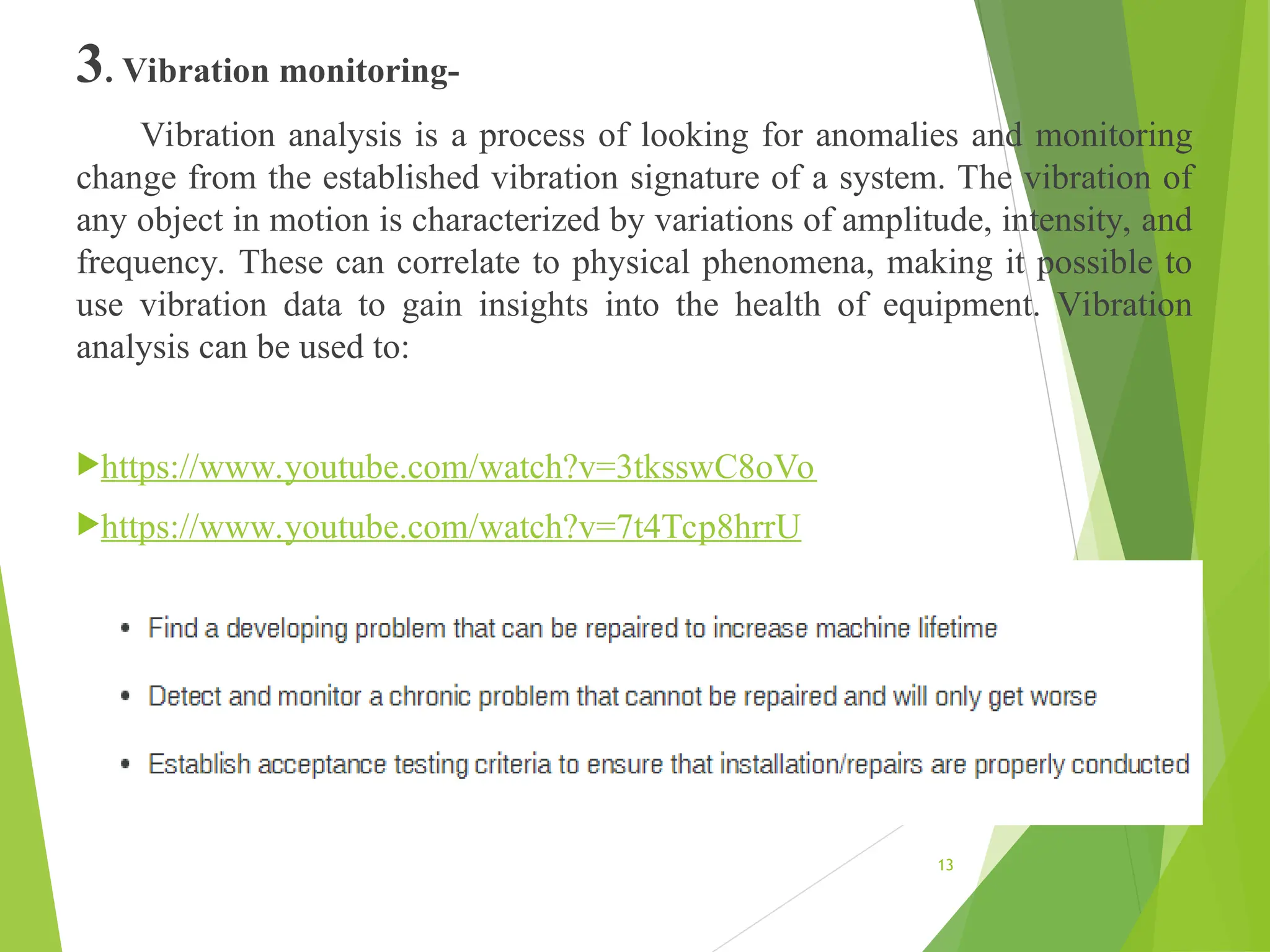
Vibration analysis is a process of looking for anomalies and monitoring
change from the established vibration signature of a system. The vibration of
any object in motion is characterized by variations of amplitude, intensity, and
frequency. These can correlate to physical phenomena, making it possible to
use vibration data to gain insights into the health of equipment. Vibration
analysis can be used to:
https://www.youtube.com/watch?v=3tksswC8oVo
https://www.youtube.com/watch?v=7t4Tcp8hrrU
13
4. Corrosion monitoring-
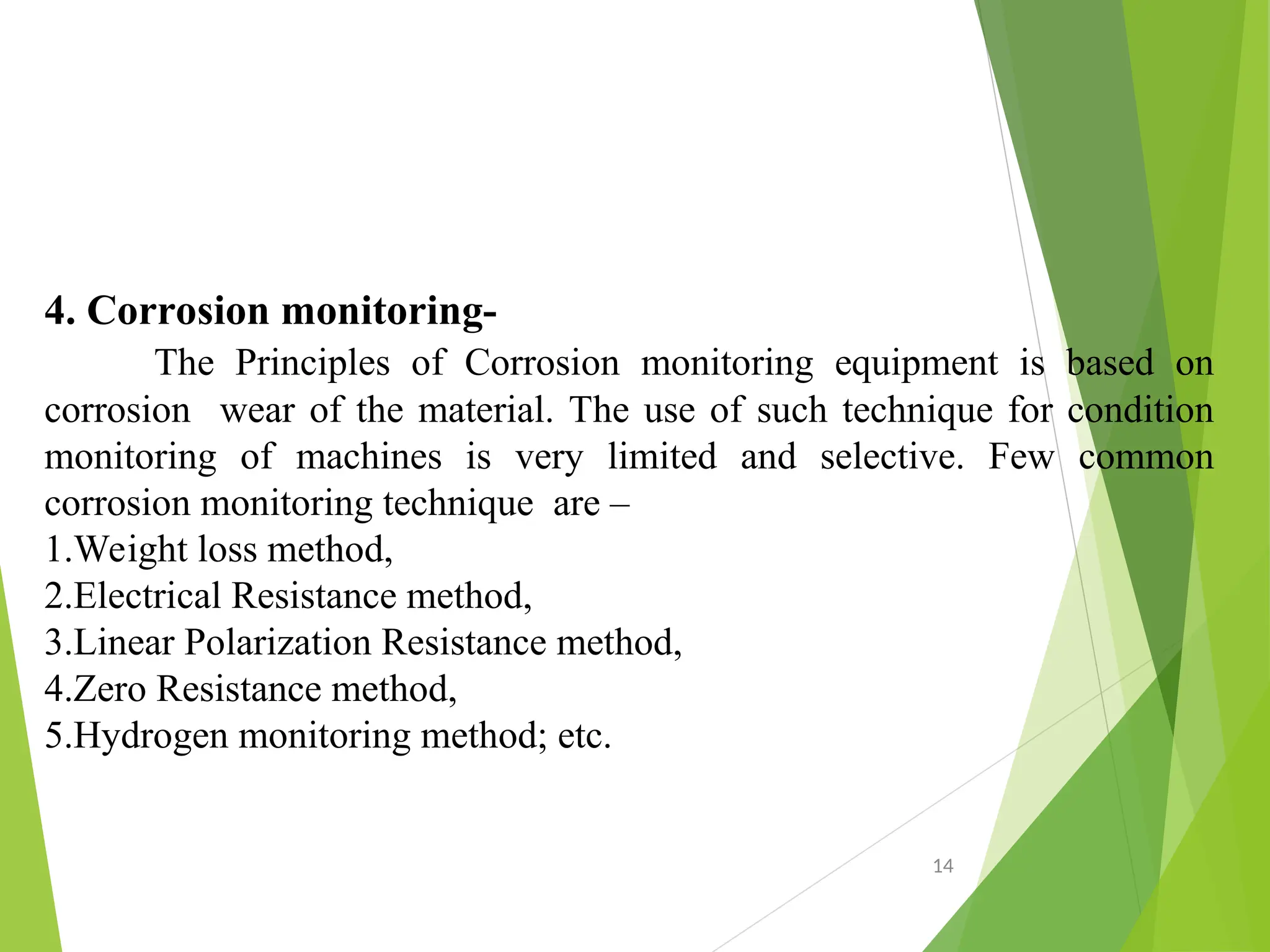
The Principles of Corrosion monitoring equipment is based on
corrosion wear of the material. The use of such technique for condition
monitoring of machines is very limited and selective. Few common
corrosion monitoring technique are –
1.Weight loss method,
2.Electrical Resistance method,
3.Linear Polarization Resistance method,
4.Zero Resistance method,
5.Hydrogen monitoring method; etc.
14
5. wear debris monitoring-
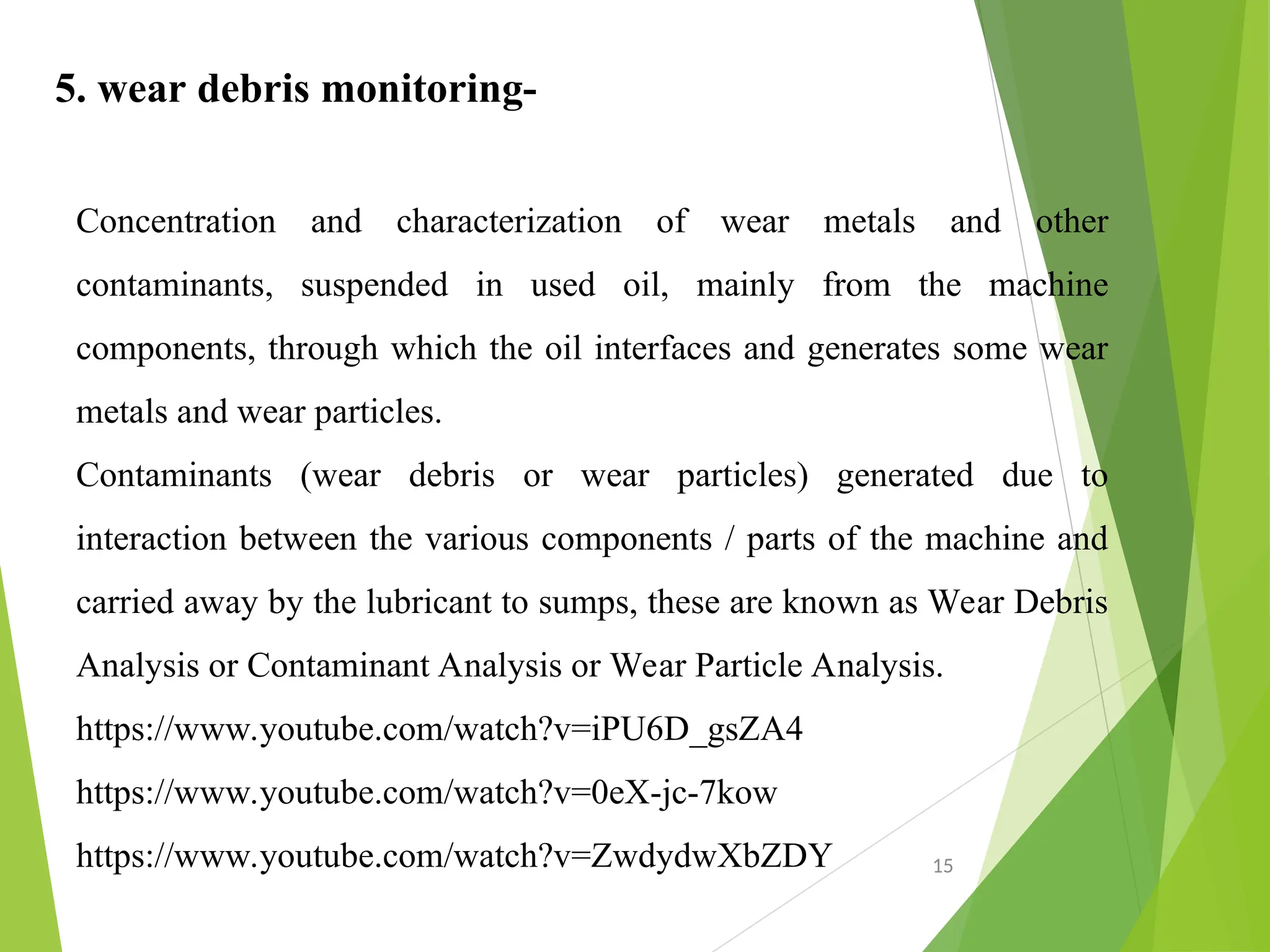
Concentration and characterization of wear metals and other
contaminants, suspended in used oil, mainly from the machine
components, through which the oil interfaces and generates some wear
metals and wear particles.
Contaminants (wear debris or wear particles) generated due to
interaction between the various components / parts of the machine and
carried away by the lubricant to sumps, these are known as Wear Debris
Analysis or Contaminant Analysis or Wear Particle Analysis.
https://www.youtube.com/watch?v=iPU6D_gsZA4
https://www.youtube.com/watch?v=0eX-jc-7kow
https://www.youtube.com/watch?v=ZwdydwXbZDY 15
16
Advantages of Condition Based Maintenance
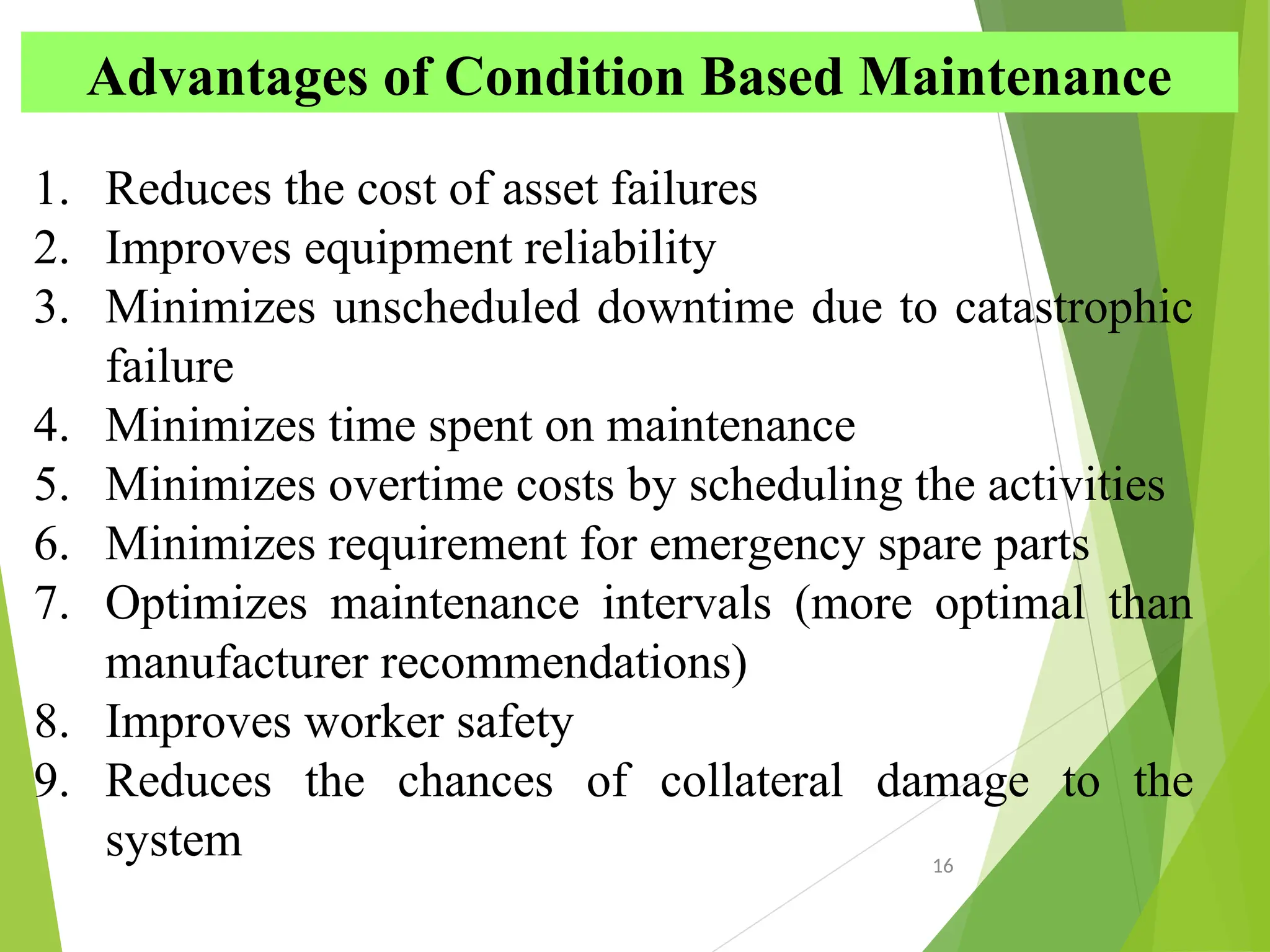
1. Reduces the cost of asset failures
2. Improves equipment reliability
3. Minimizes unscheduled downtime due to catastrophic
failure
4. Minimizes time spent on maintenance
5. Minimizes overtime costs by scheduling the activities
6. Minimizes requirement for emergency spare parts
7. Optimizes maintenance intervals (more optimal than
manufacturer recommendations)
8. Improves worker safety
9. Reduces the chances of collateral damage to the
system
17
Disadvantages of Condition Based Maintenance
1. Condition monitoring test equipment is expensive to
install, and databases cost money to analyze
2. Cost to train staff–you need a knowledgeable
professional to analyze the data and perform the work
3. Fatigue or uniform wear failures are not easily
detected with CBM measurements
4. Condition sensors may not survive in the operating
environment
5. May require asset modifications to retrofit the system
with sensors
6. Unpredictable maintenance periods
https://www.micromain.com/how-to-improve-your-
calculate-mtbf-and-mttr-skills-in-5-days/
18
Thank you
For
listening to me

LECTURE 18 condition based monitoring.ppt

  • 1.
  • 2.
    Principles of CBM 2 Condition-basedmaintenance (CBM) is a maintenance strategy that monitors the actual condition of an asset to decide what maintenance needs to be done. CBM dictates that maintenance should only be performed when certain indicators show signs of decreasing performance or upcoming failure.
  • 3.
    Condition-Based Maintenance Implementation. 1.Commitment - The maintenance staff must commit to the process and its new technology. It has to trust the training and technology, while management needs to commit to procuring adequate equipment and training for all staff. 2. Participation - To achieve success, 100 percent participation in the CBM program is required from all groups. This expectation must be reinforced by management. 3. Holistic approach - This applies to all systems throughout the plant with no exceptions. 4. Sustainability - The CBM program, staff and equipment must be maintained over time to reap the long-term benefits. As people come and go from the organization, the proper training and resources need to be available. 3
  • 4.
    Pillars of Condition Monitoring 4 Thecondition monitoring also known as Dynamic Predictive Maintenance is composed of several functional aspects on which the maintenance is carried out. However there are four important schematic and functional steps observed in any implementation of condition monitoring activity. These functional aspects are often called four pillars of Condition Monitoring. These are following: 1.Detection, 2.Diagnosis, 3.Prognosis, and 4.Programme
  • 5.
    Detection This pillar ofDPM details when of the developing fault has just arisen. This focuses to answer the following 'When' questions. When might the fault have started? When (or how early) is the fault noticed? When does this fault result in a disaster if left unattended? Diagnosis Diagnosis concentrates on knowing 'what' of the origin of the fault so that spares parts can be ordered. What is origin of the fault? At what stage is the fault now? What is the growth rate of the fault? What are the components or parts that suffering from this fault? 5
  • 6.
    Prognosis This pinpoints whatcould happen if the fault is left unattended, i.e. the FORECAST of after effects. Subsequent measurement will then establish the trend to indicate what may happen. This function puts the effort to answer the following queries. What is the severity of the fault? What could be the results of the fault? What could be the production loss? What is cost of the fault in terms of hours of production and maintenance or repair? What are the side effects? What is the trend of the failure? (progressive/constant/retrogressive) What is the lead time? 6
  • 7.
    Programme This function isconcerned with preparation of SCHEDULE to enable the repair, schedule to be planned. This function attempts to reply the following type of questions: When should the equipment be taken for maintenance or repair? What maintenance policy should be adopted? When should the restoring action start and likely time when it can be finished? Who will maintain or repair so as to restore the condition? What is the action plan? 7
  • 8.
    Benefits from conditionbased maintenance 8  Safety: The injury and fatal accidents can possibly be reduced by adopting the safety measures in equipment and system. So, the condition based maintenance enables the system by indicating the future failure in the form of giving signal to the operator.  Extended useful life: The continuous monitoring enables the system to avoid sudden failures which is not unscheduled. It extends the life of the equipment considerably.  Enhanced availability: The breakdowns are minimized through proper maintenance which leads to increase the availability. It is achieved by reducing the down time.
  • 9.
     Reduction inmaintenance time: The repair time and fault correction time can be reduced by condition based maintenance.  Improved output: The output of the process is directly linked with the availability, enabled life of the equipment, reduced maintenance time. The condition based maintena nce improves these three factors which lead to improve the quality of produ cts.  Quality product: The better quality products could be ensured through condition based maint enance with healthy equipment in the process line. The quality of the produc ts will satisfy the customer expectation. 9
  • 10.
     Improved reliability Sincethe condition monitoring can predict the possible failures, it is possible to remove or replace a piece of equipment before any series consequences arises and hence, the reliability of the equipment can be improved.  Improved planning: Condition monitoring also helps in improving maintenance and production planning. This is due to the fact that the ability to predict the onset of failure ensures that the organisation of materials and staffing can be carried out in advance, and fitted into any existing schedules. The reduction in unexpected failures should reduce the need to reschedule or cancel the existing work. 10
  • 11.
    Condition Monitoring Techniques 11 Theevolution of information technology has done much for automating condition monitoring and making it practical for a wider rang of users. We would consider traditional techniques, most of which can broadly be classified in following types- 1.Performance monitoring 2.Visual monitoring 3.Vibration monitoring 4.Temperature monitoring 5.Lubricant monitoring 6.Leakage monitoring 7.Crack monitoring 8.Corrosion monitoring 9.Thickness monitoring. 10.Noise monitoring; etc. Other monitoring methods, commonly used- 1.Pressure monitoring 2.Flow monitoring 3.Level monitoring 4.Physical monitoring
  • 12.
    1. Performance monitoring- ThoughPerformance monitoring is, basically, essential for production, these also help in indicating monitoring of equipments. Primary Performance parameters are-pressure, temperature difference and comparison ratio etc. Primary Performance parameters are- mean effective pressure, fuel consumption , and change air pressure etc. 2.Visual monitoring- These are the most commonly used systems. Such monitoring can be done using— (A) Direct Methods- Human Eyes ears and senses, Optical probes (B) Indirect Methods- Optical probes with Television etc., Photographs and videos, Radiographs, X rays, thermographs. https://www.youtube.com/watch?v=lD27AtVb2I0 https://www.youtube.com/watch?v=zgjYSSP71_g 4/16/202 0 12
  • 13.
    3. Vibration monitoring- Vibrationanalysis is a process of looking for anomalies and monitoring change from the established vibration signature of a system. The vibration of any object in motion is characterized by variations of amplitude, intensity, and frequency. These can correlate to physical phenomena, making it possible to use vibration data to gain insights into the health of equipment. Vibration analysis can be used to: https://www.youtube.com/watch?v=3tksswC8oVo https://www.youtube.com/watch?v=7t4Tcp8hrrU 13
  • 14.
    4. Corrosion monitoring- ThePrinciples of Corrosion monitoring equipment is based on corrosion wear of the material. The use of such technique for condition monitoring of machines is very limited and selective. Few common corrosion monitoring technique are – 1.Weight loss method, 2.Electrical Resistance method, 3.Linear Polarization Resistance method, 4.Zero Resistance method, 5.Hydrogen monitoring method; etc. 14
  • 15.
    5. wear debrismonitoring- Concentration and characterization of wear metals and other contaminants, suspended in used oil, mainly from the machine components, through which the oil interfaces and generates some wear metals and wear particles. Contaminants (wear debris or wear particles) generated due to interaction between the various components / parts of the machine and carried away by the lubricant to sumps, these are known as Wear Debris Analysis or Contaminant Analysis or Wear Particle Analysis. https://www.youtube.com/watch?v=iPU6D_gsZA4 https://www.youtube.com/watch?v=0eX-jc-7kow https://www.youtube.com/watch?v=ZwdydwXbZDY 15
  • 16.
    16 Advantages of ConditionBased Maintenance 1. Reduces the cost of asset failures 2. Improves equipment reliability 3. Minimizes unscheduled downtime due to catastrophic failure 4. Minimizes time spent on maintenance 5. Minimizes overtime costs by scheduling the activities 6. Minimizes requirement for emergency spare parts 7. Optimizes maintenance intervals (more optimal than manufacturer recommendations) 8. Improves worker safety 9. Reduces the chances of collateral damage to the system
  • 17.
    17 Disadvantages of ConditionBased Maintenance 1. Condition monitoring test equipment is expensive to install, and databases cost money to analyze 2. Cost to train staff–you need a knowledgeable professional to analyze the data and perform the work 3. Fatigue or uniform wear failures are not easily detected with CBM measurements 4. Condition sensors may not survive in the operating environment 5. May require asset modifications to retrofit the system with sensors 6. Unpredictable maintenance periods https://www.micromain.com/how-to-improve-your- calculate-mtbf-and-mttr-skills-in-5-days/
  • 18.