5/30/2015
1
RBI
RISK BASED INSPECTION
Presented by:
Mohammad Javad Ranjbar
5 May 2014
Introduction to RBI
•what is RBI
•what are the key elements of RBI
•how to implement an RBI program
•how to sustain an RBI program
RBI Softwares
•TWI - RISKWISE
•ReliaSoft – RBI
Outline
5/30/2015
2
What is RBI?
Risk-based Inspection (RBI) is a methodology for
identification of high-risk equipment by review of
active/potential damage mechanisms and the suitability of
mitigation methods
RBI allows inspection/maintenance RBI systematical
evaluated both the probability of failure and the
associated consequence of failure.
Risk is the combination of the probability of some event
occurring during a time period of interest and the
consequences,(generally negative) associated with the
event. In mathematical terms, risk can be calculated by
the equation:
Risk = Probability × Consequence
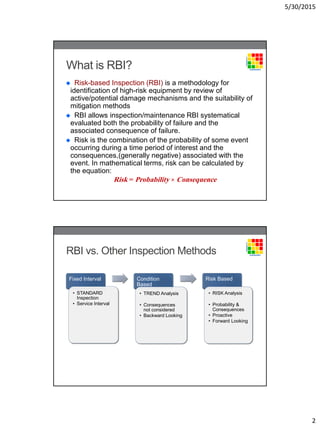
RBI vs. Other Inspection Methods
Fixed Interval
• STANDARD
Inspection
• Service Interval
Condition
Based
• TREND Analysis
• Consequences
not considered
• Backward Looking
Risk Based
• RISK Analysis
• Probability &
Consequences
• Proactive
• Forward Looking
5/30/2015
3
Increase Availability
(reducing unplanned outages )
Improve Safety
)Ensure Safe Operation)
Optimise Inspection
Costs
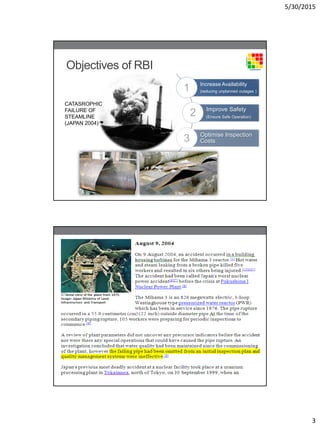
Objectives of RBI
CATASROPHIC
FAILURE OF
STEAMLINE
(JAPAN 2004)
1
2
3
5/30/2015
4
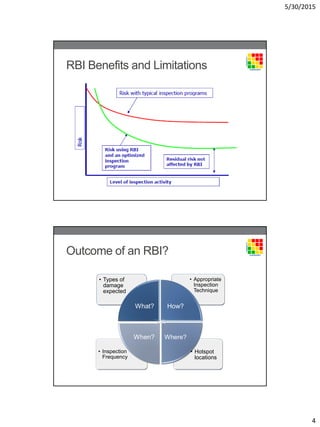
RBI Benefits and Limitations
• a) an overall reduction in risk for the facilities and
equipment assessed,
• b) an acceptance/understanding of the current risk.
RBI will not compensate:
• c) inaccurate or missing information,
• d) Design errors or faulty equipment installation,
• e) External events (e.g. Collisions or falling object)
• f) not effectively executing the plans,
• g) Secondary effects from nearby units
• h) lack of qualified personnel or teamwork,
Outcome of an RBI?
• Hotspot
locations
• Inspection
Frequency
• Appropriate
Inspection
Technique
• Types of
damage
expected
What? How?
Where?When?
5/30/2015
5
International Standards
API 580 / API 581 ASME PCC-3
CWA 15740 DNV-RP-G101
(Offshore topsides)
Type of RBI Assessment
Qualitative: Provides a broad-based risk assessment of
an operating unit or a part of an operating unit, required
less detail information about the facility. In this
assessment using engineering judgement and experience
for the analysis of probability and consequences of failure.
Quantitative: Provides risk values for each equipment
item and pipe segment in a operating unit, required
comprehensive detail information about the facility and
equipment. In this assessment using logic models,
likelihood and probability data to calculate the risk of
failure.
Semi-quantitative: Some were between either approach.
5/30/2015
6
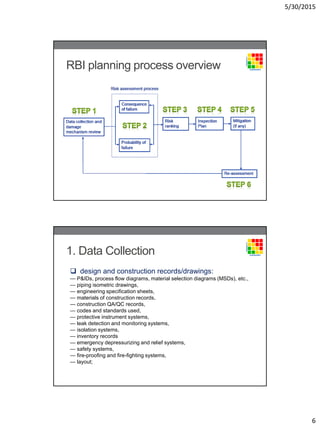
RBI planning process overview
1. Data Collection
 design and construction records/drawings:
— P&IDs, process flow diagrams, material selection diagrams (MSDs), etc.,
— piping isometric drawings,
— engineering specification sheets,
— materials of construction records,
— construction QA/QC records,
— codes and standards used,
— protective instrument systems,
— leak detection and monitoring systems,
— isolation systems,
— inventory records
— emergency depressurizing and relief systems,
— safety systems,
— fire-proofing and fire-fighting systems,
— layout;
5/30/2015
7
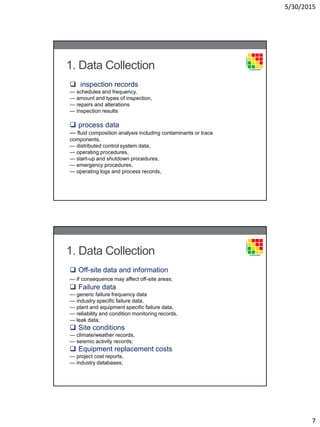
1. Data Collection
 inspection records
— schedules and frequency,
— amount and types of inspection,
— repairs and alterations
— inspection results
 process data
— fluid composition analysis including contaminants or trace
components,
— distributed control system data,
— operating procedures,
— start-up and shutdown procedures,
— emergency procedures,
— operating logs and process records,
1. Data Collection
 Off-site data and information
— if consequence may affect off-site areas;
 Failure data
— generic failure frequency data
— industry specific failure data,
— plant and equipment specific failure data,
— reliability and condition monitoring records,
— leak data;
 Site conditions
— climate/weather records,
— seismic activity records;
 Equipment replacement costs
— project cost reports,
— industry databases;
5/30/2015
8
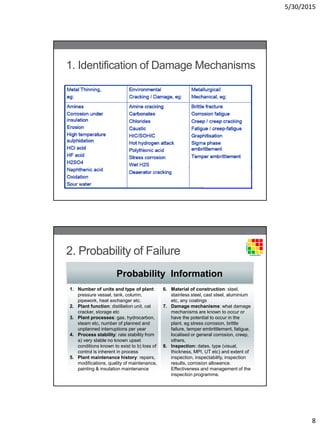
1. Identification of Damage Mechanisms
2. Probability of Failure
6. Material of construction: steel,
stainless steel, cast steel, aluminium
etc, any coatings
7. Damage mechanisms: what damage
mechanisms are known to occur or
have the potential to occur in the
plant. eg stress corrosion, brittle
failure, temper embrittlement, fatigue,
localised or general corrosion, creep,
others,
8. Inspection: dates, type (visual,
thickness, MPI, UT etc) and extent of
inspection, inspectability, inspection
results, corrosion allowance.
Effectiveness and management of the
inspection programme.
1. Number of units and type of plant:
pressure vessel, tank, column,
pipework, heat exchanger etc.
2. Plant function: distillation unit, cat
cracker, storage etc
3. Plant processes: gas, hydrocarbon,
steam etc, number of planned and
unplanned interruptions per year
4. Process stability: rate stability from
a) very stable no known upset
conditions known to exist to b) loss of
control is inherent in process
5. Plant maintenance history: repairs,
modifications, quality of maintenance,
painting & insulation maintenance
Probability Information
5/30/2015
9
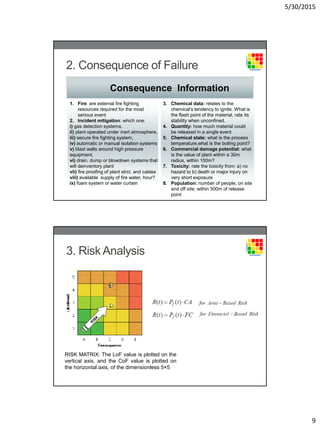
2. Consequence of Failure
3. Chemical data: relates to the
chemical’s tendency to ignite. What is
the flash point of the material, rate its
stability when unconfined.
4. Quantity: how much material could
be released in a single event
5. Chemical state: what is the process
temperature,what is the boiling point?
6. Commercial damage potential: what
is the value of plant within a 30m
radius, within 150m?
7. Toxicity: rate the toxicity from: a) no
hazard to b) death or major injury on
very short exposure
8. Population: number of people, on site
and off site, within 500m of release
point
1. Fire: are external fire fighting
resources required for the most
serious event
2. Incident mitigation: which one:
i) gas detection systems,
ii) plant operated under inert atmosphere,
iii) secure fire fighting system,
iv) automatic or manual isolation systems
v) blast walls around high pressure
equipment,
vi) drain, dump or blowdown systems that
will deinventory plant
vii) fire proofing of plant strct. and cables
viii) available supply of fire water, hour?
ix) foam system or water curtain
Consequence Information
3. Risk Analysis
RISK MATRIX: The LoF value is plotted on the
vertical axis, and the CoF value is plotted on
the horizontal axis, of the dimensionless 5×5
5/30/2015
10
4. Inspection Planning
When or before the risk target is reached, an inspection of the
equipment is recommended based on a ranking of the
component damage mechanisms that have the highest
calculated damage factors.
An inspection program is the combination of NDE methods
(i.e. visual, ultrasonic, radiographic etc.), frequency of
inspection, and the location and coverage of an inspection.
Inspection programs vary in their effectiveness for locating
and sizing damage, and thus for determining damage rates.
4. Inspection Effectiveness
Lack of coverage of an area subject to deterioration,
Inherent limitations of some inspection methods to detect and
quantify certain types of deterioration,
Selection of inappropriate inspection methods and tools,
Application of methods and tools by inadequately trained
inspection personnel,
Inadequate inspection procedures,
The damage rate under some conditions (e.g. start-up, shut-
down, or process upsets) may increase the likelihood or
probability that failure may occur within a very short time.
Inaccurate analysis of results leading to inaccurate trending of
individual components, and Probability of detection of the applied
NDE technique for a given component type, metallurgy,
temperature and geometry .
5/30/2015
11
5. Mitigation
Reducing the POF, Primary source of consequence,
magnitude of consequence:
• Equipment Replacement and Repair
• Evaluating Flaws for Fitness-For-Service
• Equipment Modification, Redesign, and Rerating
• Emergency Isolation
• Emergency Depressurizing/Deinventorying
• Modify Process
• Water Spray/Deluge
• Blast-resistant Construction
• spill detector
• Fireproofing
• …….;
6. Reassessment and
Updating RBI Assessments
Why Conduct an RBI Reassessment?
• Damage Mechanisms and Inspection Activities
• Process and Hardware Changes
• RBI Assessment Premise Change
• The Effect of Mitigation Strategies
When to Conduct an RBI Reassessment?
• After Significant Changes
• After a Set Time Period
• After Implementation of Risk Mitigation Strategies
• Before and After Maintenance Turnarounds
5/30/2015
12
RBI Softwares
RiskWISE™
ORBIT™RBI™
Credo™ RDMIP™
RB.Eye
RB.QEye
FAME+
S.RBI
RBI
RISKWISE™
Risk Based Inspection / Risk Based
Maintenance software
5/30/2015
13
Demonstrator Contents
 System Overview
 Introduction
 Ease of Use
 Access Controls
 Knowledge-base
 Options and Settings
 Fluid Properties
 Nameplate Information
 Inspection History
 Damage Mechanisms
 Risk Factors
 Risk Summary
 Risk Profile
 Record Data Tables
 Record Properties
 Risk Mitigation
 Risk Comparison
 Inspection Plans
 Management Reporting
 Contact TWI
TWI Ltd is the sole owner of this software
demonstration show and may change this
demonstration without issuing notice. No
person or entity may reproduce or transmit
any part of the demonstration without written
permission from TWI Ltd.
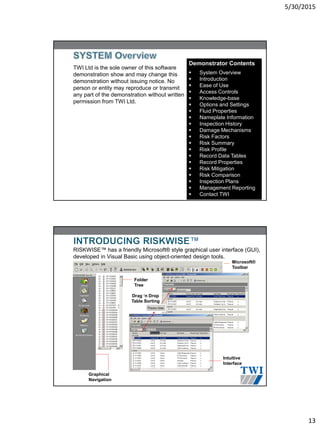
RISKWISE™ has a friendly Microsoft® style graphical user interface )GUI),
developed in Visual Basic using object-oriented design tools.
Graphical
Navigation
Microsoft®
Toolbar
Folder
Tree
Intuitive
Interface
Drag „n Drop
Table Sorting
5/30/2015
14
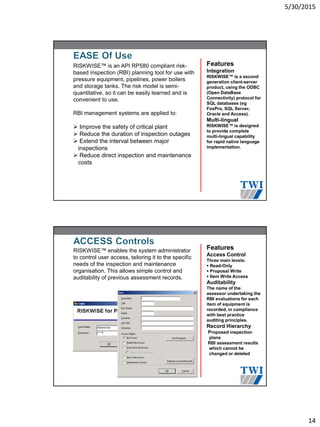
RISKWISE™ is an API RP580 compliant risk-
based inspection (RBI) planning tool for use with
pressure equipment, pipelines, power boilers
and storage tanks. The risk model is semi-
quantitative, so it can be easily learned and is
convenient to use.
RBI management systems are applied to:
 Improve the safety of critical plant
 Reduce the duration of inspection outages
 Extend the interval between major
inspections
 Reduce direct inspection and maintenance
costs
Features
Integration
RISKWISE™ is a second
generation client-server
product, using the ODBC
(Open DataBase
Connectivity) protocol for
SQL databases (eg
FoxPro, SQL Server,
Oracle and Access).
Multi-lingual
RISKWISE™ is designed
to provide complete
multi-lingual capability
for rapid native language
implementation.
RISKWISE™ enables the system administrator
to control user access, tailoring it to the specific
needs of the inspection and maintenance
organisation. This allows simple control and
auditability of previous assessment records.
Features
Access Control
Three main levels:
 Read-Only
 Proposal Write
 Item Write Access
Auditability
The name of the
assessor undertaking the
RBI evaluations for each
item of equipment is
recorded, in compliance
with best practice
auditing principles.
Record Hierarchy
Proposed inspection
plans
RBI assessment results
which cannot be
changed or deleted
5/30/2015
15
RISKWISE™ stores equipment nameplate
information in the Item Properties and Materials
screens. This information can be easily
integrated with asset information in other
applications, via the in-built RISKWISE™ ‘Import
Wizard’.
Features
Item Properties
Captures general
information about the
equipment including
drawings, design and
operating parameters.
Materials
Captures information
about the materials of
construction
components within
equipment or pressure
system.
RISKWISE™ contains an inspection knowledge-
base covering non-destructive testing (NDT)
methods and comprehensive descriptions of
over 30 damage mechanisms (DM), including 20
corrosive species leading to general and
localised corrosion and 10 species leading to
stress corrosion cracking.
Features
NDT
The knowledge-base
covers visual, magnetic,
ultrasonic, eddy current,
metallurgical,
radiographic,
thermographic, acoustic
emission and other non-
intrusive methods.
Damage Mechanisms
The common
mechanisms are
categorised in terms of
leading to „Metal loss‟,
„Environmental‟ or
„Metallurgical and
mechanical‟ damage.
5/30/2015
16
RISKWISE™ allows users complete freedom to
undertake assessments in European, US
Customary units or User-defined units. System
administrators have the ability to define safety
factors based on assessment consequence
categories, for direct use in the derivation of
equipment inspection intervals.
Features
Units
Define system wide
defaults for assessment,
such as engineering
units of measure.
Factors of Safety
Modify configuration of
safety factors, that are
linked to the
consequence categories,
in the calculation of
remaining life indicators
for all damage
mechanisms.
RISKWISE™ assesses consequence of failure
generally in accordance with guidance provided
in API BRD581 based on the fluid property
classifications presented by National Fire
Protection Association (NFPA).
Features
Chemical Factor
A Flammability Factor is
used by RISKWISE™, in
combination with a
Reactivity Factor, to derive
a Chemical Factor,
representing a fluid‟s
inherent tendency to ignite.
Explosion and Fire
RISKWISE™ assesses a
State Factor and the
Chemical Factor, in
accordance with the
procedure in publication
API BRD581.
Toxicity
RISKWISE™ employs the
NFPA ranking of the
probable severity of the
effects of a fluid on
exposure to personnel, in
the event of a release and a
fire.
5/30/2015
17
RISKWISE™ captures all relevant historical
inspection and maintenance history in the
Inspection Methods screen for subsequent use
in the identification of equipment damage
mechanism prior to the risk assessment.
Features
Inspection Methods
Captures relevant
historical information
including coverage and
findings, that will be
regularly updated
following future
inspections.
Inspection Plans
RISKWISE™ transfers
historical findings as well
as the proposed
inspection activities, to
the „Written Scheme of
Examination‟.
5/30/2015
18
RISKWISE™ captures the location of all active
and potentially active damage mechanisms
within each item of pressure equipment.
Features
Checklist
RISKWISE™ deals with
damage mechanisms
relevant to oil, gas and
petrochemical process
equipment, storage
tanks, pipelines, and
fossil fuel power boilers.
Remaining Life
Indicators
The estimated remaining
life of each damage
mechanism is assessed
within RISKWISE™, to
establish equipment
inspection intervals.
RISKWISE™ assesses seven likelihood
(probability) of failure factors and nine
consequence of failure factors, for each item of
equipment.
Features
Time-based Risk
Analysis
RISKWISE™ assesses
failure probability over
three forward periods of
time, for each active or
potentially active damage
mechanism.
Inspection
Effectiveness
RISKWISE™ assesses
the effectiveness of the
current inspection
program for each
damage mechanism
separately.
5/30/2015
19
RISKWISE™ presents the results of the risk
analysis for each of the damage mechanisms,
over the three forward time intervals, as well as
the resulting remaining life indicator (RLI) which
defines a safe inspection interval.
Features
Risk Matrix
RISKWISE™ plots each
assessment point on an
API RP580 five-by-five
risk matrix for risk
regions ranging from
„Favourable‟ to „Critical‟.
Limiting Damage
Mechanisms
The lowest RLI out of all
damage mechanisms
equates to the maximum
allowable inspection
interval for the
equipment.
RISKWISE™ provides a risk profile of all
equipment within the facility for the identification
of critical and non-critical equipment.
Features
Summary
The distribution of risk
can be presented using a
risk matrix, pie charts or
bar charts as well as
comparatively, ie for
subsequent post-
assessment cost-benefit
analysis.
5/30/2015
20
RISKWISE™ simply identifies critical equipment
as those items where the RLI is less than
current inspection period, and non-critical
equipment as those items where the RLI is
greater than the current inspection period!
Features
Table Sorting
The results of the RBI
assessment are
presented in the
RISKWISE™ data tables,
which can be easily
sorted using the „drag „n
drop‟ column titles.
RISKWISE™ ensures that the individual authors
of each equipment RBI assessment are fully
traceable.
Features
Auditability
RISKWISE™ enables
comprehensive tracking
of assessment results
and input assumptions,
in accordance with the
requirements of API
RP580.
Record Notes
RISKWISE™ includes a
simple “catch-all” free
text field for any other
information relevant to
the likelihood of
consequence of failure of
the equipment under
consideration.
5/30/2015
21
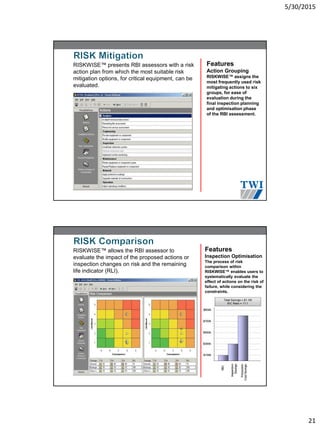
RISKWISE™ presents RBI assessors with a risk
action plan from which the most suitable risk
mitigation options, for critical equipment, can be
evaluated.
Features
Action Grouping
RISKWISE™ assigns the
most frequently used risk
mitigating actions to six
groups, for ease of
evaluation during the
final inspection planning
and optimisation phase
of the RBI assessment.
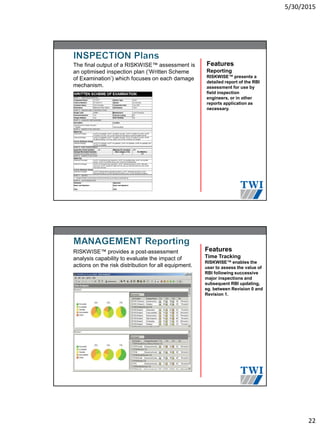
RISKWISE™ allows the RBI assessor to
evaluate the impact of the proposed actions or
inspection changes on risk and the remaining
life indicator (RLI).
Features
Inspection Optimisation
The process of risk
comparison within
RISKWISE™ enables users to
systematically evaluate the
effect of actions on the risk of
failure, while considering the
constraints.
RBI
Inspection
Savings
Production
CostSavings
$100k
$300k
$500k
$700k
$900k
Total Savings = $1.1M
B/C Ratio = 11:1
RBI
Inspection
Savings
Production
CostSavings
$100k
$300k
$500k
$700k
$900k
Total Savings = $1.1M
B/C Ratio = 11:1
5/30/2015
22
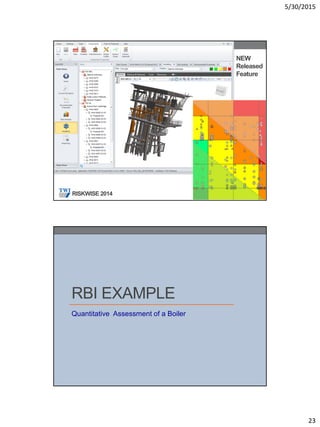
The final output of a RISKWISE™ assessment is
an optimised inspection plan )‘Written Scheme
of Examination’) which focuses on each damage
mechanism.
Features
Reporting
RISKWISE™ presents a
detailed report of the RBI
assessment for use by
field inspection
engineers, or in other
reports application as
necessary.
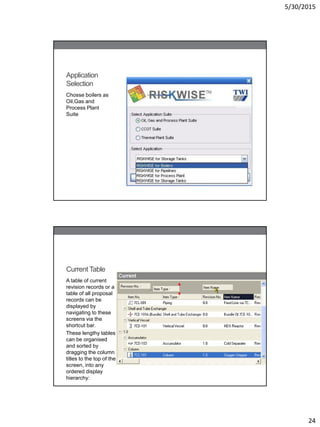
RISKWISE™ provides a post-assessment
analysis capability to evaluate the impact of
actions on the risk distribution for all equipment.
Features
Time Tracking
RISKWISE™ enables the
user to assess the value of
RBI following successive
major inspections and
subsequent RBI updating,
eg. between Revision 0 and
Revision 1.
5/30/2015
23
RISKWISE 2014
NEW
Released
Feature
RBI EXAMPLE
Quantitative Assessment of a Boiler
5/30/2015
24
Application
Selection
Chosse boilers as
Oil,Gas and
Process Plant
Suite
Current Table
A table of current
revision records or a
table of all proposal
records can be
displayed by
navigating to these
screens via the
shortcut bar.
These lengthy tables
can be organised
and sorted by
dragging the column
titles to the top of the
screen, into any
ordered display
hierarchy:
5/30/2015
25
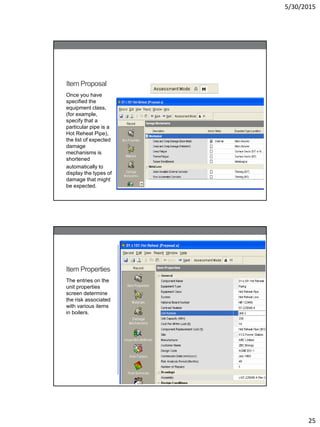
Item Proposal
Once you have
specified the
equipment class,
(for example,
specify that a
particular pipe is a
Hot Reheat Pipe),
the list of expected
damage
mechanisms is
shortened
automatically to
display the types of
damage that might
be expected.
Item Properties
The entries on the
unit properties
screen determine
the risk associated
with various items
in boilers.
5/30/2015
26
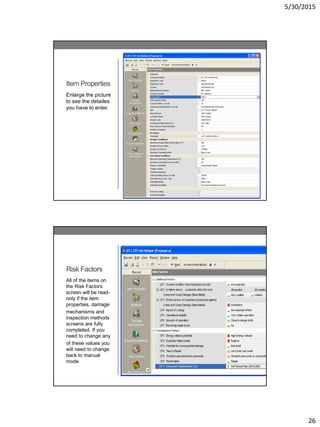
Item Properties
Enlarge the picture
to see the detailes
you have to enter.
Risk Factors
All of the items on
the Risk Factors
screen will be read-
only if the item
properties, damage
mechanisms and
inspection methods
screens are fully
completed. If you
need to change any
of these values you
will need to change
back to manual
mode
5/30/2015
27
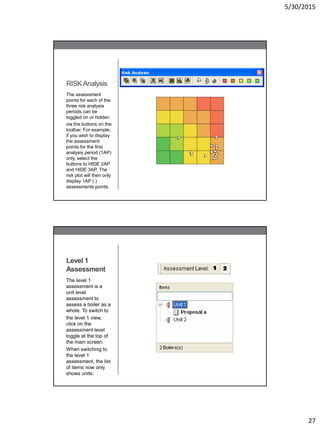
RISKAnalysis
The assessment
points for each of the
three risk analysis
periods can be
toggled on or hidden
via the buttons on the
toolbar. For example,
if you wish to display
the assessment
points for the first
analysis period (1AP)
only, select the
buttons to HIDE 2AP
and HIDE 3AP. The
risk plot will then only
display 1AP ( )
assessments points.
Level 1
Assessment
The level 1
assessment is a
unit level
assessment to
assess a boiler as a
whole. To switch to
the level 1 view,
click on the
assessment level
toggle at the top of
the main screen.
When switching to
the level 1
assessment, the list
of items now only
shows units.
5/30/2015
28
Home
You can right-click
on an existing unit
to create a
proposal, or create
a new unit or
proposal
from the links on
the home screen.
Unit
Proposal
Each unit has a set
of properties
associated with it
in a similar way
that other (level 2)
components have
an item properties
list. The proposal
record can be
viewed by double
clicking on it in the
items list.
5/30/2015
29
Unit
Analysis
The analysis
screen shows the
business
consequence of
the major
components of the
boiler failure.
THANK YOU FOR YOUR ATTENTION
Your Questions Are Wellcomed …
mj.ranjbar@gmail.com

Rbi

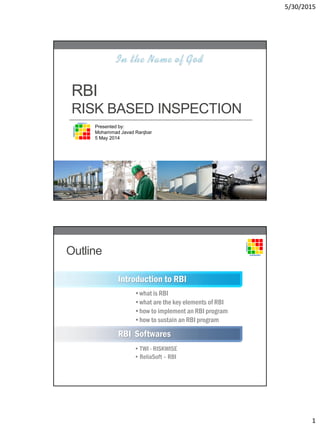
  • 1.
    5/30/2015 1 RBI RISK BASED INSPECTION Presentedby: Mohammad Javad Ranjbar 5 May 2014 Introduction to RBI •what is RBI •what are the key elements of RBI •how to implement an RBI program •how to sustain an RBI program RBI Softwares •TWI - RISKWISE •ReliaSoft – RBI Outline
  • 2.
    5/30/2015 2 What is RBI? Risk-basedInspection (RBI) is a methodology for identification of high-risk equipment by review of active/potential damage mechanisms and the suitability of mitigation methods RBI allows inspection/maintenance RBI systematical evaluated both the probability of failure and the associated consequence of failure. Risk is the combination of the probability of some event occurring during a time period of interest and the consequences,(generally negative) associated with the event. In mathematical terms, risk can be calculated by the equation: Risk = Probability × Consequence RBI vs. Other Inspection Methods Fixed Interval • STANDARD Inspection • Service Interval Condition Based • TREND Analysis • Consequences not considered • Backward Looking Risk Based • RISK Analysis • Probability & Consequences • Proactive • Forward Looking
  • 3.
    5/30/2015 3 Increase Availability (reducing unplannedoutages ) Improve Safety )Ensure Safe Operation) Optimise Inspection Costs Objectives of RBI CATASROPHIC FAILURE OF STEAMLINE (JAPAN 2004) 1 2 3
  • 4.
    5/30/2015 4 RBI Benefits andLimitations • a) an overall reduction in risk for the facilities and equipment assessed, • b) an acceptance/understanding of the current risk. RBI will not compensate: • c) inaccurate or missing information, • d) Design errors or faulty equipment installation, • e) External events (e.g. Collisions or falling object) • f) not effectively executing the plans, • g) Secondary effects from nearby units • h) lack of qualified personnel or teamwork, Outcome of an RBI? • Hotspot locations • Inspection Frequency • Appropriate Inspection Technique • Types of damage expected What? How? Where?When?
  • 5.
    5/30/2015 5 International Standards API 580/ API 581 ASME PCC-3 CWA 15740 DNV-RP-G101 (Offshore topsides) Type of RBI Assessment Qualitative: Provides a broad-based risk assessment of an operating unit or a part of an operating unit, required less detail information about the facility. In this assessment using engineering judgement and experience for the analysis of probability and consequences of failure. Quantitative: Provides risk values for each equipment item and pipe segment in a operating unit, required comprehensive detail information about the facility and equipment. In this assessment using logic models, likelihood and probability data to calculate the risk of failure. Semi-quantitative: Some were between either approach.
  • 6.
    5/30/2015 6 RBI planning processoverview 1. Data Collection  design and construction records/drawings: — P&IDs, process flow diagrams, material selection diagrams (MSDs), etc., — piping isometric drawings, — engineering specification sheets, — materials of construction records, — construction QA/QC records, — codes and standards used, — protective instrument systems, — leak detection and monitoring systems, — isolation systems, — inventory records — emergency depressurizing and relief systems, — safety systems, — fire-proofing and fire-fighting systems, — layout;
  • 7.
    5/30/2015 7 1. Data Collection inspection records — schedules and frequency, — amount and types of inspection, — repairs and alterations — inspection results  process data — fluid composition analysis including contaminants or trace components, — distributed control system data, — operating procedures, — start-up and shutdown procedures, — emergency procedures, — operating logs and process records, 1. Data Collection  Off-site data and information — if consequence may affect off-site areas;  Failure data — generic failure frequency data — industry specific failure data, — plant and equipment specific failure data, — reliability and condition monitoring records, — leak data;  Site conditions — climate/weather records, — seismic activity records;  Equipment replacement costs — project cost reports, — industry databases;
  • 8.
    5/30/2015 8 1. Identification ofDamage Mechanisms 2. Probability of Failure 6. Material of construction: steel, stainless steel, cast steel, aluminium etc, any coatings 7. Damage mechanisms: what damage mechanisms are known to occur or have the potential to occur in the plant. eg stress corrosion, brittle failure, temper embrittlement, fatigue, localised or general corrosion, creep, others, 8. Inspection: dates, type (visual, thickness, MPI, UT etc) and extent of inspection, inspectability, inspection results, corrosion allowance. Effectiveness and management of the inspection programme. 1. Number of units and type of plant: pressure vessel, tank, column, pipework, heat exchanger etc. 2. Plant function: distillation unit, cat cracker, storage etc 3. Plant processes: gas, hydrocarbon, steam etc, number of planned and unplanned interruptions per year 4. Process stability: rate stability from a) very stable no known upset conditions known to exist to b) loss of control is inherent in process 5. Plant maintenance history: repairs, modifications, quality of maintenance, painting & insulation maintenance Probability Information
  • 9.
    5/30/2015 9 2. Consequence ofFailure 3. Chemical data: relates to the chemical’s tendency to ignite. What is the flash point of the material, rate its stability when unconfined. 4. Quantity: how much material could be released in a single event 5. Chemical state: what is the process temperature,what is the boiling point? 6. Commercial damage potential: what is the value of plant within a 30m radius, within 150m? 7. Toxicity: rate the toxicity from: a) no hazard to b) death or major injury on very short exposure 8. Population: number of people, on site and off site, within 500m of release point 1. Fire: are external fire fighting resources required for the most serious event 2. Incident mitigation: which one: i) gas detection systems, ii) plant operated under inert atmosphere, iii) secure fire fighting system, iv) automatic or manual isolation systems v) blast walls around high pressure equipment, vi) drain, dump or blowdown systems that will deinventory plant vii) fire proofing of plant strct. and cables viii) available supply of fire water, hour? ix) foam system or water curtain Consequence Information 3. Risk Analysis RISK MATRIX: The LoF value is plotted on the vertical axis, and the CoF value is plotted on the horizontal axis, of the dimensionless 5×5
  • 10.
    5/30/2015 10 4. Inspection Planning Whenor before the risk target is reached, an inspection of the equipment is recommended based on a ranking of the component damage mechanisms that have the highest calculated damage factors. An inspection program is the combination of NDE methods (i.e. visual, ultrasonic, radiographic etc.), frequency of inspection, and the location and coverage of an inspection. Inspection programs vary in their effectiveness for locating and sizing damage, and thus for determining damage rates. 4. Inspection Effectiveness Lack of coverage of an area subject to deterioration, Inherent limitations of some inspection methods to detect and quantify certain types of deterioration, Selection of inappropriate inspection methods and tools, Application of methods and tools by inadequately trained inspection personnel, Inadequate inspection procedures, The damage rate under some conditions (e.g. start-up, shut- down, or process upsets) may increase the likelihood or probability that failure may occur within a very short time. Inaccurate analysis of results leading to inaccurate trending of individual components, and Probability of detection of the applied NDE technique for a given component type, metallurgy, temperature and geometry .
  • 11.
    5/30/2015 11 5. Mitigation Reducing thePOF, Primary source of consequence, magnitude of consequence: • Equipment Replacement and Repair • Evaluating Flaws for Fitness-For-Service • Equipment Modification, Redesign, and Rerating • Emergency Isolation • Emergency Depressurizing/Deinventorying • Modify Process • Water Spray/Deluge • Blast-resistant Construction • spill detector • Fireproofing • …….; 6. Reassessment and Updating RBI Assessments Why Conduct an RBI Reassessment? • Damage Mechanisms and Inspection Activities • Process and Hardware Changes • RBI Assessment Premise Change • The Effect of Mitigation Strategies When to Conduct an RBI Reassessment? • After Significant Changes • After a Set Time Period • After Implementation of Risk Mitigation Strategies • Before and After Maintenance Turnarounds
  • 12.
  • 13.
    5/30/2015 13 Demonstrator Contents  SystemOverview  Introduction  Ease of Use  Access Controls  Knowledge-base  Options and Settings  Fluid Properties  Nameplate Information  Inspection History  Damage Mechanisms  Risk Factors  Risk Summary  Risk Profile  Record Data Tables  Record Properties  Risk Mitigation  Risk Comparison  Inspection Plans  Management Reporting  Contact TWI TWI Ltd is the sole owner of this software demonstration show and may change this demonstration without issuing notice. No person or entity may reproduce or transmit any part of the demonstration without written permission from TWI Ltd. RISKWISE™ has a friendly Microsoft® style graphical user interface )GUI), developed in Visual Basic using object-oriented design tools. Graphical Navigation Microsoft® Toolbar Folder Tree Intuitive Interface Drag „n Drop Table Sorting
  • 14.
    5/30/2015 14 RISKWISE™ is anAPI RP580 compliant risk- based inspection (RBI) planning tool for use with pressure equipment, pipelines, power boilers and storage tanks. The risk model is semi- quantitative, so it can be easily learned and is convenient to use. RBI management systems are applied to:  Improve the safety of critical plant  Reduce the duration of inspection outages  Extend the interval between major inspections  Reduce direct inspection and maintenance costs Features Integration RISKWISE™ is a second generation client-server product, using the ODBC (Open DataBase Connectivity) protocol for SQL databases (eg FoxPro, SQL Server, Oracle and Access). Multi-lingual RISKWISE™ is designed to provide complete multi-lingual capability for rapid native language implementation. RISKWISE™ enables the system administrator to control user access, tailoring it to the specific needs of the inspection and maintenance organisation. This allows simple control and auditability of previous assessment records. Features Access Control Three main levels:  Read-Only  Proposal Write  Item Write Access Auditability The name of the assessor undertaking the RBI evaluations for each item of equipment is recorded, in compliance with best practice auditing principles. Record Hierarchy Proposed inspection plans RBI assessment results which cannot be changed or deleted
  • 15.
    5/30/2015 15 RISKWISE™ stores equipmentnameplate information in the Item Properties and Materials screens. This information can be easily integrated with asset information in other applications, via the in-built RISKWISE™ ‘Import Wizard’. Features Item Properties Captures general information about the equipment including drawings, design and operating parameters. Materials Captures information about the materials of construction components within equipment or pressure system. RISKWISE™ contains an inspection knowledge- base covering non-destructive testing (NDT) methods and comprehensive descriptions of over 30 damage mechanisms (DM), including 20 corrosive species leading to general and localised corrosion and 10 species leading to stress corrosion cracking. Features NDT The knowledge-base covers visual, magnetic, ultrasonic, eddy current, metallurgical, radiographic, thermographic, acoustic emission and other non- intrusive methods. Damage Mechanisms The common mechanisms are categorised in terms of leading to „Metal loss‟, „Environmental‟ or „Metallurgical and mechanical‟ damage.
  • 16.
    5/30/2015 16 RISKWISE™ allows userscomplete freedom to undertake assessments in European, US Customary units or User-defined units. System administrators have the ability to define safety factors based on assessment consequence categories, for direct use in the derivation of equipment inspection intervals. Features Units Define system wide defaults for assessment, such as engineering units of measure. Factors of Safety Modify configuration of safety factors, that are linked to the consequence categories, in the calculation of remaining life indicators for all damage mechanisms. RISKWISE™ assesses consequence of failure generally in accordance with guidance provided in API BRD581 based on the fluid property classifications presented by National Fire Protection Association (NFPA). Features Chemical Factor A Flammability Factor is used by RISKWISE™, in combination with a Reactivity Factor, to derive a Chemical Factor, representing a fluid‟s inherent tendency to ignite. Explosion and Fire RISKWISE™ assesses a State Factor and the Chemical Factor, in accordance with the procedure in publication API BRD581. Toxicity RISKWISE™ employs the NFPA ranking of the probable severity of the effects of a fluid on exposure to personnel, in the event of a release and a fire.
  • 17.
    5/30/2015 17 RISKWISE™ captures allrelevant historical inspection and maintenance history in the Inspection Methods screen for subsequent use in the identification of equipment damage mechanism prior to the risk assessment. Features Inspection Methods Captures relevant historical information including coverage and findings, that will be regularly updated following future inspections. Inspection Plans RISKWISE™ transfers historical findings as well as the proposed inspection activities, to the „Written Scheme of Examination‟.
  • 18.
    5/30/2015 18 RISKWISE™ captures thelocation of all active and potentially active damage mechanisms within each item of pressure equipment. Features Checklist RISKWISE™ deals with damage mechanisms relevant to oil, gas and petrochemical process equipment, storage tanks, pipelines, and fossil fuel power boilers. Remaining Life Indicators The estimated remaining life of each damage mechanism is assessed within RISKWISE™, to establish equipment inspection intervals. RISKWISE™ assesses seven likelihood (probability) of failure factors and nine consequence of failure factors, for each item of equipment. Features Time-based Risk Analysis RISKWISE™ assesses failure probability over three forward periods of time, for each active or potentially active damage mechanism. Inspection Effectiveness RISKWISE™ assesses the effectiveness of the current inspection program for each damage mechanism separately.
  • 19.
    5/30/2015 19 RISKWISE™ presents theresults of the risk analysis for each of the damage mechanisms, over the three forward time intervals, as well as the resulting remaining life indicator (RLI) which defines a safe inspection interval. Features Risk Matrix RISKWISE™ plots each assessment point on an API RP580 five-by-five risk matrix for risk regions ranging from „Favourable‟ to „Critical‟. Limiting Damage Mechanisms The lowest RLI out of all damage mechanisms equates to the maximum allowable inspection interval for the equipment. RISKWISE™ provides a risk profile of all equipment within the facility for the identification of critical and non-critical equipment. Features Summary The distribution of risk can be presented using a risk matrix, pie charts or bar charts as well as comparatively, ie for subsequent post- assessment cost-benefit analysis.
  • 20.
    5/30/2015 20 RISKWISE™ simply identifiescritical equipment as those items where the RLI is less than current inspection period, and non-critical equipment as those items where the RLI is greater than the current inspection period! Features Table Sorting The results of the RBI assessment are presented in the RISKWISE™ data tables, which can be easily sorted using the „drag „n drop‟ column titles. RISKWISE™ ensures that the individual authors of each equipment RBI assessment are fully traceable. Features Auditability RISKWISE™ enables comprehensive tracking of assessment results and input assumptions, in accordance with the requirements of API RP580. Record Notes RISKWISE™ includes a simple “catch-all” free text field for any other information relevant to the likelihood of consequence of failure of the equipment under consideration.
  • 21.
    5/30/2015 21 RISKWISE™ presents RBIassessors with a risk action plan from which the most suitable risk mitigation options, for critical equipment, can be evaluated. Features Action Grouping RISKWISE™ assigns the most frequently used risk mitigating actions to six groups, for ease of evaluation during the final inspection planning and optimisation phase of the RBI assessment. RISKWISE™ allows the RBI assessor to evaluate the impact of the proposed actions or inspection changes on risk and the remaining life indicator (RLI). Features Inspection Optimisation The process of risk comparison within RISKWISE™ enables users to systematically evaluate the effect of actions on the risk of failure, while considering the constraints. RBI Inspection Savings Production CostSavings $100k $300k $500k $700k $900k Total Savings = $1.1M B/C Ratio = 11:1 RBI Inspection Savings Production CostSavings $100k $300k $500k $700k $900k Total Savings = $1.1M B/C Ratio = 11:1
  • 22.
    5/30/2015 22 The final outputof a RISKWISE™ assessment is an optimised inspection plan )‘Written Scheme of Examination’) which focuses on each damage mechanism. Features Reporting RISKWISE™ presents a detailed report of the RBI assessment for use by field inspection engineers, or in other reports application as necessary. RISKWISE™ provides a post-assessment analysis capability to evaluate the impact of actions on the risk distribution for all equipment. Features Time Tracking RISKWISE™ enables the user to assess the value of RBI following successive major inspections and subsequent RBI updating, eg. between Revision 0 and Revision 1.
  • 23.
  • 24.
    5/30/2015 24 Application Selection Chosse boilers as Oil,Gasand Process Plant Suite Current Table A table of current revision records or a table of all proposal records can be displayed by navigating to these screens via the shortcut bar. These lengthy tables can be organised and sorted by dragging the column titles to the top of the screen, into any ordered display hierarchy:
  • 25.
    5/30/2015 25 Item Proposal Once youhave specified the equipment class, (for example, specify that a particular pipe is a Hot Reheat Pipe), the list of expected damage mechanisms is shortened automatically to display the types of damage that might be expected. Item Properties The entries on the unit properties screen determine the risk associated with various items in boilers.
  • 26.
    5/30/2015 26 Item Properties Enlarge thepicture to see the detailes you have to enter. Risk Factors All of the items on the Risk Factors screen will be read- only if the item properties, damage mechanisms and inspection methods screens are fully completed. If you need to change any of these values you will need to change back to manual mode
  • 27.
    5/30/2015 27 RISKAnalysis The assessment points foreach of the three risk analysis periods can be toggled on or hidden via the buttons on the toolbar. For example, if you wish to display the assessment points for the first analysis period (1AP) only, select the buttons to HIDE 2AP and HIDE 3AP. The risk plot will then only display 1AP ( ) assessments points. Level 1 Assessment The level 1 assessment is a unit level assessment to assess a boiler as a whole. To switch to the level 1 view, click on the assessment level toggle at the top of the main screen. When switching to the level 1 assessment, the list of items now only shows units.
  • 28.
    5/30/2015 28 Home You can right-click onan existing unit to create a proposal, or create a new unit or proposal from the links on the home screen. Unit Proposal Each unit has a set of properties associated with it in a similar way that other (level 2) components have an item properties list. The proposal record can be viewed by double clicking on it in the items list.
  • 29.
    5/30/2015 29 Unit Analysis The analysis screen showsthe business consequence of the major components of the boiler failure. THANK YOU FOR YOUR ATTENTION Your Questions Are Wellcomed … mj.ranjbar@gmail.com