Operations Management
Presentation on
Concurrent Engineering
Theory and Case study
Post Graduate Course in
Operations Management
(PGCOM)
2019
SYMBIOSIS INTERNATIONAL
(DEEMED UNIVERSITY)
SYMBIOSIS INSTITUTE OF
OPERATIONS MANAGEMENT
Presented by:
Aditya Deshpande
Govinda Heda
Mirtyunjay Kumar
Guided by:
Dr. Arunkumar O N. Sir
130-03-2019
CONTENT
1. Intro and History of Concurrent Engineering
2. Intro to Sequential and Concurrent Engineering, their Differences
3. Concurrent Engg- what is Exact, Need
4. CE-Requirements, Working Areas
5. Concurrent Engineering– Example Case Study
6. Advantages and Limitations
7. Conclusions
230-03-2019
History of Concurrent Engineering
A set of lines are
concurrent if
they intersect at
same point.
All non-parallel
lines are
concurrent
 CE is a work methodology emphasizing the parallelisation of tasks,
which is called Simultaneous Engineering or Integrated Product
Development (IPD)
 Relatively recent term - Beginning in the early 1990s started with
aerospace industry later for automobile, process industry and others
 One of the first motivations for a concurrent engineering approach to
the product development is a desire to shorten the total time that
takes to bring a product to the market
330-03-2019
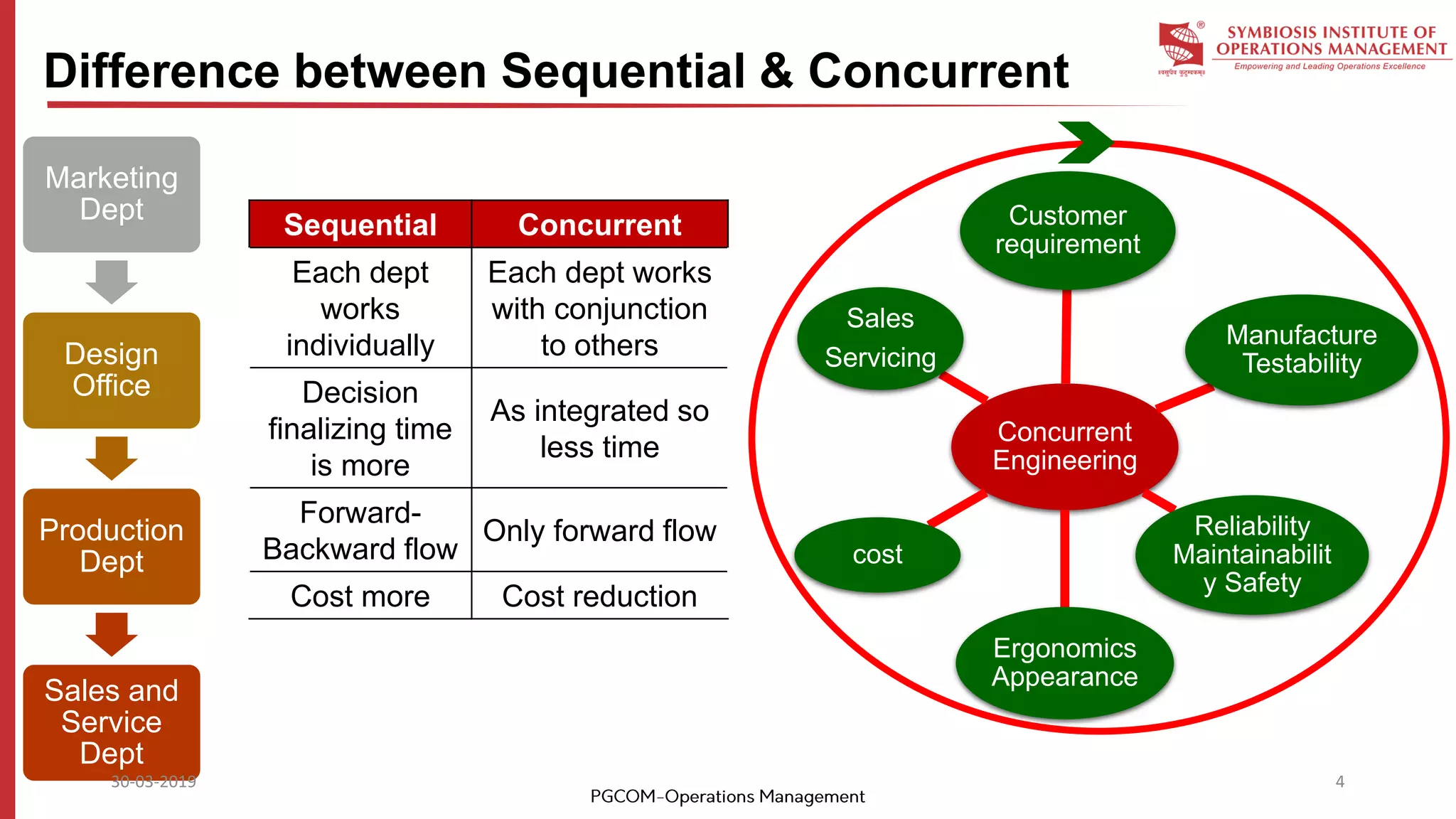
Difference between Sequential & Concurrent
Concurrent
Engineering
Customer
requirement
Manufacture
Testability
Reliability
Maintainabilit
y Safety
Ergonomics
Appearance
cost
Sales
Servicing
Marketing
Dept
Design
Office
Production
Dept
Sales and
Service
Dept
Sequential Concurrent
Each dept
works
individually
Each dept works
with conjunction
to others
Decision
finalizing time
is more
As integrated so
less time
Forward-
Backward flow
Only forward flow
Cost more Cost reduction
430-03-2019
Concurrent Engg- What is Exactly
Starting from clay modeling to product style to concept sections to surface creations
style then tooling and assembly with crash test checking
All done simultaneously
Automobile Interior Design
530-03-2019
Concurrent Engg- What is Exactly
Starting from clay modeling to product style to concept sections to surface creations
style then tooling and assembly with crash test checking
All done simultaneously
Automobile Interior Design
630-03-2019
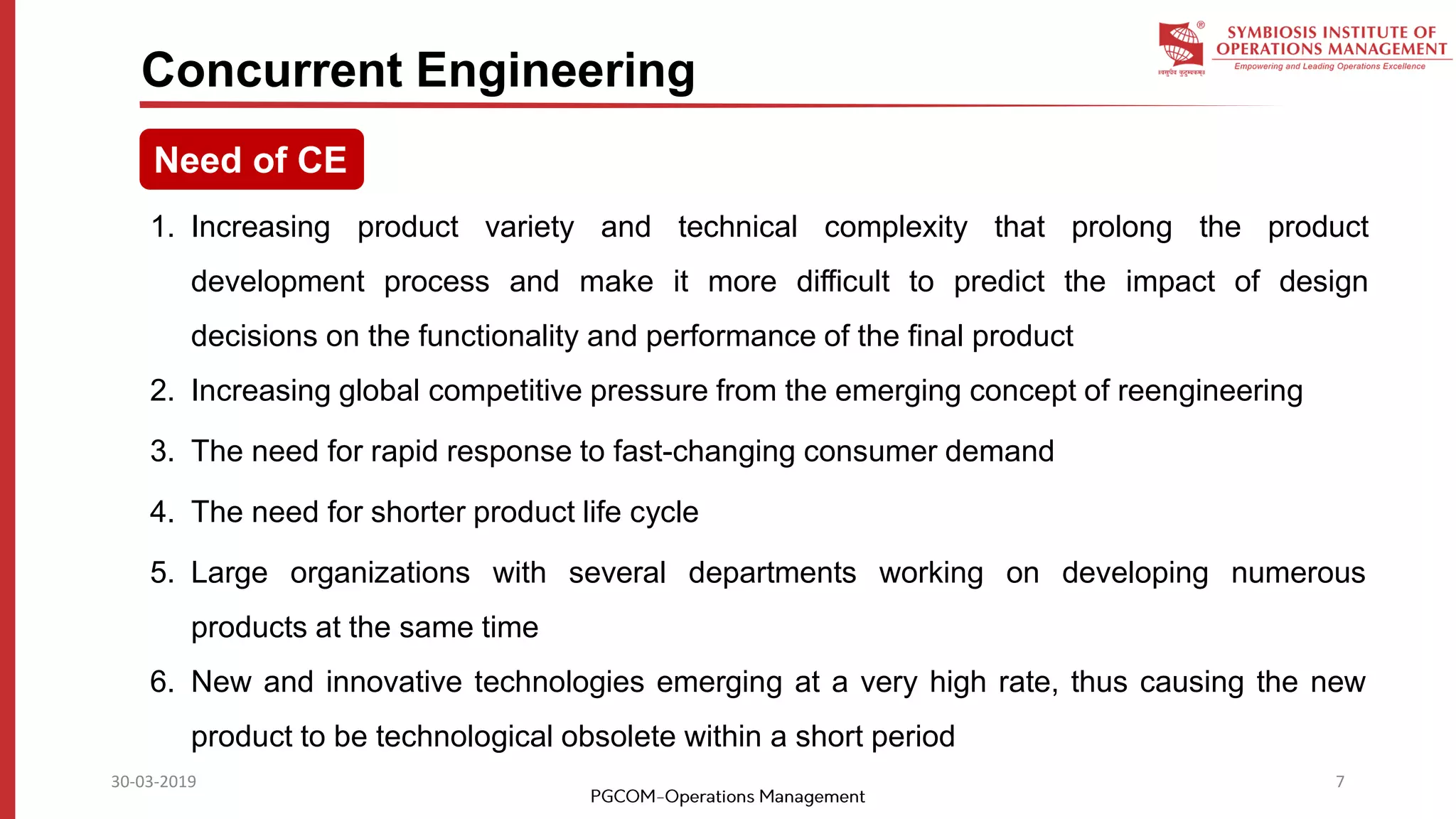
Concurrent Engineering
1. Increasing product variety and technical complexity that prolong the product
development process and make it more difficult to predict the impact of design
decisions on the functionality and performance of the final product
2. Increasing global competitive pressure from the emerging concept of reengineering
3. The need for rapid response to fast-changing consumer demand
4. The need for shorter product life cycle
5. Large organizations with several departments working on developing numerous
products at the same time
6. New and innovative technologies emerging at a very high rate, thus causing the new
product to be technological obsolete within a short period
Need of CE
730-03-2019
CE-Requirements, Working Areas
CE
People
Team
Formation
Training
Process
Process
Change
Open to
Change
Technology
CAD/CAM
Software
Integration
Traditional
Barriers
Teamwork
Develop
Outside
Influence
Co-
evolution
Continue
Improve
Info
Sharing
Mgnt
Requirements of CE Working Areas of CE
830-03-2019
CE- Rule based Method Applications
 CE is the application of mixture of all techniques to evaluate the total life-cycle cost
and quality
 Design for
1. Manufacturing
2. Quality
3. Cost
4. Assembly
5. Safety
6. Reliability
7. Failure-Mode and Effects Analysis
8. Product prototyping
930-03-2019
CE-Case Example Study
1030-03-2019
 Well Known company in automotive Propeller Shaft Manufacturing industry having
use of sequential engineering approach
 Wants to use CE for 3 parameters:
1. Unit Cost
2. Mfg. Lead Time
3. Quality
 Previous:
Mfg dept accepts specifications and attempts to find the best manufacturing technology
to accommodate request made by design. Mfg dept will challenge specification only if
design is not producible
 Now:
All depts. work together decides tolerances, machines technology used improving all 3
parameters
CE-Case Example Study
1130-03-2019
Sequential Concurrent
• Tolerance of ±0.03”
accepted from D&D
• So turret lathe is used for
mfg
• So unit o/p cost= 23.97
• Mfg. lead time=1485 units
• No. of rejects= 465
• Tolerance of ±0.03” OK
• Engine lathe is used for mfg
for better capability
• Process cost increases
• So unit o/p cost= 21.63
• No of rejects= 155
Stage 1
• Tolerance change to ±0.04”
• Engine lathe is used for mfg
• So unit o/p cost= 19.78
• No of rejects= 46
Stage 2
• Tolerance as it is ±0.04”
• Auto Screw M/C is used for
mfg
• So unit o/p cost= 22.04
• No of rejects= 01
• Mfg. lead time=750 units
Stage 3
All data for 1000 parts with
Unit raw mtl= Rs.10
Unit processing= Rs.7
Final
• Unit cost= 8.95%
• Quality= zero scrap than 465
• Lead time= 98%
Advantages of Concurrent Engg
1. Reduces project cycle time
2. Life cycle cost of project reduces
3. All project phases are executed
simultaneously helping in managing
changes that required for effective
project achievement
4. Focuses on customer requirement at
every phase of projects so quality
project outcome
5. Provides 7Cs improving project team
effectiveness
1230-03-2019
Disadvantages of Concurrent Engg
1. Complex to manage- considerable reconstruction of organization and the extensive
retraining of workers
2. Relies on everyone working together hence communication is critical
3. Room for mistakes are small as it impacts all the departments or discipline ( electrical,
mechanical or software)
4. Rushing products to the market can sometimes be a mistake
1330-03-2019
Conclusions
1. Concurrent Engineering process is demonstrated with case study
2. In today’s fast hanging world where as complex as automobile product launching
time has came to almost 6 months, CE plays very imp role
3. Cost of including CE in all process is les than its benefits so highly recommended
4. CE having great advantages but need to have focused management to get full
results
1430-03-2019
THANK YOU
PGCOM-Operations Management 1530-03-2019

Concurrent Engineering- Automotive Interiors and MNC Case Study

  • 1.
    Operations Management Presentation on ConcurrentEngineering Theory and Case study Post Graduate Course in Operations Management (PGCOM) 2019 SYMBIOSIS INTERNATIONAL (DEEMED UNIVERSITY) SYMBIOSIS INSTITUTE OF OPERATIONS MANAGEMENT Presented by: Aditya Deshpande Govinda Heda Mirtyunjay Kumar Guided by: Dr. Arunkumar O N. Sir 130-03-2019
  • 2.
    CONTENT 1. Intro andHistory of Concurrent Engineering 2. Intro to Sequential and Concurrent Engineering, their Differences 3. Concurrent Engg- what is Exact, Need 4. CE-Requirements, Working Areas 5. Concurrent Engineering– Example Case Study 6. Advantages and Limitations 7. Conclusions 230-03-2019
  • 3.
    History of ConcurrentEngineering A set of lines are concurrent if they intersect at same point. All non-parallel lines are concurrent  CE is a work methodology emphasizing the parallelisation of tasks, which is called Simultaneous Engineering or Integrated Product Development (IPD)  Relatively recent term - Beginning in the early 1990s started with aerospace industry later for automobile, process industry and others  One of the first motivations for a concurrent engineering approach to the product development is a desire to shorten the total time that takes to bring a product to the market 330-03-2019
  • 4.
    Difference between Sequential& Concurrent Concurrent Engineering Customer requirement Manufacture Testability Reliability Maintainabilit y Safety Ergonomics Appearance cost Sales Servicing Marketing Dept Design Office Production Dept Sales and Service Dept Sequential Concurrent Each dept works individually Each dept works with conjunction to others Decision finalizing time is more As integrated so less time Forward- Backward flow Only forward flow Cost more Cost reduction 430-03-2019
  • 5.
    Concurrent Engg- Whatis Exactly Starting from clay modeling to product style to concept sections to surface creations style then tooling and assembly with crash test checking All done simultaneously Automobile Interior Design 530-03-2019
  • 6.
    Concurrent Engg- Whatis Exactly Starting from clay modeling to product style to concept sections to surface creations style then tooling and assembly with crash test checking All done simultaneously Automobile Interior Design 630-03-2019
  • 7.
    Concurrent Engineering 1. Increasingproduct variety and technical complexity that prolong the product development process and make it more difficult to predict the impact of design decisions on the functionality and performance of the final product 2. Increasing global competitive pressure from the emerging concept of reengineering 3. The need for rapid response to fast-changing consumer demand 4. The need for shorter product life cycle 5. Large organizations with several departments working on developing numerous products at the same time 6. New and innovative technologies emerging at a very high rate, thus causing the new product to be technological obsolete within a short period Need of CE 730-03-2019
  • 8.
    CE-Requirements, Working Areas CE People Team Formation Training Process Process Change Opento Change Technology CAD/CAM Software Integration Traditional Barriers Teamwork Develop Outside Influence Co- evolution Continue Improve Info Sharing Mgnt Requirements of CE Working Areas of CE 830-03-2019
  • 9.
    CE- Rule basedMethod Applications  CE is the application of mixture of all techniques to evaluate the total life-cycle cost and quality  Design for 1. Manufacturing 2. Quality 3. Cost 4. Assembly 5. Safety 6. Reliability 7. Failure-Mode and Effects Analysis 8. Product prototyping 930-03-2019
  • 10.
    CE-Case Example Study 1030-03-2019 Well Known company in automotive Propeller Shaft Manufacturing industry having use of sequential engineering approach  Wants to use CE for 3 parameters: 1. Unit Cost 2. Mfg. Lead Time 3. Quality  Previous: Mfg dept accepts specifications and attempts to find the best manufacturing technology to accommodate request made by design. Mfg dept will challenge specification only if design is not producible  Now: All depts. work together decides tolerances, machines technology used improving all 3 parameters
  • 11.
    CE-Case Example Study 1130-03-2019 SequentialConcurrent • Tolerance of ±0.03” accepted from D&D • So turret lathe is used for mfg • So unit o/p cost= 23.97 • Mfg. lead time=1485 units • No. of rejects= 465 • Tolerance of ±0.03” OK • Engine lathe is used for mfg for better capability • Process cost increases • So unit o/p cost= 21.63 • No of rejects= 155 Stage 1 • Tolerance change to ±0.04” • Engine lathe is used for mfg • So unit o/p cost= 19.78 • No of rejects= 46 Stage 2 • Tolerance as it is ±0.04” • Auto Screw M/C is used for mfg • So unit o/p cost= 22.04 • No of rejects= 01 • Mfg. lead time=750 units Stage 3 All data for 1000 parts with Unit raw mtl= Rs.10 Unit processing= Rs.7 Final • Unit cost= 8.95% • Quality= zero scrap than 465 • Lead time= 98%
  • 12.
    Advantages of ConcurrentEngg 1. Reduces project cycle time 2. Life cycle cost of project reduces 3. All project phases are executed simultaneously helping in managing changes that required for effective project achievement 4. Focuses on customer requirement at every phase of projects so quality project outcome 5. Provides 7Cs improving project team effectiveness 1230-03-2019
  • 13.
    Disadvantages of ConcurrentEngg 1. Complex to manage- considerable reconstruction of organization and the extensive retraining of workers 2. Relies on everyone working together hence communication is critical 3. Room for mistakes are small as it impacts all the departments or discipline ( electrical, mechanical or software) 4. Rushing products to the market can sometimes be a mistake 1330-03-2019
  • 14.
    Conclusions 1. Concurrent Engineeringprocess is demonstrated with case study 2. In today’s fast hanging world where as complex as automobile product launching time has came to almost 6 months, CE plays very imp role 3. Cost of including CE in all process is les than its benefits so highly recommended 4. CE having great advantages but need to have focused management to get full results 1430-03-2019
  • 15.