A Brief Study on Introduction to
“HCCI Engine”
(Homogeneous Charge
Compression Ignition Engine)
Aditya Deshpande
March 2014
For the of course – Power Engineering
(Government Polytechnic, Nasik)
Contents
1. Introduction
2. Importance
3. Working of HCCI Engine
4. Fuel Used
5. Advantages
6. Challenges
7. Some Prototypes
8. Future Aspects
9. Conclusion
March 14 Aditya Deshpande 2
 HCCI is a lean combustion process.
 Unlike a traditional S.I. or Diesel engine, HCCI combustion
takes place spontaneously and homogeneously without
flame propagation.
 This eliminates heterogeneous air/fuel mixture regions.
Introduction
March 14 Aditya Deshpande 3
Importance of HCCI engine
 S.I. engines have very low NOx and PM emissions.
 C.I. engines have high efficiency.
 Homogeneous Charge Compression Ignition (HCCI) is a
promising alternative combustion technology with high
efficiency and lower NOx and particulate matter
emissions.
March 14 Aditya Deshpande 4
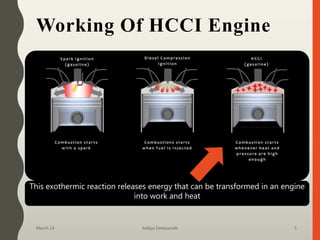
Working Of HCCI Engine
March 14 Aditya Deshpande 5
This exothermic reaction releases energy that can be transformed in an engine
into work and heat
Use of Alternative Fuels
 Key element- Biofuel
 Biofuels derived from sustainable oil crops such as
jatropha, camelina and algae or from wood and waste
 Natural gas, propane, alcohols, or on a blend of
conventional and alternative fuels.
March 14 Aditya Deshpande 6
Advantages
1. Improved Efficiency
2. Cleaner Combustion
3. Fuel Flexibility
4. Up to 15% fuel savings
5. Environment Friendly
6. HCCI engines may be lower cost since use lower-pressure
fuel-injection equipment
March 14 Aditya Deshpande 7
Challenges
1. Controlling Ignition Timing over a Range of Speeds and
Load
2. Extending the Operating Range to High Load
3. Hydrocarbon and Carbon Monoxide Emission
4. Lacks Cold-Start Capability
March 14 Aditya Deshpande 8
Some Prototypes
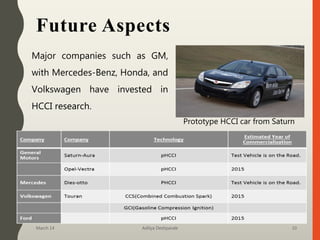
1. General Motors - Opel Vectra and Saturn Aura
2. Mercedes-Benz - Dies Otto, F 700 concept car
3. Volkswagen- Touran
March 14 Aditya Deshpande 9
Future Aspects
Major companies such as GM,
with Mercedes-Benz, Honda, and
Volkswagen have invested in
HCCI research.
March 14 Aditya Deshpande 10
Prototype HCCI car from Saturn
Conclusion
1. HCCI - a promising technology for future internal
combustion engines.
2. HCCI engines are more efficient compare to SI & CI
engine.
3. A very good alternative for SI and CI engine.
March 14 Aditya Deshpande 11
References
1. “Homogeneous Charge Compression Ignition (HCCI) Engines”
by Gajendra Singh.
2. “Homogeneous Charge Compression Ignition (HCCI):
Alternative Engine Combustion Mode” by Rakesh Kumar
Maurya, Senior Research Associate (CSIR, Pool Scientist
Scheme) in Engine Research Laboratory of Mechanical
Engineering Department at IIT Kanpur
3. “HCCI Engine- Need for Society” by Prof. Sanjay Harip
Government Polytechnic, Nasik, India
4. “Development of HCCI engines for Dimethyl Ether” by Kim R.
Hansen, Troels Dyhr Pedersen and Jesper Schramm.
March 14 Aditya Deshpande 12
THANK YOU

A Brief Study on Introduction to HCCI Engine- Hybrid Engine

  • 1.
    A Brief Studyon Introduction to “HCCI Engine” (Homogeneous Charge Compression Ignition Engine) Aditya Deshpande March 2014 For the of course – Power Engineering (Government Polytechnic, Nasik)
  • 2.
    Contents 1. Introduction 2. Importance 3.Working of HCCI Engine 4. Fuel Used 5. Advantages 6. Challenges 7. Some Prototypes 8. Future Aspects 9. Conclusion March 14 Aditya Deshpande 2
  • 3.
     HCCI isa lean combustion process.  Unlike a traditional S.I. or Diesel engine, HCCI combustion takes place spontaneously and homogeneously without flame propagation.  This eliminates heterogeneous air/fuel mixture regions. Introduction March 14 Aditya Deshpande 3
  • 4.
    Importance of HCCIengine  S.I. engines have very low NOx and PM emissions.  C.I. engines have high efficiency.  Homogeneous Charge Compression Ignition (HCCI) is a promising alternative combustion technology with high efficiency and lower NOx and particulate matter emissions. March 14 Aditya Deshpande 4
  • 5.
    Working Of HCCIEngine March 14 Aditya Deshpande 5 This exothermic reaction releases energy that can be transformed in an engine into work and heat
  • 6.
    Use of AlternativeFuels  Key element- Biofuel  Biofuels derived from sustainable oil crops such as jatropha, camelina and algae or from wood and waste  Natural gas, propane, alcohols, or on a blend of conventional and alternative fuels. March 14 Aditya Deshpande 6
  • 7.
    Advantages 1. Improved Efficiency 2.Cleaner Combustion 3. Fuel Flexibility 4. Up to 15% fuel savings 5. Environment Friendly 6. HCCI engines may be lower cost since use lower-pressure fuel-injection equipment March 14 Aditya Deshpande 7
  • 8.
    Challenges 1. Controlling IgnitionTiming over a Range of Speeds and Load 2. Extending the Operating Range to High Load 3. Hydrocarbon and Carbon Monoxide Emission 4. Lacks Cold-Start Capability March 14 Aditya Deshpande 8
  • 9.
    Some Prototypes 1. GeneralMotors - Opel Vectra and Saturn Aura 2. Mercedes-Benz - Dies Otto, F 700 concept car 3. Volkswagen- Touran March 14 Aditya Deshpande 9
  • 10.
    Future Aspects Major companiessuch as GM, with Mercedes-Benz, Honda, and Volkswagen have invested in HCCI research. March 14 Aditya Deshpande 10 Prototype HCCI car from Saturn
  • 11.
    Conclusion 1. HCCI -a promising technology for future internal combustion engines. 2. HCCI engines are more efficient compare to SI & CI engine. 3. A very good alternative for SI and CI engine. March 14 Aditya Deshpande 11
  • 12.
    References 1. “Homogeneous ChargeCompression Ignition (HCCI) Engines” by Gajendra Singh. 2. “Homogeneous Charge Compression Ignition (HCCI): Alternative Engine Combustion Mode” by Rakesh Kumar Maurya, Senior Research Associate (CSIR, Pool Scientist Scheme) in Engine Research Laboratory of Mechanical Engineering Department at IIT Kanpur 3. “HCCI Engine- Need for Society” by Prof. Sanjay Harip Government Polytechnic, Nasik, India 4. “Development of HCCI engines for Dimethyl Ether” by Kim R. Hansen, Troels Dyhr Pedersen and Jesper Schramm. March 14 Aditya Deshpande 12
  • 13.