3 Concurrency
 • A thread is an independent sequential execution path through a
   program. Each thread is scheduled for execution separately and
   independently from other threads.
 • A process is a program component (like a routine) that has its own
   thread and has the same state information as a coroutine.
 • A task is similar to a process except that it is reduced along some
   particular dimension (like the difference between a boat and a ship, one
   is physically smaller than the other). It is often the case that a process
   has its own memory, while tasks share a common memory. A task is
   sometimes called a light-weight process (LWP).
 • Parallel execution is when 2 or more operations occur simultaneously,
   which can only occur when multiple processors (CPUs) are present.
 • Concurrent execution is any situation in which execution of multiple
   threads appears to be performed in parallel. It is the threads of control
   associated with processes and tasks that results in concurrent execution.
   Except as otherwise noted, the content of this presentation is licensed under the Creative Com-
mons Attribution 2.5 License.


                                               58
59
3.1 Why Write Concurrent Programs
• Dividing a problem into multiple executing threads is an important
  programming technique just like dividing a problem into multiple
  routines.
• Expressing a problem with multiple executing threads may be the
  natural (best) way of describing it.
• Multiple executing threads can enhance the execution-time efficiency, by
  taking advantage of inherent concurrency in an algorithm and of any
  parallelism available in the computer system.

3.2 Why Concurrency is Difficult
• to understand:
   – While people can do several things concurrently, the number is small
     because of the difficulty in managing and coordinating them.
   – Especially when the things interact with one another.
• to specify:
   – How can/should a problem be broken up so that parts of it can be
     solved at the same time as other parts?
60
   – How and when do these parts interact or are they independent?
   – If interaction is necessary, what information must be communicated
     during the interaction?
• to debug:
   – Concurrent operations proceed at varying speeds and in
     non-deterministic order, hence execution is not repeatable
     (Heisenbug).
   – Reasoning about multiple streams or threads of execution and their
     interactions is much more complex than for a single thread.
• E.g. Moving furniture out of a room; can’t do it alone, but how many
  helpers and how to do it quickly to minimize the cost.
• How many helpers?
   – 1,2,3, ... N, where N is the number of items of furniture
   – more than N?
• Where are the bottlenecks?
   – the door out of the room, items in front of other items, large items
• What communication is necessary between the helpers?
   – which item to take next
61
  – some are fragile and need special care
  – big items need several helpers working together

3.3 Structure of Concurrent Systems
• Concurrent systems can be divided into 3 major types:
  1. those that attempt to discover concurrency in an otherwise sequential
     program, e.g., parallelizing loops and access to data structures
  2. those that provide concurrency through implicit constructs, which a
     programmer uses to build a concurrent program
  3. those that provide concurrency through explicit constructs, which a
     programmer uses to build a concurrent program
• In case 1, there is a fundamental limit to how much parallelism can be
  found and current techniques only work on certain kinds of programs.
• In case 2, threads are accessed indirectly via specialized mechanisms
  (e.g., pragmas or parallel for) and implicitly managed.
• In case 3, threads are directly access and explicitly managed.
• Cases 1 & 2 are always built from case 3.
• To solve all concurrency problems, threads needs to be explicit.
62
• Both implicit and explicit mechanisms are complementary, and hence,
  can appear together in a single programming language.
• However, the limitations of implicit mechanisms require that explicit
  mechanisms always be available to achieve maximum concurrency.
• µC+ only supports explicit mechanisms, but nothing in its design
      +
  precludes implicit mechanisms.
• Some concurrent systems provide a single technique or paradigm that
  must be used to solve all concurrent problems.
• While a particular paradigm may be very good for solving certain kinds
  of problems, it may be awkward or preclude other kinds of solutions.
• Therefore, a good concurrent system must support a variety of different
  concurrent approaches, while at the same time not requiring the
  programmer to work at too low a level.
• Fundamentally, as the amount of concurrency increases, so does the
  complexity to express and manage it.
63
3.4 Structure of Concurrent Hardware
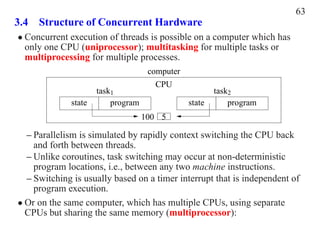
• Concurrent execution of threads is possible on a computer which has
  only one CPU (uniprocessor); multitasking for multiple tasks or
  multiprocessing for multiple processes.
                                     computer
                                      CPU
                      task1                             task2
              state       program               state       program
                                    100 5

  – Parallelism is simulated by rapidly context switching the CPU back
    and forth between threads.
  – Unlike coroutines, task switching may occur at non-deterministic
    program locations, i.e., between any two machine instructions.
  – Switching is usually based on a timer interrupt that is independent of
    program execution.
• Or on the same computer, which has multiple CPUs, using separate
  CPUs but sharing the same memory (multiprocessor):
64
                                    computer
                     CPU                               CPU
                     task1                             task2
             state       program               state       program
                                   100 5

  These tasks run in parallel with each other.
• Processes may be on different computers using separate CPUs and
  separate memories (distributed system):
                 computer1                             computer2
                    CPU                                  CPU
                   process                              process
             state      program                   state      program
                 100 7                                 100 5

  These processes run in parallel with each other.
• By examining the first case, which is the simplest, all of the problems
  that occur with parallelism can be illustrated.
65
3.5 Execution States
• A thread may go through the following states during its execution.
     new              ready               running               halted


                               blocked
                              (waiting)

• state transitions are initiated in response to events:
   – timer alarm (running → ready)
   – completion of I/O operation (blocked → ready)
   – exceeding some limit (CPU time, etc.) (running → halted)
   – exceptions (running → halted)

3.6 Thread Creation
• Concurrency requires the ability to specify the following 3 mechanisms
  in a programming language.
66
  1. thread creation – the ability to cause another thread of control to come
     into existence.
  2. thread synchronization – the ability to establish timing relationships
     among threads, e.g., same time, same rate, happens before/after.
  3. thread communication – the ability to correctly transmit data among
     threads.
• Thread creation must be a primitive operation; cannot be built from
  other operations in a language.
• ⇒ need new construct to create a thread and define where the thread
  starts execution, e.g., COBEGIN/COEND:
    BEGIN     initial thread creates internal threads,
       COBEGIN one for each statement in this block
          BEGIN i := 1; . . . END;
          p1(5); order and speed of execution
          p2(7); of internal threads is unknown
          p3(9);
       COEND initial thread waits for all internal threads to
    END;      finish (synchronize) before control continues

• A thread graph represents thread creations:
67
                                             p
                                                 COBEGIN


       p      i := 1           p1(...)               p2(...)   p3(...)
                                   COBEGIN

                       ...   ...     ...     ...

                                         COEND

                                                 COEND
                                             p

• Restricted to creating trees (lattice) of threads.
• In µC+ a task must be created for each statement of a COBEGIN using
        +,
  a _Task object:
68
    _Task T1 {                    void uMain::main() {
       void main()   { i = 1; }       // { int i, j, k; } ???
    };                                { // COBEGIN
    _Task T2 {                              T1 t1; T2 t2; T3 t3; T4 t4;
       void main()   { p1(5); }       } // COEND
    };                            }
    _Task T3 {                    void p1(. . .) {
       void main()   { p2(7); }       { // COBEGIN
    };                                      T5 t5; T6 t6; T7 t7; T8 t8;
    _Task T4 {                        } // COEND
       void main()   { p3(9); }   }
    };
• Unusual to create objects in a block and not use them.
• For task objects, the block waits for each task’s thread to finish.
• Alternative approach for thread creation is START/WAIT, which can
  create arbitrary thread graph:
69
 PROGRAM p                                                  p
      PROC p1(. . .) . . .                                    START
      FUNCTION f1(. . .) . . .                    p1       s1
      INT i;                                          START
   BEGIN                                                   s2         f1
 (fork) START p1(5); thread starts in p1                      WAIT
      s1       continue execution, do not wait for p1
                                                           s3
 (fork) START f1(8); thread starts in f1
      s2                                               WAIT
 (join) WAIT p1; wait for p1 to finish                      s4
      s3
 (join) WAIT i := f1; wait for f1 to finish
      s4
• COBEGIN/COEND can only approximate this thread graph:
   COBEGIN
        p1(5);
        BEGIN s1; COBEGIN f1(8); s2; COEND END // wait for f1!
   COEND
   s3; s4;
• START/WAIT can simulate COBEGIN/COEND:
70
    COBEGIN            START p1(. . .)
      p1(. . .)        START p2(. . .)
      p2(. . .)        WAIT p2
    COEND              WAIT p1
• In µC++:
 _Task T1 {                         void uMain::main() {
      void main() { p1(5); }            T1 *p1p = new T1;         // start a T1
 };                                     . . . s1 . . .
 _Task T2 {                             T2 *f1p = new T2;         // start a T2
      int temp;                         . . . s2 . . .
      void main() { temp = f1(8); }     delete p1p;               // wait for p1
    public:                             . . . s3 . . .
      ~T2() { i = temp; }               delete f1p;               // wait for f1
 };                                     . . . s4 . . .
                                    }
• Variable i cannot be assigned until the delete of f1p, otherwise the value
  could change in s2/s3.
• Allows same routine to be started multiple times with different
  arguments.
71
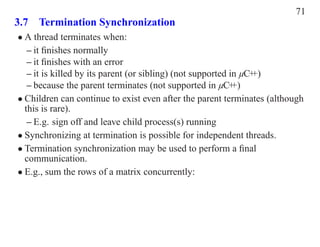
3.7 Termination Synchronization
• A thread terminates when:
   – it finishes normally
   – it finishes with an error
   – it is killed by its parent (or sibling) (not supported in µC++)
   – because the parent terminates (not supported in µC+     +)
• Children can continue to exist even after the parent terminates (although
  this is rare).
   – E.g. sign off and leave child process(s) running
• Synchronizing at termination is possible for independent threads.
• Termination synchronization may be used to perform a final
  communication.
• E.g., sum the rows of a matrix concurrently:
72
_Task Adder {                                                    matrix     subtotals
     int *row, size, &subtotal;
     void main() {                                   T0 ∑ 23 10 5 7            0
          subtotal = 0;
          for ( int r = 0; r < size; r += 1 ) {
                                                     T1 ∑ -1 6 11 20           0
                subtotal += row[r];                  T2 ∑ 56 -13 6 0           0
           }
     }                                               T3 ∑ -2 8 -5 1            0
   public:
     Adder( int row[ ], int size, int &subtotal ) :                     total ∑
           row( row ), size( size ), subtotal( subtotal ) {}
};
void uMain::main() {
     int rows = 10, cols = 10;
     int matrix[rows][cols], subtotals[rows], total = 0, r;
     Adder *adders[rows];
     // read in matrix
     for ( r = 0; r < rows; r += 1 ) { // start threads to sum rows
           adders[r] = new Adder( matrix[r], cols, subtotals[r] );
     }
     for ( r = 0; r < rows; r += 1 ) { // wait for threads to finish
           delete adders[r];
           total += subtotals[r];
     }
     cout << total << endl;
}
73
3.8 Synchronization and Communication during Execution
• Synchronization occurs when one thread waits until another thread has
  reached a certain point in its code.
• One place synchronization is needed is in transmitting data between
  threads.
   – One thread has to be ready to transmit the information and the other
     has to be ready to receive it, simultaneously.
   – Otherwise one might transmit when no one is receiving, or one might
     receive when nothing is transmitted.
74
bool Insert = false, Remove = false;           _Task Cons {
int Data;                                          int N;
                                                   void main() {
_Task Prod {                                           int data;
    int N;                                             for ( int i = 1; i <= N; i += 1 ) {
    void main() {                                          while ( ! Insert ) {} // busy wait
        for ( int i = 1; i <= N; i += 1 ) {                Insert = false;
            Data = i;        // transfer data              data = Data; // remove data
            Insert = true;                                 Remove = true;
            while ( ! Remove ) {} // busy wait         }
            Remove = false;                        }
        }                                         public:
    }                                              Cons( int N ) : N( N ) {}
   public:                                     };
    Prod( int N ) : N( N ) {}                  void uMain::main() {
};                                                 Prod prod( 5 ); Cons cons( 5 );
                                               }
• 2 infinite loops! No, because of implicit switching of threads.
• cons synchronizes (waits) until prod transfers some data, then prod waits
  for cons to remove the data.
• Are 2 synchronization flags necessary?
75
3.9 Communication
• Once threads are synchronized there are many ways that information can
  be transferred from one thread to the other.
• If the threads are in the same memory, then information can be
  transferred by value or address (VAR parameters).
• If the threads are not in the same memory (distributed), then transferring
  information by value is straightforward but by address is difficult.

3.10 Exceptions
• Exceptions can be handled locally within a task, or nonlocally among
  coroutines, or concurrently among tasks.
   – All concurrent exceptions are nonlocal, but nonlocal exceptions can
     also be sequential.
• Local task exceptions are the same as for a class.
   – An unhandled exception raised by a task terminates the program.
• Nonlocal exceptions are possible because each task has its own stack
  (execution state)
76
• Nonlocal exceptions between a task and a coroutine are the same as
  between coroutines (single thread).
• Concurrent exceptions among tasks are more complex due to the
  multiple threads.
• A concurrent exception provides an additional kind of communication
  among tasks.
• For example, two tasks may begin searching for a key in different sets:
    _Task searcher {
       searcher &partner;
       void main() {
           try {
                ...
                if ( key == . . . )
                      _Throw stopEvent() _At partner;
           } catch( stopEvent ) { . . . }
  When one task finds the key, it informs the other task to stop searching.
• For a concurrent raise, the source execution may only block while
  queueing the event for delivery at the faulting execution.
• After the event is delivered, the faulting execution propagates it at the
77
  soonest possible opportunity (next context switch); i.e., the faulting task
  is not interrupted.
• Nonlocal delivery is initially disabled for a task, so handlers can be
  set up before any exception can be delivered.
    void main() {
        // initialization, no nonlocal delivery
        try { // setup handlers
              _Enable { // enable delivery of exceptions
                    // rest of the code
              }
        } catch( nonlocal-exception ) {
              // handle nonlocal exception
        }
        // finalization, no nonlocal delivery
    }

3.11 Critical Section
• Threads may access non-concurrent objects, like a file or linked-list.
• There is a potential problem if there are multiple threads attempting to
78
  operate on the same object simultaneously.
• Not a problem if the operation on the object is atomic (not divisible).
• This means no other thread can modify any partial results during the
  operation on the object (but the thread can be interrupted).
• Where an operation is composed of many instructions, it is often
  necessary to make the operation atomic.
• A group of instructions on an associated object (data) that must be
  performed atomically is called a critical section.
• Preventing simultaneous execution of a critical section by multiple
  thread is called mutual exclusion.
• Must determine when concurrent access is allowed and when it must be
  prevented.
• One way to handle this is to detect any sharing and serialize all access;
  wasteful if threads are only reading.
• Improve by differentiating between reading and writing
   – allow multiple readers or a single writer; still wasteful as a writer may
     only write at the end of its usage.
79
• Need to minimize the amount of mutual exclusion (i.e., make critical
  sections as small as possible) to maximize concurrency.

3.12 Static Variables
• Static variables in a class are shared among all objects generated by that
  class.
• However, shared variables may need mutual exclusion for correct usage.
• There are a few special cases where static variables can be used safely,
  e.g., task constructor.
• If task objects are generated serially, static variables can be used in the
  constructor.
• E.g., assigning each task is own name:
80
    _Task T {
         static int tid;
         string name; // must supply storage
         ...
       public:
         T() {
              name = "T" + itostring(tid); // shared read
              setName( name.c_str() );
              tid += 1; // shared write
         }
         ...
    };
    int T::tid = 0;      // initialize static variable in .C file
    T t[10];             // 10 tasks with individual names
• Instead of static variables, pass a task identifier to the constructor:
    T::T( int tid ) { . . . } // create name
    T *t[10];             // 10 pointers to tasks
    for ( int i = 0; i < 10; i += 1 ) {
         t[i] = new T(i); // with individual names
    }
81
• These approaches only work if one task creates all the objects so
  creation is performed serially.
• In general, it is best to avoid using shared static variables in a
  concurrent program.

3.13 Mutual Exclusion Game
• Is it possible to write (in your favourite programming language) some
  code that guarantees that a statement (or group of statements) is always
  serially executed by 2 threads?
• Rules of the Game:
  1. Only one thread can be in its critical section at a time.
  2. Threads run at arbitrary speed and in arbitrary order, and the
     underlying system guarantees each thread makes progress (i.e.,
     threads get some CPU time).
  3. If a thread is not in its critical section or the entry or exit code that
     controls access to the critical section, it may not prevent other threads
     from entering their critical section.
  4. In selecting a thread for entry to the critical section, the selection
82
     cannot be postponed indefinitely. Not satisfying this rule is called
     indefinite postponement.
  5. There must exist a bound on the number of other threads that are
     allowed to enter the critical section after a thread has made a request
     to enter it. Not satisfying this rule is called starvation.

3.14 Self-Testing Critical Section
uBaseTask *CurrTid;             // current task id
                                                          Peter
void CriticalSection() {
    ::CurrTid = &uThisTask();
    for ( int i = 1; i <= 100; i += 1 ) { // work
         if ( ::CurrTid != &uThisTask() ) {
               uAbort( "interference" );
         }
    }
}                                                         inside
• What is the minimum number of interference tests and where?
83
3.15 Software Solutions
3.15.1 Lock
enum Yale {CLOSED, OPEN} Lock = OPEN; // shared
                                                                       Peter
_Task PermissionLock {
     void main() {
          for ( int i = 1; i <= 1000; i += 1 )   {
               while (::Lock == CLOSED) {}       // entry protocol
               ::Lock = CLOSED;
               CriticalSection();                // critical section
               ::Lock = OPEN;                    // exit protocol
          }
     }
   public:                                                             inside
     PermissionLock() {}
};
void uMain::main() {
     PermissionLock t0, t1;
}
Breaks rule 1
84
3.15.2 Alternation
int Last = 0;                             // shared
                                                               Peter
_Task Alternation {
   int me;

   void main() {
        for ( int i = 1; i <= 1000; i += 1 ) {
             while (::Last == me) {}     // entry protocol
             CriticalSection();          // critical section
             ::Last = me;                // exit protocol      outside
        }
   }
 public:
   Alternation(int me) : me(me) {}
};
void uMain::main() {
    Alternation t0( 0 ), t1( 1 );
}
Breaks rule 3
85
3.15.3 Declare Intent
enum Intent {WantIn, DontWantIn};

_Task DeclIntent {
     Intent &me, &you;
     void main() {
          for ( int i = 1; i <= 1000; i += 1 ) {
               me = WantIn;           // entry protocol
               while ( you == WantIn ) {}
               CriticalSection();     // critical section
               me = DontWantIn;       // exit protocol      outside
          }
     }
   public:
     DeclIntent( Intent &me, Intent &you ) :
                me(me), you(you) {}
};
void uMain::main() {
     Intent me = DontWantIn, you = DontWantIn;
     DeclIntent t0( me, you ), t1( you, me );
}
Breaks rule 4
86
3.15.4 Retract Intent
enum Intent {WantIn, DontWantIn};
_Task RetractIntent {
     Intent &me, &you;
     void main() {
          for ( int i = 1; i <= 1000; i += 1 ) {
               for ( ;; ) {           // entry protocol
                     me = WantIn;
                 if (you == DontWantIn) break;
                     me = DontWantIn;
                     while ( you == WantIn ) {}
               }
               CriticalSection();     // critical section
               me = DontWantIn;       // exit protocol
          }
     }
   public:
     RetractIntent( Intent &me, Intent &you ) : me(me), you(you) {}
};
void uMain::main() {
     Intent me = DontWantIn, you = DontWantIn;
     RetractIntent t0( me, you ), t1( you, me );
}
Breaks rule 4
87
3.15.5 Prioritize Entry
enum Intent {WantIn, DontWantIn}; enum Priority {HIGH, low};
_Task PriorityEntry {
     Intent &me, &you; Priority priority;                       HIGH
     void main() {
          for ( int i = 1; i <= 1000; i += 1 ) {
               if ( priority == HIGH ) { // entry protocol                                   low
                    me = WantIn;
                    while ( you == WantIn ) {}
               } else {
                    for ( ;; ) {
                           me = WantIn;
                       if ( you == DontWantIn ) break;
                           me = DontWantIn;
                                                                             outside
                           while ( you == WantIn ) {}
                    }
               }
               CriticalSection();           // critical section
               me = DontWantIn;             // exit protocol
          }
     }
   public:
     PriorityEntry( Priority p, Intent &me, Intent &you ) : priority(p), me(me), you(you) {}
};
void uMain::main() {
     Intent me = DontWantIn, you = DontWantIn;
     PriorityEntry t0( HIGH, me, you ), t1( low, you, me );
} // main
Breaks rule 5
88
3.15.6 Dekker
enum Intent {WantIn, DontWantIn};
Intent *Last;
_Task Dekker {
     Intent &me, &you;
     void main() {
          for ( int i = 1; i <= 1000; i += 1 ) {
               for ( ;; ) {              // entry protocol
                     me = WantIn;
                 if ( you == DontWantIn ) break;
                     if ( ::Last == &me ) {
                           me = DontWantIn;
                           while ( ::Last == &me ) {} // you == WantIn
                     }
                                                                         outside
               }
               CriticalSection();        // critical section
               ::Last = &me;             // exit protocol
               me = DontWantIn;
          }
     }
   public:
     Dekker( Intent &me, Intent &you ) : me(me), you(you) {}
};
void uMain::main() {
     Intent me = DontWantIn, you = DontWantIn;
     ::Last = &me;
     Dekker t0( me, you ), t1( you, me );
}
3.15.7 Peterson                                                      89

enum Intent {WantIn, DontWantIn};
Intent *Last;

_Task Peterson {
     Intent &me, &you;
     void main() {
          for ( int i = 1; i <= 1000; i += 1 ) {
               me = WantIn;                    // entry protocol
               ::Last = &me;
               while ( you == WantIn && ::Last == &me ) {}
               CriticalSection();              // critical section
               me = DontWantIn;                // exit protocol
          }
     }
   public:
     Peterson(Intent &me, Intent &you) : me(me), you(you) {}
};
void uMain::main() {
     Intent me = DontWantIn, you = DontWantIn;
     Peterson t0(me, you), t1(you, me);
}
90
• Differences between Dekker and Peterson
  – Dekker’s algorithm makes no assumptions about atomicity, while
    Peterson’s algorithm assumes assignment is an atomic operation.
  – Dekker’s algorithm works on a machine where bits are scrambled
    during simultaneous assignment; Peterson’s algorithm does not.
• Prove Dekker’s algorithm has no simultaneous assignments.
91
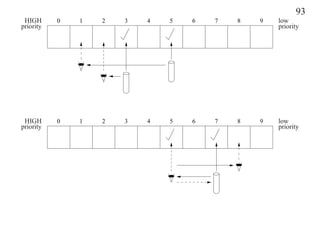
3.15.8 N-Thread Prioritized Entry
enum Intent { WantIn, DontWantIn };

_Task NTask {
   Intent *intents;           // position & priority
   int N, priority, i, j;
   void main() {
        for ( i = 1; i <= 1000; i += 1 ) {
             // step 1, wait for tasks with higher priority
             do {                                     // entry protocol
                  intents[priority] = WantIn;
                  // check if task with higher priority wants in
                  for ( j = priority-1; j >= 0; j -= 1 ) {
                     if ( intents[j] == WantIn ) {
                              intents[priority] = DontWantIn;
                              while ( intents[j] == WantIn ) {}
                              break;
                         }
                  }
             } while ( intents[priority] == DontWantIn );
92
                 // step 2, wait for tasks with lower priority
                 for ( j = priority+1; j < N; j += 1 ) {
                      while ( intents[j] == WantIn ) {}
                 }
                 CriticalSection();                     // critical section
                 intents[priority] = DontWantIn;        // exit protocol
            }
       }
     public:
       NTask( Intent i[ ], int N, int p ) : intents(i), N(N), priority(p) {}
};
Breaks rule 5
93
 HIGH      0   1   2   3   4   5   6   7   8   9   low
priority                                           priority


 HIGH      0   1   2   3   4   5   6   7   8   9   low
priority                                           priority
94
3.15.9 N-Thread Bakery (Tickets)
_Task Bakery { // (Lamport) Hehner/Shyamasundar
     int *ticket, N, priority;
     void main() {
          for ( int i = 0; i < 1000; i += 1 ) {
               // step 1, select a ticket
               ticket[priority] = 0;                // highest priority
               int max = 0;                         // O(N) search
               for ( int j = 0; j < N; j += 1 ) // for largest ticket
                    if ( max < ticket[j] && ticket[j] < INT_MAX )
                          max = ticket[j];
               ticket[priority] = max + 1;          // advance ticket
               // step 2, wait for ticket to be selected
               for ( int j = 0; j < N; j += 1 ) { // check tickets
                    while ( ticket[j] < ticket[priority] | |
                      (ticket[j] == ticket[priority] && j < priority) ) {}
               }
               CriticalSection();
               ticket[priority] = INT_MAX;          // exit protocol
          }
     }
   public:
     Bakery( int t[ ], int N, int p ) : ticket(t), N(N), priority(p) {}
};
95
  HIGH      0   1     2     3     4     5     6     7     8     9    low
 priority                                                            priority
            ∞   ∞     17    ∞     ∞     18    18    0    20     19


• ticket value of ∞ (INT_MAX) ⇒ don’t want in
• low ticket and position value ⇒ high priority
• ticket selection is unusual
• tickets are not unique ⇒ use position as secondary priority
• ticket values cannot increase indefinitely ⇒ could fail

3.15.10 Tournament
 • N-thread Prioritized Entry uses N bits.
 • However, no known solution for all 5 rules using only N bits.
 • N-Thread Bakery uses NM bits, where M is the ticket size (e.g., 32 bits),
   but is only probabilistically correct (limited ticket size).
 • Other N-thread solutions are possible using more memory.
96
• The tournament approach uses a minimal binary tree with ⌈N/2⌉ start
  nodes (i.e., full tree with ⌈lg N⌉ levels).
• Each node is a Dekker or Peterson 2-thread algorithm.
• Each thread is assigned to a particular start node, where it begins the
  mutual exclusion process.
               T0        T1        T2        T3        T4        T5


                    D1                  D2                  D3             T6


                              D4                                      D5


                    = start node                  D6

• At each node, one pair of threads is guaranteed to make progress;
  therefore, each thread eventually reaches the root of the tree.
• With a minimal binary tree, the tournament approach uses (N − 1)M
  bits, where (N − 1) is the number of tree nodes and M is the node size
  (e.g., Last, me, you, next node).
97
3.15.11 Arbiter
 • Create full-time arbitrator task to control entry to critical section.
  bool intent[5]; // initialize to false
  bool serving[5]; // initialize to false

  _Task Client {
       int me;
       void main() {
            for ( int i = 0; i < 100; i += 1 ) {
                 intent[me] = true;              // entry protocol
                 while ( ! serving[me] ) {}
                 CriticalSection();
                 intent[me] = false;             // exit protocol
                 while ( serving[me] ) {}
            }
       }
     public:
       Client( int me ) : me( me ) {}
  };
98
 _Task Arbiter {
    void main() {
        int i = 0;
        for ( ;; ) {
             // cycle for request => no starvation
             for ( ; ! intent[i]; i = (i + 1) % 5 ) {}
             serving[i] = true;
             while ( intent[i] ) {}
             serving[i] = false;
        }
    }
 };
• Mutual exclusion becomes a synchronization between arbiter and each
  waiting client.
• Arbiter cycles through waiting clients ⇒ no starvation.
• Does not require atomic assignment ⇒ no simultaneous assignments.
• Cost is creation, management, and execution (continuous spinning) of
  the arbiter task.
99
3.16 Hardware Solutions
• Software solutions to the critical section problem rely on nothing other
  than shared information and communication between threads.
• Hardware solutions introduce level below software level.
• At this level, it is possible to make assumptions about execution that are
  impossible at the software level. E.g., that certain instructions are
  executed atomically.
• This allows elimination of much of the shared information and the
  checking of this information required in the software solution.
• Certain special instructions are defined to perform an atomic read and
  write operation.
• This is sufficient for multitasking on a single CPU.
• Simple lock of critical section failed:
100
    int Lock = OPEN;                // shared
    // each task does
    while ( Lock == CLOSED );       // fails to achieve
    Lock = CLOSED;                  // mutual exclusion
    // critical section
    Lock = OPEN;

• Imagine if the C conditional operator ? is executed atomically.
    while((Lock==CLOSED? CLOSED : (Lock=CLOSED),OPEN)
                        ==CLOSED);
    // critical section
    Lock = OPEN;
• Works for N threads attempting entry to critical section and only depend
  on one shared datum (lock).
• However, rule 5 is broken, as there is no bound on service.
• Unfortunately, there is no such atomic construct in C.
• Atomic hardware instructions can be used to achieve this effect.
101
3.16.1 Test/Set Instruction
 • The test-and-set instruction performs an atomic read and fixed
   assignment.
     int Lock = OPEN; // shared
     int TestSet( int &b ) {  void Task::main() { // each task does
          /* begin atomic */      while( TestSet( Lock ) == CLOSED );
          int temp = b;           /* critical section */
          b = CLOSED;             Lock = OPEN;
          /* end atomic */    }
          return temp;
     }
   – if test/set returns open ⇒ loop stops and lock is set to closed
   – if test/set returns closed ⇒ loop executes until the other thread sets
     lock to open
• In the multiple CPU case, memory must also guarantee that multiple
  CPUs cannot interleave these special R/W instructions on the same
  memory location.
102
3.16.2 Swap Instruction
 • The swap instruction performs an atomic interchange of two separate
   values.
     int Lock = OPEN; // shared
     Swap( int &a, &b ) {     void Task::main() { // each task does
          int temp;               int dummy = CLOSED;
          /* begin atomic */      do {
          temp = a;                    Swap( Lock,dummy );
          a = b;                  } while( dummy == CLOSED );
          b = temp;               /* critical section */
          /* end atomic */        Lock = OPEN;
     }                        }
   – if swap returns open ⇒ loop stops and lock is set to closed
   – if swap returns closed ⇒ loop executes until the other thread sets lock
     to open

3.16.3 Compare/Assign Instruction
 • The compare-and-assign instruction performs an atomic compare and
   conditional assignment (erronously called compare-and-swap).
103
    int Lock = OPEN; // shared
    bool CAssn( int &val,    void Task::main() { // each task does
      int comp, int nval ) {     while ( ! CAssn(Lock,OPEN,CLOSED));
          /* begin atomic */     /* critical section */
          if (val == comp) {     Lock = OPEN;
               val = nval;   }
               return true;
          }
          return false;
          /* end atomic */
    }
  – if compare/assign returns open ⇒ loop stops and lock is set to closed
  – if compare/assign returns closed ⇒ loop executes until the other
    thread sets lock to open
• compare/assign can build other solutions (stack data structure) with a
  bound on service but with short busy waits.
• However, these solutions are complex.

Concurrency

  • 1.
    3 Concurrency •A thread is an independent sequential execution path through a program. Each thread is scheduled for execution separately and independently from other threads. • A process is a program component (like a routine) that has its own thread and has the same state information as a coroutine. • A task is similar to a process except that it is reduced along some particular dimension (like the difference between a boat and a ship, one is physically smaller than the other). It is often the case that a process has its own memory, while tasks share a common memory. A task is sometimes called a light-weight process (LWP). • Parallel execution is when 2 or more operations occur simultaneously, which can only occur when multiple processors (CPUs) are present. • Concurrent execution is any situation in which execution of multiple threads appears to be performed in parallel. It is the threads of control associated with processes and tasks that results in concurrent execution. Except as otherwise noted, the content of this presentation is licensed under the Creative Com- mons Attribution 2.5 License. 58
  • 2.
    59 3.1 Why WriteConcurrent Programs • Dividing a problem into multiple executing threads is an important programming technique just like dividing a problem into multiple routines. • Expressing a problem with multiple executing threads may be the natural (best) way of describing it. • Multiple executing threads can enhance the execution-time efficiency, by taking advantage of inherent concurrency in an algorithm and of any parallelism available in the computer system. 3.2 Why Concurrency is Difficult • to understand: – While people can do several things concurrently, the number is small because of the difficulty in managing and coordinating them. – Especially when the things interact with one another. • to specify: – How can/should a problem be broken up so that parts of it can be solved at the same time as other parts?
  • 3.
    60 – How and when do these parts interact or are they independent? – If interaction is necessary, what information must be communicated during the interaction? • to debug: – Concurrent operations proceed at varying speeds and in non-deterministic order, hence execution is not repeatable (Heisenbug). – Reasoning about multiple streams or threads of execution and their interactions is much more complex than for a single thread. • E.g. Moving furniture out of a room; can’t do it alone, but how many helpers and how to do it quickly to minimize the cost. • How many helpers? – 1,2,3, ... N, where N is the number of items of furniture – more than N? • Where are the bottlenecks? – the door out of the room, items in front of other items, large items • What communication is necessary between the helpers? – which item to take next
  • 4.
    61 –some are fragile and need special care – big items need several helpers working together 3.3 Structure of Concurrent Systems • Concurrent systems can be divided into 3 major types: 1. those that attempt to discover concurrency in an otherwise sequential program, e.g., parallelizing loops and access to data structures 2. those that provide concurrency through implicit constructs, which a programmer uses to build a concurrent program 3. those that provide concurrency through explicit constructs, which a programmer uses to build a concurrent program • In case 1, there is a fundamental limit to how much parallelism can be found and current techniques only work on certain kinds of programs. • In case 2, threads are accessed indirectly via specialized mechanisms (e.g., pragmas or parallel for) and implicitly managed. • In case 3, threads are directly access and explicitly managed. • Cases 1 & 2 are always built from case 3. • To solve all concurrency problems, threads needs to be explicit.
  • 5.
    62 • Both implicitand explicit mechanisms are complementary, and hence, can appear together in a single programming language. • However, the limitations of implicit mechanisms require that explicit mechanisms always be available to achieve maximum concurrency. • µC+ only supports explicit mechanisms, but nothing in its design + precludes implicit mechanisms. • Some concurrent systems provide a single technique or paradigm that must be used to solve all concurrent problems. • While a particular paradigm may be very good for solving certain kinds of problems, it may be awkward or preclude other kinds of solutions. • Therefore, a good concurrent system must support a variety of different concurrent approaches, while at the same time not requiring the programmer to work at too low a level. • Fundamentally, as the amount of concurrency increases, so does the complexity to express and manage it.
  • 6.
    63 3.4 Structure ofConcurrent Hardware • Concurrent execution of threads is possible on a computer which has only one CPU (uniprocessor); multitasking for multiple tasks or multiprocessing for multiple processes. computer CPU task1 task2 state program state program 100 5 – Parallelism is simulated by rapidly context switching the CPU back and forth between threads. – Unlike coroutines, task switching may occur at non-deterministic program locations, i.e., between any two machine instructions. – Switching is usually based on a timer interrupt that is independent of program execution. • Or on the same computer, which has multiple CPUs, using separate CPUs but sharing the same memory (multiprocessor):
  • 7.
    64 computer CPU CPU task1 task2 state program state program 100 5 These tasks run in parallel with each other. • Processes may be on different computers using separate CPUs and separate memories (distributed system): computer1 computer2 CPU CPU process process state program state program 100 7 100 5 These processes run in parallel with each other. • By examining the first case, which is the simplest, all of the problems that occur with parallelism can be illustrated.
  • 8.
    65 3.5 Execution States •A thread may go through the following states during its execution. new ready running halted blocked (waiting) • state transitions are initiated in response to events: – timer alarm (running → ready) – completion of I/O operation (blocked → ready) – exceeding some limit (CPU time, etc.) (running → halted) – exceptions (running → halted) 3.6 Thread Creation • Concurrency requires the ability to specify the following 3 mechanisms in a programming language.
  • 9.
    66 1.thread creation – the ability to cause another thread of control to come into existence. 2. thread synchronization – the ability to establish timing relationships among threads, e.g., same time, same rate, happens before/after. 3. thread communication – the ability to correctly transmit data among threads. • Thread creation must be a primitive operation; cannot be built from other operations in a language. • ⇒ need new construct to create a thread and define where the thread starts execution, e.g., COBEGIN/COEND: BEGIN initial thread creates internal threads, COBEGIN one for each statement in this block BEGIN i := 1; . . . END; p1(5); order and speed of execution p2(7); of internal threads is unknown p3(9); COEND initial thread waits for all internal threads to END; finish (synchronize) before control continues • A thread graph represents thread creations:
  • 10.
    67 p COBEGIN p i := 1 p1(...) p2(...) p3(...) COBEGIN ... ... ... ... COEND COEND p • Restricted to creating trees (lattice) of threads. • In µC+ a task must be created for each statement of a COBEGIN using +, a _Task object:
  • 11.
    68 _Task T1 { void uMain::main() { void main() { i = 1; } // { int i, j, k; } ??? }; { // COBEGIN _Task T2 { T1 t1; T2 t2; T3 t3; T4 t4; void main() { p1(5); } } // COEND }; } _Task T3 { void p1(. . .) { void main() { p2(7); } { // COBEGIN }; T5 t5; T6 t6; T7 t7; T8 t8; _Task T4 { } // COEND void main() { p3(9); } } }; • Unusual to create objects in a block and not use them. • For task objects, the block waits for each task’s thread to finish. • Alternative approach for thread creation is START/WAIT, which can create arbitrary thread graph:
  • 12.
    69 PROGRAM p p PROC p1(. . .) . . . START FUNCTION f1(. . .) . . . p1 s1 INT i; START BEGIN s2 f1 (fork) START p1(5); thread starts in p1 WAIT s1 continue execution, do not wait for p1 s3 (fork) START f1(8); thread starts in f1 s2 WAIT (join) WAIT p1; wait for p1 to finish s4 s3 (join) WAIT i := f1; wait for f1 to finish s4 • COBEGIN/COEND can only approximate this thread graph: COBEGIN p1(5); BEGIN s1; COBEGIN f1(8); s2; COEND END // wait for f1! COEND s3; s4; • START/WAIT can simulate COBEGIN/COEND:
  • 13.
    70 COBEGIN START p1(. . .) p1(. . .) START p2(. . .) p2(. . .) WAIT p2 COEND WAIT p1 • In µC++: _Task T1 { void uMain::main() { void main() { p1(5); } T1 *p1p = new T1; // start a T1 }; . . . s1 . . . _Task T2 { T2 *f1p = new T2; // start a T2 int temp; . . . s2 . . . void main() { temp = f1(8); } delete p1p; // wait for p1 public: . . . s3 . . . ~T2() { i = temp; } delete f1p; // wait for f1 }; . . . s4 . . . } • Variable i cannot be assigned until the delete of f1p, otherwise the value could change in s2/s3. • Allows same routine to be started multiple times with different arguments.
  • 14.
    71 3.7 Termination Synchronization •A thread terminates when: – it finishes normally – it finishes with an error – it is killed by its parent (or sibling) (not supported in µC++) – because the parent terminates (not supported in µC+ +) • Children can continue to exist even after the parent terminates (although this is rare). – E.g. sign off and leave child process(s) running • Synchronizing at termination is possible for independent threads. • Termination synchronization may be used to perform a final communication. • E.g., sum the rows of a matrix concurrently:
  • 15.
    72 _Task Adder { matrix subtotals int *row, size, &subtotal; void main() { T0 ∑ 23 10 5 7 0 subtotal = 0; for ( int r = 0; r < size; r += 1 ) { T1 ∑ -1 6 11 20 0 subtotal += row[r]; T2 ∑ 56 -13 6 0 0 } } T3 ∑ -2 8 -5 1 0 public: Adder( int row[ ], int size, int &subtotal ) : total ∑ row( row ), size( size ), subtotal( subtotal ) {} }; void uMain::main() { int rows = 10, cols = 10; int matrix[rows][cols], subtotals[rows], total = 0, r; Adder *adders[rows]; // read in matrix for ( r = 0; r < rows; r += 1 ) { // start threads to sum rows adders[r] = new Adder( matrix[r], cols, subtotals[r] ); } for ( r = 0; r < rows; r += 1 ) { // wait for threads to finish delete adders[r]; total += subtotals[r]; } cout << total << endl; }
  • 16.
    73 3.8 Synchronization andCommunication during Execution • Synchronization occurs when one thread waits until another thread has reached a certain point in its code. • One place synchronization is needed is in transmitting data between threads. – One thread has to be ready to transmit the information and the other has to be ready to receive it, simultaneously. – Otherwise one might transmit when no one is receiving, or one might receive when nothing is transmitted.
  • 17.
    74 bool Insert =false, Remove = false; _Task Cons { int Data; int N; void main() { _Task Prod { int data; int N; for ( int i = 1; i <= N; i += 1 ) { void main() { while ( ! Insert ) {} // busy wait for ( int i = 1; i <= N; i += 1 ) { Insert = false; Data = i; // transfer data data = Data; // remove data Insert = true; Remove = true; while ( ! Remove ) {} // busy wait } Remove = false; } } public: } Cons( int N ) : N( N ) {} public: }; Prod( int N ) : N( N ) {} void uMain::main() { }; Prod prod( 5 ); Cons cons( 5 ); } • 2 infinite loops! No, because of implicit switching of threads. • cons synchronizes (waits) until prod transfers some data, then prod waits for cons to remove the data. • Are 2 synchronization flags necessary?
  • 18.
    75 3.9 Communication • Oncethreads are synchronized there are many ways that information can be transferred from one thread to the other. • If the threads are in the same memory, then information can be transferred by value or address (VAR parameters). • If the threads are not in the same memory (distributed), then transferring information by value is straightforward but by address is difficult. 3.10 Exceptions • Exceptions can be handled locally within a task, or nonlocally among coroutines, or concurrently among tasks. – All concurrent exceptions are nonlocal, but nonlocal exceptions can also be sequential. • Local task exceptions are the same as for a class. – An unhandled exception raised by a task terminates the program. • Nonlocal exceptions are possible because each task has its own stack (execution state)
  • 19.
    76 • Nonlocal exceptionsbetween a task and a coroutine are the same as between coroutines (single thread). • Concurrent exceptions among tasks are more complex due to the multiple threads. • A concurrent exception provides an additional kind of communication among tasks. • For example, two tasks may begin searching for a key in different sets: _Task searcher { searcher &partner; void main() { try { ... if ( key == . . . ) _Throw stopEvent() _At partner; } catch( stopEvent ) { . . . } When one task finds the key, it informs the other task to stop searching. • For a concurrent raise, the source execution may only block while queueing the event for delivery at the faulting execution. • After the event is delivered, the faulting execution propagates it at the
  • 20.
    77 soonestpossible opportunity (next context switch); i.e., the faulting task is not interrupted. • Nonlocal delivery is initially disabled for a task, so handlers can be set up before any exception can be delivered. void main() { // initialization, no nonlocal delivery try { // setup handlers _Enable { // enable delivery of exceptions // rest of the code } } catch( nonlocal-exception ) { // handle nonlocal exception } // finalization, no nonlocal delivery } 3.11 Critical Section • Threads may access non-concurrent objects, like a file or linked-list. • There is a potential problem if there are multiple threads attempting to
  • 21.
    78 operateon the same object simultaneously. • Not a problem if the operation on the object is atomic (not divisible). • This means no other thread can modify any partial results during the operation on the object (but the thread can be interrupted). • Where an operation is composed of many instructions, it is often necessary to make the operation atomic. • A group of instructions on an associated object (data) that must be performed atomically is called a critical section. • Preventing simultaneous execution of a critical section by multiple thread is called mutual exclusion. • Must determine when concurrent access is allowed and when it must be prevented. • One way to handle this is to detect any sharing and serialize all access; wasteful if threads are only reading. • Improve by differentiating between reading and writing – allow multiple readers or a single writer; still wasteful as a writer may only write at the end of its usage.
  • 22.
    79 • Need tominimize the amount of mutual exclusion (i.e., make critical sections as small as possible) to maximize concurrency. 3.12 Static Variables • Static variables in a class are shared among all objects generated by that class. • However, shared variables may need mutual exclusion for correct usage. • There are a few special cases where static variables can be used safely, e.g., task constructor. • If task objects are generated serially, static variables can be used in the constructor. • E.g., assigning each task is own name:
  • 23.
    80 _Task T { static int tid; string name; // must supply storage ... public: T() { name = "T" + itostring(tid); // shared read setName( name.c_str() ); tid += 1; // shared write } ... }; int T::tid = 0; // initialize static variable in .C file T t[10]; // 10 tasks with individual names • Instead of static variables, pass a task identifier to the constructor: T::T( int tid ) { . . . } // create name T *t[10]; // 10 pointers to tasks for ( int i = 0; i < 10; i += 1 ) { t[i] = new T(i); // with individual names }
  • 24.
    81 • These approachesonly work if one task creates all the objects so creation is performed serially. • In general, it is best to avoid using shared static variables in a concurrent program. 3.13 Mutual Exclusion Game • Is it possible to write (in your favourite programming language) some code that guarantees that a statement (or group of statements) is always serially executed by 2 threads? • Rules of the Game: 1. Only one thread can be in its critical section at a time. 2. Threads run at arbitrary speed and in arbitrary order, and the underlying system guarantees each thread makes progress (i.e., threads get some CPU time). 3. If a thread is not in its critical section or the entry or exit code that controls access to the critical section, it may not prevent other threads from entering their critical section. 4. In selecting a thread for entry to the critical section, the selection
  • 25.
    82 cannot be postponed indefinitely. Not satisfying this rule is called indefinite postponement. 5. There must exist a bound on the number of other threads that are allowed to enter the critical section after a thread has made a request to enter it. Not satisfying this rule is called starvation. 3.14 Self-Testing Critical Section uBaseTask *CurrTid; // current task id Peter void CriticalSection() { ::CurrTid = &uThisTask(); for ( int i = 1; i <= 100; i += 1 ) { // work if ( ::CurrTid != &uThisTask() ) { uAbort( "interference" ); } } } inside • What is the minimum number of interference tests and where?
  • 26.
    83 3.15 Software Solutions 3.15.1Lock enum Yale {CLOSED, OPEN} Lock = OPEN; // shared Peter _Task PermissionLock { void main() { for ( int i = 1; i <= 1000; i += 1 ) { while (::Lock == CLOSED) {} // entry protocol ::Lock = CLOSED; CriticalSection(); // critical section ::Lock = OPEN; // exit protocol } } public: inside PermissionLock() {} }; void uMain::main() { PermissionLock t0, t1; } Breaks rule 1
  • 27.
    84 3.15.2 Alternation int Last= 0; // shared Peter _Task Alternation { int me; void main() { for ( int i = 1; i <= 1000; i += 1 ) { while (::Last == me) {} // entry protocol CriticalSection(); // critical section ::Last = me; // exit protocol outside } } public: Alternation(int me) : me(me) {} }; void uMain::main() { Alternation t0( 0 ), t1( 1 ); } Breaks rule 3
  • 28.
    85 3.15.3 Declare Intent enumIntent {WantIn, DontWantIn}; _Task DeclIntent { Intent &me, &you; void main() { for ( int i = 1; i <= 1000; i += 1 ) { me = WantIn; // entry protocol while ( you == WantIn ) {} CriticalSection(); // critical section me = DontWantIn; // exit protocol outside } } public: DeclIntent( Intent &me, Intent &you ) : me(me), you(you) {} }; void uMain::main() { Intent me = DontWantIn, you = DontWantIn; DeclIntent t0( me, you ), t1( you, me ); } Breaks rule 4
  • 29.
    86 3.15.4 Retract Intent enumIntent {WantIn, DontWantIn}; _Task RetractIntent { Intent &me, &you; void main() { for ( int i = 1; i <= 1000; i += 1 ) { for ( ;; ) { // entry protocol me = WantIn; if (you == DontWantIn) break; me = DontWantIn; while ( you == WantIn ) {} } CriticalSection(); // critical section me = DontWantIn; // exit protocol } } public: RetractIntent( Intent &me, Intent &you ) : me(me), you(you) {} }; void uMain::main() { Intent me = DontWantIn, you = DontWantIn; RetractIntent t0( me, you ), t1( you, me ); } Breaks rule 4
  • 30.
    87 3.15.5 Prioritize Entry enumIntent {WantIn, DontWantIn}; enum Priority {HIGH, low}; _Task PriorityEntry { Intent &me, &you; Priority priority; HIGH void main() { for ( int i = 1; i <= 1000; i += 1 ) { if ( priority == HIGH ) { // entry protocol low me = WantIn; while ( you == WantIn ) {} } else { for ( ;; ) { me = WantIn; if ( you == DontWantIn ) break; me = DontWantIn; outside while ( you == WantIn ) {} } } CriticalSection(); // critical section me = DontWantIn; // exit protocol } } public: PriorityEntry( Priority p, Intent &me, Intent &you ) : priority(p), me(me), you(you) {} }; void uMain::main() { Intent me = DontWantIn, you = DontWantIn; PriorityEntry t0( HIGH, me, you ), t1( low, you, me ); } // main Breaks rule 5
  • 31.
    88 3.15.6 Dekker enum Intent{WantIn, DontWantIn}; Intent *Last; _Task Dekker { Intent &me, &you; void main() { for ( int i = 1; i <= 1000; i += 1 ) { for ( ;; ) { // entry protocol me = WantIn; if ( you == DontWantIn ) break; if ( ::Last == &me ) { me = DontWantIn; while ( ::Last == &me ) {} // you == WantIn } outside } CriticalSection(); // critical section ::Last = &me; // exit protocol me = DontWantIn; } } public: Dekker( Intent &me, Intent &you ) : me(me), you(you) {} }; void uMain::main() { Intent me = DontWantIn, you = DontWantIn; ::Last = &me; Dekker t0( me, you ), t1( you, me ); }
  • 32.
    3.15.7 Peterson 89 enum Intent {WantIn, DontWantIn}; Intent *Last; _Task Peterson { Intent &me, &you; void main() { for ( int i = 1; i <= 1000; i += 1 ) { me = WantIn; // entry protocol ::Last = &me; while ( you == WantIn && ::Last == &me ) {} CriticalSection(); // critical section me = DontWantIn; // exit protocol } } public: Peterson(Intent &me, Intent &you) : me(me), you(you) {} }; void uMain::main() { Intent me = DontWantIn, you = DontWantIn; Peterson t0(me, you), t1(you, me); }
  • 33.
    90 • Differences betweenDekker and Peterson – Dekker’s algorithm makes no assumptions about atomicity, while Peterson’s algorithm assumes assignment is an atomic operation. – Dekker’s algorithm works on a machine where bits are scrambled during simultaneous assignment; Peterson’s algorithm does not. • Prove Dekker’s algorithm has no simultaneous assignments.
  • 34.
    91 3.15.8 N-Thread PrioritizedEntry enum Intent { WantIn, DontWantIn }; _Task NTask { Intent *intents; // position & priority int N, priority, i, j; void main() { for ( i = 1; i <= 1000; i += 1 ) { // step 1, wait for tasks with higher priority do { // entry protocol intents[priority] = WantIn; // check if task with higher priority wants in for ( j = priority-1; j >= 0; j -= 1 ) { if ( intents[j] == WantIn ) { intents[priority] = DontWantIn; while ( intents[j] == WantIn ) {} break; } } } while ( intents[priority] == DontWantIn );
  • 35.
    92 // step 2, wait for tasks with lower priority for ( j = priority+1; j < N; j += 1 ) { while ( intents[j] == WantIn ) {} } CriticalSection(); // critical section intents[priority] = DontWantIn; // exit protocol } } public: NTask( Intent i[ ], int N, int p ) : intents(i), N(N), priority(p) {} }; Breaks rule 5
  • 36.
    93 HIGH 0 1 2 3 4 5 6 7 8 9 low priority priority HIGH 0 1 2 3 4 5 6 7 8 9 low priority priority
  • 37.
    94 3.15.9 N-Thread Bakery(Tickets) _Task Bakery { // (Lamport) Hehner/Shyamasundar int *ticket, N, priority; void main() { for ( int i = 0; i < 1000; i += 1 ) { // step 1, select a ticket ticket[priority] = 0; // highest priority int max = 0; // O(N) search for ( int j = 0; j < N; j += 1 ) // for largest ticket if ( max < ticket[j] && ticket[j] < INT_MAX ) max = ticket[j]; ticket[priority] = max + 1; // advance ticket // step 2, wait for ticket to be selected for ( int j = 0; j < N; j += 1 ) { // check tickets while ( ticket[j] < ticket[priority] | | (ticket[j] == ticket[priority] && j < priority) ) {} } CriticalSection(); ticket[priority] = INT_MAX; // exit protocol } } public: Bakery( int t[ ], int N, int p ) : ticket(t), N(N), priority(p) {} };
  • 38.
    95 HIGH 0 1 2 3 4 5 6 7 8 9 low priority priority ∞ ∞ 17 ∞ ∞ 18 18 0 20 19 • ticket value of ∞ (INT_MAX) ⇒ don’t want in • low ticket and position value ⇒ high priority • ticket selection is unusual • tickets are not unique ⇒ use position as secondary priority • ticket values cannot increase indefinitely ⇒ could fail 3.15.10 Tournament • N-thread Prioritized Entry uses N bits. • However, no known solution for all 5 rules using only N bits. • N-Thread Bakery uses NM bits, where M is the ticket size (e.g., 32 bits), but is only probabilistically correct (limited ticket size). • Other N-thread solutions are possible using more memory.
  • 39.
    96 • The tournamentapproach uses a minimal binary tree with ⌈N/2⌉ start nodes (i.e., full tree with ⌈lg N⌉ levels). • Each node is a Dekker or Peterson 2-thread algorithm. • Each thread is assigned to a particular start node, where it begins the mutual exclusion process. T0 T1 T2 T3 T4 T5 D1 D2 D3 T6 D4 D5 = start node D6 • At each node, one pair of threads is guaranteed to make progress; therefore, each thread eventually reaches the root of the tree. • With a minimal binary tree, the tournament approach uses (N − 1)M bits, where (N − 1) is the number of tree nodes and M is the node size (e.g., Last, me, you, next node).
  • 40.
    97 3.15.11 Arbiter •Create full-time arbitrator task to control entry to critical section. bool intent[5]; // initialize to false bool serving[5]; // initialize to false _Task Client { int me; void main() { for ( int i = 0; i < 100; i += 1 ) { intent[me] = true; // entry protocol while ( ! serving[me] ) {} CriticalSection(); intent[me] = false; // exit protocol while ( serving[me] ) {} } } public: Client( int me ) : me( me ) {} };
  • 41.
    98 _Task Arbiter{ void main() { int i = 0; for ( ;; ) { // cycle for request => no starvation for ( ; ! intent[i]; i = (i + 1) % 5 ) {} serving[i] = true; while ( intent[i] ) {} serving[i] = false; } } }; • Mutual exclusion becomes a synchronization between arbiter and each waiting client. • Arbiter cycles through waiting clients ⇒ no starvation. • Does not require atomic assignment ⇒ no simultaneous assignments. • Cost is creation, management, and execution (continuous spinning) of the arbiter task.
  • 42.
    99 3.16 Hardware Solutions •Software solutions to the critical section problem rely on nothing other than shared information and communication between threads. • Hardware solutions introduce level below software level. • At this level, it is possible to make assumptions about execution that are impossible at the software level. E.g., that certain instructions are executed atomically. • This allows elimination of much of the shared information and the checking of this information required in the software solution. • Certain special instructions are defined to perform an atomic read and write operation. • This is sufficient for multitasking on a single CPU. • Simple lock of critical section failed:
  • 43.
    100 int Lock = OPEN; // shared // each task does while ( Lock == CLOSED ); // fails to achieve Lock = CLOSED; // mutual exclusion // critical section Lock = OPEN; • Imagine if the C conditional operator ? is executed atomically. while((Lock==CLOSED? CLOSED : (Lock=CLOSED),OPEN) ==CLOSED); // critical section Lock = OPEN; • Works for N threads attempting entry to critical section and only depend on one shared datum (lock). • However, rule 5 is broken, as there is no bound on service. • Unfortunately, there is no such atomic construct in C. • Atomic hardware instructions can be used to achieve this effect.
  • 44.
    101 3.16.1 Test/Set Instruction • The test-and-set instruction performs an atomic read and fixed assignment. int Lock = OPEN; // shared int TestSet( int &b ) { void Task::main() { // each task does /* begin atomic */ while( TestSet( Lock ) == CLOSED ); int temp = b; /* critical section */ b = CLOSED; Lock = OPEN; /* end atomic */ } return temp; } – if test/set returns open ⇒ loop stops and lock is set to closed – if test/set returns closed ⇒ loop executes until the other thread sets lock to open • In the multiple CPU case, memory must also guarantee that multiple CPUs cannot interleave these special R/W instructions on the same memory location.
  • 45.
    102 3.16.2 Swap Instruction • The swap instruction performs an atomic interchange of two separate values. int Lock = OPEN; // shared Swap( int &a, &b ) { void Task::main() { // each task does int temp; int dummy = CLOSED; /* begin atomic */ do { temp = a; Swap( Lock,dummy ); a = b; } while( dummy == CLOSED ); b = temp; /* critical section */ /* end atomic */ Lock = OPEN; } } – if swap returns open ⇒ loop stops and lock is set to closed – if swap returns closed ⇒ loop executes until the other thread sets lock to open 3.16.3 Compare/Assign Instruction • The compare-and-assign instruction performs an atomic compare and conditional assignment (erronously called compare-and-swap).
  • 46.
    103 int Lock = OPEN; // shared bool CAssn( int &val, void Task::main() { // each task does int comp, int nval ) { while ( ! CAssn(Lock,OPEN,CLOSED)); /* begin atomic */ /* critical section */ if (val == comp) { Lock = OPEN; val = nval; } return true; } return false; /* end atomic */ } – if compare/assign returns open ⇒ loop stops and lock is set to closed – if compare/assign returns closed ⇒ loop executes until the other thread sets lock to open • compare/assign can build other solutions (stack data structure) with a bound on service but with short busy waits. • However, these solutions are complex.