IT 8076 Software Testing
UNIT – I Part -3
Dr. S. Roselin Mary,
Professor & Head
Department of Computer Science and Engineering
(NBA Accredited)
Anand Institute of Higher Technology, Chennai
Defect Classes :
• Important – adapt a single classification scheme & apply it to all projects
• Some defects will fit into more than one class or category – developers, testers &
SQA – try to be consistent when recording defect data
• Defect types & frequency of occurrence  guide test planning & test design
• Execution based testing strategies – strongest possibilities of detecting particular
types of defect
• Tests for new & modified software – designed to detect the most frequently
occurring defects
• Defect classes focusing execution based testing:
» Requirement/specification defect class
- Design defect class
- Coding defect class
- Testing defect class12/14/2019 2Dr.S.Roselin Mary, HOD/CSE
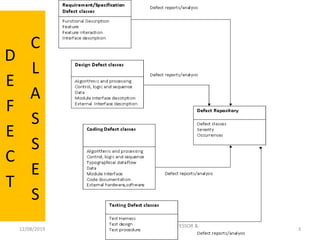
D
E
F
E
C
T
C
L
A
S
S
E
S
12/08/2019
DR.S.ROSELIN MARY, PROFESSOR &
HOD/CSE
3
1. Requirement / specification Defect classes:
• Defects injected in early phase persist & very tough to remove at later phases
• Requirement document
– written in natural language with specification
– Occurrence of ambiguous, contradictions, unclear, redundant &imprecise requirements
• Specification document – similar
– format specification language with tools
– to prevent incorrect description of system behavior
 Functional Description defects –
overall description of what the system does & how the system should behave is incorrect, ambiguous
& incomplete
 Feature defects
– feature descriptions – missing, incorrect, incomplete superfluous
– Distinguishing character of a software component/system
 Feature Interaction defects
– incorrect description of how the features should interact
– Explain the example
 Interface description defects
– defects that occur in the description of how the target software is to interface with external
hardware, software & users
• Blackbox based testing – at unit, integration, system & acceptance levels
• Feature interaction & Interface description defects – detected using BB test at integration & system level
tests
12/14/2019 4Dr.S.Roselin Mary, HOD/CSE
2. Design defects:
• Occur when system components, interaction between component to
component, component to outside software/hardware are incorrectly
designed
• Covers defects in design of algorithm, control, logic, data elements, module
interface description
• Detailed design description – at pseudo level with processing steps, data
structures, input output parameters & control structures
 Algorithmic & Processing defects:
– Processing steps – incorrect
– Calculation – not in order – missing/duplicated
– Algorithm reuse – chosen an inappropriate algorithm
 Control, logic & sequence defects
– Control defects occur when logic flow – incorrect
– Branching – soon, late, incorrect
– Unreachable psuedocode, improper nesting, improper procedure calls
– Incorrect use of logic operators < , >, Boolean expression in branching operation
 Data defects
– Incorrect design of data structures
– Record – lacking a field, incorrect type for variable in record
– Array – not have proper number of elements assigned
– Reviews/data dictionary – reveal these defects
12/14/2019 5Dr.S.Roselin Mary, HOD/CSE
 Module Interface description defects
– Incorrect/inconsistent parameter types
– Incorrect number of parameters/ ordering of parameters
 Functional description defects
– Design maynot properly describe the functionality of a module
– Incorrect/missing/unclear design elements
– Detected during design review
 External Interface description defects
– Incorrect design descriptions for interfaces external software, database & hardware
devices
– Improper sequence of commands, lack of proper messages & feedback messages
3. Coding defects
• From errors in implementing the code
• Closely related to design defect classes
• Not understanding programming constructs
• Transcription/omission
 Algorithmic & Processing defects
– Unchecked overflow, underflow conditions
– Comparing inappropriate data types
– Conversion of datatype
– Precedence of operators
– Misuse of parentheses
– Incorrect use of signs12/14/2019 6Dr.S.Roselin Mary, HOD/CSE
 Control, logic and sequence defects
– Case statements , iteration of loops, missing paths
 Typographical defects –syntax error
 Initialization defects – omission / incorrect initialization statements
 Dataflow defects
– Variable should be initialized before its use
– Don’t initialize twice before intermediate use
 Data defects
– Incorrect implementation of data structures
– record, array, flags, indices & constant sets
 Module Interface defects – similar to design defects
 Code documentation defects
– Code documentation – doesn’t reflect what the program actually does
– Incomplete/ ambiguous/incorrect/out of date
 External hardware, software interface defects
– System calls, links to database, input output sequences, memeory usage, resource
usage, interrupts, protocols & interfaces with build files
• Design & coding defects – whitebox testing – dataflow, control, logic
– Blackbox testing – decision tables, Boolean expression
12/14/2019 7Dr.S.Roselin Mary, HOD/CSE
4. Testing defects
• Defects in test plan, test cases, test harnesses,
procedures
Test Hareness defect
– Test hareness / Scaffolding code – auxiliary code
developed to test the software at the unit and integration
levels
– Should be carefully designed & tested – reuse
– Subject to all other types of defects
Test case design/ Test procedure defects
– Incorrect/incomplete, missing, inappropriate test cases &
procedures
12/14/2019 8Dr.S.Roselin Mary, HOD/CSE

Unit 1 defects classes

  • 1.
    IT 8076 SoftwareTesting UNIT – I Part -3 Dr. S. Roselin Mary, Professor & Head Department of Computer Science and Engineering (NBA Accredited) Anand Institute of Higher Technology, Chennai
  • 2.
    Defect Classes : •Important – adapt a single classification scheme & apply it to all projects • Some defects will fit into more than one class or category – developers, testers & SQA – try to be consistent when recording defect data • Defect types & frequency of occurrence  guide test planning & test design • Execution based testing strategies – strongest possibilities of detecting particular types of defect • Tests for new & modified software – designed to detect the most frequently occurring defects • Defect classes focusing execution based testing: » Requirement/specification defect class - Design defect class - Coding defect class - Testing defect class12/14/2019 2Dr.S.Roselin Mary, HOD/CSE
  • 3.
  • 4.
    1. Requirement /specification Defect classes: • Defects injected in early phase persist & very tough to remove at later phases • Requirement document – written in natural language with specification – Occurrence of ambiguous, contradictions, unclear, redundant &imprecise requirements • Specification document – similar – format specification language with tools – to prevent incorrect description of system behavior  Functional Description defects – overall description of what the system does & how the system should behave is incorrect, ambiguous & incomplete  Feature defects – feature descriptions – missing, incorrect, incomplete superfluous – Distinguishing character of a software component/system  Feature Interaction defects – incorrect description of how the features should interact – Explain the example  Interface description defects – defects that occur in the description of how the target software is to interface with external hardware, software & users • Blackbox based testing – at unit, integration, system & acceptance levels • Feature interaction & Interface description defects – detected using BB test at integration & system level tests 12/14/2019 4Dr.S.Roselin Mary, HOD/CSE
  • 5.
    2. Design defects: •Occur when system components, interaction between component to component, component to outside software/hardware are incorrectly designed • Covers defects in design of algorithm, control, logic, data elements, module interface description • Detailed design description – at pseudo level with processing steps, data structures, input output parameters & control structures  Algorithmic & Processing defects: – Processing steps – incorrect – Calculation – not in order – missing/duplicated – Algorithm reuse – chosen an inappropriate algorithm  Control, logic & sequence defects – Control defects occur when logic flow – incorrect – Branching – soon, late, incorrect – Unreachable psuedocode, improper nesting, improper procedure calls – Incorrect use of logic operators < , >, Boolean expression in branching operation  Data defects – Incorrect design of data structures – Record – lacking a field, incorrect type for variable in record – Array – not have proper number of elements assigned – Reviews/data dictionary – reveal these defects 12/14/2019 5Dr.S.Roselin Mary, HOD/CSE
  • 6.
     Module Interfacedescription defects – Incorrect/inconsistent parameter types – Incorrect number of parameters/ ordering of parameters  Functional description defects – Design maynot properly describe the functionality of a module – Incorrect/missing/unclear design elements – Detected during design review  External Interface description defects – Incorrect design descriptions for interfaces external software, database & hardware devices – Improper sequence of commands, lack of proper messages & feedback messages 3. Coding defects • From errors in implementing the code • Closely related to design defect classes • Not understanding programming constructs • Transcription/omission  Algorithmic & Processing defects – Unchecked overflow, underflow conditions – Comparing inappropriate data types – Conversion of datatype – Precedence of operators – Misuse of parentheses – Incorrect use of signs12/14/2019 6Dr.S.Roselin Mary, HOD/CSE
  • 7.
     Control, logicand sequence defects – Case statements , iteration of loops, missing paths  Typographical defects –syntax error  Initialization defects – omission / incorrect initialization statements  Dataflow defects – Variable should be initialized before its use – Don’t initialize twice before intermediate use  Data defects – Incorrect implementation of data structures – record, array, flags, indices & constant sets  Module Interface defects – similar to design defects  Code documentation defects – Code documentation – doesn’t reflect what the program actually does – Incomplete/ ambiguous/incorrect/out of date  External hardware, software interface defects – System calls, links to database, input output sequences, memeory usage, resource usage, interrupts, protocols & interfaces with build files • Design & coding defects – whitebox testing – dataflow, control, logic – Blackbox testing – decision tables, Boolean expression 12/14/2019 7Dr.S.Roselin Mary, HOD/CSE
  • 8.
    4. Testing defects •Defects in test plan, test cases, test harnesses, procedures Test Hareness defect – Test hareness / Scaffolding code – auxiliary code developed to test the software at the unit and integration levels – Should be carefully designed & tested – reuse – Subject to all other types of defects Test case design/ Test procedure defects – Incorrect/incomplete, missing, inappropriate test cases & procedures 12/14/2019 8Dr.S.Roselin Mary, HOD/CSE