Code Optimization
Presenter:
Pradip Bhattarai
Nepathya College
6th Semester
Introduction
 Optimization is a program transformation technique, which
tries to improve the code by making it consume less resources
(i.e. CPU, Memory) and deliver high speed.
 Optimizations are classified into two categories:
a) Machine independent optimizations
- improve target code without taking properties
of target machine into consideration.
b) Machine dependent optimization
Criteria for Optimization
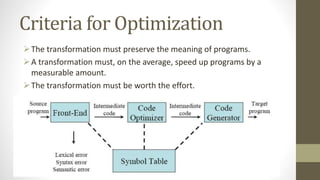
The transformation must preserve the meaning of programs.
A transformation must, on the average, speed up programs by a
measurable amount.
The transformation must be worth the effort.
Techniques for Optimization
1) Compile time evaluation
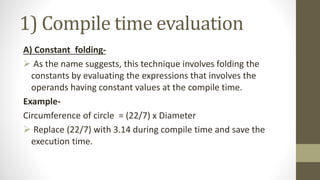
A) Constant folding-
 As the name suggests, this technique involves folding the
constants by evaluating the expressions that involves the
operands having constant values at the compile time.
Example-
Circumference of circle = (22/7) x Diameter
 Replace (22/7) with 3.14 during compile time and save the
execution time.
1) Compile time evaluation
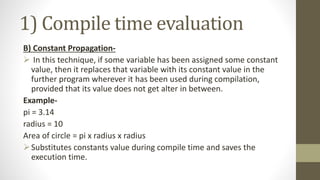
B) Constant Propagation-
 In this technique, if some variable has been assigned some constant
value, then it replaces that variable with its constant value in the
further program wherever it has been used during compilation,
provided that its value does not get alter in between.
Example-
pi = 3.14
radius = 10
Area of circle = pi x radius x radius
Substitutes constants value during compile time and saves the
execution time.
2) Commonsub-expressionselimination
 Eliminates the redundant expressions and avoids their
computation again and again.
Code before Optimization Code after Optimization
S1 = 4 x i
S2 = a[S1]
S3 = 4 x j
S4 = 4 x i // Redundant Expression
S5 = n
S6 = b[S4] + S5
S1 = 4 x i
S2 = a[S1]
S3 = 4 x j
S5 = n
S6 = b[S1] + S5
Example-
3) Code movement
 The code is moved out of the loop if it does not matter
whether it is present inside the loop or it is present outside
the loop.
Code before Optimization Code after Optimization
for ( int j = 0 ; j < n ; j ++)
{
x = y + z ;
a[j] = 6 x j;
}
x = y + z ;
for ( int j = 0 ; j < n ; j ++)
{
a[j] = 6 x j;
}
Example-
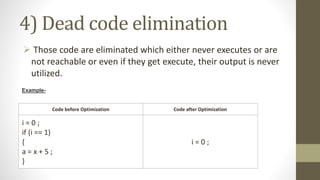
4) Dead code elimination
 Those code are eliminated which either never executes or are
not reachable or even if they get execute, their output is never
utilized.
Code before Optimization Code after Optimization
i = 0 ;
if (i == 1)
{
a = x + 5 ;
}
i = 0 ;
Example-
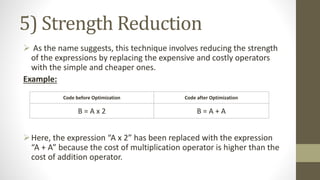
5) Strength Reduction
 As the name suggests, this technique involves reducing the strength
of the expressions by replacing the expensive and costly operators
with the simple and cheaper ones.
Example:
Here, the expression “A x 2” has been replaced with the expression
“A + A” because the cost of multiplication operator is higher than the
cost of addition operator.
Code before Optimization Code after Optimization
B = A x 2 B = A + A

Code optimization

  • 1.
  • 2.
    Introduction  Optimization isa program transformation technique, which tries to improve the code by making it consume less resources (i.e. CPU, Memory) and deliver high speed.  Optimizations are classified into two categories: a) Machine independent optimizations - improve target code without taking properties of target machine into consideration. b) Machine dependent optimization
  • 3.
    Criteria for Optimization Thetransformation must preserve the meaning of programs. A transformation must, on the average, speed up programs by a measurable amount. The transformation must be worth the effort.
  • 4.
  • 5.
    1) Compile timeevaluation A) Constant folding-  As the name suggests, this technique involves folding the constants by evaluating the expressions that involves the operands having constant values at the compile time. Example- Circumference of circle = (22/7) x Diameter  Replace (22/7) with 3.14 during compile time and save the execution time.
  • 6.
    1) Compile timeevaluation B) Constant Propagation-  In this technique, if some variable has been assigned some constant value, then it replaces that variable with its constant value in the further program wherever it has been used during compilation, provided that its value does not get alter in between. Example- pi = 3.14 radius = 10 Area of circle = pi x radius x radius Substitutes constants value during compile time and saves the execution time.
  • 7.
    2) Commonsub-expressionselimination  Eliminatesthe redundant expressions and avoids their computation again and again. Code before Optimization Code after Optimization S1 = 4 x i S2 = a[S1] S3 = 4 x j S4 = 4 x i // Redundant Expression S5 = n S6 = b[S4] + S5 S1 = 4 x i S2 = a[S1] S3 = 4 x j S5 = n S6 = b[S1] + S5 Example-
  • 8.
    3) Code movement The code is moved out of the loop if it does not matter whether it is present inside the loop or it is present outside the loop. Code before Optimization Code after Optimization for ( int j = 0 ; j < n ; j ++) { x = y + z ; a[j] = 6 x j; } x = y + z ; for ( int j = 0 ; j < n ; j ++) { a[j] = 6 x j; } Example-
  • 9.
    4) Dead codeelimination  Those code are eliminated which either never executes or are not reachable or even if they get execute, their output is never utilized. Code before Optimization Code after Optimization i = 0 ; if (i == 1) { a = x + 5 ; } i = 0 ; Example-
  • 10.
    5) Strength Reduction As the name suggests, this technique involves reducing the strength of the expressions by replacing the expensive and costly operators with the simple and cheaper ones. Example: Here, the expression “A x 2” has been replaced with the expression “A + A” because the cost of multiplication operator is higher than the cost of addition operator. Code before Optimization Code after Optimization B = A x 2 B = A + A