8 Other Approaches
8.1 Languages with Concurrency Constructs
8.1.1 Ada 95
 • Like µC+ but not as general.
           +,
 • E.g., monitor bounded-buffer, restricted implicit (automatic) signal:
   Except as otherwise noted, the content of this presentation is licensed under the Creative Com-
mons Attribution 2.5 License.


                                              224
225
    protected type buffer is -- _Monitor
         entry insert( elem : in ElemType ) when count < Size is
         begin
                 -- add to buffer
                 count := count + 1;
         end insert;
         entry remove( elem : out ElemType ) when count > 0 is
         begin
                 -- remove from buffer, return via parameter
                 count := count - 1;
         end remove;
      private:
         . . . // buffer declarations
         count : Integer := 0;
    end buffer;
• The when clause is external scheduling because it can only be used at
  start of entry routine not within.
• The when expression can contain only global object variables;
  parameter or local variables are disallowed ⇒ no dating-service.
• E.g., task bounded-buffer:
226
task type buffer is -- _Task
  . . . -- buffer declarations
  count : integer := 0;
begin -- thread starts here (task main)
  loop
     select -- _Accept
        when count < Size => -- guard
        accept insert(elem : in ElemType) do -- mutex member
          -- add to buffer
          count := count + 1;
        end;
        -- executed if this accept called
     or
        when count > 0 => -- guard
        accept remove(elem : out ElemType) do -- mutex member
          -- remove from buffer, return via parameter
          count := count - 1;
        end;
     end select;
  end loop;
end buffer;

var b : buffer   -- create a task
227
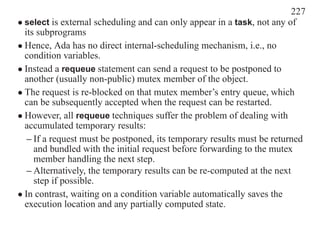
• select is external scheduling and can only appear in a task, not any of
  its subprograms
• Hence, Ada has no direct internal-scheduling mechanism, i.e., no
  condition variables.
• Instead a requeue statement can send a request to be postponed to
  another (usually non-public) mutex member of the object.
• The request is re-blocked on that mutex member’s entry queue, which
  can be subsequently accepted when the request can be restarted.
• However, all requeue techniques suffer the problem of dealing with
  accumulated temporary results:
   – If a request must be postponed, its temporary results must be returned
     and bundled with the initial request before forwarding to the mutex
     member handling the next step.
   – Alternatively, the temporary results can be re-computed at the next
     step if possible.
• In contrast, waiting on a condition variable automatically saves the
  execution location and any partially computed state.
228
8.1.2 Modula-3/Java/C#
 • Java’s concurrency constructs are largely derived from Modula-3.
     class Thread implements Runnable {
         public Thread();
         public Thread(String name);
         public String getName();
         public void setName(String name);
         public void run();
         public synchronized void start();
         public static Thread currentThread();
         public static void yield();
         public final void join();
     }
• Thread is like uBaseTask in µC+ and all tasks must explicitly inherit
                                 +,
  from it:
229
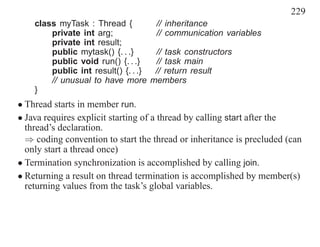
    class myTask : Thread {         // inheritance
        private int arg;            // communication variables
        private int result;
        public mytask() {. . .}     // task constructors
        public void run() {. . .}   // task main
        public int result() {. . .} // return result
        // unusual to have more members
    }
• Thread starts in member run.
• Java requires explicit starting of a thread by calling start after the
  thread’s declaration.
  ⇒ coding convention to start the thread or inheritance is precluded (can
  only start a thread once)
• Termination synchronization is accomplished by calling join.
• Returning a result on thread termination is accomplished by member(s)
  returning values from the task’s global variables.
230
    mytask th = new myTask(. . .); // create and initialized task
    th.start();        // start thread
    // concurrency
    th.join();         // wait for thread termination
    a2 = th.result();  // retrieve answer from task object
• Like µC+ when the task’s thread terminates, it becomes an object,
            +,
  hence allowing the call to result to retrieve a result.
• Java has synchronized class members (i.e., _Mutex members but
  incorrectly named), and a synchronized statement.
• Modula-3 has a lock statement that can be used to simulate _Mutex
  members if certain coding conventions are followed.
• Neither language has very useful external scheduling.
• While it is possible to have public synchronized members of a task,
  there is no mechanism to manage direct calls, i.e., no accept statement.
  ⇒ no useful direct communication.
• Internal scheduling is no-priority nonblocking ⇒ barging ⇒ wait
  statements must be in while loops to recheck conditions
• All classes have one implicit condition variable and these routines to
  manipulate it:
231
    public wait();
    public notify();
    public notifyall()
• Bounded buffer:
    class buffer {
        // buffer declarations
        private int count = 0;
        public synchronized void insert( int elem ) {
             while ( count == Size ) wait(); // busy-waiting
             // add to buffer
             count += 1;
             notify();
        }
        public synchronized int remove() {
             while ( count == 0 ) wait(); // busy-waiting
             // remove from buffer
             count -= 1;
             notify();
             return elem;
        }
    }
• Because there is only one condition queue ⇒ certain solutions are
232
 difficult or impossible.

8.2 Threads & Locks Library
• All concurrency libraries are unsafe or inefficient because the compiler
  thinks the program is sequential.
• unsafe:
   – Valid sequential optimizations can invalidate concurrent programs:
      P(lock);
      // critical section
      V(lock);
    compiler moves P or V after/before critical section
  – Turn off sequential optimizations to prevent concurrent error but now
    entire program is unnecessarily slower.
• Several libraries exist for C (pthreads) and C+ (µC+
                                                 +     +).
• C libraries built around simple model of starting a thread in a routine
  and mutex/condition locks (“attribute” parameters not shown).
233
    int pthread_create( pthread_t *new_thread_ID,
             void * (*start_func)(void *), void *arg );
    int pthread_join( pthread_t target_thread, void **status );
    pthread_t pthread_self( void );

    int   pthread_mutex_init( pthread_mutex_t *mp );
    int   pthread_mutex_lock( pthread_mutex_t *mp );
    int   pthread_mutex_unlock( pthread_mutex_t *mp );
    int   pthread_mutex_destroy( pthread_mutex_t *mp );

    int   pthread_cond_init( pthread_cond_t *cp );
    int   pthread_cond_wait( pthread_cond_t *cp, pthread_mutex_t *mutex );
    int   pthread_cond_signal( pthread_cond_ t *cp );
    int   pthread_cond_broadcast( pthread_cond_t *cp );
    int   pthread_cond_destroy( pthread_cond_t *cp );

• Thread starts in routine start_func via pthread_create.
  Initialization data is single void * value.
• Termination synchronization is performed by calling pthread_join.
• Return a result on thread termination by passing back a single void *
  value from pthread_join.
234
    void *rtn( void *arg ) { . . . }
    int i = 3, r, rc;
    pthread_t t;           // thread id
    rc = pthread_create(&t,rtn,(void *)i); // create and initialized task
    if ( rc != 0 ) . . .   // check for error
    // concurrency
    rc = pthread_join(t,&r); // wait for thread termination and result
    if ( rc != 0 ) . . .   // check for error
• All C library approaches have type-unsafe communication with tasks.
• No external scheduling ⇒ no direct communication.
• Internal scheduling is no-priority nonblocking ⇒ barging ⇒ wait
  statements must be in while loops to recheck conditions
235
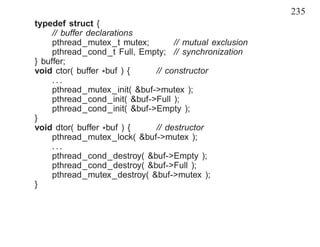
typedef struct {
     // buffer declarations
     pthread_mutex_t mutex;        // mutual exclusion
     pthread_cond_t Full, Empty; // synchronization
} buffer;
void ctor( buffer *buf ) {    // constructor
     ...
     pthread_mutex_init( &buf->mutex );
     pthread_cond_init( &buf->Full );
     pthread_cond_init( &buf->Empty );
}
void dtor( buffer *buf ) {    // destructor
     pthread_mutex_lock( &buf->mutex );
     ...
     pthread_cond_destroy( &buf->Empty );
     pthread_cond_destroy( &buf->Full );
     pthread_mutex_destroy( &buf->mutex );
}
236
    void insert( buffer *buf, int elem ) {
         pthread_mutex_lock( &buf->mutex );
         while ( buf->count == Size
              pthread_cond_wait( &buf->Empty, &buf->mutex );
         // add to buffer
         buf->count += 1;
         pthread_cond_signal( &buf->Full );
         pthread_mutex_unlock( &buf->mutex );
    }
    int remove( buffer *buf ) {
         pthread_mutex_lock( &buf->mutex );
         while ( buf->count == 0 )
              pthread_cond_wait( &buf->Full, &buf->mutex );
         // remove from buffer
         buf->count -= 1;
         pthread_cond_signal( &buf->Empty );
         pthread_mutex_unlock( &buf->mutex );
         return elem;
    }
• Since there are no constructors/destructors in C, explicit calls are
  necessary to ctor/dtor before/after use.
237
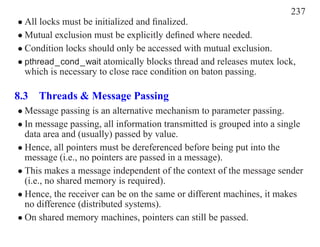
• All locks must be initialized and finalized.
• Mutual exclusion must be explicitly defined where needed.
• Condition locks should only be accessed with mutual exclusion.
• pthread_cond_wait atomically blocks thread and releases mutex lock,
  which is necessary to close race condition on baton passing.

8.3 Threads & Message Passing
• Message passing is an alternative mechanism to parameter passing.
• In message passing, all information transmitted is grouped into a single
  data area and (usually) passed by value.
• Hence, all pointers must be dereferenced before being put into the
  message (i.e., no pointers are passed in a message).
• This makes a message independent of the context of the message sender
  (i.e., no shared memory is required).
• Hence, the receiver can be on the same or different machines, it makes
  no difference (distributed systems).
• On shared memory machines, pointers can still be passed.
238
• Message passing is usually direct communication.
• Messages are directed to a specific task and received from a specific task
  (receive specific):
     task1                      task2
     send(tid2, msg)            receive(tid1, msg)
• Or messages are directed to a specific task and received from any task
  (receive any):
     task1                      task2
     send(tid2, msg)            tid = receive(msg)

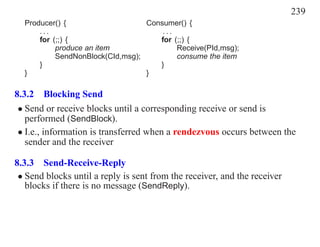
8.3.1 Nonblocking Send
 • Send does not block, and receive gets the messages in the order they are
   sent (SendNonBlock).
 • ⇒ an infinite length buffer between the sender and receiver
 • since the buffer is bounded, the sender occasionally blocks until the
   receiver catches up.
 • the receiver blocks if there is no message
239
  Producer() {                    Consumer() {
      ...                             ...
      for (;;) {                     for (;;) {
           produce an item                Receive(PId,msg);
           SendNonBlock(CId,msg);         consume the item
      }                              }
  }                               }

8.3.2 Blocking Send
 • Send or receive blocks until a corresponding receive or send is
   performed (SendBlock).
 • I.e., information is transferred when a rendezvous occurs between the
   sender and the receiver

8.3.3 Send-Receive-Reply
 • Send blocks until a reply is sent from the receiver, and the receiver
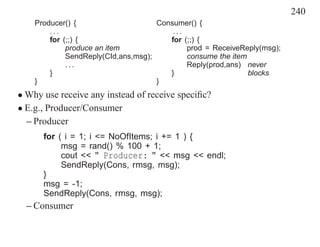
   blocks if there is no message (SendReply).
240
    Producer() {                     Consumer() {
        ...                              ...
        for (;;) {                      for (;;) {
             produce an item                 prod = ReceiveReply(msg);
             SendReply(CId,ans,msg);         consume the item
             ...                             Reply(prod,ans) never
        }                               }                     blocks
    }                                }
• Why use receive any instead of receive specific?
• E.g., Producer/Consumer
  – Producer
      for ( i = 1; i <= NoOfItems; i += 1 ) {
           msg = rand() % 100 + 1;
           cout << " Producer: " << msg << endl;
           SendReply(Cons, rmsg, msg);
      }
      msg = -1;
      SendReply(Cons, rmsg, msg);
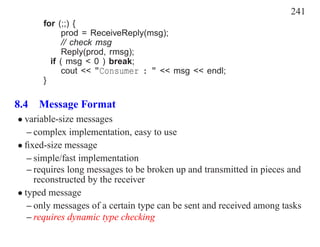
  – Consumer
241
      for (;;) {
            prod = ReceiveReply(msg);
            // check msg
            Reply(prod, rmsg);
        if ( msg < 0 ) break;
            cout << "Consumer : " << msg << endl;
      }

8.4 Message Format
• variable-size messages
   – complex implementation, easy to use
• fixed-size message
   – simple/fast implementation
   – requires long messages to be broken up and transmitted in pieces and
     reconstructed by the receiver
• typed message
   – only messages of a certain type can be sent and received among tasks
   – requires dynamic type checking

Other Approaches (Concurrency)

  • 1.
    8 Other Approaches 8.1Languages with Concurrency Constructs 8.1.1 Ada 95 • Like µC+ but not as general. +, • E.g., monitor bounded-buffer, restricted implicit (automatic) signal: Except as otherwise noted, the content of this presentation is licensed under the Creative Com- mons Attribution 2.5 License. 224
  • 2.
    225 protected type buffer is -- _Monitor entry insert( elem : in ElemType ) when count < Size is begin -- add to buffer count := count + 1; end insert; entry remove( elem : out ElemType ) when count > 0 is begin -- remove from buffer, return via parameter count := count - 1; end remove; private: . . . // buffer declarations count : Integer := 0; end buffer; • The when clause is external scheduling because it can only be used at start of entry routine not within. • The when expression can contain only global object variables; parameter or local variables are disallowed ⇒ no dating-service. • E.g., task bounded-buffer:
  • 3.
    226 task type bufferis -- _Task . . . -- buffer declarations count : integer := 0; begin -- thread starts here (task main) loop select -- _Accept when count < Size => -- guard accept insert(elem : in ElemType) do -- mutex member -- add to buffer count := count + 1; end; -- executed if this accept called or when count > 0 => -- guard accept remove(elem : out ElemType) do -- mutex member -- remove from buffer, return via parameter count := count - 1; end; end select; end loop; end buffer; var b : buffer -- create a task
  • 4.
    227 • select isexternal scheduling and can only appear in a task, not any of its subprograms • Hence, Ada has no direct internal-scheduling mechanism, i.e., no condition variables. • Instead a requeue statement can send a request to be postponed to another (usually non-public) mutex member of the object. • The request is re-blocked on that mutex member’s entry queue, which can be subsequently accepted when the request can be restarted. • However, all requeue techniques suffer the problem of dealing with accumulated temporary results: – If a request must be postponed, its temporary results must be returned and bundled with the initial request before forwarding to the mutex member handling the next step. – Alternatively, the temporary results can be re-computed at the next step if possible. • In contrast, waiting on a condition variable automatically saves the execution location and any partially computed state.
  • 5.
    228 8.1.2 Modula-3/Java/C# •Java’s concurrency constructs are largely derived from Modula-3. class Thread implements Runnable { public Thread(); public Thread(String name); public String getName(); public void setName(String name); public void run(); public synchronized void start(); public static Thread currentThread(); public static void yield(); public final void join(); } • Thread is like uBaseTask in µC+ and all tasks must explicitly inherit +, from it:
  • 6.
    229 class myTask : Thread { // inheritance private int arg; // communication variables private int result; public mytask() {. . .} // task constructors public void run() {. . .} // task main public int result() {. . .} // return result // unusual to have more members } • Thread starts in member run. • Java requires explicit starting of a thread by calling start after the thread’s declaration. ⇒ coding convention to start the thread or inheritance is precluded (can only start a thread once) • Termination synchronization is accomplished by calling join. • Returning a result on thread termination is accomplished by member(s) returning values from the task’s global variables.
  • 7.
    230 mytask th = new myTask(. . .); // create and initialized task th.start(); // start thread // concurrency th.join(); // wait for thread termination a2 = th.result(); // retrieve answer from task object • Like µC+ when the task’s thread terminates, it becomes an object, +, hence allowing the call to result to retrieve a result. • Java has synchronized class members (i.e., _Mutex members but incorrectly named), and a synchronized statement. • Modula-3 has a lock statement that can be used to simulate _Mutex members if certain coding conventions are followed. • Neither language has very useful external scheduling. • While it is possible to have public synchronized members of a task, there is no mechanism to manage direct calls, i.e., no accept statement. ⇒ no useful direct communication. • Internal scheduling is no-priority nonblocking ⇒ barging ⇒ wait statements must be in while loops to recheck conditions • All classes have one implicit condition variable and these routines to manipulate it:
  • 8.
    231 public wait(); public notify(); public notifyall() • Bounded buffer: class buffer { // buffer declarations private int count = 0; public synchronized void insert( int elem ) { while ( count == Size ) wait(); // busy-waiting // add to buffer count += 1; notify(); } public synchronized int remove() { while ( count == 0 ) wait(); // busy-waiting // remove from buffer count -= 1; notify(); return elem; } } • Because there is only one condition queue ⇒ certain solutions are
  • 9.
    232 difficult orimpossible. 8.2 Threads & Locks Library • All concurrency libraries are unsafe or inefficient because the compiler thinks the program is sequential. • unsafe: – Valid sequential optimizations can invalidate concurrent programs: P(lock); // critical section V(lock); compiler moves P or V after/before critical section – Turn off sequential optimizations to prevent concurrent error but now entire program is unnecessarily slower. • Several libraries exist for C (pthreads) and C+ (µC+ + +). • C libraries built around simple model of starting a thread in a routine and mutex/condition locks (“attribute” parameters not shown).
  • 10.
    233 int pthread_create( pthread_t *new_thread_ID, void * (*start_func)(void *), void *arg ); int pthread_join( pthread_t target_thread, void **status ); pthread_t pthread_self( void ); int pthread_mutex_init( pthread_mutex_t *mp ); int pthread_mutex_lock( pthread_mutex_t *mp ); int pthread_mutex_unlock( pthread_mutex_t *mp ); int pthread_mutex_destroy( pthread_mutex_t *mp ); int pthread_cond_init( pthread_cond_t *cp ); int pthread_cond_wait( pthread_cond_t *cp, pthread_mutex_t *mutex ); int pthread_cond_signal( pthread_cond_ t *cp ); int pthread_cond_broadcast( pthread_cond_t *cp ); int pthread_cond_destroy( pthread_cond_t *cp ); • Thread starts in routine start_func via pthread_create. Initialization data is single void * value. • Termination synchronization is performed by calling pthread_join. • Return a result on thread termination by passing back a single void * value from pthread_join.
  • 11.
    234 void *rtn( void *arg ) { . . . } int i = 3, r, rc; pthread_t t; // thread id rc = pthread_create(&t,rtn,(void *)i); // create and initialized task if ( rc != 0 ) . . . // check for error // concurrency rc = pthread_join(t,&r); // wait for thread termination and result if ( rc != 0 ) . . . // check for error • All C library approaches have type-unsafe communication with tasks. • No external scheduling ⇒ no direct communication. • Internal scheduling is no-priority nonblocking ⇒ barging ⇒ wait statements must be in while loops to recheck conditions
  • 12.
    235 typedef struct { // buffer declarations pthread_mutex_t mutex; // mutual exclusion pthread_cond_t Full, Empty; // synchronization } buffer; void ctor( buffer *buf ) { // constructor ... pthread_mutex_init( &buf->mutex ); pthread_cond_init( &buf->Full ); pthread_cond_init( &buf->Empty ); } void dtor( buffer *buf ) { // destructor pthread_mutex_lock( &buf->mutex ); ... pthread_cond_destroy( &buf->Empty ); pthread_cond_destroy( &buf->Full ); pthread_mutex_destroy( &buf->mutex ); }
  • 13.
    236 void insert( buffer *buf, int elem ) { pthread_mutex_lock( &buf->mutex ); while ( buf->count == Size pthread_cond_wait( &buf->Empty, &buf->mutex ); // add to buffer buf->count += 1; pthread_cond_signal( &buf->Full ); pthread_mutex_unlock( &buf->mutex ); } int remove( buffer *buf ) { pthread_mutex_lock( &buf->mutex ); while ( buf->count == 0 ) pthread_cond_wait( &buf->Full, &buf->mutex ); // remove from buffer buf->count -= 1; pthread_cond_signal( &buf->Empty ); pthread_mutex_unlock( &buf->mutex ); return elem; } • Since there are no constructors/destructors in C, explicit calls are necessary to ctor/dtor before/after use.
  • 14.
    237 • All locksmust be initialized and finalized. • Mutual exclusion must be explicitly defined where needed. • Condition locks should only be accessed with mutual exclusion. • pthread_cond_wait atomically blocks thread and releases mutex lock, which is necessary to close race condition on baton passing. 8.3 Threads & Message Passing • Message passing is an alternative mechanism to parameter passing. • In message passing, all information transmitted is grouped into a single data area and (usually) passed by value. • Hence, all pointers must be dereferenced before being put into the message (i.e., no pointers are passed in a message). • This makes a message independent of the context of the message sender (i.e., no shared memory is required). • Hence, the receiver can be on the same or different machines, it makes no difference (distributed systems). • On shared memory machines, pointers can still be passed.
  • 15.
    238 • Message passingis usually direct communication. • Messages are directed to a specific task and received from a specific task (receive specific): task1 task2 send(tid2, msg) receive(tid1, msg) • Or messages are directed to a specific task and received from any task (receive any): task1 task2 send(tid2, msg) tid = receive(msg) 8.3.1 Nonblocking Send • Send does not block, and receive gets the messages in the order they are sent (SendNonBlock). • ⇒ an infinite length buffer between the sender and receiver • since the buffer is bounded, the sender occasionally blocks until the receiver catches up. • the receiver blocks if there is no message
  • 16.
    239 Producer(){ Consumer() { ... ... for (;;) { for (;;) { produce an item Receive(PId,msg); SendNonBlock(CId,msg); consume the item } } } } 8.3.2 Blocking Send • Send or receive blocks until a corresponding receive or send is performed (SendBlock). • I.e., information is transferred when a rendezvous occurs between the sender and the receiver 8.3.3 Send-Receive-Reply • Send blocks until a reply is sent from the receiver, and the receiver blocks if there is no message (SendReply).
  • 17.
    240 Producer() { Consumer() { ... ... for (;;) { for (;;) { produce an item prod = ReceiveReply(msg); SendReply(CId,ans,msg); consume the item ... Reply(prod,ans) never } } blocks } } • Why use receive any instead of receive specific? • E.g., Producer/Consumer – Producer for ( i = 1; i <= NoOfItems; i += 1 ) { msg = rand() % 100 + 1; cout << " Producer: " << msg << endl; SendReply(Cons, rmsg, msg); } msg = -1; SendReply(Cons, rmsg, msg); – Consumer
  • 18.
    241 for (;;) { prod = ReceiveReply(msg); // check msg Reply(prod, rmsg); if ( msg < 0 ) break; cout << "Consumer : " << msg << endl; } 8.4 Message Format • variable-size messages – complex implementation, easy to use • fixed-size message – simple/fast implementation – requires long messages to be broken up and transmitted in pieces and reconstructed by the receiver • typed message – only messages of a certain type can be sent and received among tasks – requires dynamic type checking