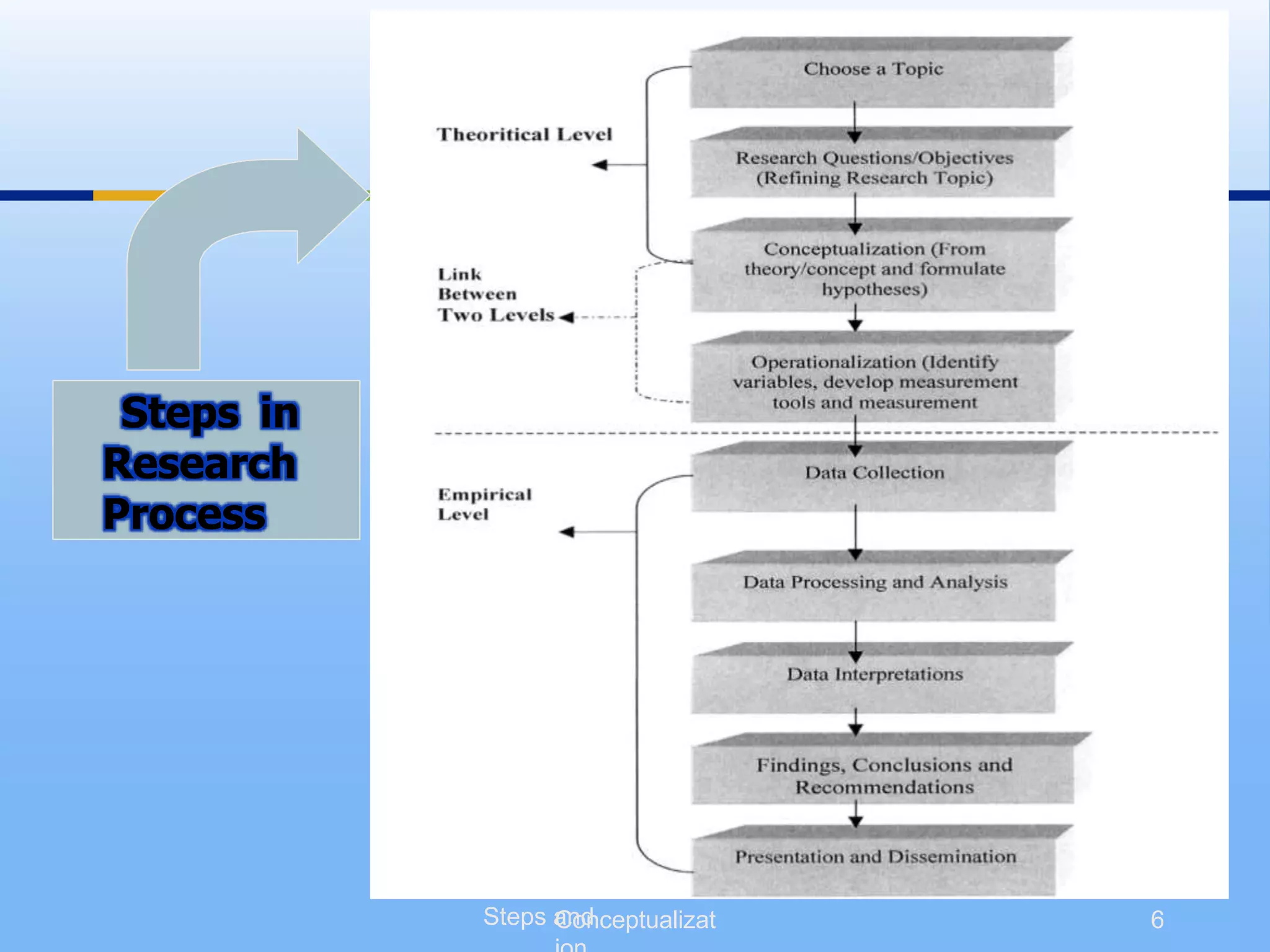
This document discusses conceptualization and operationalization in research planning methods. It begins by explaining how to choose a research topic, including potential sources of topics and ways to narrow a topic. It then discusses conceptual frameworks, including how to construct one using theories, concepts, and literature. The document explains conceptualization as specifying the meaning of terms, and operationalization as developing measurable variables. It provides examples of dimensions and indicators to operationalize concepts. Finally, it discusses steps in the research process like problem identification, framing research questions and objectives.
![URP-803: Planning Research Methods, Spring Semester 2020, NUST [Dr. Irfan Ahmad Rana]
Research Conceptualization and
Operationalization
Dr. Irfan Ahmad Rana
Assistant Professor
Department of Urban and Regional Planning,
National University of Sciences and Technology
URP-803 : Planning Research Methods](https://image.slidesharecdn.com/lecture7-researchconceptualization-230212225826-9948735f/75/Lecture-7-Research-Conceptualization-pptx-1-2048.jpg)

![URP-803: Planning Research Methods, Spring Semester 2020, NUST [Dr. Irfan Ahmad Rana]
Classroom
School
Community
Own teaching experiences
Class discussions
Seminars
Workshops/paper presentations
Where do you see problems that may
ignite your mind to think about research?
3](https://image.slidesharecdn.com/lecture7-researchconceptualization-230212225826-9948735f/75/Lecture-7-Research-Conceptualization-pptx-3-2048.jpg)
![URP-803: Planning Research Methods, Spring Semester 2020, NUST [Dr. Irfan Ahmad Rana]
Internet
Out-of-class exchanges of ideas with fellow students and
professors
Reading assignments
Consultation with…
Course instructor; Advisor; Major Professor; Faculty member
Where do you see problems that may
ignite your mind to think about research?
4](https://image.slidesharecdn.com/lecture7-researchconceptualization-230212225826-9948735f/75/Lecture-7-Research-Conceptualization-pptx-4-2048.jpg)
![URP-803: Planning Research Methods, Spring Semester 2020, NUST [Dr. Irfan Ahmad Rana]
Personal values/curiosity/challenge
Work experience
Everyday life/media
Hot/fashionable
Body of knowledge/academic interest
Solving problems
Donor-driven issues
Ways to Choose a Research Topic
5](https://image.slidesharecdn.com/lecture7-researchconceptualization-230212225826-9948735f/75/Lecture-7-Research-Conceptualization-pptx-5-2048.jpg)
![URP-803: Planning Research Methods, Spring Semester 2020, NUST [Dr. Irfan Ahmad Rana]
Is the problem/topic significant enough?
Is it feasible (practical/possible for me to do it)?
Is it free of unknown hazards/dangers?
Is it clear (unambiguous)?
Answer the following preliminary
questions…
6](https://image.slidesharecdn.com/lecture7-researchconceptualization-230212225826-9948735f/75/Lecture-7-Research-Conceptualization-pptx-6-2048.jpg)
![URP-803: Planning Research Methods, Spring Semester 2020, NUST [Dr. Irfan Ahmad Rana]
Narrowing the focus (Scope)
Population (Target)
Situation (time, condition, subject availability, researcher’s
readiness, resources available, etc.)
Measurements
Issue(s) dealt with?
Setting the scope of the problem
(“this is my line…I won’t go beyond it…”)
Actively involve yourself (and other experts) in
NARROWING & REFINEMENT of the problem
7](https://image.slidesharecdn.com/lecture7-researchconceptualization-230212225826-9948735f/75/Lecture-7-Research-Conceptualization-pptx-7-2048.jpg)
![URP-803: Planning Research Methods, Spring Semester 2020, NUST [Dr. Irfan Ahmad Rana]
Techniques for narrowing a topic:
Examine the literature. You can repeat a previous
study, explore unexpected findings from previous
studies. Follow author suggestions for future
research, extend a theory to a new topic.
Talk over ideas with others.
Apply research to a specific demographic group.
Define the aim or desired outcome of the study.](https://image.slidesharecdn.com/lecture7-researchconceptualization-230212225826-9948735f/75/Lecture-7-Research-Conceptualization-pptx-8-2048.jpg)
![URP-803: Planning Research Methods, Spring Semester 2020, NUST [Dr. Irfan Ahmad Rana]
There are times when it is appropriate to replicate
(repeat) a study to verify its conclusions or to extend
the validity of its findings to a different situation or
population ……….
Should we replicate?...
9](https://image.slidesharecdn.com/lecture7-researchconceptualization-230212225826-9948735f/75/Lecture-7-Research-Conceptualization-pptx-9-2048.jpg)
![URP-803: Planning Research Methods, Spring Semester 2020, NUST [Dr. Irfan Ahmad Rana]
Interesting – keeps the researcher interested in it throughout
the research process
Researchable – can be investigated through the collection and
analysis of data
Significant – contributes to the improvement and
understanding of educational theory and practice
Manageable – fits the level of researcher’s level of research
skills, needed resources, and time restrictions
Ethical – does not embarrass or harm participants
Characteristics of good topics
10](https://image.slidesharecdn.com/lecture7-researchconceptualization-230212225826-9948735f/75/Lecture-7-Research-Conceptualization-pptx-10-2048.jpg)
![URP-803: Planning Research Methods, Spring Semester 2020, NUST [Dr. Irfan Ahmad Rana]
What do we mean by concept?
o Concepts are constructs; they represent the
agreed-upon meanings we assign to terms.
o Our concepts don’t exist in the real world, so
they cannot be measured directly.
o Can measure the things our concepts
summarize.](https://image.slidesharecdn.com/lecture7-researchconceptualization-230212225826-9948735f/75/Lecture-7-Research-Conceptualization-pptx-12-2048.jpg)
![URP-803: Planning Research Methods, Spring Semester 2020, NUST [Dr. Irfan Ahmad Rana]
• Conceptualization is the process of
specifying what we mean by a term.
• A clear, verbal specification of your
variable (concept) so that others know
what it is and can place cognitive
borders around it.
Conceptualization
13](https://image.slidesharecdn.com/lecture7-researchconceptualization-230212225826-9948735f/75/Lecture-7-Research-Conceptualization-pptx-13-2048.jpg)
![URP-803: Planning Research Methods, Spring Semester 2020, NUST [Dr. Irfan Ahmad Rana]
Sustainability?
Absolute Poverty?
Corruption?
Social Status?
Risk?
Poverty?
What do we mean by concept?](https://image.slidesharecdn.com/lecture7-researchconceptualization-230212225826-9948735f/75/Lecture-7-Research-Conceptualization-pptx-14-2048.jpg)
![URP-803: Planning Research Methods, Spring Semester 2020, NUST [Dr. Irfan Ahmad Rana]
Conceptualization is a process for taking
concept and refining it by giving a conceptual
and theoretical definition and explanation,
which may be either in abstract or concrete
terms or both.
Conceptualization
15](https://image.slidesharecdn.com/lecture7-researchconceptualization-230212225826-9948735f/75/Lecture-7-Research-Conceptualization-pptx-15-2048.jpg)
![URP-803: Planning Research Methods, Spring Semester 2020, NUST [Dr. Irfan Ahmad Rana]
Concept: “Idea or plan that takes shape in
one’s mind”
Framework: “Pull together; shape/build up
or form a plan”
A conceptual framework is “to build up the
way of thoughts in perspective”.
Conceptual Framework
16](https://image.slidesharecdn.com/lecture7-researchconceptualization-230212225826-9948735f/75/Lecture-7-Research-Conceptualization-pptx-16-2048.jpg)
![URP-803: Planning Research Methods, Spring Semester 2020, NUST [Dr. Irfan Ahmad Rana]
A conceptual framework specifies the variables of
interest and the expected relationship among them.
The framework may be relatively straightforward or
complex, which depends on the identification of
research problem or issue.
The development of a conceptual framework is a
mechanism to refine the focus of the
study and it can be used as a vehicle to explain the
research study.
Conceptual Framework
17](https://image.slidesharecdn.com/lecture7-researchconceptualization-230212225826-9948735f/75/Lecture-7-Research-Conceptualization-pptx-17-2048.jpg)
![URP-803: Planning Research Methods, Spring Semester 2020, NUST [Dr. Irfan Ahmad Rana]
What do we mean by conceptualization?
Conceptualization is the process of specifying what we mean
when we use particular terms.
In research, conceptualization produces an agreed upon meaning
for a concept for the purposes of research.
Different researchers may conceptualize a concept slightly
differently.
The end product of conceptualization is the
specification of a set of indicators and dimensions of
what we have in mind, indicating the presence or
absence of the concept.](https://image.slidesharecdn.com/lecture7-researchconceptualization-230212225826-9948735f/75/Lecture-7-Research-Conceptualization-pptx-18-2048.jpg)
![URP-803: Planning Research Methods, Spring Semester 2020, NUST [Dr. Irfan Ahmad Rana]
What are dimensions and indicators?
Dimensions
o We classify different meanings into different groups.
Such groups are called "dimensions."
o A concept may have more than one dimension
o At a practical level, we are usually more interested in
dimensions than in concepts (which are more abstract,
vague).](https://image.slidesharecdn.com/lecture7-researchconceptualization-230212225826-9948735f/75/Lecture-7-Research-Conceptualization-pptx-19-2048.jpg)
![URP-803: Planning Research Methods, Spring Semester 2020, NUST [Dr. Irfan Ahmad Rana]
What are dimensions and indicators?
Indicators
o When a dimension is not directly observable, we use
indicators.
o Indicators are identified to mark the presence or
absence of a concept.](https://image.slidesharecdn.com/lecture7-researchconceptualization-230212225826-9948735f/75/Lecture-7-Research-Conceptualization-pptx-20-2048.jpg)
![URP-803: Planning Research Methods, Spring Semester 2020, NUST [Dr. Irfan Ahmad Rana]
Provide knowledge and understanding of social
phenomena by explaining it through
theories and/or concepts;
Show boundaries or conceptual limits of theories
and concepts applied in the study; and
Present the direction of the relations among factors
and/or variables for hypothesis testing.
Why do we need the conceptual
framework?
21](https://image.slidesharecdn.com/lecture7-researchconceptualization-230212225826-9948735f/75/Lecture-7-Research-Conceptualization-pptx-21-2048.jpg)
![URP-803: Planning Research Methods, Spring Semester 2020, NUST [Dr. Irfan Ahmad Rana]
Theories and concepts; and
Theories start out as ideas, which may be explored scientifically, which
should be characterized by logical consistency, interrelatedness,
exhaustiveness and prospect to empirical scrutiny.
Literature review
The literature review will enable a researcher to have better
understanding and knowledge on the study subjects, key concepts and
theories and the relationship between factors and variables used in
various studies both from theoretical and empirical perspective.
How can we construct the conceptual
framework?
22](https://image.slidesharecdn.com/lecture7-researchconceptualization-230212225826-9948735f/75/Lecture-7-Research-Conceptualization-pptx-22-2048.jpg)
![URP-803: Planning Research Methods, Spring Semester 2020, NUST [Dr. Irfan Ahmad Rana]
From Chambers' Concept
From Sustainable Livelihood Concept
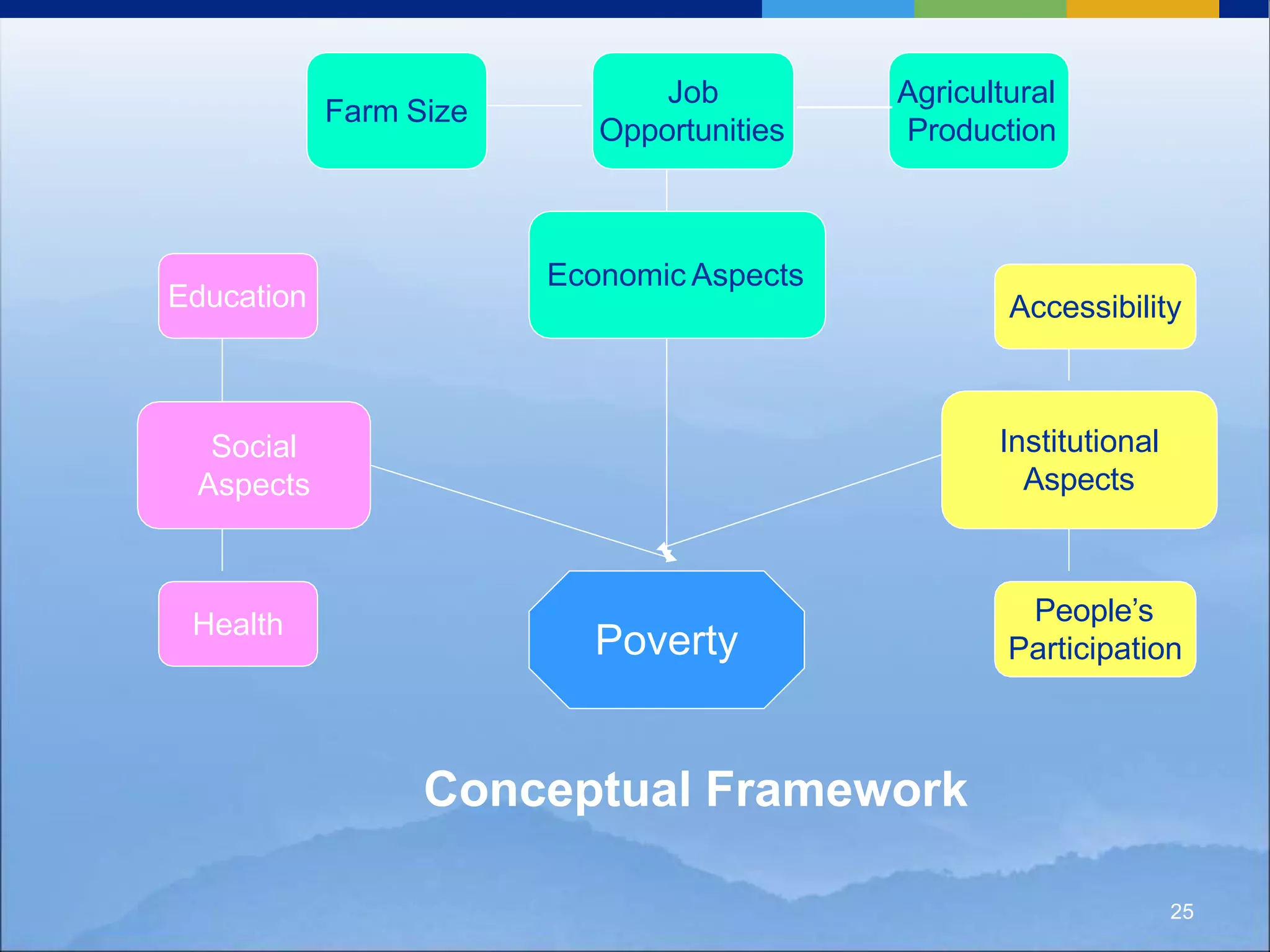
Poverty of rural people is caused by several
social, economic and institutional factors”.
“What is/are key factor (s) to be considered in
this research?
Concept of Poverty
23](https://image.slidesharecdn.com/lecture7-researchconceptualization-230212225826-9948735f/75/Lecture-7-Research-Conceptualization-pptx-23-2048.jpg)
![URP-803: Planning Research Methods, Spring Semester 2020, NUST [Dr. Irfan Ahmad Rana]
In this research:
Social Factors: Education Level, Health Condition
Economic Factors: Farm Size, Job Opportunities and
Agricultural Production
Institutional Factors: Accessibility and Isolation from
Local Groups,
Concept of Poverty
24](https://image.slidesharecdn.com/lecture7-researchconceptualization-230212225826-9948735f/75/Lecture-7-Research-Conceptualization-pptx-24-2048.jpg)

![URP-803: Planning Research Methods, Spring Semester 2020, NUST [Dr. Irfan Ahmad Rana]
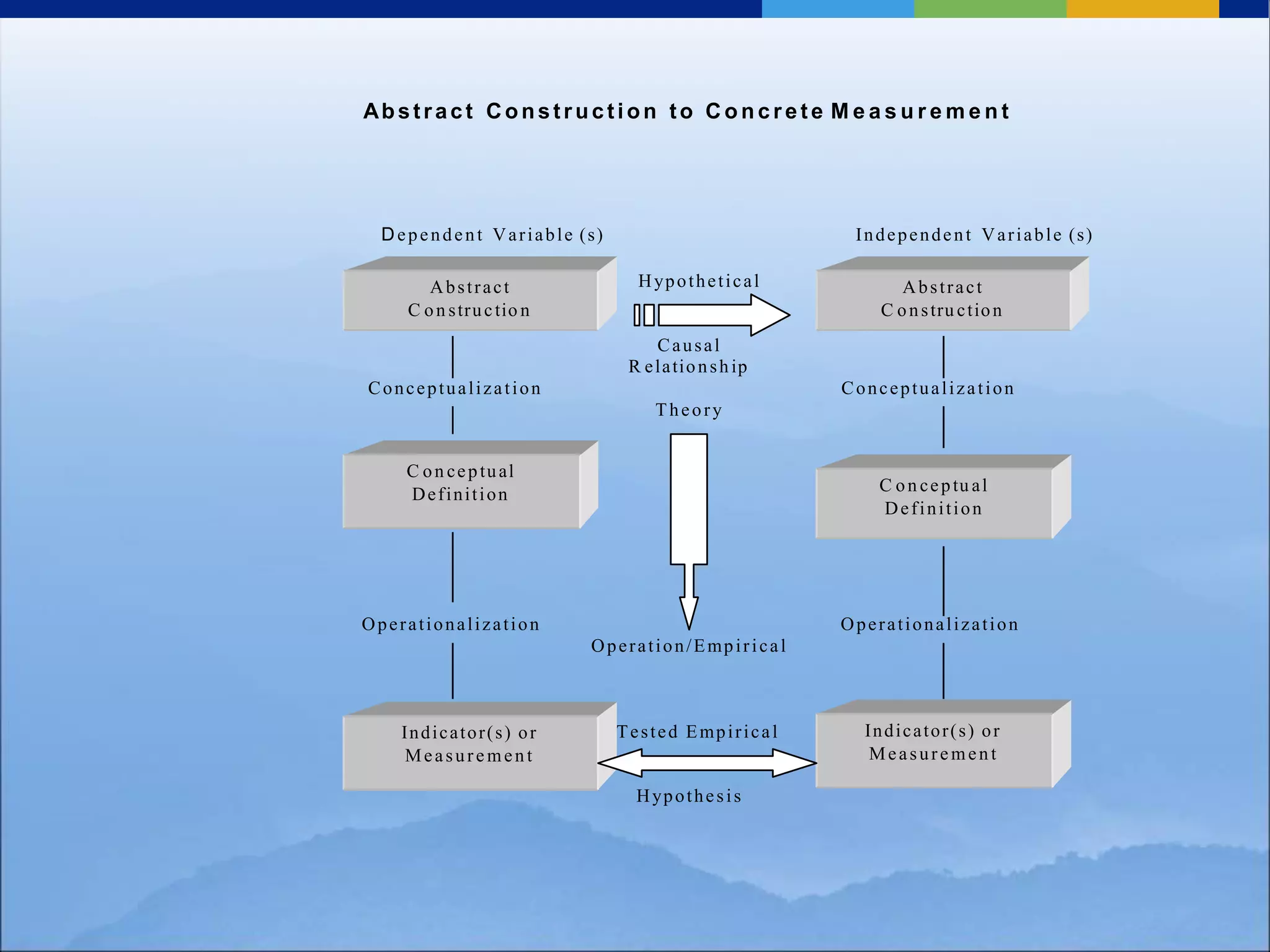
Operationalization is a process of developing an
operational definition of the theory/ concept or
hypothesis into variable(s) that can be measurable
in concrete terms.
It is a process to transform
“abstract” into “concrete” in research.
Operationalization: Definition
27](https://image.slidesharecdn.com/lecture7-researchconceptualization-230212225826-9948735f/75/Lecture-7-Research-Conceptualization-pptx-27-2048.jpg)
![URP-803: Planning Research Methods, Spring Semester 2020, NUST [Dr. Irfan Ahmad Rana]
There are two levels to be considered in the
operationalization:
1. Conceptual Level: the causal relationship in the
theory and/or concept (conceptual relationship);
Operationalization: Levels
29
Conceptual Relationship
(CR)
Hypothesis Formulation
(HF)](https://image.slidesharecdn.com/lecture7-researchconceptualization-230212225826-9948735f/75/Lecture-7-Research-Conceptualization-pptx-29-2048.jpg)
![URP-803: Planning Research Methods, Spring Semester 2020, NUST [Dr. Irfan Ahmad Rana]
2. Operational level: the degree of
association between them through empirical
investigation (testing)
Operational Level (OL): the measurement of
indicators/variables to identify the (actual) empirical
relationship (ER)
Operationalization: Levels
30
Conceptual Relationship
(CR)
Empirical Relationship
(ER)
(Testing)](https://image.slidesharecdn.com/lecture7-researchconceptualization-230212225826-9948735f/75/Lecture-7-Research-Conceptualization-pptx-30-2048.jpg)
![URP-803: Planning Research Methods, Spring Semester 2020, NUST [Dr. Irfan Ahmad Rana]
Conceptual and Empirical
Relationship
Dependent
Variable
Independent
Variables
a b1
Empirical
Association (?)
b2 b3](https://image.slidesharecdn.com/lecture7-researchconceptualization-230212225826-9948735f/75/Lecture-7-Research-Conceptualization-pptx-31-2048.jpg)
![URP-803: Planning Research Methods, Spring Semester 2020, NUST [Dr. Irfan Ahmad Rana]
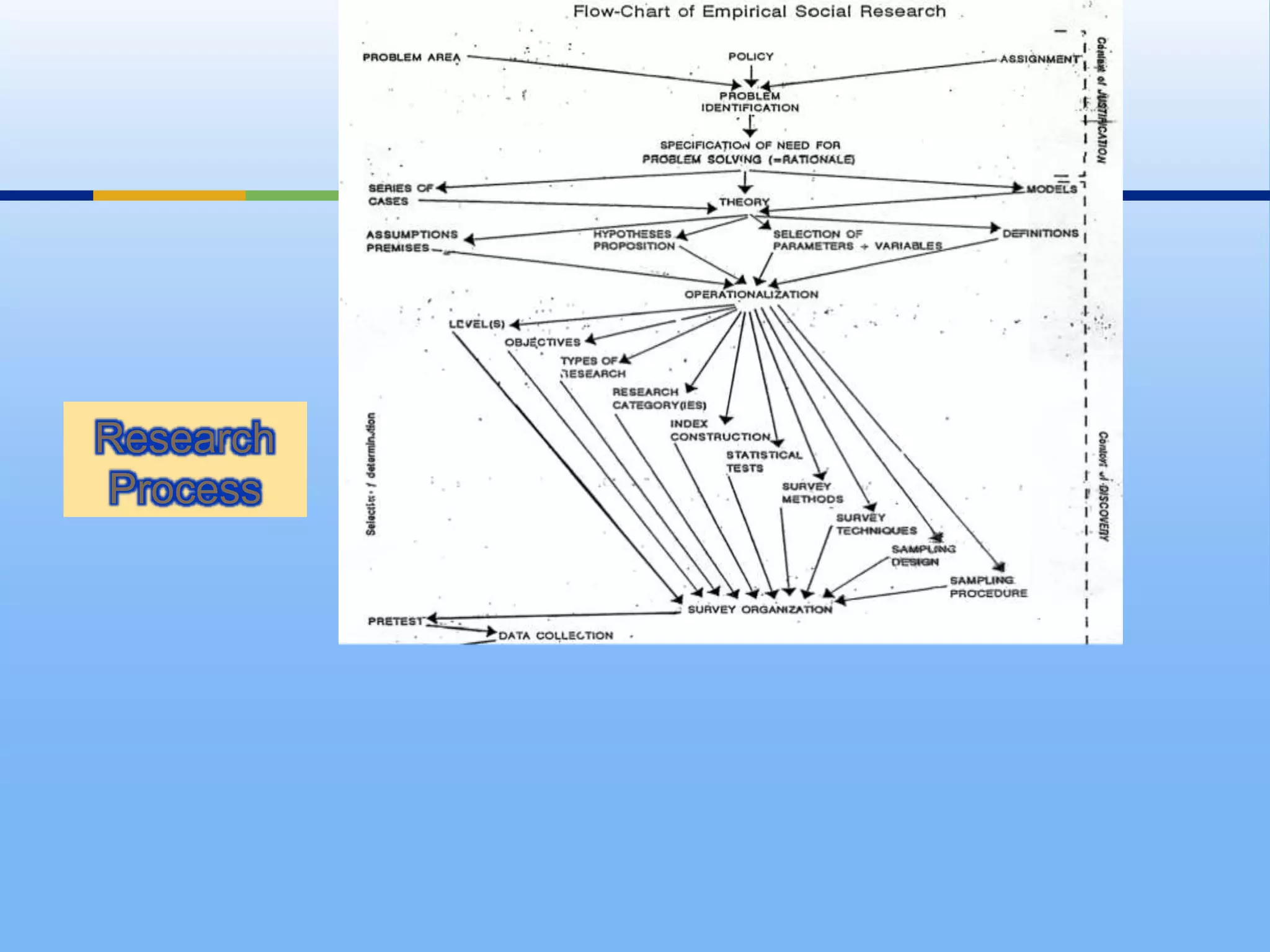
From conceptualization the researcher creates a
nominal definition to identify the focus of the study.
An operational definition is created to defined the
procedures or steps used in measuring a concept.
From Conceptualization to
Operationalization](https://image.slidesharecdn.com/lecture7-researchconceptualization-230212225826-9948735f/75/Lecture-7-Research-Conceptualization-pptx-34-2048.jpg)
![URP-803: Planning Research Methods, Spring Semester 2020, NUST [Dr. Irfan Ahmad Rana]
Operationalization or operational definition consists
of the development of a measuring instrument by
means of which it is possible to obtain accurate data
about specific phenomena.
Operationalization](https://image.slidesharecdn.com/lecture7-researchconceptualization-230212225826-9948735f/75/Lecture-7-Research-Conceptualization-pptx-35-2048.jpg)
![URP-803: Planning Research Methods, Spring Semester 2020, NUST [Dr. Irfan Ahmad Rana]
The Research Question
The foundation of the research process
It all begins with a question](https://image.slidesharecdn.com/lecture7-researchconceptualization-230212225826-9948735f/75/Lecture-7-Research-Conceptualization-pptx-37-2048.jpg)
![URP-803: Planning Research Methods, Spring Semester 2020, NUST [Dr. Irfan Ahmad Rana]
What is your area of interest?
Where could you look for help in deciding upon a
specific research problem?
What criteria will you apply when deciding upon a
specific research problem?
How could you narrow down your research problem?
How might your value-judgments (preconceived
ideas) affect your research endeavors?
Your research problem
38](https://image.slidesharecdn.com/lecture7-researchconceptualization-230212225826-9948735f/75/Lecture-7-Research-Conceptualization-pptx-38-2048.jpg)
![URP-803: Planning Research Methods, Spring Semester 2020, NUST [Dr. Irfan Ahmad Rana]
Practical critical development problems
Sources of problem people, community,
policy/program/project and social phenomena (i.e.,
changes of situations).
Realization of existing needs and the necessity of
change for the better (efficiency and effectiveness)
situation.
Feasibility for searching solutions to the problem
identified.
Problem Statement
39](https://image.slidesharecdn.com/lecture7-researchconceptualization-230212225826-9948735f/75/Lecture-7-Research-Conceptualization-pptx-39-2048.jpg)
![URP-803: Planning Research Methods, Spring Semester 2020, NUST [Dr. Irfan Ahmad Rana]
Problem Statements
“The problem of this study was to …”
“This study was concerned with …”
“This study is designed to …”
“The purpose of this investigation is to …”](https://image.slidesharecdn.com/lecture7-researchconceptualization-230212225826-9948735f/75/Lecture-7-Research-Conceptualization-pptx-40-2048.jpg)
![URP-803: Planning Research Methods, Spring Semester 2020, NUST [Dr. Irfan Ahmad Rana]
Educational Research 2e:
Creswell
A research problem is an educational
issue or concern that an investigator
presents and justifies in a research
study.](https://image.slidesharecdn.com/lecture7-researchconceptualization-230212225826-9948735f/75/Lecture-7-Research-Conceptualization-pptx-41-2048.jpg)
![URP-803: Planning Research Methods, Spring Semester 2020, NUST [Dr. Irfan Ahmad Rana]
This study was designed to determine the
relationship between stability performance and
physical growth characteristics of preschool children.
The present study was designed to identify those
characteristics which differentiate between students
who binge Netflix and those that do not.
Sample Problem Statements](https://image.slidesharecdn.com/lecture7-researchconceptualization-230212225826-9948735f/75/Lecture-7-Research-Conceptualization-pptx-42-2048.jpg)
![URP-803: Planning Research Methods, Spring Semester 2020, NUST [Dr. Irfan Ahmad Rana]
Why are research questions
important?
“Well-crafted questions guide the systematic planning
of research. Formulating your questions precisely
enables you to design a study with a good chance of
answering them.”
-- Light, Singer, Willett, By Design (1990)](https://image.slidesharecdn.com/lecture7-researchconceptualization-230212225826-9948735f/75/Lecture-7-Research-Conceptualization-pptx-43-2048.jpg)
![URP-803: Planning Research Methods, Spring Semester 2020, NUST [Dr. Irfan Ahmad Rana]
Why did the chicken cross the road?
(The question does not address which
chicken or which road.)
Preparing questions
44](https://image.slidesharecdn.com/lecture7-researchconceptualization-230212225826-9948735f/75/Lecture-7-Research-Conceptualization-pptx-44-2048.jpg)
![URP-803: Planning Research Methods, Spring Semester 2020, NUST [Dr. Irfan Ahmad Rana]
How many chickens crossed Kashmir Highway,
G-11 Crossing, on February 17th , 2020?.
This question could be answered in one
sentence and does not leave room for analysis
Preparing questions
45](https://image.slidesharecdn.com/lecture7-researchconceptualization-230212225826-9948735f/75/Lecture-7-Research-Conceptualization-pptx-45-2048.jpg)
![URP-803: Planning Research Methods, Spring Semester 2020, NUST [Dr. Irfan Ahmad Rana]
What are some of the environmental factors that
occurred, G-11 Crossing between January and
February 2020 that would cause chickens to cross in
Kashmir Highway?
Preparing questions
46](https://image.slidesharecdn.com/lecture7-researchconceptualization-230212225826-9948735f/75/Lecture-7-Research-Conceptualization-pptx-46-2048.jpg)
![URP-803: Planning Research Methods, Spring Semester 2020, NUST [Dr. Irfan Ahmad Rana]
Establishes importance of topic
Creates reader interest
Focuses reader’s attention on how study will add to
literature
Why is the Research Problem
Important?
Educational Research 2e:
Creswell](https://image.slidesharecdn.com/lecture7-researchconceptualization-230212225826-9948735f/75/Lecture-7-Research-Conceptualization-pptx-47-2048.jpg)
![URP-803: Planning Research Methods, Spring Semester 2020, NUST [Dr. Irfan Ahmad Rana]
1. Define or measure a specific fact or gather
facts about a specific phenomenon.
2. Match facts and theory
3. Evaluate and compare two theories, models,
or hypotheses.
4. Prove that a certain method is more effective
than other methods.
Checklist of Potential Research
Questions
48](https://image.slidesharecdn.com/lecture7-researchconceptualization-230212225826-9948735f/75/Lecture-7-Research-Conceptualization-pptx-48-2048.jpg)
![URP-803: Planning Research Methods, Spring Semester 2020, NUST [Dr. Irfan Ahmad Rana]
Cause Question: Why did this action/event
happen?
Effect of Relationship Question: What effect*
did this action/event have on that
action/event?
Comparison Question: How are two
things/events similar or different?
Types of Research Questions
49
Adapted from Concepts: Types of Research Questions. Thinkertools, University of California at Berkeley, 2002](https://image.slidesharecdn.com/lecture7-researchconceptualization-230212225826-9948735f/75/Lecture-7-Research-Conceptualization-pptx-49-2048.jpg)
![URP-803: Planning Research Methods, Spring Semester 2020, NUST [Dr. Irfan Ahmad Rana]
Determine All Factors Question: What are all the
factors that affect something?
Characterize Processes Question: How does
something happen? What processes make
something happen?
Determine Successful/Effective Strategies Question:
What are the best strategies for accomplishing
something?
Types of Research Questions
50
Adapted from Concepts: Types of Research Questions. Thinkertools, University of California at Berkeley, 2002](https://image.slidesharecdn.com/lecture7-researchconceptualization-230212225826-9948735f/75/Lecture-7-Research-Conceptualization-pptx-50-2048.jpg)
![URP-803: Planning Research Methods, Spring Semester 2020, NUST [Dr. Irfan Ahmad Rana]
Function or Purpose Question: What is the
function or purpose of something?
Ways to Achieve Purpose Question: How can
something be done or achieved?
Identify Types Question: What are all the
different types of something?
Types of Research Questions
51](https://image.slidesharecdn.com/lecture7-researchconceptualization-230212225826-9948735f/75/Lecture-7-Research-Conceptualization-pptx-51-2048.jpg)
![URP-803: Planning Research Methods, Spring Semester 2020, NUST [Dr. Irfan Ahmad Rana]
Properties/Characteristics Question: What
are the characteristics of something?
Stages Question: What are the stages that
something goes through?
Structural Question: How are the parts of
something interrelated?
Types of Research Questions
52](https://image.slidesharecdn.com/lecture7-researchconceptualization-230212225826-9948735f/75/Lecture-7-Research-Conceptualization-pptx-52-2048.jpg)
![URP-803: Planning Research Methods, Spring Semester 2020, NUST [Dr. Irfan Ahmad Rana]
Descriptive:
To what extent the Pakistani people vote for Party A and/or
Party B candidates in the next national election?
Relational:
What is a relation between education (male and female voters)
and voting preference between Party A and/or Party B in the
next national election?
Causal:
How the political advertising campaigns increase number of
votes of both candidates from Party A and/or Party B? Why?
Research Questions
53](https://image.slidesharecdn.com/lecture7-researchconceptualization-230212225826-9948735f/75/Lecture-7-Research-Conceptualization-pptx-53-2048.jpg)
![URP-803: Planning Research Methods, Spring Semester 2020, NUST [Dr. Irfan Ahmad Rana]
Research question vs. Hypothesis
A research question is similar to a hypothesis, except
that a hypothesis presents an expectation about the
way two or more variables are related, but a research
question does not](https://image.slidesharecdn.com/lecture7-researchconceptualization-230212225826-9948735f/75/Lecture-7-Research-Conceptualization-pptx-54-2048.jpg)
![URP-803: Planning Research Methods, Spring Semester 2020, NUST [Dr. Irfan Ahmad Rana]
Develop research questions/objectives for your topic
Show your classmates
Refine research questions
Submit
Exercise
55](https://image.slidesharecdn.com/lecture7-researchconceptualization-230212225826-9948735f/75/Lecture-7-Research-Conceptualization-pptx-55-2048.jpg)
![URP-803: Planning Research Methods, Spring Semester 2020, NUST [Dr. Irfan Ahmad Rana]
Topic: People’s Participation in a Development
Project.
Research Questions:
1. How people’s participation is organized in a
development project?
2. How is people’s participation effective in a project?
Why?
Research Questions and Objectives
56](https://image.slidesharecdn.com/lecture7-researchconceptualization-230212225826-9948735f/75/Lecture-7-Research-Conceptualization-pptx-56-2048.jpg)

![URP-803: Planning Research Methods, Spring Semester 2020, NUST [Dr. Irfan Ahmad Rana]
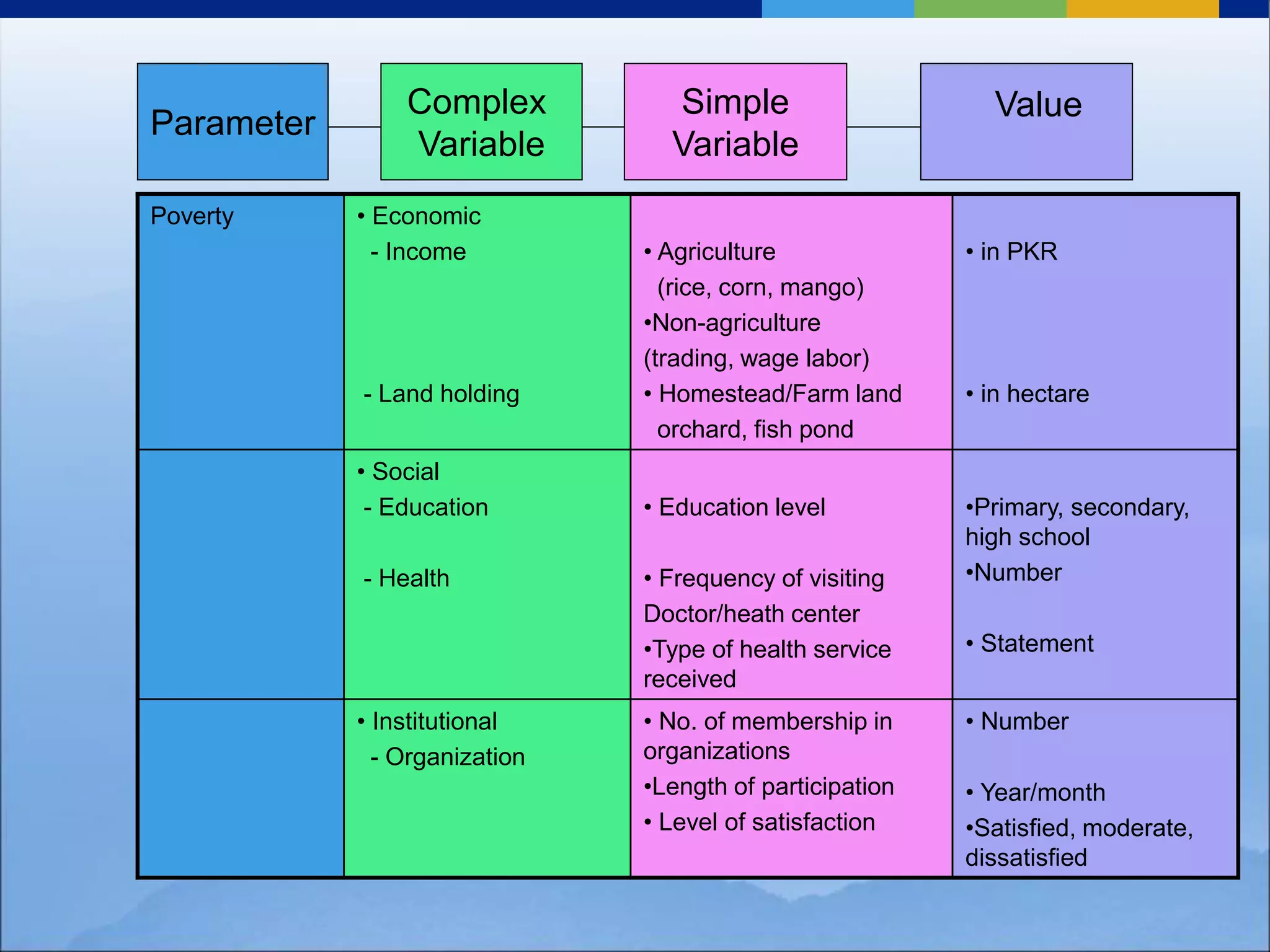
“A coordination schema is a plan to
facilitate the establishing of linkages
between each topic under research and
its lowest-order measurement”.
(Weber and Tiwari, 1992)
Definition
58](https://image.slidesharecdn.com/lecture7-researchconceptualization-230212225826-9948735f/75/Lecture-7-Research-Conceptualization-pptx-58-2048.jpg)
![URP-803: Planning Research Methods, Spring Semester 2020, NUST [Dr. Irfan Ahmad Rana]
Parameters
Complex Variables
Simple Variables
Values
Components of Coordination Schema
59](https://image.slidesharecdn.com/lecture7-researchconceptualization-230212225826-9948735f/75/Lecture-7-Research-Conceptualization-pptx-59-2048.jpg)
![URP-803: Planning Research Methods, Spring Semester 2020, NUST [Dr. Irfan Ahmad Rana]
A complex variable represents a group of closely
interrelated variables. Its relevance lies in the
organization and systematization of a research
design.
A simple variable is the real unit which a researcher
uses for diagnosis, analysis, prognosis and
interpretation.
Complex and Simple Variables
60](https://image.slidesharecdn.com/lecture7-researchconceptualization-230212225826-9948735f/75/Lecture-7-Research-Conceptualization-pptx-60-2048.jpg)
![URP-803: Planning Research Methods, Spring Semester 2020, NUST [Dr. Irfan Ahmad Rana]
Concept of Variables
A variable is a characteristic, trait, or attribute of a
person or thing that can be classified or measured
Attitude
Gender
Heart rate
Hair color
Variable - the condition or characteristic which in a
given study may have more than one value](https://image.slidesharecdn.com/lecture7-researchconceptualization-230212225826-9948735f/75/Lecture-7-Research-Conceptualization-pptx-61-2048.jpg)
![URP-803: Planning Research Methods, Spring Semester 2020, NUST [Dr. Irfan Ahmad Rana]
Classification of Variables
Quantitative – measured numerically
Discrete
Continuous
Qualitative – categorical in nature](https://image.slidesharecdn.com/lecture7-researchconceptualization-230212225826-9948735f/75/Lecture-7-Research-Conceptualization-pptx-63-2048.jpg)
![URP-803: Planning Research Methods, Spring Semester 2020, NUST [Dr. Irfan Ahmad Rana]
Independent Variable
A variable that is presumed to influence another
variable; the variable under study or the one that the
researcher manipulates
Two types
Active – variable is actually manipulated
Attribute – cannot be manipulated because it is preexisting
trait; sometimes called a “categorical” variable (e.g., race,
gender)](https://image.slidesharecdn.com/lecture7-researchconceptualization-230212225826-9948735f/75/Lecture-7-Research-Conceptualization-pptx-64-2048.jpg)
![URP-803: Planning Research Methods, Spring Semester 2020, NUST [Dr. Irfan Ahmad Rana]
Dependent Variable
The variable that is expected to change as a result of
the manipulation of the independent variable; that
which is measured in a study](https://image.slidesharecdn.com/lecture7-researchconceptualization-230212225826-9948735f/75/Lecture-7-Research-Conceptualization-pptx-65-2048.jpg)
![URP-803: Planning Research Methods, Spring Semester 2020, NUST [Dr. Irfan Ahmad Rana]
determining the scope of research;
ensuring coherence and consistency;
eliminating redundancy and avoiding gaps;
providing perspective for specific research design
designing data collection tools (survey format, checklists
for observation and interviews);
drafting data processing and analysis guidelines; and
Specifying type of expected findings.
Usefulness of Coordination Schema in
Research
66](https://image.slidesharecdn.com/lecture7-researchconceptualization-230212225826-9948735f/75/Lecture-7-Research-Conceptualization-pptx-66-2048.jpg)


