Download the full version and explore a variety of ebooks
or textbooks at https://ebookultra.com
Qualitative Research Bridging the Conceptual
Theoretical and Methodological Sharon M. Ravitch

_____ Follow the link below to get your download now _____
https://ebookultra.com/download/qualitative-research-
bridging-the-conceptual-theoretical-and-methodological-
sharon-m-ravitch/
Access ebookultra.com now to download high-quality
ebooks or textbooks
We have selected some products that you may be interested in
Click the link to download now or visit ebookultra.com
for more options!.
The International Handbook of Social Impact Assessment
Conceptual and Methodological Advances Henk A. Becker
https://ebookultra.com/download/the-international-handbook-of-social-
impact-assessment-conceptual-and-methodological-advances-henk-a-
becker/
Archaeology and Language I Theoretical and Methodological
Orientations 1st Edition Roger Blench
https://ebookultra.com/download/archaeology-and-language-i-
theoretical-and-methodological-orientations-1st-edition-roger-blench/
The SAGE Encyclopedia of Qualitative Research Methods
Volumes 1 2 1st Edition Lisa M. Given
https://ebookultra.com/download/the-sage-encyclopedia-of-qualitative-
research-methods-volumes-1-2-1st-edition-lisa-m-given/
Learning by Expanding An Activity Theoretical Approach to
Developmental Research 2nd Edition Yrjö Engeström
https://ebookultra.com/download/learning-by-expanding-an-activity-
theoretical-approach-to-developmental-research-2nd-edition-yrjo-
engestrom/
Qualitative Research Methods 3rd Edition Pranee
Liamputtong
https://ebookultra.com/download/qualitative-research-methods-3rd-
edition-pranee-liamputtong/
Designing Qualitative Research 6th Edition Catherine
Marshall
https://ebookultra.com/download/designing-qualitative-research-6th-
edition-catherine-marshall/
Qualitative Research in Social Work Introducing
Qualitative Methods series 1st Edition Ian F Shaw
https://ebookultra.com/download/qualitative-research-in-social-work-
introducing-qualitative-methods-series-1st-edition-ian-f-shaw/
Understanding Qualitative Research and Ethnomethodology
1st Edition Paul Ten Have
https://ebookultra.com/download/understanding-qualitative-research-
and-ethnomethodology-1st-edition-paul-ten-have/
Understanding Qualitative Research and Ethnomethodology
1st Edition Paul Ten Have
https://ebookultra.com/download/understanding-qualitative-research-
and-ethnomethodology-1st-edition-paul-ten-have-2/
Qualitative Research Bridging the Conceptual Theoretical
and Methodological Sharon M. Ravitch Digital Instant

Download
Author(s): Sharon M. Ravitch; Nicole Mittenfelner Carl
ISBN(s): 9781483351742, 1483351742
Edition: Paperback
File Details: PDF, 18.42 MB
Year: 2015
Language: english
Qualitative Research
2
We dedicate this book to
Our Children:
Maxwell and Evelyn, who were born during the writing of this book.
Ari and Lev, who continued to grow, teach, and learn as we wrote.
We hope this book will contribute to your generation and beyond
through the good work of those who read this and use research as a tool
to help heal our world.
And to Our Students:
Whose questions, passions, concerns, and commitments have shaped this book beyond words. Thank you for your
engaging learning, your curiosity, and for being our teachers.
Curiosity as restless questioning, as movement toward the revelation of something hidden, as a question
verbalized or not, as search for clarity, as a moment of attention, suggestion, and vigilance, constitutes an
integral part of the phenomenon of being alive. There could be no creativity without the curiosity that moves us
and sets us patiently impatient before a world that we did not make, to add to it something of our own making.
—Paulo Freire, Pedagogy of Freedom
3
Qualitative Research
Bridging the Conceptual, Theoretical, and Methodological
SHARON M. RAVITCH
University of Pennsylvania
NICOLE MITTENFELNER CARL
University of Pennsylvania
4
FOR INFORMATION:
SAGE Publications, Inc.
2455 Teller Road
Thousand Oaks, California 91320
E-mail: order@sagepub.com
SAGE Publications Ltd.
1 Oliver’s Yard
55 City Road
London EC1Y 1SP
United Kingdom
SAGE Publications India Pvt. Ltd.
B 1/I 1 Mohan Cooperative Industrial Area
Mathura Road, New Delhi 110 044
India
SAGE Publications Asia-Pacific Pte. Ltd.
3 Church Street
#10-04 Samsung Hub
Singapore 049483
Copyright © 2016 by SAGE Publications, Inc.
All rights reserved. No part of this book may be reproduced or utilized in any form or by any means,
electronic or mechanical, including photocopying, recording, or by any information storage and retrieval
system, without permission in writing from the publisher.
Printed in the United States of America
ISBN 978-1-4833-5174-2
This book is printed on acid-free paper.
Acquisitions Editor: Vicki Knight
Editorial Assistant: Yvonne McDuffee
eLearning Editor: Katie Bierach
Production Editor: Libby Larson
Copy Editor: Gillian Dickens
Typesetter: C&M Digitals (P) Ltd.
Proofreader: Dennis W. Webb
Indexer: Wendy Allex
Cover Designer: Leonardo March
Marketing Manager: Nicole Elliott
5
6
Detailed Contents
7
Detailed Contents
Foreword
Preface
Acknowledgments
About The Authors
1 Qualitative Research: An Opening Orientation
Chapter Overview and Goals
An Overview of the Processes of Qualitative Research
Figure 1.1: The Dynamic Elements of Qualitative Research
Situating Qualitative Research
Defining Qualitative Research
Key Components of Qualitative Research
Table 1.1: Components of Qualitative Research
The Role of the Researcher in Qualitative Research
Horizontals in Qualitative Research: Criticality, Reflexivity, Collaboration, and Rigor
Criticality
Reflexivity
Collaboration
Rigor
Approaches to Qualitative Research: An Overview
Table 1.2: Approaches to Qualitative Research
A Note on the Possibilities of Qualitative Research
Questions for Reflection
Resources for Further Reading
2 Using Conceptual Frameworks in Research
Chapter Overview and Goals
Defining and Understanding Conceptual Frameworks and Their Role in Research
What Is a Conceptual Framework?
The Components of a Conceptual Network
What Does a Conceptual Framework Help You Do?
Figure 2.1: The Components of a Conceptual Framework
The Roles and Uses of a Conceptual Framework
Constructing and Developing a Conceptual Framework
The Role of the Researcher in Conceptual Frameworks
The Role of Tacit Theories in a Conceptual Framework
How Study Goals Influence and Inform a Conceptual Framework
Conceptual Frameworks and the Role of Setting and Context
Table 2.1: Questions for Considering the Goals of Your Study
8
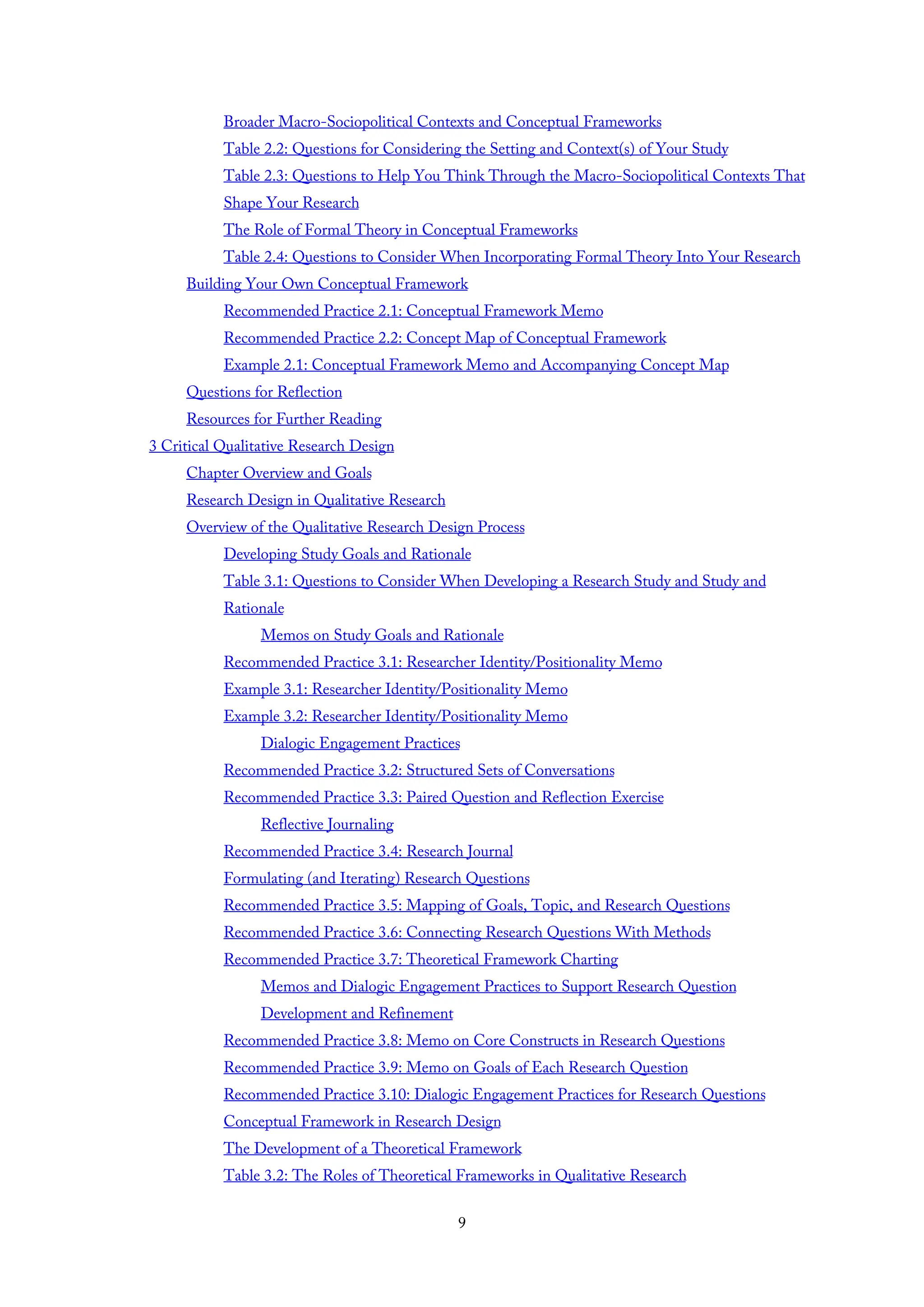
Broader Macro-Sociopolitical Contexts and Conceptual Frameworks
Table 2.2: Questions for Considering the Setting and Context(s) of Your Study
Table 2.3: Questions to Help You Think Through the Macro-Sociopolitical Contexts That
Shape Your Research
The Role of Formal Theory in Conceptual Frameworks
Table 2.4: Questions to Consider When Incorporating Formal Theory Into Your Research
Building Your Own Conceptual Framework
Recommended Practice 2.1: Conceptual Framework Memo
Recommended Practice 2.2: Concept Map of Conceptual Framework
Example 2.1: Conceptual Framework Memo and Accompanying Concept Map
Questions for Reflection
Resources for Further Reading
3 Critical Qualitative Research Design
Chapter Overview and Goals
Research Design in Qualitative Research
Overview of the Qualitative Research Design Process
Developing Study Goals and Rationale
Table 3.1: Questions to Consider When Developing a Research Study and Study and
Rationale
Memos on Study Goals and Rationale
Recommended Practice 3.1: Researcher Identity/Positionality Memo
Example 3.1: Researcher Identity/Positionality Memo
Example 3.2: Researcher Identity/Positionality Memo
Dialogic Engagement Practices
Recommended Practice 3.2: Structured Sets of Conversations
Recommended Practice 3.3: Paired Question and Reflection Exercise
Reflective Journaling
Recommended Practice 3.4: Research Journal
Formulating (and Iterating) Research Questions
Recommended Practice 3.5: Mapping of Goals, Topic, and Research Questions
Recommended Practice 3.6: Connecting Research Questions With Methods
Recommended Practice 3.7: Theoretical Framework Charting
Memos and Dialogic Engagement Practices to Support Research Question
Development and Refinement
Recommended Practice 3.8: Memo on Core Constructs in Research Questions
Recommended Practice 3.9: Memo on Goals of Each Research Question
Recommended Practice 3.10: Dialogic Engagement Practices for Research Questions
Conceptual Framework in Research Design
The Development of a Theoretical Framework
Table 3.2: The Roles of Theoretical Frameworks in Qualitative Research
9
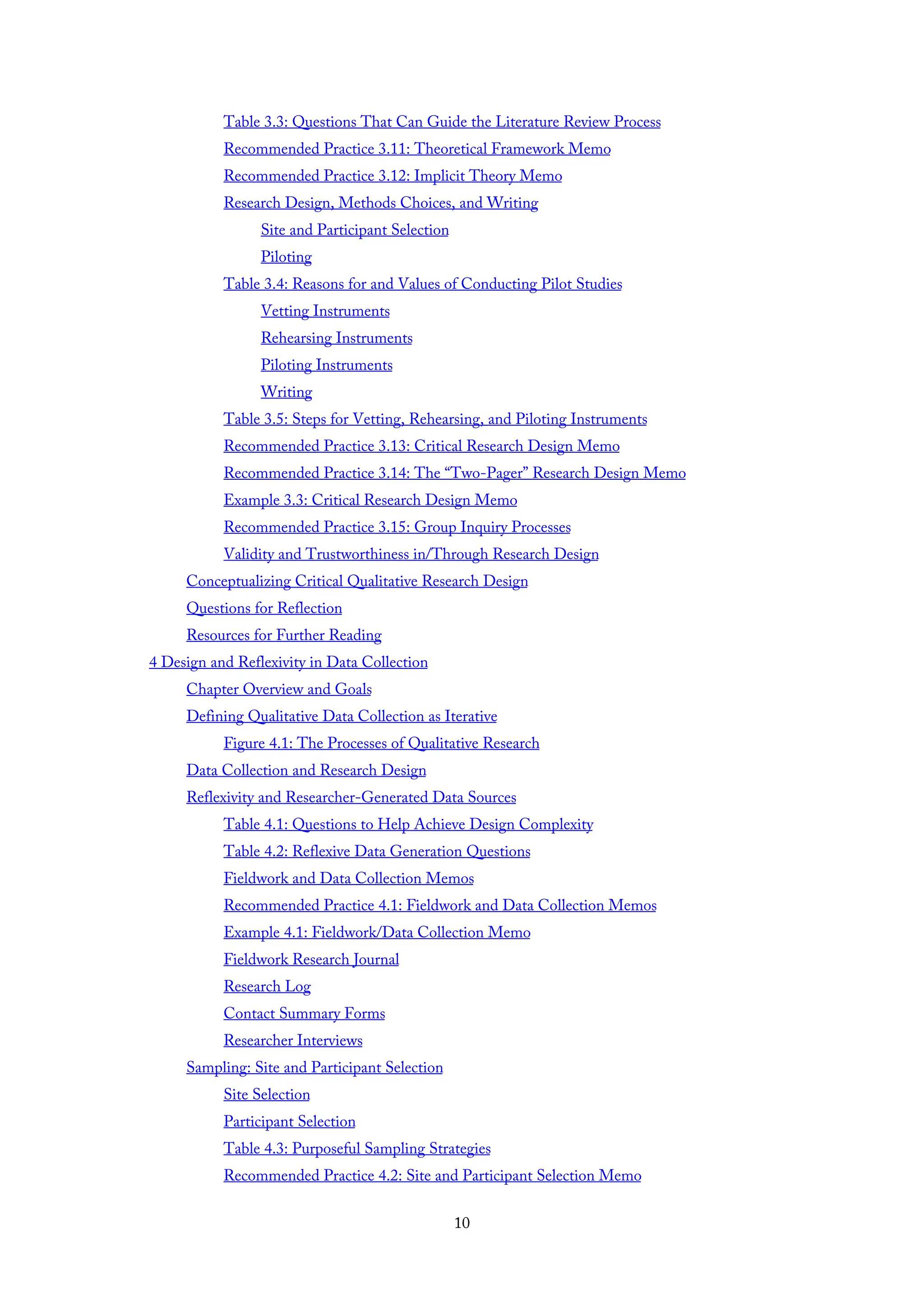
Table 3.3: Questions That Can Guide the Literature Review Process
Recommended Practice 3.11: Theoretical Framework Memo
Recommended Practice 3.12: Implicit Theory Memo
Research Design, Methods Choices, and Writing
Site and Participant Selection
Piloting
Table 3.4: Reasons for and Values of Conducting Pilot Studies
Vetting Instruments
Rehearsing Instruments
Piloting Instruments
Writing
Table 3.5: Steps for Vetting, Rehearsing, and Piloting Instruments
Recommended Practice 3.13: Critical Research Design Memo
Recommended Practice 3.14: The “Two-Pager” Research Design Memo
Example 3.3: Critical Research Design Memo
Recommended Practice 3.15: Group Inquiry Processes
Validity and Trustworthiness in/Through Research Design
Conceptualizing Critical Qualitative Research Design
Questions for Reflection
Resources for Further Reading
4 Design and Reflexivity in Data Collection
Chapter Overview and Goals
Defining Qualitative Data Collection as Iterative
Figure 4.1: The Processes of Qualitative Research
Data Collection and Research Design
Reflexivity and Researcher-Generated Data Sources
Table 4.1: Questions to Help Achieve Design Complexity
Table 4.2: Reflexive Data Generation Questions
Fieldwork and Data Collection Memos
Recommended Practice 4.1: Fieldwork and Data Collection Memos
Example 4.1: Fieldwork/Data Collection Memo
Fieldwork Research Journal
Research Log
Contact Summary Forms
Researcher Interviews
Sampling: Site and Participant Selection
Site Selection
Participant Selection
Table 4.3: Purposeful Sampling Strategies
Recommended Practice 4.2: Site and Participant Selection Memo
10
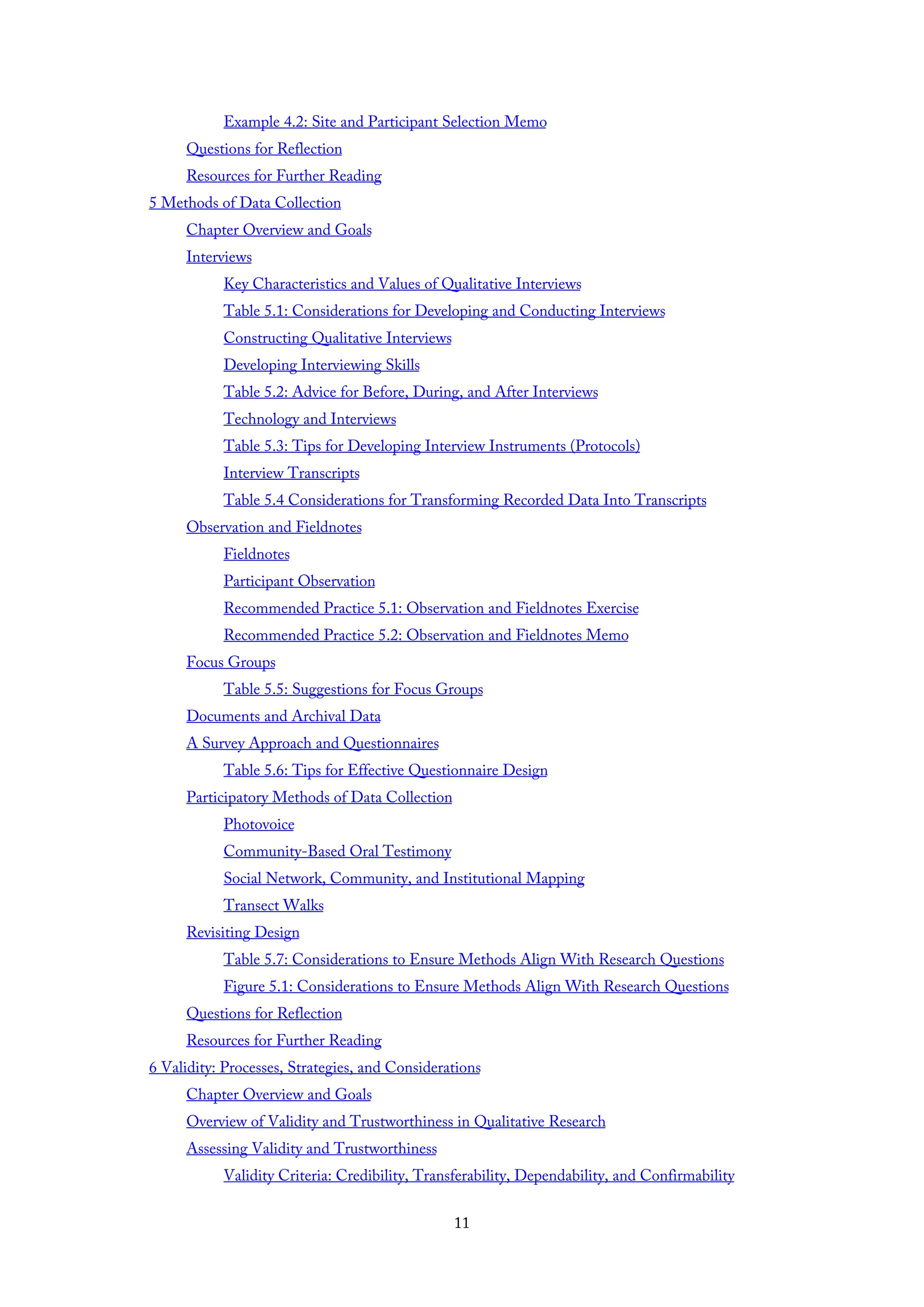
Example 4.2: Site and Participant Selection Memo
Questions for Reflection
Resources for Further Reading
5 Methods of Data Collection
Chapter Overview and Goals
Interviews
Key Characteristics and Values of Qualitative Interviews
Table 5.1: Considerations for Developing and Conducting Interviews
Constructing Qualitative Interviews
Developing Interviewing Skills
Table 5.2: Advice for Before, During, and After Interviews
Technology and Interviews
Table 5.3: Tips for Developing Interview Instruments (Protocols)
Interview Transcripts
Table 5.4 Considerations for Transforming Recorded Data Into Transcripts
Observation and Fieldnotes
Fieldnotes
Participant Observation
Recommended Practice 5.1: Observation and Fieldnotes Exercise
Recommended Practice 5.2: Observation and Fieldnotes Memo
Focus Groups
Table 5.5: Suggestions for Focus Groups
Documents and Archival Data
A Survey Approach and Questionnaires
Table 5.6: Tips for Effective Questionnaire Design
Participatory Methods of Data Collection
Photovoice
Community-Based Oral Testimony
Social Network, Community, and Institutional Mapping
Transect Walks
Revisiting Design
Table 5.7: Considerations to Ensure Methods Align With Research Questions
Figure 5.1: Considerations to Ensure Methods Align With Research Questions
Questions for Reflection
Resources for Further Reading
6 Validity: Processes, Strategies, and Considerations
Chapter Overview and Goals
Overview of Validity and Trustworthiness in Qualitative Research
Assessing Validity and Trustworthiness
Validity Criteria: Credibility, Transferability, Dependability, and Confirmability
11
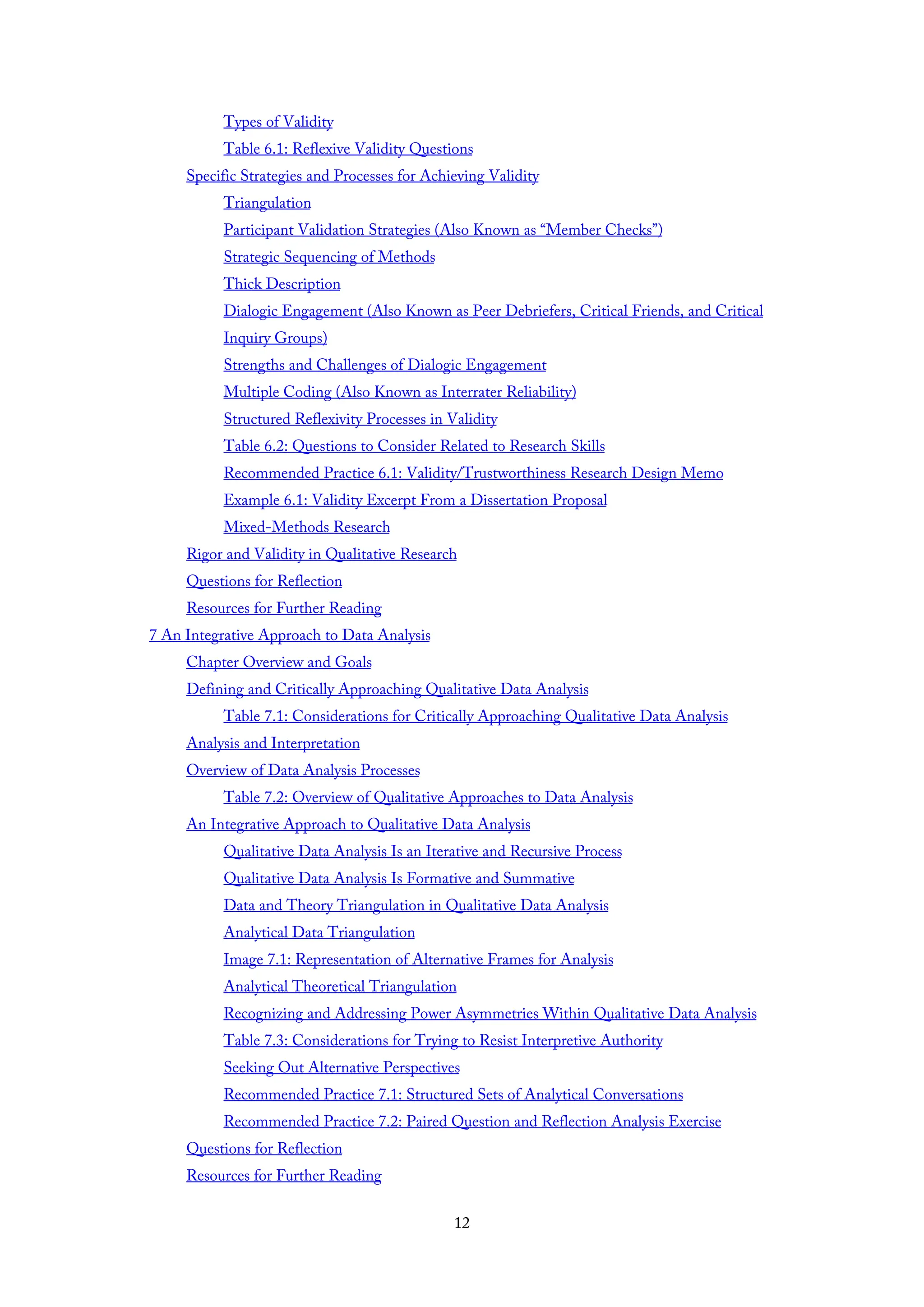
Types of Validity
Table 6.1: Reflexive Validity Questions
Specific Strategies and Processes for Achieving Validity
Triangulation
Participant Validation Strategies (Also Known as “Member Checks”)
Strategic Sequencing of Methods
Thick Description
Dialogic Engagement (Also Known as Peer Debriefers, Critical Friends, and Critical
Inquiry Groups)
Strengths and Challenges of Dialogic Engagement
Multiple Coding (Also Known as Interrater Reliability)
Structured Reflexivity Processes in Validity
Table 6.2: Questions to Consider Related to Research Skills
Recommended Practice 6.1: Validity/Trustworthiness Research Design Memo
Example 6.1: Validity Excerpt From a Dissertation Proposal
Mixed-Methods Research
Rigor and Validity in Qualitative Research
Questions for Reflection
Resources for Further Reading
7 An Integrative Approach to Data Analysis
Chapter Overview and Goals
Defining and Critically Approaching Qualitative Data Analysis
Table 7.1: Considerations for Critically Approaching Qualitative Data Analysis
Analysis and Interpretation
Overview of Data Analysis Processes
Table 7.2: Overview of Qualitative Approaches to Data Analysis
An Integrative Approach to Qualitative Data Analysis
Qualitative Data Analysis Is an Iterative and Recursive Process
Qualitative Data Analysis Is Formative and Summative
Data and Theory Triangulation in Qualitative Data Analysis
Analytical Data Triangulation
Image 7.1: Representation of Alternative Frames for Analysis
Analytical Theoretical Triangulation
Recognizing and Addressing Power Asymmetries Within Qualitative Data Analysis
Table 7.3: Considerations for Trying to Resist Interpretive Authority
Seeking Out Alternative Perspectives
Recommended Practice 7.1: Structured Sets of Analytical Conversations
Recommended Practice 7.2: Paired Question and Reflection Analysis Exercise
Questions for Reflection
Resources for Further Reading
12
8 Methods and Processes of Data Analysis
Chapter Overview and Goals
Data Organization and Management
Data Management Plan
Figure 8.1: Three-Pronged Data Analysis Process
Table 8.1: Tips for Organizing and Managing Your Data
Transcripts
Precoding
Table 8.2: Practical Considerations Regarding Transcription
Recommended Practice 8.1: Precoding Memo
Immersive Engagement
Multiple Data Readings
Recommended Practice 8.2: Formative Data Analysis Memo
Data Analysis Strategies: Coding, Connecting, and Dialogic Engagement
Coding
Approaches to Coding
Coding Processes
Table 8.3: Concepts to Look for When Coding Data
Other Coding Considerations
Recommended Practice 8.3: Coding Memos
Example 8.1: Coding Memo
Example 8.2: Example Code Descriptions and Definitions
Feature Box 8.1 Computer-Assisted Qualitative Data Analysis Software (CAQDAS)
Connecting Strategies
Dialogic Engagement
Generating, Scrutinizing, and Vetting Themes
Recommended Practice 8.4: Peer Data Analysis Review Session
Table 8.4: A Sample Process for Developing Themes
Analysis and Validity
Table 8.5: Validity Strategies and Data Analysis
Data Saturation
Writing and Representation
Memos
Recommended Practice 8.5: Vignette Memo
Other Writing Considerations
Questions for Reflection
Resources for Further Reading
9 Writing and Representing Inquiry: The Research Report
Chapter Overview and Goals
The Craft of Writing: Outlining, Drafting, and Revising
13
Recommended Practice 9.1: Mini Presentations
Writing a Final Report: Building On, Deepening, and Codifying Analysis
Goals, Audience(s), and Purposes
Articulating Your Study’s Purpose
Table 9.1: Questions to Consider Related to the Purpose(s) and Audience(s) of Your Study
Recommended Practice 9.2: Speed Research Exchange
Format and Structure of a Final Research Report
Sample Qualitative Report Structure
Example 9.1: Sample Final Report Template
Table 9.2: Questions to Consider for Determining How to Structure a Final Research
Report
Incorporating and Representing Data
Using Quotations
Other Considerations for Representing Data
Table 9.3: Questions for Considering How to Include and Represent Data
Finding a Balance Between Description and Analysis
Voice, Language, and Participant Portrayal
Table 9.4: Questions to Consider Related to Participant Voice and Language Choices
Critical Writing Considerations
Concluding Thoughts: The Ethics of Research Writing
Table 9.5: Considerations for Writing and Representing Qualitative Data
Questions for Reflection
Resources for Further Reading
10 Crafting Qualitative Research Proposals
Chapter Overview and Goals
Qualitative Research Proposals
Components of Research Proposals
The Introduction
Table 10.1: Qualitative Research Proposal Template
The Conceptual Framework
Methodology and Research Design
Table 10.2: Data Analysis Proposal Considerations
Table 10.3: Matrix for Detailing How Methods Align With Research Questions
Aligning Methods With Research Questions
Ongoing Considerations
Recommended Practice 10.1: Proposal Move-Forward Discussion
Writing Quality Proposals
Table 10.4: Characteristics of Strong Research Proposals
Example 10.1: Dissertation Proposal
Adapting Research Proposals
14
Questions for Reflection
Resources for Further Reading
11 Research Ethics and the Relational Quality of Research
Chapter Overview and Goals
Relational Ethics: Taking a Relational Approach to Research
Deepening the Concept of Research Ethics: Beyond IRB and Informed Consent
Institutional Review Boards, Ethics Committees, and Codes of Ethics
Going Beyond “Negotiating Entrée” and “Building Rapport”
Table 11.1: Considerations for Establishing and Maintaining Healthy Research
Relationships
Research Boundaries
Example 11.1: On the Need for Proactive Thought on Boundaries With Participants
Example 11.2: On the Need to Set and Manage Expectations With Site and Participants
Table 11.2: Considerations Related to Establishing and Maintaining Relationships With
Participants
Reciprocity: Not as Simple as It May Seem
Informed Consent, With an Emphasis on Informed
Table 11.3: Consent Form Overview and Contents
Assent
Transparency in Goals, Expectations, Processes, and Roles
Confidentiality and Anonymity
Table 11.4: Transparency-Related Questions to Consider
Data Management and Security in the Information Age
Example 11.3: Lost Phone Creates Breach in Confidentiality
Table 11.5: Considerations Related to Data Management and Security
The Ethical Dimensions of the “Researcher as Instrument”
Pushing Against the “Expert-Learner Binary”
Ethical Collaboration: “Reciprocal Transformation and Dialectics of Mutual Influence”
Table 11.6: Considerations for Collaborating With Colleagues, Peers, Thought Partners,
Advisers, and Teachers
Table 11.7: Considerations for Collaborating With Research Participants
Recommended Practice 11.1: Ethical Collaboration Memo
Balance Between Design Flexibility and Rigor: Responsive Research as Ethical Stance
Questions for Reflection
Resources for Further Reading
Epilogue: Revisiting Criticality, Reflexivity, Collaboration, and Rigor
Revisiting the Horizontals in Qualitative Research
Criticality
Feature Box 12.1: Criticality in Qualitative Research
Reflexivity
15
Exploring the Variety of Random
Documents with Different Content
being on one side bounded by Lincoln Minster (which is, in a clear
atmosphere, distinctly visible) and the hills beyond, although thirty
miles off “as the crow flies.” Its immediate neighbourhood, the lovely
and fertile “vale of Belvoir,” the theme of poet and prose-writer, and
the delight of the painter and lover of nature, lies immediately
below, while beyond are miles of lovely country, gloriously diversified
with wood and water, and studded at intervals with hamlets, villages,
and homesteads, which add greatly to the beauty of the scene.
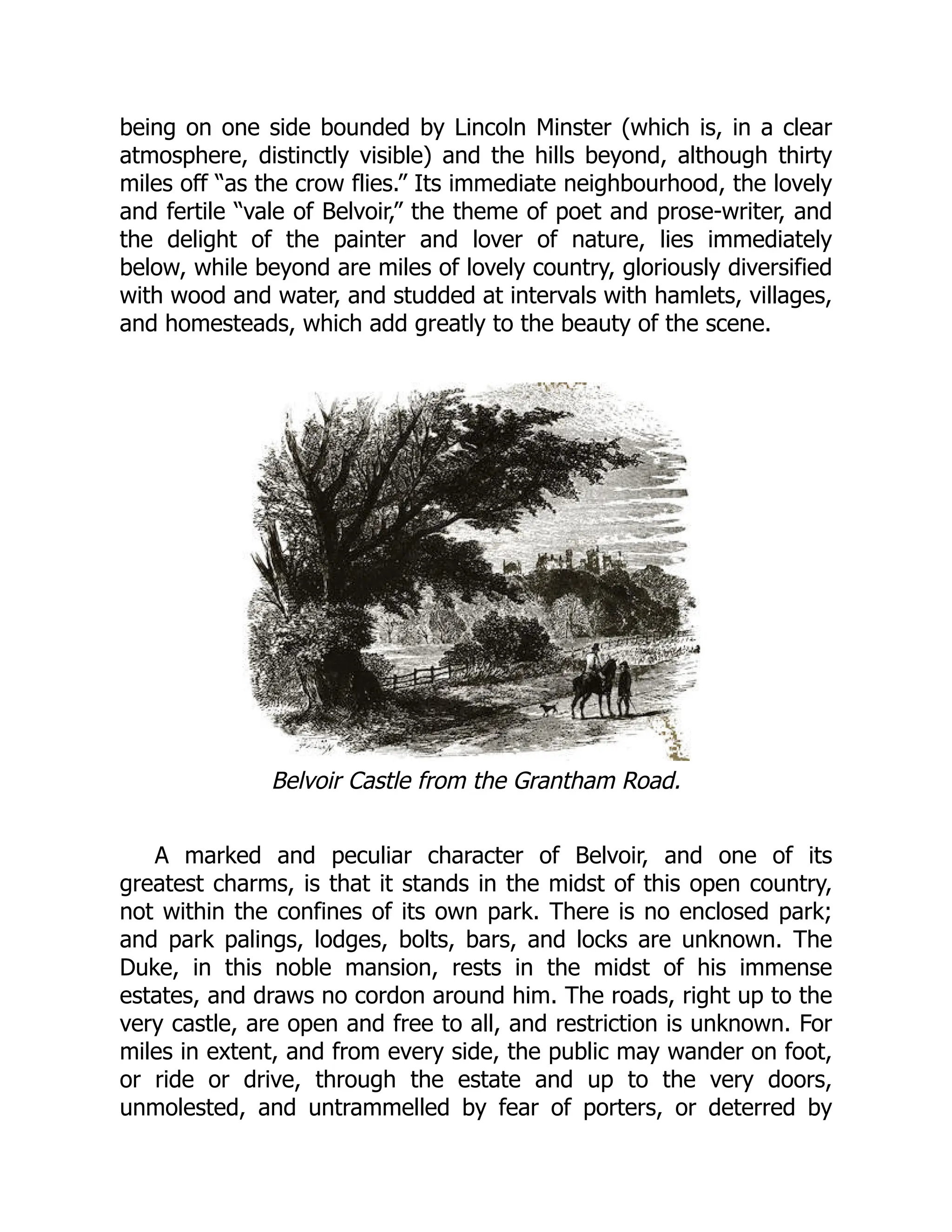
Belvoir Castle from the Grantham Road.
A marked and peculiar character of Belvoir, and one of its
greatest charms, is that it stands in the midst of this open country,
not within the confines of its own park. There is no enclosed park;
and park palings, lodges, bolts, bars, and locks are unknown. The
Duke, in this noble mansion, rests in the midst of his immense
estates, and draws no cordon around him. The roads, right up to the
very castle, are open and free to all, and restriction is unknown. For
miles in extent, and from every side, the public may wander on foot,
or ride or drive, through the estate and up to the very doors,
unmolested, and untrammelled by fear of porters, or deterred by
appliances of state or ceremony. The stronghold of the De Todenis,
the Albinis, the Especs, the De Ros’, and the Manners’, thus nestles
securely in the very heart of the country, as does its noble owner—
the descendant and representative of this long line of illustrious men
—in the hearts of his tenantry, his friends, and all who have the
privilege of knowing him.
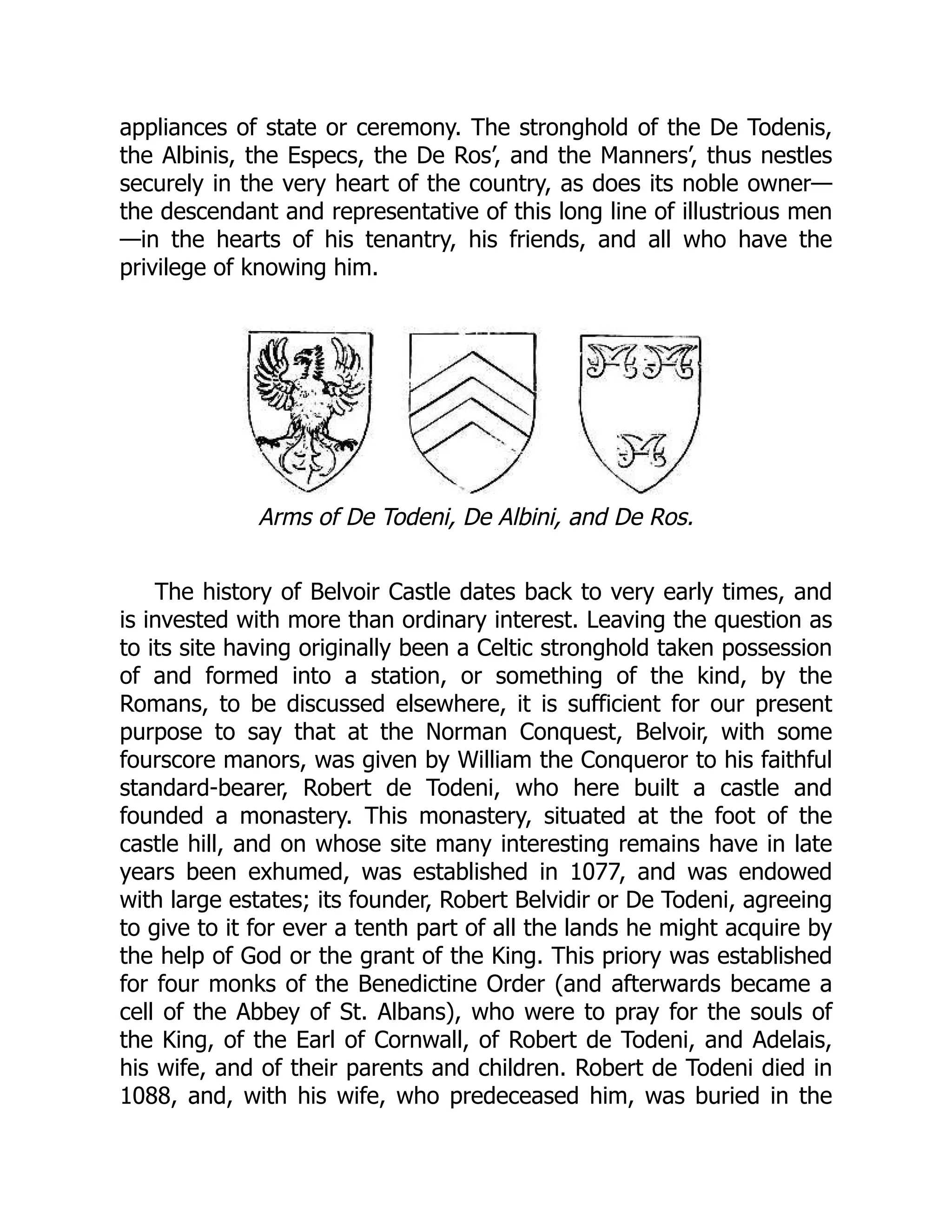
Arms of De Todeni, De Albini, and De Ros.
The history of Belvoir Castle dates back to very early times, and
is invested with more than ordinary interest. Leaving the question as
to its site having originally been a Celtic stronghold taken possession
of and formed into a station, or something of the kind, by the
Romans, to be discussed elsewhere, it is sufficient for our present
purpose to say that at the Norman Conquest, Belvoir, with some
fourscore manors, was given by William the Conqueror to his faithful
standard-bearer, Robert de Todeni, who here built a castle and
founded a monastery. This monastery, situated at the foot of the
castle hill, and on whose site many interesting remains have in late
years been exhumed, was established in 1077, and was endowed
with large estates; its founder, Robert Belvidir or De Todeni, agreeing
to give to it for ever a tenth part of all the lands he might acquire by
the help of God or the grant of the King. This priory was established
for four monks of the Benedictine Order (and afterwards became a
cell of the Abbey of St. Albans), who were to pray for the souls of
the King, of the Earl of Cornwall, of Robert de Todeni, and Adelais,
his wife, and of their parents and children. Robert de Todeni died in
1088, and, with his wife, who predeceased him, was buried in the
priory at Belvoir which he had founded. He was succeeded by his
son William, who took the surname of De Albini Brito, by whom the
grants to the priory were confirmed and increased, and he obtained
for the monks a grant of a fair for eight days in the year on the feast
of St. John the Baptist. He married Maud de St. Liz, widow of Robert
de Tonebrigg, daughter of Simon, Earl of Northampton and
Huntingdon, and, dying in 1155, he, too, was buried at Belvoir, and
was succeeded by his son, William de Albini, or Meschines (also
buried here), who in turn was succeeded by his son, the third
William de Albini, whose name, in connection with King John and
Magna Charta, is matter of history. During his imprisonment at Corfe
Castle by his unforgiving king, Belvoir Castle was, at the summons of
the sovereign, surrendered into his hands. Under Henry III., Albini,
being reinstated in favour, had a chief command at the battle of
Lincoln, and took part in most of the stirring events of the period.
Besides adding to the endowments of Belvoir Priory, he founded the
Hospital of Our Lady at Newstead, for the health of the souls of
himself and his two wives, and there his body was buried in 1236,
while his heart was placed under the wall opposite the high altar at
Belvoir. He married Agatha Trusbut, for the privilege of marrying
whom he gave the King 600 marks (about £6,000 of our money). He
was succeeded by his son, the fourth William de Albini, or, as he was
called, William de Belvoir, who left no male issue, but, by his wife
Albreda Biset, had an only child, a daughter Isabel, who married
Robert de Ros, Lord of Hamlake, fifth in regular descent from Peter
de Ros, who, by marriage with Adeline, daughter of Walter Espec,
became the inheritor of two princely fortunes. Thus by the marriage
of Isabel de Albini with Robert de Ros the estates of Espec, Ros, and
Albini became united.
This Robert de Ros, after his accession to the Belvoir estates,
obtained a grant of free warren and a weekly market there from
Henry III. Later on, as one of the insurgent barons, he was
imprisoned and fined. In 1267 he raised a new embattled and
fortified wall at Belvoir Castle. He died in 1285; his body being
buried at Kirkham, his bowels before the high altar at Belvoir, and his
heart at Croxton Abbey. At the suppression of the monasteries part
of the monument which had been placed over his heart at Croxton
was removed to Bottesford Church, where it still remains in the
chancel wall. His widow, Isabel, died in 1301, and was buried at
Newstead. He was succeeded by his son, William de Ros, who
became an unsuccessful competitor for the crown of Scotland,
founding his claim on his descent from his great-grandmother Isabel,
daughter to William the Lion, King of Scotland. By his marriage with
Matilda de Vaux he added to the family estates and ecclesiastical
patronage; and on his death, in 1317, was succeeded by his son,
William de Ros, who was created Lord Ros of Werke; became Baron
Ros of Hamlake, Werke, Belvoir, and Trusbut; was summoned to
Parliament, second Edward II. to sixteenth Edward III.; was made
Lord High Admiral, and one of the Commissioners to treat for peace
with Robert Bruce. He died in 1342, and was succeeded by his son,
William de Ros, who, after a busy military life, fighting against the
Scots, at the siege of Calais, and against the Saracens, died on his
way to the Holy Land, and was buried abroad. He married Margaret,
daughter of Ralph, Lord Nevill, who survived him, and afterwards
married Sir Henry de Percy.
Dying without issue he was succeeded by his brother, Thomas de
Ros; who, having married, in 1359, Beatrice, daughter of the Earl of
Strafford and widow of the Earl of Desmond, was in turn followed by
his son, John de Ros, who dying without issue, was succeeded by his
brother, Sir William de Ros. Sir William was, with Walter, Bishop of
Durham, and the Earl of Northumberland, sent by King Henry IV. to
arrange a treaty of peace with Scotland. He was a favourite with the
King, who gave him many important offices; made him a K.G.; and
granted him the town of Chingford, in Essex. By his wife, Margaret,
of the family of the Earl of Arundel, Sir William had issue five sons
and four daughters. He died at Belvoir Castle in 1414, and was
buried in the choir of that priory, his monument being now at
Bottesford. The next in succession was John de Ros, son of the last
named, who came to the title and estates when only seventeen
years of age. He was killed along with the Duke of Clarence and
others in 1421; and, dying without issue, had for successor his
brother, Sir Thomas de Ros, who married Eleanor, daughter of
Richard de Beauchamp, Earl of Warwick, by whom he had issue
three sons, of whom his successor, Thomas, Lord Ros, was the
eldest, and who, at his father’s death in 1431, was only four years of
age.
This nobleman, Thomas, Baron Ros of Hamlake, Trusbut, and
Belvoir, was by the King put into full possession of his father’s
estates when only eighteen years of age. He married Philippa, eldest
daughter of John de Tiptoft, by whom he had issue one son and four
daughters. For his fidelity to the House of Lancaster in the Wars of
the Roses, he was, with his adherents, attainted in Parliament in
1461, and is said by Rapin to have been beheaded. His estates were
confiscated, and given to various adherents of the House of York;
Lord Hastings receiving Belvoir and its members. By him Belvoir
Castle was utterly despoiled, he carrying away the lead from the
roofs to Ashby-de-la-Zouch, to use in his own castle there, and
rendering the place no better than a ruin.
The next in succession, Edmund, Lord Ros, was by Henry VII.
(who had united the rival houses) restored to his father’s state and
dignity; the attainder was removed; and the Belvoir and other
estates returned to him. He died in 1508, at his house of Elsinges, at
Enfield (in the church at which, place is a noble monument erected
to his memory), without issue, and his estates were divided between
his sisters and co-heiresses—viz. Eleanor, married to Sir Robert
Manners, Knight; and Isabel, married to Sir Thomas Lovel. Belvoir,
with Hamlake in Yorkshire, and Orston in Nottinghamshire, being the
portion of the elder sister, Eleanor, thus passed into the hands of the
family of Manners, in whom it has remained in unbroken succession
to the present hour. The manor of Elsinges, which had passed to Sir
Thomas Lovel, as part of his wife’s portion, was bequeathed by him
to the Earl of Rutland.
This Sir Robert Manners, who, as we have said, acquired Belvoir
through his marriage with one of the co-heiresses of the last Lord de
Ros, was descended from a long line of Manners’ of
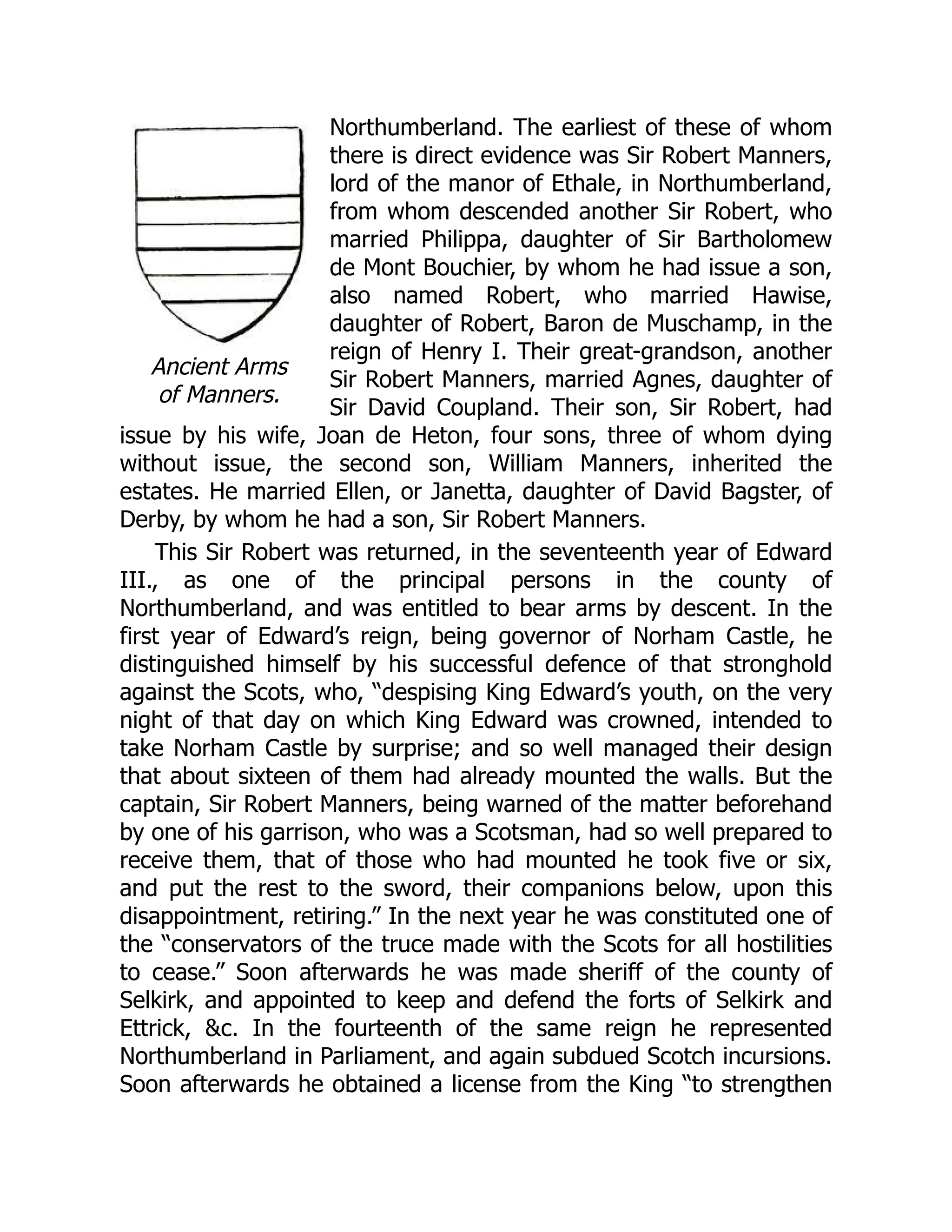
Ancient Arms
of Manners.
Northumberland. The earliest of these of whom
there is direct evidence was Sir Robert Manners,
lord of the manor of Ethale, in Northumberland,
from whom descended another Sir Robert, who
married Philippa, daughter of Sir Bartholomew
de Mont Bouchier, by whom he had issue a son,
also named Robert, who married Hawise,
daughter of Robert, Baron de Muschamp, in the
reign of Henry I. Their great-grandson, another
Sir Robert Manners, married Agnes, daughter of
Sir David Coupland. Their son, Sir Robert, had
issue by his wife, Joan de Heton, four sons, three of whom dying
without issue, the second son, William Manners, inherited the
estates. He married Ellen, or Janetta, daughter of David Bagster, of
Derby, by whom he had a son, Sir Robert Manners.
This Sir Robert was returned, in the seventeenth year of Edward
III., as one of the principal persons in the county of
Northumberland, and was entitled to bear arms by descent. In the
first year of Edward’s reign, being governor of Norham Castle, he
distinguished himself by his successful defence of that stronghold
against the Scots, who, “despising King Edward’s youth, on the very
night of that day on which King Edward was crowned, intended to
take Norham Castle by surprise; and so well managed their design
that about sixteen of them had already mounted the walls. But the
captain, Sir Robert Manners, being warned of the matter beforehand
by one of his garrison, who was a Scotsman, had so well prepared to
receive them, that of those who had mounted he took five or six,
and put the rest to the sword, their companions below, upon this
disappointment, retiring.” In the next year he was constituted one of
the “conservators of the truce made with the Scots for all hostilities
to cease.” Soon afterwards he was made sheriff of the county of
Selkirk, and appointed to keep and defend the forts of Selkirk and
Ettrick, &c. In the fourteenth of the same reign he represented
Northumberland in Parliament, and again subdued Scotch incursions.
Soon afterwards he obtained a license from the King “to strengthen
and embattle his dwelling-house at Ethale, in Northumberland, with
a wall made of stone and lime, and to hold the same to himself and
his heirs for ever.” The next year he was constituted one of the
commissioners to treat with David Bruce and his adherents for a
peace, and subsequently was made Lord of the Marches. At the
battle of Neville’s Cross in 1346, under Queen Philippa, in which the
Scottish king was taken prisoner, Sir Robert displayed great valour,
and was intrusted to keep charge of the prisoners, and deliver them
to the Constable at the Tower of London. He died in 1355, leaving
his son and heir, John de Manners (by his wife, Aliva, or Alice,
daughter of Henry Strather), only one year and three weeks old.
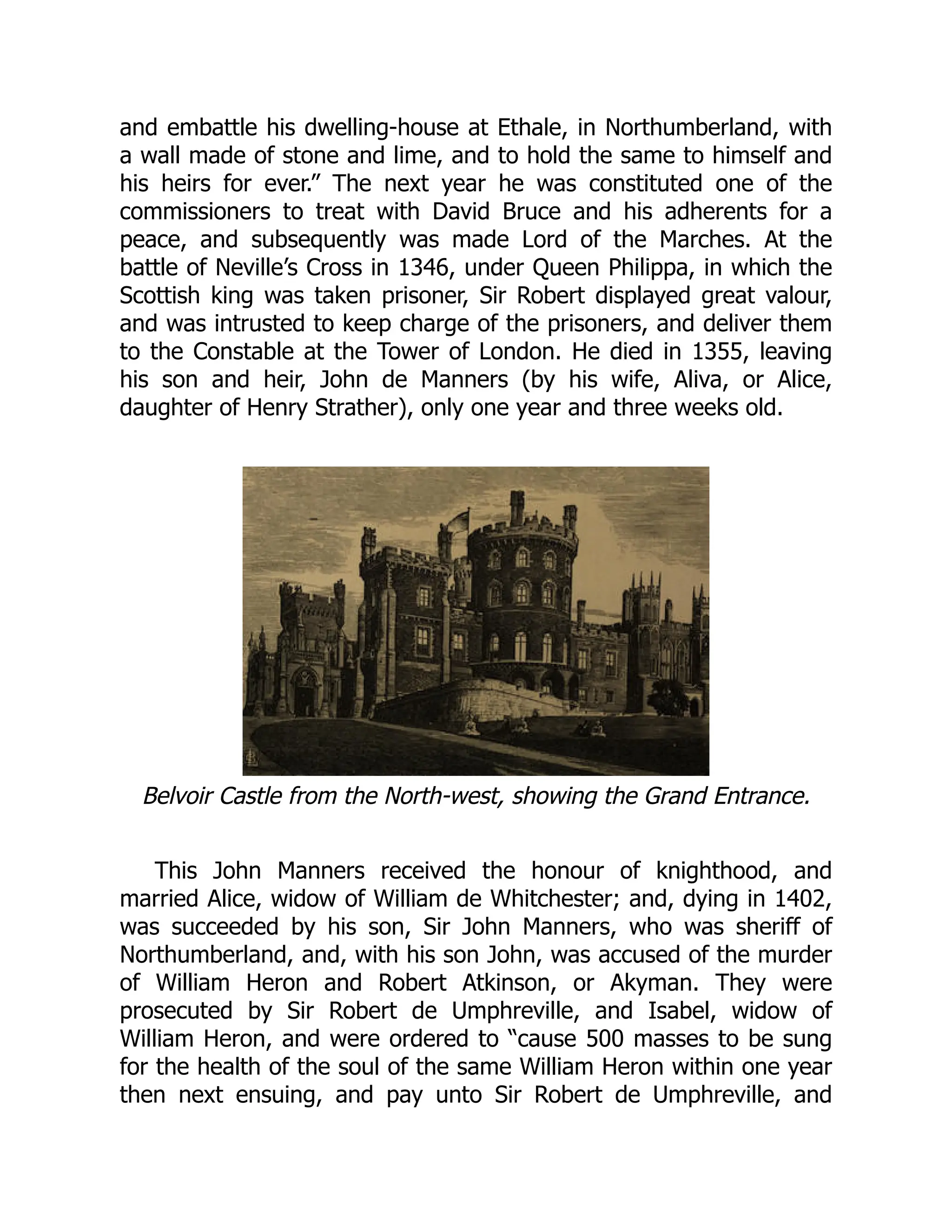
Belvoir Castle from the North-west, showing the Grand Entrance.
This John Manners received the honour of knighthood, and
married Alice, widow of William de Whitchester; and, dying in 1402,
was succeeded by his son, Sir John Manners, who was sheriff of
Northumberland, and, with his son John, was accused of the murder
of William Heron and Robert Atkinson, or Akyman. They were
prosecuted by Sir Robert de Umphreville, and Isabel, widow of
William Heron, and were ordered to “cause 500 masses to be sung
for the health of the soul of the same William Heron within one year
then next ensuing, and pay unto Sir Robert de Umphreville, and
Augmented
Arms of
Manners.
Isabel, to the use of the said Isabel and her children by Heron, 200
marks.” He was succeeded by his son Robert, who married Joan,
daughter of Sir Robert Ogle, and had issue by her, with others, a
son, Robert, by whom he was succeeded. This was the Sir Robert
Manners who married Eleanor, daughter of Thomas, Lord Ros, as
already shown. Sir Robert Manners had issue by his wife, Eleanor
Ros, three daughters, who each married into the family of Fairfax,
and two sons. The elder of these sons was Sir George Manners,
who, on the death of his mother, became Lord Ros or Roos, and was
also lineal heir to the baronies of Vaux, Trusbut, and Belvoir.
M ARRYING Anne, only daughter and heiress of
Sir Thomas St. Leger, by his wife Anne,
daughter of Richard, Duke of York, and
sister to King Edward IV., and widow of
John Holland, Duke of Exeter, this lady
brought royal blood into the family. By her
Sir George had a numerous family, the
eldest of whom, Thomas, succeeded him.
This Sir Thomas Manners, on the death
of his father, became thirteenth Lord Ros,
of Hamlake, and Baron Trusbut, Riveaulx,
and Belvoir. He was with Henry VIII. and
his queen at the celebrated interview
between that monarch and the King of
France at Guisnes, and in the same reign
was made Warden of the East Marches,
and had many other honours granted him.
In the seventeenth year of the same
monarch he was created Earl of Rutland
—“a title which none but royal family had
ever borne, and by reason of his descent
from the sister of King Edward IV. had an augmentation to his
ancient arms.” The old arms were—or two bars azure, and a chief
gules; which chief was augmented thus quarterly azure and gules, in
the first and fourth two fleurs-de-lis and in the second and third a
lion passant guardant, all or. He was also installed a Knight of the
Garter. A few years later this nobleman was present at the second
interview between Henry VIII. and Francis I.; he was also present at
the marriage of his sovereign with the ill-fated Anne Boleyn; and,
later on, attended Anne of Cleves to England, and was made her
chamberlain. He was made Chief Justice in Eyre of all the King’s
lands north of the Trent, and obtained grants of the manors of
Muston, Waltham, Croxton, Upwell, Bilsdale, Helmsley, Outwell, Elm,
Emneth, Branston, &c., and lands belonging to several dissolved
monasteries. He rebuilt Belvoir Castle, and removed many of the
monuments from the dissolved priories of Croxton and Belvoir to
Bottesford, where he himself was buried in 1543. His lordship—who
took part in most of the events of this stirring reign, and held
numerous important offices—married twice: first, Elizabeth,
daughter of Sir Robert Lovel; and second, Eleanor, daughter of Sir
William Paston, by the latter of whom only he had issue. To the
eldest and second of that issue we now refer.
The eldest son, Henry Manners, succeeded his father, in 1543, as
second Earl of Rutland. He continued the rebuilding of Belvoir Castle,
and was made Constable of Nottingham Castle, Chief Justice in Eyre
of Sherwood Forest, &c. He was married twice: first, to Margaret,
daughter of the fourth Earl of Westmoreland, by whom he had issue;
and second, to Bridget, daughter of Lord Hussey, by whom he had
no children. He was succeeded by his eldest son, Edward Manners,
as third Earl of Rutland, who, dying without male issue, was
succeeded by his brother, John Manners (the second son of the
second earl), as fourth Earl of Rutland. This nobleman married
Elizabeth, daughter of Francis Charlton, of Apsley, by whom he had
issue, with others, three sons—Roger Manners, Sir Francis Manners,
and Sir George Manners—who successively became fifth, sixth, and
seventh Earls of Rutland. All these dying without surviving male
issue, the title passed to the descendants of the second son of the
first Earl, as we shall now show.
Sir John Manners, second son of the first Earl of Rutland, and
great-grandson of the sister of King Edward IV., became, before he
was knighted, attached to Dorothy Vernon, the youngest daughter
and co-heiress of Sir George Vernon of Haddon Hall, known as “the
King of the Peak,” and so effectually wooed and won her, that he at
length carried her off on horseback into his own county of Leicester,
and there married her. By this marriage Haddon Hall, and the
Derbyshire property of the “King of the Peak,” passed into the family
of Manners. Sir John Manners had issue by his wife, Dorothy Vernon,
three sons—Sir George, who succeeded him; John, who died at the
age of fourteen; and Sir Roger, of Whitwell; and one daughter,
Grace, who married Sir Francis Fortescue, of Salden. Sir George
Manners, their son, married Grace, daughter of Sir Henry
Pierrepoint, and sister to the Earl of Kingston, by whom he had
issue, with others, John Manners, his eldest son, who not only
succeeded him, but also succeeded his cousin George, seventh Earl
of Rutland, in his title and estates, and thus became eighth Earl of
Rutland. He married Frances, daughter of Edward, Lord Montague of
Boughton, by whom he had issue four sons and seven daughters. He
was sheriff of Derbyshire in the ninth and eleventh years of Charles
I., and also represented that county in Parliament. His lordship was
attached to the Parliamentary interest during the civil wars, and was
one of the twenty-two peers who remained at Westminster when the
King summoned both Houses to attend him at Oxford. As a
consequence, his castle of Belvoir was seized by the Royalists, and
was held by them and Sir Gervase Lucas, and here the King
frequently resided. It was finally surrendered to the Parliamentarians
in January, 1645-6. In 1649 the castle was demolished, by consent
of the Earl, who soon afterwards set about rebuilding it, which he
completed in 1668. During this time the Earl lived principally at
Haddon Hall, where he died in 1679, and was succeeded by his third
and only surviving son, John Manners, as ninth Earl of Rutland.
This nobleman was born in 1638, and, in 1679 was created a
peer in his own right by the title of Baron Manners of Haddon; and
in September of the same year, his father dying, he became Earl of
Rutland. When twenty years of age he had married the Lady Anne
Pierrepoint, daughter of the Marquis of Dorchester, from whom he
was afterwards divorced; and he married, secondly, Lady Diana
Bruce, widow of Sir Seymour Shirley, and daughter of the Earl of
Aylesbury, who died in child-bed. His lordship married, thirdly,
Catherine, daughter of Baptist Noel, Viscount Camden, by whom
only he had surviving issue. In 1703 the Earl was raised to the
highest dignity in the realm, by the titles of Marquis of Granby and
Duke of Rutland. He died in January, 1710-11, aged seventy-three,
and was succeeded by his only surviving son, John Manners.
John, second Duke of Rutland, when scarcely seventeen years of
age, was married to Katherine, second daughter of Lord William
Russell, who was beheaded in 1683. He then bore the title of Lord
Roos; and the wedding festivities seem, judging from some curious
letters still extant concerning them, to have been of the most
lavishly extravagant character. This lady, who was sister to the
Duchess of Devonshire and to the Duke of Bedford, gave birth to
five sons and four daughters, and died in child-bed in 1711. The
Duke married, secondly, Lucy, daughter of Lord Sherard, and sister
of the Earl of Harborough, by whom also he had issue six sons and
two daughters. His grace died in 1721, and was succeeded, as third
Duke of Rutland, by his eldest son, John Manners. This nobleman,
who was born in 1696, married, in 1717, Bridget, only daughter and
heiress of Robert Sutton, Lord Lexington (an alliance that gave him a
large accession of estates), by whom he had issue thirteen children,
nearly all of whom died young. He it was who built the hunting-seat
at Croxton, and made many improvements at Belvoir Castle. He was
the last of the family who made Haddon Hall a residence. The
estates of Lord Lexington having been settled upon the younger
branch of the family, the second and surviving sons, successively,
took, by Act of Parliament, the additional surname of Sutton, and
thus founded the family of Manners-Sutton.
The Duke, who was familiarly known as “Old John of the Hill,”
dying in 1779, was succeeded by his grandson, Charles Manners,
son of the celebrated Marquis of Granby, Commander-in-chief of the
British forces in Germany, and Master of the Ordnance, who died
during his father’s lifetime. Charles, fourth Duke of Rutland, married
Mary Isabella, daughter of Charles Noel, Duke of Beaufort, by whom
he had issue four sons—viz. Lord John Henry (who succeeded him),
Lord Charles Henry Somerset, Lord Robert William, and Lord William
Robert Albini; and two daughters—viz. the Lady Elizabeth Isabella,
married to Richard Norman, Esq., and Lady Catherine Mary, married
to Lord Forester. His Grace died while holding office as Lord-
Lieutenant of Ireland, and was succeeded by his eldest son—
John Henry Manners, as fifth Duke of Rutland, who married
Elizabeth, daughter of the Earl of Carlisle, and by her had issue six
sons and five daughters. The sons were—Lord George Henry
Manners, to whom King George III. stood sponsor in person, but
who died in infancy; Lord George John Frederick Manners, to whom
the Prince Regent and H.R.H. the Duke of York stood sponsors in
person, but who also died in infancy; Lord Charles Cecil John
Manners (the present Duke of Rutland); Lord Adolphus Edward
Manners, who died in infancy: Lord John James Robert Manners,
M.P., the present eminent statesman and man of letters; and Lord
George John Manners, M.P., who married in 1855 the Lady Adeliza
Matilda Howard, daughter of the thirteenth Duke of Norfolk, and
died in 1875. The five daughters were—the Lady Caroline Isabella
Manners, who died in infancy; the Lady Elizabeth Frederica Manners,
now the widow of Andrew Robert Drummond, Esq.; the Lady
Emmeline Charlotte Elizabeth Manners (deceased), married to the
Hon. Charles Stuart Wortley; the Lady Katherine Isabella Manners
(deceased), married to Earl Jermyn; and the Lady Adeliza Gertrude
Elizabeth Manners, married to the Rev. Frederick John Norman,
Rector of Bottesford.
The present noble head of the House of Manners is, as we have
just stated, his Grace Charles Cecil John Manners, the sixth Duke of
Rutland, Marquis of Granby, fourteenth Earl of Rutland, Baron
Manners of Haddon, Baron Ros of Hamlake, Baron Trusbut, Riveaulx,
and Belvoir, K.G., &c., the “King of Belvoir,” as he may not inaptly be
called, for his is a regal residence, and he reigns in the hearts of the
people around him. He is, therefore, the direct descendant and
representative in unbroken succession of the grand old standard-
bearer of William the Conqueror, Robert de Todeni, and of the
families of De Albini, Espec, De Ros, and Manners; and by equally
direct descent he has royal blood coursing through his veins. His
grace was born in 1815, and was educated at Eton and at Trinity
College, Cambridge, where he took his M.A. degree in 1835; was
M.P. for Stamford from 1837 to 1852, and from that time to his
accession to the titles in 1867, for North Leicestershire; and he was
a Lord of the Bed-chamber to the late Prince Consort. His grace is
not married, the heir to his titles, estates, and revenues being his
brother, Lord John Manners, who is a worthy representative of the
long and illustrious line from which he has sprung. The Duke is
patron of twenty-four livings, of which one is in Rutland, fifteen in
Leicestershire, two in Lincolnshire, two in Cambridgeshire, two in
Nottinghamshire, and two in Derbyshire. His seats are—Belvoir
Castle, in Leicestershire; Haddon Hall and Longshawe Lodge, in
Derbyshire; and Cheveley Park, in Cambridgeshire.
Lord John Manners was born in 1818, and in 1851 married Louisa
Catherine, daughter of Colonel Marlay, by whom he had issue one
son (the present Henry John Brinsley Manners), and another who
died in infancy. This lady, dying in 1854, was buried at Rowsley,
where a magnificent monument—one of the happiest efforts of W.
Calder Marshall—has been erected to her memory. His lordship
married secondly, in 1862, Janetta, eldest daughter of Thomas
Hughan, Esq., by whom he has issue several children. Lord John
Manners has held many important offices. He was sworn a Privy
Councillor, and appointed First Commissioner of Works and Buildings,
which office he held many years, and in 1874 was appointed
Postmaster-General.
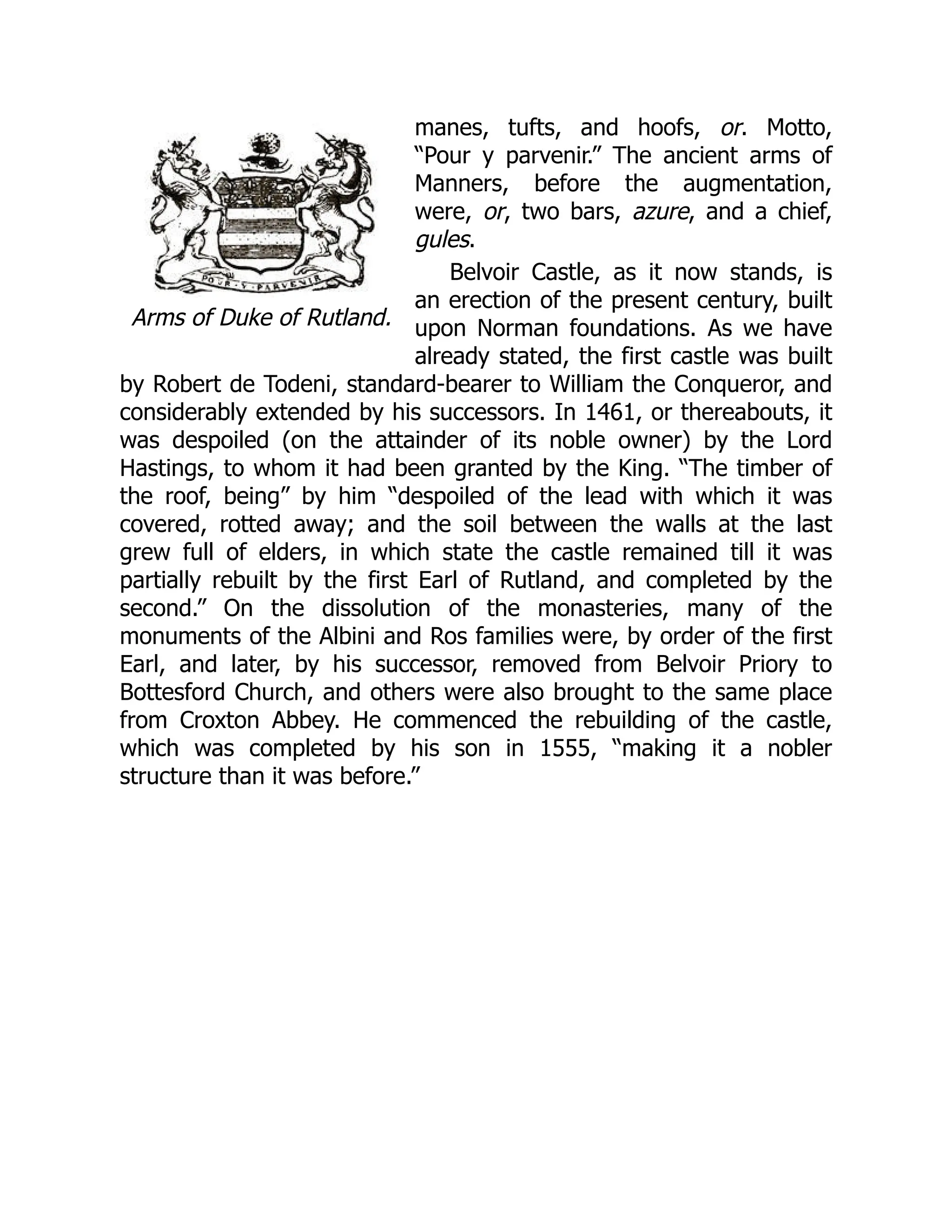
The arms of the Duke of Rutland are—or, two bars, azure;
augmented by a chief, quarterly, first and fourth azure, two fleurs-
de-lis, or (France), second and third gules, a lion passant guardant,
or (England). Crest, on a chapeau, gules, turned up, ermine, a
peacock in pride, proper. Supporters, two unicorns, argent, horns,
Arms of Duke of Rutland.
manes, tufts, and hoofs, or. Motto,
“Pour y parvenir.” The ancient arms of
Manners, before the augmentation,
were, or, two bars, azure, and a chief,
gules.
Belvoir Castle, as it now stands, is
an erection of the present century, built
upon Norman foundations. As we have
already stated, the first castle was built
by Robert de Todeni, standard-bearer to William the Conqueror, and
considerably extended by his successors. In 1461, or thereabouts, it
was despoiled (on the attainder of its noble owner) by the Lord
Hastings, to whom it had been granted by the King. “The timber of
the roof, being” by him “despoiled of the lead with which it was
covered, rotted away; and the soil between the walls at the last
grew full of elders, in which state the castle remained till it was
partially rebuilt by the first Earl of Rutland, and completed by the
second.” On the dissolution of the monasteries, many of the
monuments of the Albini and Ros families were, by order of the first
Earl, and later, by his successor, removed from Belvoir Priory to
Bottesford Church, and others were also brought to the same place
from Croxton Abbey. He commenced the rebuilding of the castle,
which was completed by his son in 1555, “making it a nobler
structure than it was before.”
Belvoir Castle from the North-west.
In 1619 the singular trial of an old woman, named Joan Flower,
of Belvoir, and her two daughters, Margaret and Philippa, for sorcery,
and causing the deaths of the two sons of the Earl of Rutland, took
place, and resulted in the execution of the two younger “witches,”
the old “monstrous malicious woman,” or “devil incarnate,” as she
was styled, having died as she was being taken to gaol; and the
destruction of her cat, “Rutterkin.” The two sons, whose deaths were
laid to the charge of these miserable victims of superstition, were
Henry, Lord Ros, and Francis Manners, his brother, sons of Francis,
sixth Earl of Rutland, by his second wife, Cecilia, daughter of Sir
John Tufton, and widow of Sir Henry Hungerford. That Joan Flower,
aided by her profligate daughters, did cause the deaths of the two
children, and attempt the lives of the Earl and Countess, probably by
poison, seems most probable, and they were justly punished. The
following account of this singular transaction, printed in 1619,
describes—
“Joan Flower as a monstrous woman, full of oaths, curses, and
imprecations; and for any thing they saw by her, a plain atheist. Besides,
of late days, her very countenance was estranged, her eyes very fiery and
hollow, her speech fell and envious, her demeanour strange and exotic,
and her conversation sequestered; so that the whole course of her life
gave great suspicion that she was a notorious witch; yea, some of her
neighbours dared to affirm that she dealt with familiar spirits, and terrified
them all with curses and threatening of revenge, if there were never so
little cause of displeasure and unkindness. Concerning Margaret, the
daughter, that she often resorted from the castle to her mother, bringing
such provision as they thought was unbefitting for a servant to purloin;
and coming at such unseasonable hours that they could not but
conjecture some mischief between them, and that their extraordinary riot
and expenses tended both to rob the lady and to maintain certain deboist
and base company, which frequented this Joan Flower’s house, the
mother, and especially the youngest daughter. Concerning Philippa, that
she was leudly transported with the love of one Thomas Simpson, who
presumed to say that she had bewitched him, for he had no power to
leave her, and was, as he supposed, marvellously altered both in mind and
body, since her acquainted company. These complaints began many years
before either their conviction or public apprehension. Notwithstanding,
such was the honour of this earl and his lady; such was the cunning of
this monstrous woman, in observation towards them; such was the
subtlety of the devil, to bring his purposes to pass; such was the pleasure
of God, to make trial of his servants; and such was the effect of a
damnable woman’s wit and malicious envy, that all things were carried
away in the smooth channel of liking and good entertainment, on every
side, until the earl refused to give that credence to her, on some complaint
preferred, which he had been accustomed to give; and the countess
discovering in the daughter Margaret some indecencies of her life, and
neglect of her business, discharged her from lying any more in the castle;
dismissing her with handsome presents, but commanding her to go home.
This inflamed the mother with hatred and rancour towards the earl, and
his family.
“When the devil perceived the inficious disposition of this wretch, and
that she, and her daughters, might easily be made instruments to enlarge
his kingdom; and be, as it were, the executioners of his vengeance, not
caring whether it lighted upon innocents, or no; he came more near unto
them, and in plain terms, to come quickly to the purpose, offered them his
service, and that in such a manner, as they might easily command what
they pleased; for he would attend you in such pretty forms of dog, cat, or
rat, that they should neither be terrified, nor any body else suspicious of
the matter. Upon this, they agree, and (as it should seem) give away their
souls to the service of such spirits, as he had promised them; which filthy
conditions were ratified with abominable kisses, and an odious sacrifice of
blood, not leaving out certain charms and conjurations, with which the
devil deceived them, as though nothing could be done without ceremony,
and a solemnity of orderly ratification. By this time doth sathan triumph,
and goeth away satisfied to have caught such fish in the net of his
illusions: by this time, are these women devils incarnate, and grow proud
again in their cunning and artificial power, to do what mischief they listed.
By this time, they have learnt the manner of incantations, spells, and
charms. By this time, they kill what cattle they list; and under the cover of
flattery and familiar entertainment, keep hidden the stinging serpent of
malice, and a venomous inclination to mischief. By this time, is the earl
and his family threatened, and must feel the burthen of a terrible tempest,
which, by these women’s devilish devices, fell upon him; he neither
suspecting nor understanding the same. By this time, both himself and his
honourable countess, are many times subject to sickness and
extraordinary convulsions; which they, taking as gentle corrections from
the hand of God, submit with quietness to his mercy, and study nothing
more than to glorify their Creator in heaven, and bear his crosses on
earth.
“At last, as malice increased in these damnable women, so his family
felt the smart of their revenge and inficious disposition; for his eldest son,
Henry, Lord Rosse, sickened very strangely, and after awhile, died. His
next, named Francis, Lord Rosse accordingly, was severely tormented by
them, and most barbarously, and inhumanly tortured by a strange
sickness. Not long after, the Lady Catherine was set upon by their
dangerous and devilish practices; and many times in great danger of life,
through extreme maladies and unusual fits, nay, (as it should seem, and
they afterwards confessed) both the earl and his countess were brought
into their snares, as they imagined, and indeed determined to keep them
from having any more children. Oh unheard of wickedness and
mischievous damnation! Notwithstanding all this, did the noble earl attend
his majesty, both at Newmarket, before Christmas; and at Christmas, at
Whitehall; bearing the loss of his children most nobly; and little suspecting
that they had miscarried by witchcraft, or such like inventions of the devil;
until it pleased God to discover the villanous practices of these women,
and to command the devil from executing any further vengeance on
innocents, but leave them to their shames, and the hands of justice, that
they might not only be confounded for their villanous practices, but
remain as a notorious example to all ages, of his judgment and fury. Thus
were they apprehended, about Christmas, and carried to Lincoln gaol;
after due examination, before sufficient justices of the peace, and discreet
magistrates, who wondered at their audacious wickedness. But Joan
Flower, the mother, before her conviction, (as they say,) called for bread
and butter, and wished it might never go through her, if she were guilty of
that whereupon she was examined; so, mumbling it in her mouth, never
spake more words after; but fell down and died, as she was carried to
Lincoln gaol, with a horrible excruciation of soul and body, and was buried
at Ancaster.
“When the earl heard of their apprehension, he hasted down with his
brother, Sir George, and sometimes examined them himself, and
sometimes sending them to others; at last, left them to the trial of law,
before the judges of assize at Lincoln; and so they were convicted of
murder, and executed accordingly, about the eleventh of March, to the
terror of all beholders as example of such dissolute and abominable
creatures.”
On the stately monument of the Earl at Bottesford the death of
these two sons is thus alluded to:—“In 1608 he married the Lady
Cecelia Hungerf’rd, daughter to the Hon’ble Knight, Sir John Tufton,
by whom he had two sonnes, both which dyed in their infancy, by
wicked practice and sorcerye.”
In the civil wars Belvoir Castle was taken by the Royalist party in
1642, and placed under command of Colonel Lucas. In 1645 the
King himself was there. In the same year Prince Rupert and Prince
Maurice were at Belvoir. Soon afterwards it was besieged by the
Parliamentarians; the outworks and stables, which had been
fortified, were taken by storm; the entire village of Belvoir was
demolished; and on the 3rd of February, 1646, the castle, with its
appurtenances, was, in pursuance of terms of capitulation,
surrendered to the Parliament, who immediately appointed Captain
Markham as its governor. Shortly afterwards the castle was
disgarrisoned and restored to its owner, the Earl of Rutland. In 1649
the Council of State reported “their resolution for demolishing the
castle; which the Earl of Rutland was content with,” and it was
accordingly demolished, the Earl receiving a miserable pittance by
way of compensation, and taking up his residence at Haddon Hall.
About 1662 the Earl appears to have commenced the rebuilding of
the castle, which was completed in 1668. In 1801 the then Duke of
Rutland, father of the present duke, who had, during his minority,
conceived the idea of rebuilding and extending the castle, began to
carry out his design by pulling down the south and west fronts next
to the court-yard, and continued rebuilding under Wyatt till 1816, by
which time the south-west and south-east parts were completed,
and the Grand Staircase and Picture Gallery in the north-west front
were nearly finished. In that year a fire broke out in the castle, by
which the north-east and north-west fronts were entirely destroyed.
By that fire a large number of valuable paintings, estimated at nearly
eleven thousand pounds in value, were totally destroyed. Among
these were no less than nineteen by Sir Joshua Reynolds (including
the “Nativity” and a number of family portraits); and many by
Rubens, Vandyke, Carlo Maratti, Lely, Domenichino, Rembrandt,
Velasquez, Titian, Poussin, West, and others. Fortunately, although
five children of the Duke and Duchess (who themselves were at
Cheveley), and all the household were sleeping in the castle, no loss
of life occurred. In March, 1817, the Duke commenced rebuilding the
castle, the architect being the Rev. Sir John Thoroton, of Bottesford,
to whose good taste and that of the Duke and his amiable duchess,
are due the fine proportions and the majestic character of the
building as it now stands.
Belvoir has often been visited by royalty. James I. and Charles I.
both stayed there, and in 1813, the Prince Regent, afterwards
George IV., and the Duke of York, spent several days there. In 1839
the Dowager Queen Adelaide remained there for nearly a week, and
in 1843 our present beloved Queen Victoria, with the Prince Consort,
the Queen Dowager, the Duke of Wellington, and others, visited the
Duke, and remained his guests for four days. In 1866 their Royal
Highnesses the Prince and Princess of Wales visited Belvoir, and the
Prince again remained there in 1873. Other members of the royal
family have also been received within its walls.
The principal apartments of the castle are, by kind permission of
the Duke, shown to visitors, and the surrounding grounds are
literally, as we have before said, open to all, “without let or
hindrance.”
Passing up the steep ascent from near the cosy inn (on, or
closely adjoining to, the site of the old priory), the visitor, if on foot,
wends his way along the path among magnificent forest trees, and
up a flight of stone steps to the basement story of the castle, where,
in the solid masonry from which the superstructure rises, are the
workshops of the artisan retainers of the family; and from hence by
a rising pathway to the bastion, mounted with cannon, which gives
an air of baronial importance to the place. If the visitor ride or drive,
the ascent is somewhat more circuitous, but the carriage-way leads
to the same point—the Grand Entrance to the Castle.
The Grand Entrance, which is shown to the spectator’s left in our
general views from the north-west, opens from an advanced groined
porch, into which carriages drive from one side, and out at the other,
massive doors enclosing them while visitors alight. Over the doors
are armorial bearings of the family and its alliances. From the porch
the entrance doorway opens into the groined entrance passage, or
corridor, decorated with stands of arms, banners (among which is
the one borne by the present Duke of Rutland at the funeral of the
Duke of Wellington), and military trophies, which leads to the Guard-
room, or Great Hall of the mansion. This noble room, which has a
groined ceiling, and a mosaic floor of black and white marble and
Nottinghamshire freestone, bears in recesses and arcades on its
walls groups of arms and armour, trophies of war, and other
appropriate decorations; and in two glazed recesses a number of
relics of the great Marquis of Granby, and of his brilliant military
achievements, and his well-earned decorations. Besides many other
objects of peculiar interest in this room are two tables made from
remarkable deposits, of eleven years’ formation, in the wooden
water-pipes of the Blithe Mine in Derbyshire; a model of the old
castle; standards, arms, and armour from the field of Waterloo; a
Chinese junk; and some good armour.
Opposite the entrance are the Grand Staircase and the Guard-
room Gallery. In the windows of the latter are finely executed
stained-glass figures (by Wyatt) of Robert de Todeni, William de
Albini, Walter Espec, and Robert de Ros, with their armorial insignia.
From the landing at the head of the Guard-room Staircase, which
contains full-length portraits of Queen Anne and George Prince of
Denmark, access is gained to the Grand Staircase leading to the
principal apartments; the walls of the staircase itself being hung with
full-length paintings of the first eight Earls of Rutland, with their
armorial bearings within the archways. The ceiling is richly groined.
The Regent’s Gallery, so called from the Prince Regent (George
IV.), for whose use it was fitted up on his visit to Belvoir in 1813, is
one of the main features of the castle. It is a noble apartment, 128
feet long by 18 feet wide, with a central bow, formed by the central
tower, of 36 feet wide. At one end is Nollekens’ fine bust of George
IV., and at the other the equally fine bust of the late estimable duke,
while other parts of the room are adorned with corresponding
sculptures of the late Duchess of Rutland, the Marquis of Granby,
Lord Robert Manners, Pitt, Cromwell, William III., George II., Earl of
Mansfield, Duke of Somerset, Earl of Chatham, Admiral Keppel, and
others. One striking feature of this gallery is the Gobelins tapestry
(eight pieces) which adorns the walls. It is in perfect preservation,
and represents scenes in the story of Don Quixote from designs by
Coypel, and appear to have been made in 1770. The walls are also
adorned by many family portraits and other paintings by Reynolds,
Hoppner, Kneller, Smirke, Lely, Bishop, Zucchero, Stothard, and
others. The appointments of this splendid room are arranged with
perfect taste, and it is filled with objects of interest and beauty; one
object that often attracts attention being a carved chair, bearing an
inscription showing that it was made, as is also one belonging to the
Queen, from the wood of the tree at La Haye Sainte, against which
the Duke of Wellington took up his station at the battle of Waterloo.
The opposite end of the Regent’s Gallery to that at which the visitor
enters from the Grand Staircase is one gigantic mirror filling the
whole space, and thus, in appearance, giving it a double length.
From this end one doorway leads to the private gallery of the chapel,
and another opens into the library.
The Library is entirely of oak, the ceiling divided into
compartments, with carved bosses at the intersections, and armorial
bearings decorating other parts. Over the fire-place Grant’s fine
portrait of the late duke, “presented to his grace as a token of
affection and esteem by his tenantry, 27th February, 1856,” is
placed, and forms a pleasant feature in the room. The collection of
books is, as is natural to expect, of the most choice and costly kind,
many of the literary treasures being priceless gems of past ages.
Among these are several curious and valuable MS. rarities and
sketches by the old masters.
The Picture Gallery, a noble apartment of admirable proportions,
has a coved ceiling, rising from a cornice richly ornamented in gold
and white, with figures and foliage in bold relief. The collection of
pictures in this gallery, some two hundred in number, is remarkably
fine and choice, and contains many notable examples of the best
and most reputed masters—Murillo, Rubens, Teniers, Gerard Douw,
Rembrandt, Claude, Gaspar Poussin, Parmigiano, Carlo Dolce,
Berghem, Carracci, Guido, Vandyke, Holbein, Bassano, Paul
Veronese, Bronzino, Van der Heyden, Netscher, Van der Velde,
Reynolds, Jansen, Ruysdael, Correggio, Albert Dürer, Dekker,
Schalken, Spagnoletto, Caravaggio, Wouvermans, Cuyp, and a host
of others.
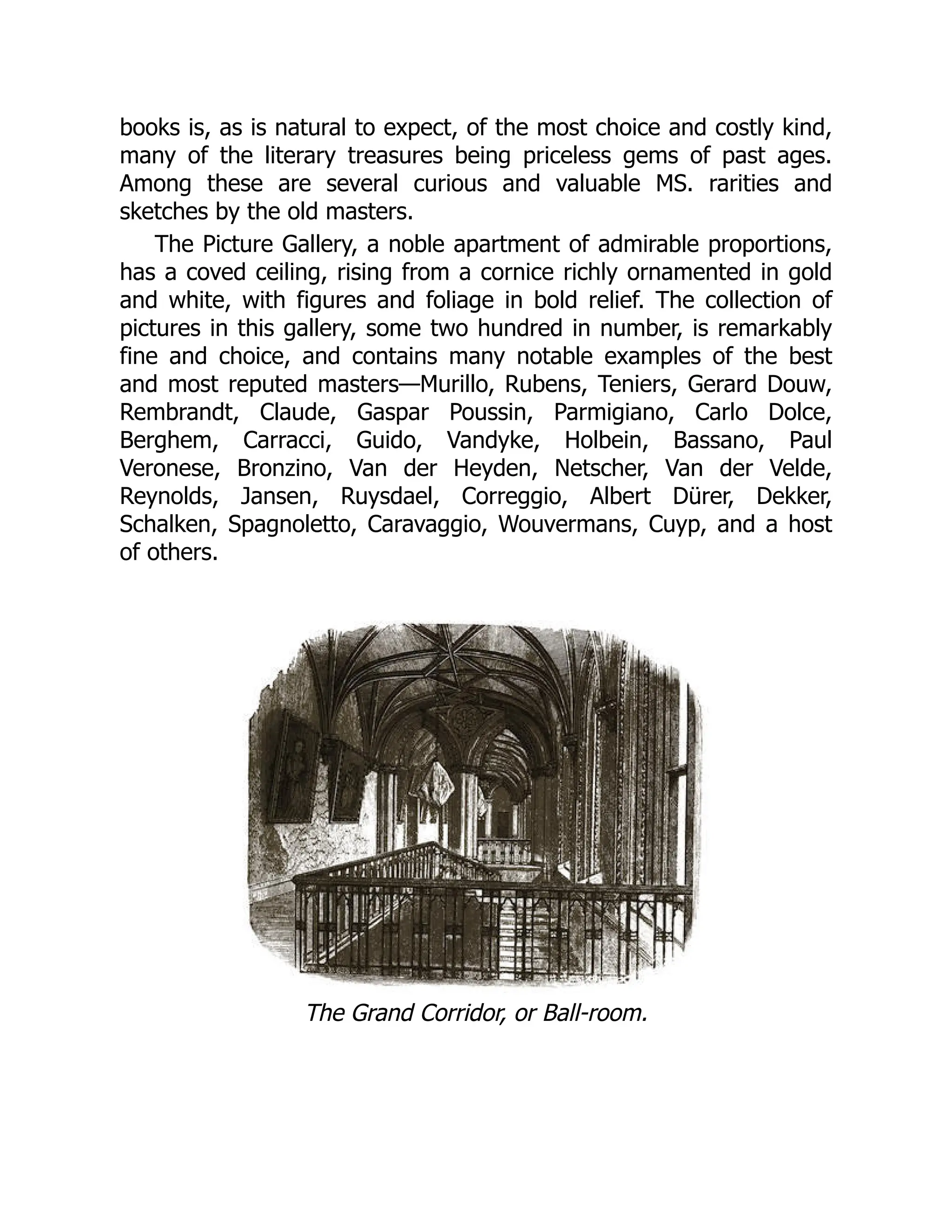
The Grand Corridor, or Ball-room.
The Duchess’s Boudoir, a lovely room, commanding an almost
enchanting view of the grounds and distant country, was the
favourite apartment of the late duchess, and remains as left by her.
Like the other private rooms, passages, and corridors, it contains
many genuine pictures of note as well as family portraits.
The Grand Corridor, or Ball-room, which, seen from the landing of
the staircase, is shown in the engraving on the preceding page, is
one of the most striking features of the interior of the castle. It is of
Gothic design, the whole being of stone, and copied from various
parts of Lincoln Cathedral. It is lit by nine windows in length, with
stained-glass armorial decorations, and has an elegant groined
ceiling, with carved bosses at the intersections; and the walls are
arcaded, and contain full-length life-size and other portraits of the
present noble duke (two) by Grant; the late Lady John Manners, by
Buckner; Lord Robert Manners, by Reynolds; and several others.
The Queen’s Sitting-room, or Green Assembling-room, in the
Staunton Tower, besides being an elegant apartment, commands a
magnificent view of the charming grounds and the distant country,
including Croxton with the Duke’s Deer Park, Woolsthorpe,
Harlaxton, the Kennels, and the Lake. Adjoining this are the Chinese
Rooms—a suite of bed and dressing rooms, so called from the style
of their furniture and papering—which were occupied by our beloved
Queen in 1843.
The Grand Dining-room has a richly panelled ceiling of white and
gold, and contains a side-table of white marble, carved by Wyatt, so
as to look like a table “covered with a white linen table napkin; the
folds being so accurately represented in the marble as to require a
close inspection to convince the observer of the solidity of the
material.” It weighs between two and three tons. In this room are
magnificent examples, life-size full-length portraits, by Sir Joshua
Reynolds, and others by Sir Godfrey Kneller.
The Elizabeth Saloon, so called after the late duchess (Elizabeth,
second daughter of Frederick Howard, Earl of Carlisle, and wife of
John Henry, fifth Duke of Rutland), by whose taste and judgment it
was arranged and decorated. The walls are hung with satin drapery,
and the ceiling, which was painted by Wyatt, is filled with
mythological subjects and family and other portraits. The furniture
and appliances are sumptuous and elegant, and altogether this
saloon is the most gorgeous in the castle. Among its Art treasures
are a full-length marble statue of the late duchess by Wyatt; two
full-length life-size portraits of the late duke and duchess by
Sanders; several rare enamels and pictures; a number of choice
watercolour drawings; an extensive series of cabinet portraits, &c.;
and many cabinets, caskets, and other choice objects.
Other apartments are the King’s Rooms, so called because used
by the Prince Regent while at Belvoir; the Hunters’ Dining-room; the
Wellington Rooms, so named because occupied by the Duke of
Wellington; the Family Dining-room, &c., but these require no word
of comment.
The Chapel, with panelled stone walls and elegant groined
ceiling, has a canopied reredos, containing one of Murillo’s grandest
and choicest works—the “Holy Family,” whose value is estimated at
four thousand guineas.
The Wine Cellar in the Staunton Tower, with its vaulted ceiling
and carved boss with crowned monogram of the Blessed Virgin, is
one of the oldest parts of the castle. The Ale Cellar is said to contain
thirty-one thousand gallons of liquor! The largest tun, which holds
about thirteen hundred gallons of ale, is called after the founder of
the castle, “Robert de Todeni,” while the next three largest are
named respectively the “Marquis of Granby,” “Lord John,” and “Lord
George.” The Housekeeper’s Rooms, with their fine assemblage of
old Chelsea, Derby, Sèvres, and other china services; the Steward’s
Room; the Plate Pantry, with the grand and invaluable services of
plate; the kitchens and other offices, perhaps the most perfect of
any in their arrangements and appliances, are all deserving more
notice than the mere mention we can give them.
The Muniment-room, under the able guardianship of Mr. Green,
is, in our eyes, one of the most important and interesting features of
the castle, and one in which we would fain “live and move and have
our being” for the rest of our lives. It is a perfect mine of historical
wealth, and as a storehouse of genealogical and antiquarian lore is
unsurpassed by any other mansion. It literally overflows with deeds
and MSS. of one kind or other, and all in the most admirable order
and condition. The deeds in this room are above four thousand in
number, the greater part of which date back to the twelfth,
thirteenth, fourteenth, and fifteenth centuries.
The Duchess’s Garden.
Among the treasures are the cartularies and registers of Belvoir
Priory and Croxton Abbey; rent-rolls of Croxton; household books of
various early periods; a vast amount of original letters; personal
accounts and bills relating to Haddon Hall; inventories of Riveaulx
Abbey, Belvoir, Croxton, St. Dunstans-in-the-West, Haddon, &c.;
plea-rolls, charters, and grants and confirmations of lands,
pedigrees, agreements, &c.
One of the great glories of Belvoir, however, is its grounds and
surroundings; but to these, which to do them justice would require a
special article to themselves, we can only devote a few brief lines.
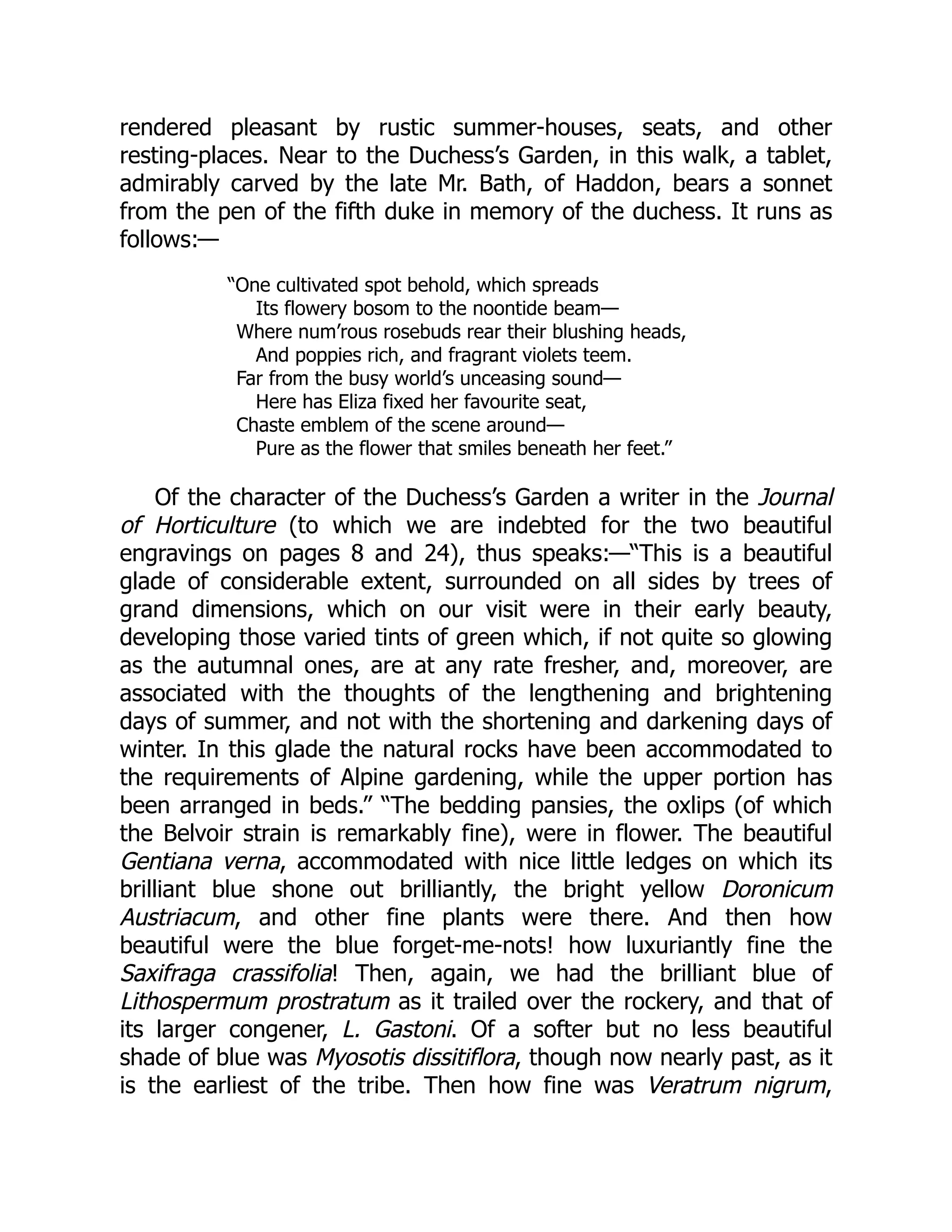
The Statue Garden.
The whole place is a labyrinth of beauty, each separate spot that
we come to exceeding in exquisite loveliness those we have passed,
and each turn bringing to view fresh glimpses of charming scenery
which show how well Nature has been studied, and how thoroughly
Art, with the pure and accomplished taste of the late duchess, has
been wedded to her. The Duchess’s Garden, below the slope on the
west of the castle, is formed in an exquisite glade, surrounded on all
sides by grand old trees and luxuriant shrubs; the beds terraced one
above the other, or gently sloped and planted in amphitheatre form,
with masses of colour which give a richness and peculiarity to the
scene. The Duke’s Walk—an avenued path extending in its devious
way for about three miles in length—passes above this garden, and
is broken by glimpses of all the varied scenery on the way, and
rendered pleasant by rustic summer-houses, seats, and other
resting-places. Near to the Duchess’s Garden, in this walk, a tablet,
admirably carved by the late Mr. Bath, of Haddon, bears a sonnet
from the pen of the fifth duke in memory of the duchess. It runs as
follows:—
“One cultivated spot behold, which spreads
Its flowery bosom to the noontide beam—
Where num’rous rosebuds rear their blushing heads,
And poppies rich, and fragrant violets teem.
Far from the busy world’s unceasing sound—
Here has Eliza fixed her favourite seat,
Chaste emblem of the scene around—
Pure as the flower that smiles beneath her feet.”
Of the character of the Duchess’s Garden a writer in the Journal
of Horticulture (to which we are indebted for the two beautiful
engravings on pages 8 and 24), thus speaks:—“This is a beautiful
glade of considerable extent, surrounded on all sides by trees of
grand dimensions, which on our visit were in their early beauty,
developing those varied tints of green which, if not quite so glowing
as the autumnal ones, are at any rate fresher, and, moreover, are
associated with the thoughts of the lengthening and brightening
days of summer, and not with the shortening and darkening days of
winter. In this glade the natural rocks have been accommodated to
the requirements of Alpine gardening, while the upper portion has
been arranged in beds.” “The bedding pansies, the oxlips (of which
the Belvoir strain is remarkably fine), were in flower. The beautiful
Gentiana verna, accommodated with nice little ledges on which its
brilliant blue shone out brilliantly, the bright yellow Doronicum
Austriacum, and other fine plants were there. And then how
beautiful were the blue forget-me-nots! how luxuriantly fine the
Saxifraga crassifolia! Then, again, we had the brilliant blue of
Lithospermum prostratum as it trailed over the rockery, and that of
its larger congener, L. Gastoni. Of a softer but no less beautiful
shade of blue was Myosotis dissitiflora, though now nearly past, as it
is the earliest of the tribe. Then how fine was Veratrum nigrum,
Welcome to our website – the ideal destination for book lovers and
knowledge seekers. With a mission to inspire endlessly, we offer a
vast collection of books, ranging from classic literary works to
specialized publications, self-development books, and children's
literature. Each book is a new journey of discovery, expanding
knowledge and enriching the soul of the reade
Our website is not just a platform for buying books, but a bridge
connecting readers to the timeless values of culture and wisdom. With
an elegant, user-friendly interface and an intelligent search system,
we are committed to providing a quick and convenient shopping
experience. Additionally, our special promotions and home delivery
services ensure that you save time and fully enjoy the joy of reading.
Let us accompany you on the journey of exploring knowledge and
personal growth!
ebookultra.com

Qualitative Research Bridging the Conceptual Theoretical and Methodological Sharon M. Ravitch
  • 1.
    Download the fullversion and explore a variety of ebooks or textbooks at https://ebookultra.com Qualitative Research Bridging the Conceptual Theoretical and Methodological Sharon M. Ravitch _____ Follow the link below to get your download now _____ https://ebookultra.com/download/qualitative-research- bridging-the-conceptual-theoretical-and-methodological- sharon-m-ravitch/ Access ebookultra.com now to download high-quality ebooks or textbooks

  • 2.
    We have selectedsome products that you may be interested in Click the link to download now or visit ebookultra.com for more options!. The International Handbook of Social Impact Assessment Conceptual and Methodological Advances Henk A. Becker https://ebookultra.com/download/the-international-handbook-of-social- impact-assessment-conceptual-and-methodological-advances-henk-a- becker/ Archaeology and Language I Theoretical and Methodological Orientations 1st Edition Roger Blench https://ebookultra.com/download/archaeology-and-language-i- theoretical-and-methodological-orientations-1st-edition-roger-blench/ The SAGE Encyclopedia of Qualitative Research Methods Volumes 1 2 1st Edition Lisa M. Given https://ebookultra.com/download/the-sage-encyclopedia-of-qualitative- research-methods-volumes-1-2-1st-edition-lisa-m-given/ Learning by Expanding An Activity Theoretical Approach to Developmental Research 2nd Edition Yrjö Engeström https://ebookultra.com/download/learning-by-expanding-an-activity- theoretical-approach-to-developmental-research-2nd-edition-yrjo- engestrom/
  • 3.
    Qualitative Research Methods3rd Edition Pranee Liamputtong https://ebookultra.com/download/qualitative-research-methods-3rd- edition-pranee-liamputtong/ Designing Qualitative Research 6th Edition Catherine Marshall https://ebookultra.com/download/designing-qualitative-research-6th- edition-catherine-marshall/ Qualitative Research in Social Work Introducing Qualitative Methods series 1st Edition Ian F Shaw https://ebookultra.com/download/qualitative-research-in-social-work- introducing-qualitative-methods-series-1st-edition-ian-f-shaw/ Understanding Qualitative Research and Ethnomethodology 1st Edition Paul Ten Have https://ebookultra.com/download/understanding-qualitative-research- and-ethnomethodology-1st-edition-paul-ten-have/ Understanding Qualitative Research and Ethnomethodology 1st Edition Paul Ten Have https://ebookultra.com/download/understanding-qualitative-research- and-ethnomethodology-1st-edition-paul-ten-have-2/
  • 5.
    Qualitative Research Bridgingthe Conceptual Theoretical and Methodological Sharon M. Ravitch Digital Instant Download Author(s): Sharon M. Ravitch; Nicole Mittenfelner Carl ISBN(s): 9781483351742, 1483351742 Edition: Paperback File Details: PDF, 18.42 MB Year: 2015 Language: english

  • 7.
  • 8.
    We dedicate thisbook to Our Children: Maxwell and Evelyn, who were born during the writing of this book. Ari and Lev, who continued to grow, teach, and learn as we wrote. We hope this book will contribute to your generation and beyond through the good work of those who read this and use research as a tool to help heal our world. And to Our Students: Whose questions, passions, concerns, and commitments have shaped this book beyond words. Thank you for your engaging learning, your curiosity, and for being our teachers. Curiosity as restless questioning, as movement toward the revelation of something hidden, as a question verbalized or not, as search for clarity, as a moment of attention, suggestion, and vigilance, constitutes an integral part of the phenomenon of being alive. There could be no creativity without the curiosity that moves us and sets us patiently impatient before a world that we did not make, to add to it something of our own making. —Paulo Freire, Pedagogy of Freedom 3
  • 9.
    Qualitative Research Bridging theConceptual, Theoretical, and Methodological SHARON M. RAVITCH University of Pennsylvania NICOLE MITTENFELNER CARL University of Pennsylvania 4
  • 10.
    FOR INFORMATION: SAGE Publications,Inc. 2455 Teller Road Thousand Oaks, California 91320 E-mail: order@sagepub.com SAGE Publications Ltd. 1 Oliver’s Yard 55 City Road London EC1Y 1SP United Kingdom SAGE Publications India Pvt. Ltd. B 1/I 1 Mohan Cooperative Industrial Area Mathura Road, New Delhi 110 044 India SAGE Publications Asia-Pacific Pte. Ltd. 3 Church Street #10-04 Samsung Hub Singapore 049483 Copyright © 2016 by SAGE Publications, Inc. All rights reserved. No part of this book may be reproduced or utilized in any form or by any means, electronic or mechanical, including photocopying, recording, or by any information storage and retrieval system, without permission in writing from the publisher. Printed in the United States of America ISBN 978-1-4833-5174-2 This book is printed on acid-free paper. Acquisitions Editor: Vicki Knight Editorial Assistant: Yvonne McDuffee eLearning Editor: Katie Bierach Production Editor: Libby Larson Copy Editor: Gillian Dickens Typesetter: C&M Digitals (P) Ltd. Proofreader: Dennis W. Webb Indexer: Wendy Allex Cover Designer: Leonardo March Marketing Manager: Nicole Elliott 5
  • 11.
  • 12.
  • 13.
    Detailed Contents Foreword Preface Acknowledgments About TheAuthors 1 Qualitative Research: An Opening Orientation Chapter Overview and Goals An Overview of the Processes of Qualitative Research Figure 1.1: The Dynamic Elements of Qualitative Research Situating Qualitative Research Defining Qualitative Research Key Components of Qualitative Research Table 1.1: Components of Qualitative Research The Role of the Researcher in Qualitative Research Horizontals in Qualitative Research: Criticality, Reflexivity, Collaboration, and Rigor Criticality Reflexivity Collaboration Rigor Approaches to Qualitative Research: An Overview Table 1.2: Approaches to Qualitative Research A Note on the Possibilities of Qualitative Research Questions for Reflection Resources for Further Reading 2 Using Conceptual Frameworks in Research Chapter Overview and Goals Defining and Understanding Conceptual Frameworks and Their Role in Research What Is a Conceptual Framework? The Components of a Conceptual Network What Does a Conceptual Framework Help You Do? Figure 2.1: The Components of a Conceptual Framework The Roles and Uses of a Conceptual Framework Constructing and Developing a Conceptual Framework The Role of the Researcher in Conceptual Frameworks The Role of Tacit Theories in a Conceptual Framework How Study Goals Influence and Inform a Conceptual Framework Conceptual Frameworks and the Role of Setting and Context Table 2.1: Questions for Considering the Goals of Your Study 8
  • 14.
    Broader Macro-Sociopolitical Contextsand Conceptual Frameworks Table 2.2: Questions for Considering the Setting and Context(s) of Your Study Table 2.3: Questions to Help You Think Through the Macro-Sociopolitical Contexts That Shape Your Research The Role of Formal Theory in Conceptual Frameworks Table 2.4: Questions to Consider When Incorporating Formal Theory Into Your Research Building Your Own Conceptual Framework Recommended Practice 2.1: Conceptual Framework Memo Recommended Practice 2.2: Concept Map of Conceptual Framework Example 2.1: Conceptual Framework Memo and Accompanying Concept Map Questions for Reflection Resources for Further Reading 3 Critical Qualitative Research Design Chapter Overview and Goals Research Design in Qualitative Research Overview of the Qualitative Research Design Process Developing Study Goals and Rationale Table 3.1: Questions to Consider When Developing a Research Study and Study and Rationale Memos on Study Goals and Rationale Recommended Practice 3.1: Researcher Identity/Positionality Memo Example 3.1: Researcher Identity/Positionality Memo Example 3.2: Researcher Identity/Positionality Memo Dialogic Engagement Practices Recommended Practice 3.2: Structured Sets of Conversations Recommended Practice 3.3: Paired Question and Reflection Exercise Reflective Journaling Recommended Practice 3.4: Research Journal Formulating (and Iterating) Research Questions Recommended Practice 3.5: Mapping of Goals, Topic, and Research Questions Recommended Practice 3.6: Connecting Research Questions With Methods Recommended Practice 3.7: Theoretical Framework Charting Memos and Dialogic Engagement Practices to Support Research Question Development and Refinement Recommended Practice 3.8: Memo on Core Constructs in Research Questions Recommended Practice 3.9: Memo on Goals of Each Research Question Recommended Practice 3.10: Dialogic Engagement Practices for Research Questions Conceptual Framework in Research Design The Development of a Theoretical Framework Table 3.2: The Roles of Theoretical Frameworks in Qualitative Research 9
  • 15.
    Table 3.3: QuestionsThat Can Guide the Literature Review Process Recommended Practice 3.11: Theoretical Framework Memo Recommended Practice 3.12: Implicit Theory Memo Research Design, Methods Choices, and Writing Site and Participant Selection Piloting Table 3.4: Reasons for and Values of Conducting Pilot Studies Vetting Instruments Rehearsing Instruments Piloting Instruments Writing Table 3.5: Steps for Vetting, Rehearsing, and Piloting Instruments Recommended Practice 3.13: Critical Research Design Memo Recommended Practice 3.14: The “Two-Pager” Research Design Memo Example 3.3: Critical Research Design Memo Recommended Practice 3.15: Group Inquiry Processes Validity and Trustworthiness in/Through Research Design Conceptualizing Critical Qualitative Research Design Questions for Reflection Resources for Further Reading 4 Design and Reflexivity in Data Collection Chapter Overview and Goals Defining Qualitative Data Collection as Iterative Figure 4.1: The Processes of Qualitative Research Data Collection and Research Design Reflexivity and Researcher-Generated Data Sources Table 4.1: Questions to Help Achieve Design Complexity Table 4.2: Reflexive Data Generation Questions Fieldwork and Data Collection Memos Recommended Practice 4.1: Fieldwork and Data Collection Memos Example 4.1: Fieldwork/Data Collection Memo Fieldwork Research Journal Research Log Contact Summary Forms Researcher Interviews Sampling: Site and Participant Selection Site Selection Participant Selection Table 4.3: Purposeful Sampling Strategies Recommended Practice 4.2: Site and Participant Selection Memo 10
  • 16.
    Example 4.2: Siteand Participant Selection Memo Questions for Reflection Resources for Further Reading 5 Methods of Data Collection Chapter Overview and Goals Interviews Key Characteristics and Values of Qualitative Interviews Table 5.1: Considerations for Developing and Conducting Interviews Constructing Qualitative Interviews Developing Interviewing Skills Table 5.2: Advice for Before, During, and After Interviews Technology and Interviews Table 5.3: Tips for Developing Interview Instruments (Protocols) Interview Transcripts Table 5.4 Considerations for Transforming Recorded Data Into Transcripts Observation and Fieldnotes Fieldnotes Participant Observation Recommended Practice 5.1: Observation and Fieldnotes Exercise Recommended Practice 5.2: Observation and Fieldnotes Memo Focus Groups Table 5.5: Suggestions for Focus Groups Documents and Archival Data A Survey Approach and Questionnaires Table 5.6: Tips for Effective Questionnaire Design Participatory Methods of Data Collection Photovoice Community-Based Oral Testimony Social Network, Community, and Institutional Mapping Transect Walks Revisiting Design Table 5.7: Considerations to Ensure Methods Align With Research Questions Figure 5.1: Considerations to Ensure Methods Align With Research Questions Questions for Reflection Resources for Further Reading 6 Validity: Processes, Strategies, and Considerations Chapter Overview and Goals Overview of Validity and Trustworthiness in Qualitative Research Assessing Validity and Trustworthiness Validity Criteria: Credibility, Transferability, Dependability, and Confirmability 11
  • 17.
    Types of Validity Table6.1: Reflexive Validity Questions Specific Strategies and Processes for Achieving Validity Triangulation Participant Validation Strategies (Also Known as “Member Checks”) Strategic Sequencing of Methods Thick Description Dialogic Engagement (Also Known as Peer Debriefers, Critical Friends, and Critical Inquiry Groups) Strengths and Challenges of Dialogic Engagement Multiple Coding (Also Known as Interrater Reliability) Structured Reflexivity Processes in Validity Table 6.2: Questions to Consider Related to Research Skills Recommended Practice 6.1: Validity/Trustworthiness Research Design Memo Example 6.1: Validity Excerpt From a Dissertation Proposal Mixed-Methods Research Rigor and Validity in Qualitative Research Questions for Reflection Resources for Further Reading 7 An Integrative Approach to Data Analysis Chapter Overview and Goals Defining and Critically Approaching Qualitative Data Analysis Table 7.1: Considerations for Critically Approaching Qualitative Data Analysis Analysis and Interpretation Overview of Data Analysis Processes Table 7.2: Overview of Qualitative Approaches to Data Analysis An Integrative Approach to Qualitative Data Analysis Qualitative Data Analysis Is an Iterative and Recursive Process Qualitative Data Analysis Is Formative and Summative Data and Theory Triangulation in Qualitative Data Analysis Analytical Data Triangulation Image 7.1: Representation of Alternative Frames for Analysis Analytical Theoretical Triangulation Recognizing and Addressing Power Asymmetries Within Qualitative Data Analysis Table 7.3: Considerations for Trying to Resist Interpretive Authority Seeking Out Alternative Perspectives Recommended Practice 7.1: Structured Sets of Analytical Conversations Recommended Practice 7.2: Paired Question and Reflection Analysis Exercise Questions for Reflection Resources for Further Reading 12
  • 18.
    8 Methods andProcesses of Data Analysis Chapter Overview and Goals Data Organization and Management Data Management Plan Figure 8.1: Three-Pronged Data Analysis Process Table 8.1: Tips for Organizing and Managing Your Data Transcripts Precoding Table 8.2: Practical Considerations Regarding Transcription Recommended Practice 8.1: Precoding Memo Immersive Engagement Multiple Data Readings Recommended Practice 8.2: Formative Data Analysis Memo Data Analysis Strategies: Coding, Connecting, and Dialogic Engagement Coding Approaches to Coding Coding Processes Table 8.3: Concepts to Look for When Coding Data Other Coding Considerations Recommended Practice 8.3: Coding Memos Example 8.1: Coding Memo Example 8.2: Example Code Descriptions and Definitions Feature Box 8.1 Computer-Assisted Qualitative Data Analysis Software (CAQDAS) Connecting Strategies Dialogic Engagement Generating, Scrutinizing, and Vetting Themes Recommended Practice 8.4: Peer Data Analysis Review Session Table 8.4: A Sample Process for Developing Themes Analysis and Validity Table 8.5: Validity Strategies and Data Analysis Data Saturation Writing and Representation Memos Recommended Practice 8.5: Vignette Memo Other Writing Considerations Questions for Reflection Resources for Further Reading 9 Writing and Representing Inquiry: The Research Report Chapter Overview and Goals The Craft of Writing: Outlining, Drafting, and Revising 13
  • 19.
    Recommended Practice 9.1:Mini Presentations Writing a Final Report: Building On, Deepening, and Codifying Analysis Goals, Audience(s), and Purposes Articulating Your Study’s Purpose Table 9.1: Questions to Consider Related to the Purpose(s) and Audience(s) of Your Study Recommended Practice 9.2: Speed Research Exchange Format and Structure of a Final Research Report Sample Qualitative Report Structure Example 9.1: Sample Final Report Template Table 9.2: Questions to Consider for Determining How to Structure a Final Research Report Incorporating and Representing Data Using Quotations Other Considerations for Representing Data Table 9.3: Questions for Considering How to Include and Represent Data Finding a Balance Between Description and Analysis Voice, Language, and Participant Portrayal Table 9.4: Questions to Consider Related to Participant Voice and Language Choices Critical Writing Considerations Concluding Thoughts: The Ethics of Research Writing Table 9.5: Considerations for Writing and Representing Qualitative Data Questions for Reflection Resources for Further Reading 10 Crafting Qualitative Research Proposals Chapter Overview and Goals Qualitative Research Proposals Components of Research Proposals The Introduction Table 10.1: Qualitative Research Proposal Template The Conceptual Framework Methodology and Research Design Table 10.2: Data Analysis Proposal Considerations Table 10.3: Matrix for Detailing How Methods Align With Research Questions Aligning Methods With Research Questions Ongoing Considerations Recommended Practice 10.1: Proposal Move-Forward Discussion Writing Quality Proposals Table 10.4: Characteristics of Strong Research Proposals Example 10.1: Dissertation Proposal Adapting Research Proposals 14
  • 20.
    Questions for Reflection Resourcesfor Further Reading 11 Research Ethics and the Relational Quality of Research Chapter Overview and Goals Relational Ethics: Taking a Relational Approach to Research Deepening the Concept of Research Ethics: Beyond IRB and Informed Consent Institutional Review Boards, Ethics Committees, and Codes of Ethics Going Beyond “Negotiating Entrée” and “Building Rapport” Table 11.1: Considerations for Establishing and Maintaining Healthy Research Relationships Research Boundaries Example 11.1: On the Need for Proactive Thought on Boundaries With Participants Example 11.2: On the Need to Set and Manage Expectations With Site and Participants Table 11.2: Considerations Related to Establishing and Maintaining Relationships With Participants Reciprocity: Not as Simple as It May Seem Informed Consent, With an Emphasis on Informed Table 11.3: Consent Form Overview and Contents Assent Transparency in Goals, Expectations, Processes, and Roles Confidentiality and Anonymity Table 11.4: Transparency-Related Questions to Consider Data Management and Security in the Information Age Example 11.3: Lost Phone Creates Breach in Confidentiality Table 11.5: Considerations Related to Data Management and Security The Ethical Dimensions of the “Researcher as Instrument” Pushing Against the “Expert-Learner Binary” Ethical Collaboration: “Reciprocal Transformation and Dialectics of Mutual Influence” Table 11.6: Considerations for Collaborating With Colleagues, Peers, Thought Partners, Advisers, and Teachers Table 11.7: Considerations for Collaborating With Research Participants Recommended Practice 11.1: Ethical Collaboration Memo Balance Between Design Flexibility and Rigor: Responsive Research as Ethical Stance Questions for Reflection Resources for Further Reading Epilogue: Revisiting Criticality, Reflexivity, Collaboration, and Rigor Revisiting the Horizontals in Qualitative Research Criticality Feature Box 12.1: Criticality in Qualitative Research Reflexivity 15
  • 21.
    Exploring the Varietyof Random Documents with Different Content
  • 22.
    being on oneside bounded by Lincoln Minster (which is, in a clear atmosphere, distinctly visible) and the hills beyond, although thirty miles off “as the crow flies.” Its immediate neighbourhood, the lovely and fertile “vale of Belvoir,” the theme of poet and prose-writer, and the delight of the painter and lover of nature, lies immediately below, while beyond are miles of lovely country, gloriously diversified with wood and water, and studded at intervals with hamlets, villages, and homesteads, which add greatly to the beauty of the scene. Belvoir Castle from the Grantham Road. A marked and peculiar character of Belvoir, and one of its greatest charms, is that it stands in the midst of this open country, not within the confines of its own park. There is no enclosed park; and park palings, lodges, bolts, bars, and locks are unknown. The Duke, in this noble mansion, rests in the midst of his immense estates, and draws no cordon around him. The roads, right up to the very castle, are open and free to all, and restriction is unknown. For miles in extent, and from every side, the public may wander on foot, or ride or drive, through the estate and up to the very doors, unmolested, and untrammelled by fear of porters, or deterred by
  • 23.
    appliances of stateor ceremony. The stronghold of the De Todenis, the Albinis, the Especs, the De Ros’, and the Manners’, thus nestles securely in the very heart of the country, as does its noble owner— the descendant and representative of this long line of illustrious men —in the hearts of his tenantry, his friends, and all who have the privilege of knowing him. Arms of De Todeni, De Albini, and De Ros. The history of Belvoir Castle dates back to very early times, and is invested with more than ordinary interest. Leaving the question as to its site having originally been a Celtic stronghold taken possession of and formed into a station, or something of the kind, by the Romans, to be discussed elsewhere, it is sufficient for our present purpose to say that at the Norman Conquest, Belvoir, with some fourscore manors, was given by William the Conqueror to his faithful standard-bearer, Robert de Todeni, who here built a castle and founded a monastery. This monastery, situated at the foot of the castle hill, and on whose site many interesting remains have in late years been exhumed, was established in 1077, and was endowed with large estates; its founder, Robert Belvidir or De Todeni, agreeing to give to it for ever a tenth part of all the lands he might acquire by the help of God or the grant of the King. This priory was established for four monks of the Benedictine Order (and afterwards became a cell of the Abbey of St. Albans), who were to pray for the souls of the King, of the Earl of Cornwall, of Robert de Todeni, and Adelais, his wife, and of their parents and children. Robert de Todeni died in 1088, and, with his wife, who predeceased him, was buried in the
  • 24.
    priory at Belvoirwhich he had founded. He was succeeded by his son William, who took the surname of De Albini Brito, by whom the grants to the priory were confirmed and increased, and he obtained for the monks a grant of a fair for eight days in the year on the feast of St. John the Baptist. He married Maud de St. Liz, widow of Robert de Tonebrigg, daughter of Simon, Earl of Northampton and Huntingdon, and, dying in 1155, he, too, was buried at Belvoir, and was succeeded by his son, William de Albini, or Meschines (also buried here), who in turn was succeeded by his son, the third William de Albini, whose name, in connection with King John and Magna Charta, is matter of history. During his imprisonment at Corfe Castle by his unforgiving king, Belvoir Castle was, at the summons of the sovereign, surrendered into his hands. Under Henry III., Albini, being reinstated in favour, had a chief command at the battle of Lincoln, and took part in most of the stirring events of the period. Besides adding to the endowments of Belvoir Priory, he founded the Hospital of Our Lady at Newstead, for the health of the souls of himself and his two wives, and there his body was buried in 1236, while his heart was placed under the wall opposite the high altar at Belvoir. He married Agatha Trusbut, for the privilege of marrying whom he gave the King 600 marks (about £6,000 of our money). He was succeeded by his son, the fourth William de Albini, or, as he was called, William de Belvoir, who left no male issue, but, by his wife Albreda Biset, had an only child, a daughter Isabel, who married Robert de Ros, Lord of Hamlake, fifth in regular descent from Peter de Ros, who, by marriage with Adeline, daughter of Walter Espec, became the inheritor of two princely fortunes. Thus by the marriage of Isabel de Albini with Robert de Ros the estates of Espec, Ros, and Albini became united. This Robert de Ros, after his accession to the Belvoir estates, obtained a grant of free warren and a weekly market there from Henry III. Later on, as one of the insurgent barons, he was imprisoned and fined. In 1267 he raised a new embattled and fortified wall at Belvoir Castle. He died in 1285; his body being buried at Kirkham, his bowels before the high altar at Belvoir, and his
  • 25.
    heart at CroxtonAbbey. At the suppression of the monasteries part of the monument which had been placed over his heart at Croxton was removed to Bottesford Church, where it still remains in the chancel wall. His widow, Isabel, died in 1301, and was buried at Newstead. He was succeeded by his son, William de Ros, who became an unsuccessful competitor for the crown of Scotland, founding his claim on his descent from his great-grandmother Isabel, daughter to William the Lion, King of Scotland. By his marriage with Matilda de Vaux he added to the family estates and ecclesiastical patronage; and on his death, in 1317, was succeeded by his son, William de Ros, who was created Lord Ros of Werke; became Baron Ros of Hamlake, Werke, Belvoir, and Trusbut; was summoned to Parliament, second Edward II. to sixteenth Edward III.; was made Lord High Admiral, and one of the Commissioners to treat for peace with Robert Bruce. He died in 1342, and was succeeded by his son, William de Ros, who, after a busy military life, fighting against the Scots, at the siege of Calais, and against the Saracens, died on his way to the Holy Land, and was buried abroad. He married Margaret, daughter of Ralph, Lord Nevill, who survived him, and afterwards married Sir Henry de Percy. Dying without issue he was succeeded by his brother, Thomas de Ros; who, having married, in 1359, Beatrice, daughter of the Earl of Strafford and widow of the Earl of Desmond, was in turn followed by his son, John de Ros, who dying without issue, was succeeded by his brother, Sir William de Ros. Sir William was, with Walter, Bishop of Durham, and the Earl of Northumberland, sent by King Henry IV. to arrange a treaty of peace with Scotland. He was a favourite with the King, who gave him many important offices; made him a K.G.; and granted him the town of Chingford, in Essex. By his wife, Margaret, of the family of the Earl of Arundel, Sir William had issue five sons and four daughters. He died at Belvoir Castle in 1414, and was buried in the choir of that priory, his monument being now at Bottesford. The next in succession was John de Ros, son of the last named, who came to the title and estates when only seventeen years of age. He was killed along with the Duke of Clarence and
  • 26.
    others in 1421;and, dying without issue, had for successor his brother, Sir Thomas de Ros, who married Eleanor, daughter of Richard de Beauchamp, Earl of Warwick, by whom he had issue three sons, of whom his successor, Thomas, Lord Ros, was the eldest, and who, at his father’s death in 1431, was only four years of age. This nobleman, Thomas, Baron Ros of Hamlake, Trusbut, and Belvoir, was by the King put into full possession of his father’s estates when only eighteen years of age. He married Philippa, eldest daughter of John de Tiptoft, by whom he had issue one son and four daughters. For his fidelity to the House of Lancaster in the Wars of the Roses, he was, with his adherents, attainted in Parliament in 1461, and is said by Rapin to have been beheaded. His estates were confiscated, and given to various adherents of the House of York; Lord Hastings receiving Belvoir and its members. By him Belvoir Castle was utterly despoiled, he carrying away the lead from the roofs to Ashby-de-la-Zouch, to use in his own castle there, and rendering the place no better than a ruin. The next in succession, Edmund, Lord Ros, was by Henry VII. (who had united the rival houses) restored to his father’s state and dignity; the attainder was removed; and the Belvoir and other estates returned to him. He died in 1508, at his house of Elsinges, at Enfield (in the church at which, place is a noble monument erected to his memory), without issue, and his estates were divided between his sisters and co-heiresses—viz. Eleanor, married to Sir Robert Manners, Knight; and Isabel, married to Sir Thomas Lovel. Belvoir, with Hamlake in Yorkshire, and Orston in Nottinghamshire, being the portion of the elder sister, Eleanor, thus passed into the hands of the family of Manners, in whom it has remained in unbroken succession to the present hour. The manor of Elsinges, which had passed to Sir Thomas Lovel, as part of his wife’s portion, was bequeathed by him to the Earl of Rutland. This Sir Robert Manners, who, as we have said, acquired Belvoir through his marriage with one of the co-heiresses of the last Lord de Ros, was descended from a long line of Manners’ of
  • 27.
    Ancient Arms of Manners. Northumberland.The earliest of these of whom there is direct evidence was Sir Robert Manners, lord of the manor of Ethale, in Northumberland, from whom descended another Sir Robert, who married Philippa, daughter of Sir Bartholomew de Mont Bouchier, by whom he had issue a son, also named Robert, who married Hawise, daughter of Robert, Baron de Muschamp, in the reign of Henry I. Their great-grandson, another Sir Robert Manners, married Agnes, daughter of Sir David Coupland. Their son, Sir Robert, had issue by his wife, Joan de Heton, four sons, three of whom dying without issue, the second son, William Manners, inherited the estates. He married Ellen, or Janetta, daughter of David Bagster, of Derby, by whom he had a son, Sir Robert Manners. This Sir Robert was returned, in the seventeenth year of Edward III., as one of the principal persons in the county of Northumberland, and was entitled to bear arms by descent. In the first year of Edward’s reign, being governor of Norham Castle, he distinguished himself by his successful defence of that stronghold against the Scots, who, “despising King Edward’s youth, on the very night of that day on which King Edward was crowned, intended to take Norham Castle by surprise; and so well managed their design that about sixteen of them had already mounted the walls. But the captain, Sir Robert Manners, being warned of the matter beforehand by one of his garrison, who was a Scotsman, had so well prepared to receive them, that of those who had mounted he took five or six, and put the rest to the sword, their companions below, upon this disappointment, retiring.” In the next year he was constituted one of the “conservators of the truce made with the Scots for all hostilities to cease.” Soon afterwards he was made sheriff of the county of Selkirk, and appointed to keep and defend the forts of Selkirk and Ettrick, &c. In the fourteenth of the same reign he represented Northumberland in Parliament, and again subdued Scotch incursions. Soon afterwards he obtained a license from the King “to strengthen
  • 28.
    and embattle hisdwelling-house at Ethale, in Northumberland, with a wall made of stone and lime, and to hold the same to himself and his heirs for ever.” The next year he was constituted one of the commissioners to treat with David Bruce and his adherents for a peace, and subsequently was made Lord of the Marches. At the battle of Neville’s Cross in 1346, under Queen Philippa, in which the Scottish king was taken prisoner, Sir Robert displayed great valour, and was intrusted to keep charge of the prisoners, and deliver them to the Constable at the Tower of London. He died in 1355, leaving his son and heir, John de Manners (by his wife, Aliva, or Alice, daughter of Henry Strather), only one year and three weeks old. Belvoir Castle from the North-west, showing the Grand Entrance. This John Manners received the honour of knighthood, and married Alice, widow of William de Whitchester; and, dying in 1402, was succeeded by his son, Sir John Manners, who was sheriff of Northumberland, and, with his son John, was accused of the murder of William Heron and Robert Atkinson, or Akyman. They were prosecuted by Sir Robert de Umphreville, and Isabel, widow of William Heron, and were ordered to “cause 500 masses to be sung for the health of the soul of the same William Heron within one year then next ensuing, and pay unto Sir Robert de Umphreville, and
  • 29.
    Augmented Arms of Manners. Isabel, tothe use of the said Isabel and her children by Heron, 200 marks.” He was succeeded by his son Robert, who married Joan, daughter of Sir Robert Ogle, and had issue by her, with others, a son, Robert, by whom he was succeeded. This was the Sir Robert Manners who married Eleanor, daughter of Thomas, Lord Ros, as already shown. Sir Robert Manners had issue by his wife, Eleanor Ros, three daughters, who each married into the family of Fairfax, and two sons. The elder of these sons was Sir George Manners, who, on the death of his mother, became Lord Ros or Roos, and was also lineal heir to the baronies of Vaux, Trusbut, and Belvoir. M ARRYING Anne, only daughter and heiress of Sir Thomas St. Leger, by his wife Anne, daughter of Richard, Duke of York, and sister to King Edward IV., and widow of John Holland, Duke of Exeter, this lady brought royal blood into the family. By her Sir George had a numerous family, the eldest of whom, Thomas, succeeded him. This Sir Thomas Manners, on the death of his father, became thirteenth Lord Ros, of Hamlake, and Baron Trusbut, Riveaulx, and Belvoir. He was with Henry VIII. and his queen at the celebrated interview between that monarch and the King of France at Guisnes, and in the same reign was made Warden of the East Marches, and had many other honours granted him. In the seventeenth year of the same monarch he was created Earl of Rutland —“a title which none but royal family had ever borne, and by reason of his descent from the sister of King Edward IV. had an augmentation to his ancient arms.” The old arms were—or two bars azure, and a chief gules; which chief was augmented thus quarterly azure and gules, in
  • 30.
    the first andfourth two fleurs-de-lis and in the second and third a lion passant guardant, all or. He was also installed a Knight of the Garter. A few years later this nobleman was present at the second interview between Henry VIII. and Francis I.; he was also present at the marriage of his sovereign with the ill-fated Anne Boleyn; and, later on, attended Anne of Cleves to England, and was made her chamberlain. He was made Chief Justice in Eyre of all the King’s lands north of the Trent, and obtained grants of the manors of Muston, Waltham, Croxton, Upwell, Bilsdale, Helmsley, Outwell, Elm, Emneth, Branston, &c., and lands belonging to several dissolved monasteries. He rebuilt Belvoir Castle, and removed many of the monuments from the dissolved priories of Croxton and Belvoir to Bottesford, where he himself was buried in 1543. His lordship—who took part in most of the events of this stirring reign, and held numerous important offices—married twice: first, Elizabeth, daughter of Sir Robert Lovel; and second, Eleanor, daughter of Sir William Paston, by the latter of whom only he had issue. To the eldest and second of that issue we now refer. The eldest son, Henry Manners, succeeded his father, in 1543, as second Earl of Rutland. He continued the rebuilding of Belvoir Castle, and was made Constable of Nottingham Castle, Chief Justice in Eyre of Sherwood Forest, &c. He was married twice: first, to Margaret, daughter of the fourth Earl of Westmoreland, by whom he had issue; and second, to Bridget, daughter of Lord Hussey, by whom he had no children. He was succeeded by his eldest son, Edward Manners, as third Earl of Rutland, who, dying without male issue, was succeeded by his brother, John Manners (the second son of the second earl), as fourth Earl of Rutland. This nobleman married Elizabeth, daughter of Francis Charlton, of Apsley, by whom he had issue, with others, three sons—Roger Manners, Sir Francis Manners, and Sir George Manners—who successively became fifth, sixth, and seventh Earls of Rutland. All these dying without surviving male issue, the title passed to the descendants of the second son of the first Earl, as we shall now show.
  • 31.
    Sir John Manners,second son of the first Earl of Rutland, and great-grandson of the sister of King Edward IV., became, before he was knighted, attached to Dorothy Vernon, the youngest daughter and co-heiress of Sir George Vernon of Haddon Hall, known as “the King of the Peak,” and so effectually wooed and won her, that he at length carried her off on horseback into his own county of Leicester, and there married her. By this marriage Haddon Hall, and the Derbyshire property of the “King of the Peak,” passed into the family of Manners. Sir John Manners had issue by his wife, Dorothy Vernon, three sons—Sir George, who succeeded him; John, who died at the age of fourteen; and Sir Roger, of Whitwell; and one daughter, Grace, who married Sir Francis Fortescue, of Salden. Sir George Manners, their son, married Grace, daughter of Sir Henry Pierrepoint, and sister to the Earl of Kingston, by whom he had issue, with others, John Manners, his eldest son, who not only succeeded him, but also succeeded his cousin George, seventh Earl of Rutland, in his title and estates, and thus became eighth Earl of Rutland. He married Frances, daughter of Edward, Lord Montague of Boughton, by whom he had issue four sons and seven daughters. He was sheriff of Derbyshire in the ninth and eleventh years of Charles I., and also represented that county in Parliament. His lordship was attached to the Parliamentary interest during the civil wars, and was one of the twenty-two peers who remained at Westminster when the King summoned both Houses to attend him at Oxford. As a consequence, his castle of Belvoir was seized by the Royalists, and was held by them and Sir Gervase Lucas, and here the King frequently resided. It was finally surrendered to the Parliamentarians in January, 1645-6. In 1649 the castle was demolished, by consent of the Earl, who soon afterwards set about rebuilding it, which he completed in 1668. During this time the Earl lived principally at Haddon Hall, where he died in 1679, and was succeeded by his third and only surviving son, John Manners, as ninth Earl of Rutland. This nobleman was born in 1638, and, in 1679 was created a peer in his own right by the title of Baron Manners of Haddon; and in September of the same year, his father dying, he became Earl of
  • 32.
    Rutland. When twentyyears of age he had married the Lady Anne Pierrepoint, daughter of the Marquis of Dorchester, from whom he was afterwards divorced; and he married, secondly, Lady Diana Bruce, widow of Sir Seymour Shirley, and daughter of the Earl of Aylesbury, who died in child-bed. His lordship married, thirdly, Catherine, daughter of Baptist Noel, Viscount Camden, by whom only he had surviving issue. In 1703 the Earl was raised to the highest dignity in the realm, by the titles of Marquis of Granby and Duke of Rutland. He died in January, 1710-11, aged seventy-three, and was succeeded by his only surviving son, John Manners. John, second Duke of Rutland, when scarcely seventeen years of age, was married to Katherine, second daughter of Lord William Russell, who was beheaded in 1683. He then bore the title of Lord Roos; and the wedding festivities seem, judging from some curious letters still extant concerning them, to have been of the most lavishly extravagant character. This lady, who was sister to the Duchess of Devonshire and to the Duke of Bedford, gave birth to five sons and four daughters, and died in child-bed in 1711. The Duke married, secondly, Lucy, daughter of Lord Sherard, and sister of the Earl of Harborough, by whom also he had issue six sons and two daughters. His grace died in 1721, and was succeeded, as third Duke of Rutland, by his eldest son, John Manners. This nobleman, who was born in 1696, married, in 1717, Bridget, only daughter and heiress of Robert Sutton, Lord Lexington (an alliance that gave him a large accession of estates), by whom he had issue thirteen children, nearly all of whom died young. He it was who built the hunting-seat at Croxton, and made many improvements at Belvoir Castle. He was the last of the family who made Haddon Hall a residence. The estates of Lord Lexington having been settled upon the younger branch of the family, the second and surviving sons, successively, took, by Act of Parliament, the additional surname of Sutton, and thus founded the family of Manners-Sutton. The Duke, who was familiarly known as “Old John of the Hill,” dying in 1779, was succeeded by his grandson, Charles Manners, son of the celebrated Marquis of Granby, Commander-in-chief of the
  • 33.
    British forces inGermany, and Master of the Ordnance, who died during his father’s lifetime. Charles, fourth Duke of Rutland, married Mary Isabella, daughter of Charles Noel, Duke of Beaufort, by whom he had issue four sons—viz. Lord John Henry (who succeeded him), Lord Charles Henry Somerset, Lord Robert William, and Lord William Robert Albini; and two daughters—viz. the Lady Elizabeth Isabella, married to Richard Norman, Esq., and Lady Catherine Mary, married to Lord Forester. His Grace died while holding office as Lord- Lieutenant of Ireland, and was succeeded by his eldest son— John Henry Manners, as fifth Duke of Rutland, who married Elizabeth, daughter of the Earl of Carlisle, and by her had issue six sons and five daughters. The sons were—Lord George Henry Manners, to whom King George III. stood sponsor in person, but who died in infancy; Lord George John Frederick Manners, to whom the Prince Regent and H.R.H. the Duke of York stood sponsors in person, but who also died in infancy; Lord Charles Cecil John Manners (the present Duke of Rutland); Lord Adolphus Edward Manners, who died in infancy: Lord John James Robert Manners, M.P., the present eminent statesman and man of letters; and Lord George John Manners, M.P., who married in 1855 the Lady Adeliza Matilda Howard, daughter of the thirteenth Duke of Norfolk, and died in 1875. The five daughters were—the Lady Caroline Isabella Manners, who died in infancy; the Lady Elizabeth Frederica Manners, now the widow of Andrew Robert Drummond, Esq.; the Lady Emmeline Charlotte Elizabeth Manners (deceased), married to the Hon. Charles Stuart Wortley; the Lady Katherine Isabella Manners (deceased), married to Earl Jermyn; and the Lady Adeliza Gertrude Elizabeth Manners, married to the Rev. Frederick John Norman, Rector of Bottesford. The present noble head of the House of Manners is, as we have just stated, his Grace Charles Cecil John Manners, the sixth Duke of Rutland, Marquis of Granby, fourteenth Earl of Rutland, Baron Manners of Haddon, Baron Ros of Hamlake, Baron Trusbut, Riveaulx, and Belvoir, K.G., &c., the “King of Belvoir,” as he may not inaptly be called, for his is a regal residence, and he reigns in the hearts of the
  • 34.
    people around him.He is, therefore, the direct descendant and representative in unbroken succession of the grand old standard- bearer of William the Conqueror, Robert de Todeni, and of the families of De Albini, Espec, De Ros, and Manners; and by equally direct descent he has royal blood coursing through his veins. His grace was born in 1815, and was educated at Eton and at Trinity College, Cambridge, where he took his M.A. degree in 1835; was M.P. for Stamford from 1837 to 1852, and from that time to his accession to the titles in 1867, for North Leicestershire; and he was a Lord of the Bed-chamber to the late Prince Consort. His grace is not married, the heir to his titles, estates, and revenues being his brother, Lord John Manners, who is a worthy representative of the long and illustrious line from which he has sprung. The Duke is patron of twenty-four livings, of which one is in Rutland, fifteen in Leicestershire, two in Lincolnshire, two in Cambridgeshire, two in Nottinghamshire, and two in Derbyshire. His seats are—Belvoir Castle, in Leicestershire; Haddon Hall and Longshawe Lodge, in Derbyshire; and Cheveley Park, in Cambridgeshire. Lord John Manners was born in 1818, and in 1851 married Louisa Catherine, daughter of Colonel Marlay, by whom he had issue one son (the present Henry John Brinsley Manners), and another who died in infancy. This lady, dying in 1854, was buried at Rowsley, where a magnificent monument—one of the happiest efforts of W. Calder Marshall—has been erected to her memory. His lordship married secondly, in 1862, Janetta, eldest daughter of Thomas Hughan, Esq., by whom he has issue several children. Lord John Manners has held many important offices. He was sworn a Privy Councillor, and appointed First Commissioner of Works and Buildings, which office he held many years, and in 1874 was appointed Postmaster-General. The arms of the Duke of Rutland are—or, two bars, azure; augmented by a chief, quarterly, first and fourth azure, two fleurs- de-lis, or (France), second and third gules, a lion passant guardant, or (England). Crest, on a chapeau, gules, turned up, ermine, a peacock in pride, proper. Supporters, two unicorns, argent, horns,
  • 35.
    Arms of Dukeof Rutland. manes, tufts, and hoofs, or. Motto, “Pour y parvenir.” The ancient arms of Manners, before the augmentation, were, or, two bars, azure, and a chief, gules. Belvoir Castle, as it now stands, is an erection of the present century, built upon Norman foundations. As we have already stated, the first castle was built by Robert de Todeni, standard-bearer to William the Conqueror, and considerably extended by his successors. In 1461, or thereabouts, it was despoiled (on the attainder of its noble owner) by the Lord Hastings, to whom it had been granted by the King. “The timber of the roof, being” by him “despoiled of the lead with which it was covered, rotted away; and the soil between the walls at the last grew full of elders, in which state the castle remained till it was partially rebuilt by the first Earl of Rutland, and completed by the second.” On the dissolution of the monasteries, many of the monuments of the Albini and Ros families were, by order of the first Earl, and later, by his successor, removed from Belvoir Priory to Bottesford Church, and others were also brought to the same place from Croxton Abbey. He commenced the rebuilding of the castle, which was completed by his son in 1555, “making it a nobler structure than it was before.”
  • 36.
    Belvoir Castle fromthe North-west. In 1619 the singular trial of an old woman, named Joan Flower, of Belvoir, and her two daughters, Margaret and Philippa, for sorcery, and causing the deaths of the two sons of the Earl of Rutland, took place, and resulted in the execution of the two younger “witches,” the old “monstrous malicious woman,” or “devil incarnate,” as she was styled, having died as she was being taken to gaol; and the destruction of her cat, “Rutterkin.” The two sons, whose deaths were laid to the charge of these miserable victims of superstition, were Henry, Lord Ros, and Francis Manners, his brother, sons of Francis, sixth Earl of Rutland, by his second wife, Cecilia, daughter of Sir John Tufton, and widow of Sir Henry Hungerford. That Joan Flower, aided by her profligate daughters, did cause the deaths of the two children, and attempt the lives of the Earl and Countess, probably by poison, seems most probable, and they were justly punished. The following account of this singular transaction, printed in 1619, describes— “Joan Flower as a monstrous woman, full of oaths, curses, and imprecations; and for any thing they saw by her, a plain atheist. Besides, of late days, her very countenance was estranged, her eyes very fiery and hollow, her speech fell and envious, her demeanour strange and exotic, and her conversation sequestered; so that the whole course of her life
  • 37.
    gave great suspicionthat she was a notorious witch; yea, some of her neighbours dared to affirm that she dealt with familiar spirits, and terrified them all with curses and threatening of revenge, if there were never so little cause of displeasure and unkindness. Concerning Margaret, the daughter, that she often resorted from the castle to her mother, bringing such provision as they thought was unbefitting for a servant to purloin; and coming at such unseasonable hours that they could not but conjecture some mischief between them, and that their extraordinary riot and expenses tended both to rob the lady and to maintain certain deboist and base company, which frequented this Joan Flower’s house, the mother, and especially the youngest daughter. Concerning Philippa, that she was leudly transported with the love of one Thomas Simpson, who presumed to say that she had bewitched him, for he had no power to leave her, and was, as he supposed, marvellously altered both in mind and body, since her acquainted company. These complaints began many years before either their conviction or public apprehension. Notwithstanding, such was the honour of this earl and his lady; such was the cunning of this monstrous woman, in observation towards them; such was the subtlety of the devil, to bring his purposes to pass; such was the pleasure of God, to make trial of his servants; and such was the effect of a damnable woman’s wit and malicious envy, that all things were carried away in the smooth channel of liking and good entertainment, on every side, until the earl refused to give that credence to her, on some complaint preferred, which he had been accustomed to give; and the countess discovering in the daughter Margaret some indecencies of her life, and neglect of her business, discharged her from lying any more in the castle; dismissing her with handsome presents, but commanding her to go home. This inflamed the mother with hatred and rancour towards the earl, and his family. “When the devil perceived the inficious disposition of this wretch, and that she, and her daughters, might easily be made instruments to enlarge his kingdom; and be, as it were, the executioners of his vengeance, not caring whether it lighted upon innocents, or no; he came more near unto them, and in plain terms, to come quickly to the purpose, offered them his service, and that in such a manner, as they might easily command what they pleased; for he would attend you in such pretty forms of dog, cat, or rat, that they should neither be terrified, nor any body else suspicious of the matter. Upon this, they agree, and (as it should seem) give away their souls to the service of such spirits, as he had promised them; which filthy conditions were ratified with abominable kisses, and an odious sacrifice of blood, not leaving out certain charms and conjurations, with which the devil deceived them, as though nothing could be done without ceremony, and a solemnity of orderly ratification. By this time doth sathan triumph,
  • 38.
    and goeth awaysatisfied to have caught such fish in the net of his illusions: by this time, are these women devils incarnate, and grow proud again in their cunning and artificial power, to do what mischief they listed. By this time, they have learnt the manner of incantations, spells, and charms. By this time, they kill what cattle they list; and under the cover of flattery and familiar entertainment, keep hidden the stinging serpent of malice, and a venomous inclination to mischief. By this time, is the earl and his family threatened, and must feel the burthen of a terrible tempest, which, by these women’s devilish devices, fell upon him; he neither suspecting nor understanding the same. By this time, both himself and his honourable countess, are many times subject to sickness and extraordinary convulsions; which they, taking as gentle corrections from the hand of God, submit with quietness to his mercy, and study nothing more than to glorify their Creator in heaven, and bear his crosses on earth. “At last, as malice increased in these damnable women, so his family felt the smart of their revenge and inficious disposition; for his eldest son, Henry, Lord Rosse, sickened very strangely, and after awhile, died. His next, named Francis, Lord Rosse accordingly, was severely tormented by them, and most barbarously, and inhumanly tortured by a strange sickness. Not long after, the Lady Catherine was set upon by their dangerous and devilish practices; and many times in great danger of life, through extreme maladies and unusual fits, nay, (as it should seem, and they afterwards confessed) both the earl and his countess were brought into their snares, as they imagined, and indeed determined to keep them from having any more children. Oh unheard of wickedness and mischievous damnation! Notwithstanding all this, did the noble earl attend his majesty, both at Newmarket, before Christmas; and at Christmas, at Whitehall; bearing the loss of his children most nobly; and little suspecting that they had miscarried by witchcraft, or such like inventions of the devil; until it pleased God to discover the villanous practices of these women, and to command the devil from executing any further vengeance on innocents, but leave them to their shames, and the hands of justice, that they might not only be confounded for their villanous practices, but remain as a notorious example to all ages, of his judgment and fury. Thus were they apprehended, about Christmas, and carried to Lincoln gaol; after due examination, before sufficient justices of the peace, and discreet magistrates, who wondered at their audacious wickedness. But Joan Flower, the mother, before her conviction, (as they say,) called for bread and butter, and wished it might never go through her, if she were guilty of that whereupon she was examined; so, mumbling it in her mouth, never spake more words after; but fell down and died, as she was carried to
  • 39.
    Lincoln gaol, witha horrible excruciation of soul and body, and was buried at Ancaster. “When the earl heard of their apprehension, he hasted down with his brother, Sir George, and sometimes examined them himself, and sometimes sending them to others; at last, left them to the trial of law, before the judges of assize at Lincoln; and so they were convicted of murder, and executed accordingly, about the eleventh of March, to the terror of all beholders as example of such dissolute and abominable creatures.” On the stately monument of the Earl at Bottesford the death of these two sons is thus alluded to:—“In 1608 he married the Lady Cecelia Hungerf’rd, daughter to the Hon’ble Knight, Sir John Tufton, by whom he had two sonnes, both which dyed in their infancy, by wicked practice and sorcerye.” In the civil wars Belvoir Castle was taken by the Royalist party in 1642, and placed under command of Colonel Lucas. In 1645 the King himself was there. In the same year Prince Rupert and Prince Maurice were at Belvoir. Soon afterwards it was besieged by the Parliamentarians; the outworks and stables, which had been fortified, were taken by storm; the entire village of Belvoir was demolished; and on the 3rd of February, 1646, the castle, with its appurtenances, was, in pursuance of terms of capitulation, surrendered to the Parliament, who immediately appointed Captain Markham as its governor. Shortly afterwards the castle was disgarrisoned and restored to its owner, the Earl of Rutland. In 1649 the Council of State reported “their resolution for demolishing the castle; which the Earl of Rutland was content with,” and it was accordingly demolished, the Earl receiving a miserable pittance by way of compensation, and taking up his residence at Haddon Hall. About 1662 the Earl appears to have commenced the rebuilding of the castle, which was completed in 1668. In 1801 the then Duke of Rutland, father of the present duke, who had, during his minority, conceived the idea of rebuilding and extending the castle, began to carry out his design by pulling down the south and west fronts next to the court-yard, and continued rebuilding under Wyatt till 1816, by which time the south-west and south-east parts were completed,
  • 40.
    and the GrandStaircase and Picture Gallery in the north-west front were nearly finished. In that year a fire broke out in the castle, by which the north-east and north-west fronts were entirely destroyed. By that fire a large number of valuable paintings, estimated at nearly eleven thousand pounds in value, were totally destroyed. Among these were no less than nineteen by Sir Joshua Reynolds (including the “Nativity” and a number of family portraits); and many by Rubens, Vandyke, Carlo Maratti, Lely, Domenichino, Rembrandt, Velasquez, Titian, Poussin, West, and others. Fortunately, although five children of the Duke and Duchess (who themselves were at Cheveley), and all the household were sleeping in the castle, no loss of life occurred. In March, 1817, the Duke commenced rebuilding the castle, the architect being the Rev. Sir John Thoroton, of Bottesford, to whose good taste and that of the Duke and his amiable duchess, are due the fine proportions and the majestic character of the building as it now stands. Belvoir has often been visited by royalty. James I. and Charles I. both stayed there, and in 1813, the Prince Regent, afterwards George IV., and the Duke of York, spent several days there. In 1839 the Dowager Queen Adelaide remained there for nearly a week, and in 1843 our present beloved Queen Victoria, with the Prince Consort, the Queen Dowager, the Duke of Wellington, and others, visited the Duke, and remained his guests for four days. In 1866 their Royal Highnesses the Prince and Princess of Wales visited Belvoir, and the Prince again remained there in 1873. Other members of the royal family have also been received within its walls. The principal apartments of the castle are, by kind permission of the Duke, shown to visitors, and the surrounding grounds are literally, as we have before said, open to all, “without let or hindrance.” Passing up the steep ascent from near the cosy inn (on, or closely adjoining to, the site of the old priory), the visitor, if on foot, wends his way along the path among magnificent forest trees, and up a flight of stone steps to the basement story of the castle, where, in the solid masonry from which the superstructure rises, are the
  • 41.
    workshops of theartisan retainers of the family; and from hence by a rising pathway to the bastion, mounted with cannon, which gives an air of baronial importance to the place. If the visitor ride or drive, the ascent is somewhat more circuitous, but the carriage-way leads to the same point—the Grand Entrance to the Castle. The Grand Entrance, which is shown to the spectator’s left in our general views from the north-west, opens from an advanced groined porch, into which carriages drive from one side, and out at the other, massive doors enclosing them while visitors alight. Over the doors are armorial bearings of the family and its alliances. From the porch the entrance doorway opens into the groined entrance passage, or corridor, decorated with stands of arms, banners (among which is the one borne by the present Duke of Rutland at the funeral of the Duke of Wellington), and military trophies, which leads to the Guard- room, or Great Hall of the mansion. This noble room, which has a groined ceiling, and a mosaic floor of black and white marble and Nottinghamshire freestone, bears in recesses and arcades on its walls groups of arms and armour, trophies of war, and other appropriate decorations; and in two glazed recesses a number of relics of the great Marquis of Granby, and of his brilliant military achievements, and his well-earned decorations. Besides many other objects of peculiar interest in this room are two tables made from remarkable deposits, of eleven years’ formation, in the wooden water-pipes of the Blithe Mine in Derbyshire; a model of the old castle; standards, arms, and armour from the field of Waterloo; a Chinese junk; and some good armour. Opposite the entrance are the Grand Staircase and the Guard- room Gallery. In the windows of the latter are finely executed stained-glass figures (by Wyatt) of Robert de Todeni, William de Albini, Walter Espec, and Robert de Ros, with their armorial insignia. From the landing at the head of the Guard-room Staircase, which contains full-length portraits of Queen Anne and George Prince of Denmark, access is gained to the Grand Staircase leading to the principal apartments; the walls of the staircase itself being hung with
  • 42.
    full-length paintings ofthe first eight Earls of Rutland, with their armorial bearings within the archways. The ceiling is richly groined. The Regent’s Gallery, so called from the Prince Regent (George IV.), for whose use it was fitted up on his visit to Belvoir in 1813, is one of the main features of the castle. It is a noble apartment, 128 feet long by 18 feet wide, with a central bow, formed by the central tower, of 36 feet wide. At one end is Nollekens’ fine bust of George IV., and at the other the equally fine bust of the late estimable duke, while other parts of the room are adorned with corresponding sculptures of the late Duchess of Rutland, the Marquis of Granby, Lord Robert Manners, Pitt, Cromwell, William III., George II., Earl of Mansfield, Duke of Somerset, Earl of Chatham, Admiral Keppel, and others. One striking feature of this gallery is the Gobelins tapestry (eight pieces) which adorns the walls. It is in perfect preservation, and represents scenes in the story of Don Quixote from designs by Coypel, and appear to have been made in 1770. The walls are also adorned by many family portraits and other paintings by Reynolds, Hoppner, Kneller, Smirke, Lely, Bishop, Zucchero, Stothard, and others. The appointments of this splendid room are arranged with perfect taste, and it is filled with objects of interest and beauty; one object that often attracts attention being a carved chair, bearing an inscription showing that it was made, as is also one belonging to the Queen, from the wood of the tree at La Haye Sainte, against which the Duke of Wellington took up his station at the battle of Waterloo. The opposite end of the Regent’s Gallery to that at which the visitor enters from the Grand Staircase is one gigantic mirror filling the whole space, and thus, in appearance, giving it a double length. From this end one doorway leads to the private gallery of the chapel, and another opens into the library. The Library is entirely of oak, the ceiling divided into compartments, with carved bosses at the intersections, and armorial bearings decorating other parts. Over the fire-place Grant’s fine portrait of the late duke, “presented to his grace as a token of affection and esteem by his tenantry, 27th February, 1856,” is placed, and forms a pleasant feature in the room. The collection of
  • 43.
    books is, asis natural to expect, of the most choice and costly kind, many of the literary treasures being priceless gems of past ages. Among these are several curious and valuable MS. rarities and sketches by the old masters. The Picture Gallery, a noble apartment of admirable proportions, has a coved ceiling, rising from a cornice richly ornamented in gold and white, with figures and foliage in bold relief. The collection of pictures in this gallery, some two hundred in number, is remarkably fine and choice, and contains many notable examples of the best and most reputed masters—Murillo, Rubens, Teniers, Gerard Douw, Rembrandt, Claude, Gaspar Poussin, Parmigiano, Carlo Dolce, Berghem, Carracci, Guido, Vandyke, Holbein, Bassano, Paul Veronese, Bronzino, Van der Heyden, Netscher, Van der Velde, Reynolds, Jansen, Ruysdael, Correggio, Albert Dürer, Dekker, Schalken, Spagnoletto, Caravaggio, Wouvermans, Cuyp, and a host of others. The Grand Corridor, or Ball-room.
  • 44.
    The Duchess’s Boudoir,a lovely room, commanding an almost enchanting view of the grounds and distant country, was the favourite apartment of the late duchess, and remains as left by her. Like the other private rooms, passages, and corridors, it contains many genuine pictures of note as well as family portraits. The Grand Corridor, or Ball-room, which, seen from the landing of the staircase, is shown in the engraving on the preceding page, is one of the most striking features of the interior of the castle. It is of Gothic design, the whole being of stone, and copied from various parts of Lincoln Cathedral. It is lit by nine windows in length, with stained-glass armorial decorations, and has an elegant groined ceiling, with carved bosses at the intersections; and the walls are arcaded, and contain full-length life-size and other portraits of the present noble duke (two) by Grant; the late Lady John Manners, by Buckner; Lord Robert Manners, by Reynolds; and several others. The Queen’s Sitting-room, or Green Assembling-room, in the Staunton Tower, besides being an elegant apartment, commands a magnificent view of the charming grounds and the distant country, including Croxton with the Duke’s Deer Park, Woolsthorpe, Harlaxton, the Kennels, and the Lake. Adjoining this are the Chinese Rooms—a suite of bed and dressing rooms, so called from the style of their furniture and papering—which were occupied by our beloved Queen in 1843. The Grand Dining-room has a richly panelled ceiling of white and gold, and contains a side-table of white marble, carved by Wyatt, so as to look like a table “covered with a white linen table napkin; the folds being so accurately represented in the marble as to require a close inspection to convince the observer of the solidity of the material.” It weighs between two and three tons. In this room are magnificent examples, life-size full-length portraits, by Sir Joshua Reynolds, and others by Sir Godfrey Kneller. The Elizabeth Saloon, so called after the late duchess (Elizabeth, second daughter of Frederick Howard, Earl of Carlisle, and wife of John Henry, fifth Duke of Rutland), by whose taste and judgment it was arranged and decorated. The walls are hung with satin drapery,
  • 45.
    and the ceiling,which was painted by Wyatt, is filled with mythological subjects and family and other portraits. The furniture and appliances are sumptuous and elegant, and altogether this saloon is the most gorgeous in the castle. Among its Art treasures are a full-length marble statue of the late duchess by Wyatt; two full-length life-size portraits of the late duke and duchess by Sanders; several rare enamels and pictures; a number of choice watercolour drawings; an extensive series of cabinet portraits, &c.; and many cabinets, caskets, and other choice objects. Other apartments are the King’s Rooms, so called because used by the Prince Regent while at Belvoir; the Hunters’ Dining-room; the Wellington Rooms, so named because occupied by the Duke of Wellington; the Family Dining-room, &c., but these require no word of comment. The Chapel, with panelled stone walls and elegant groined ceiling, has a canopied reredos, containing one of Murillo’s grandest and choicest works—the “Holy Family,” whose value is estimated at four thousand guineas. The Wine Cellar in the Staunton Tower, with its vaulted ceiling and carved boss with crowned monogram of the Blessed Virgin, is one of the oldest parts of the castle. The Ale Cellar is said to contain thirty-one thousand gallons of liquor! The largest tun, which holds about thirteen hundred gallons of ale, is called after the founder of the castle, “Robert de Todeni,” while the next three largest are named respectively the “Marquis of Granby,” “Lord John,” and “Lord George.” The Housekeeper’s Rooms, with their fine assemblage of old Chelsea, Derby, Sèvres, and other china services; the Steward’s Room; the Plate Pantry, with the grand and invaluable services of plate; the kitchens and other offices, perhaps the most perfect of any in their arrangements and appliances, are all deserving more notice than the mere mention we can give them. The Muniment-room, under the able guardianship of Mr. Green, is, in our eyes, one of the most important and interesting features of the castle, and one in which we would fain “live and move and have our being” for the rest of our lives. It is a perfect mine of historical
  • 46.
    wealth, and asa storehouse of genealogical and antiquarian lore is unsurpassed by any other mansion. It literally overflows with deeds and MSS. of one kind or other, and all in the most admirable order and condition. The deeds in this room are above four thousand in number, the greater part of which date back to the twelfth, thirteenth, fourteenth, and fifteenth centuries. The Duchess’s Garden. Among the treasures are the cartularies and registers of Belvoir Priory and Croxton Abbey; rent-rolls of Croxton; household books of various early periods; a vast amount of original letters; personal accounts and bills relating to Haddon Hall; inventories of Riveaulx Abbey, Belvoir, Croxton, St. Dunstans-in-the-West, Haddon, &c.; plea-rolls, charters, and grants and confirmations of lands, pedigrees, agreements, &c. One of the great glories of Belvoir, however, is its grounds and surroundings; but to these, which to do them justice would require a special article to themselves, we can only devote a few brief lines.
  • 47.
    The Statue Garden. Thewhole place is a labyrinth of beauty, each separate spot that we come to exceeding in exquisite loveliness those we have passed, and each turn bringing to view fresh glimpses of charming scenery which show how well Nature has been studied, and how thoroughly Art, with the pure and accomplished taste of the late duchess, has been wedded to her. The Duchess’s Garden, below the slope on the west of the castle, is formed in an exquisite glade, surrounded on all sides by grand old trees and luxuriant shrubs; the beds terraced one above the other, or gently sloped and planted in amphitheatre form, with masses of colour which give a richness and peculiarity to the scene. The Duke’s Walk—an avenued path extending in its devious way for about three miles in length—passes above this garden, and is broken by glimpses of all the varied scenery on the way, and
  • 48.
    rendered pleasant byrustic summer-houses, seats, and other resting-places. Near to the Duchess’s Garden, in this walk, a tablet, admirably carved by the late Mr. Bath, of Haddon, bears a sonnet from the pen of the fifth duke in memory of the duchess. It runs as follows:— “One cultivated spot behold, which spreads Its flowery bosom to the noontide beam— Where num’rous rosebuds rear their blushing heads, And poppies rich, and fragrant violets teem. Far from the busy world’s unceasing sound— Here has Eliza fixed her favourite seat, Chaste emblem of the scene around— Pure as the flower that smiles beneath her feet.” Of the character of the Duchess’s Garden a writer in the Journal of Horticulture (to which we are indebted for the two beautiful engravings on pages 8 and 24), thus speaks:—“This is a beautiful glade of considerable extent, surrounded on all sides by trees of grand dimensions, which on our visit were in their early beauty, developing those varied tints of green which, if not quite so glowing as the autumnal ones, are at any rate fresher, and, moreover, are associated with the thoughts of the lengthening and brightening days of summer, and not with the shortening and darkening days of winter. In this glade the natural rocks have been accommodated to the requirements of Alpine gardening, while the upper portion has been arranged in beds.” “The bedding pansies, the oxlips (of which the Belvoir strain is remarkably fine), were in flower. The beautiful Gentiana verna, accommodated with nice little ledges on which its brilliant blue shone out brilliantly, the bright yellow Doronicum Austriacum, and other fine plants were there. And then how beautiful were the blue forget-me-nots! how luxuriantly fine the Saxifraga crassifolia! Then, again, we had the brilliant blue of Lithospermum prostratum as it trailed over the rockery, and that of its larger congener, L. Gastoni. Of a softer but no less beautiful shade of blue was Myosotis dissitiflora, though now nearly past, as it is the earliest of the tribe. Then how fine was Veratrum nigrum,
  • 49.
    Welcome to ourwebsite – the ideal destination for book lovers and knowledge seekers. With a mission to inspire endlessly, we offer a vast collection of books, ranging from classic literary works to specialized publications, self-development books, and children's literature. Each book is a new journey of discovery, expanding knowledge and enriching the soul of the reade Our website is not just a platform for buying books, but a bridge connecting readers to the timeless values of culture and wisdom. With an elegant, user-friendly interface and an intelligent search system, we are committed to providing a quick and convenient shopping experience. Additionally, our special promotions and home delivery services ensure that you save time and fully enjoy the joy of reading. Let us accompany you on the journey of exploring knowledge and personal growth! ebookultra.com