Conceptual Framework
What Do You Think Is Going On?
(Wills, 2012)
Purna Bdr. Thapa Prabhat
Sept 20, 2013
Class presentation
Advance Qualitative Research
Methods (621)
(Maxwell. J)
The structure of presentation
 Understanding Conceptual Framework
 Purpose of Conceptual Framework
 What Make Good Conceptual Framework
 Why Philosophical Paradigms
 Modules to Construct Conceptual Framework
 Developing Concept Maps
 Specific forms of Conceptual Framework
 Samples
 Observation
Understanding Conceptual Framework
 System of concepts, assumptions, expectations,
beliefs and theories – supports and informs
 Relations with variables, concepts and key factors
 Linked concepts- comprehensive understanding
(Jabareen, 2009)
 Ontological or epistemological role
 Visual or written product / theory– graphical or
narrative
 Understanding of things you plan to study
Purposes of Conceptual Framework
 To clarify concepts and purposes relationships
among the concepts
 Provide a context for interpreting the study
findings
 Explain observations
 Theory development
What Make Good Conceptual Framework
 Outside the tradition – integrate different
approaches, theories
 Critical not just descriptive
 Constructed , not found
 Your understanding about the world
 Researcher identity and experience
 Links with literature, research questions
(www.authorstream.com)
Why Philosophical Paradigms
 Clear about philosophical and methodologies
 Each embody different ideas about ontology and
epistemology
 Justify your design decisions-theory
 Build on accepted theory
CHOOSING PARADIGMS
 Understand the theme
 Assessing which world is fit with you
 Preference of researchers
 Compatible with research questions, methods
Modules to Construct Conceptual Framework
1. Your experiential knowledge
 Via Identity Memo, personal experience
2. Prior theory and research
 Theory is a “coat closet”
 Theory is a “spotlight”
3. Your pilot and exploratory research
4. Thought experiments
 Helpful working on whiteboard or computer
programs
Use of Theory in Conceptual Framework
 Theory: set of concepts, ideas, broader than its
usual meaning; eg. rock
 Why? roadmap, enlightenment, broaden
understanding
 How? existing theory, critical use of theory
 ‘Believing game’ and ‘doubting game’
 Develop, borrow an d test
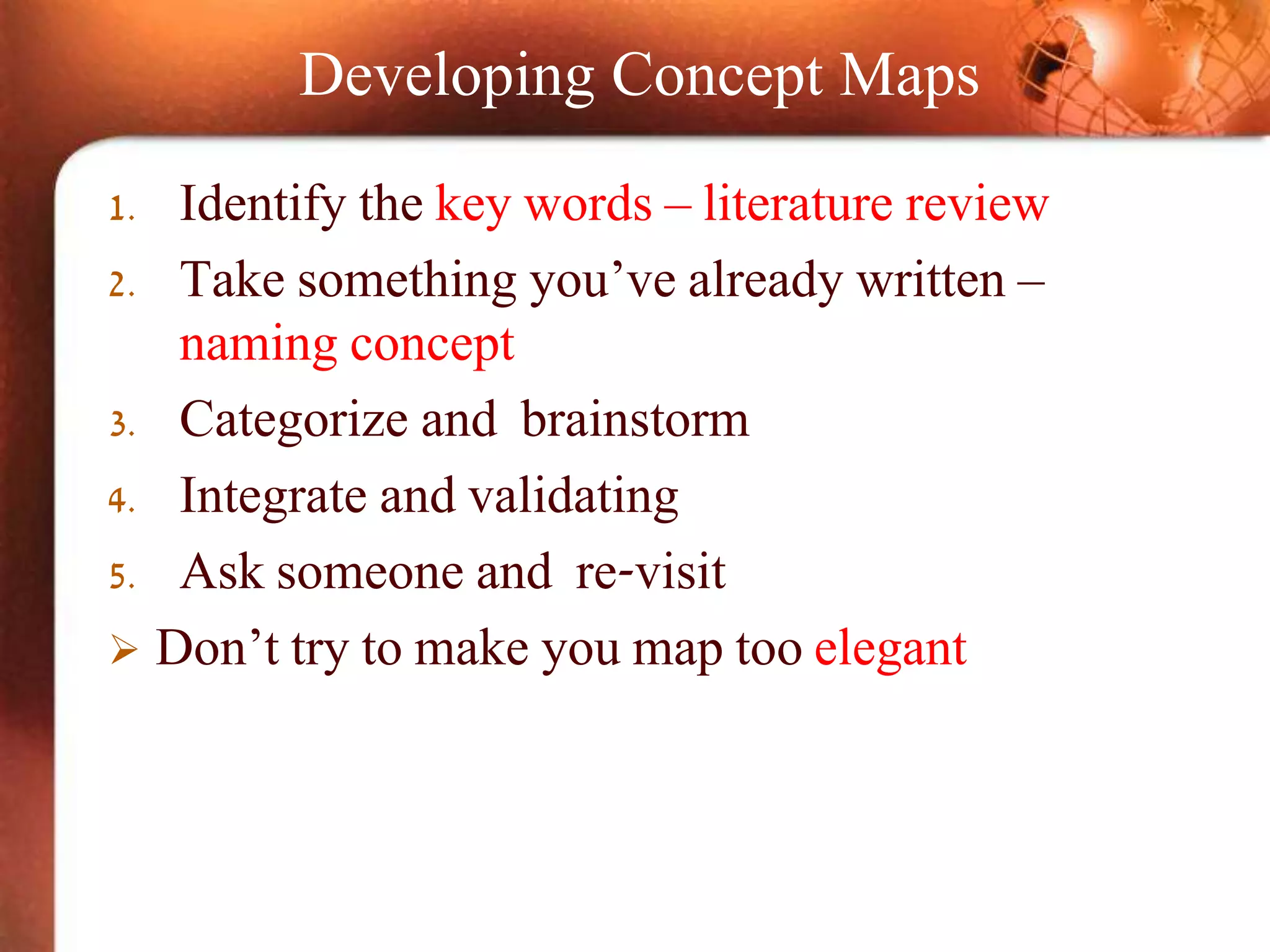
Developing Concept Maps
1. Identify the key words – literature review
2. Take something you’ve already written –
naming concept
3. Categorize and brainstorm
4. Integrate and validating
5. Ask someone and re-visit
 Don’t try to make you map too elegant
Specific forms of conceptual framework
 Model can be: schematic or mathematical
– Schematic model- conveys concepts and
propositions – boxes, arrows tree chart, or
other symbols
– Mathematical: conveys concepts and
propositions, through, letters, number, and
mathematical symbols , ( Nalzaro, 2009)
– Mind Maps
– Software system
(Vaughan, 2008)
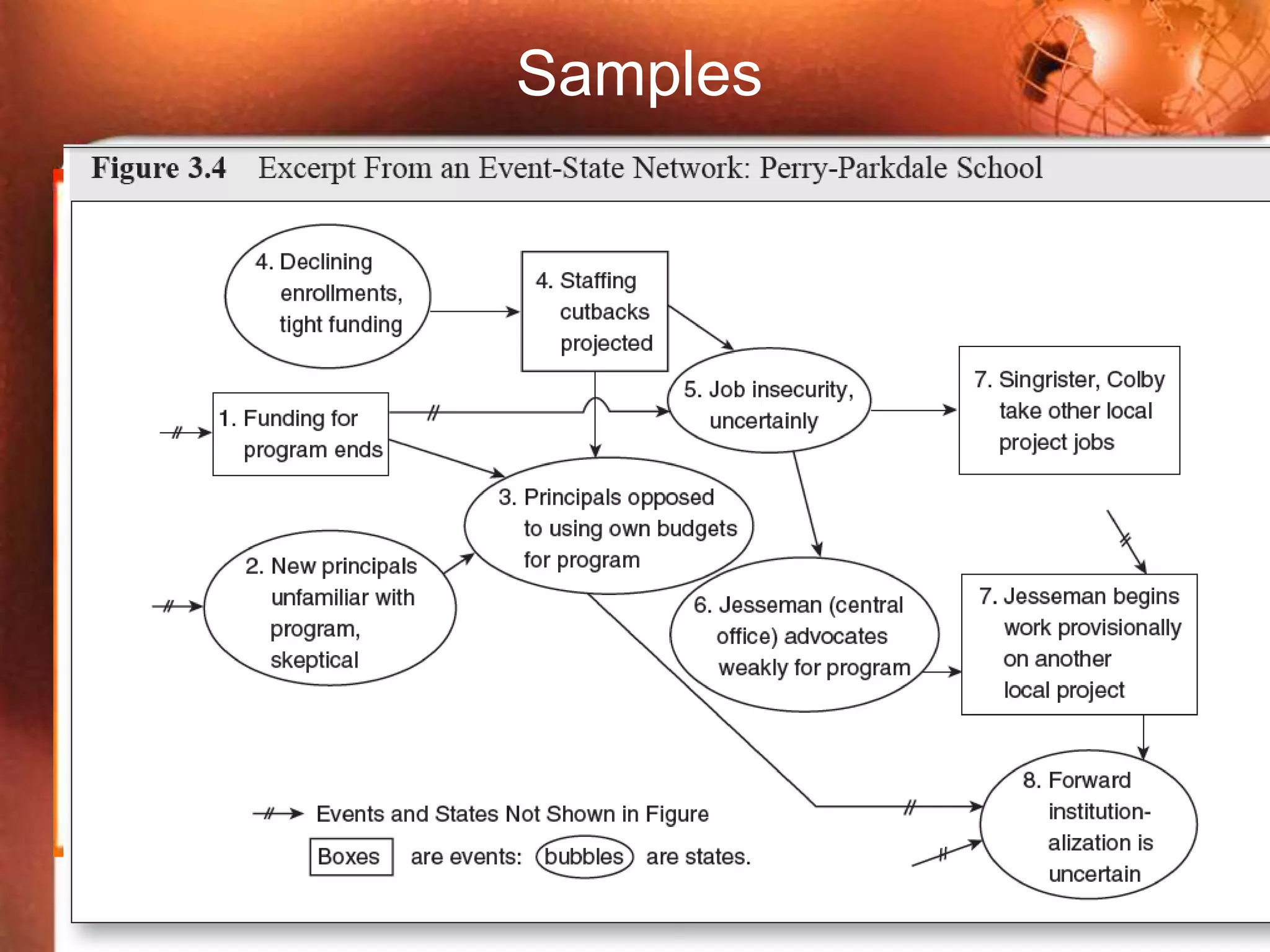
Samples
Observation
 Individual construction
 ‘Concept maps’ and conceptual framework
 Cases and examples
 Recommend to read
 No reference – seems book chapter
Reference
 Maxwell, J. (2012). Qualitative Research Design: An
interactive approach (Chapter 3: Conceptual
Framework. Thousand Oaks. Sage.
 Jabareen, Y. (2009). Building a Conceputal
Framework: Philosophy, Definitions and Procedure.
International institute fro qualitative methodology.
Alberta.
 ( Nalzaro, 2009). Conceptual Framework. www.
/ludymae/chapter-6theoretical-conceptual framework

Conceptual Framework for Academic writing

  • 1.
    Conceptual Framework What DoYou Think Is Going On? (Wills, 2012) Purna Bdr. Thapa Prabhat Sept 20, 2013 Class presentation Advance Qualitative Research Methods (621) (Maxwell. J)
  • 2.
    The structure ofpresentation  Understanding Conceptual Framework  Purpose of Conceptual Framework  What Make Good Conceptual Framework  Why Philosophical Paradigms  Modules to Construct Conceptual Framework  Developing Concept Maps  Specific forms of Conceptual Framework  Samples  Observation
  • 3.
    Understanding Conceptual Framework System of concepts, assumptions, expectations, beliefs and theories – supports and informs  Relations with variables, concepts and key factors  Linked concepts- comprehensive understanding (Jabareen, 2009)  Ontological or epistemological role  Visual or written product / theory– graphical or narrative  Understanding of things you plan to study
  • 4.
    Purposes of ConceptualFramework  To clarify concepts and purposes relationships among the concepts  Provide a context for interpreting the study findings  Explain observations  Theory development
  • 5.
    What Make GoodConceptual Framework  Outside the tradition – integrate different approaches, theories  Critical not just descriptive  Constructed , not found  Your understanding about the world  Researcher identity and experience  Links with literature, research questions (www.authorstream.com)
  • 6.
    Why Philosophical Paradigms Clear about philosophical and methodologies  Each embody different ideas about ontology and epistemology  Justify your design decisions-theory  Build on accepted theory CHOOSING PARADIGMS  Understand the theme  Assessing which world is fit with you  Preference of researchers  Compatible with research questions, methods
  • 7.
    Modules to ConstructConceptual Framework 1. Your experiential knowledge  Via Identity Memo, personal experience 2. Prior theory and research  Theory is a “coat closet”  Theory is a “spotlight” 3. Your pilot and exploratory research 4. Thought experiments  Helpful working on whiteboard or computer programs
  • 8.
    Use of Theoryin Conceptual Framework  Theory: set of concepts, ideas, broader than its usual meaning; eg. rock  Why? roadmap, enlightenment, broaden understanding  How? existing theory, critical use of theory  ‘Believing game’ and ‘doubting game’  Develop, borrow an d test
  • 9.
    Developing Concept Maps 1.Identify the key words – literature review 2. Take something you’ve already written – naming concept 3. Categorize and brainstorm 4. Integrate and validating 5. Ask someone and re-visit  Don’t try to make you map too elegant
  • 10.
    Specific forms ofconceptual framework  Model can be: schematic or mathematical – Schematic model- conveys concepts and propositions – boxes, arrows tree chart, or other symbols – Mathematical: conveys concepts and propositions, through, letters, number, and mathematical symbols , ( Nalzaro, 2009) – Mind Maps – Software system (Vaughan, 2008)
  • 11.
  • 12.
    Observation  Individual construction ‘Concept maps’ and conceptual framework  Cases and examples  Recommend to read  No reference – seems book chapter
  • 13.
    Reference  Maxwell, J.(2012). Qualitative Research Design: An interactive approach (Chapter 3: Conceptual Framework. Thousand Oaks. Sage.  Jabareen, Y. (2009). Building a Conceputal Framework: Philosophy, Definitions and Procedure. International institute fro qualitative methodology. Alberta.  ( Nalzaro, 2009). Conceptual Framework. www. /ludymae/chapter-6theoretical-conceptual framework

Editor's Notes

  • #4 Articulates the pathways by which an intervention is expected to cause the desired outcomes Causal linkages among a set of concepts It is not a collection of concepts, but constructs, in which each plays an intergral role Not Casual and analytical seeting, but interpretative approch
  • #5 www.sliderhare.net/ludymae/chapter-6theoretical-conceptual framework
  • #6 Productive conceptual frameworks What problems with previous research and theory, alternative ways of farming issue Ideas brought, but sturcture, cohernce you build Some time theory may misleading - Knowledge specific to the particular case Research identity: Resercher belifes, expectatoin and assumptions on desinged subject matter
  • #7 Paradgimgs: constructuivism, interpretivisim Justfiy: Productive conceptual frameworks What problems with previous research and theory, alternative ways of farming issue Some time theory may misleading
  • #8 Pg 44 Links with person life, Researcher technical knowledge, research background, personal experiences, eg. Neontal care and breast self examination Theory: simply a set of concepts and ideas and the proposed realtioships among these A major function of theory is to provide a model or map of why the world is the way it is Enlightening story about phenomena Coat closet: hang anythings, making sense of what you see, coat hooks Spotlight: sheds light for tracking, otherwise go unnoticed or misunderstood 3. pilot: test your ideas or methods, example, with own family members People ideas, meaning and values are essential parts 4. Encourge creativity and sense of discovery: plausibe explantations, illeterate parents are much more likely to have childern illiterate childern; STOP AND THINK: describe reality
  • #9 Why ?To pick up rocks, you need theory, that tells what is rock, and how it is?
  • #10 Building coceptual framework is a process of theorizing, Therorizing: Is simply the cognitive process of discovering or manipulating abstract categories and the relationship among these categoris. Wills, pg 48 Joseph Novak develop and miles and huberman called a conceptual framework Concept map of theory is the visual display of that theory It consists: concpets and the relationships among these CM can based on theory, experiences, CM is a tool for developing theory
  • #11 www.sliderhare.net/ludymae/chapter-6theoretical-conceptual framework
  • #13 Differnet researchers may have different conceptions Beauty of journals: Case
  • #14 Differnet researchers may have different conceptions