Stranger Things Science
(Part 1)
Prepared by – Rohan Jagdale
Introduction
Demogorgon
Upside Down
Planck’s constant
Telekinesis
MK-Ultra
Post Traumatic Stress Disorder (PTSD)
References
Index
Stranger Things is one of the best show I saw. Its because the show is getting better and
better by every season . I love the characters in it. I love the America in 80s. The cars,
peoples and all the emerging technologies.
With all this going on the storyline with amazing science concepts and beautiful
friendships. That is why its so much engaging to us.
Here in this slideshow I am going to discuss the science behind the show. I mean all the
concepts like upside down, Demogorgon's, mental disorders etc.
This kind of horror fantasies may seem to be best way to entertain but it feels realistic and
somehow we connect to that deeply . May be these concepts are real somewhere on other
planet. Here is my small effort to understand the science behind stranger things.
Introduction
Demogorgon
Demogorgons which is a monster in a series and which kills the residents of small town in
Indiana is likely to have properties of cellular slime mold.
The immature or very initial stage of Demogorgon is legless slug like form
Slime mold
Many species of cichlid fish carry developing larvae in their mouths, and an extinct
Australian frog, Rheobatrachus, developed its tadpoles in its stomach.
“The Demogorgon could be like a cichlid where it’s either mouth-brooding or like a
Rheobatrachus where it’s in his stomach,”
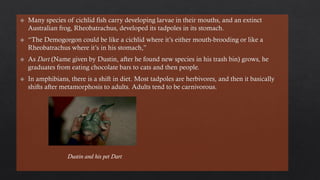
As Dart (Name given by Dustin, after he found new species in his trash bin) grows, he
graduates from eating chocolate bars to cats and then people.
In amphibians, there is a shift in diet. Most tadpoles are herbivores, and then it basically
shifts after metamorphosis to adults. Adults tend to be carnivorous.
Dustin and his pet Dart
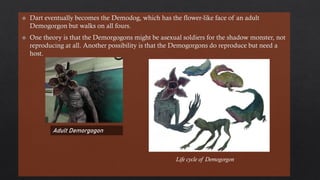
Dart eventually becomes the Demodog, which has the flower-like face of an adult
Demogorgon but walks on all fours.
One theory is that the Demorgogons might be asexual soldiers for the shadow monster, not
reproducing at all. Another possibility is that the Demogorgons do reproduce but need a
host.
Adult Demorgogon
Life cycle of Demogorgon
Upside Down (Parallel world)
A Descent Into the Unconscious (or the Upside Down)
The Upside Down is an alternate dimension that mirrors our world — or at least our world
if it was a toxic hellscape overrun with creepy, moving vines, filled with murderous
creatures linked together in a hive mind system, and is constantly experiencing electrical
storms.
you can have a single universe that has more dimensions than the ones that we’re aware of.
There’s reason to think that there might be more dimensions of space beyond our three that
we don’t see. – Brian Greene (Columbia University)
Upside Down affects the electromagnetic field of our world. This is how Will was able to
use the Christmas lights to communicate with Joyce and why compasses will, if they’re in
close enough range, point to Upside Down gates rather than true north.
Things in the Upside Down appear to be in decay or disrepair, too. There are ash and
spores of something floating around in the air, making for an environment that feels as
claustrophobic as it does expansive. All of it makes for an unpleasant version of the world
we know and one that would be horrifying to be stuck in
Planck’s Constant
Named for physicist Max Planck, this fundamental physical constant links the amount of
energy carried by a photon with its frequency. Currently, scientists calculate Planck's
constant to be 6.62607015 x 10^(-34) joule-seconds.
Planck identified his game-changing constant in 1900, essentially putting the "quanta" in
quantum mechanics, by describing how the tiniest bits of matter release energy in discrete
bundles called quanta. In other words, energy transfers occur in set amounts, rather than
continuous flows. And at any given wavelength, there was the smallest amount of light that
could possibly exist.
Planck figured this out by measuring heat radiation given off by vibrating atoms
Telekinesis
The ability to move objects by using only mind is form of telekinesis . Its is a famous in
science fictions but not scientifically proven.
hypothetical psychic ability allowing an individual to influence a physical system without
physical interaction.
Two theories that explain how telekinesis works are:
1. Quantum Connection
According to this theory, since matter is made of particles, the mind actually has the
capacity to move these particles. Particles are made up of energies and since the mind is
said to be made of energy, as well, it is believed that particles can be moved from the
energies that come from the mind. Because atoms are everywhere, it is believed that the
energy emitted from the mind is able to move these atoms and therefore, our mind has the
ability to move objects.
2. Magnetic Field
It is believed that the mind has a magnetic field and when used in its full capacity, the mind has
the ability to push this magnetic field into the object you want to move.
Every single person in the world is said to have psychic capacities with some being more in tune
with their natural ability with some being completely unaware. And because of this, believers
say that telekinesis can actually be learned and done by absolutely anyone.
MK-Ultra
This was a real CIA program that experimented with mind
control using drugs and other methods. In the show, Eleven’s
mother was subjected to such experiments, which led to Eleven’s
powers.
During the 1950s and '60s, the CIA used brainwashing, hypnosis,
and torture on thousands of subjects brutalized by the infamous
Project MK-Ultra experiments.
Convinced that the Soviet Union had developed mind-control
capabilities, the CIA tried to do the same with MK-Ultra starting
in 1953. What followed was an expansive program undertaken
across 80 institutions, universities, and hospitals. Each one
carried out torturous experiments, including electrocution, verbal
and sexual abuse, and dosing subjects with massive quantities of
LSD.
Post-traumatic stress disorder (PTSD)
Post-traumatic stress disorder (PTSD) is a mental health
condition that's triggered by a terrifying event — either
experiencing it or witnessing it. Symptoms may include
flashbacks, nightmares and severe anxiety, as well as
uncontrollable thoughts about the event.
Several characters in the Stranger Things exhibit symptoms of
post-traumatic stress disorder (PTSD), including:
Eleven : Eleven's past haunts her with disturbing flashbacks and
hypervigilance, even after she escapes the laboratory.
Max : Max has nightmares about her stepbrother's death, and
avoids talking about it with her friends and family. She also feels
shame and guilt for surviving when her brother did not.
Post-traumatic stress disorder (PTSD)
Chrissy : Chrissy hides her eating disorder and trauma from her mother. She feels detached
from her friends and family, and seeks help from Eddie Munson.
Jim Hopper : The chief of police deals with anger issues and PTSD.
The seriousness of the trauma, your proximity to it, and your relationship to the victim or
perpetrator can all play a role in whether you develop PTSD.
symptoms may start within the first three months after a traumatic event. But sometimes
symptoms may not appear until years after the event.
PTSD is treatable with therapy and sometimes medication. living a healthy life with PTSD
is possible. A person struggling with PTSD should seek out a treatment plan that will work
for them to get them on track to managing their PTSD.
References (Research Papers)
Kocabal, Melda. "THE RETURN OF THE REPRESSED SEXUALITY AND HORROR IN
STRANGER THINGS." PhD diss., San Francisco State University, 2020.
Kavanagh, Francesca. "The Gothic Pasts of Stranger Things." European Romantic
Review 35.1 (2024): 129-143.
Mollet, Tracey. "Demogorgons, Death Stars and Difference: Masculinity and Geek Culture in
Stranger Things." Refractory 31 (2019).
Buethe, John. "A Strange Critique: What Demogorgons Tell Us about the Educative Power
of Risk." Philosophical Studies in Education 50 (2019): 71-81.
Lu, Kevin, Greta Kaluzeviciute, and William Sharp. "Things can only get Stranger:
theoretical and clinical reflections on Netflix’s Stranger Things." Journal of Popular
Culture 55, no. 3 (2022): 611-631.
Glennon, Hailey. "Genre Theory and Stranger Things." Mise-en-scène: The Journal of Film
& Visual Narration 8, no. 1 (2023).
https://ar.inspiredpencil.com/pictures-2023/plasmodial-slime-molds
https://dnascience.plos.org/2017/11/16/the-biology-of-stranger-things/
https://www.popsci.com/tackling-stranger-things-parallel-universes-and-state-string-
theory/
https://knowridge.com/2019/07/the-science-behind-the-stranger-things-demogorgon
https://www.polygon.com/stranger-things/23191189/stranger-things-upside-down-
explained
https://www.jamiefosterscience.com/is-stranger-things-science-fiction/
https://zenorzen.com/divination/energy-world/develop-telekinesis/
https://allthatsinteresting.com/mk-ultra
References (Links)
To be continued …

Stranger Things Science (part 1) .......

  • 1.
    Stranger Things Science (Part1) Prepared by – Rohan Jagdale
  • 2.
  • 3.
    Stranger Things isone of the best show I saw. Its because the show is getting better and better by every season . I love the characters in it. I love the America in 80s. The cars, peoples and all the emerging technologies. With all this going on the storyline with amazing science concepts and beautiful friendships. That is why its so much engaging to us. Here in this slideshow I am going to discuss the science behind the show. I mean all the concepts like upside down, Demogorgon's, mental disorders etc. This kind of horror fantasies may seem to be best way to entertain but it feels realistic and somehow we connect to that deeply . May be these concepts are real somewhere on other planet. Here is my small effort to understand the science behind stranger things. Introduction
  • 4.
    Demogorgon Demogorgons which isa monster in a series and which kills the residents of small town in Indiana is likely to have properties of cellular slime mold. The immature or very initial stage of Demogorgon is legless slug like form Slime mold
  • 5.
    Many species ofcichlid fish carry developing larvae in their mouths, and an extinct Australian frog, Rheobatrachus, developed its tadpoles in its stomach. “The Demogorgon could be like a cichlid where it’s either mouth-brooding or like a Rheobatrachus where it’s in his stomach,” As Dart (Name given by Dustin, after he found new species in his trash bin) grows, he graduates from eating chocolate bars to cats and then people. In amphibians, there is a shift in diet. Most tadpoles are herbivores, and then it basically shifts after metamorphosis to adults. Adults tend to be carnivorous. Dustin and his pet Dart
  • 6.
    Dart eventually becomesthe Demodog, which has the flower-like face of an adult Demogorgon but walks on all fours. One theory is that the Demorgogons might be asexual soldiers for the shadow monster, not reproducing at all. Another possibility is that the Demogorgons do reproduce but need a host. Adult Demorgogon Life cycle of Demogorgon
  • 7.
    Upside Down (Parallelworld) A Descent Into the Unconscious (or the Upside Down) The Upside Down is an alternate dimension that mirrors our world — or at least our world if it was a toxic hellscape overrun with creepy, moving vines, filled with murderous creatures linked together in a hive mind system, and is constantly experiencing electrical storms. you can have a single universe that has more dimensions than the ones that we’re aware of. There’s reason to think that there might be more dimensions of space beyond our three that we don’t see. – Brian Greene (Columbia University) Upside Down affects the electromagnetic field of our world. This is how Will was able to use the Christmas lights to communicate with Joyce and why compasses will, if they’re in close enough range, point to Upside Down gates rather than true north. Things in the Upside Down appear to be in decay or disrepair, too. There are ash and spores of something floating around in the air, making for an environment that feels as claustrophobic as it does expansive. All of it makes for an unpleasant version of the world we know and one that would be horrifying to be stuck in
  • 8.
    Planck’s Constant Named forphysicist Max Planck, this fundamental physical constant links the amount of energy carried by a photon with its frequency. Currently, scientists calculate Planck's constant to be 6.62607015 x 10^(-34) joule-seconds. Planck identified his game-changing constant in 1900, essentially putting the "quanta" in quantum mechanics, by describing how the tiniest bits of matter release energy in discrete bundles called quanta. In other words, energy transfers occur in set amounts, rather than continuous flows. And at any given wavelength, there was the smallest amount of light that could possibly exist. Planck figured this out by measuring heat radiation given off by vibrating atoms
  • 9.
    Telekinesis The ability tomove objects by using only mind is form of telekinesis . Its is a famous in science fictions but not scientifically proven. hypothetical psychic ability allowing an individual to influence a physical system without physical interaction. Two theories that explain how telekinesis works are: 1. Quantum Connection According to this theory, since matter is made of particles, the mind actually has the capacity to move these particles. Particles are made up of energies and since the mind is said to be made of energy, as well, it is believed that particles can be moved from the energies that come from the mind. Because atoms are everywhere, it is believed that the energy emitted from the mind is able to move these atoms and therefore, our mind has the ability to move objects.
  • 10.
    2. Magnetic Field Itis believed that the mind has a magnetic field and when used in its full capacity, the mind has the ability to push this magnetic field into the object you want to move. Every single person in the world is said to have psychic capacities with some being more in tune with their natural ability with some being completely unaware. And because of this, believers say that telekinesis can actually be learned and done by absolutely anyone.
  • 11.
    MK-Ultra This was areal CIA program that experimented with mind control using drugs and other methods. In the show, Eleven’s mother was subjected to such experiments, which led to Eleven’s powers. During the 1950s and '60s, the CIA used brainwashing, hypnosis, and torture on thousands of subjects brutalized by the infamous Project MK-Ultra experiments. Convinced that the Soviet Union had developed mind-control capabilities, the CIA tried to do the same with MK-Ultra starting in 1953. What followed was an expansive program undertaken across 80 institutions, universities, and hospitals. Each one carried out torturous experiments, including electrocution, verbal and sexual abuse, and dosing subjects with massive quantities of LSD.
  • 12.
    Post-traumatic stress disorder(PTSD) Post-traumatic stress disorder (PTSD) is a mental health condition that's triggered by a terrifying event — either experiencing it or witnessing it. Symptoms may include flashbacks, nightmares and severe anxiety, as well as uncontrollable thoughts about the event. Several characters in the Stranger Things exhibit symptoms of post-traumatic stress disorder (PTSD), including: Eleven : Eleven's past haunts her with disturbing flashbacks and hypervigilance, even after she escapes the laboratory. Max : Max has nightmares about her stepbrother's death, and avoids talking about it with her friends and family. She also feels shame and guilt for surviving when her brother did not.
  • 13.
    Post-traumatic stress disorder(PTSD) Chrissy : Chrissy hides her eating disorder and trauma from her mother. She feels detached from her friends and family, and seeks help from Eddie Munson. Jim Hopper : The chief of police deals with anger issues and PTSD. The seriousness of the trauma, your proximity to it, and your relationship to the victim or perpetrator can all play a role in whether you develop PTSD. symptoms may start within the first three months after a traumatic event. But sometimes symptoms may not appear until years after the event. PTSD is treatable with therapy and sometimes medication. living a healthy life with PTSD is possible. A person struggling with PTSD should seek out a treatment plan that will work for them to get them on track to managing their PTSD.
  • 14.
    References (Research Papers) Kocabal,Melda. "THE RETURN OF THE REPRESSED SEXUALITY AND HORROR IN STRANGER THINGS." PhD diss., San Francisco State University, 2020. Kavanagh, Francesca. "The Gothic Pasts of Stranger Things." European Romantic Review 35.1 (2024): 129-143. Mollet, Tracey. "Demogorgons, Death Stars and Difference: Masculinity and Geek Culture in Stranger Things." Refractory 31 (2019). Buethe, John. "A Strange Critique: What Demogorgons Tell Us about the Educative Power of Risk." Philosophical Studies in Education 50 (2019): 71-81. Lu, Kevin, Greta Kaluzeviciute, and William Sharp. "Things can only get Stranger: theoretical and clinical reflections on Netflix’s Stranger Things." Journal of Popular Culture 55, no. 3 (2022): 611-631. Glennon, Hailey. "Genre Theory and Stranger Things." Mise-en-scène: The Journal of Film & Visual Narration 8, no. 1 (2023).
  • 15.
  • 16.