SYNTHETIC SPRAY
BANDAGE
Prepared by - Rohan R Jagdale
Outline
â—Ź Introduction
â—Ź AIM and Objectives
â—Ź Plan of work
â—Ź Formulation
â—Ź Evaluation parameters
â—Ź Results and discussions
â—Ź Conclusion
â—Ź References
Introduction
â—Ź Pharmaceutical spraying technology is an amplified method of
delivering medication.
â—Ź The improved version of spray bandage contains either liquid or
solid particle in a container that can be delivered via fine spray
nozzle once activated by actuator.
â—Ź In other words, a bandage film formed in situ on a skin surface by
actuating a hydrophilic polymer and a low volatile plasticizer with
the solvent system.
AIM AND OBJECTIVES
AIM OF PRESENT WORK
Formulation and evaluation of Spray Bandage prepared using
Camphor and Eugenol.
OBJECTIVES OF RESEARCH PROJECT
â—Ź To prepare Standard calibration curve for camphor & Eugenol
â—Ź To formulate Spray Bandage using suitable drug delivery
system.
â—Ź To carry out drug release study using Spray bottle
Plan of work
❏ Literature review
❏ Selection of Drug
❏ Formulation of Spray Bandage
❏ Evaluation of Spray Bandage
❏ Diffusion
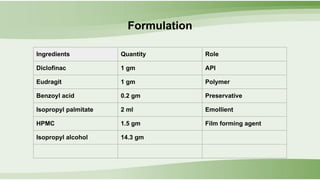
Formulation
Ingredients Quantity Role
Diclofinac 1 gm API
Eudragit 1 gm Polymer
Benzoyl acid 0.2 gm Preservative
Isopropyl palmitate 2 ml Emollient
HPMC 1.5 gm Film forming agent
Isopropyl alcohol 14.3 gm
Drug Profile
Camphor - Camphor is a compound used topically to help relieve pain and also
as a topical antiseptic. May also be used in vaporizers to help suppress coughing.
This medication should not be swallowed. Camphor is a bicyclic monoterpene
ketone found widely in plants, especially Cinnamomum camphora.
MATERIALS AND METHODS
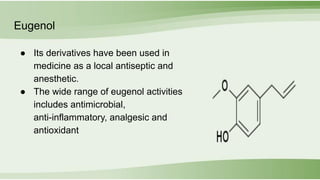
Eugenol
â—Ź Its derivatives have been used in
medicine as a local antiseptic and
anesthetic.
â—Ź The wide range of eugenol activities
includes antimicrobial,
anti-inflammatory, analgesic and
antioxidant
EUDRAGIT S 100
â—Ź are anionic copolymers based on methacrylic acic and methyl
methacrylate.
â—Ź Physical properties It is a solid substance in form of a white powder
with a faint characteristic odour.
â—Ź Characteristics: Granulation of drug substances in powder form for
controlled release.
Excipient profile
HPMC K4M
● METHOCEL™ K4M is a medium–molecular weight,
hydroxypropyl methylcellulose (HPMC) thickener.
â—Ź It will yield a viscosity of 4,000 cPs at 2% in water and is
typically used in coatings, adhesives, and ceramics.
â—Ź Molar mass - 1261.4 g/mol
Formula:- Initially study was carried out to find suitable polymers having good film forming
capacity.
In the study, we have selected 2 grades of eudragit for comparison- RS-100 and S-100.
Both (RS-100 and S-100) grades of Eudragit were tested for There Drying time and Film
forming ability
Procedure:- 1)In beaker 1 take the hydrophilic polymer HPMC and dissolve it in ethanol by
sprinkling within minimum amount with proper mixing and cover it with aluminum foil as
ethanol is volatile in nature and causes precipitation of polymer.
2)In beaker 2 Eudragit is dissolved in acetone with proper mixing.
3)Mix beaker 1 and 2 contents with continuous stirring and add propylene glycol and
tocopherol.
4)Transfer the formulation into a container.
EXPERIMENTAL WORK OF SPRAY BANDAGE
â—Ź Film formation- The films are formed in a Petri-dish and on skin. Film-formation is
evaluated and rated as uniform or non-uniform, with or without precipitation of the
film-forming polymer. The cosmetic aspects of the film are given in terms of
transparency and peel-ability.
â—Ź Appearance- The prepared formulation was inspected visually for their color,
appearance and consistency. It is determined by inspecting the sample in clear and
transparent petriplate under the presence of light against reflection into the eyes.
â—Ź Film flexibility- Film flexibility is evaluated on the basis of cracking and skin fixation
and this is determined by stretching the skin in 2–3 directions. The film is rated flexible
if there is no cracking or skin fixation and non-flexible if there is cracking and skin
fixation.
EVALUATION PARAMETERS
â—Ź Drying time- For the evaluation of the drying time, the formulation is
applied to the inner sides of the forearm of a volunteer or on the
petriplate.
â—Ź Stickiness- The stickiness of the film formed is determined by
pressing cotton wool on the dry film with low pressure.
â—Ź Washability- Eudragit S-100 as polymer is easily washable by water.
â—Ź Tackiness- When sprayed on the back of the petridishes, the film
formed was examined for its adhesive nature by gently touching it on
drying.
â—Ź Adherence time-The film formed on the petridishes was measured
for its adherence time till the film came off of the petridishes.
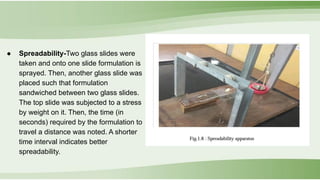
â—Ź Spreadability-Two glass slides were
taken and onto one slide formulation is
sprayed. Then, another glass slide was
placed such that formulation
sandwiched between two glass slides.
The top slide was subjected to a stress
by weight on it. Then, the time (in
seconds) required by the formulation to
travel a distance was noted. A shorter
time interval indicates better
spreadability.
Diffusion
Using Diffusion apparatus, the diffusion of drug is studied. In this 50% of 0.5ml (5
sprays) is taken for study as same for & 75% and 90% formulation using
phosphate buffer of pH 7.4 is prepared and temperature is maintained at 37ËšC, the
formulation of different concentration is sprayed on cellulose membrane then it is
to be placed on the apparatus for diffusion study.
The aliquot of 2ml is withdrawn at each 1 hr interval and absorbance is determined
by λ max (290nm) using UV spectrometer.
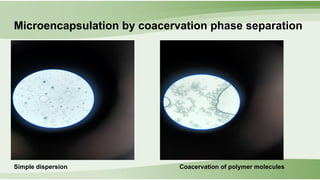
Microencapsulation by coacervation phase separation
â—Ź Microencapsulation is the packaging of small particles of solid, liquid or gas,
also known as core, within a secondary material, also known as shell or coating
to form small microparticles.
â—Ź Coacervation means the separation of a liquid or phase when solution of two
hydrophilic colloids are mixed under suitable conditions.
â—Ź In this method, the three immiscible phases of core material, solvent and
coating material are formed followed by deposition of coating material on the
core
â—Ź The coating material is dissolved in a suitable solvent and the core material is
uniformly dispersed in the solution of the coating material. Then the coating
material is phased out of its solution which starts getting deposited on the
particles of the core material.
Microencapsulation by coacervation phase separation
Simple dispersion Coacervation of polymer molecules
Results and discussions
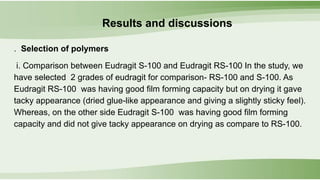
. Selection of polymers
i. Comparison between Eudragit S-100 and Eudragit RS-100 In the study, we
have selected 2 grades of eudragit for comparison- RS-100 and S-100. As
Eudragit RS-100 was having good film forming capacity but on drying it gave
tacky appearance (dried glue-like appearance and giving a slightly sticky feel).
Whereas, on the other side Eudragit S-100 was having good film forming
capacity and did not give tacky appearance on drying as compare to RS-100.
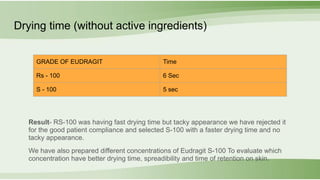
Drying time (without active ingredients)
Result- RS-100 was having fast drying time but tacky appearance we have rejected it
for the good patient compliance and selected S-100 with a faster drying time and no
tacky appearance.
We have also prepared different concentrations of Eudragit S-100 To evaluate which
concentration have better drying time, spreadibility and time of retention on skin.
GRADE OF EUDRAGIT Time
Rs - 100 6 Sec
S - 100 5 sec
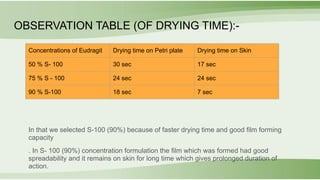
OBSERVATION TABLE (OF DRYING TIME):-
In that we selected S-100 (90%) because of faster drying time and good film forming
capacity
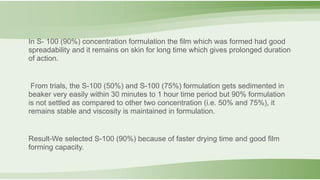
. In S- 100 (90%) concentration formulation the film which was formed had good
spreadability and it remains on skin for long time which gives prolonged duration of
action.
Concentrations of Eudragit Drying time on Petri plate Drying time on Skin
50 % S- 100 30 sec 17 sec
75 % S - 100 24 sec 24 sec
90 % S-100 18 sec 7 sec
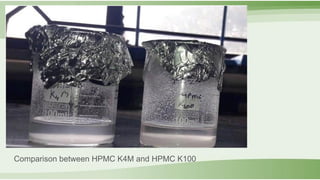
Comparison between HPMC-K4M & HPMC K-100
Hydrophilic polymer like HPMC is available in different grades like HPMC –K100,
K4M.Using these two different grades we formulated two different formulations
and observed that the HPMC K-100 is less soluble and forms a cake whereas
HPMC-K4M had good solubility and less sedimentation was seen comparatively.
Result - HPMC K-100 is less soluble and forms a cake whereas HPMC-K4M had
good solubility and less sedimentation was seen comparatively, so we selected
HPMC K4M.
Comparison between HPMC K4M and HPMC K100
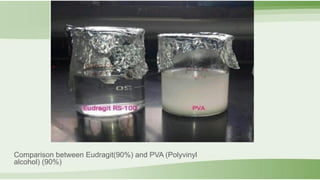
During study we also tried using PVP (Polyvinyl alcohol 90%) as polymer but it
does not give consistency as eudragit gives and it is insoluble in solvent and not
form film as compared to Eudragit S100 (90%).Therefore, S-100 was selected.
Result- Selected eudragit S-100(90%) because of consistency and good solubility
in solvent medium i.e ethanol and acetone.
Comparison between Eudragit and PVA (Polyvinyl alcohol)
Comparison between Eudragit(90%) and PVA (Polyvinyl
alcohol) (90%)
In S- 100 (90%) concentration formulation the film which was formed had good
spreadability and it remains on skin for long time which gives prolonged duration
of action.
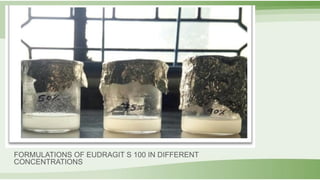
From trials, the S-100 (50%) and S-100 (75%) formulation gets sedimented in
beaker very easily within 30 minutes to 1 hour time period but 90% formulation
is not settled as compared to other two concentration (i.e. 50% and 75%), it
remains stable and viscosity is maintained in formulation.
Result-We selected S-100 (90%) because of faster drying time and good film
forming capacity.
FORMULATIONS OF EUDRAGIT S 100 IN DIFFERENT
CONCENTRATIONS
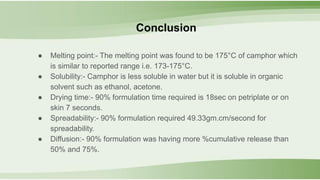
● Melting point:- The melting point was found to be 175°C of camphor which
is similar to reported range i.e. 173-175°C.
â—Ź Solubility:- Camphor is less soluble in water but it is soluble in organic
solvent such as ethanol, acetone.
â—Ź Drying time:- 90% formulation time required is 18sec on petriplate or on
skin 7 seconds.
â—Ź Spreadability:- 90% formulation required 49.33gm.cm/second for
spreadability.
â—Ź Diffusion:- 90% formulation was having more %cumulative release than
50% and 75%.
Conclusion
References
1-www.researchgate.net/publication/320105604_Spray_bandage
_strategy_in_topical _drug_delivery
2-Review of Film forming systems for topical and transdermal
drug delivery Kashmira Kathe, Harsha Kathpalia
3-https://patents.google.com/patent/US6962691B1/en Page 39

Spray Bandage -1.pdf

  • 1.
  • 2.
    Outline â—Ź Introduction â—Ź AIMand Objectives â—Ź Plan of work â—Ź Formulation â—Ź Evaluation parameters â—Ź Results and discussions â—Ź Conclusion â—Ź References
  • 3.
    Introduction â—Ź Pharmaceutical sprayingtechnology is an amplified method of delivering medication. â—Ź The improved version of spray bandage contains either liquid or solid particle in a container that can be delivered via fine spray nozzle once activated by actuator. â—Ź In other words, a bandage film formed in situ on a skin surface by actuating a hydrophilic polymer and a low volatile plasticizer with the solvent system.
  • 4.
    AIM AND OBJECTIVES AIMOF PRESENT WORK Formulation and evaluation of Spray Bandage prepared using Camphor and Eugenol. OBJECTIVES OF RESEARCH PROJECT â—Ź To prepare Standard calibration curve for camphor & Eugenol â—Ź To formulate Spray Bandage using suitable drug delivery system. â—Ź To carry out drug release study using Spray bottle
  • 5.
    Plan of work ❏Literature review ❏ Selection of Drug ❏ Formulation of Spray Bandage ❏ Evaluation of Spray Bandage ❏ Diffusion
  • 6.
    Formulation Ingredients Quantity Role Diclofinac1 gm API Eudragit 1 gm Polymer Benzoyl acid 0.2 gm Preservative Isopropyl palmitate 2 ml Emollient HPMC 1.5 gm Film forming agent Isopropyl alcohol 14.3 gm
  • 7.
    Drug Profile Camphor -Camphor is a compound used topically to help relieve pain and also as a topical antiseptic. May also be used in vaporizers to help suppress coughing. This medication should not be swallowed. Camphor is a bicyclic monoterpene ketone found widely in plants, especially Cinnamomum camphora. MATERIALS AND METHODS
  • 8.
    Eugenol â—Ź Its derivativeshave been used in medicine as a local antiseptic and anesthetic. â—Ź The wide range of eugenol activities includes antimicrobial, anti-inflammatory, analgesic and antioxidant
  • 9.
    EUDRAGIT S 100 â—Źare anionic copolymers based on methacrylic acic and methyl methacrylate. â—Ź Physical properties It is a solid substance in form of a white powder with a faint characteristic odour. â—Ź Characteristics: Granulation of drug substances in powder form for controlled release. Excipient profile
  • 10.
    HPMC K4M ● METHOCEL™K4M is a medium–molecular weight, hydroxypropyl methylcellulose (HPMC) thickener. ● It will yield a viscosity of 4,000 cPs at 2% in water and is typically used in coatings, adhesives, and ceramics. ● Molar mass - 1261.4 g/mol
  • 11.
    Formula:- Initially studywas carried out to find suitable polymers having good film forming capacity. In the study, we have selected 2 grades of eudragit for comparison- RS-100 and S-100. Both (RS-100 and S-100) grades of Eudragit were tested for There Drying time and Film forming ability Procedure:- 1)In beaker 1 take the hydrophilic polymer HPMC and dissolve it in ethanol by sprinkling within minimum amount with proper mixing and cover it with aluminum foil as ethanol is volatile in nature and causes precipitation of polymer. 2)In beaker 2 Eudragit is dissolved in acetone with proper mixing. 3)Mix beaker 1 and 2 contents with continuous stirring and add propylene glycol and tocopherol. 4)Transfer the formulation into a container. EXPERIMENTAL WORK OF SPRAY BANDAGE
  • 12.
    ● Film formation-The films are formed in a Petri-dish and on skin. Film-formation is evaluated and rated as uniform or non-uniform, with or without precipitation of the film-forming polymer. The cosmetic aspects of the film are given in terms of transparency and peel-ability. ● Appearance- The prepared formulation was inspected visually for their color, appearance and consistency. It is determined by inspecting the sample in clear and transparent petriplate under the presence of light against reflection into the eyes. ● Film flexibility- Film flexibility is evaluated on the basis of cracking and skin fixation and this is determined by stretching the skin in 2–3 directions. The film is rated flexible if there is no cracking or skin fixation and non-flexible if there is cracking and skin fixation. EVALUATION PARAMETERS
  • 13.
    â—Ź Drying time-For the evaluation of the drying time, the formulation is applied to the inner sides of the forearm of a volunteer or on the petriplate. â—Ź Stickiness- The stickiness of the film formed is determined by pressing cotton wool on the dry film with low pressure. â—Ź Washability- Eudragit S-100 as polymer is easily washable by water. â—Ź Tackiness- When sprayed on the back of the petridishes, the film formed was examined for its adhesive nature by gently touching it on drying. â—Ź Adherence time-The film formed on the petridishes was measured for its adherence time till the film came off of the petridishes.
  • 14.
    â—Ź Spreadability-Two glassslides were taken and onto one slide formulation is sprayed. Then, another glass slide was placed such that formulation sandwiched between two glass slides. The top slide was subjected to a stress by weight on it. Then, the time (in seconds) required by the formulation to travel a distance was noted. A shorter time interval indicates better spreadability.
  • 15.
    Diffusion Using Diffusion apparatus,the diffusion of drug is studied. In this 50% of 0.5ml (5 sprays) is taken for study as same for & 75% and 90% formulation using phosphate buffer of pH 7.4 is prepared and temperature is maintained at 37˚C, the formulation of different concentration is sprayed on cellulose membrane then it is to be placed on the apparatus for diffusion study. The aliquot of 2ml is withdrawn at each 1 hr interval and absorbance is determined by λ max (290nm) using UV spectrometer.
  • 16.
    Microencapsulation by coacervationphase separation â—Ź Microencapsulation is the packaging of small particles of solid, liquid or gas, also known as core, within a secondary material, also known as shell or coating to form small microparticles. â—Ź Coacervation means the separation of a liquid or phase when solution of two hydrophilic colloids are mixed under suitable conditions. â—Ź In this method, the three immiscible phases of core material, solvent and coating material are formed followed by deposition of coating material on the core â—Ź The coating material is dissolved in a suitable solvent and the core material is uniformly dispersed in the solution of the coating material. Then the coating material is phased out of its solution which starts getting deposited on the particles of the core material.
  • 17.
    Microencapsulation by coacervationphase separation Simple dispersion Coacervation of polymer molecules
  • 18.
    Results and discussions .Selection of polymers i. Comparison between Eudragit S-100 and Eudragit RS-100 In the study, we have selected 2 grades of eudragit for comparison- RS-100 and S-100. As Eudragit RS-100 was having good film forming capacity but on drying it gave tacky appearance (dried glue-like appearance and giving a slightly sticky feel). Whereas, on the other side Eudragit S-100 was having good film forming capacity and did not give tacky appearance on drying as compare to RS-100.
  • 19.
    Drying time (withoutactive ingredients) Result- RS-100 was having fast drying time but tacky appearance we have rejected it for the good patient compliance and selected S-100 with a faster drying time and no tacky appearance. We have also prepared different concentrations of Eudragit S-100 To evaluate which concentration have better drying time, spreadibility and time of retention on skin. GRADE OF EUDRAGIT Time Rs - 100 6 Sec S - 100 5 sec
  • 20.
    OBSERVATION TABLE (OFDRYING TIME):- In that we selected S-100 (90%) because of faster drying time and good film forming capacity . In S- 100 (90%) concentration formulation the film which was formed had good spreadability and it remains on skin for long time which gives prolonged duration of action. Concentrations of Eudragit Drying time on Petri plate Drying time on Skin 50 % S- 100 30 sec 17 sec 75 % S - 100 24 sec 24 sec 90 % S-100 18 sec 7 sec
  • 21.
    Comparison between HPMC-K4M& HPMC K-100 Hydrophilic polymer like HPMC is available in different grades like HPMC –K100, K4M.Using these two different grades we formulated two different formulations and observed that the HPMC K-100 is less soluble and forms a cake whereas HPMC-K4M had good solubility and less sedimentation was seen comparatively. Result - HPMC K-100 is less soluble and forms a cake whereas HPMC-K4M had good solubility and less sedimentation was seen comparatively, so we selected HPMC K4M.
  • 22.
    Comparison between HPMCK4M and HPMC K100
  • 23.
    During study wealso tried using PVP (Polyvinyl alcohol 90%) as polymer but it does not give consistency as eudragit gives and it is insoluble in solvent and not form film as compared to Eudragit S100 (90%).Therefore, S-100 was selected. Result- Selected eudragit S-100(90%) because of consistency and good solubility in solvent medium i.e ethanol and acetone. Comparison between Eudragit and PVA (Polyvinyl alcohol)
  • 24.
    Comparison between Eudragit(90%)and PVA (Polyvinyl alcohol) (90%)
  • 25.
    In S- 100(90%) concentration formulation the film which was formed had good spreadability and it remains on skin for long time which gives prolonged duration of action. From trials, the S-100 (50%) and S-100 (75%) formulation gets sedimented in beaker very easily within 30 minutes to 1 hour time period but 90% formulation is not settled as compared to other two concentration (i.e. 50% and 75%), it remains stable and viscosity is maintained in formulation. Result-We selected S-100 (90%) because of faster drying time and good film forming capacity.
  • 26.
    FORMULATIONS OF EUDRAGITS 100 IN DIFFERENT CONCENTRATIONS
  • 27.
    ● Melting point:-The melting point was found to be 175°C of camphor which is similar to reported range i.e. 173-175°C. ● Solubility:- Camphor is less soluble in water but it is soluble in organic solvent such as ethanol, acetone. ● Drying time:- 90% formulation time required is 18sec on petriplate or on skin 7 seconds. ● Spreadability:- 90% formulation required 49.33gm.cm/second for spreadability. ● Diffusion:- 90% formulation was having more %cumulative release than 50% and 75%. Conclusion
  • 28.
    References 1-www.researchgate.net/publication/320105604_Spray_bandage _strategy_in_topical _drug_delivery 2-Review ofFilm forming systems for topical and transdermal drug delivery Kashmira Kathe, Harsha Kathpalia 3-https://patents.google.com/patent/US6962691B1/en Page 39