Presented to: Prof. Safaa Abdel-Azeem
Presented by: Fathia Gamal
Outlines
 Definition of hallucinations
 Types of hallucinations
 Conditions in which hallucination may occur
 Phases of hallucinations
 Etiology of hallucination
 Assessment of hallucination
 Nursing diagnoses
 The patient’s attitude toward hallucinations
 A training program on coping methods, to improve auditory
hallucinations among patients with psychiatric disorders
 Hallucination are the most common example of alteration of
sensory stimuli observed in patient with schizophrenia.
 Hallucination can be experienced in all sensory modalities,
however, auditory hallucination are the most frequent in
schizophrenia.
Introduction
 Hallucinations are false perception or
wrong perception, in the absence of any
object. Hallucinations are very real to the
person experiencing them.
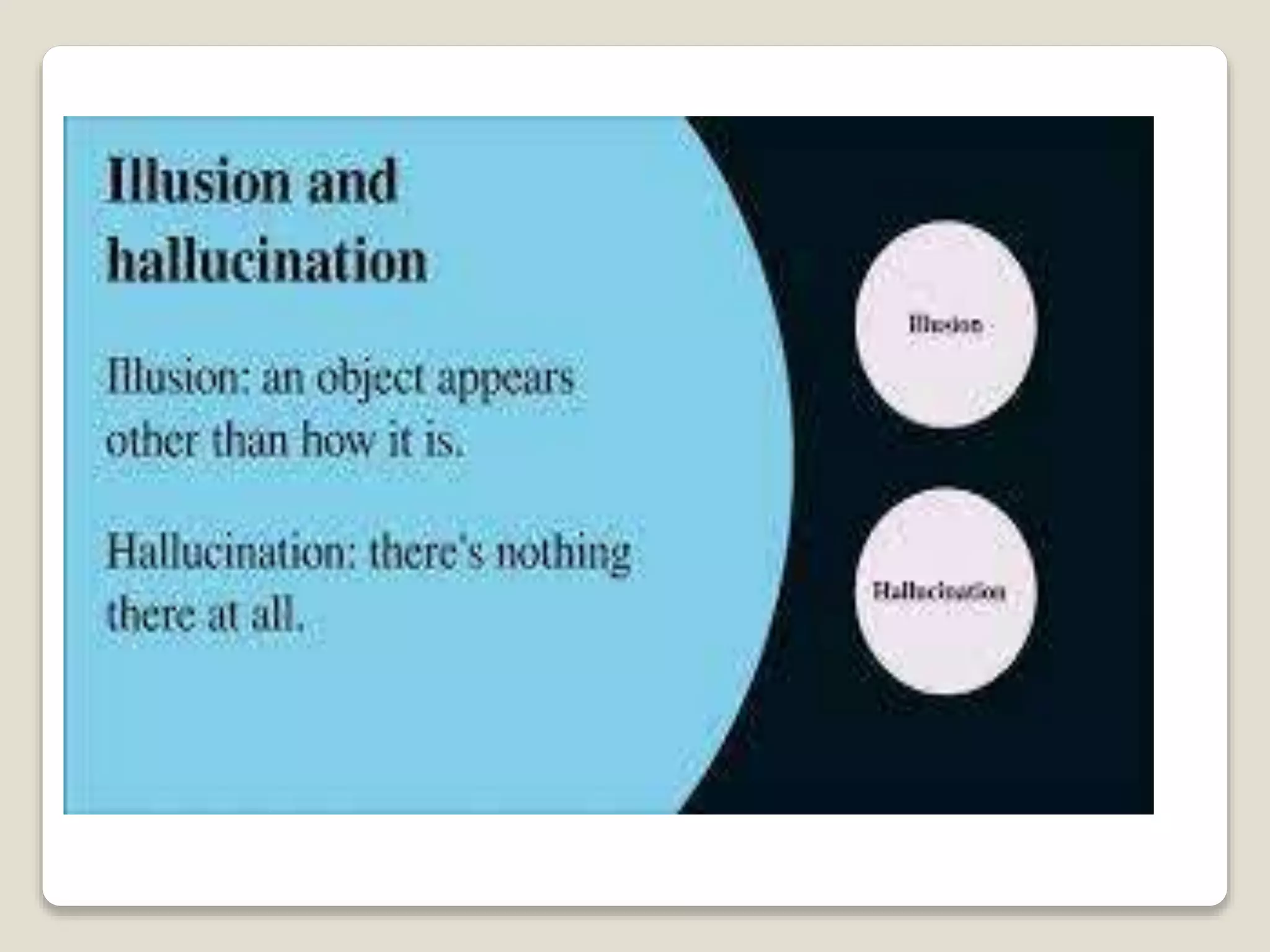
Both illusion and hallucination are perceptual
disturbances.
illusion is a false perception or perception in a wrong
manner of a real object. So,
- in the case of hallucination, there is no object
present, but it is the person who perceives that there is
some object, but in the other case the person perceives
an object differently than it is actually. for example
misinterpreting a coat hanging on a door as a person.
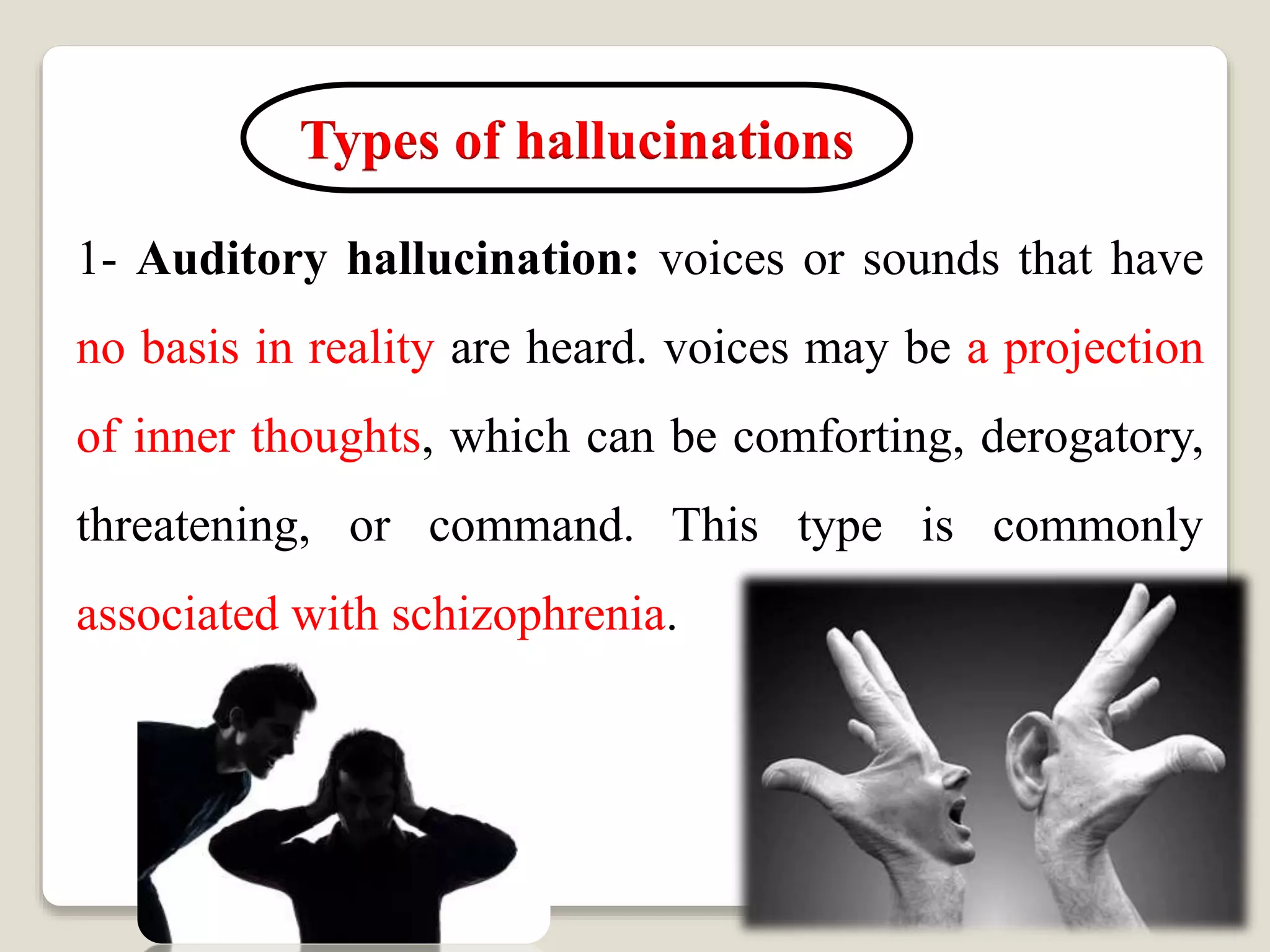
1- Auditory hallucination: voices or sounds that have
no basis in reality are heard. voices may be a projection
of inner thoughts, which can be comforting, derogatory,
threatening, or command. This type is commonly
associated with schizophrenia.
Types of hallucinations
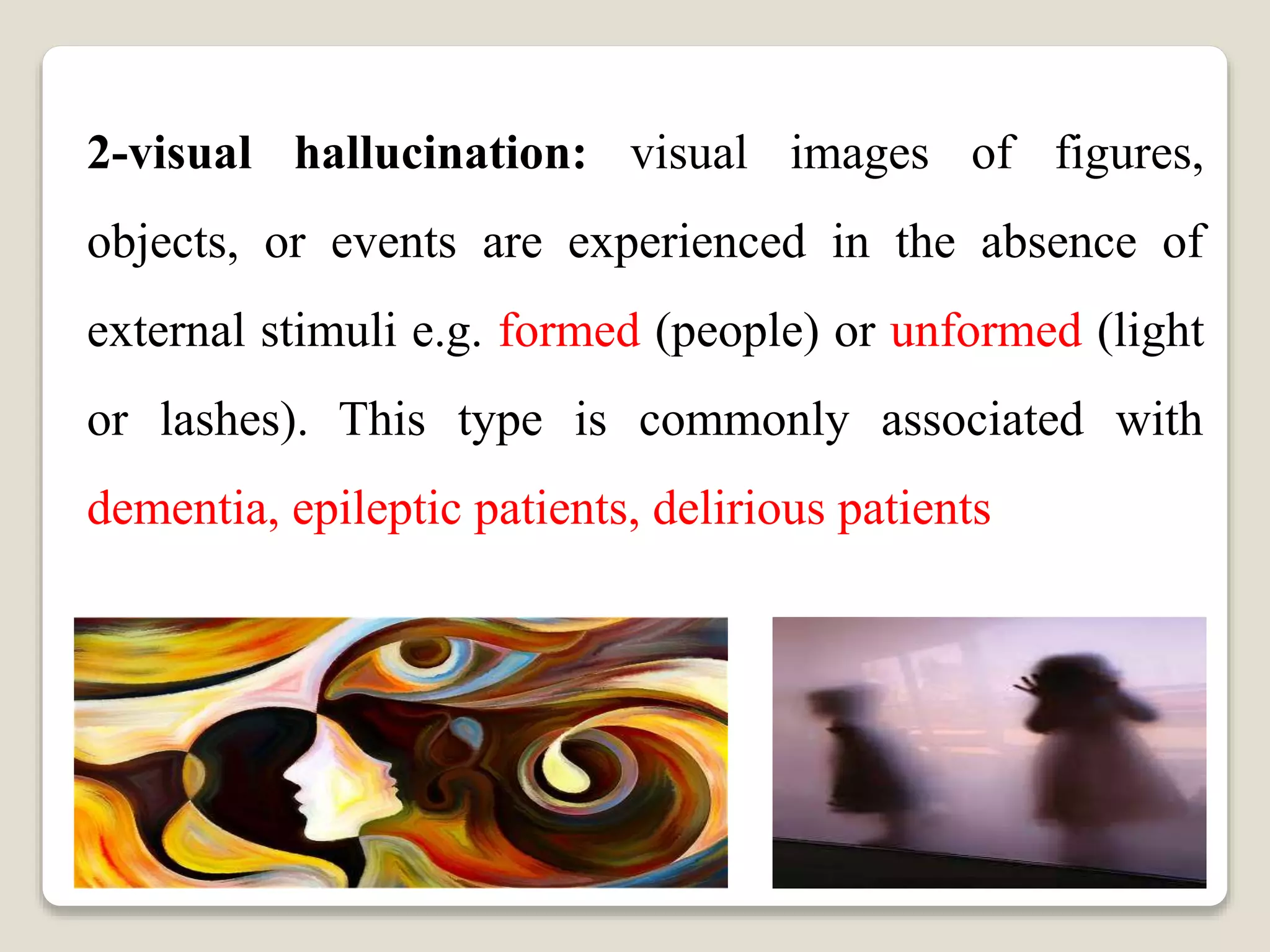
2-visual hallucination: visual images of figures,
objects, or events are experienced in the absence of
external stimuli e.g. formed (people) or unformed (light
or lashes). This type is commonly associated with
dementia, epileptic patients, delirious patients
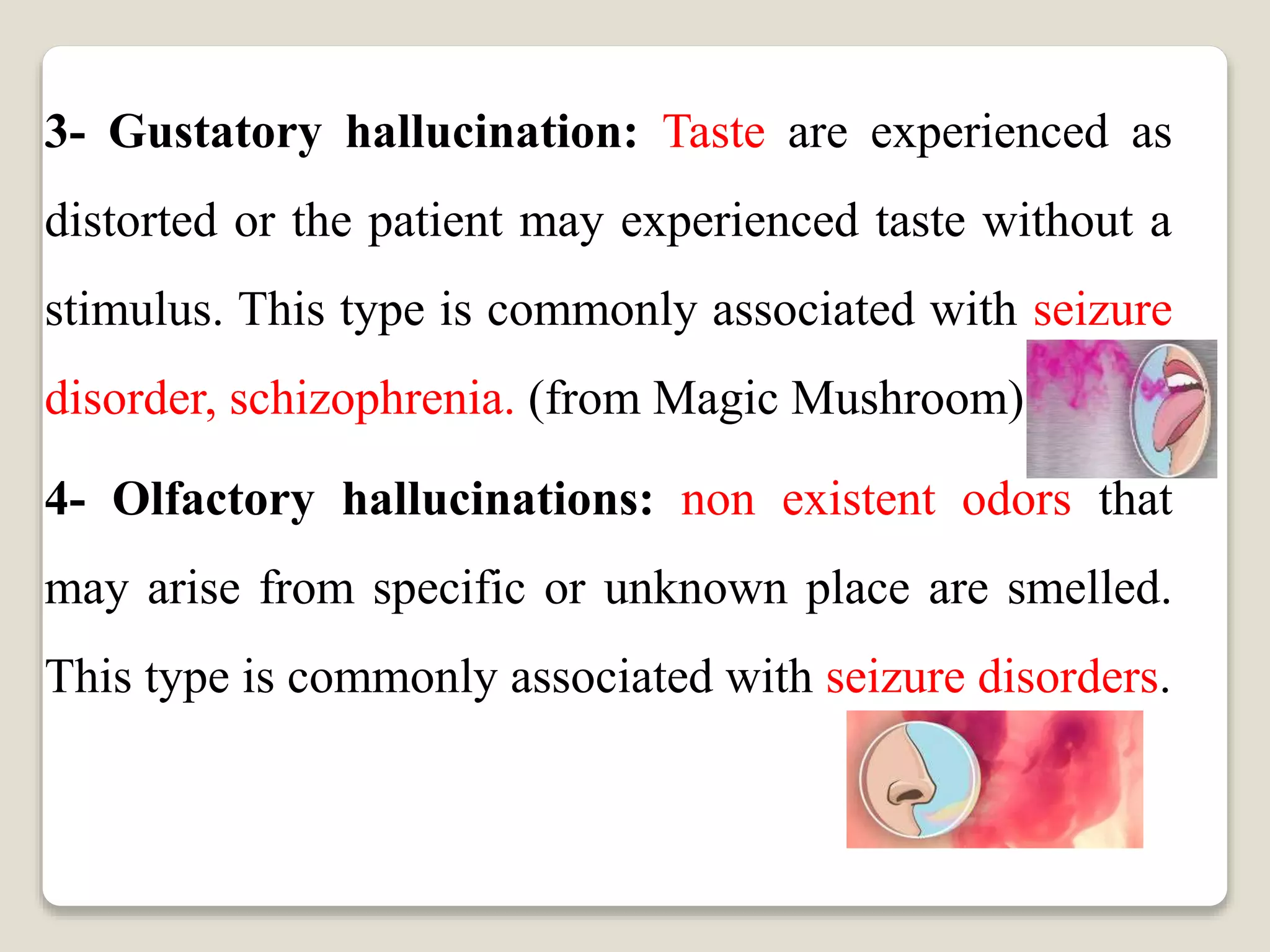
3- Gustatory hallucination: Taste are experienced as
distorted or the patient may experienced taste without a
stimulus. This type is commonly associated with seizure
disorder, schizophrenia. (from Magic Mushroom)
4- Olfactory hallucinations: non existent odors that
may arise from specific or unknown place are smelled.
This type is commonly associated with seizure disorders.
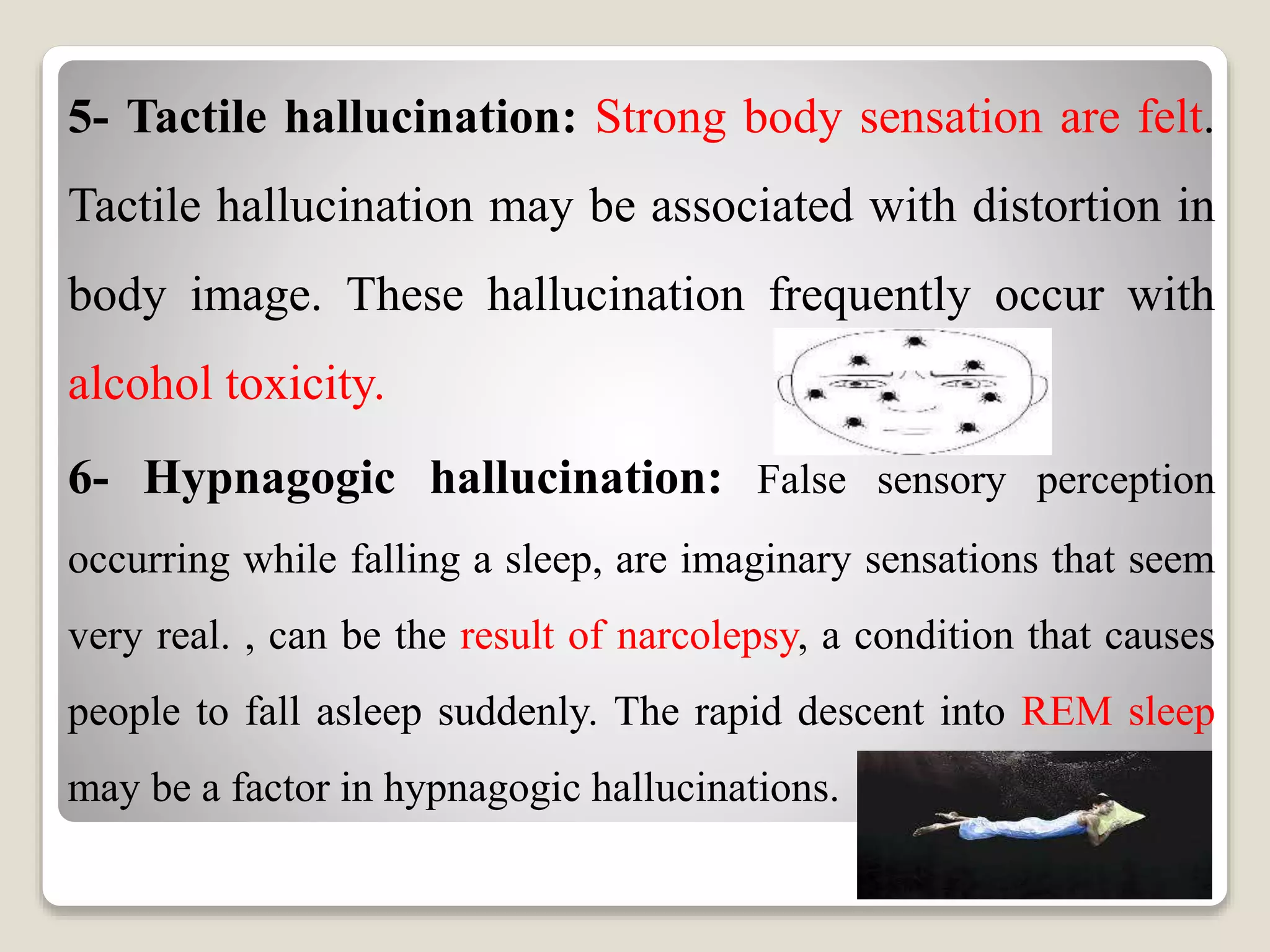
5- Tactile hallucination: Strong body sensation are felt.
Tactile hallucination may be associated with distortion in
body image. These hallucination frequently occur with
alcohol toxicity.
6- Hypnagogic hallucination: False sensory perception
occurring while falling a sleep, are imaginary sensations that seem
very real. , can be the result of narcolepsy, a condition that causes
people to fall asleep suddenly. The rapid descent into REM sleep
may be a factor in hypnagogic hallucinations.
7- Hypnopompic hallucination: false perception occurring
while awakening from sleep, generally considered non
pathological. ‫االتنين‬
‫ممكن‬
‫يكونو‬
‫طبيعين‬
‫يحدث‬
‫لالشخاص‬
‫طبيعى‬
8- Somatic hallucination: False sensation of things occurring in
or to the body, most often visceral in origin (also known
cenesthetsic hallucination).
9- Lilliputian hallucination: False perception in
which objects are seen as reduced in size also termed
(micropsia)
10- Mood congruent hallucination: hallucination the
content of which is consistent with either a depressed
or a manic mood. e.g. a depressed patient hear voices saying
that the patient's bad person, a manic patient hears voices saying
that the patient is of inflated worth, power, knowledge ……etc.
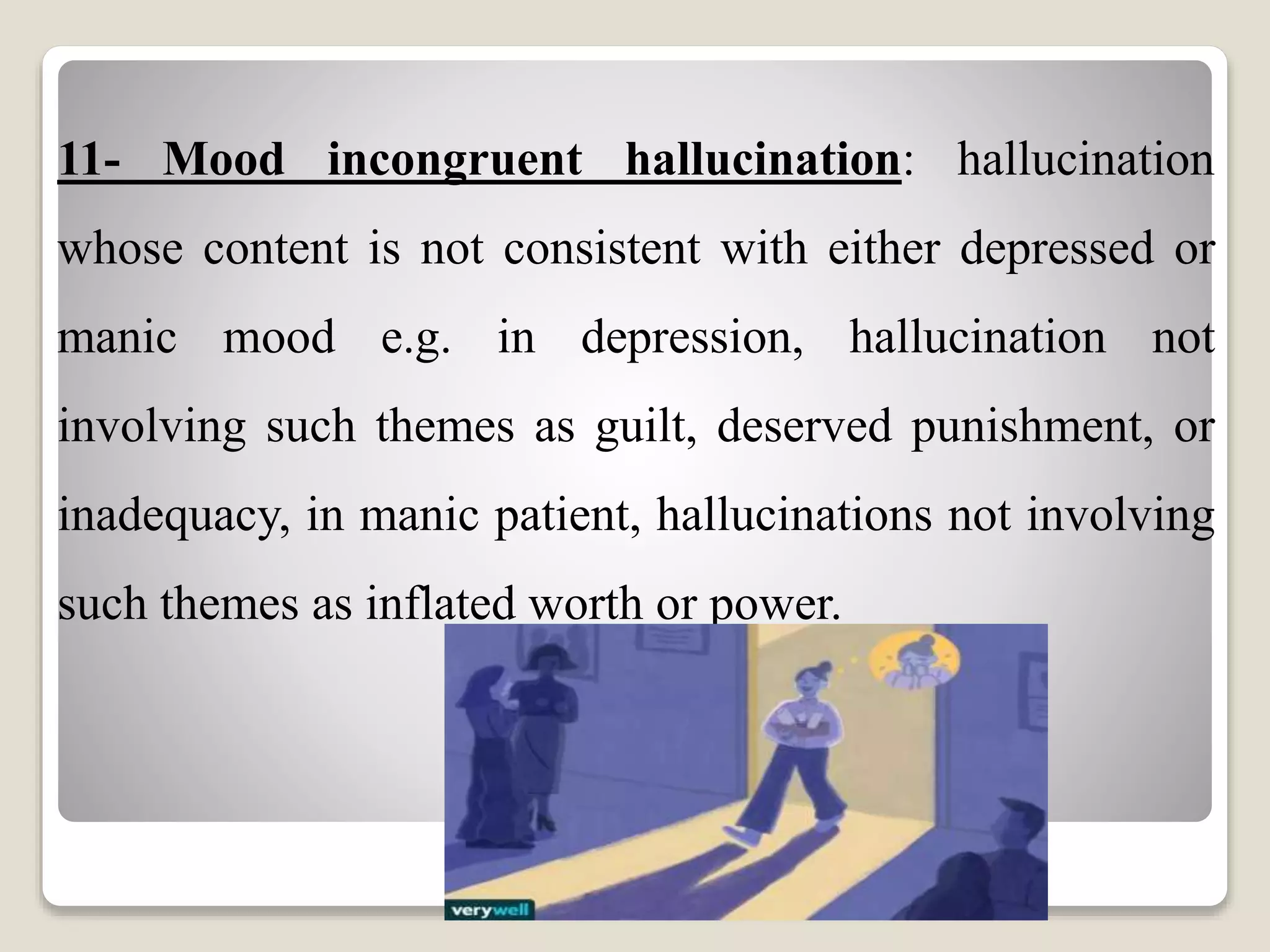
11- Mood incongruent hallucination: hallucination
whose content is not consistent with either depressed or
manic mood e.g. in depression, hallucination not
involving such themes as guilt, deserved punishment, or
inadequacy, in manic patient, hallucinations not involving
such themes as inflated worth or power.
12- Synesthesia: sensation or hallucination caused by
another sensation. E.g. An auditory sensation is
accompanied by triggers a visual sensation, a sound is
experienced as being seen, or a visual experience is heard.
 Withdrawal from alcohol, barbiturates, and other substances
 Organic brain diseases.
 Schizophrenia or Parkinson's disease
 a change or loss of vision, such as Charles Bonnet syndrome
 Hallucinogenic drugs.
 Drug toxicity.
 Bipolar affective disorder, sever mania.
 Endocrine imbalance (steroid psychosis, thyrotoxicosis)
 Sleep or sensory deprivation.
Condition in which hallucination may occur:
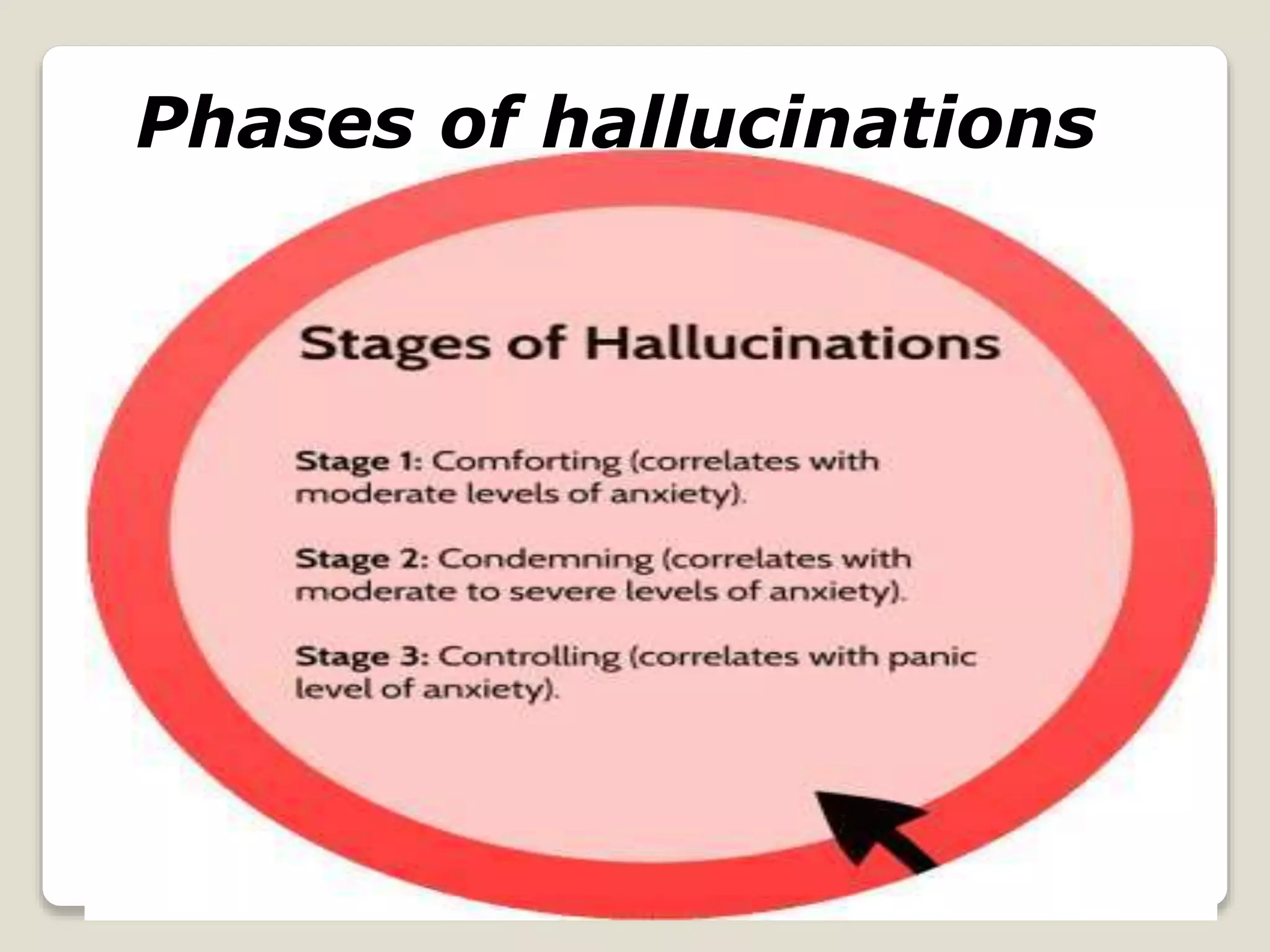
Phases of hallucinations
• Hallucinations may be accompanied by varying
degrees of anxiety and distress.
• The level of anxiety relates to the degree of influence
the hallucination has on the person’s behaviour.
• At the lowest level, (comforting) a person may
begin to experience a sense of anxiety, loneliness or
guilt that can cause them to focus obsessively on
thoughts that will relieve those feelings. However, the
sufferer realizes the thoughts are their own and finds
that they can control them.
• At a moderate level, (condemning) Anxiety is felt to
a greater degree than in stage 1 and the sufferer purposely
prepares to listen to the hallucination. They may become
unable to recognize that the hallucination is not real and start
to experience extreme distress and terror.
• The person may also start to fear that other people can hear
the voices and therefore avoid social situations. They may
also start to find ways to avoid the hallucination.
• A decreased attention span and an increased blood pressure,
heart rate and respiration rate are features of stage 2
hallucination.
• At the extreme level ( conrtolling)
here the sufferer starts to experience anxiety at the
panic level. Voices they are hearing may start to
make commands and become threatening if the
commands are not followed.
At this stage, the hallucinations can last for hours or
days if the patient is left untreated and they may start
to feel suicidal or violent.
 Current theories regarding the etiology of hallucinations
include :
 A response to stress, as an unconscious attempt to defend the
ego, and symbolic expressions of dissociated thought.
 Causes:
Hallucinations can be the result of intense emotions or psychiatric
disorder, disorders of sense organs, sensory deprivation and
disorders of the central nervous system.
Etiology of hallucination
1-Emotion
Very depressed patients with delusions of guilt may hear voices
reproaching them. These are not the continuous voices of paranoid
schizophrenia or organic hallucinosis but tend to be disjointed or
fragmentary, uttering single words or short phrases such as ‘rotter’,
‘kill yourself’, etc.
2-Disorders of a peripheral sense organ:
Hallucinatory voices may occur in ear disease and visual
hallucinations in diseases of the eye, but often there is some
disorder of the central nervous.
3-Sensory deprivation
 If all incoming stimuli are reduced to a minimum in a normal
subject, they will begin to hallucinate after a few hours.
These hallucinations are usually changing visual
hallucinations and repetitive words and phrases. It has been
suggested that the sensory isolation produced by deafness
may cause paranoid disorders in the deaf. ‫جنونالعظمه‬ ‫لهم‬ ‫يحدث‬ ‫الصم‬ ‫مثل‬
‫حولهم‬ ‫محفز‬ ‫اى‬ ‫سماع‬ ‫لقله‬
4- Disorders of the central nervous system:
Current neuroscience evidence suggests several brain areas are
involved in the generation of hallucinations including the sensory
cortex, insula, putamen, and hippocampus.
 Lesions of the cortex can produce hallucinations that are
usually visual but can be auditory. Hypnagogic and
hypnopompic hallucinations are special kinds of organic
hallucination.
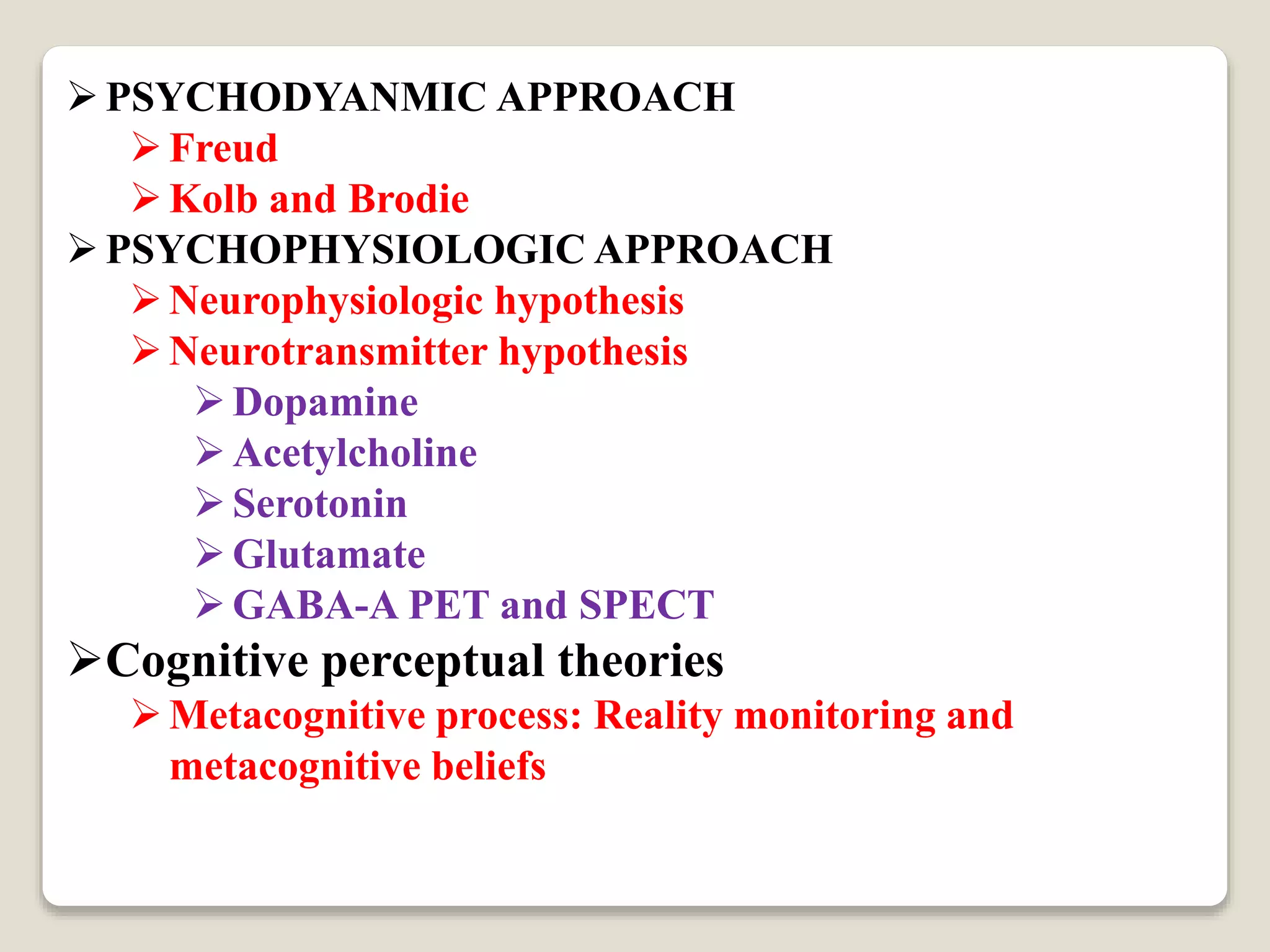
PSYCHODYANMIC APPROACH
Freud
Kolb and Brodie
PSYCHOPHYSIOLOGIC APPROACH
Neurophysiologic hypothesis
Neurotransmitter hypothesis
Dopamine
Acetylcholine
Serotonin
Glutamate
GABA-A PET and SPECT
Cognitive perceptual theories
Metacognitive process: Reality monitoring and
metacognitive beliefs
PSYCHODYANMIC APPROACH
Freud (1953)
felt that hallucinations are very similar to dreams and that both
conditions represent a psychotic state in which there is a
complete lack of time sense.
 In this process, thoughts are transformed into visual images,
mainly of a visual sort.
Kolb and Brodie (1982)
hallucinations represent a breakthrough of preconscious or
unconscious material into consciousness in response to certain
psychological situations and needs,
 e.g., wish fulfillment, enhancement of self-esteem, guilt
feelings.
PSYCHOPHYSIOLOGIC APPROACH
1. Neurophysiologic hypothesis
Hughlings Jackson (1932) This model is known as
disinhibition model. suggested that hallucinations occur when
the usual inhibitory influences of the uppermost level are
impeded, thus leading to release of middle-level activity, which
takes the form of hallucinations.
(Marrazzi, 1970) The neurophysiologic dissociation theory
proposes that hallucinations result from a dissociation between
primary sensory cortex and cortical association areas which
exert a regulatory influence on the former.
(West, 1975) : The perceptual release theory
 postulated the presence of a censorship mechanism in the
brain which actively excluded from the consciousness the
majority of sensory information that is received continually
by the brain.
 But the censorship mechanism can operate only when there is
constant flow of sensory inputs. If by any chance there is
stoppage or impairment of sensory input (e.g., in case of
excessive affects during “functional psychosis,” prolonged
periods of sensory deprivations),
 then earlier perception or memory traces emerge into the
conscious, and the individual experiences hallucinations. This
explains the occurrence of hallucinations following specific
sensory modality deprivation.
Neurotransmitter hypothesis
1- Dopamine In schizophrenia (SCZ) there is evidence that
very high levels of dopamine in the limbic system play a
major role in emergence of hallucinations and delusions.
Antipsychotic medications, which block central dopamine
activity, alleviate the hallucinations of psychosis.
2- Acetylcholine Hallucinations occur in about 30% of
patients with Alzheimer’s disease and 60% of patients with
Lewy body dementia, which are characterized by reduction in
acetylcholine and abnormalities in nicotinic and muscarinic
receptor expression.
3- Serotonin
Hallucinations have been reported as side effects of Selective
serotonin reuptake inhibitors (SSRIs), which increase the
availability of serotonin in the synaptic cleft.
Serotonin has also been implicated in the causation of
hallucinations, based on the fact that a number of
hallucinogenic drugs: like lysergic acid diethylamide
(LSD), mescaline, psilocybin and ecstasy, appear to act, at
least in part, as serotonin 5 HT2A receptor agonist or partial
agonists.
4- Glutamate
A possible role of glutamate in hallucinations is suggested
by the finding that glutamate antagonists like phencyclidine
and ketamine can induce hallucinations. This has led to the
hypothesis that psychotic symptoms may in part be
attributed to hypofunction of NMDA receptors.
5- GABA-A
PET and SPECT studies using GABA-A receptor ligands
showed that the intensity of hallucinations was strongly
associated with diminished GABA-A binding, specifically
in the left medial temporal region.
Metacognitive process: Reality monitoring and
metacognitive beliefs
 Psychological research has argued that hallucinations may result
from biases in what are known as metacognitive abilities.
 These are abilities that allow us to monitor or draw inferences
from our own internal psychological states (such as intentions,
memories, beliefs and thoughts). The ability to discriminate
between internal (self-generated) and external (stimuli) sources
of information is considered to be an important metacognitive
skill, but one which may break down to cause hallucinatory
experiences.
 Projection of an internal state (or a person's own reaction to
another's) may arise in the form of hallucinations, especially
auditory hallucinations. A recent hypothesis that is gaining
acceptance concerns the role of overactive top-down
processing, or strong perceptual expectations, that can
generate spontaneous perceptual output (that is,
hallucination).
Cont.’
A complete assessment of hallucinations should identify the
following:
 Whether the hallucinations are solely auditory or include
other senses.
 How long the patient has experienced the hallucinations, what
the initial hallucinations were like, and whether they have
changed.
 Which situations are most likely to trigger hallucinations, and
which time of day they occur most frequently.
Assessment of hallucination:
 What the hallucinations are about? Are they just sounds, or
voices? If the patient hear voices, what do they say?
 How strongly the patient believes in the reality of the
hallucination.
 Whether the hallucination command the patient to do
something, and if so, how potentially destructive the commands
are.
Cont.’
Cont.’
Whether the patient hears other voices contradicting the
commands received in hallucinations
How the patient feels about the hallucinations.
Which strategies the patient has used to cope with
the hallucinations and how effective the strategies
were.
Nurses who have worked with patients who are
hallucinating have reported the following reactions:
Disregard Nurses may assume that complaints of physical
discomfort are part of the hallucination and so may not take the
time to investigate the problem.
Amusement A common (but unhelpful) reaction to a person
who is hallucinating is for a nurse to be amused at his or her
behaviour.
Anxiety Some nurses report experiencing anxiety due to the
person’s unpredictable behaviour.
Inadequacy Nurses may feel that it is beyond the range of their
skills to effectively intervene.
Avoidance A nurse might experience a desire to avoid such
patients due to a lack of confidence, insufficient knowledge or
difficulties in engaging with the person.
- It is most important to remember that hallucinations seem real
to the patient. The patient may perceive the hallucination as
reality and reject the reality of the surrounding
environment or persons.
- In organic hallucinations the patient is usually terrified by the
visual hallucinations and may try desperately to get away
from them. Most delirious patients feel threatened and are
generally suspicious.
The patient’s attitude to hallucinations
Depressed patients
 Patients with depression often hear disjointed voices
abusing them or telling them to kill themselves. They are not
terrified by the voices, as they believe they are wicked and
deserve to hear what is being said of them. The instructions to
kill themselves are not frightening since they may have
thought of this for some time anyway.
Schizophrenic patient:
- The onset of voices in acute schizophrenia is often very
frightening and the patient at times may attack the person he
believes to be their source.
- Those with chronic schizophrenia on the other hand are often
not troubled by the voices and may treat them as old friends,
but a few patients complain bitterly about them.
-Those patients who are knowledgeable about their
illness or who have insight into it may deny
hallucinations, since they know this is an abnormal
feature. Sometimes it is obvious that a patient is
hallucinating if they stop talking and appear to be
listening to something else or if they attempt to reply to
the voices.
- Be realistic in your expectation of the patient do not expect
more or less of the patient than he or she is capable of doing.
- As agitation subsides, encourage the patient to express his or
her feelings, first in one to one contacts, then in small groups,
and then in large groups as tolerated.
- Help the patient identify and practice ways to relieve anxiety
when the patient is able to verbalize such feeling.
Nursing diagnoses
1. Sensory perceptual alterations
2. Risk for violence self directed or directed at others.
 Short term goal: The patient will:
- Demonstrate decrease hallucinations
- Interact with other in the external environment.
- Participate in the real environment.
 Long term goal: the patient will:
- Verbalize plans to deal with hallucinations, if they recur.
- Verbalize knowledge of hallucinations or illness and safe use of
medications.
 Nursing intervention:
- Be aware of all surrounding stimuli, including sounds from
other rooms such as television.
- Try to decrease stimuli or move the patient to another area.
- Avoid conveying to the patient the belief that hallucinations are
real.
- Explore the content of the patient hallucinations during the
initial assessment to determine what kind of stimuli the patient
is receiving. Remember not to reinforce the hallucinations as
real, you might say, I don't hear any voices what are you
hearing?
- Communicate with the patient verbally in direct, concrete
specific terms. Avoid gestures, abstract ideas.
- Avoid placing the patient in a situation in which choices need to
be made. Don't ask would you like to talk or be alone for a
while? Rather than, suggest that the patient talk with you.
- Respond verbally to any thing real that the patient talks about,
reinforce the patient conversation when he or she refers to
reality.
- Encourage the patient to make staff members aware of
hallucinations when they occur or when they interfere with
the patient ability to converse and carry out activities.
- If the patient appears to be hallucinating, attempt to engage
the patient attention, and provide conversation or a concrete
activity of interest to the patient.
- Maintain simple, basic topics of conversation to provide a
base in reality.
- Provide simple activities that can be easily or realistically
accomplished by the patient.
- Encourage any expression of any feeling of guilt, remorse, or
embarrassment the patient may have once he or she is aware
of psychotic behavior, be supportive.
- Shows acceptance of the patient's behavior and of the patient
as a person, do not joke about or judge the patient's behavior.
 Nursing intervention for risk for violence self-directed or directed to
others
 Short term goal: the patient will:
- Be free of injury.
- Not injury others or destroy property.
- Verbalize feelings of anger, frustration, or confusion.
- Express decrease feeling of agitation, fear, or anxiety,
 Long term goal: the patient will:
- Demonstrate satisfying relationship with others.
- Demonstrate effective coping strategies.
- Provide protective supervision for the client, but avoid
hovering over him or her.
- Remain aware of cues indicating that the patient is
hallucinating (intent listening for no apparent reason talking to
someone when no one is present, inappropriate facial
expression).
- Provide structured environment with scheduled routine
activities of daily living.
Nursing interventions:
- Be alert for sign increasing fear, anxiety, or agitation so that
you may intervene as early as possible and prevent harm to
the patient, others, or property.
- Be realistic in your expectation of the patient do not expect
more or less of the patient than he or she is capable of doing.
- As agitation subsides, encourage the patient to express his or
her feelings, first in one to one contacts, then in small groups,
and then in large groups as tolerated.
- Help the patient identify and practice ways to relieve anxiety
when the patient is able to verbalize such feeling.
A training program on coping
methods, to improve auditory
hallucinations among patients
with psychiatric disorders
• We will apply training programs for patients with psychiatric
disorders who suffer from auditory hallucinations and teach
them how to use cognitive, behavioral and physical coping
methods to deal with the hallucinations.
Aim of the program:
• The aim of this program is to evaluate the
effectiveness of a training program on coping methods,
to improve auditory hallucinations among patients with
psychiatric disorders and reduced all dimensions of
auditory hallucination after and at the follow-up
implementation of the program.
Inclusion and Exclusion Criteria:
• Participants recruited in this study were patients with psychiatric
disorders (e.g., schizophrenia, bipolar disorders, mania,
depression) concurrence to the "DSM-IV" edition and according
to the patients’ sheet.
• the duration of illness 2 years,
• patients have the insight about auditory hallucinations,
• their age ranged, between 18 to 65 years of both sexes, and
agreeing to participate in the study.
2. Exclusion Criteria
• A patient with an organic brain disorder,
• with age younger than18 years or older than 65 years.
• A patient has no insight on his/her auditory hallucinations,
• and patient suffering from substance abuse, and mental
retardation.
3. Setting
• The study will applied at the Inpatients of a Mental Hospital,
affiliated to the Ministry of Health at suez-canal university
• It contributes care to participants of both sexes and outpatient
mental services.
4. Tools
• Tool I: A constructed interview, which contains two parts as
follow:
Part 1: Developed one , it will use to collect the
demographic data as; age, gender, residence, occupation, marital
status, living status, and educational level.
Part 2: It includes clinical characteristics of data: The
psychiatric history as diagnosis, duration of illness, number of
previous psychiatric hospitalizations, history of the beginning of
hallucinations (in years), effect of hallucinations on the patients' life
and history of receipt antipsychotic medications (in years).
The tool II:
A Structured Interviewing Sheet of Self
Management Strategies to Control the Auditory
Hallucinations: Developed by Abd El-Hay. It will be
used to elicit information in relation to self-management
of auditory hallucinations.
It comprises 36 items of coping approaches that are
separated into three classes:
• (1) Physiological coping strategy: It contains 7 items
to diminish the patient’s arousal, such as sleeping, lying
down, taking extra medication and resting, and
strategies to increase patient’s arousal, such as, listening
to music, exercising, smoking cigarettes, etc.
• (2) Cognitive coping strategy: It encompasses 11 items
of acceptance of voices, such as debating with the
voices, accepting and remaining with voices peacefully,
acting as the voices say, speaking to the voices,
requesting self to calm down, and declined attention to
voices, such as; ignoring them, confirming voices, etc.
• (3) Behavioral coping strategy: It comprises 17 items,
such as blocking ears, watching television, looking for
help from the nurse and doctor, conversation with
others, praying, singing, going to crowded places,
separating self, eating, crying, leaving the place, etc.
The patients reply with a four-point Likert scale for each
item
Training Program Construction: Involved Four Phases
1. Assessment phase: we will revise all psychiatric inpatients’
sheets to select patients who meet inclusion criteria.
The recruited patients will be submitted to a pre-test utilizing the
tools of the study to assess the patients' history and adapting
approaches of hallucinations. This will be applied through
interviewing patients in a separate manner by the researcher,
each patient took 35-50 minutes.
2. Preparation phase: According to the results achieved from
interviewing, observation and patients' records, as well, review
of the literature, a training instruction was developed by the
researcher. It was applied immediately after the pretest.
The contents of the program: Handouts will be designed to meet
patients’ needs and to fit into their interest and levels of
understanding. They consisted of different elements of coping
methods, cognitive, physiological, and behavioral and were used to
reduce auditory hallucinations and improve their features.
Methods of teaching
Lectures/discussions, demonstration, and redemonstration. Media
of teaching: They included handouts, videos, pictures,
3. Implementation phase:
10 sessions will be applied, every session lasted 1.30 hours within
10 minutes, break. The distribution of the program sessions was as
follows:
First session: It included welcome, the identification
between the researcher and a group that emphasizes approval
between the group members (5 patients). As well, the
researcher presented an introduction and a clarification of the
program objective and importance of coping methods to ensure
that the patients apprehend the program
Second session: It deals with the physiological and cognitive
coping methods, explaining the application of such methods.
Some methods were supported by movies film. In addition, the
researcher assisted the patients to practice physical exercises
with listening to stimulating music.
Third session: Training the patient and the caregiver use techniques that
will help in controlling auditory hallucinations, such as talking to someone
"nurse", expression of the content of the voices, and the physical act of
talking or using the vocal cords in other means, such as singing which
restricts the process that creates voices, thus decreasing the intensity of the
hallucinations.
Fourth session: Training the patients about behavioral coping method
clarification and its applications, it was supported by videos. Group activity
such as; playing cards, dominoes, puzzles and any preferable activity as
watching TV and something that moves, and praying are used" to distract
them from hallucinations.
Fifth session: Teaching the patients and the caregivers the technique to
control hallucination, such as; saying stop and you are not real; changing
his or her position and going away. In this session the researcher, organized
drawing/painting, singing competition with patients to reward them to
active participation in the program.
.
Sixth session: Instructing the patients to use earplugs to
control hallucination and prescribed medication as doctor order
and instructed them not to stop it abruptly.
Seventh session: Encourage patient to concentrate on carrying
out the exercises, thereby engaging in the activity, reducing
anxiety and contributing to a reduction in the intensity of the
auditory hallucinations.
Eighth session: Training the patient relaxation techniques such
as rest, exercise, to cope with auditory hallucination, it was
supported by videos and photos about it, demonstration and
remodeling of these exercises
Ninth session: Encourage patients to practice relaxation
exercises, and promote constructive criticism about other
patients’ behavior in doing relaxation exercises under the
researcher observations.
Tenth session: Give revision in all over the program and
provide patients a chance to express the benefits from the
program and their feeling about it.
4. Evaluation phase: Evaluation of the program was done
through promptly after the eventual application of the program
functionality a post-test survey, which was the same as the pre-
test to evaluate the effect of the program. One month later, after
post-test, the follow-up test was performed using the same tools
in orders to assess the degree of retention through comparison of
results with pre-post-tests.
Concept of hallucination.pptx

Concept of hallucination.pptx

  • 1.
    Presented to: Prof.Safaa Abdel-Azeem Presented by: Fathia Gamal
  • 3.
    Outlines  Definition ofhallucinations  Types of hallucinations  Conditions in which hallucination may occur  Phases of hallucinations  Etiology of hallucination  Assessment of hallucination  Nursing diagnoses  The patient’s attitude toward hallucinations  A training program on coping methods, to improve auditory hallucinations among patients with psychiatric disorders
  • 4.
     Hallucination arethe most common example of alteration of sensory stimuli observed in patient with schizophrenia.  Hallucination can be experienced in all sensory modalities, however, auditory hallucination are the most frequent in schizophrenia. Introduction
  • 5.
     Hallucinations arefalse perception or wrong perception, in the absence of any object. Hallucinations are very real to the person experiencing them.
  • 6.
    Both illusion andhallucination are perceptual disturbances. illusion is a false perception or perception in a wrong manner of a real object. So, - in the case of hallucination, there is no object present, but it is the person who perceives that there is some object, but in the other case the person perceives an object differently than it is actually. for example misinterpreting a coat hanging on a door as a person.
  • 8.
    1- Auditory hallucination:voices or sounds that have no basis in reality are heard. voices may be a projection of inner thoughts, which can be comforting, derogatory, threatening, or command. This type is commonly associated with schizophrenia. Types of hallucinations
  • 9.
    2-visual hallucination: visualimages of figures, objects, or events are experienced in the absence of external stimuli e.g. formed (people) or unformed (light or lashes). This type is commonly associated with dementia, epileptic patients, delirious patients
  • 10.
    3- Gustatory hallucination:Taste are experienced as distorted or the patient may experienced taste without a stimulus. This type is commonly associated with seizure disorder, schizophrenia. (from Magic Mushroom) 4- Olfactory hallucinations: non existent odors that may arise from specific or unknown place are smelled. This type is commonly associated with seizure disorders.
  • 11.
    5- Tactile hallucination:Strong body sensation are felt. Tactile hallucination may be associated with distortion in body image. These hallucination frequently occur with alcohol toxicity. 6- Hypnagogic hallucination: False sensory perception occurring while falling a sleep, are imaginary sensations that seem very real. , can be the result of narcolepsy, a condition that causes people to fall asleep suddenly. The rapid descent into REM sleep may be a factor in hypnagogic hallucinations.
  • 12.
    7- Hypnopompic hallucination:false perception occurring while awakening from sleep, generally considered non pathological. ‫االتنين‬ ‫ممكن‬ ‫يكونو‬ ‫طبيعين‬ ‫يحدث‬ ‫لالشخاص‬ ‫طبيعى‬ 8- Somatic hallucination: False sensation of things occurring in or to the body, most often visceral in origin (also known cenesthetsic hallucination).
  • 13.
    9- Lilliputian hallucination:False perception in which objects are seen as reduced in size also termed (micropsia) 10- Mood congruent hallucination: hallucination the content of which is consistent with either a depressed or a manic mood. e.g. a depressed patient hear voices saying that the patient's bad person, a manic patient hears voices saying that the patient is of inflated worth, power, knowledge ……etc.
  • 14.
    11- Mood incongruenthallucination: hallucination whose content is not consistent with either depressed or manic mood e.g. in depression, hallucination not involving such themes as guilt, deserved punishment, or inadequacy, in manic patient, hallucinations not involving such themes as inflated worth or power.
  • 15.
    12- Synesthesia: sensationor hallucination caused by another sensation. E.g. An auditory sensation is accompanied by triggers a visual sensation, a sound is experienced as being seen, or a visual experience is heard.
  • 16.
     Withdrawal fromalcohol, barbiturates, and other substances  Organic brain diseases.  Schizophrenia or Parkinson's disease  a change or loss of vision, such as Charles Bonnet syndrome  Hallucinogenic drugs.  Drug toxicity.  Bipolar affective disorder, sever mania.  Endocrine imbalance (steroid psychosis, thyrotoxicosis)  Sleep or sensory deprivation. Condition in which hallucination may occur:
  • 17.
  • 18.
    • Hallucinations maybe accompanied by varying degrees of anxiety and distress. • The level of anxiety relates to the degree of influence the hallucination has on the person’s behaviour. • At the lowest level, (comforting) a person may begin to experience a sense of anxiety, loneliness or guilt that can cause them to focus obsessively on thoughts that will relieve those feelings. However, the sufferer realizes the thoughts are their own and finds that they can control them.
  • 19.
    • At amoderate level, (condemning) Anxiety is felt to a greater degree than in stage 1 and the sufferer purposely prepares to listen to the hallucination. They may become unable to recognize that the hallucination is not real and start to experience extreme distress and terror. • The person may also start to fear that other people can hear the voices and therefore avoid social situations. They may also start to find ways to avoid the hallucination. • A decreased attention span and an increased blood pressure, heart rate and respiration rate are features of stage 2 hallucination.
  • 20.
    • At theextreme level ( conrtolling) here the sufferer starts to experience anxiety at the panic level. Voices they are hearing may start to make commands and become threatening if the commands are not followed. At this stage, the hallucinations can last for hours or days if the patient is left untreated and they may start to feel suicidal or violent.
  • 21.
     Current theoriesregarding the etiology of hallucinations include :  A response to stress, as an unconscious attempt to defend the ego, and symbolic expressions of dissociated thought.  Causes: Hallucinations can be the result of intense emotions or psychiatric disorder, disorders of sense organs, sensory deprivation and disorders of the central nervous system. Etiology of hallucination
  • 22.
    1-Emotion Very depressed patientswith delusions of guilt may hear voices reproaching them. These are not the continuous voices of paranoid schizophrenia or organic hallucinosis but tend to be disjointed or fragmentary, uttering single words or short phrases such as ‘rotter’, ‘kill yourself’, etc. 2-Disorders of a peripheral sense organ: Hallucinatory voices may occur in ear disease and visual hallucinations in diseases of the eye, but often there is some disorder of the central nervous.
  • 23.
    3-Sensory deprivation  Ifall incoming stimuli are reduced to a minimum in a normal subject, they will begin to hallucinate after a few hours. These hallucinations are usually changing visual hallucinations and repetitive words and phrases. It has been suggested that the sensory isolation produced by deafness may cause paranoid disorders in the deaf. ‫جنونالعظمه‬ ‫لهم‬ ‫يحدث‬ ‫الصم‬ ‫مثل‬ ‫حولهم‬ ‫محفز‬ ‫اى‬ ‫سماع‬ ‫لقله‬
  • 24.
    4- Disorders ofthe central nervous system: Current neuroscience evidence suggests several brain areas are involved in the generation of hallucinations including the sensory cortex, insula, putamen, and hippocampus.  Lesions of the cortex can produce hallucinations that are usually visual but can be auditory. Hypnagogic and hypnopompic hallucinations are special kinds of organic hallucination.
  • 25.
    PSYCHODYANMIC APPROACH Freud Kolb andBrodie PSYCHOPHYSIOLOGIC APPROACH Neurophysiologic hypothesis Neurotransmitter hypothesis Dopamine Acetylcholine Serotonin Glutamate GABA-A PET and SPECT Cognitive perceptual theories Metacognitive process: Reality monitoring and metacognitive beliefs
  • 26.
    PSYCHODYANMIC APPROACH Freud (1953) feltthat hallucinations are very similar to dreams and that both conditions represent a psychotic state in which there is a complete lack of time sense.  In this process, thoughts are transformed into visual images, mainly of a visual sort. Kolb and Brodie (1982) hallucinations represent a breakthrough of preconscious or unconscious material into consciousness in response to certain psychological situations and needs,  e.g., wish fulfillment, enhancement of self-esteem, guilt feelings.
  • 27.
    PSYCHOPHYSIOLOGIC APPROACH 1. Neurophysiologichypothesis Hughlings Jackson (1932) This model is known as disinhibition model. suggested that hallucinations occur when the usual inhibitory influences of the uppermost level are impeded, thus leading to release of middle-level activity, which takes the form of hallucinations. (Marrazzi, 1970) The neurophysiologic dissociation theory proposes that hallucinations result from a dissociation between primary sensory cortex and cortical association areas which exert a regulatory influence on the former.
  • 28.
    (West, 1975) :The perceptual release theory  postulated the presence of a censorship mechanism in the brain which actively excluded from the consciousness the majority of sensory information that is received continually by the brain.  But the censorship mechanism can operate only when there is constant flow of sensory inputs. If by any chance there is stoppage or impairment of sensory input (e.g., in case of excessive affects during “functional psychosis,” prolonged periods of sensory deprivations),  then earlier perception or memory traces emerge into the conscious, and the individual experiences hallucinations. This explains the occurrence of hallucinations following specific sensory modality deprivation.
  • 29.
    Neurotransmitter hypothesis 1- DopamineIn schizophrenia (SCZ) there is evidence that very high levels of dopamine in the limbic system play a major role in emergence of hallucinations and delusions. Antipsychotic medications, which block central dopamine activity, alleviate the hallucinations of psychosis. 2- Acetylcholine Hallucinations occur in about 30% of patients with Alzheimer’s disease and 60% of patients with Lewy body dementia, which are characterized by reduction in acetylcholine and abnormalities in nicotinic and muscarinic receptor expression.
  • 30.
    3- Serotonin Hallucinations havebeen reported as side effects of Selective serotonin reuptake inhibitors (SSRIs), which increase the availability of serotonin in the synaptic cleft. Serotonin has also been implicated in the causation of hallucinations, based on the fact that a number of hallucinogenic drugs: like lysergic acid diethylamide (LSD), mescaline, psilocybin and ecstasy, appear to act, at least in part, as serotonin 5 HT2A receptor agonist or partial agonists.
  • 31.
    4- Glutamate A possiblerole of glutamate in hallucinations is suggested by the finding that glutamate antagonists like phencyclidine and ketamine can induce hallucinations. This has led to the hypothesis that psychotic symptoms may in part be attributed to hypofunction of NMDA receptors. 5- GABA-A PET and SPECT studies using GABA-A receptor ligands showed that the intensity of hallucinations was strongly associated with diminished GABA-A binding, specifically in the left medial temporal region.
  • 32.
    Metacognitive process: Realitymonitoring and metacognitive beliefs  Psychological research has argued that hallucinations may result from biases in what are known as metacognitive abilities.  These are abilities that allow us to monitor or draw inferences from our own internal psychological states (such as intentions, memories, beliefs and thoughts). The ability to discriminate between internal (self-generated) and external (stimuli) sources of information is considered to be an important metacognitive skill, but one which may break down to cause hallucinatory experiences.
  • 33.
     Projection ofan internal state (or a person's own reaction to another's) may arise in the form of hallucinations, especially auditory hallucinations. A recent hypothesis that is gaining acceptance concerns the role of overactive top-down processing, or strong perceptual expectations, that can generate spontaneous perceptual output (that is, hallucination). Cont.’
  • 34.
    A complete assessmentof hallucinations should identify the following:  Whether the hallucinations are solely auditory or include other senses.  How long the patient has experienced the hallucinations, what the initial hallucinations were like, and whether they have changed.  Which situations are most likely to trigger hallucinations, and which time of day they occur most frequently. Assessment of hallucination:
  • 35.
     What thehallucinations are about? Are they just sounds, or voices? If the patient hear voices, what do they say?  How strongly the patient believes in the reality of the hallucination.  Whether the hallucination command the patient to do something, and if so, how potentially destructive the commands are. Cont.’
  • 36.
    Cont.’ Whether the patienthears other voices contradicting the commands received in hallucinations How the patient feels about the hallucinations. Which strategies the patient has used to cope with the hallucinations and how effective the strategies were.
  • 37.
    Nurses who haveworked with patients who are hallucinating have reported the following reactions: Disregard Nurses may assume that complaints of physical discomfort are part of the hallucination and so may not take the time to investigate the problem. Amusement A common (but unhelpful) reaction to a person who is hallucinating is for a nurse to be amused at his or her behaviour. Anxiety Some nurses report experiencing anxiety due to the person’s unpredictable behaviour. Inadequacy Nurses may feel that it is beyond the range of their skills to effectively intervene. Avoidance A nurse might experience a desire to avoid such patients due to a lack of confidence, insufficient knowledge or difficulties in engaging with the person.
  • 38.
    - It ismost important to remember that hallucinations seem real to the patient. The patient may perceive the hallucination as reality and reject the reality of the surrounding environment or persons. - In organic hallucinations the patient is usually terrified by the visual hallucinations and may try desperately to get away from them. Most delirious patients feel threatened and are generally suspicious. The patient’s attitude to hallucinations
  • 39.
    Depressed patients  Patientswith depression often hear disjointed voices abusing them or telling them to kill themselves. They are not terrified by the voices, as they believe they are wicked and deserve to hear what is being said of them. The instructions to kill themselves are not frightening since they may have thought of this for some time anyway.
  • 40.
    Schizophrenic patient: - Theonset of voices in acute schizophrenia is often very frightening and the patient at times may attack the person he believes to be their source. - Those with chronic schizophrenia on the other hand are often not troubled by the voices and may treat them as old friends, but a few patients complain bitterly about them.
  • 41.
    -Those patients whoare knowledgeable about their illness or who have insight into it may deny hallucinations, since they know this is an abnormal feature. Sometimes it is obvious that a patient is hallucinating if they stop talking and appear to be listening to something else or if they attempt to reply to the voices.
  • 42.
    - Be realisticin your expectation of the patient do not expect more or less of the patient than he or she is capable of doing. - As agitation subsides, encourage the patient to express his or her feelings, first in one to one contacts, then in small groups, and then in large groups as tolerated. - Help the patient identify and practice ways to relieve anxiety when the patient is able to verbalize such feeling.
  • 43.
    Nursing diagnoses 1. Sensoryperceptual alterations 2. Risk for violence self directed or directed at others.  Short term goal: The patient will: - Demonstrate decrease hallucinations - Interact with other in the external environment. - Participate in the real environment.  Long term goal: the patient will: - Verbalize plans to deal with hallucinations, if they recur. - Verbalize knowledge of hallucinations or illness and safe use of medications.
  • 44.
     Nursing intervention: -Be aware of all surrounding stimuli, including sounds from other rooms such as television. - Try to decrease stimuli or move the patient to another area. - Avoid conveying to the patient the belief that hallucinations are real. - Explore the content of the patient hallucinations during the initial assessment to determine what kind of stimuli the patient is receiving. Remember not to reinforce the hallucinations as real, you might say, I don't hear any voices what are you hearing?
  • 45.
    - Communicate withthe patient verbally in direct, concrete specific terms. Avoid gestures, abstract ideas. - Avoid placing the patient in a situation in which choices need to be made. Don't ask would you like to talk or be alone for a while? Rather than, suggest that the patient talk with you. - Respond verbally to any thing real that the patient talks about, reinforce the patient conversation when he or she refers to reality.
  • 46.
    - Encourage thepatient to make staff members aware of hallucinations when they occur or when they interfere with the patient ability to converse and carry out activities. - If the patient appears to be hallucinating, attempt to engage the patient attention, and provide conversation or a concrete activity of interest to the patient. - Maintain simple, basic topics of conversation to provide a base in reality.
  • 47.
    - Provide simpleactivities that can be easily or realistically accomplished by the patient. - Encourage any expression of any feeling of guilt, remorse, or embarrassment the patient may have once he or she is aware of psychotic behavior, be supportive. - Shows acceptance of the patient's behavior and of the patient as a person, do not joke about or judge the patient's behavior.
  • 48.
     Nursing interventionfor risk for violence self-directed or directed to others  Short term goal: the patient will: - Be free of injury. - Not injury others or destroy property. - Verbalize feelings of anger, frustration, or confusion. - Express decrease feeling of agitation, fear, or anxiety,  Long term goal: the patient will: - Demonstrate satisfying relationship with others. - Demonstrate effective coping strategies.
  • 49.
    - Provide protectivesupervision for the client, but avoid hovering over him or her. - Remain aware of cues indicating that the patient is hallucinating (intent listening for no apparent reason talking to someone when no one is present, inappropriate facial expression). - Provide structured environment with scheduled routine activities of daily living. Nursing interventions:
  • 50.
    - Be alertfor sign increasing fear, anxiety, or agitation so that you may intervene as early as possible and prevent harm to the patient, others, or property. - Be realistic in your expectation of the patient do not expect more or less of the patient than he or she is capable of doing. - As agitation subsides, encourage the patient to express his or her feelings, first in one to one contacts, then in small groups, and then in large groups as tolerated. - Help the patient identify and practice ways to relieve anxiety when the patient is able to verbalize such feeling.
  • 51.
    A training programon coping methods, to improve auditory hallucinations among patients with psychiatric disorders
  • 52.
    • We willapply training programs for patients with psychiatric disorders who suffer from auditory hallucinations and teach them how to use cognitive, behavioral and physical coping methods to deal with the hallucinations. Aim of the program: • The aim of this program is to evaluate the effectiveness of a training program on coping methods, to improve auditory hallucinations among patients with psychiatric disorders and reduced all dimensions of auditory hallucination after and at the follow-up implementation of the program.
  • 53.
    Inclusion and ExclusionCriteria: • Participants recruited in this study were patients with psychiatric disorders (e.g., schizophrenia, bipolar disorders, mania, depression) concurrence to the "DSM-IV" edition and according to the patients’ sheet. • the duration of illness 2 years, • patients have the insight about auditory hallucinations, • their age ranged, between 18 to 65 years of both sexes, and agreeing to participate in the study. 2. Exclusion Criteria • A patient with an organic brain disorder, • with age younger than18 years or older than 65 years. • A patient has no insight on his/her auditory hallucinations, • and patient suffering from substance abuse, and mental retardation.
  • 54.
    3. Setting • Thestudy will applied at the Inpatients of a Mental Hospital, affiliated to the Ministry of Health at suez-canal university • It contributes care to participants of both sexes and outpatient mental services. 4. Tools • Tool I: A constructed interview, which contains two parts as follow: Part 1: Developed one , it will use to collect the demographic data as; age, gender, residence, occupation, marital status, living status, and educational level. Part 2: It includes clinical characteristics of data: The psychiatric history as diagnosis, duration of illness, number of previous psychiatric hospitalizations, history of the beginning of hallucinations (in years), effect of hallucinations on the patients' life and history of receipt antipsychotic medications (in years).
  • 55.
    The tool II: AStructured Interviewing Sheet of Self Management Strategies to Control the Auditory Hallucinations: Developed by Abd El-Hay. It will be used to elicit information in relation to self-management of auditory hallucinations. It comprises 36 items of coping approaches that are separated into three classes: • (1) Physiological coping strategy: It contains 7 items to diminish the patient’s arousal, such as sleeping, lying down, taking extra medication and resting, and strategies to increase patient’s arousal, such as, listening to music, exercising, smoking cigarettes, etc.
  • 56.
    • (2) Cognitivecoping strategy: It encompasses 11 items of acceptance of voices, such as debating with the voices, accepting and remaining with voices peacefully, acting as the voices say, speaking to the voices, requesting self to calm down, and declined attention to voices, such as; ignoring them, confirming voices, etc. • (3) Behavioral coping strategy: It comprises 17 items, such as blocking ears, watching television, looking for help from the nurse and doctor, conversation with others, praying, singing, going to crowded places, separating self, eating, crying, leaving the place, etc. The patients reply with a four-point Likert scale for each item
  • 57.
    Training Program Construction:Involved Four Phases 1. Assessment phase: we will revise all psychiatric inpatients’ sheets to select patients who meet inclusion criteria. The recruited patients will be submitted to a pre-test utilizing the tools of the study to assess the patients' history and adapting approaches of hallucinations. This will be applied through interviewing patients in a separate manner by the researcher, each patient took 35-50 minutes. 2. Preparation phase: According to the results achieved from interviewing, observation and patients' records, as well, review of the literature, a training instruction was developed by the researcher. It was applied immediately after the pretest.
  • 58.
    The contents ofthe program: Handouts will be designed to meet patients’ needs and to fit into their interest and levels of understanding. They consisted of different elements of coping methods, cognitive, physiological, and behavioral and were used to reduce auditory hallucinations and improve their features. Methods of teaching Lectures/discussions, demonstration, and redemonstration. Media of teaching: They included handouts, videos, pictures, 3. Implementation phase: 10 sessions will be applied, every session lasted 1.30 hours within 10 minutes, break. The distribution of the program sessions was as follows:
  • 59.
    First session: Itincluded welcome, the identification between the researcher and a group that emphasizes approval between the group members (5 patients). As well, the researcher presented an introduction and a clarification of the program objective and importance of coping methods to ensure that the patients apprehend the program Second session: It deals with the physiological and cognitive coping methods, explaining the application of such methods. Some methods were supported by movies film. In addition, the researcher assisted the patients to practice physical exercises with listening to stimulating music.
  • 60.
    Third session: Trainingthe patient and the caregiver use techniques that will help in controlling auditory hallucinations, such as talking to someone "nurse", expression of the content of the voices, and the physical act of talking or using the vocal cords in other means, such as singing which restricts the process that creates voices, thus decreasing the intensity of the hallucinations. Fourth session: Training the patients about behavioral coping method clarification and its applications, it was supported by videos. Group activity such as; playing cards, dominoes, puzzles and any preferable activity as watching TV and something that moves, and praying are used" to distract them from hallucinations. Fifth session: Teaching the patients and the caregivers the technique to control hallucination, such as; saying stop and you are not real; changing his or her position and going away. In this session the researcher, organized drawing/painting, singing competition with patients to reward them to active participation in the program. .
  • 61.
    Sixth session: Instructingthe patients to use earplugs to control hallucination and prescribed medication as doctor order and instructed them not to stop it abruptly. Seventh session: Encourage patient to concentrate on carrying out the exercises, thereby engaging in the activity, reducing anxiety and contributing to a reduction in the intensity of the auditory hallucinations. Eighth session: Training the patient relaxation techniques such as rest, exercise, to cope with auditory hallucination, it was supported by videos and photos about it, demonstration and remodeling of these exercises
  • 62.
    Ninth session: Encouragepatients to practice relaxation exercises, and promote constructive criticism about other patients’ behavior in doing relaxation exercises under the researcher observations. Tenth session: Give revision in all over the program and provide patients a chance to express the benefits from the program and their feeling about it. 4. Evaluation phase: Evaluation of the program was done through promptly after the eventual application of the program functionality a post-test survey, which was the same as the pre- test to evaluate the effect of the program. One month later, after post-test, the follow-up test was performed using the same tools in orders to assess the degree of retention through comparison of results with pre-post-tests.