Caffe Tutorial
http://caffe.berkeleyvision.org/tutorial/
Blobs
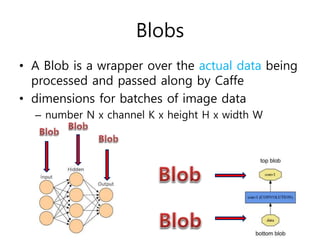
• A Blob is a wrapper over the actual data being
processed and passed along by Caffe
• dimensions for batches of image data
– number N x channel K x height H x width W
Layer
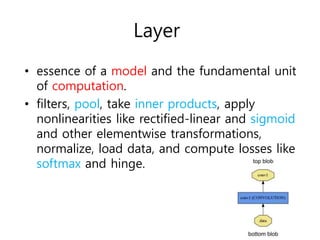
• essence of a model and the fundamental unit
of computation.
• filters, pool, take inner products, apply
nonlinearities like rectified-linear and sigmoid
and other elementwise transformations,
normalize, load data, and compute losses like
softmax and hinge.
Net
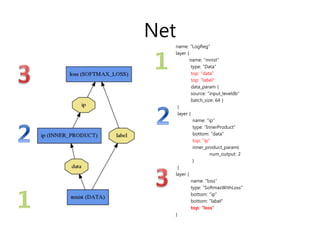
name: "LogReg"
layer {
name: "mnist"
type: "Data"
top: "data"
top: "label"
data_param {
source: "input_leveldb"
batch_size: 64 }
}
layer {
name: "ip"
type: "InnerProduct"
bottom: "data"
top: "ip"
inner_product_param{
num_output: 2
}
}
layer {
name: "loss"
type: "SoftmaxWithLoss"
bottom: "ip"
bottom: "label"
top: "loss"
}
Forward and Backward
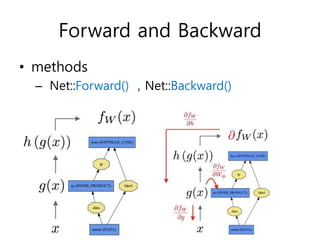
• methods
– Net::Forward() , Net::Backward()
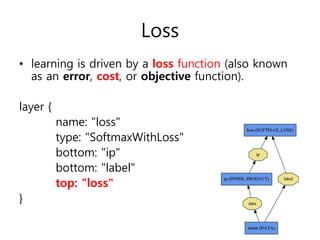
Loss
• learning is driven by a loss function (also known
as an error, cost, or objective function).
layer {
name: "loss"
type: "SoftmaxWithLoss"
bottom: "ip"
bottom: "label"
top: "loss"
}
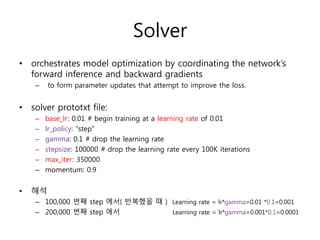
Solver
• orchestrates model optimization by coordinating the network’s
forward inference and backward gradients
– to form parameter updates that attempt to improve the loss.
• solver prototxt file:
– base_lr: 0.01 # begin training at a learning rate of 0.01
– lr_policy: "step"
– gamma: 0.1 # drop the learning rate
– stepsize: 100000 # drop the learning rate every 100K iterations
– max_iter: 350000
– momentum: 0.9
• 해석
– 100,000 번째 step 에서( 반복했을 때 ) Learning rate = lr*gamma=0.01 *0.1=0.001
– 200,000 번째 step 에서 Learning rate = lr*gamma=0.001*0.1=0.0001
Data: Ins and Outs
layer {
name: "mnist"
type: "Data"
top: "data"
top: "label"
data_param {
source: "examples/mnist/mnist_train_lmdb"
backend: LMDB
batch_size: 64
}
transform_param {scale: 0.00390625}
}
%해석: transform으로 [0, 255]의 MNIST data 를 [0, 1] 로 스케일 변경

Caffe framework tutorial

  • 1.
  • 2.
    Blobs • A Blobis a wrapper over the actual data being processed and passed along by Caffe • dimensions for batches of image data – number N x channel K x height H x width W
  • 3.
    Layer • essence ofa model and the fundamental unit of computation. • filters, pool, take inner products, apply nonlinearities like rectified-linear and sigmoid and other elementwise transformations, normalize, load data, and compute losses like softmax and hinge.
  • 4.
    Net name: "LogReg" layer { name:"mnist" type: "Data" top: "data" top: "label" data_param { source: "input_leveldb" batch_size: 64 } } layer { name: "ip" type: "InnerProduct" bottom: "data" top: "ip" inner_product_param{ num_output: 2 } } layer { name: "loss" type: "SoftmaxWithLoss" bottom: "ip" bottom: "label" top: "loss" }
  • 5.
    Forward and Backward •methods – Net::Forward() , Net::Backward()
  • 6.
    Loss • learning isdriven by a loss function (also known as an error, cost, or objective function). layer { name: "loss" type: "SoftmaxWithLoss" bottom: "ip" bottom: "label" top: "loss" }
  • 7.
    Solver • orchestrates modeloptimization by coordinating the network’s forward inference and backward gradients – to form parameter updates that attempt to improve the loss. • solver prototxt file: – base_lr: 0.01 # begin training at a learning rate of 0.01 – lr_policy: "step" – gamma: 0.1 # drop the learning rate – stepsize: 100000 # drop the learning rate every 100K iterations – max_iter: 350000 – momentum: 0.9 • 해석 – 100,000 번째 step 에서( 반복했을 때 ) Learning rate = lr*gamma=0.01 *0.1=0.001 – 200,000 번째 step 에서 Learning rate = lr*gamma=0.001*0.1=0.0001
  • 8.
    Data: Ins andOuts layer { name: "mnist" type: "Data" top: "data" top: "label" data_param { source: "examples/mnist/mnist_train_lmdb" backend: LMDB batch_size: 64 } transform_param {scale: 0.00390625} } %해석: transform으로 [0, 255]의 MNIST data 를 [0, 1] 로 스케일 변경