R&D Center System Technology Development Division Base System Development Department
Copyright 2018 Sony Corporation
aibo with ROS
Tomoya Fujita
R&D Center
Sony Corporation
What is aibo ?
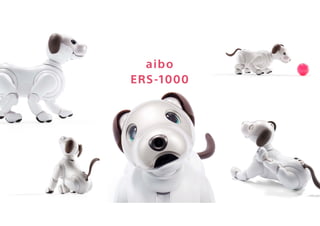
aibo
ERS-1000
Coming up in US
Very soon
Comes close to you
&
Makes interaction
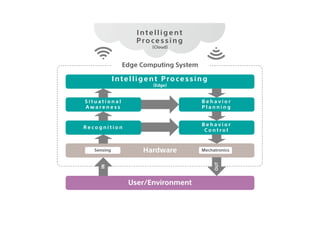
Hardware
R e c o g n i t i o n
B e h a v i o r
C o n t r o l
S i t u a t i o n a l
A w a r e n e s s
B e h a v i o r
P l a n n i n g
Intelligent Processing
(Edge)
User/Environment
I n tel l i g e n t
Pro ce ss i n g
(Cloud)
Sensing Mechatronics
IN
OUT
Edge Computing System
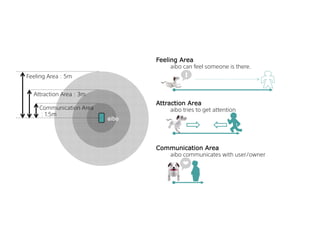
Feeling Area:5m
Attraction Area:3m
Communication Area
:1.5m
aibo
Feeling Area
aibo can feel someone is there.
Attraction Area
aibo tries to get attention
Communication Area
aibo communicates with user/owner
!
❤
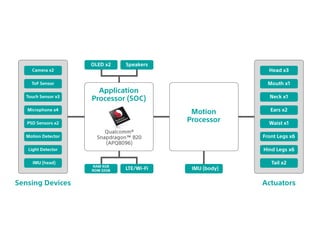
Camera x2
ToF Sensor
Touch Sensor x3
Microphone x4
Motion Detector
Light Detector
IMU (head)
PSD Sensors x2
Head x3
Mouth x1
Neck x1
Ears x2
Front Legs x6
Hind Legs x6
Tail x2
Waist x1
Sensing Devices Actuators
Qualcomm®
Snapdragon™ 820
(APQ8096)
Speakers
RAM 4GB
ROM 32GB
Application
Processor (SOC)
Motion
Processor
OLED x2
LTE/Wi-Fi IMU (body)
9
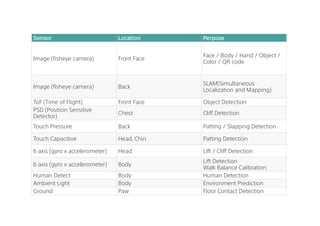
Sensor Location Perpose
Image (fisheye camera) Front Face
Face / Body / Hand / Object /
Color / QR code
Image (fisheye camera) Back
SLAM(Simultaneous
Localization and Mapping)
ToF (Time of Flight) Front Face Object Detection
PSD (Position Sensitive
Detector)
Chest Cliff Detection
Touch Pressure Back Patting / Slapping Detection
Touch Capacitive Head, Chin Patting Detection
6 axis (gyro x accelerometer) Head Lift / Cliff Detection
6 axis (gyro x accelerometer) Body
Lift Detection
Walk Balance Calibration
Human Detect Body Human Detection
Ambient Light Body Environment Prediction
Ground Paw Floor Contact Detection
10
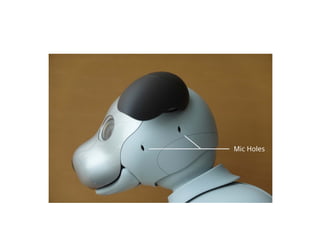
Mic Holes
13
14
15
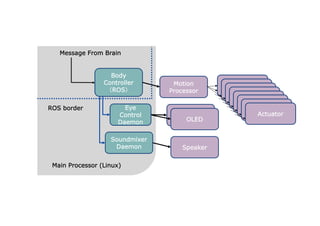
Body
Controller
(ROS)
Motion
Processor
OLED
OLED
Speaker
Soundmixer
Daemon
Eye
Control
Daemon
Actuator
Main Processor (Linux)
Actuator
Actuator
Actuator
Actuator
Actuator
Actuator
Actuator
Message From Brain
ROS border
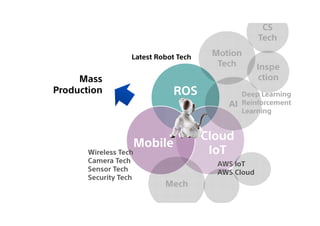
ROS
Cloud
IoT
Mobile
Mass
Production
Wireless Tech
Camera Tech
Sensor Tech
Security Tech
AWS IoT
AWS Cloud
Latest Robot Tech
AI
Deep Learning
Reinforcement
Learning
Mech
Motion
Tech
CS
Tech
Inspe
ction
ROS Embedded Optimization
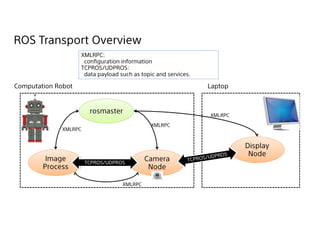
ROS Transport Overview
XMLRPC:
configuration information
TCPROS/UDPROS:
data payload such as topic and services.
rosmaster
Image
Process
XMLRPC
XMLRPC
XMLRPC
Camera
Node
Computation Robot
TCPROS/UDPROS
Laptop
Display
Node
XMLRPC
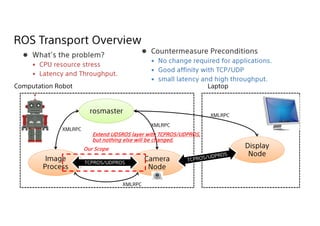
ROS Transport Overview
 What s the problem?
• CPU resource stress
• Latency and Throughput.
 Countermeasure Preconditions
• No change required for applications.
• Good affinity with TCP/UDP
• small latency and high throughput.
rosmaster
Image
Process
XMLRPC
XMLRPC
XMLRPC
Camera
Node
Computation Robot
TCPROS/UDPROS
Laptop
Display
Node
XMLRPC
Our Scope
Extend UDSROS layer with TCPROS/UDPROS,
but nothing else will be changed.
Expected Improvement as System
Category Skylake Hikey
Latency UDS(STREAM) 1.82 us 44.4 us
[usec] UDS(DGRAM) 2.14 us 19.9 us
TCP/IP 3.14 us 87.7 us
UDP/IP 2.78 us 67.2 us
Through-Put UDS(STREAM) 1.95 Gbps 127 Mbps
UDS(DGRAM) 1.98 Gbps 92 Mbps
TCP/IP 0.43 Gbps 12 Mbps
x2 ↓
 Source Code
• https://github.com/tomoyafujita/ipc-bench
 Environment
• skylake(amd64) / hikey(arm64)
• CPU frequency governor is performance
• 100byte data payload / 10000 test loop average
 Performance Improvement for System
x10 ↑
x1.7 ↓
x4 ↑
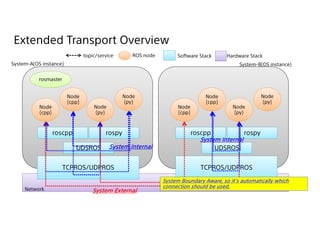
Extended Transport Overview
Network
System-A(OS instance) System-B(OS instance)
roscpp rospy
rosmaster
Node
(cpp)
ROS node Software Stack Hardware Stack
Node
(py)
UDSROS
TCPROS/UDPROS
Node
(cpp)
Node
(py)
roscpp rospy
UDSROS
TCPROS/UDPROS
Node
(cpp)
Node
(py)
Node
(cpp)
Node
(py)
System Internal
topic/service
System Internal
System External
System Boundary Aware, so it s automatically which
connection should be used.
Improvement Result
 HelloWorld Benchmark
• Publisher:Subscriber=1:1
• Synchronous test loop using shared memory.
• Latency is the time window between publish and callback entrance.
• Environment: amd64(skylake) and arm64(hikey)
 Result Comparison
Platform ROS
Transport
Duration [nsec]
min max average
Skylake TCP/IP 46,582 287,173 70,393
UDS 42,877 286,130 64,796
Hikey TCP/IP 552,224 6,040,312 1,145,881
UDS 435,833 10,075,833 872,981
8% ↓
24% ↓
Github Repository
https://github.com/fujitatomoya/ros_comm/tree/topic-kinetic-devel-uds-support
Pull Request
https://github.com/ros/ros_comm/pull/1510
Tomoya Fujita <Tomoya.Fujita@sony.com>
Barry Xu <Barry.Xu@sony.com>
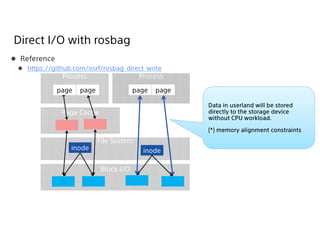
Direct I/O with rosbag
 Reference
 https://github.com/osrf/rosbag_direct_write
Data in userland will be stored
directly to the storage device
without CPU workload.
(*) memory alignment constraints
Process
Page Cache
File System
Block I/O
inode inode
Process
page page page page
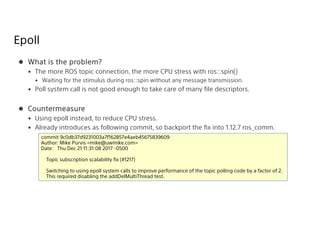
Epoll
 What is the problem?
• The more ROS topic connection, the more CPU stress with ros::spin()
• Waiting for the stimulus during ros::spin without any message transmission.
• Poll system call is not good enough to take care of many file descriptors.
 Countermeasure
• Using epoll instead, to reduce CPU stress.
• Already introduces as following commit, so backport the fix into 1.12.7 ros_comm.
commit 9c0db37d9231003a7f162857e4aeb45675839609
Author: Mike Purvis <mike@uwmike.com>
Date: Thu Dec 21 11:31:08 2017 -0500
Topic subscription scalability fix (#1217)
Switching to using epoll system calls to improve performance of the topic polling code by a factor of 2.
This required disabling the addDelMultiThread test.
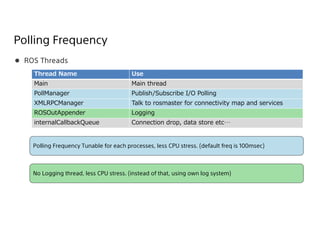
Polling Frequency
 ROS Threads
Thread Name Use
Main Main thread
PollManager Publish/Subscribe I/O Polling
XMLRPCManager Talk to rosmaster for connectivity map and services
ROSOutAppender Logging
internalCallbackQueue Connection drop, data store etc…
Polling Frequency Tunable for each processes, less CPU stress. (default freq is 100msec)
No Logging thread, less CPU stress. (instead of that, using own log system)
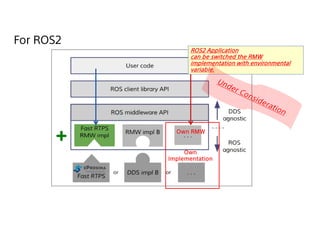
For ROS2
Own RMW
Own
Implementation
ROS2 Application
can be switched the RMW
implementation with environmental
variable.
Special Thanks to ROS Community
SONYはソニー株式会社の登録商標または商標です。
各ソニー製品の商品名・サービス名はソニー株式会社またはグループ各社の登録商標または商標です。その他の製品および会社名は、各社の商号、登録商標または商標です。

aibo introduction at ROSCon2018@Madrid

  • 1.
    R&D Center SystemTechnology Development Division Base System Development Department Copyright 2018 Sony Corporation aibo with ROS Tomoya Fujita R&D Center Sony Corporation
  • 2.
  • 3.
  • 4.
    Coming up inUS Very soon
  • 5.
    Comes close toyou & Makes interaction
  • 6.
    Hardware R e co g n i t i o n B e h a v i o r C o n t r o l S i t u a t i o n a l A w a r e n e s s B e h a v i o r P l a n n i n g Intelligent Processing (Edge) User/Environment I n tel l i g e n t Pro ce ss i n g (Cloud) Sensing Mechatronics IN OUT Edge Computing System
  • 7.
    Feeling Area:5m Attraction Area:3m CommunicationArea :1.5m aibo Feeling Area aibo can feel someone is there. Attraction Area aibo tries to get attention Communication Area aibo communicates with user/owner ! ❤
  • 8.
    Camera x2 ToF Sensor TouchSensor x3 Microphone x4 Motion Detector Light Detector IMU (head) PSD Sensors x2 Head x3 Mouth x1 Neck x1 Ears x2 Front Legs x6 Hind Legs x6 Tail x2 Waist x1 Sensing Devices Actuators Qualcomm® Snapdragon™ 820 (APQ8096) Speakers RAM 4GB ROM 32GB Application Processor (SOC) Motion Processor OLED x2 LTE/Wi-Fi IMU (body)
  • 9.
    9 Sensor Location Perpose Image(fisheye camera) Front Face Face / Body / Hand / Object / Color / QR code Image (fisheye camera) Back SLAM(Simultaneous Localization and Mapping) ToF (Time of Flight) Front Face Object Detection PSD (Position Sensitive Detector) Chest Cliff Detection Touch Pressure Back Patting / Slapping Detection Touch Capacitive Head, Chin Patting Detection 6 axis (gyro x accelerometer) Head Lift / Cliff Detection 6 axis (gyro x accelerometer) Body Lift Detection Walk Balance Calibration Human Detect Body Human Detection Ambient Light Body Environment Prediction Ground Paw Floor Contact Detection
  • 10.
  • 13.
  • 14.
  • 15.
  • 17.
  • 18.
    ROS Cloud IoT Mobile Mass Production Wireless Tech Camera Tech SensorTech Security Tech AWS IoT AWS Cloud Latest Robot Tech AI Deep Learning Reinforcement Learning Mech Motion Tech CS Tech Inspe ction
  • 19.
  • 20.
    ROS Transport Overview XMLRPC: configurationinformation TCPROS/UDPROS: data payload such as topic and services. rosmaster Image Process XMLRPC XMLRPC XMLRPC Camera Node Computation Robot TCPROS/UDPROS Laptop Display Node XMLRPC
  • 21.
    ROS Transport Overview What s the problem? • CPU resource stress • Latency and Throughput.  Countermeasure Preconditions • No change required for applications. • Good affinity with TCP/UDP • small latency and high throughput. rosmaster Image Process XMLRPC XMLRPC XMLRPC Camera Node Computation Robot TCPROS/UDPROS Laptop Display Node XMLRPC Our Scope Extend UDSROS layer with TCPROS/UDPROS, but nothing else will be changed.
  • 22.
    Expected Improvement asSystem Category Skylake Hikey Latency UDS(STREAM) 1.82 us 44.4 us [usec] UDS(DGRAM) 2.14 us 19.9 us TCP/IP 3.14 us 87.7 us UDP/IP 2.78 us 67.2 us Through-Put UDS(STREAM) 1.95 Gbps 127 Mbps UDS(DGRAM) 1.98 Gbps 92 Mbps TCP/IP 0.43 Gbps 12 Mbps x2 ↓  Source Code • https://github.com/tomoyafujita/ipc-bench  Environment • skylake(amd64) / hikey(arm64) • CPU frequency governor is performance • 100byte data payload / 10000 test loop average  Performance Improvement for System x10 ↑ x1.7 ↓ x4 ↑
  • 23.
    Extended Transport Overview Network System-A(OSinstance) System-B(OS instance) roscpp rospy rosmaster Node (cpp) ROS node Software Stack Hardware Stack Node (py) UDSROS TCPROS/UDPROS Node (cpp) Node (py) roscpp rospy UDSROS TCPROS/UDPROS Node (cpp) Node (py) Node (cpp) Node (py) System Internal topic/service System Internal System External System Boundary Aware, so it s automatically which connection should be used.
  • 24.
    Improvement Result  HelloWorldBenchmark • Publisher:Subscriber=1:1 • Synchronous test loop using shared memory. • Latency is the time window between publish and callback entrance. • Environment: amd64(skylake) and arm64(hikey)  Result Comparison Platform ROS Transport Duration [nsec] min max average Skylake TCP/IP 46,582 287,173 70,393 UDS 42,877 286,130 64,796 Hikey TCP/IP 552,224 6,040,312 1,145,881 UDS 435,833 10,075,833 872,981 8% ↓ 24% ↓
  • 25.
  • 26.
    Direct I/O withrosbag  Reference  https://github.com/osrf/rosbag_direct_write Data in userland will be stored directly to the storage device without CPU workload. (*) memory alignment constraints Process Page Cache File System Block I/O inode inode Process page page page page
  • 27.
    Epoll  What isthe problem? • The more ROS topic connection, the more CPU stress with ros::spin() • Waiting for the stimulus during ros::spin without any message transmission. • Poll system call is not good enough to take care of many file descriptors.  Countermeasure • Using epoll instead, to reduce CPU stress. • Already introduces as following commit, so backport the fix into 1.12.7 ros_comm. commit 9c0db37d9231003a7f162857e4aeb45675839609 Author: Mike Purvis <mike@uwmike.com> Date: Thu Dec 21 11:31:08 2017 -0500 Topic subscription scalability fix (#1217) Switching to using epoll system calls to improve performance of the topic polling code by a factor of 2. This required disabling the addDelMultiThread test.
  • 28.
    Polling Frequency  ROSThreads Thread Name Use Main Main thread PollManager Publish/Subscribe I/O Polling XMLRPCManager Talk to rosmaster for connectivity map and services ROSOutAppender Logging internalCallbackQueue Connection drop, data store etc… Polling Frequency Tunable for each processes, less CPU stress. (default freq is 100msec) No Logging thread, less CPU stress. (instead of that, using own log system)
  • 29.
    For ROS2 Own RMW Own Implementation ROS2Application can be switched the RMW implementation with environmental variable.
  • 30.
    Special Thanks toROS Community
  • 31.