
Image Classification
Ali A. Jalil
What is Computer Vision?
• Here are a couple of formal textbook definitions:
• “the construction of explicit, meaningful descriptions of physical
objects from images” (Ballard & Brown, 1982)
• “computing properties of the 3D world from one or more digital
images” (Trucco & Verri, 1998)
• “to make useful decisions about real physical objects and scenes
based on sensed images” (Sockman & Shapiro, 2001)
Classification
•A structured model that maps unlabeled
instances to finite set of classes
• is the process of assigning value in a data
set to a predefined label (Categories)
•labeled data set shared a common
properties )features).
Classifier
A classifier: Algorithm that produces class labels as
output, from a set of features of an object.
• A classifier, for example, is used to classify
certain features extracted from a face image and
provide a label (an identity of the individual)
• ANN
• Decision Tree
• Naive Bayes
• Etc..
Types of Learning
• Supervised:
Learning process designed to form a mapping
from one set of variables (data) to another set of
variables (information classes).
A teacher is involved in the learning process
Types of Learning
• Unsupervised learning:
Learning happens without a teacher.
Exploration of the data space to discover the
scientific laws underlying the data distribution.
Supervised vs. Unsupervised Classifiers
• Supervised classification generally performs
better than unsupervised classification IF good
quality training data is available
• Unsupervised classifiers are used to carry out
preliminary analysis of data prior to supervised
classification
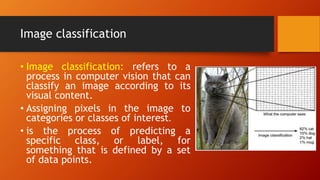
Image classification
• Image classification: refers to a
process in computer vision that can
classify an image according to its
visual content.
• Assigning pixels in the image to
categories or classes of interest.
• is the process of predicting a
specific class, or label, for
something that is defined by a set
of data points.
Image Classification
• The problem of image classification goes like this: Given a set
of images that are all labeled with a single category.
• we’re asked to predict these categories for a novel set of
test images and measure the accuracy of the predictions.
• There are a variety of challenges associated with this task,
including viewpoint variation, scale variation, intra-class
variation, image deformation, image occlusion, illumination
conditions, and background clutter.
Image Classification
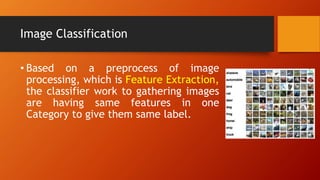
• Based on a preprocess of image
processing, which is Feature Extraction,
the classifier work to gathering images
are having same features in one
Category to give them same label.
Classification Process
• Each classification process contain following:
• Classifier
• Data set : Training data set and Test Data Set
• Our input is a training dataset that consists of N images, each
labeled with one of K different classes.
• Then, we use this training set to train a classifier to learn what
every one of the classes looks like.
• In the end, we evaluate the quality of the classifier by asking it to
predict labels for a new set of images that it’s never seen before.
We’ll then compare the true labels of these images to the ones
predicted by the classifier.
Application of Image Classification
• Classify Medical Images (e.g., tumor is cancer or not).
• Urban planning (By using satellite images to identify lands).
• Images collection and reordering.
• Visual Search for Improved Product Discoverability
• And more….
Thank You

Image classification

  • 1.
  • 2.
    What is ComputerVision? • Here are a couple of formal textbook definitions: • “the construction of explicit, meaningful descriptions of physical objects from images” (Ballard & Brown, 1982) • “computing properties of the 3D world from one or more digital images” (Trucco & Verri, 1998) • “to make useful decisions about real physical objects and scenes based on sensed images” (Sockman & Shapiro, 2001)
  • 3.
    Classification •A structured modelthat maps unlabeled instances to finite set of classes • is the process of assigning value in a data set to a predefined label (Categories) •labeled data set shared a common properties )features).
  • 4.
    Classifier A classifier: Algorithmthat produces class labels as output, from a set of features of an object. • A classifier, for example, is used to classify certain features extracted from a face image and provide a label (an identity of the individual) • ANN • Decision Tree • Naive Bayes • Etc..
  • 5.
    Types of Learning •Supervised: Learning process designed to form a mapping from one set of variables (data) to another set of variables (information classes). A teacher is involved in the learning process
  • 6.
    Types of Learning •Unsupervised learning: Learning happens without a teacher. Exploration of the data space to discover the scientific laws underlying the data distribution.
  • 7.
    Supervised vs. UnsupervisedClassifiers • Supervised classification generally performs better than unsupervised classification IF good quality training data is available • Unsupervised classifiers are used to carry out preliminary analysis of data prior to supervised classification
  • 8.
    Image classification • Imageclassification: refers to a process in computer vision that can classify an image according to its visual content. • Assigning pixels in the image to categories or classes of interest. • is the process of predicting a specific class, or label, for something that is defined by a set of data points.
  • 9.
    Image Classification • Theproblem of image classification goes like this: Given a set of images that are all labeled with a single category. • we’re asked to predict these categories for a novel set of test images and measure the accuracy of the predictions. • There are a variety of challenges associated with this task, including viewpoint variation, scale variation, intra-class variation, image deformation, image occlusion, illumination conditions, and background clutter.
  • 10.
    Image Classification • Basedon a preprocess of image processing, which is Feature Extraction, the classifier work to gathering images are having same features in one Category to give them same label.
  • 11.
    Classification Process • Eachclassification process contain following: • Classifier • Data set : Training data set and Test Data Set • Our input is a training dataset that consists of N images, each labeled with one of K different classes. • Then, we use this training set to train a classifier to learn what every one of the classes looks like. • In the end, we evaluate the quality of the classifier by asking it to predict labels for a new set of images that it’s never seen before. We’ll then compare the true labels of these images to the ones predicted by the classifier.
  • 12.
    Application of ImageClassification • Classify Medical Images (e.g., tumor is cancer or not). • Urban planning (By using satellite images to identify lands). • Images collection and reordering. • Visual Search for Improved Product Discoverability • And more….
  • 13.