Recomendaciones de ACM e IEEE
      para carreras de
  Computación e Informática
          Xavier Ochoa
             ESPOL
http://www.slideshare.net/xaoch
Agenda
• Que es el Computing Curricula

• Perfiles de Carreras

• Caso Estudio: Ajustar una carrera al CC
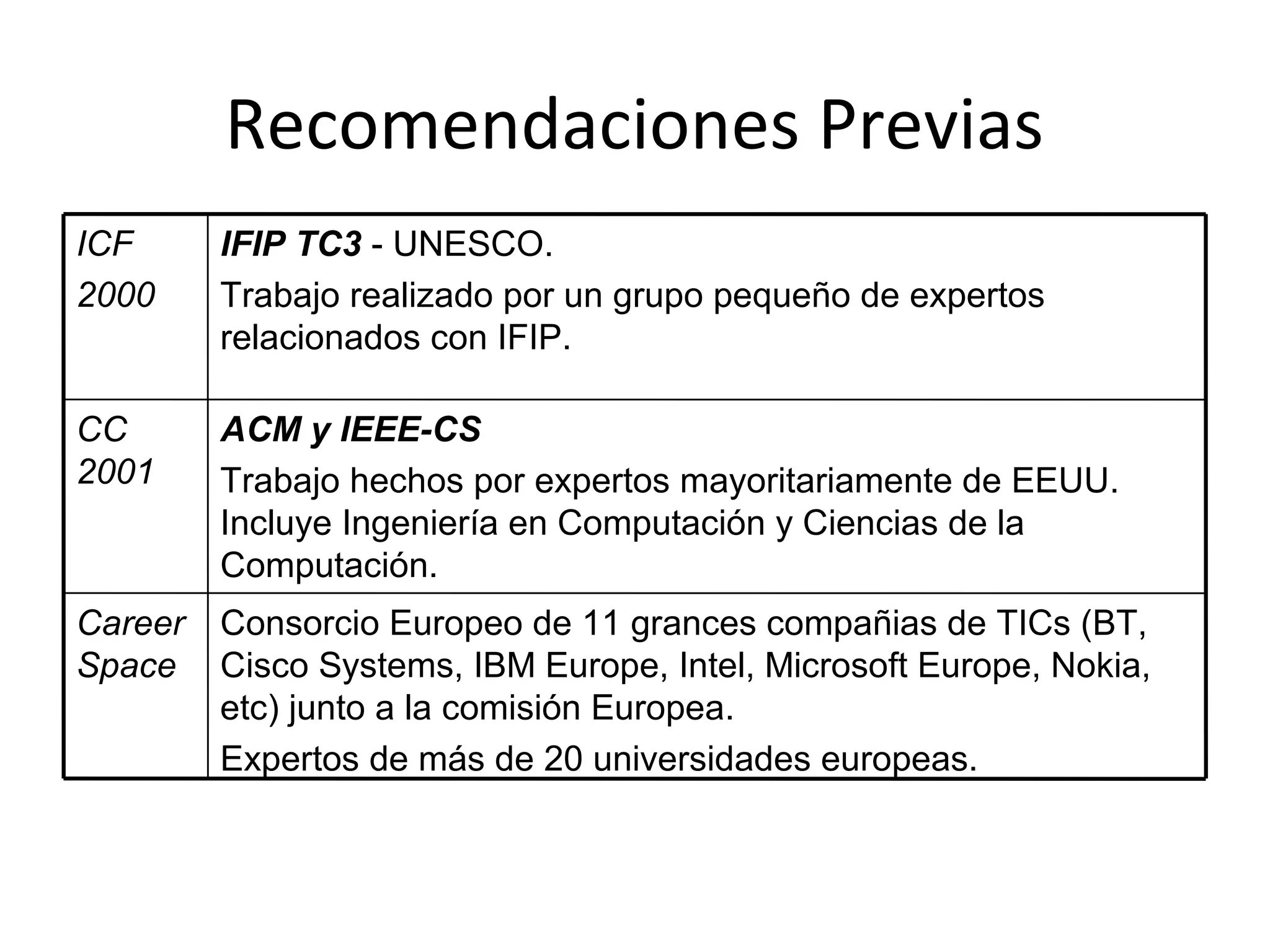
Recomendaciones Previas
ICF      IFIP TC3 - UNESCO.
2000     Trabajo realizado por un grupo pequeño de expertos
         relacionados con IFIP.

CC       ACM y IEEE-CS
2001     Trabajo hechos por expertos mayoritariamente de EEUU.
         Incluye Ingeniería en Computación y Ciencias de la
         Computación.
Career   Consorcio Europeo de 11 grances compañias de TICs (BT,
Space    Cisco Systems, IBM Europe, Intel, Microsoft Europe, Nokia,
         etc) junto a la comisión Europea.
         Expertos de más de 20 universidades europeas.
Computing Curricula
• Esfuerzo conjunto de IEEE/ACM y otras
  asociaciones profesionales
• Estándares internacionales para currículas en
  computación
• Publicadas periodicamente
  – http://www.acm.org/education/
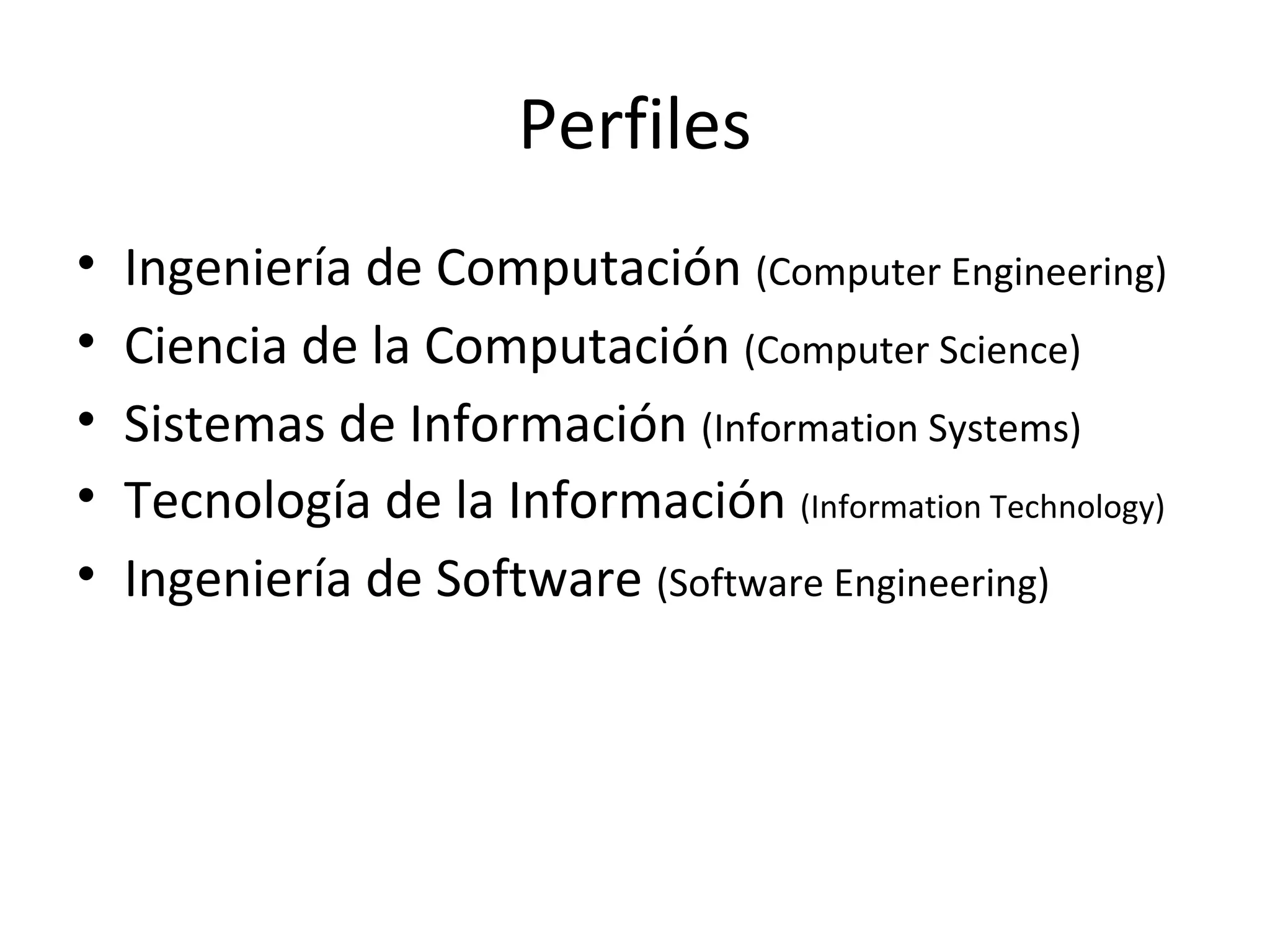
Perfiles
•   Ingeniería de Computación (Computer Engineering)
•   Ciencia de la Computación (Computer Science)
•   Sistemas de Información (Information Systems)
•   Tecnología de la Información (Information Technology)
•   Ingeniería de Software (Software Engineering)
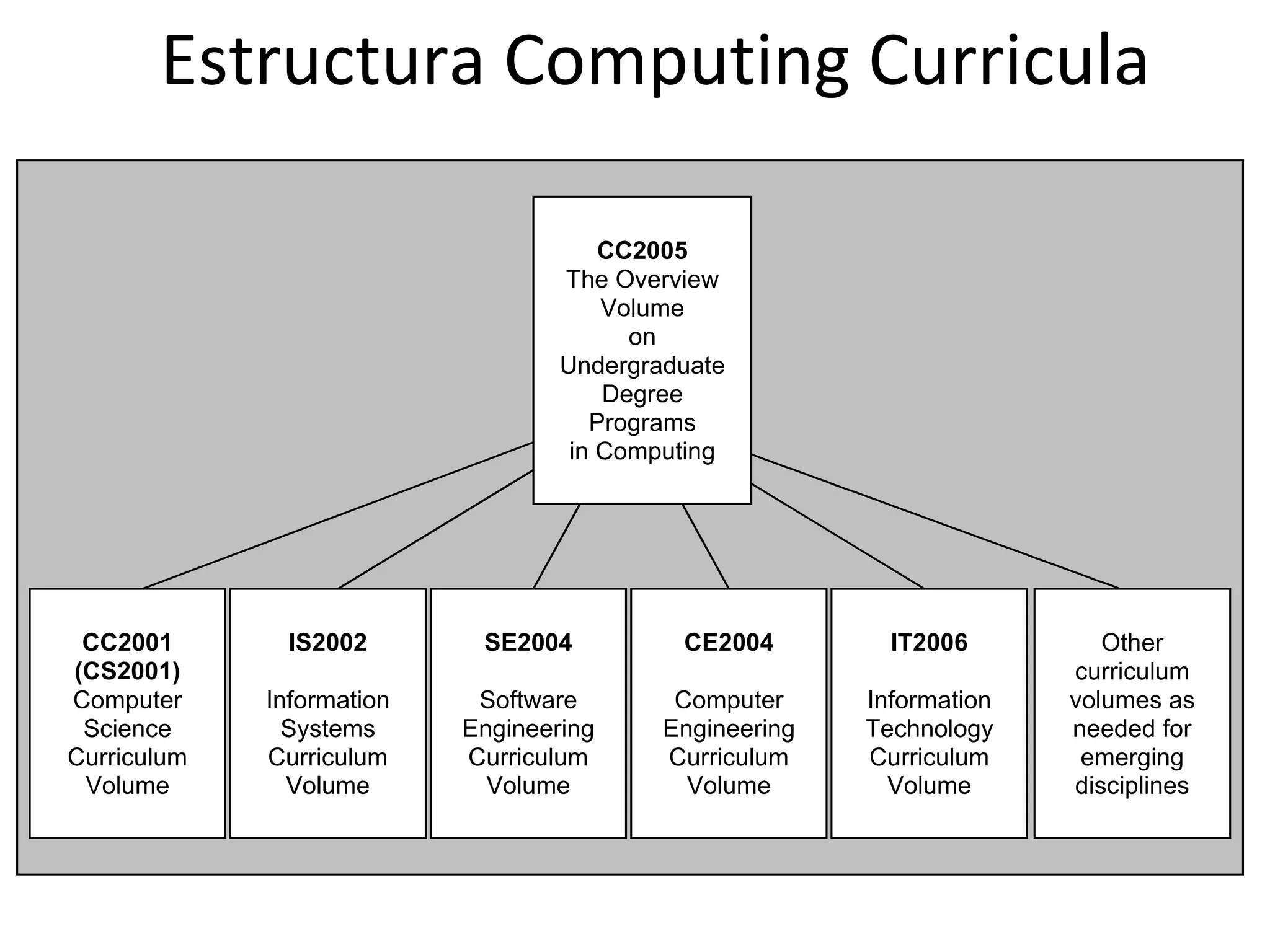
Estructura Computing Curricula
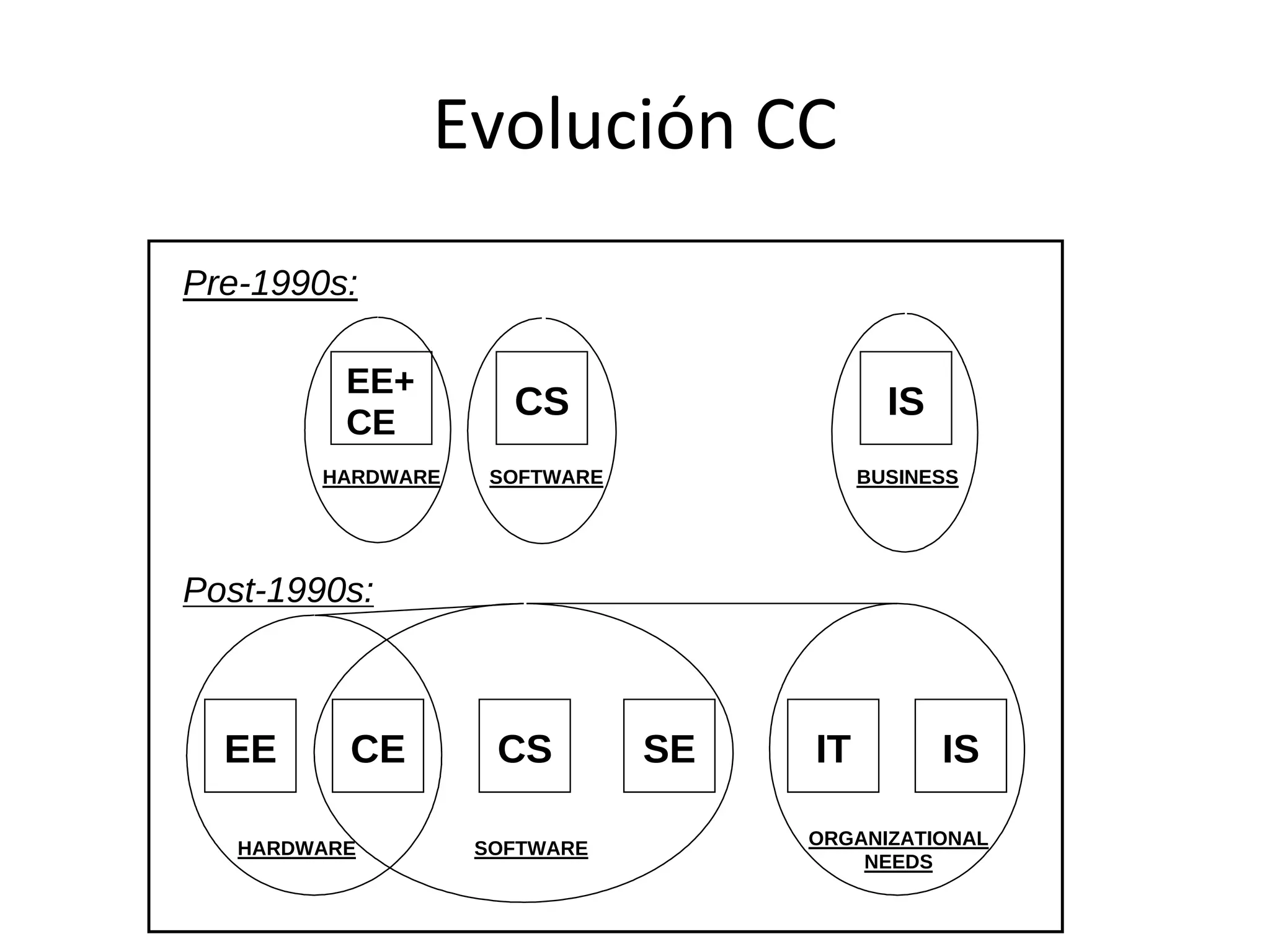
It is clear where students who want to study hardware should go. Computer engineering has emerged
from electrical engineering as the home for those working on the hardware and software issues involved
in the design of digital devices. For those with other interests, the choices are not so clear-cut. In the pre-
1990s world, students who wanted to become expert in software development would study computer

                                 Evolución CC
science. The post-1990s world presents meaningful choices: computer science, software engineering, and
even computer engineering each include their own perspective on software development. These three
choices imply real differences: for CE, software attention is focused on hardware devices; for SE, the
emphasis is on creating software that satisfies robust real-world requirements; and for CS, software is the
currency in which ideas are expressed and a wide range of computing problems and applications are


   Pre-1990s:

                       EE+
                       CE
                                           CS                                           IS
                    HARDWARE            SOFTWARE                                    BUSINESS


   Post-1990s:


        EE             CE                CS               SE                   IT             IS

          HARDWARE                    SOFTWARE                                ORGANIZATIONAL
                                                                                  NEEDS
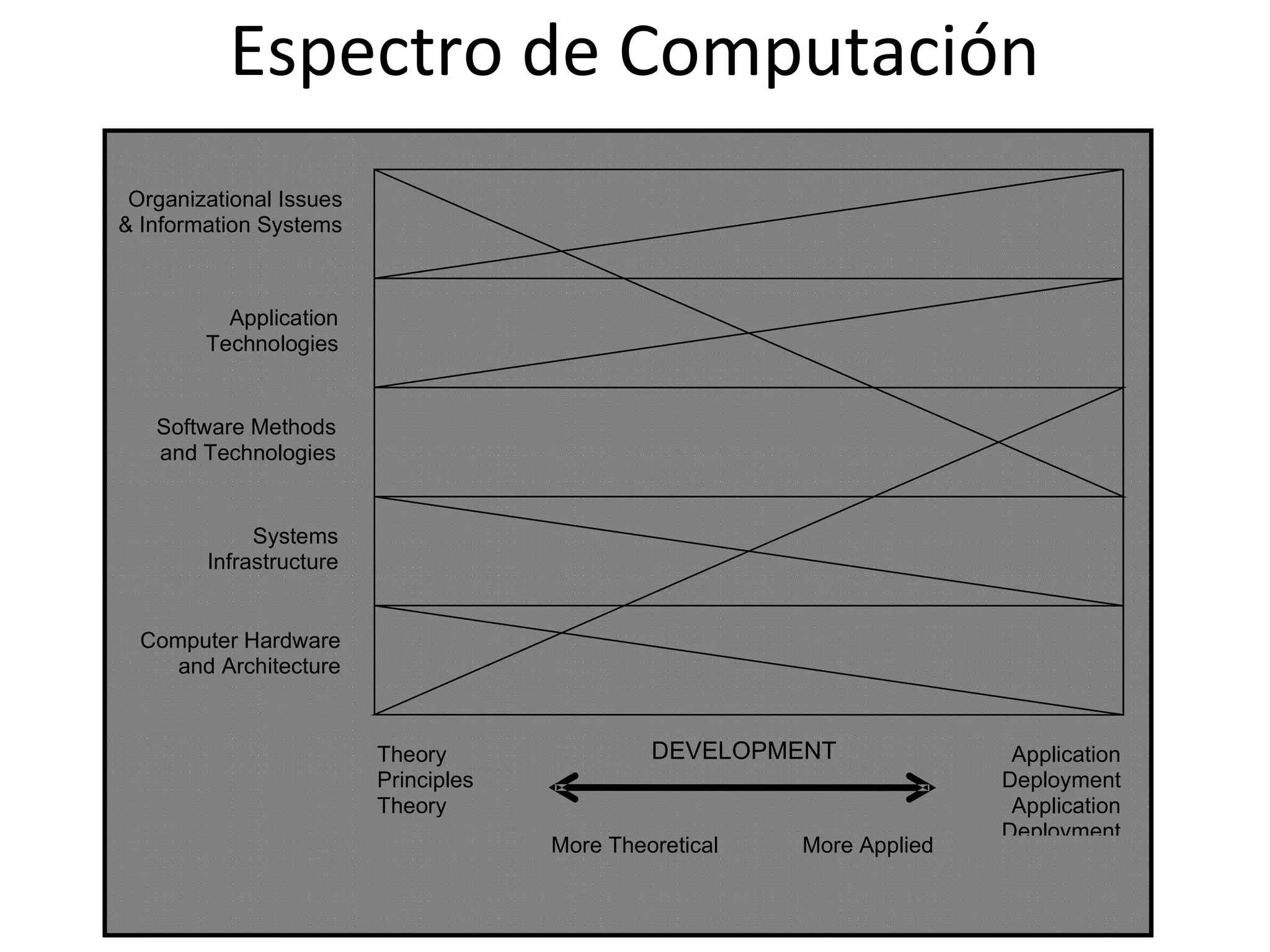
subjective interpretation of the various disciplines. They are not based on any precise quantitative

            Espectro de Computación
foundation. Furthermore, they show only computing topics. Both computer engineering and information
systems programs devote significant attention to topics that are outside of computing and not reflected in
this diagram. Tables of required computing and non-computing topics are provided in Chapter 3.


  Organizational Issues
 & Information Systems


            Application
          Technologies


     Software Methods
     and Technologies


               Systems
          Infrastructure


   Computer Hardware
      and Architecture


                           Theory                       DEVELOPMENT                          Application
                           Principles                                                       Deployment
                           Theory                                                            Application
                                                                                            Deployment
                                             More Theoretical          More Applied
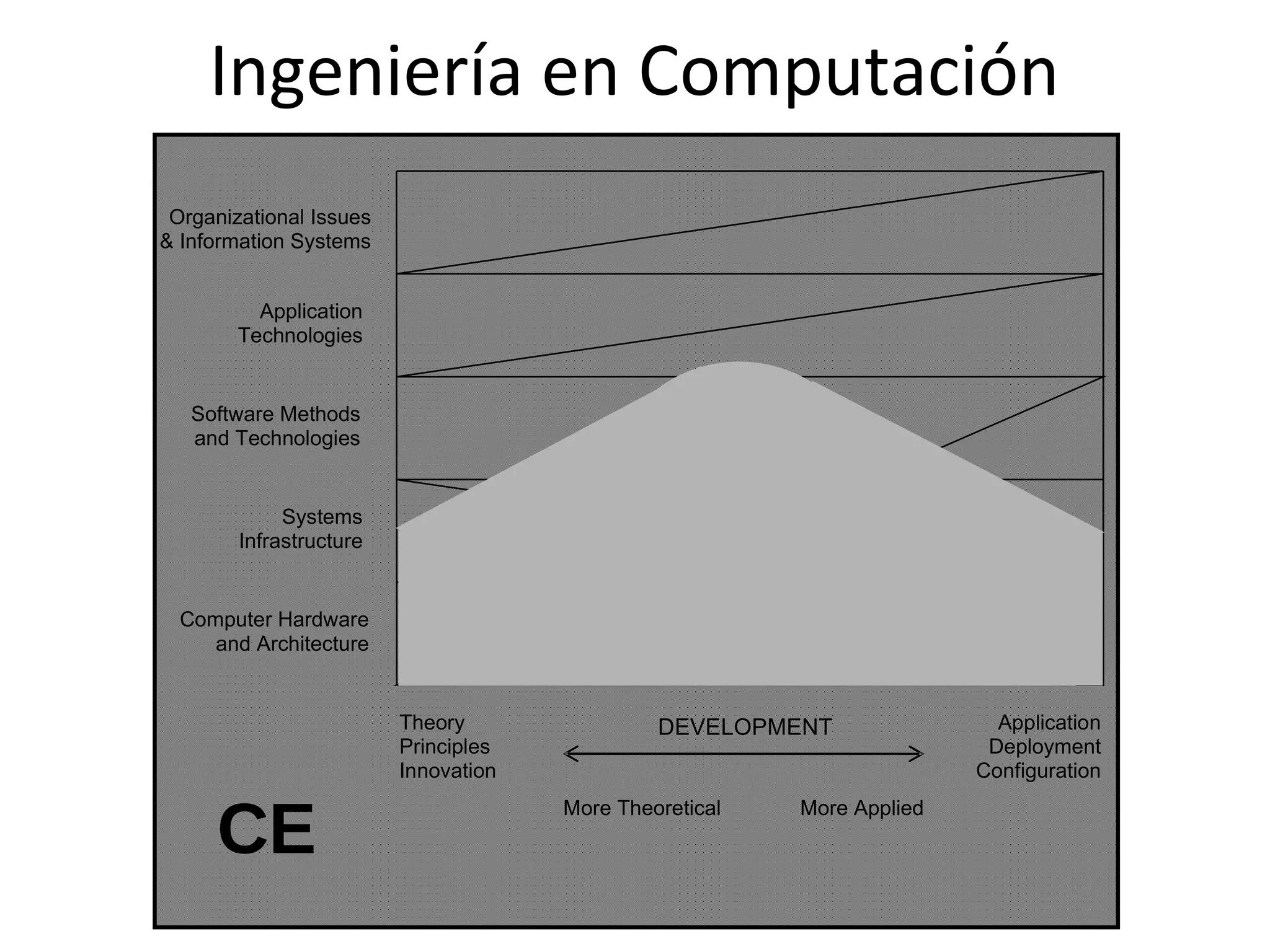
center as we move upwards because a computer engineer’s interests narrow as we move away from the


       Ingeniería en Computación
hardware. By the time we get up to the level of software development, we see that the computer
engineer’s interest has narrowed to the horizontal center because they care about software only inasmuch
as they need it to develop integrated devices.


  Organizational Issues
 & Information Systems


            Application
          Technologies


     Software Methods
     and Technologies


               Systems
          Infrastructure


   Computer Hardware
      and Architecture


                           Theory                      DEVELOPMENT                         Application
                           Principles                                                     Deployment
                           Innovation                                                    Configuration


       CE
                                            More Theoretical          More Applied
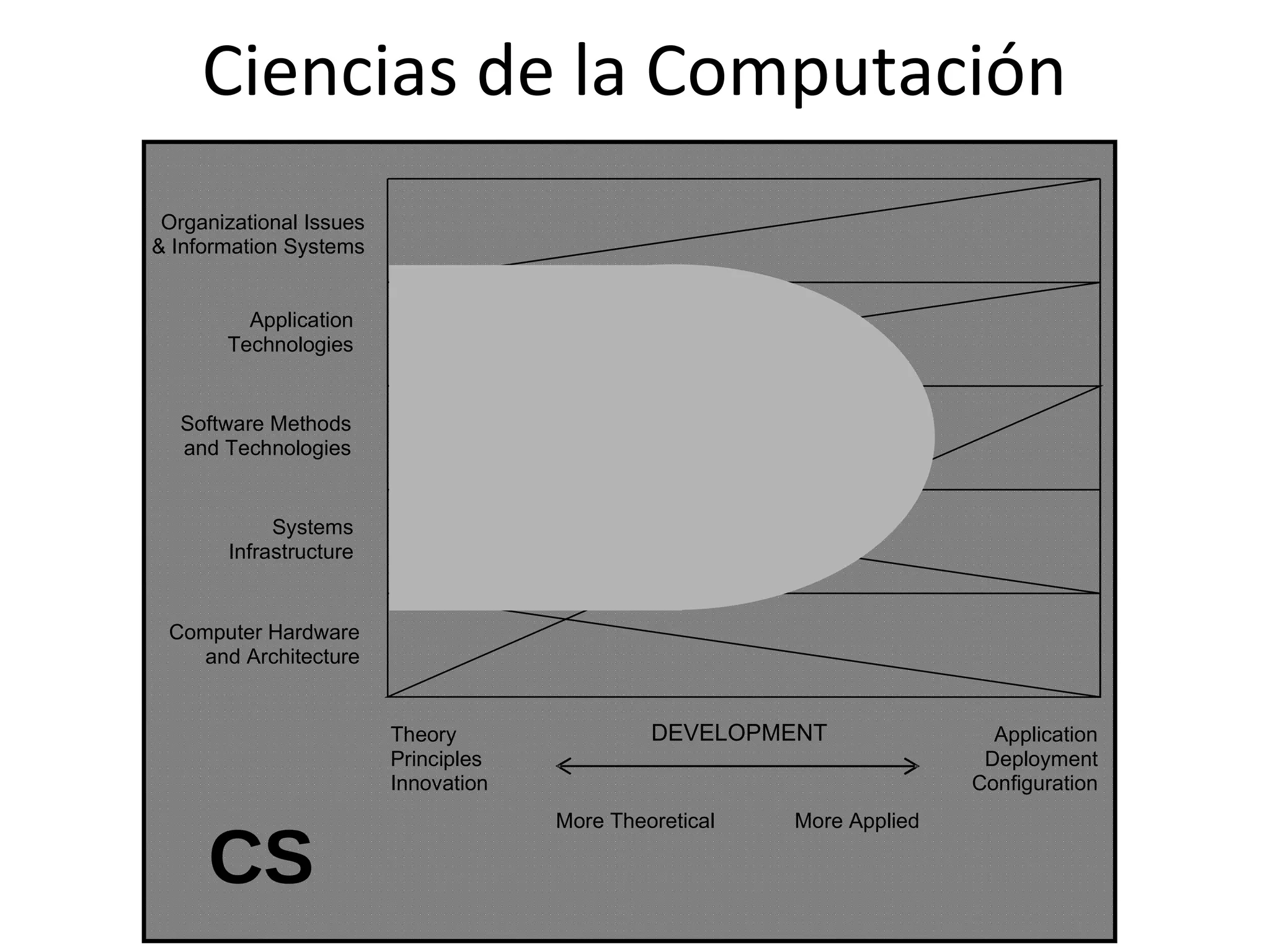
technologies (web browsers, databases, search engines, etc.) Computer scientists create these capabilities,


       Ciencias de la Computación
but they do not manage the deployment of them. Therefore, the shaded area for computer science
narrows and then stops as we move to the right. This is because computer scientists do not help people to
select computing products, or tailor products to organizational needs, or learn to use such products.


  Organizational Issues
 & Information Systems


            Application
          Technologies


     Software Methods
     and Technologies


               Systems
          Infrastructure


   Computer Hardware
      and Architecture


                           Theory                      DEVELOPMENT                          Application
                           Principles                                                      Deployment
                           Innovation                                                     Configuration
                                             More Theoretical          More Applied

        CS
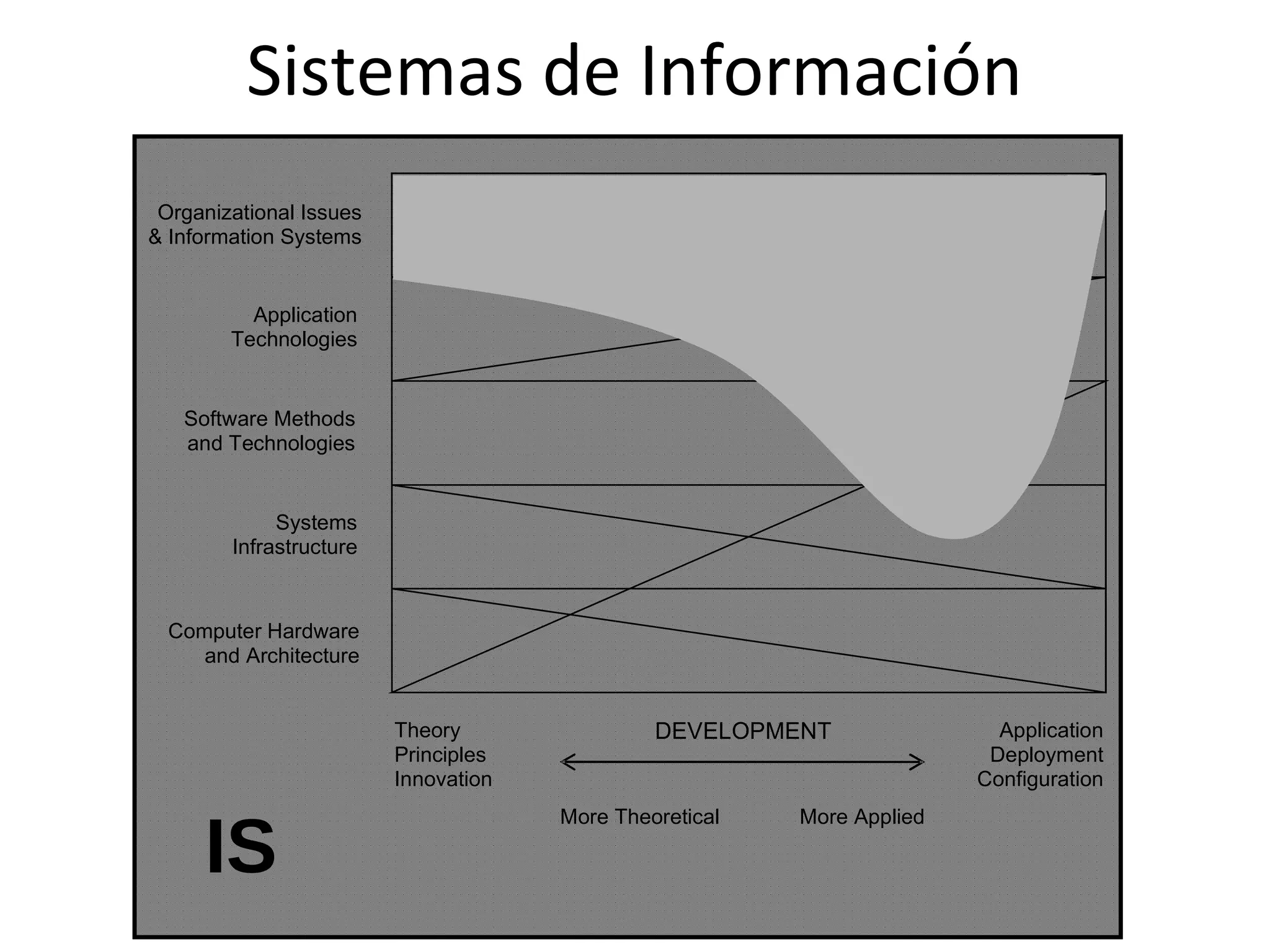
they often develop systems that utilize other software products to suit their organizations’ needs for


             Sistemas de Información
information. (This figure does not reflect the attention that information systems programs devote to core
business topics. See Chapter 3 for tables that summarize both computing and non-computing topics.)


   Organizational Issues
  & Information Systems


             Application
           Technologies


      Software Methods
      and Technologies


                Systems
           Infrastructure


    Computer Hardware
       and Architecture


                            Theory                      DEVELOPMENT                          Application
                            Principles                                                      Deployment
                            Innovation                                                     Configuration


        IS
                                              More Theoretical          More Applied
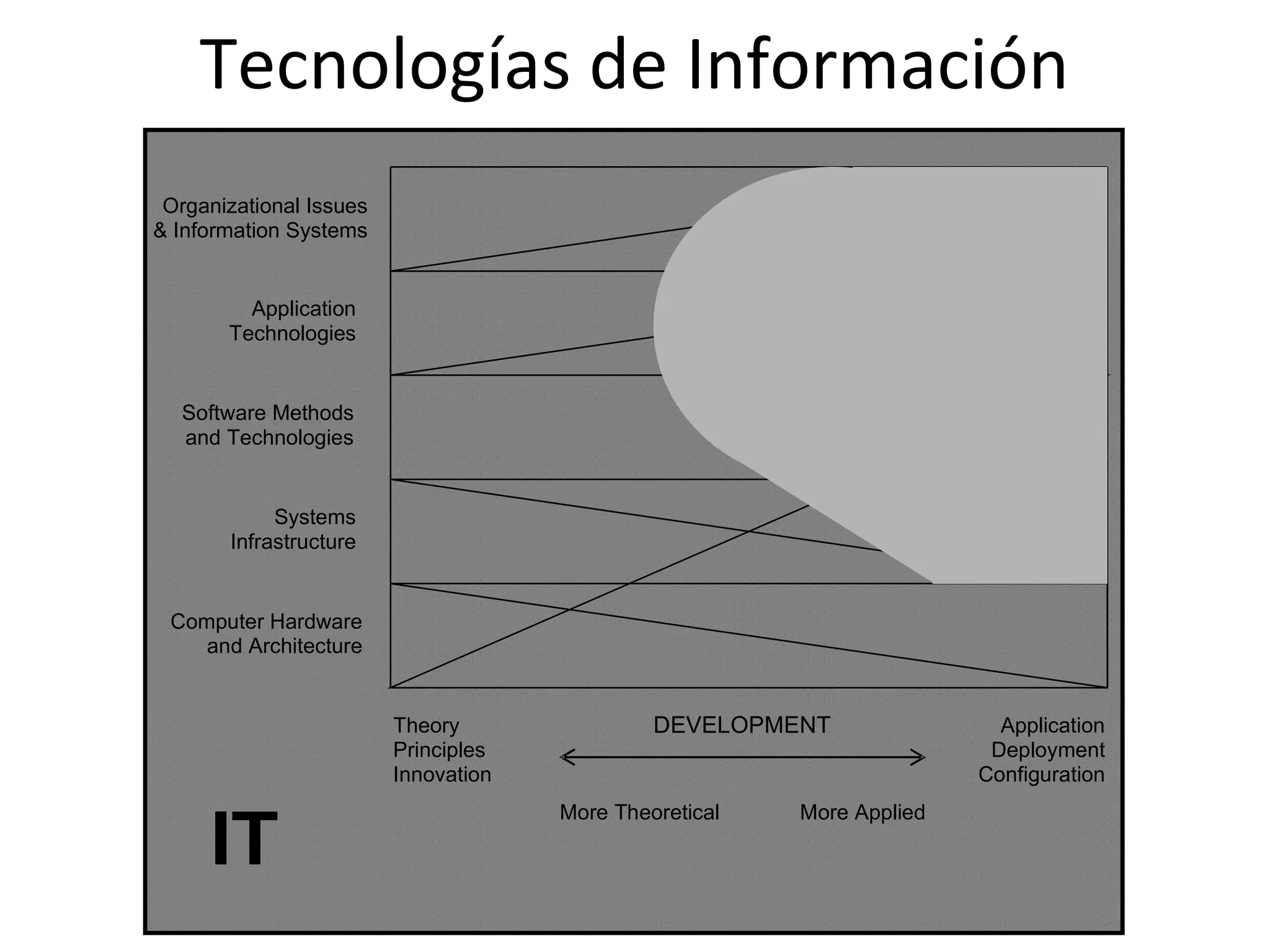
students a foundation in existing concepts and skills. Many in the community of IT faculty assert that
research in their field will grow to create and develop new knowledge in relevant areas. When that

       Tecnologías de Información
happens, an appropriate snapshot would feature a shaded area that extends significantly further to the left.
However, this is an ambition and not yet an achievement. This figure reflects the current status of IT.


  Organizational Issues
 & Information Systems


            Application
          Technologies


     Software Methods
     and Technologies


               Systems
          Infrastructure


   Computer Hardware
      and Architecture


                            Theory                      DEVELOPMENT                          Application
                            Principles                                                      Deployment
                            Innovation                                                     Configuration


        IT
                                              More Theoretical          More Applied
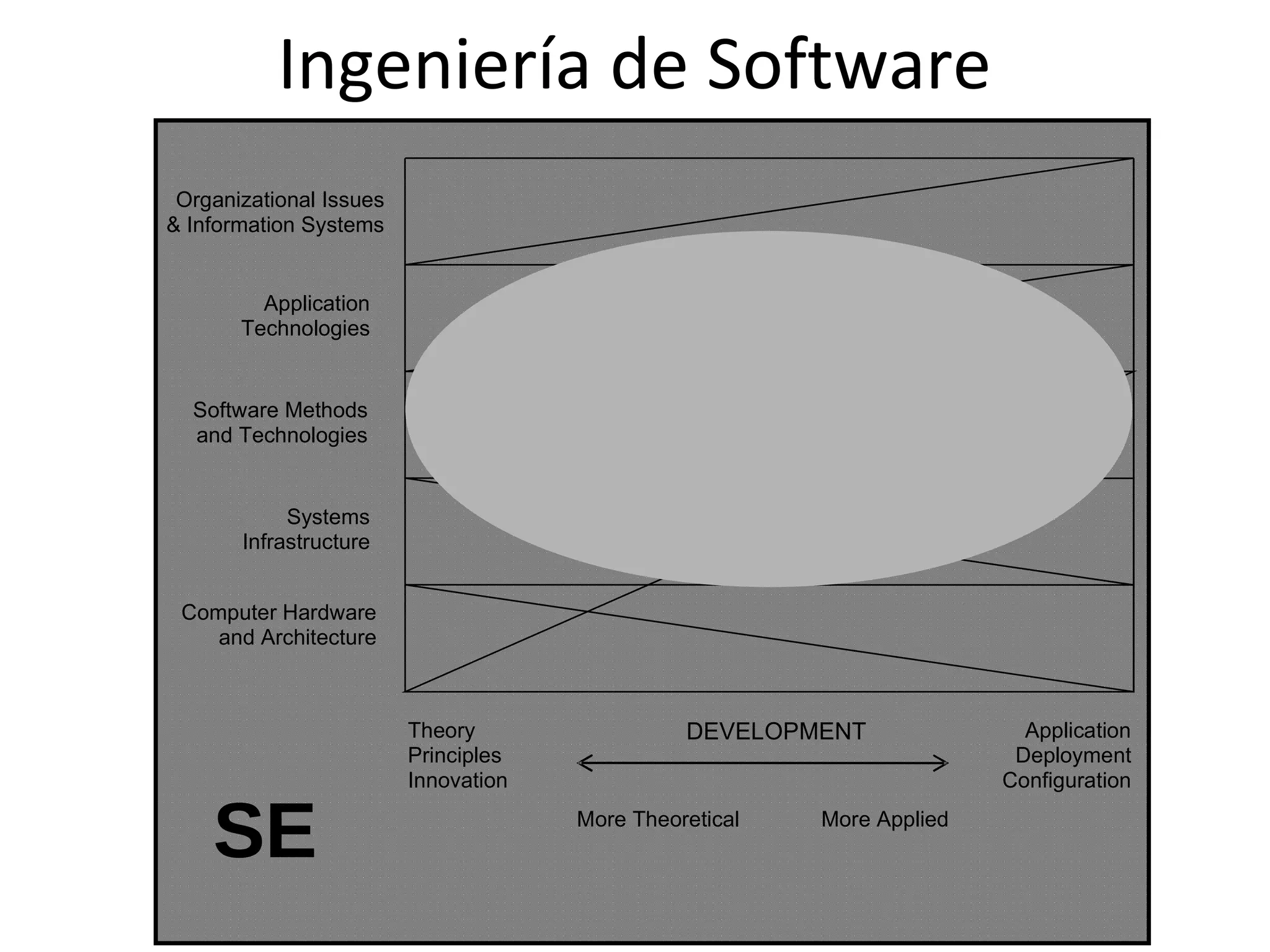
concerns extend all the way from theory and principles to daily practice. The domain of SE also extends
downward through systems infrastructure since SE people develop software infrastructure that is robust in

            Ingeniería de Software
operation. Its domain also extends upward into organizational issues because SE people are interested in
designing and developing information systems that are appropriate to the client organization.


 Organizational Issues
& Information Systems


          Application
        Technologies


   Software Methods
   and Technologies


             Systems
        Infrastructure


  Computer Hardware
     and Architecture


                          Theory                      DEVELOPMENT                        Application
                          Principles                                                    Deployment
                          Innovation                                                   Configuration


     SE                                    More Theoretical         More Applied
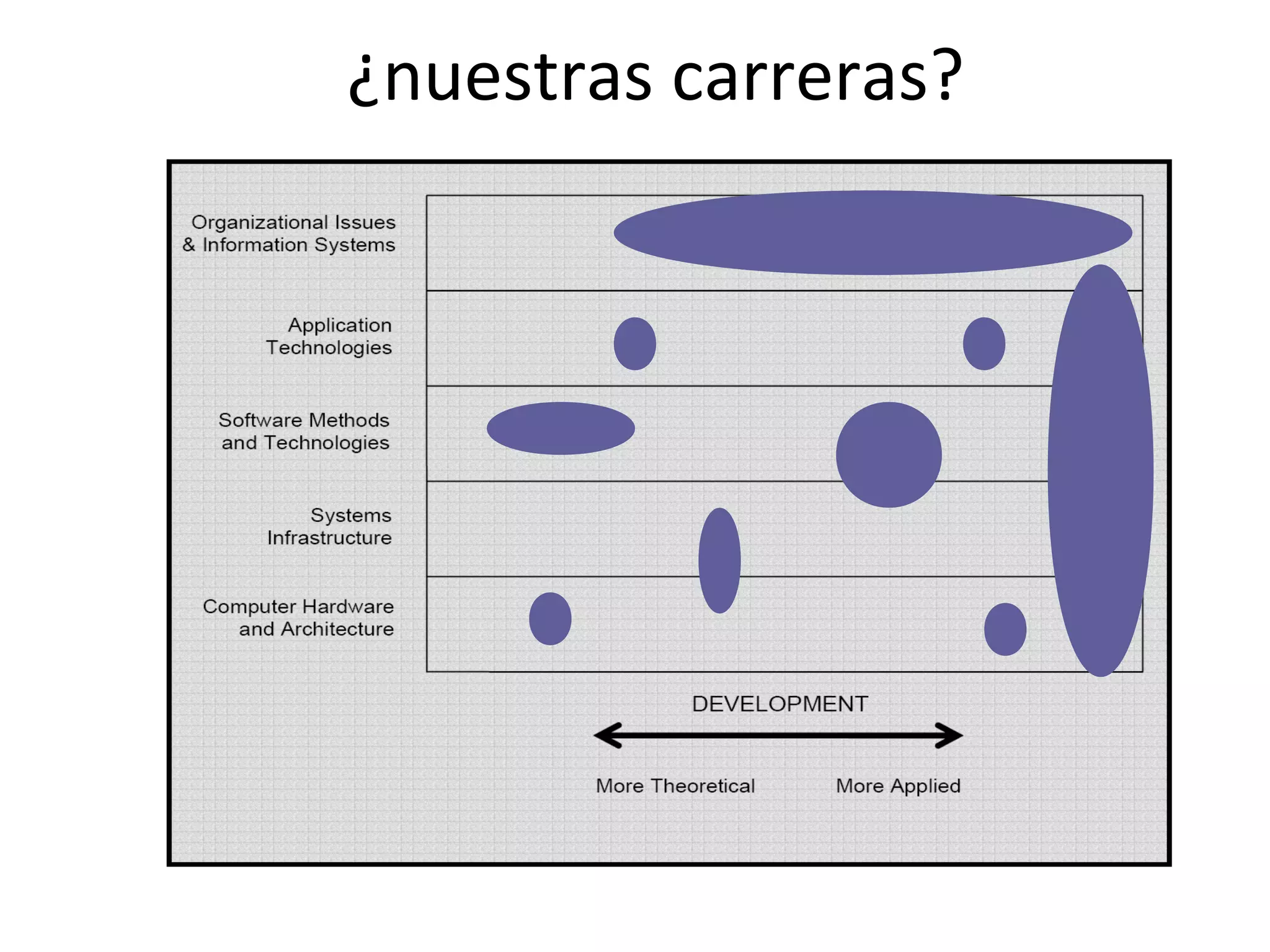
¿nuestras carreras?
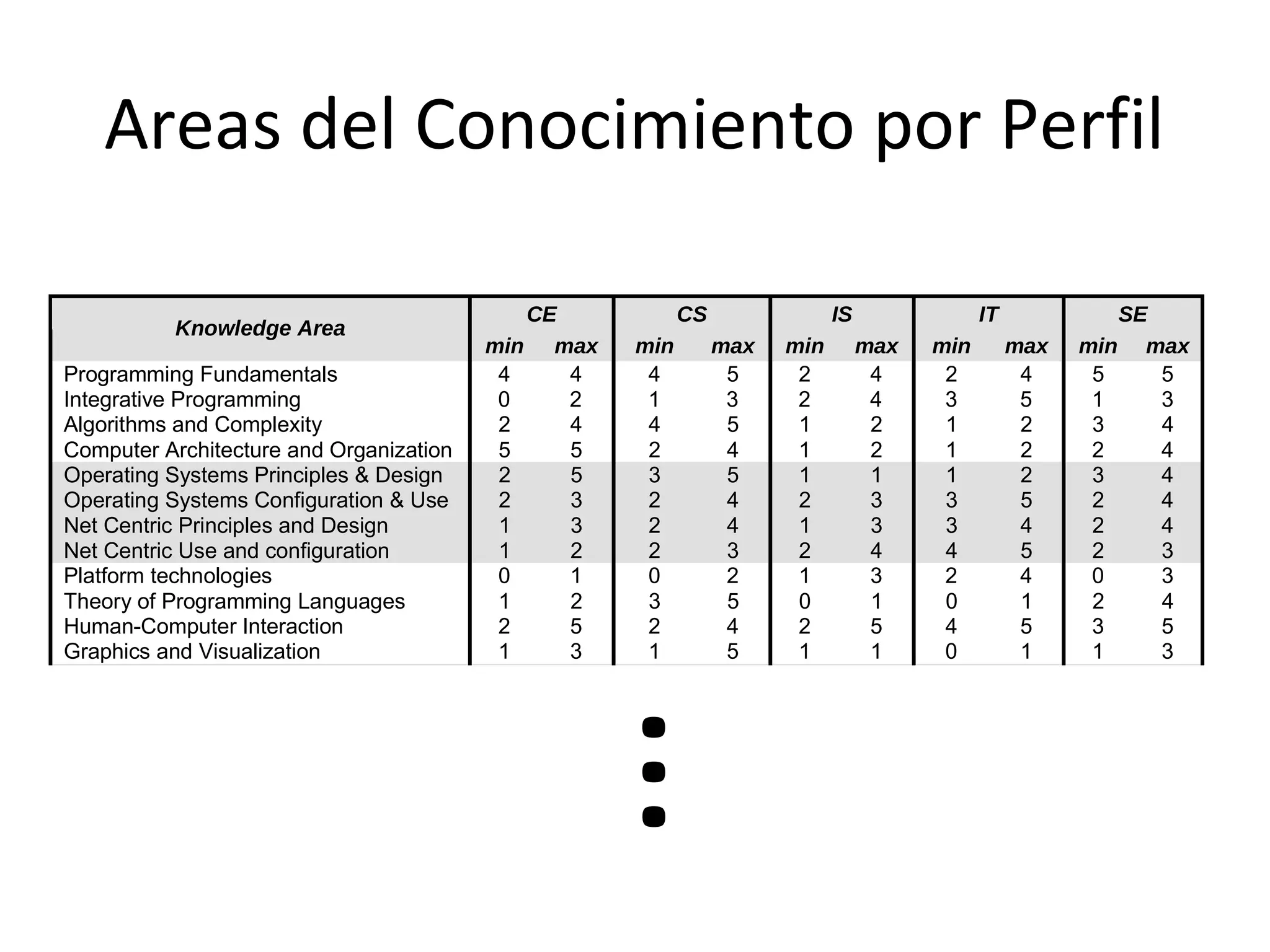
Areas del Conocimiento por Perfil
                                  Computing Curricula 2005 – The Overview Report


Table 3.1: Comparative weight of computing topics across the five kinds of degree programs

                                             CE                CS               IS               IT            SE
           Knowledge Area
                                          min max        min        max   min        max   min        max   min max
Programming Fundamentals                   4    4         4          5     2          4     2          4     5    5
Integrative Programming                    0    2         1          3     2          4     3          5     1    3
Algorithms and Complexity                  2    4         4          5     1          2     1          2     3    4
Computer Architecture and Organization     5    5         2          4     1          2     1          2     2    4
Operating Systems Principles & Design      2    5         3          5     1          1     1          2     3    4
Operating Systems Configuration & Use      2    3         2          4     2          3     3          5     2    4
Net Centric Principles and Design          1    3         2          4     1          3     3          4     2    4
Net Centric Use and configuration          1    2         2          3     2          4     4          5     2    3
Platform technologies                      0    1         0          2     1          3     2          4     0    3
Theory of Programming Languages            1    2         3          5     0          1     0          1     2    4
Human-Computer Interaction                 2    5         2          4     2          5     4          5     3    5
Graphics and Visualization                 1    3         1          5     1          1     0          1     1    3
Intelligent Systems (AI)                   1    3         2          5     1          1     0          0     0    0
Information Management (DB) Theory         1    3         2          5     1          3     1          1     2    5
Information Management (DB) Practice       1    2
                                                    …     1          4     4          5     3          4     1    4
Scientific computing (Numerical mthds)     0    2         0          5     0          0     0          0     0    0
Legal / Professional / Ethics / Society    2    5         2          4     2          5     2          4     2    5
Information Systems Development            0    2         0          2     5          5     1          3     2    4
Analysis of Business Requirements          0    1         0          1     5          5     1          2     1    3
E-business                                 0    0         0          0     4          5     1          2     0    3
Analysis of Technical Requirements         2    5         2          4     2          4     3          5     3    5
Engineering Foundations for SW             1    2         1          2     1          1     0          0     2    5
Engineering Economics for SW               1    3         0          1     1          2     0          1     2    3
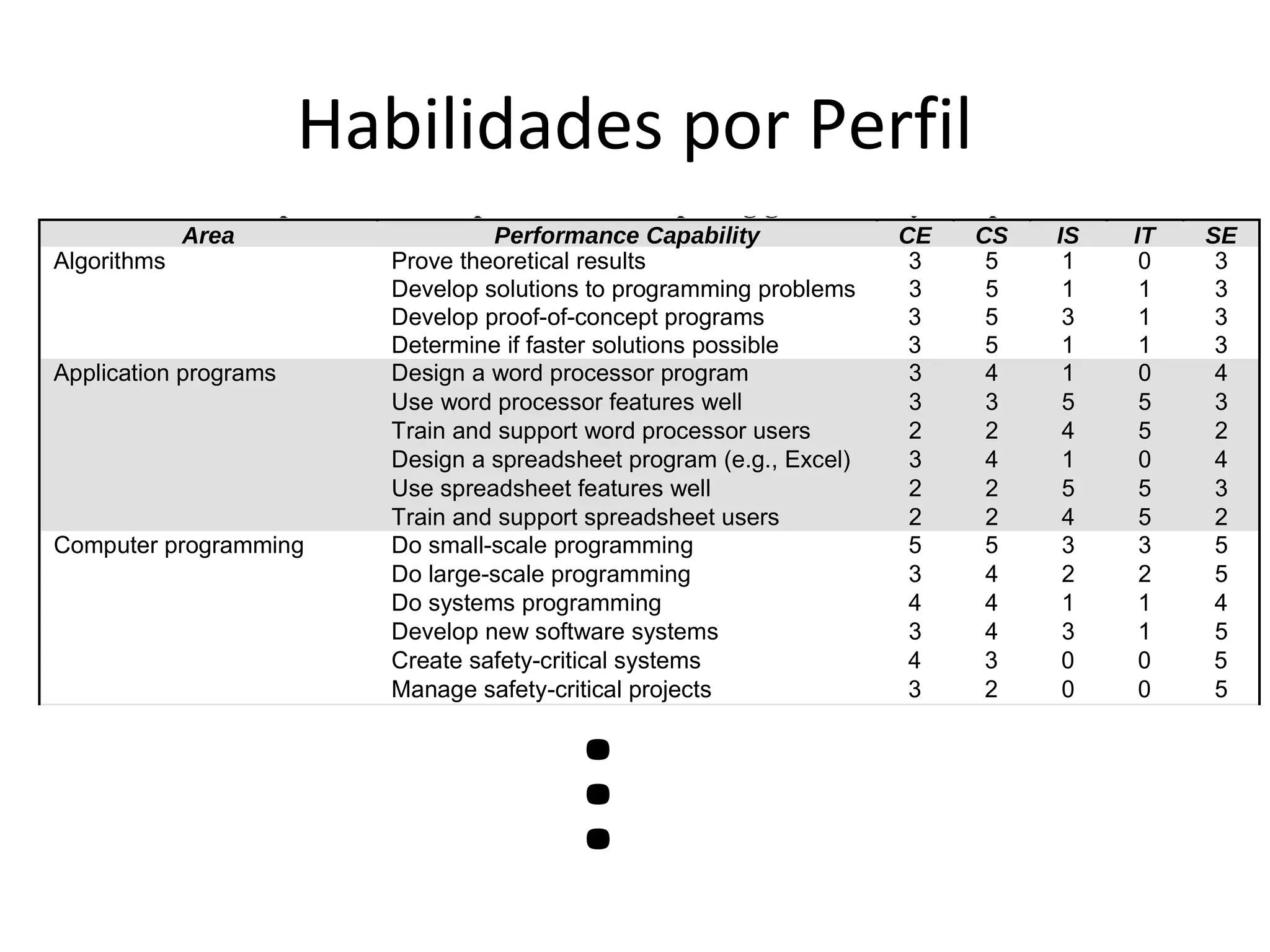
Habilidades por Perfil
                             Computing Curricula 2005 –   The Overview Report


Table 3.3. Relative performance capabilities of computing graduates by discipline
             Area                    Performance Capability                     CE   CS   IS   IT   SE
Algorithms                  Prove theoretical results                            3    5    1    0    3
                            Develop solutions to programming problems            3    5    1    1    3
                            Develop proof-of-concept programs                    3    5    3    1    3
                            Determine if faster solutions possible               3    5    1    1    3
Application programs        Design a word processor program                      3    4    1    0    4
                            Use word processor features well                     3    3    5    5    3
                            Train and support word processor users               2    2    4    5    2
                            Design a spreadsheet program (e.g., Excel)           3    4    1    0    4
                            Use spreadsheet features well                        2    2    5    5    3
                            Train and support spreadsheet users                  2    2    4    5    2
Computer programming        Do small-scale programming                           5    5    3    3    5
                            Do large-scale programming                           3    4    2    2    5
                            Do systems programming                               4    4    1    1    4
                            Develop new software systems                         3    4    3    1    5
                            Create safety-critical systems                       4    3    0    0    5
                            Manage safety-critical projects                      3    2    0    0    5
Hardware and devices        Design embedded systems                              5    1    0    0    1
                                         …
                            Implement embedded systems                           5    2    1    1    3
                            Design computer peripherals                          5    1    0    0    1
                            Design complex sensor systems                        5    1    0    0    1
                            Design a chip                                        5    1    0    0    1
                            Program a chip                                       5    1    0    0    1
                            Design a computer                                    5    1    0    0    1
Human-computer interface    Create a software user interface                     3    4    4    5    4
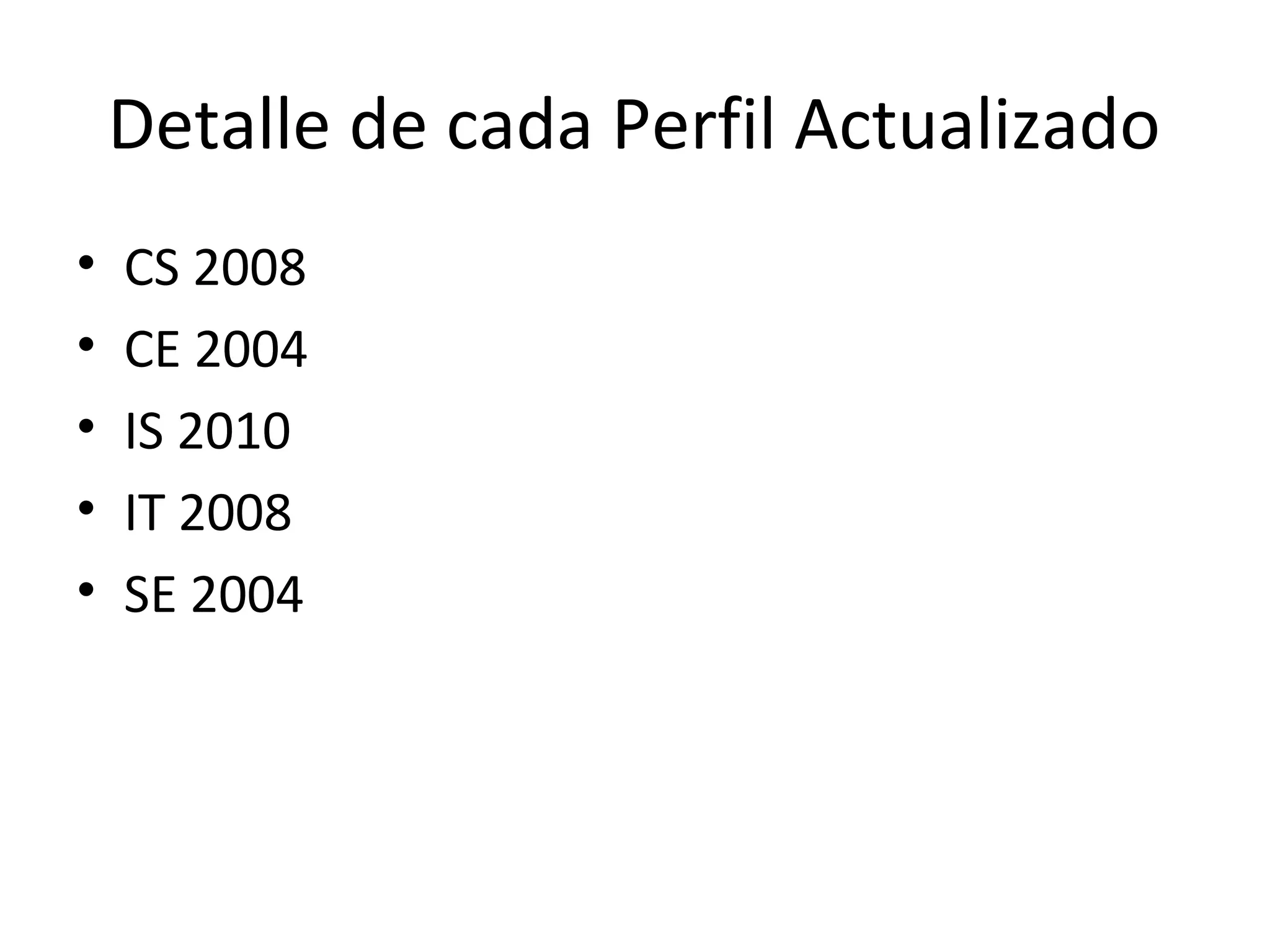
Detalle de cada Perfil Actualizado
•   CS 2008
•   CE 2004
•   IS 2010
•   IT 2008
•   SE 2004
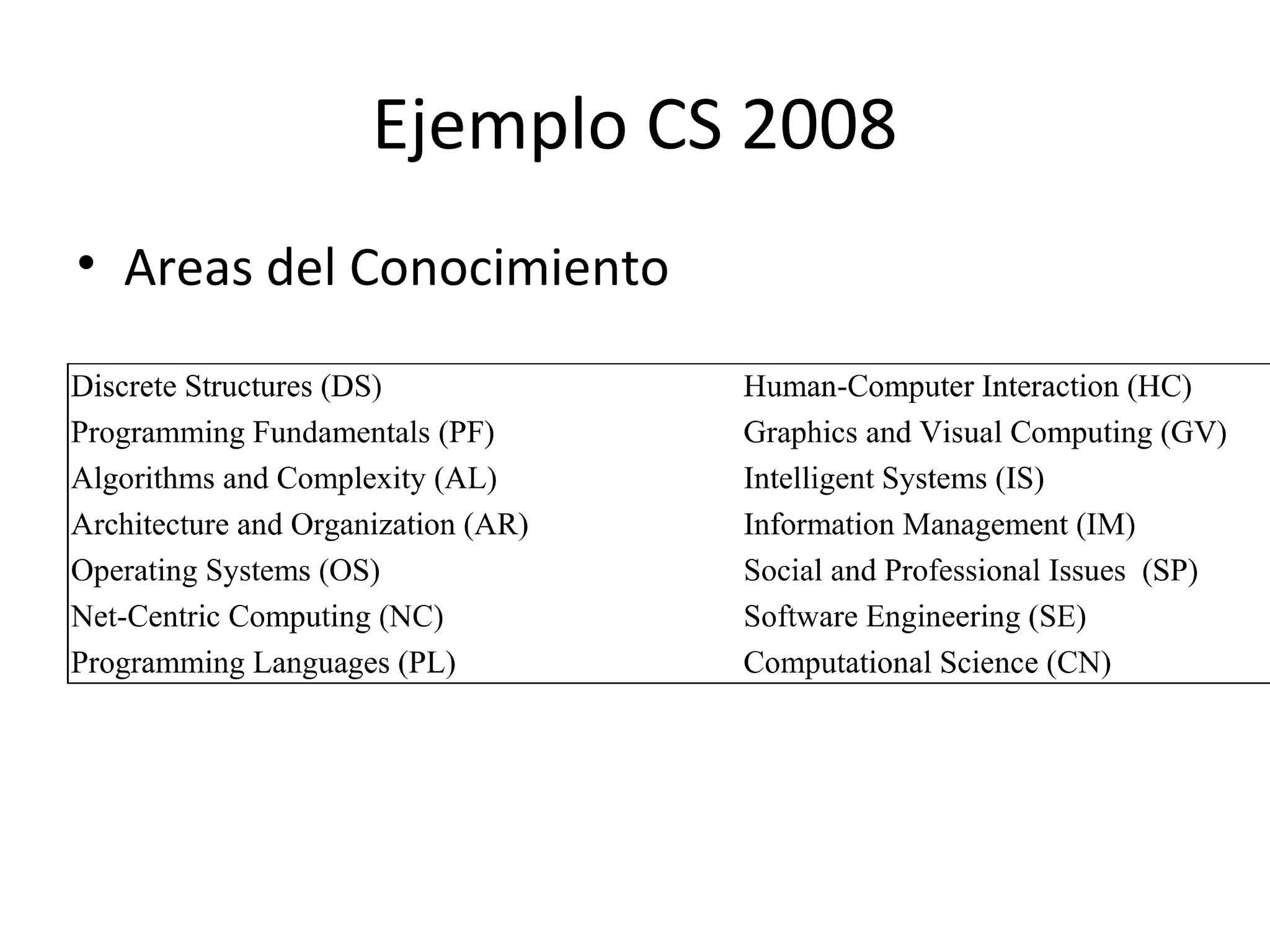
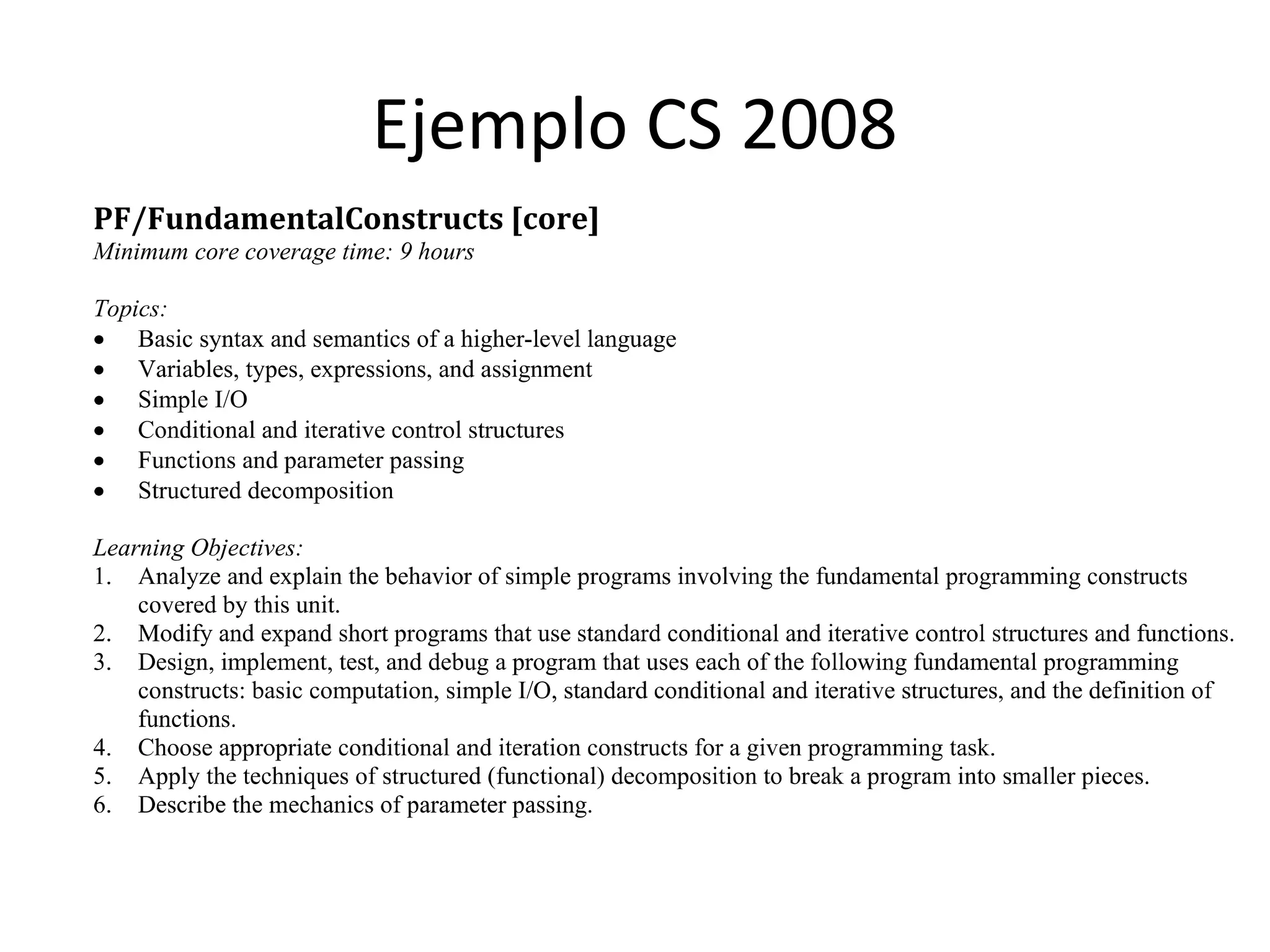
Ejemplo CS 2008
• Areas del Conocimiento
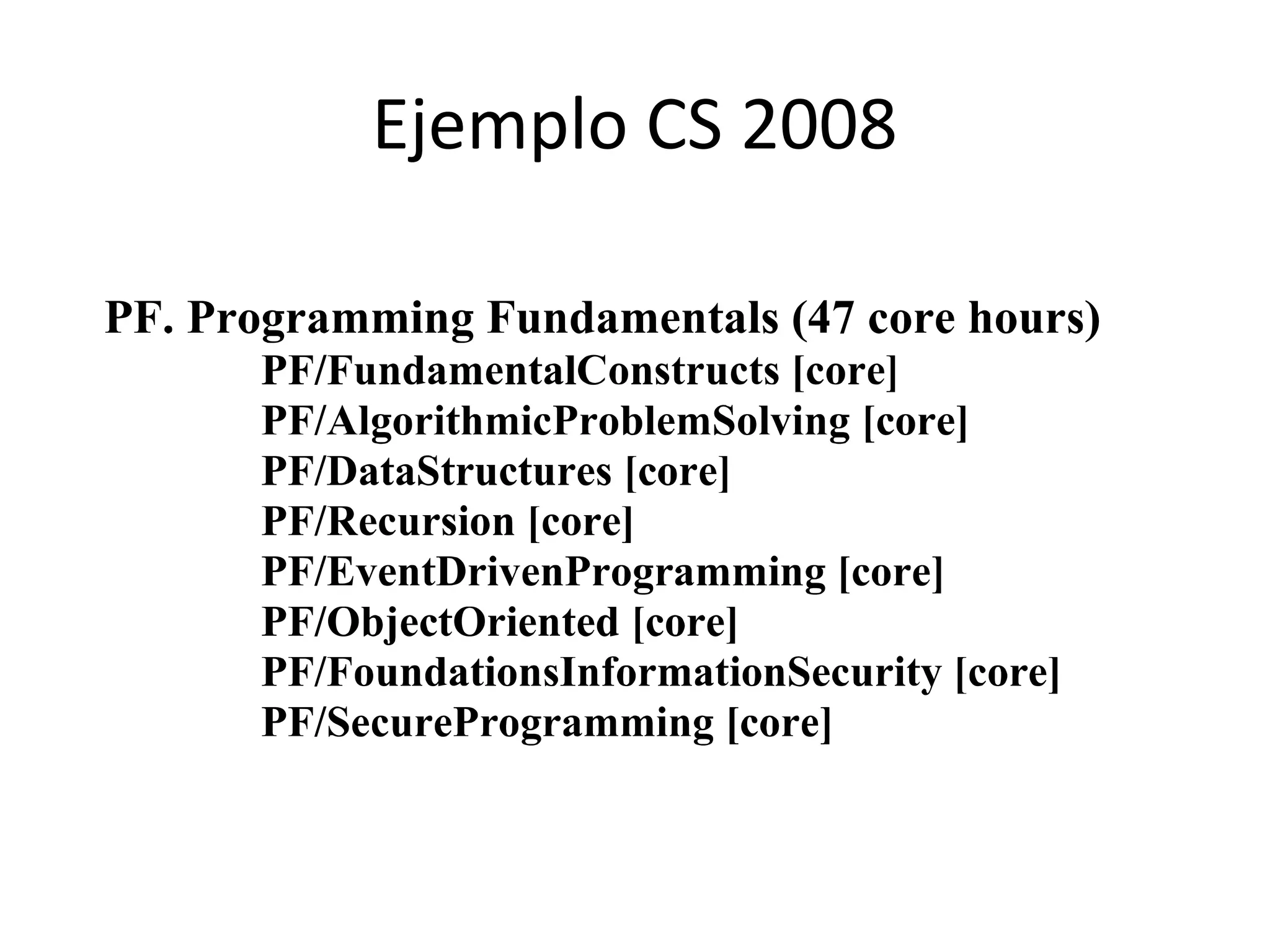
Ejemplo CS 2008
Ejemplo CS 2008
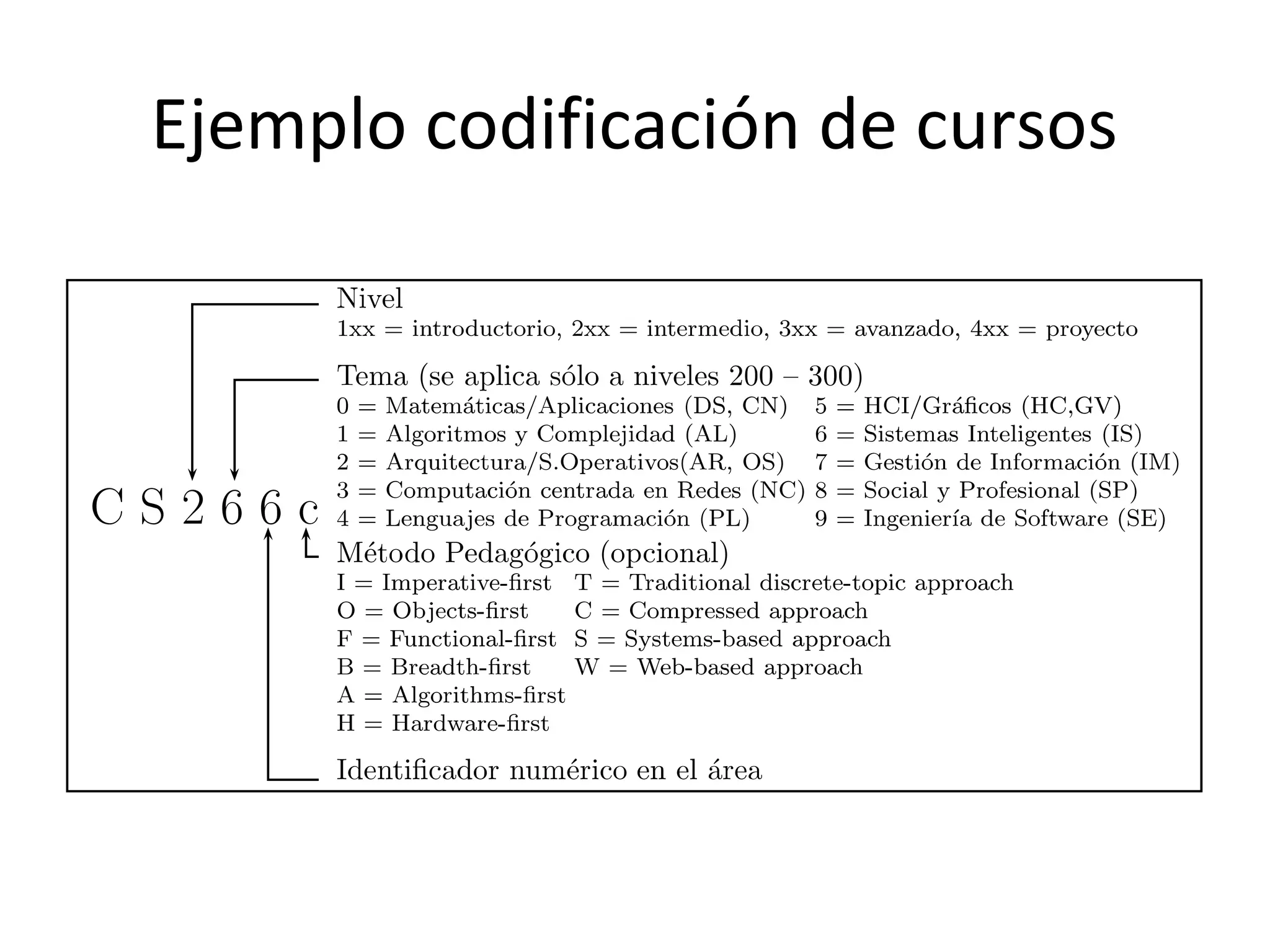
Ejemplo codificación de cursos
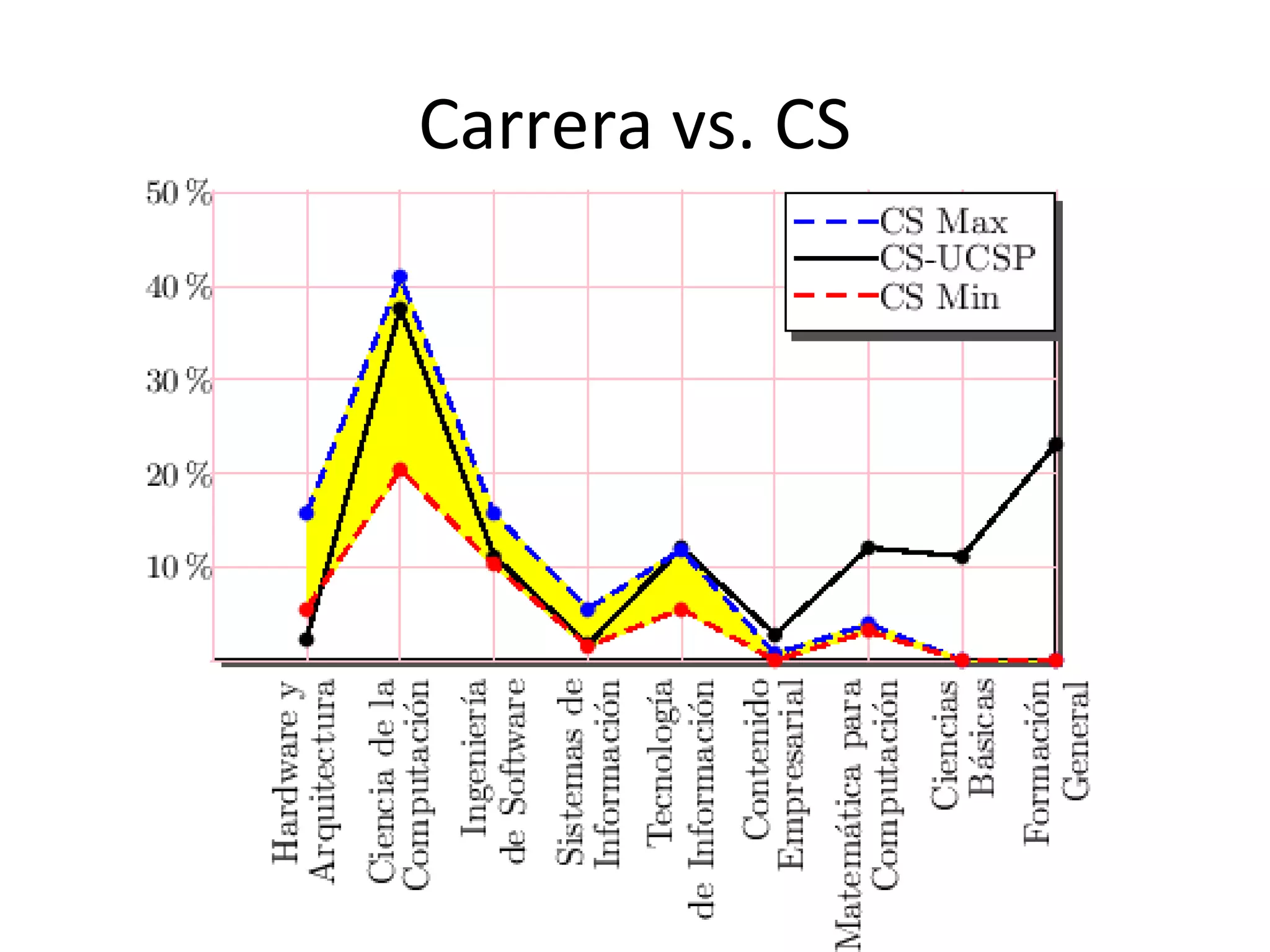
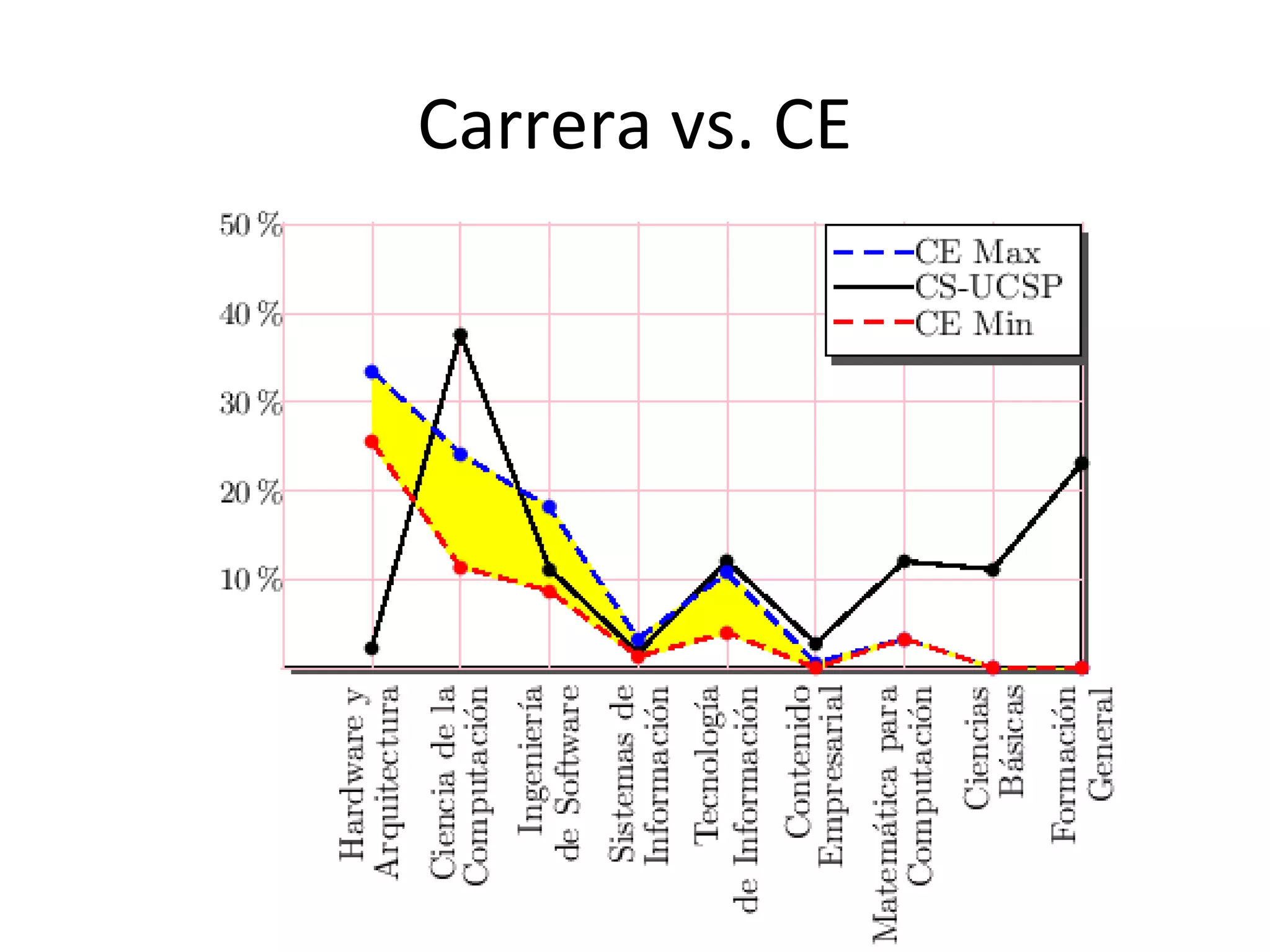
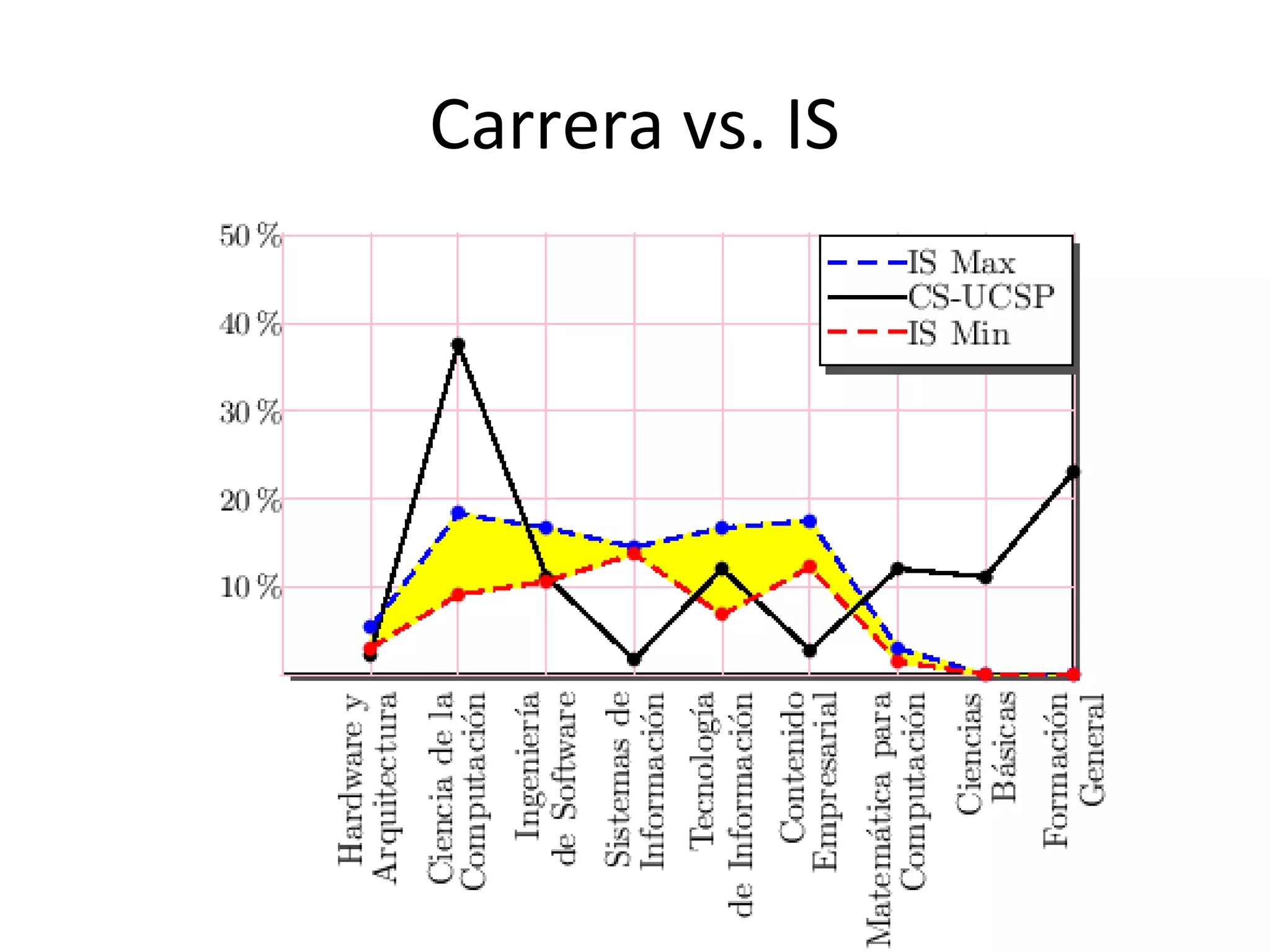
Como alinear nuestras carreras
• Caso de Estudio:
  – Licenciatura en Ciencias Computacionales
  – Universidad Católica de San Pablo (Perú)
  – http://education.spc.org.pe/Peru/CS-
    UCSP/Plan2010/
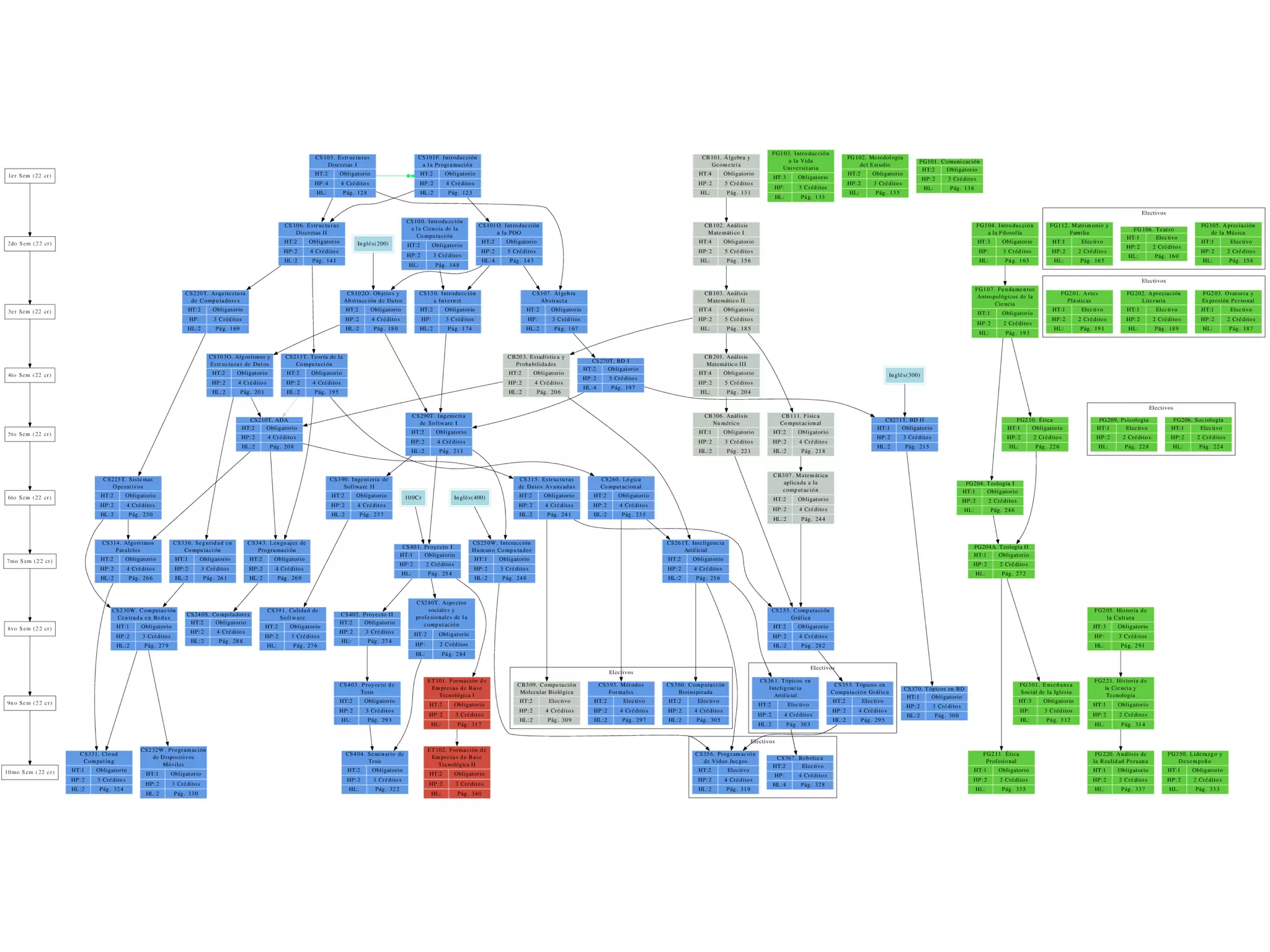
Clasificar según área de
     Conocimiento
Carrera vs. CS
Carrera vs. CE
Carrera vs. IS
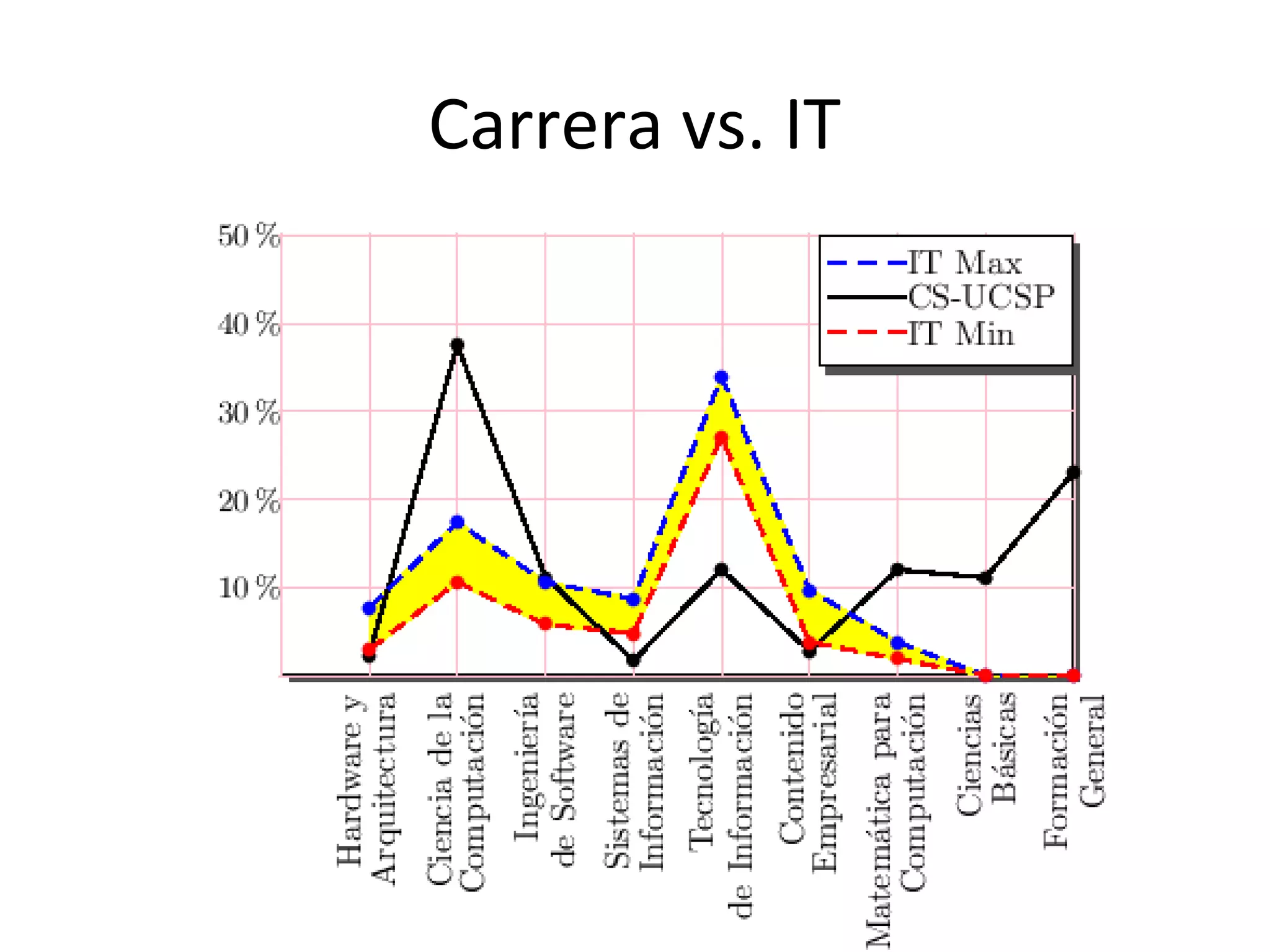
Carrera vs. IT
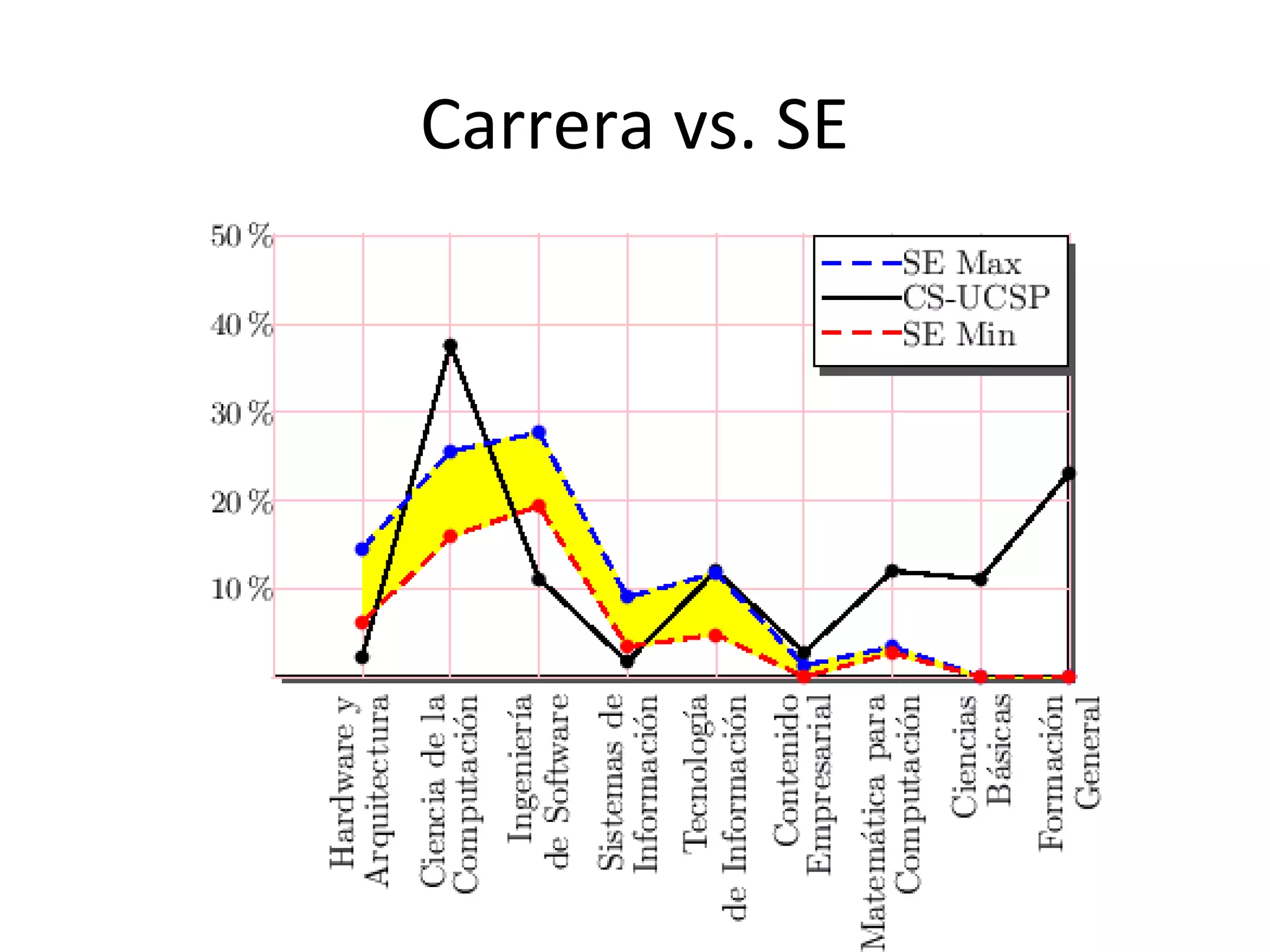
Carrera vs. SE
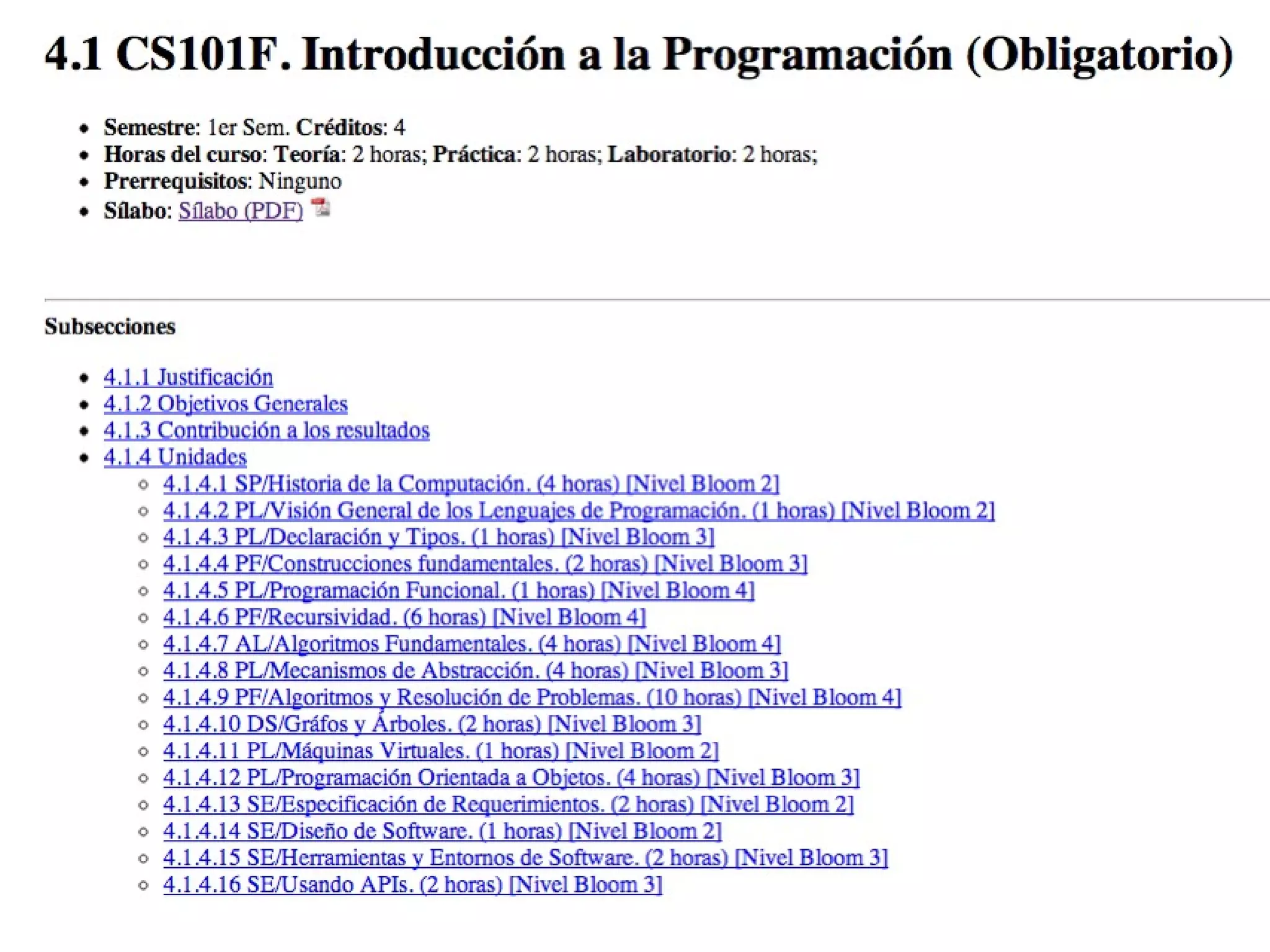
Mapear Cuerpo de Conocimiento
       en cada Materia
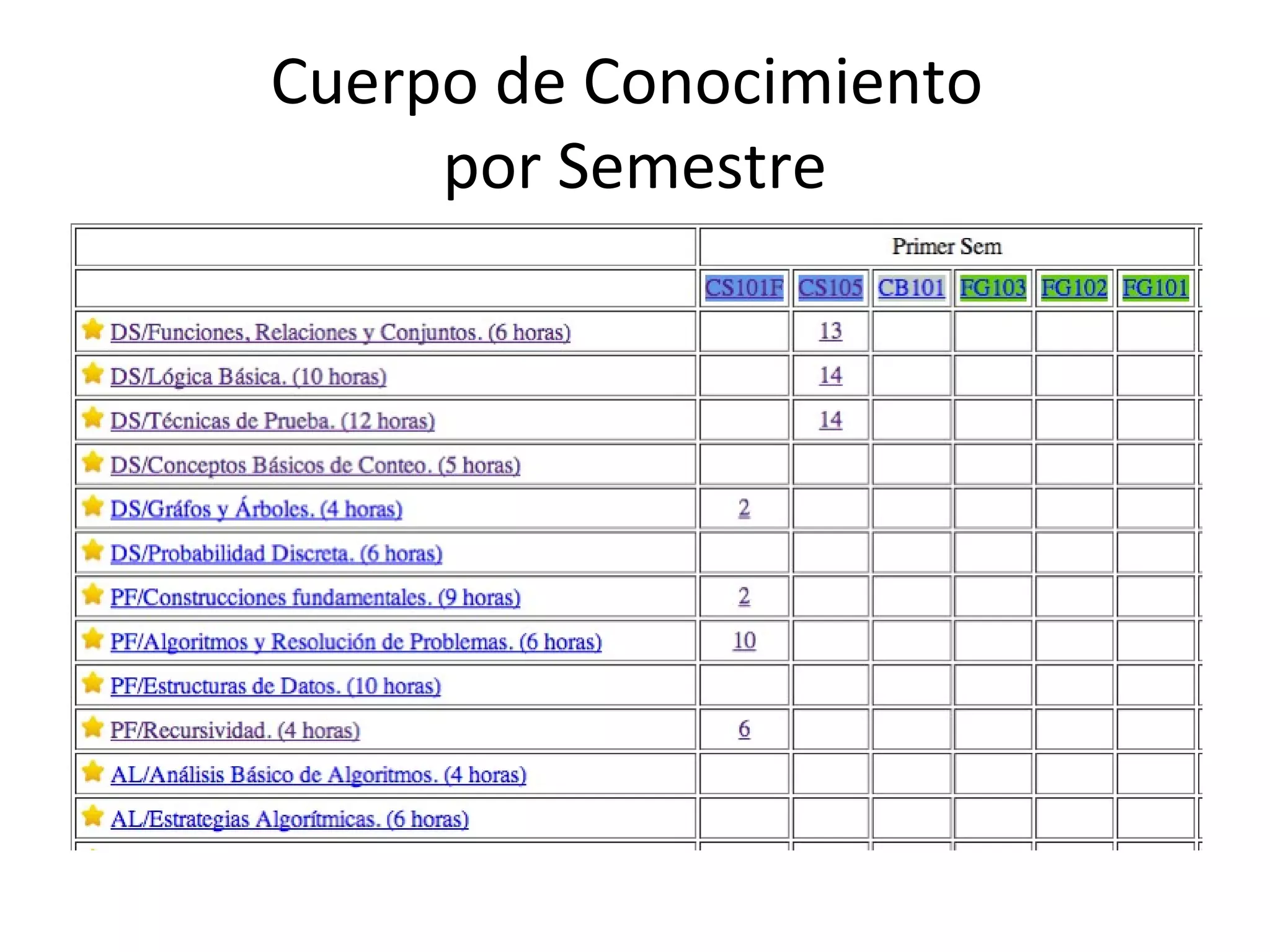
Cuerpo de Conocimiento
     por Semestre
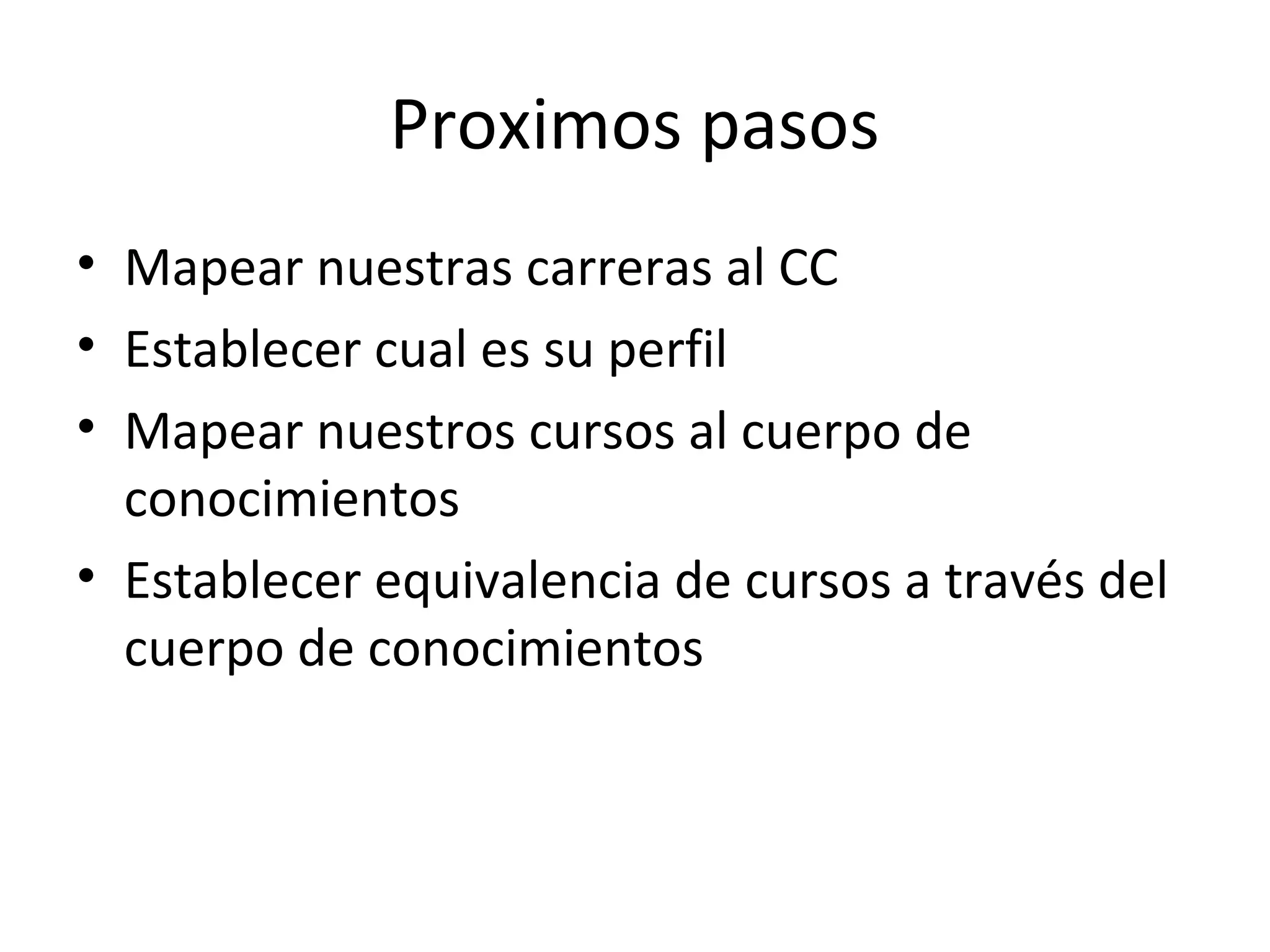
Proximos pasos
• Mapear nuestras carreras al CC
• Establecer cual es su perfil
• Mapear nuestros cursos al cuerpo de
  conocimientos
• Establecer equivalencia de cursos a través del
  cuerpo de conocimientos
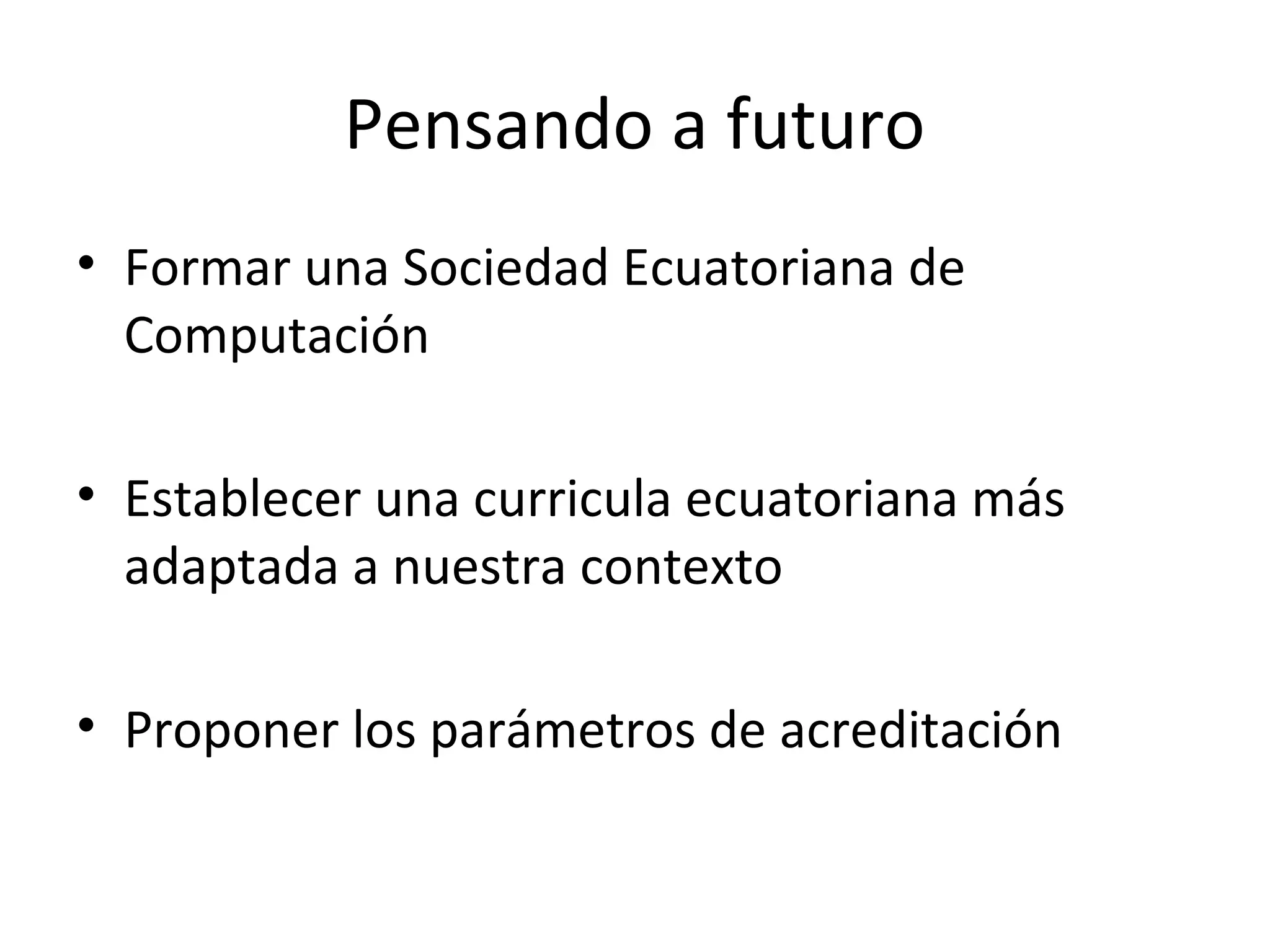
Pensando a futuro
• Formar una Sociedad Ecuatoriana de
  Computación

• Establecer una curricula ecuatoriana más
  adaptada a nuestra contexto

• Proponer los parámetros de acreditación
Gracias


Xavier Ochoa
xavier@cti.espol.edu.ec
http://ariadne.cti.espol.edu.ec/xavier
Twitter: @xaoch

Recomendaciones de ACM e IEEE para carreras de Computación e Informática

  • 1.
    Recomendaciones de ACMe IEEE para carreras de Computación e Informática Xavier Ochoa ESPOL
  • 2.
  • 3.
    Agenda • Que esel Computing Curricula • Perfiles de Carreras • Caso Estudio: Ajustar una carrera al CC
  • 4.
    Recomendaciones Previas ICF IFIP TC3 - UNESCO. 2000 Trabajo realizado por un grupo pequeño de expertos relacionados con IFIP. CC ACM y IEEE-CS 2001 Trabajo hechos por expertos mayoritariamente de EEUU. Incluye Ingeniería en Computación y Ciencias de la Computación. Career Consorcio Europeo de 11 grances compañias de TICs (BT, Space Cisco Systems, IBM Europe, Intel, Microsoft Europe, Nokia, etc) junto a la comisión Europea. Expertos de más de 20 universidades europeas.
  • 5.
    Computing Curricula • Esfuerzoconjunto de IEEE/ACM y otras asociaciones profesionales • Estándares internacionales para currículas en computación • Publicadas periodicamente – http://www.acm.org/education/
  • 6.
    Perfiles • Ingeniería de Computación (Computer Engineering) • Ciencia de la Computación (Computer Science) • Sistemas de Información (Information Systems) • Tecnología de la Información (Information Technology) • Ingeniería de Software (Software Engineering)
  • 7.
  • 8.
    It is clearwhere students who want to study hardware should go. Computer engineering has emerged from electrical engineering as the home for those working on the hardware and software issues involved in the design of digital devices. For those with other interests, the choices are not so clear-cut. In the pre- 1990s world, students who wanted to become expert in software development would study computer Evolución CC science. The post-1990s world presents meaningful choices: computer science, software engineering, and even computer engineering each include their own perspective on software development. These three choices imply real differences: for CE, software attention is focused on hardware devices; for SE, the emphasis is on creating software that satisfies robust real-world requirements; and for CS, software is the currency in which ideas are expressed and a wide range of computing problems and applications are Pre-1990s: EE+ CE CS IS HARDWARE SOFTWARE BUSINESS Post-1990s: EE CE CS SE IT IS HARDWARE SOFTWARE ORGANIZATIONAL NEEDS
  • 9.
    subjective interpretation ofthe various disciplines. They are not based on any precise quantitative Espectro de Computación foundation. Furthermore, they show only computing topics. Both computer engineering and information systems programs devote significant attention to topics that are outside of computing and not reflected in this diagram. Tables of required computing and non-computing topics are provided in Chapter 3. Organizational Issues & Information Systems Application Technologies Software Methods and Technologies Systems Infrastructure Computer Hardware and Architecture Theory DEVELOPMENT Application Principles Deployment Theory Application Deployment More Theoretical More Applied
  • 10.
    center as wemove upwards because a computer engineer’s interests narrow as we move away from the Ingeniería en Computación hardware. By the time we get up to the level of software development, we see that the computer engineer’s interest has narrowed to the horizontal center because they care about software only inasmuch as they need it to develop integrated devices. Organizational Issues & Information Systems Application Technologies Software Methods and Technologies Systems Infrastructure Computer Hardware and Architecture Theory DEVELOPMENT Application Principles Deployment Innovation Configuration CE More Theoretical More Applied
  • 11.
    technologies (web browsers,databases, search engines, etc.) Computer scientists create these capabilities, Ciencias de la Computación but they do not manage the deployment of them. Therefore, the shaded area for computer science narrows and then stops as we move to the right. This is because computer scientists do not help people to select computing products, or tailor products to organizational needs, or learn to use such products. Organizational Issues & Information Systems Application Technologies Software Methods and Technologies Systems Infrastructure Computer Hardware and Architecture Theory DEVELOPMENT Application Principles Deployment Innovation Configuration More Theoretical More Applied CS
  • 12.
    they often developsystems that utilize other software products to suit their organizations’ needs for Sistemas de Información information. (This figure does not reflect the attention that information systems programs devote to core business topics. See Chapter 3 for tables that summarize both computing and non-computing topics.) Organizational Issues & Information Systems Application Technologies Software Methods and Technologies Systems Infrastructure Computer Hardware and Architecture Theory DEVELOPMENT Application Principles Deployment Innovation Configuration IS More Theoretical More Applied
  • 13.
    students a foundationin existing concepts and skills. Many in the community of IT faculty assert that research in their field will grow to create and develop new knowledge in relevant areas. When that Tecnologías de Información happens, an appropriate snapshot would feature a shaded area that extends significantly further to the left. However, this is an ambition and not yet an achievement. This figure reflects the current status of IT. Organizational Issues & Information Systems Application Technologies Software Methods and Technologies Systems Infrastructure Computer Hardware and Architecture Theory DEVELOPMENT Application Principles Deployment Innovation Configuration IT More Theoretical More Applied
  • 14.
    concerns extend allthe way from theory and principles to daily practice. The domain of SE also extends downward through systems infrastructure since SE people develop software infrastructure that is robust in Ingeniería de Software operation. Its domain also extends upward into organizational issues because SE people are interested in designing and developing information systems that are appropriate to the client organization. Organizational Issues & Information Systems Application Technologies Software Methods and Technologies Systems Infrastructure Computer Hardware and Architecture Theory DEVELOPMENT Application Principles Deployment Innovation Configuration SE More Theoretical More Applied
  • 15.
  • 16.
    Areas del Conocimientopor Perfil Computing Curricula 2005 – The Overview Report Table 3.1: Comparative weight of computing topics across the five kinds of degree programs CE CS IS IT SE Knowledge Area min max min max min max min max min max Programming Fundamentals 4 4 4 5 2 4 2 4 5 5 Integrative Programming 0 2 1 3 2 4 3 5 1 3 Algorithms and Complexity 2 4 4 5 1 2 1 2 3 4 Computer Architecture and Organization 5 5 2 4 1 2 1 2 2 4 Operating Systems Principles & Design 2 5 3 5 1 1 1 2 3 4 Operating Systems Configuration & Use 2 3 2 4 2 3 3 5 2 4 Net Centric Principles and Design 1 3 2 4 1 3 3 4 2 4 Net Centric Use and configuration 1 2 2 3 2 4 4 5 2 3 Platform technologies 0 1 0 2 1 3 2 4 0 3 Theory of Programming Languages 1 2 3 5 0 1 0 1 2 4 Human-Computer Interaction 2 5 2 4 2 5 4 5 3 5 Graphics and Visualization 1 3 1 5 1 1 0 1 1 3 Intelligent Systems (AI) 1 3 2 5 1 1 0 0 0 0 Information Management (DB) Theory 1 3 2 5 1 3 1 1 2 5 Information Management (DB) Practice 1 2 … 1 4 4 5 3 4 1 4 Scientific computing (Numerical mthds) 0 2 0 5 0 0 0 0 0 0 Legal / Professional / Ethics / Society 2 5 2 4 2 5 2 4 2 5 Information Systems Development 0 2 0 2 5 5 1 3 2 4 Analysis of Business Requirements 0 1 0 1 5 5 1 2 1 3 E-business 0 0 0 0 4 5 1 2 0 3 Analysis of Technical Requirements 2 5 2 4 2 4 3 5 3 5 Engineering Foundations for SW 1 2 1 2 1 1 0 0 2 5 Engineering Economics for SW 1 3 0 1 1 2 0 1 2 3
  • 17.
    Habilidades por Perfil Computing Curricula 2005 – The Overview Report Table 3.3. Relative performance capabilities of computing graduates by discipline Area Performance Capability CE CS IS IT SE Algorithms Prove theoretical results 3 5 1 0 3 Develop solutions to programming problems 3 5 1 1 3 Develop proof-of-concept programs 3 5 3 1 3 Determine if faster solutions possible 3 5 1 1 3 Application programs Design a word processor program 3 4 1 0 4 Use word processor features well 3 3 5 5 3 Train and support word processor users 2 2 4 5 2 Design a spreadsheet program (e.g., Excel) 3 4 1 0 4 Use spreadsheet features well 2 2 5 5 3 Train and support spreadsheet users 2 2 4 5 2 Computer programming Do small-scale programming 5 5 3 3 5 Do large-scale programming 3 4 2 2 5 Do systems programming 4 4 1 1 4 Develop new software systems 3 4 3 1 5 Create safety-critical systems 4 3 0 0 5 Manage safety-critical projects 3 2 0 0 5 Hardware and devices Design embedded systems 5 1 0 0 1 … Implement embedded systems 5 2 1 1 3 Design computer peripherals 5 1 0 0 1 Design complex sensor systems 5 1 0 0 1 Design a chip 5 1 0 0 1 Program a chip 5 1 0 0 1 Design a computer 5 1 0 0 1 Human-computer interface Create a software user interface 3 4 4 5 4
  • 18.
    Detalle de cadaPerfil Actualizado • CS 2008 • CE 2004 • IS 2010 • IT 2008 • SE 2004
  • 19.
    Ejemplo CS 2008 •Areas del Conocimiento
  • 20.
  • 21.
  • 22.
  • 23.
    Como alinear nuestrascarreras • Caso de Estudio: – Licenciatura en Ciencias Computacionales – Universidad Católica de San Pablo (Perú) – http://education.spc.org.pe/Peru/CS- UCSP/Plan2010/
  • 25.
    Clasificar según áreade Conocimiento
  • 26.
  • 27.
  • 28.
  • 29.
  • 30.
  • 31.
    Mapear Cuerpo deConocimiento en cada Materia
  • 33.
  • 34.
    Proximos pasos • Mapearnuestras carreras al CC • Establecer cual es su perfil • Mapear nuestros cursos al cuerpo de conocimientos • Establecer equivalencia de cursos a través del cuerpo de conocimientos
  • 35.
    Pensando a futuro •Formar una Sociedad Ecuatoriana de Computación • Establecer una curricula ecuatoriana más adaptada a nuestra contexto • Proponer los parámetros de acreditación
  • 36.