Computational
modeling of
drug
distribution
Presented by:-KUNAL
CONTENTS
– INTRODUCTION
– MODELING TECHNIQUE
– DRUG DISPOSITION
– DRUG DISTRIBUTION
– REFERENCES
INTRODUTION
– Historically, drug discovery has focused almost
exclusively on efficacy and selectivity against the
biological target.
– As a result, nearly half of drug candidates fail at
phase II and phase III clinical trials because of the
undesirable drug pharmacokinetics properties,
including absorption, distribution, metabolism,
excretion and toxicity (ADMET).
– The pressure to control the escalating cost of new drug
development has changed the paradigm since the mod-
1990s.
– To reduce the attrition rate at more expensive later stages,
in vitro evaluation of ADMET properties in the early phase
of drug discovery has widely adopted.
– Many high-throughput in vitro ADMET property screening
assays have been developed and applied successfully.
– Fueled by the ever-increasing computational power
and significant advances of in silico modeling
algorithms, numerous computational programs that
aim at modeling ADMET properties have emerged.
– A comprehensive list of available commercial ADMET
modeling software has been provided till date.
Modeling techniques:
Two types of Modeling Approaches are:
– Quantitative approaches
– Qualitative approaches
Quantitative approaches
– It is represented by pharmacophore modeling and flexible docking studies
investigate the structural requirements for the interaction between drugs and
the targets that are involved in ADMET processes.
– It is represented by pharmacophore modeling and flexible docking studies
investigate the structural requirements for the interaction between drugs and
the targets that are involved in ADMET processes.
– The availability of a protein’s 3-D structure, from either X-ray crystallisation or
homology modeling, would assist flexible docking of the active ligand to derive
important interactions between the protein and the ligand.
Three widely used automated
pharmacophore perception tools:
– DISCO (Distance Comparison)
– GASP(Genetic Algorithm Similarity Program)
– Catalyst/HIPHOP
– All three programs attempt to determine common
features based on the superposition of active
compounds with different algorithms.
Qualitative approaches
– It is represented by quantitative structure activity relationship (QSAR) and
quantitative structure property relationship(QSPR) studies utilize multivariate
analysis to correlate molecular descriptors with ADMET- related properties
– A diverse range of molecular descriptors can be calculated based on the drug
structure.
– Some of these descriptors are closely related to a physical property and are
easy to comprehend (e.g. Molecular weight) whereas the majority of the
descriptors are of quantum mechanical concepts or interaction energies at
dispersed space points that are beyond simple physicochemical parameters.
– When calculating correlations, it is important to select the molecular
descriptors that represents the type of interactions contributing to the targeted
biological property.
– A set of descriptors that specifically target ADME related properties has been
proposed by Cruciani and colleagues.
– The majority of published ADMET models are generated based on 2D
descriptors.
– Even though the alignment dependent 3D descriptors that are relevant to the
targeted biological activity tend to generate the most predictive models.
– The difficulties inherent in structure alignment thwart attempts to apply this
type of modeling in a high throughput manner.
– A wide selection of statistical algorithms is available to researchers for
correlating field descriptors with ADMET properties including simple multiple
linear regression(MLR), multivariate partial least squares (PLS) and the non
linear regression type algorithms such as artificial neural network (ANN) and
support vector machine(SVM).
DRUG DISPOSITION
– Any alternation in the drug’s bioavailability is
reflected in its pharmacological effects. Others
processes that play a role in the therapeutic
activity of a drug are distribution and elimination.
Together, they are known as drug disposition.
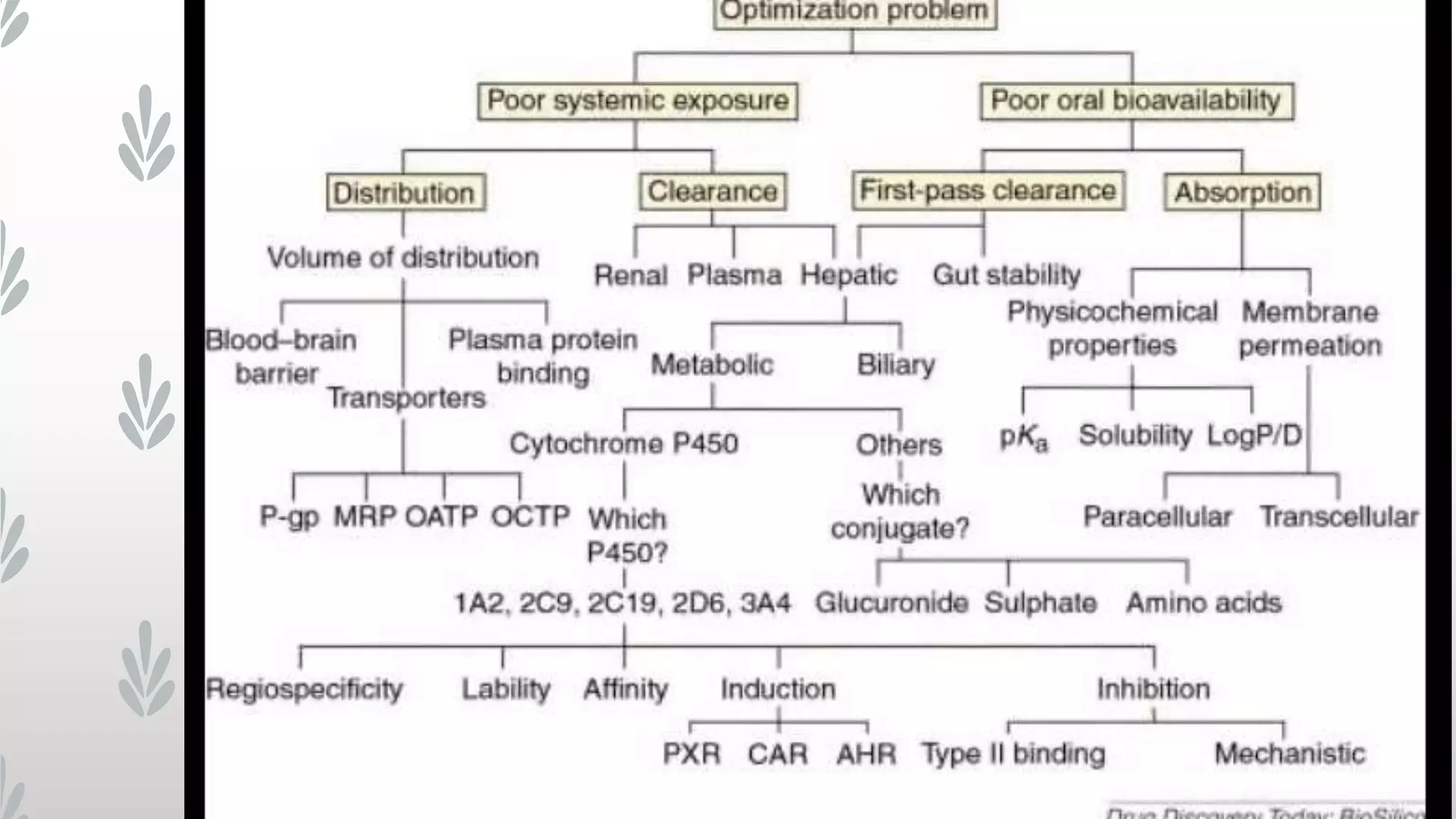
Drug distribution
– Distribution is an important aspect of drug’s pharmacokinetic
profile.
– The structural and physiochemical properties of a drug determine
the extent of distribution, which is mainly reflected by three
parameters:
– 1. volume of distribution (Vd),
– 2. plasma-protein binding (PPB) and
– 3. blood-brain barrier (BBB) permeability.
Volume of Distribution (Vd)
– Vd is a measure of relative partitioning of drug between plasma and tissue, an
important proportional constant that, when combined a drug is a major
determinant of how often the drug should be administered.
– However, because of the scarcity of in vivo data and complexity of the
underlying processes, computational models that are capable of prediction Vd
based solely on computed descriptors are still under development.
Plasma Protein Binding (PBP)
– Drugs binding to a variety of plasma proteins such as serum albumin, as
unbound drug primarily contributes to pharmacological efficacy.
– The effect of PPB is an important consideration when evaluating the effective
(unbound) drug plasma concentration.
– The models proposed to predict PBB should not rely on the binding data of only
one protein when predicting plasma protein binding because it is a composite
parameter reflecting interactions with multiple protein.
Blood-Brain Barrier (BBB)
– The BBB maintains the restricted extracellular environment in the central nerve
system.
– The evaluation of drug penetration through the BBB is an integral part of drug
discovery and development process.
– Again, because of the few experimental data derived from inconsistent
protocols, most BBB permeation prediction models are of limited practical use
despite intensive efforts.
– Most approaches model log blood/brain (logBB), which is a measurement of the
drug partitioning between blood and brain tissue.
References:
– Ekins S, “Computer Applications in Pharmaceutical Research and Development”,
(2006) John Wiley and Sons Inc., chapter 20, pp495-508
– Ekins S, Nikolsky Y and Nikolskaya T. Techniques: Application of systems biology
to absorption, distribution, metabolism, excretion and toxicity. Trends
Pharmacol Sci 2005;26;202-9
– https://hemonc.mhmedical.com/content.aspx?bookid=1810&sectionid=124489
864(accessed in 13th May, 2018 )
– • https://hemonc.mhmedical.com/content.aspx?boo
kid=1810&sectionid=124489864 (9th Mar, 2019).
– Computer Applications in Pharmaceutical Research and Development, Sean
Ekins,2006, John Wiley and Sons.

Computational modeling of drug distribution

  • 1.
  • 2.
    CONTENTS – INTRODUCTION – MODELINGTECHNIQUE – DRUG DISPOSITION – DRUG DISTRIBUTION – REFERENCES
  • 3.
    INTRODUTION – Historically, drugdiscovery has focused almost exclusively on efficacy and selectivity against the biological target. – As a result, nearly half of drug candidates fail at phase II and phase III clinical trials because of the undesirable drug pharmacokinetics properties, including absorption, distribution, metabolism, excretion and toxicity (ADMET).
  • 4.
    – The pressureto control the escalating cost of new drug development has changed the paradigm since the mod- 1990s. – To reduce the attrition rate at more expensive later stages, in vitro evaluation of ADMET properties in the early phase of drug discovery has widely adopted. – Many high-throughput in vitro ADMET property screening assays have been developed and applied successfully.
  • 5.
    – Fueled bythe ever-increasing computational power and significant advances of in silico modeling algorithms, numerous computational programs that aim at modeling ADMET properties have emerged. – A comprehensive list of available commercial ADMET modeling software has been provided till date.
  • 6.
    Modeling techniques: Two typesof Modeling Approaches are: – Quantitative approaches – Qualitative approaches
  • 7.
    Quantitative approaches – Itis represented by pharmacophore modeling and flexible docking studies investigate the structural requirements for the interaction between drugs and the targets that are involved in ADMET processes. – It is represented by pharmacophore modeling and flexible docking studies investigate the structural requirements for the interaction between drugs and the targets that are involved in ADMET processes. – The availability of a protein’s 3-D structure, from either X-ray crystallisation or homology modeling, would assist flexible docking of the active ligand to derive important interactions between the protein and the ligand.
  • 8.
    Three widely usedautomated pharmacophore perception tools: – DISCO (Distance Comparison) – GASP(Genetic Algorithm Similarity Program) – Catalyst/HIPHOP – All three programs attempt to determine common features based on the superposition of active compounds with different algorithms.
  • 9.
    Qualitative approaches – Itis represented by quantitative structure activity relationship (QSAR) and quantitative structure property relationship(QSPR) studies utilize multivariate analysis to correlate molecular descriptors with ADMET- related properties – A diverse range of molecular descriptors can be calculated based on the drug structure. – Some of these descriptors are closely related to a physical property and are easy to comprehend (e.g. Molecular weight) whereas the majority of the descriptors are of quantum mechanical concepts or interaction energies at dispersed space points that are beyond simple physicochemical parameters.
  • 10.
    – When calculatingcorrelations, it is important to select the molecular descriptors that represents the type of interactions contributing to the targeted biological property. – A set of descriptors that specifically target ADME related properties has been proposed by Cruciani and colleagues. – The majority of published ADMET models are generated based on 2D descriptors. – Even though the alignment dependent 3D descriptors that are relevant to the targeted biological activity tend to generate the most predictive models.
  • 11.
    – The difficultiesinherent in structure alignment thwart attempts to apply this type of modeling in a high throughput manner. – A wide selection of statistical algorithms is available to researchers for correlating field descriptors with ADMET properties including simple multiple linear regression(MLR), multivariate partial least squares (PLS) and the non linear regression type algorithms such as artificial neural network (ANN) and support vector machine(SVM).
  • 12.
    DRUG DISPOSITION – Anyalternation in the drug’s bioavailability is reflected in its pharmacological effects. Others processes that play a role in the therapeutic activity of a drug are distribution and elimination. Together, they are known as drug disposition.
  • 14.
    Drug distribution – Distributionis an important aspect of drug’s pharmacokinetic profile. – The structural and physiochemical properties of a drug determine the extent of distribution, which is mainly reflected by three parameters: – 1. volume of distribution (Vd), – 2. plasma-protein binding (PPB) and – 3. blood-brain barrier (BBB) permeability.
  • 15.
    Volume of Distribution(Vd) – Vd is a measure of relative partitioning of drug between plasma and tissue, an important proportional constant that, when combined a drug is a major determinant of how often the drug should be administered. – However, because of the scarcity of in vivo data and complexity of the underlying processes, computational models that are capable of prediction Vd based solely on computed descriptors are still under development.
  • 16.
    Plasma Protein Binding(PBP) – Drugs binding to a variety of plasma proteins such as serum albumin, as unbound drug primarily contributes to pharmacological efficacy. – The effect of PPB is an important consideration when evaluating the effective (unbound) drug plasma concentration. – The models proposed to predict PBB should not rely on the binding data of only one protein when predicting plasma protein binding because it is a composite parameter reflecting interactions with multiple protein.
  • 17.
    Blood-Brain Barrier (BBB) –The BBB maintains the restricted extracellular environment in the central nerve system. – The evaluation of drug penetration through the BBB is an integral part of drug discovery and development process. – Again, because of the few experimental data derived from inconsistent protocols, most BBB permeation prediction models are of limited practical use despite intensive efforts. – Most approaches model log blood/brain (logBB), which is a measurement of the drug partitioning between blood and brain tissue.
  • 18.
    References: – Ekins S,“Computer Applications in Pharmaceutical Research and Development”, (2006) John Wiley and Sons Inc., chapter 20, pp495-508 – Ekins S, Nikolsky Y and Nikolskaya T. Techniques: Application of systems biology to absorption, distribution, metabolism, excretion and toxicity. Trends Pharmacol Sci 2005;26;202-9 – https://hemonc.mhmedical.com/content.aspx?bookid=1810&sectionid=124489 864(accessed in 13th May, 2018 ) – • https://hemonc.mhmedical.com/content.aspx?boo kid=1810&sectionid=124489864 (9th Mar, 2019). – Computer Applications in Pharmaceutical Research and Development, Sean Ekins,2006, John Wiley and Sons.