Problem Statement
 Calculate the power required by two
compressors in an ammonia system which
services a 250 kw evaporator at -250C. the
system uses two stage compression with
intercooling and removal of flash gas. The
condensing temperature is 350C.
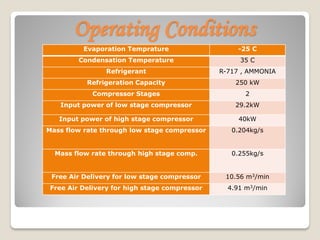
Operating Conditions
Evaporation Temprature -25 C
Condensation Temperature 35 C
Refrigerant R-717 , AMMONIA
Refrigeration Capacity 250 kW
Compressor Stages 2
Input power of low stage compressor 29.2kW
Input power of high stage compressor 40kW
Mass flow rate through low stage compressor 0.204kg/s
Mass flow rate through high stage comp. 0.255kg/s
Free Air Delivery for low stage compressor 10.56 m3/min
Free Air Delivery for high stage compressor 4.91 m3/min
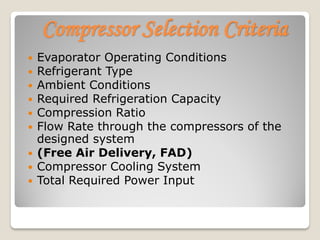
Compressor Selection Criteria
 Evaporator Operating Conditions
 Refrigerant Type
 Ambient Conditions
 Required Refrigeration Capacity
 Compression Ratio
 Flow Rate through the compressors of the
designed system
 (Free Air Delivery, FAD)
 Compressor Cooling System
 Total Required Power Input
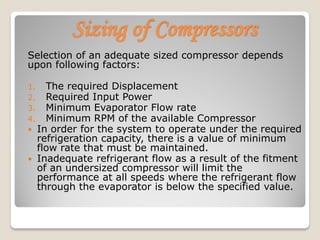
Sizing of Compressors
Selection of an adequate sized compressor depends
upon following factors:
1. The required Displacement
2. Required Input Power
3. Minimum Evaporator Flow rate
4. Minimum RPM of the available Compressor
 In order for the system to operate under the required
refrigeration capacity, there is a value of minimum
flow rate that must be maintained.
 Inadequate refrigerant flow as a result of the fitment
of an undersized compressor will limit the
performance at all speeds where the refrigerant flow
through the evaporator is below the specified value.
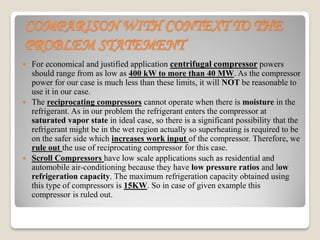
COMPARISON WITH CONTEXT TO THE
PROBLEM STATEMENT
 For economical and justified application centrifugal compressor powers
should range from as low as 400 kW to more than 40 MW. As the compressor
power for our case is much less than these limits, it will NOT be reasonable to
use it in our case.
 The reciprocating compressors cannot operate when there is moisture in the
refrigerant. As in our problem the refrigerant enters the compressor at
saturated vapor state in ideal case, so there is a significant possibility that the
refrigerant might be in the wet region actually so superheating is required to be
on the safer side which increases work input of the compressor. Therefore, we
rule out the use of reciprocating compressor for this case.
 Scroll Compressors have low scale applications such as residential and
automobile air-conditioning because they have low pressure ratios and low
refrigeration capacity. The maximum refrigeration capacity obtained using
this type of compressors is 15KW. So in case of given example this
compressor is ruled out.
Cont..
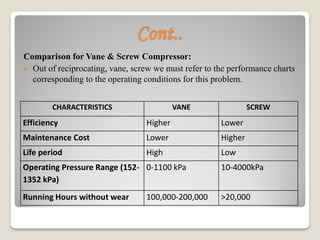
Comparison for Vane & Screw Compressor:
 Out of reciprocating, vane, screw we must refer to the performance charts
corresponding to the operating conditions for this problem.
CHARACTERISTICS VANE SCREW
Efficiency Higher Lower
Maintenance Cost Lower Higher
Life period High Low
Operating Pressure Range (152-
1352 kPa)
0-1100 kPa 10-4000kPa
Running Hours without wear 100,000-200,000 >20,000
Why to opt Vane Compressor?
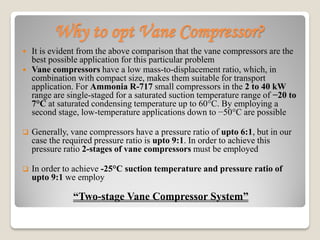
 It is evident from the above comparison that the vane compressors are the
best possible application for this particular problem
 Vane compressors have a low mass-to-displacement ratio, which, in
combination with compact size, makes them suitable for transport
application. For Ammonia R-717 small compressors in the 2 to 40 kW
range are single-staged for a saturated suction temperature range of −20 to
7°C at saturated condensing temperature up to 60°C. By employing a
second stage, low-temperature applications down to −50°C are possible
 Generally, vane compressors have a pressure ratio of upto 6:1, but in our
case the required pressure ratio is upto 9:1. In order to achieve this
pressure ratio 2-stages of vane compressors must be employed
 In order to achieve -25°C suction temperature and pressure ratio of
upto 9:1 we employ
“Two-stage Vane Compressor System”
Required Compressor Rating
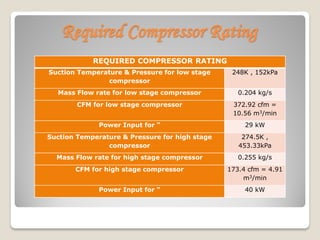
REQUIRED COMPRESSOR RATING
Suction Temperature & Pressure for low stage
compressor
248K , 152kPa
Mass Flow rate for low stage compressor 0.204 kg/s
CFM for low stage compressor 372.92 cfm =
10.56 m3/min
Power Input for “ 29 kW
Suction Temperature & Pressure for high stage
compressor
274.5K ,
453.33kPa
Mass Flow rate for high stage compressor 0.255 kg/s
CFM for high stage compressor 173.4 cfm = 4.91
m3/min
Power Input for “ 40 kW
Selected Compressor
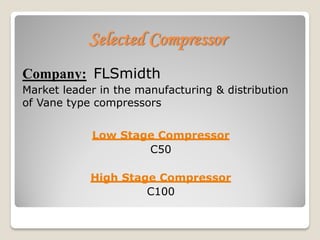
Company: FLSmidth
Market leader in the manufacturing & distribution
of Vane type compressors
Low Stage Compressor
C50
High Stage Compressor
C100
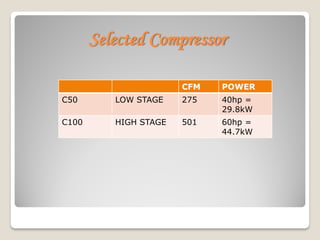
Selected Compressor
CFM POWER
C50 LOW STAGE 275 40hp =
29.8kW
C100 HIGH STAGE 501 60hp =
44.7kW

Compressor Selection in Refrigeration Systems (Example)

  • 1.
    Problem Statement  Calculatethe power required by two compressors in an ammonia system which services a 250 kw evaporator at -250C. the system uses two stage compression with intercooling and removal of flash gas. The condensing temperature is 350C.
  • 2.
    Operating Conditions Evaporation Temprature-25 C Condensation Temperature 35 C Refrigerant R-717 , AMMONIA Refrigeration Capacity 250 kW Compressor Stages 2 Input power of low stage compressor 29.2kW Input power of high stage compressor 40kW Mass flow rate through low stage compressor 0.204kg/s Mass flow rate through high stage comp. 0.255kg/s Free Air Delivery for low stage compressor 10.56 m3/min Free Air Delivery for high stage compressor 4.91 m3/min
  • 3.
    Compressor Selection Criteria Evaporator Operating Conditions  Refrigerant Type  Ambient Conditions  Required Refrigeration Capacity  Compression Ratio  Flow Rate through the compressors of the designed system  (Free Air Delivery, FAD)  Compressor Cooling System  Total Required Power Input
  • 4.
    Sizing of Compressors Selectionof an adequate sized compressor depends upon following factors: 1. The required Displacement 2. Required Input Power 3. Minimum Evaporator Flow rate 4. Minimum RPM of the available Compressor  In order for the system to operate under the required refrigeration capacity, there is a value of minimum flow rate that must be maintained.  Inadequate refrigerant flow as a result of the fitment of an undersized compressor will limit the performance at all speeds where the refrigerant flow through the evaporator is below the specified value.
  • 5.
    COMPARISON WITH CONTEXTTO THE PROBLEM STATEMENT  For economical and justified application centrifugal compressor powers should range from as low as 400 kW to more than 40 MW. As the compressor power for our case is much less than these limits, it will NOT be reasonable to use it in our case.  The reciprocating compressors cannot operate when there is moisture in the refrigerant. As in our problem the refrigerant enters the compressor at saturated vapor state in ideal case, so there is a significant possibility that the refrigerant might be in the wet region actually so superheating is required to be on the safer side which increases work input of the compressor. Therefore, we rule out the use of reciprocating compressor for this case.  Scroll Compressors have low scale applications such as residential and automobile air-conditioning because they have low pressure ratios and low refrigeration capacity. The maximum refrigeration capacity obtained using this type of compressors is 15KW. So in case of given example this compressor is ruled out.
  • 6.
    Cont.. Comparison for Vane& Screw Compressor:  Out of reciprocating, vane, screw we must refer to the performance charts corresponding to the operating conditions for this problem. CHARACTERISTICS VANE SCREW Efficiency Higher Lower Maintenance Cost Lower Higher Life period High Low Operating Pressure Range (152- 1352 kPa) 0-1100 kPa 10-4000kPa Running Hours without wear 100,000-200,000 >20,000
  • 7.
    Why to optVane Compressor?  It is evident from the above comparison that the vane compressors are the best possible application for this particular problem  Vane compressors have a low mass-to-displacement ratio, which, in combination with compact size, makes them suitable for transport application. For Ammonia R-717 small compressors in the 2 to 40 kW range are single-staged for a saturated suction temperature range of −20 to 7°C at saturated condensing temperature up to 60°C. By employing a second stage, low-temperature applications down to −50°C are possible  Generally, vane compressors have a pressure ratio of upto 6:1, but in our case the required pressure ratio is upto 9:1. In order to achieve this pressure ratio 2-stages of vane compressors must be employed  In order to achieve -25°C suction temperature and pressure ratio of upto 9:1 we employ “Two-stage Vane Compressor System”
  • 8.
    Required Compressor Rating REQUIREDCOMPRESSOR RATING Suction Temperature & Pressure for low stage compressor 248K , 152kPa Mass Flow rate for low stage compressor 0.204 kg/s CFM for low stage compressor 372.92 cfm = 10.56 m3/min Power Input for “ 29 kW Suction Temperature & Pressure for high stage compressor 274.5K , 453.33kPa Mass Flow rate for high stage compressor 0.255 kg/s CFM for high stage compressor 173.4 cfm = 4.91 m3/min Power Input for “ 40 kW
  • 9.
    Selected Compressor Company: FLSmidth Marketleader in the manufacturing & distribution of Vane type compressors Low Stage Compressor C50 High Stage Compressor C100
  • 10.
    Selected Compressor CFM POWER C50LOW STAGE 275 40hp = 29.8kW C100 HIGH STAGE 501 60hp = 44.7kW