COMPOUND DISTRIBUTION
Just intro
A seminar on
Outlines
 Definition
 Assumptions on variables
 General example on compound distribution
 Properties of compound distribution
 Numerical on compound distribution
Definition
The random variable Y is said to have a compound distribution
if Y is of the following form
Y=𝑋1+𝑋2+…….+𝑋 𝑁
or Y= 𝑖=1
𝑁
𝑋𝑖
where
 The number of terms N is uncertain
 The random variable 𝑋𝑖 are independent and identically
distribution
 Each 𝑋𝑖 is independent of N
Assumption on N and 𝑿𝒊
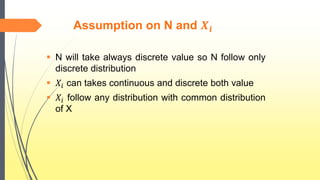
 N will take always discrete value so N follow only
discrete distribution
 𝑋𝑖 can takes continuous and discrete both value
 𝑋𝑖 follow any distribution with common distribution
of X
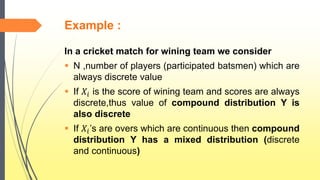
Example :
In a cricket match for wining team we consider
 N ,number of players (participated batsmen) which are
always discrete value
 If 𝑋𝑖 is the score of wining team and scores are always
discrete,thus value of compound distribution Y is
also discrete
 If 𝑋𝑖’s are overs which are continuous then compound
distribution Y has a mixed distribution (discrete
and continuous)
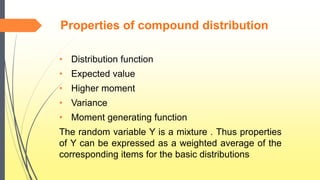
Properties of compound distribution
• Distribution function
• Expected value
• Higher moment
• Variance
• Moment generating function
The random variable Y is a mixture . Thus properties
of Y can be expressed as a weighted average of the
corresponding items for the basic distributions
1. Distribution function
By the total law of probability, the distribution function of Y
is given by
𝐹𝑌(y)= 𝑛=0
∞
𝐺 𝑛(y)P[N=n]
Where
 For n=0 ,𝐺0(y) is the distribution function of the point
mass at y=0
 For n ≥ 1 , 𝐺 𝑁 (y) is the distribution function of the
independent sum 𝑋1+𝑋2+…….+𝑋 𝑁
2. Expected value
The mean aggregate claim is :
E[Y]=E[N]E[X]
 The expected value of the aggregate claims has a natural
interpretation .
 It is the product of the expected number of claims and the
expected individual claim amount
Expected value (cont…)
proof: E[Y] = 𝐸 𝑁[E(Y|N=n)]
= 𝐸 𝑁[ E[ 𝑖=1
𝑁
𝑋𝑖]]
= 𝐸 𝑁[∑E[X]]
= 𝐸 𝑁[NE[X]]
= E[N]E[X]
The higher moments of the aggregate claims Y
do not have a intuitively clear formula as the
first moment .
3. Higher moment
We can obtain the higher moments by using the first
principle
E[𝑌 𝑛
] = 𝐸 𝑁[E(𝑌 𝑛
|N)]
= 𝐸 𝑁[E({𝑋1+𝑋2+…….+𝑋 𝑁} 𝑛|N)]
=E[𝑍1
𝑛
]P N = 1 +E[𝑍2
𝑛
]P N = 2 +…….
Where
𝑍 𝑛 = 𝑋1+𝑋2+…….+𝑋 𝑁
4. Variance
The variance of the aggregate claims var[Y] is:
var[Y] = E[N] var[X]+ var[N]𝐸[𝑋]2
 The variance of the aggregate claims also has a
natural interpretation
 It is the sum of two components such that the first
component stems from the variability of the individual
claim amount and the second component stems from
the variability of the number of claims
Variance (cont…)
The variance of the aggregate claims ,by using the total
variance formula
var[Y] = 𝐸 𝑁[𝑣𝑎𝑟(Y|N)]+𝑣𝑎𝑟 𝑁 [E(Y|N)]
= 𝐸 𝑁[𝑣𝑎𝑟(𝑋1+𝑋2+…….+𝑋 𝑁|N)]
+ 𝑣𝑎𝑟 𝑁 [E(𝑋1+𝑋2+…….+𝑋 𝑁|N)]
= 𝐸 𝑁[N𝑣𝑎𝑟(X)]+𝑣𝑎𝑟 𝑁 [NE(X)]
var[Y] = E N Var X + Var N 𝐸[𝑋]2
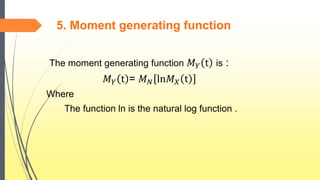
5. Moment generating function
The moment generating function 𝑀 𝑌 t is :
𝑀 𝑌 t = 𝑀 𝑁 ln𝑀 𝑋 t
Where
The function ln is the natural log function .
Steps for m.g.f.
𝑀 𝑌 t = E[𝑒 𝑡𝑌 ]
= 𝐸 𝑁[E𝑒 𝑡( 𝑋1+ 𝑋2+…….+ 𝑋 𝑁) |N]
= 𝐸 𝑁[E(𝑒 𝑡𝑋1…….. 𝑒 𝑡𝑋 𝑁)|N]
= 𝐸 𝑁[E(𝑒 𝑡𝑋1)…….. E(𝑒 𝑡𝑋 𝑁)|N]
= 𝐸 𝑁[𝑀 𝑋(𝑡) 𝑁
]
= 𝐸 𝑁[𝑒 𝑁𝑙𝑛𝑀 𝑋(𝑡)
]
𝑀 𝑌 t = 𝑀 𝑁[ln𝑀 𝑋(t)]
Numerical Problem
 𝑋𝑖 = Numbers of the 𝑖 𝑡ℎ patient has
 𝑋𝑖 is distributed as a possion
E[𝑋𝑖] = 1.6
 N = Number of patients seen by a doctor in an hour
 N is also possion distributed
E[N] = 4.7
Problem :
1. What are the expected number of symptoms
diagnosed in an hour by a doctor ?
Numerical (cont…)
2. What are the variance value of symptoms
diagnose in an hour by a doctor
Solution
S= Number of symptoms diagnosed in an hour by a
doctor
S= 𝑋1+𝑋2+…….+𝑋 𝑁
1. E[S]=E[N]E[ 𝑋𝑖]
E[S]=7.52
2. var[S] = E[N] var[ 𝑋𝑖]+ var[N]𝐸[ 𝑋𝑖]2
var[S] = 19.552
Thanks…..

compound distribution

  • 1.
  • 2.
    Outlines  Definition  Assumptionson variables  General example on compound distribution  Properties of compound distribution  Numerical on compound distribution
  • 3.
    Definition The random variableY is said to have a compound distribution if Y is of the following form Y=𝑋1+𝑋2+…….+𝑋 𝑁 or Y= 𝑖=1 𝑁 𝑋𝑖 where  The number of terms N is uncertain  The random variable 𝑋𝑖 are independent and identically distribution  Each 𝑋𝑖 is independent of N
  • 4.
    Assumption on Nand 𝑿𝒊  N will take always discrete value so N follow only discrete distribution  𝑋𝑖 can takes continuous and discrete both value  𝑋𝑖 follow any distribution with common distribution of X
  • 5.
    Example : In acricket match for wining team we consider  N ,number of players (participated batsmen) which are always discrete value  If 𝑋𝑖 is the score of wining team and scores are always discrete,thus value of compound distribution Y is also discrete  If 𝑋𝑖’s are overs which are continuous then compound distribution Y has a mixed distribution (discrete and continuous)
  • 6.
    Properties of compounddistribution • Distribution function • Expected value • Higher moment • Variance • Moment generating function The random variable Y is a mixture . Thus properties of Y can be expressed as a weighted average of the corresponding items for the basic distributions
  • 7.
    1. Distribution function Bythe total law of probability, the distribution function of Y is given by 𝐹𝑌(y)= 𝑛=0 ∞ 𝐺 𝑛(y)P[N=n] Where  For n=0 ,𝐺0(y) is the distribution function of the point mass at y=0  For n ≥ 1 , 𝐺 𝑁 (y) is the distribution function of the independent sum 𝑋1+𝑋2+…….+𝑋 𝑁
  • 8.
    2. Expected value Themean aggregate claim is : E[Y]=E[N]E[X]  The expected value of the aggregate claims has a natural interpretation .  It is the product of the expected number of claims and the expected individual claim amount
  • 9.
    Expected value (cont…) proof:E[Y] = 𝐸 𝑁[E(Y|N=n)] = 𝐸 𝑁[ E[ 𝑖=1 𝑁 𝑋𝑖]] = 𝐸 𝑁[∑E[X]] = 𝐸 𝑁[NE[X]] = E[N]E[X] The higher moments of the aggregate claims Y do not have a intuitively clear formula as the first moment .
  • 10.
    3. Higher moment Wecan obtain the higher moments by using the first principle E[𝑌 𝑛 ] = 𝐸 𝑁[E(𝑌 𝑛 |N)] = 𝐸 𝑁[E({𝑋1+𝑋2+…….+𝑋 𝑁} 𝑛|N)] =E[𝑍1 𝑛 ]P N = 1 +E[𝑍2 𝑛 ]P N = 2 +……. Where 𝑍 𝑛 = 𝑋1+𝑋2+…….+𝑋 𝑁
  • 11.
    4. Variance The varianceof the aggregate claims var[Y] is: var[Y] = E[N] var[X]+ var[N]𝐸[𝑋]2  The variance of the aggregate claims also has a natural interpretation  It is the sum of two components such that the first component stems from the variability of the individual claim amount and the second component stems from the variability of the number of claims
  • 12.
    Variance (cont…) The varianceof the aggregate claims ,by using the total variance formula var[Y] = 𝐸 𝑁[𝑣𝑎𝑟(Y|N)]+𝑣𝑎𝑟 𝑁 [E(Y|N)] = 𝐸 𝑁[𝑣𝑎𝑟(𝑋1+𝑋2+…….+𝑋 𝑁|N)] + 𝑣𝑎𝑟 𝑁 [E(𝑋1+𝑋2+…….+𝑋 𝑁|N)] = 𝐸 𝑁[N𝑣𝑎𝑟(X)]+𝑣𝑎𝑟 𝑁 [NE(X)] var[Y] = E N Var X + Var N 𝐸[𝑋]2
  • 13.
    5. Moment generatingfunction The moment generating function 𝑀 𝑌 t is : 𝑀 𝑌 t = 𝑀 𝑁 ln𝑀 𝑋 t Where The function ln is the natural log function .
  • 14.
    Steps for m.g.f. 𝑀𝑌 t = E[𝑒 𝑡𝑌 ] = 𝐸 𝑁[E𝑒 𝑡( 𝑋1+ 𝑋2+…….+ 𝑋 𝑁) |N] = 𝐸 𝑁[E(𝑒 𝑡𝑋1…….. 𝑒 𝑡𝑋 𝑁)|N] = 𝐸 𝑁[E(𝑒 𝑡𝑋1)…….. E(𝑒 𝑡𝑋 𝑁)|N] = 𝐸 𝑁[𝑀 𝑋(𝑡) 𝑁 ] = 𝐸 𝑁[𝑒 𝑁𝑙𝑛𝑀 𝑋(𝑡) ] 𝑀 𝑌 t = 𝑀 𝑁[ln𝑀 𝑋(t)]
  • 15.
    Numerical Problem  𝑋𝑖= Numbers of the 𝑖 𝑡ℎ patient has  𝑋𝑖 is distributed as a possion E[𝑋𝑖] = 1.6  N = Number of patients seen by a doctor in an hour  N is also possion distributed E[N] = 4.7 Problem : 1. What are the expected number of symptoms diagnosed in an hour by a doctor ?
  • 16.
    Numerical (cont…) 2. Whatare the variance value of symptoms diagnose in an hour by a doctor Solution S= Number of symptoms diagnosed in an hour by a doctor S= 𝑋1+𝑋2+…….+𝑋 𝑁 1. E[S]=E[N]E[ 𝑋𝑖] E[S]=7.52 2. var[S] = E[N] var[ 𝑋𝑖]+ var[N]𝐸[ 𝑋𝑖]2 var[S] = 19.552
  • 17.