Achieving Good Composition
What are some things that
make up Good Composition?
 Demonstrate by searching Flickr
 Obeying the “rule of thirds”
 Single Point of Focus / Selective Focus
 Avoiding Tonal Mergers, Dimensional
Mergers, and Border Mergers
 Proper Amount of Nose Room
 Shot Composition in a Minute:
 http://vimeo.com/1461280
Composition Evaluation
 The Beach: http://vimeo.com/10363683
 Formal Composition: The Beginning of
The Royal Tenenbaums
 Stanley Kubrick: One-Point Perspective
 5 Dollar Cover Seattle: The Beast
 What concepts from good composition
do you see examples of in this video?
Photography vs. Video
 What are the differences in the ways that we
should approach shooting video vs. shooting a
photograph?
 In many ways we should treat them the same in
terms of a center of focus
 Video is a dynamic composition
 Choose a center of interest for a shot and hold on it
– this is especially important when you are shooting
handheld footage
 Nathaniel & Angie
Composing Your Shot
 Drew Keller on Composing Shots
Movie Clips / YouTube
Search
 Search YouTube / MovieClips for a shot
that you think has some kind of
interesting composition
 Share the shot with the person next to
you and discuss the elements that make
it have good composition
Balance and Depth in Comp
 Shallow Depth vs. Deep Focus
 Shallow Depth of Field
 Controlled by a Variety of Factors
 Allows us to draw attention to a detail
 Beginning part of Citizen Kane
 Innovative use of Deep Focus made possible by
faster lenses
 Use of characters and objects to balance
composition
Demonstration of Elements of a
static composition
 We are now going to demonstrate the different things that
we should strive for in achieving good composition
 Shot demonstration – We want to demonstrate the
following:
 Focal Length
 Distance between camera and subject
 Center of Interest
 “Rule” of Thirds
 Nose Room and Head Room
 Avoiding Mergers
 High and Low angles
 Balance
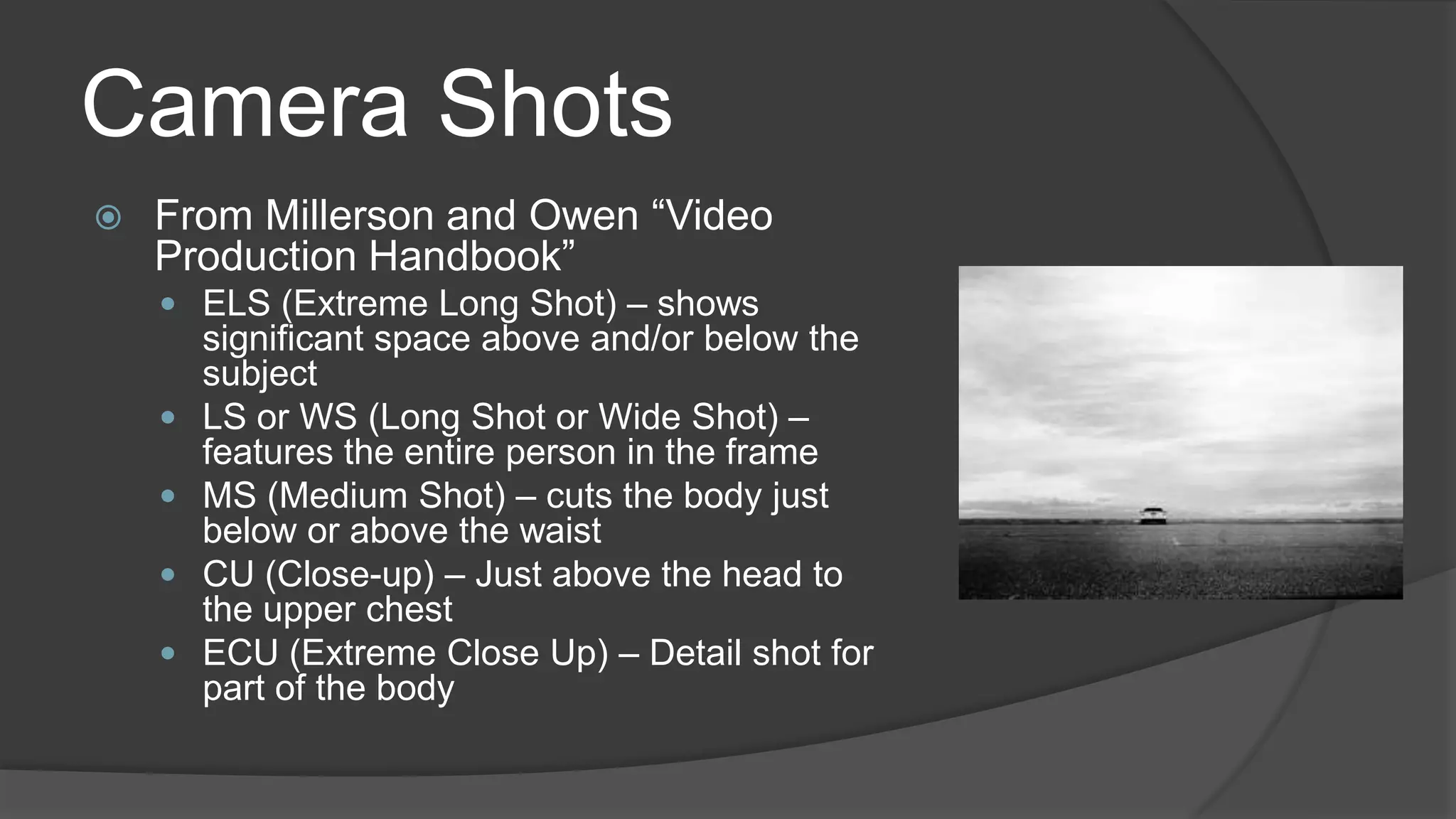
Camera Shots
 From Millerson and Owen “Video
Production Handbook”
 ELS (Extreme Long Shot) – shows
significant space above and/or below the
subject
 LS or WS (Long Shot or Wide Shot) –
features the entire person in the frame
 MS (Medium Shot) – cuts the body just
below or above the waist
 CU (Close-up) – Just above the head to
the upper chest
 ECU (Extreme Close Up) – Detail shot for
part of the body
Dynamic Composition
 Often times you will want to make your scene more
dynamic and therefore you will move the camera around
 Demonstration of dynamic movements
 Pan
 Tilt
 Zoom
 Track
 Dolly
 Holding beginnings and ending
 Rack Focus
 Leading the subject
Handheld Techniques
 Occasionally, you may choose to use
handheld techniques to bring realism
and movement to your project.
 You want to make sure that you have a good
stabilization system before you shoot the
video
 Try to put your body into position so that you
can steadily hold the camera
Handheld Examples
 Beginning of Children of Men
 Movi
Capturing B-Roll
 The purpose of B-Roll
 What B-Roll you Grab
 Videomaker: Capturing B-Roll
Demonstration of Basic Editing
 How to do basic edits in Adobe Premiere
Exercise
 Composition Scavenger Hunt
 Shoot, Edit, and Turn in today.
 Projects will be screened at the
beginning of class next week

Video Production: Achieving Good Composition

  • 1.
  • 2.
    What are somethings that make up Good Composition?  Demonstrate by searching Flickr  Obeying the “rule of thirds”  Single Point of Focus / Selective Focus  Avoiding Tonal Mergers, Dimensional Mergers, and Border Mergers  Proper Amount of Nose Room  Shot Composition in a Minute:  http://vimeo.com/1461280
  • 3.
    Composition Evaluation  TheBeach: http://vimeo.com/10363683  Formal Composition: The Beginning of The Royal Tenenbaums  Stanley Kubrick: One-Point Perspective  5 Dollar Cover Seattle: The Beast  What concepts from good composition do you see examples of in this video?
  • 4.
    Photography vs. Video What are the differences in the ways that we should approach shooting video vs. shooting a photograph?  In many ways we should treat them the same in terms of a center of focus  Video is a dynamic composition  Choose a center of interest for a shot and hold on it – this is especially important when you are shooting handheld footage  Nathaniel & Angie
  • 5.
    Composing Your Shot Drew Keller on Composing Shots
  • 6.
    Movie Clips /YouTube Search  Search YouTube / MovieClips for a shot that you think has some kind of interesting composition  Share the shot with the person next to you and discuss the elements that make it have good composition
  • 7.
    Balance and Depthin Comp  Shallow Depth vs. Deep Focus  Shallow Depth of Field  Controlled by a Variety of Factors  Allows us to draw attention to a detail  Beginning part of Citizen Kane  Innovative use of Deep Focus made possible by faster lenses  Use of characters and objects to balance composition
  • 8.
    Demonstration of Elementsof a static composition  We are now going to demonstrate the different things that we should strive for in achieving good composition  Shot demonstration – We want to demonstrate the following:  Focal Length  Distance between camera and subject  Center of Interest  “Rule” of Thirds  Nose Room and Head Room  Avoiding Mergers  High and Low angles  Balance
  • 9.
    Camera Shots  FromMillerson and Owen “Video Production Handbook”  ELS (Extreme Long Shot) – shows significant space above and/or below the subject  LS or WS (Long Shot or Wide Shot) – features the entire person in the frame  MS (Medium Shot) – cuts the body just below or above the waist  CU (Close-up) – Just above the head to the upper chest  ECU (Extreme Close Up) – Detail shot for part of the body
  • 10.
    Dynamic Composition  Oftentimes you will want to make your scene more dynamic and therefore you will move the camera around  Demonstration of dynamic movements  Pan  Tilt  Zoom  Track  Dolly  Holding beginnings and ending  Rack Focus  Leading the subject
  • 11.
    Handheld Techniques  Occasionally,you may choose to use handheld techniques to bring realism and movement to your project.  You want to make sure that you have a good stabilization system before you shoot the video  Try to put your body into position so that you can steadily hold the camera
  • 12.
    Handheld Examples  Beginningof Children of Men  Movi
  • 13.
    Capturing B-Roll  Thepurpose of B-Roll  What B-Roll you Grab  Videomaker: Capturing B-Roll
  • 14.
    Demonstration of BasicEditing  How to do basic edits in Adobe Premiere
  • 15.
    Exercise  Composition ScavengerHunt  Shoot, Edit, and Turn in today.  Projects will be screened at the beginning of class next week