Start today and homework
 Presentations!
 Pick 6 uses of camerawork (shots or
movement) from the first 1 minute of a film
of your choice.
 You will explain why you believe these to be
effective (linking to audience, character
development etc).
Learning Objective:
•To identify different types of
camera work.
•To justify WHY techniques are used
and the creators intended response.
Introduction to Film Language:
Camerawork
The next 12 slides...
 You need to draw an example of the camera
work AND write the type.
 You need to think about:
- When you would see this being used.
- Why it is being used- what effect would
it create?
Camera Shots
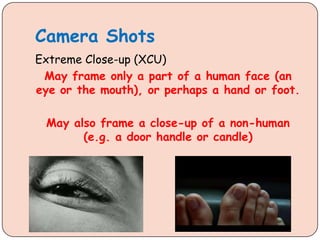
Extreme Close-up (XCU)
May frame only a part of a human face (an
eye or the mouth), or perhaps a hand or foot.
May also frame a close-up of a non-human
(e.g. a door handle or candle)
Camera Shots
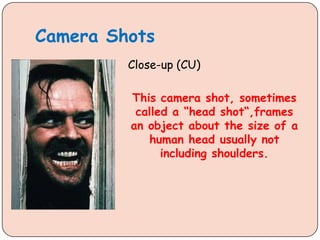
Close-up (CU)
This camera shot, sometimes
called a “head shot“,frames
an object about the size of a
human head usually not
including shoulders.
Camera Shots
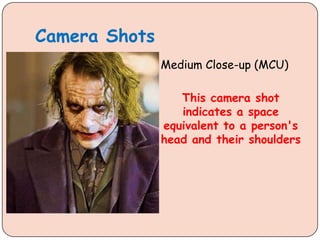
Medium Close-up (MCU)
This camera shot
indicates a space
equivalent to a person's
head and their shoulders
Camera Shots
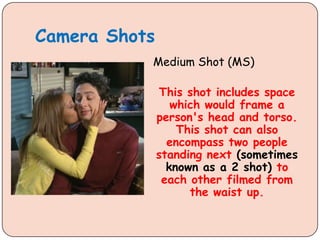
Medium Shot (MS)
This shot includes space
which would frame a
person's head and torso.
This shot can also
encompass two people
standing next (sometimes
known as a 2 shot) to
each other filmed from
the waist up.
Camera Shots
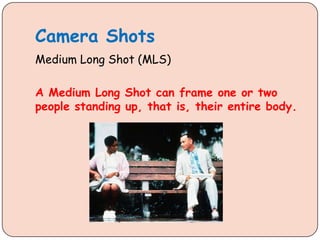
Medium Long Shot (MLS)
A Medium Long Shot can frame one or two
people standing up, that is, their entire body.
Camera Shots
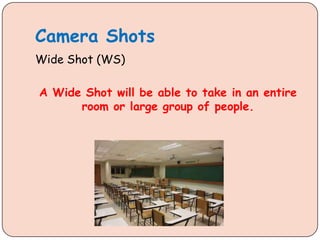
Wide Shot (WS)
A Wide Shot will be able to take in an entire
room or large group of people.
Camera Shots
Extreme Wide Shot (XWS)
An extremely wide shot might encompass a
picture of an entire house or, in
fact, anything large.
Camera Shots
Point-of-View Shot (POV)
A shot taken from a characters POV. You see
what they see.
Camera Movement
Pan
This is when the camera stays static but
pivots to show more. This could be a
character walking into shot and then out
again.
Camera Movement
Canted angle
This is when the camera is literally at an
angle.
Camera Movement
High Angle
This is when the camera is tilted down onto a
character or object.
Camera Movement
Low Angle
This is when the camera is tilted upwards to a
character or object.
Filming scenarios
1. A mother cradling her newborn baby and
the father who is on the way to meet them.
2. A couple getting married on their wedding
day with those they love around them.
3. A driver about to race in Formula One and
the woman he loves sitting in the audience.
4. A family sitting down for dinner and having
a conversation.
5. A gunfight between a Sheriff and an
Outlaw.
Start today and homework
 Presentations!
 Pick 6 uses of camerawork (shots or
movement) from the first 1 minute of a film
of your choice.
 You will explain why you believe these to be
effective (linking to audience, character
development etc).
Introduction to camera work

Introduction to camera work

  • 1.
    Start today andhomework  Presentations!  Pick 6 uses of camerawork (shots or movement) from the first 1 minute of a film of your choice.  You will explain why you believe these to be effective (linking to audience, character development etc).
  • 2.
    Learning Objective: •To identifydifferent types of camera work. •To justify WHY techniques are used and the creators intended response. Introduction to Film Language: Camerawork
  • 3.
    The next 12slides...  You need to draw an example of the camera work AND write the type.  You need to think about: - When you would see this being used. - Why it is being used- what effect would it create?
  • 4.
    Camera Shots Extreme Close-up(XCU) May frame only a part of a human face (an eye or the mouth), or perhaps a hand or foot. May also frame a close-up of a non-human (e.g. a door handle or candle)
  • 5.
    Camera Shots Close-up (CU) Thiscamera shot, sometimes called a “head shot“,frames an object about the size of a human head usually not including shoulders.
  • 6.
    Camera Shots Medium Close-up(MCU) This camera shot indicates a space equivalent to a person's head and their shoulders
  • 7.
    Camera Shots Medium Shot(MS) This shot includes space which would frame a person's head and torso. This shot can also encompass two people standing next (sometimes known as a 2 shot) to each other filmed from the waist up.
  • 8.
    Camera Shots Medium LongShot (MLS) A Medium Long Shot can frame one or two people standing up, that is, their entire body.
  • 9.
    Camera Shots Wide Shot(WS) A Wide Shot will be able to take in an entire room or large group of people.
  • 10.
    Camera Shots Extreme WideShot (XWS) An extremely wide shot might encompass a picture of an entire house or, in fact, anything large.
  • 11.
    Camera Shots Point-of-View Shot(POV) A shot taken from a characters POV. You see what they see.
  • 12.
    Camera Movement Pan This iswhen the camera stays static but pivots to show more. This could be a character walking into shot and then out again.
  • 13.
    Camera Movement Canted angle Thisis when the camera is literally at an angle.
  • 14.
    Camera Movement High Angle Thisis when the camera is tilted down onto a character or object.
  • 15.
    Camera Movement Low Angle Thisis when the camera is tilted upwards to a character or object.
  • 16.
    Filming scenarios 1. Amother cradling her newborn baby and the father who is on the way to meet them. 2. A couple getting married on their wedding day with those they love around them. 3. A driver about to race in Formula One and the woman he loves sitting in the audience. 4. A family sitting down for dinner and having a conversation. 5. A gunfight between a Sheriff and an Outlaw.
  • 17.
    Start today andhomework  Presentations!  Pick 6 uses of camerawork (shots or movement) from the first 1 minute of a film of your choice.  You will explain why you believe these to be effective (linking to audience, character development etc).