Describing Camera Angles and Movement


When describing camera positions, or choosing them yourself, you
have to think about three important factors

   •   The FRAMING or the LENGTH
   •   The ANGLE
   •   If there is any MOVEMENT involved

When describing camera positions (or shots), different terms are
used to indicate the amount of subject matter contained within a
frame, how far away the camera is from the subject, and the
perspective of the viewer. Each different shot has a different purpose
and effect. A change between two different shots is called a CUT.

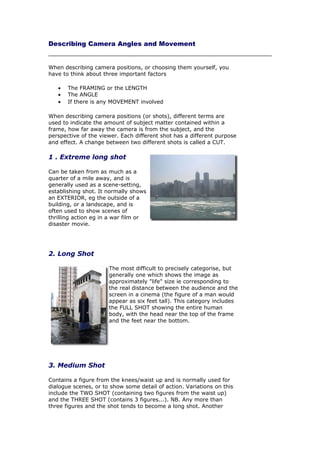
1 . Extreme long shot

Can be taken from as much as a
quarter of a mile away, and is
generally used as a scene-setting,
establishing shot. It normally shows
an EXTERIOR, eg the outside of a
building, or a landscape, and is
often used to show scenes of
thrilling action eg in a war film or
disaster movie.


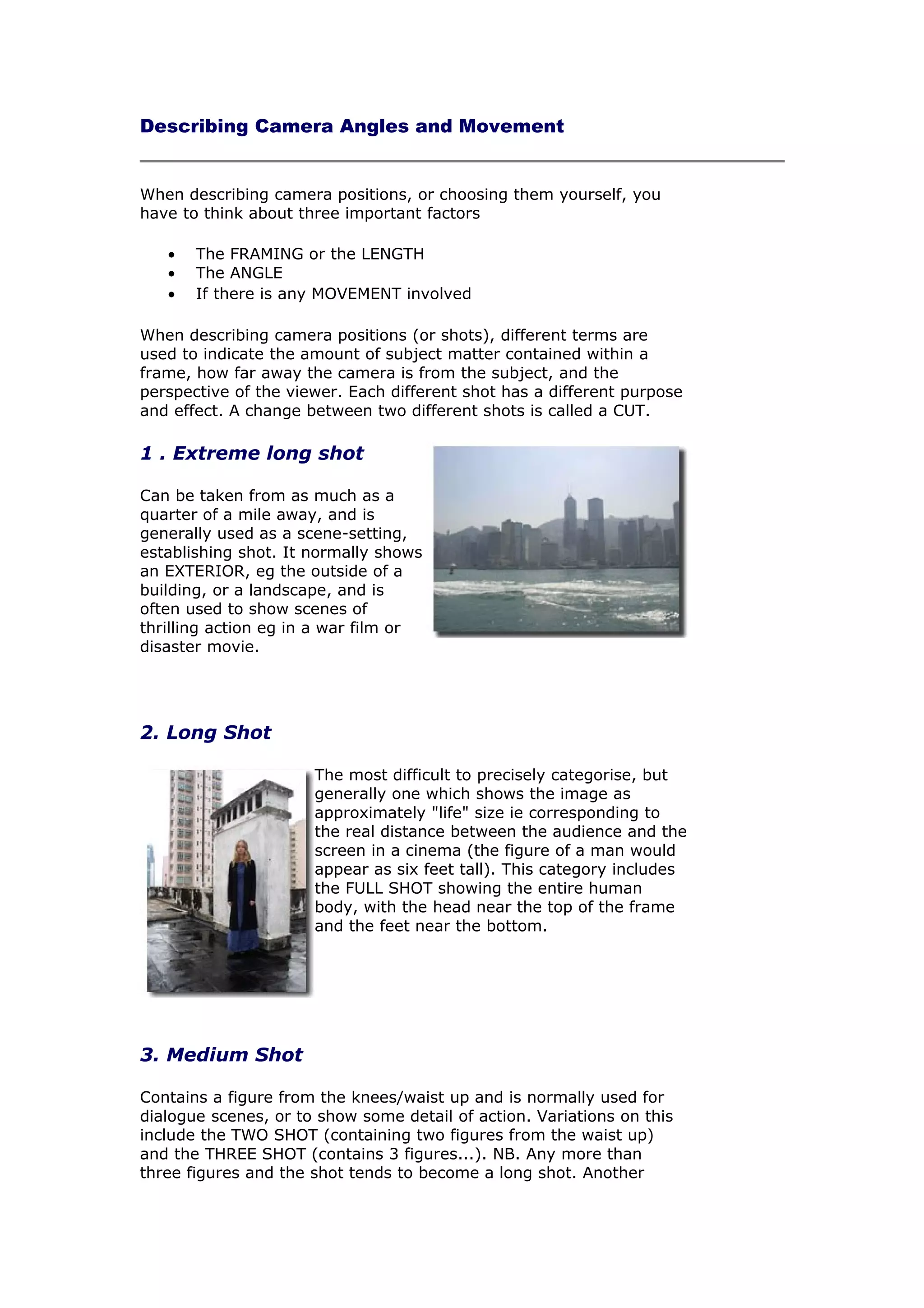
2. Long Shot

                      The most difficult to precisely categorise, but
                      generally one which shows the image as
                      approximately "life" size ie corresponding to
                      the real distance between the audience and the
                      screen in a cinema (the figure of a man would
                      appear as six feet tall). This category includes
                      the FULL SHOT showing the entire human
                      body, with the head near the top of the frame
                      and the feet near the bottom.


3. Medium Shot

Contains a figure from the knees/waist up and is normally used for
dialogue scenes, or to show some detail of action. Variations on this
include the TWO SHOT (containing two figures from the waist up)
and the THREE SHOT (contains 3 figures...). NB. Any more than
three figures and the shot tends to become a long shot. Another
variation in this category is the OVER-THE-SHOULDER-SHOT, which
positions the camera behind one figure, revealing the other figure,
and part of the first figure's back, head and shoulder.

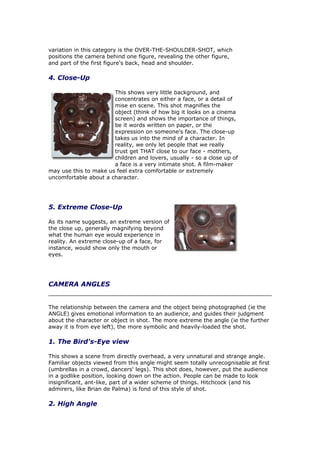
4. Close-Up

                       This shows very little background, and
                       concentrates on either a face, or a detail of
                       mise en scene. This shot magnifies the
                       object (think of how big it looks on a cinema
                       screen) and shows the importance of things,
                       be it words written on paper, or the
                       expression on someone's face. The close-up
                       takes us into the mind of a character. In
                       reality, we only let people that we really
                       trust get THAT close to our face - mothers,
                       children and lovers, usually - so a close up of
                       a face is a very intimate shot. A film-maker
may use this to make us feel extra comfortable or extremely
uncomfortable about a character.


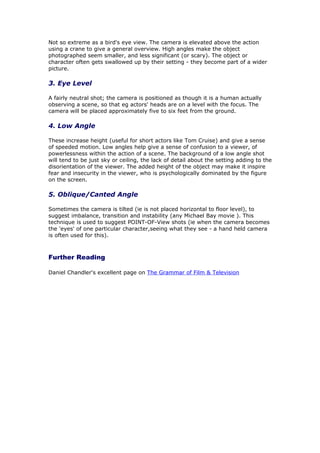
5. Extreme Close-Up

As its name suggests, an extreme version of
the close up, generally magnifying beyond
what the human eye would experience in
reality. An extreme close-up of a face, for
instance, would show only the mouth or
eyes.


CAMERA ANGLES


The relationship between the camera and the object being photographed (ie the
ANGLE) gives emotional information to an audience, and guides their judgment
about the character or object in shot. The more extreme the angle (ie the further
away it is from eye left), the more symbolic and heavily-loaded the shot.

1. The Bird's-Eye view

This shows a scene from directly overhead, a very unnatural and strange angle.
Familiar objects viewed from this angle might seem totally unrecognisable at first
(umbrellas in a crowd, dancers' legs). This shot does, however, put the audience
in a godlike position, looking down on the action. People can be made to look
insignificant, ant-like, part of a wider scheme of things. Hitchcock (and his
admirers, like Brian de Palma) is fond of this style of shot.

2. High Angle
Not so extreme as a bird's eye view. The camera is elevated above the action
using a crane to give a general overview. High angles make the object
photographed seem smaller, and less significant (or scary). The object or
character often gets swallowed up by their setting - they become part of a wider
picture.

3. Eye Level

A fairly neutral shot; the camera is positioned as though it is a human actually
observing a scene, so that eg actors' heads are on a level with the focus. The
camera will be placed approximately five to six feet from the ground.

4. Low Angle

These increase height (useful for short actors like Tom Cruise) and give a sense
of speeded motion. Low angles help give a sense of confusion to a viewer, of
powerlessness within the action of a scene. The background of a low angle shot
will tend to be just sky or ceiling, the lack of detail about the setting adding to the
disorientation of the viewer. The added height of the object may make it inspire
fear and insecurity in the viewer, who is psychologically dominated by the figure
on the screen.

5. Oblique/Canted Angle

Sometimes the camera is tilted (ie is not placed horizontal to floor level), to
suggest imbalance, transition and instability (any Michael Bay movie ). This
technique is used to suggest POINT-OF-View shots (ie when the camera becomes
the 'eyes' of one particular character,seeing what they see - a hand held camera
is often used for this).


Further Reading

Daniel Chandler's excellent page on The Grammar of Film & Television
CAMERA MOVEMENT


A director may choose to move action along by telling the story as a
series of cuts, going from one shot to another, or they may decide to
move the camera with the action. Moving the camera often takes a
great deal of time, and makes the action seem slower, as it takes
several second for a moving camera shot to be effective, when the
same information may be placed on screen in a series of fast cuts.
Not only must the style of movement be chosen, but the method of
actually moving the camera must be selected too. There are seven
basic methods:

1. Pans

A movement which scans a scene horizontally. The camera is placed
on a tripod, which operates as a stationary axis point as the camera
is turned, often to follow a moving object which is kept in the middle
of the frame.

2. Tilts

A movement which scans a scene vertically, otherwise similar to a
pan.

3. Dolly Shots

Sometimes called TRUCKING or TRACKING shots. The camera is
placed on a moving vehicle and moves alongside the action,
generally following a moving figure or object. Complicated dolly
shots will involve a track being laid on set for the camera to follow,
hence the name. The camera might be mounted on a car, a plane, or
even a shopping trolley (good method for independent film-makers
looking to save a few dollars). A dolly shot may be a good way of
portraying movement, the journey of a character for instance, or for
moving from a long shot to a close-up, gradually focusing the
audience on a particular object or character.

4. Hand-held shots

The hand-held camera (despite its name, a heavy, awkward piece of
machinery which is attached to its operator by a harness) was
invented in the 1 950s to allow the camera operator to move in and
out of scenes with greater speed. It gives a jerky, ragged effect,
totally at odds with the organised smoothness of a dolly shot, and is
favoured by filmmakers looking for a gritty realism (eg Scorsese),
which involves the viewer very closely with a scene. Much favoured
by the makers of NYPD Blue.

5. Crane Shots
Basically, dolly-shots-in-the-air. A crane is a useful way of moving a
camera - it can move up, down, left, right, swooping in on action or
moving diagonally out of it.

6. Zoom Lenses

The zoom lens means that the camera need not be moved (and
saves a lot of time and trouble). The zoom lens can zip a camera in
or out of a scene very quickly. The drawbacks include the fact that
while a dolly shot involves a steady movement similar to the
focusing change in the human eye, the zoom lens tends to be jerky
(unless used very slowly) and to distort an image, making objects
appear closer together than they really are. Zoom lenses are also
drastically over-used by many directors (including those holding
palmcorders), who try to give the impression of movement and
excitement in a scene where it does not exist.

7. The Aerial Shot

An exciting variation of a crane shot, usually taken from a helicopter.
This is often used at the beginning of a film, in order to establish
setting and movement. A helicopter is like a particularly flexible sort
of crane - it can go anywhere, keep up with anything, move in and
out of a scene, and convey real drama and exhilaration.

Further Reading

Daniel Chandler's excellent page on The Grammar of Film &
Television

Camera work start

  • 1.
    Describing Camera Anglesand Movement When describing camera positions, or choosing them yourself, you have to think about three important factors • The FRAMING or the LENGTH • The ANGLE • If there is any MOVEMENT involved When describing camera positions (or shots), different terms are used to indicate the amount of subject matter contained within a frame, how far away the camera is from the subject, and the perspective of the viewer. Each different shot has a different purpose and effect. A change between two different shots is called a CUT. 1 . Extreme long shot Can be taken from as much as a quarter of a mile away, and is generally used as a scene-setting, establishing shot. It normally shows an EXTERIOR, eg the outside of a building, or a landscape, and is often used to show scenes of thrilling action eg in a war film or disaster movie. 2. Long Shot The most difficult to precisely categorise, but generally one which shows the image as approximately "life" size ie corresponding to the real distance between the audience and the screen in a cinema (the figure of a man would appear as six feet tall). This category includes the FULL SHOT showing the entire human body, with the head near the top of the frame and the feet near the bottom. 3. Medium Shot Contains a figure from the knees/waist up and is normally used for dialogue scenes, or to show some detail of action. Variations on this include the TWO SHOT (containing two figures from the waist up) and the THREE SHOT (contains 3 figures...). NB. Any more than three figures and the shot tends to become a long shot. Another
  • 2.
    variation in thiscategory is the OVER-THE-SHOULDER-SHOT, which positions the camera behind one figure, revealing the other figure, and part of the first figure's back, head and shoulder. 4. Close-Up This shows very little background, and concentrates on either a face, or a detail of mise en scene. This shot magnifies the object (think of how big it looks on a cinema screen) and shows the importance of things, be it words written on paper, or the expression on someone's face. The close-up takes us into the mind of a character. In reality, we only let people that we really trust get THAT close to our face - mothers, children and lovers, usually - so a close up of a face is a very intimate shot. A film-maker may use this to make us feel extra comfortable or extremely uncomfortable about a character. 5. Extreme Close-Up As its name suggests, an extreme version of the close up, generally magnifying beyond what the human eye would experience in reality. An extreme close-up of a face, for instance, would show only the mouth or eyes. CAMERA ANGLES The relationship between the camera and the object being photographed (ie the ANGLE) gives emotional information to an audience, and guides their judgment about the character or object in shot. The more extreme the angle (ie the further away it is from eye left), the more symbolic and heavily-loaded the shot. 1. The Bird's-Eye view This shows a scene from directly overhead, a very unnatural and strange angle. Familiar objects viewed from this angle might seem totally unrecognisable at first (umbrellas in a crowd, dancers' legs). This shot does, however, put the audience in a godlike position, looking down on the action. People can be made to look insignificant, ant-like, part of a wider scheme of things. Hitchcock (and his admirers, like Brian de Palma) is fond of this style of shot. 2. High Angle
  • 3.
    Not so extremeas a bird's eye view. The camera is elevated above the action using a crane to give a general overview. High angles make the object photographed seem smaller, and less significant (or scary). The object or character often gets swallowed up by their setting - they become part of a wider picture. 3. Eye Level A fairly neutral shot; the camera is positioned as though it is a human actually observing a scene, so that eg actors' heads are on a level with the focus. The camera will be placed approximately five to six feet from the ground. 4. Low Angle These increase height (useful for short actors like Tom Cruise) and give a sense of speeded motion. Low angles help give a sense of confusion to a viewer, of powerlessness within the action of a scene. The background of a low angle shot will tend to be just sky or ceiling, the lack of detail about the setting adding to the disorientation of the viewer. The added height of the object may make it inspire fear and insecurity in the viewer, who is psychologically dominated by the figure on the screen. 5. Oblique/Canted Angle Sometimes the camera is tilted (ie is not placed horizontal to floor level), to suggest imbalance, transition and instability (any Michael Bay movie ). This technique is used to suggest POINT-OF-View shots (ie when the camera becomes the 'eyes' of one particular character,seeing what they see - a hand held camera is often used for this). Further Reading Daniel Chandler's excellent page on The Grammar of Film & Television
  • 4.
    CAMERA MOVEMENT A directormay choose to move action along by telling the story as a series of cuts, going from one shot to another, or they may decide to move the camera with the action. Moving the camera often takes a great deal of time, and makes the action seem slower, as it takes several second for a moving camera shot to be effective, when the same information may be placed on screen in a series of fast cuts. Not only must the style of movement be chosen, but the method of actually moving the camera must be selected too. There are seven basic methods: 1. Pans A movement which scans a scene horizontally. The camera is placed on a tripod, which operates as a stationary axis point as the camera is turned, often to follow a moving object which is kept in the middle of the frame. 2. Tilts A movement which scans a scene vertically, otherwise similar to a pan. 3. Dolly Shots Sometimes called TRUCKING or TRACKING shots. The camera is placed on a moving vehicle and moves alongside the action, generally following a moving figure or object. Complicated dolly shots will involve a track being laid on set for the camera to follow, hence the name. The camera might be mounted on a car, a plane, or even a shopping trolley (good method for independent film-makers looking to save a few dollars). A dolly shot may be a good way of portraying movement, the journey of a character for instance, or for moving from a long shot to a close-up, gradually focusing the audience on a particular object or character. 4. Hand-held shots The hand-held camera (despite its name, a heavy, awkward piece of machinery which is attached to its operator by a harness) was invented in the 1 950s to allow the camera operator to move in and out of scenes with greater speed. It gives a jerky, ragged effect, totally at odds with the organised smoothness of a dolly shot, and is favoured by filmmakers looking for a gritty realism (eg Scorsese), which involves the viewer very closely with a scene. Much favoured by the makers of NYPD Blue. 5. Crane Shots
  • 5.
    Basically, dolly-shots-in-the-air. Acrane is a useful way of moving a camera - it can move up, down, left, right, swooping in on action or moving diagonally out of it. 6. Zoom Lenses The zoom lens means that the camera need not be moved (and saves a lot of time and trouble). The zoom lens can zip a camera in or out of a scene very quickly. The drawbacks include the fact that while a dolly shot involves a steady movement similar to the focusing change in the human eye, the zoom lens tends to be jerky (unless used very slowly) and to distort an image, making objects appear closer together than they really are. Zoom lenses are also drastically over-used by many directors (including those holding palmcorders), who try to give the impression of movement and excitement in a scene where it does not exist. 7. The Aerial Shot An exciting variation of a crane shot, usually taken from a helicopter. This is often used at the beginning of a film, in order to establish setting and movement. A helicopter is like a particularly flexible sort of crane - it can go anywhere, keep up with anything, move in and out of a scene, and convey real drama and exhilaration. Further Reading Daniel Chandler's excellent page on The Grammar of Film & Television