


COMPOSITION-2
BUDDHI DHARMA UNIVERSITY
TANGERANG
The Process of Writing Paragraph
PRE-WRITING:
 “Pre-Writing means the work done
by the writer before paragraph is
actually written.
 Pre-writing strategies include the
decision you make the steps you
take before you write a draft of
your paragraph.
Planning the Paragraph
a. Making decision (topic, purpose,
and audiences)
b. Organization and presentation of
idea, topic sentence, details.
c. Concerning language structures
and vocabulary.
d. Modifying and revising the
paragraph.
Successful decision making occurs when the
writer know about the process of writing and
has developed appropriate decision making
strategies.
The purpose of most academic writing is to
explain material to a specific audience and
/or to persuade that a judgment is valid. To
achieve these objectives, a paragraph must
be focused, supported, unified.
Introduce to
Essay Development
Patterns of Essay Development
1. Developing an Exemplification Essay
Exemplification is simply proving or
supporting your point, or thesis with
examples. When writing an
exemplification essay, consider your
audience when choosing the supporting
evidence you are going to use.
 If your audience is already in
agreement with you, fewer examples
may be needed to support your point. If
your audience has an opposing
viewpoint, you may need to provide
more specific details to explain and
support your point.
2. Developing a Narrative Essay
When you write a narrative essay, you
tell a story to make your point. Illustrate
your essay with vivid details and
exciting events to make it both fun to
write and read. Colorful examples will
help keep the readers interest and
make it easier for you to make your
point. Stay focused on your topic and
try not to be too wordy.
 Do not try to include so many
details that you stray away from
your point. When choosing a topic
always consider your audience.
You would not want to write a
narrative essay about buying your
first house if your audience were a
group of children.
3. Developing a Descriptive Essay
The purpose of a descriptive essay is to
appeal to the reader’s senses. The reader
should be able to hear, see, taste or feel
what you are describing. Sharp, vivid details
help paint a picture of your topic for the
reader.
If you are writing an essay about a fishing
pier, you want to describe the bright colors of
the boats, the salty smell and taste of the air
and the sounds of the fisherman unloading
their catch of shiny, shimmering fish. In this
case a little information about fishing piers
4. Developing a Process Essay
 A process essay does the same thing. You
are explaining to the reader how to
complete a particular action or event. In
some instances you will give the reader
step-by-step instructions and in other
instances you will just provide information.
The type of essay you write will be based
on what you want your readers to know. If
you want the reader to know how to send
an email, you would write step-by-step
instructions about how to do it. If you
wanted to explain to them how the Internet
works, you would just be providing
 As with the other types of essays try to
choose a topic that will be of interest to
your readers. Remember to present your
information in a logical order for the reader
to follow. Generally, time, or chronological
order is the accepted method of
organization for a process essay.
5. Developing a Cause and Effect Essay
 The goal in a cause and effect essay is to
explain two things to the reader, the cause
of an event and the effects of that event. If
you choose to write about an event that
has had an impact on your life, your focus
in the essay will be about the effect the
event has had on your life.
 If you are writing about why you decided
to go to college, your focus will be on the
causes of your decision. Once again, be
sure to pick a topic that is going to be of
interest to your readers. No matter what
topic you choose, make your point clear
so the reader does not have trouble
following your cause and effect
relationship.
6. Developing a Comparison or Contrast
Essay
 In a compare or contrast essay you
highlight the similarities or differences of
two items. Choosing whether to compare
the similarities or contrast the differences,
depends on the point you want to make to
the readers. Before prewriting for your
essay, think about the two items you are
going to discuss and whether you will
compare or contrast, you may even do
both, then begin to gather your support.
 Whatever you choose, be sure your
compare/contrast is connected to your
point and the reader understands what
you are trying to do. Keep your
audience in mind, when choosing your
items as well as how you present them
to be sure your essay is as interesting
and informative as possible.
7. Developing a Definition Essay
 The purpose of a definition essay is to
provide the reader your understanding of
a concept or key term, not its meaning in
the dictionary. The secondary purpose is
to show the reader that your
understanding or definition is legitimate. If
your essay topic were environmentalism
for example, you would provide the reader
with examples to support your
understanding and conception of the
word.
 You might provide examples of how a
local recycling program helps to keep your
neighborhood clean, or how a
hydroelectric dam helps to reduce the
burning of fossil fuels. As with your other
essays, keep your audience in mind when
choosing your topic for a definition essay.
You may have to provide more
background information to an audience
unfamiliar with your topic.
8. Developing a Division-Classification
Essay
 When you write a division-classification
essay you are showing the reader your
system for dividing and classifying your
topic. When choosing your topic you have
to be sure that it is something that can be
divided and classified. After choosing your
topic you can then use your own method
to sort it into the different classifications.
 If your essay was about automobiles
you might sort them by size, coupes or
sedans, fuel efficiency or performance,
just try to use a system your reader will
understand. Once again, try to choose
a topic that will be appropriate for your
target audience.
9. Developing an Argument Essay
 The main purpose of an argument essay
is to provide the reader with your opinion
or view of a controversial issue and to
convince them that it is correct. The
secondary purpose is to propel the reader
into taking action on the subject.
Considering your audience is more
important in this type of essay than in any
of the other forms you have learned about.
 Your audience may be somewhat for or
opposed to the topic you are writing about.
Try to anticipate what your audience
already knows about the topic and what
their objections might be. By doing this
you can be prepared to answer their
objections and convince them that your
point of view is valid. The prewriting
process can be very helpful in generating
the types of questions or objections you
may have to address.
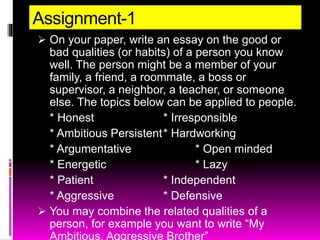
Assignment-1
 On your paper, write an essay on the good or
bad qualities (or habits) of a person you know
well. The person might be a member of your
family, a friend, a roommate, a boss or
supervisor, a neighbor, a teacher, or someone
else. The topics below can be applied to people.
* Honest * Irresponsible
* Ambitious Persistent* Hardworking
* Argumentative * Open minded
* Energetic * Lazy
* Patient * Independent
* Aggressive * Defensive
 You may combine the related qualities of a
person, for example you want to write “My
Ambitious, Aggressive Brother”

COMPOSITION 2-NINE PATTERN OF ESSAY DEVELOPMENT

  • 1.
  • 2.
    The Process ofWriting Paragraph PRE-WRITING:  “Pre-Writing means the work done by the writer before paragraph is actually written.  Pre-writing strategies include the decision you make the steps you take before you write a draft of your paragraph.
  • 3.
    Planning the Paragraph a.Making decision (topic, purpose, and audiences) b. Organization and presentation of idea, topic sentence, details. c. Concerning language structures and vocabulary. d. Modifying and revising the paragraph.
  • 4.
    Successful decision makingoccurs when the writer know about the process of writing and has developed appropriate decision making strategies. The purpose of most academic writing is to explain material to a specific audience and /or to persuade that a judgment is valid. To achieve these objectives, a paragraph must be focused, supported, unified.
  • 5.
  • 6.
    Patterns of EssayDevelopment 1. Developing an Exemplification Essay Exemplification is simply proving or supporting your point, or thesis with examples. When writing an exemplification essay, consider your audience when choosing the supporting evidence you are going to use.
  • 7.
     If youraudience is already in agreement with you, fewer examples may be needed to support your point. If your audience has an opposing viewpoint, you may need to provide more specific details to explain and support your point.
  • 8.
    2. Developing aNarrative Essay When you write a narrative essay, you tell a story to make your point. Illustrate your essay with vivid details and exciting events to make it both fun to write and read. Colorful examples will help keep the readers interest and make it easier for you to make your point. Stay focused on your topic and try not to be too wordy.
  • 9.
     Do nottry to include so many details that you stray away from your point. When choosing a topic always consider your audience. You would not want to write a narrative essay about buying your first house if your audience were a group of children.
  • 10.
    3. Developing aDescriptive Essay The purpose of a descriptive essay is to appeal to the reader’s senses. The reader should be able to hear, see, taste or feel what you are describing. Sharp, vivid details help paint a picture of your topic for the reader. If you are writing an essay about a fishing pier, you want to describe the bright colors of the boats, the salty smell and taste of the air and the sounds of the fisherman unloading their catch of shiny, shimmering fish. In this case a little information about fishing piers
  • 11.
    4. Developing aProcess Essay  A process essay does the same thing. You are explaining to the reader how to complete a particular action or event. In some instances you will give the reader step-by-step instructions and in other instances you will just provide information. The type of essay you write will be based on what you want your readers to know. If you want the reader to know how to send an email, you would write step-by-step instructions about how to do it. If you wanted to explain to them how the Internet works, you would just be providing
  • 12.
     As withthe other types of essays try to choose a topic that will be of interest to your readers. Remember to present your information in a logical order for the reader to follow. Generally, time, or chronological order is the accepted method of organization for a process essay.
  • 13.
    5. Developing aCause and Effect Essay  The goal in a cause and effect essay is to explain two things to the reader, the cause of an event and the effects of that event. If you choose to write about an event that has had an impact on your life, your focus in the essay will be about the effect the event has had on your life.
  • 14.
     If youare writing about why you decided to go to college, your focus will be on the causes of your decision. Once again, be sure to pick a topic that is going to be of interest to your readers. No matter what topic you choose, make your point clear so the reader does not have trouble following your cause and effect relationship.
  • 15.
    6. Developing aComparison or Contrast Essay  In a compare or contrast essay you highlight the similarities or differences of two items. Choosing whether to compare the similarities or contrast the differences, depends on the point you want to make to the readers. Before prewriting for your essay, think about the two items you are going to discuss and whether you will compare or contrast, you may even do both, then begin to gather your support.
  • 16.
     Whatever youchoose, be sure your compare/contrast is connected to your point and the reader understands what you are trying to do. Keep your audience in mind, when choosing your items as well as how you present them to be sure your essay is as interesting and informative as possible.
  • 17.
    7. Developing aDefinition Essay  The purpose of a definition essay is to provide the reader your understanding of a concept or key term, not its meaning in the dictionary. The secondary purpose is to show the reader that your understanding or definition is legitimate. If your essay topic were environmentalism for example, you would provide the reader with examples to support your understanding and conception of the word.
  • 18.
     You mightprovide examples of how a local recycling program helps to keep your neighborhood clean, or how a hydroelectric dam helps to reduce the burning of fossil fuels. As with your other essays, keep your audience in mind when choosing your topic for a definition essay. You may have to provide more background information to an audience unfamiliar with your topic.
  • 19.
    8. Developing aDivision-Classification Essay  When you write a division-classification essay you are showing the reader your system for dividing and classifying your topic. When choosing your topic you have to be sure that it is something that can be divided and classified. After choosing your topic you can then use your own method to sort it into the different classifications.
  • 20.
     If youressay was about automobiles you might sort them by size, coupes or sedans, fuel efficiency or performance, just try to use a system your reader will understand. Once again, try to choose a topic that will be appropriate for your target audience.
  • 21.
    9. Developing anArgument Essay  The main purpose of an argument essay is to provide the reader with your opinion or view of a controversial issue and to convince them that it is correct. The secondary purpose is to propel the reader into taking action on the subject. Considering your audience is more important in this type of essay than in any of the other forms you have learned about.
  • 22.
     Your audiencemay be somewhat for or opposed to the topic you are writing about. Try to anticipate what your audience already knows about the topic and what their objections might be. By doing this you can be prepared to answer their objections and convince them that your point of view is valid. The prewriting process can be very helpful in generating the types of questions or objections you may have to address.
  • 23.
    Assignment-1  On yourpaper, write an essay on the good or bad qualities (or habits) of a person you know well. The person might be a member of your family, a friend, a roommate, a boss or supervisor, a neighbor, a teacher, or someone else. The topics below can be applied to people. * Honest * Irresponsible * Ambitious Persistent* Hardworking * Argumentative * Open minded * Energetic * Lazy * Patient * Independent * Aggressive * Defensive  You may combine the related qualities of a person, for example you want to write “My Ambitious, Aggressive Brother”