SENIOR HIGH SCHOOL
Creative Nonfiction
QUARTER4–M
O
D
U
L
E2
WRITINgADRAFTOFACREATIVENONFICTIONPIECE
Department of Education ● Republic of the Philippines
GRADE
11
1
2
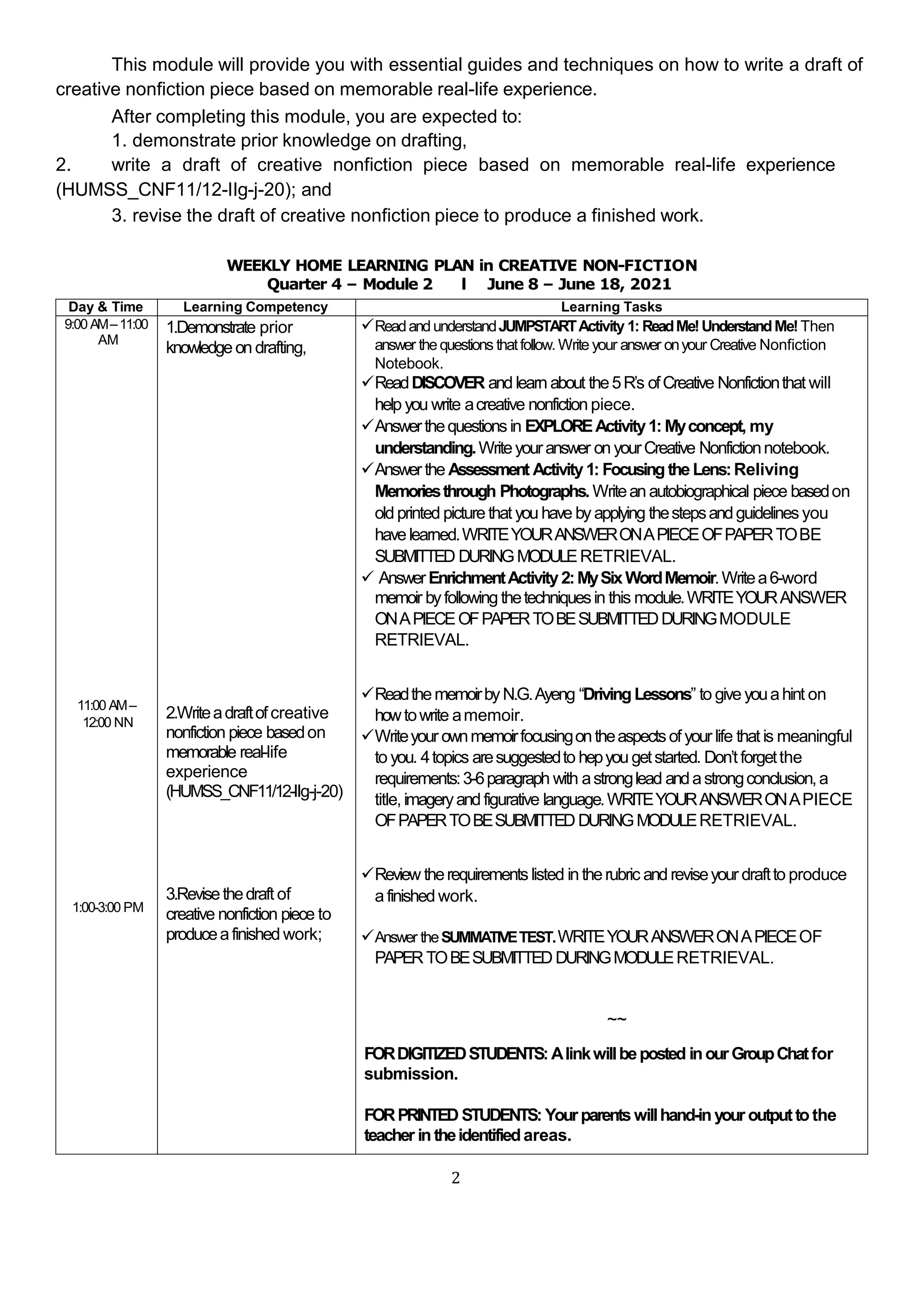
This module will provide you with essential guides and techniques on how to write a draft of
creative nonfiction piece based on memorable real-life experience.
After completing this module, you are expected to:
1. demonstrate prior knowledge on drafting,
2. write a draft of creative nonfiction piece based on memorable real-life experience
(HUMSS_CNF11/12-IIg-j-20); and
3. revise the draft of creative nonfiction piece to produce a finished work.
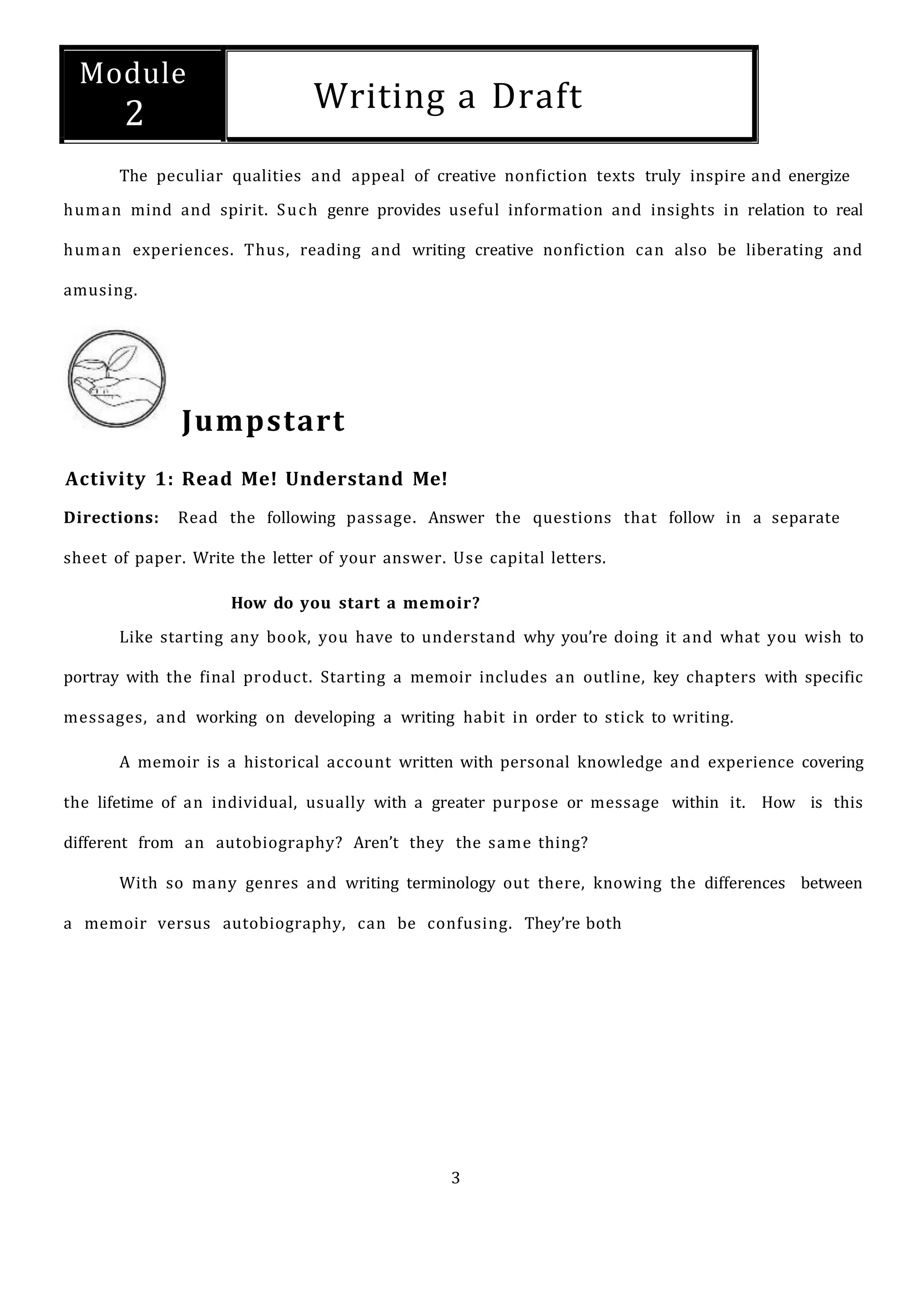
WEEKLY HOME LEARNING PLAN in CREATIVE NON-FICTION
Quarter 4 – Module 2 l June 8 – June 18, 2021
Day & Time Learning Competency Learning Tasks
9:00 AM–11:00
AM
11:00 AM–
12:00 NN
1:00-3:00 PM
1.Demonstrate prior
knowledge on drafting,
2.Writeadraftofcreative
nonfiction piece basedon
memorable real-life
experience
(HUMSS_CNF11/12-IIg-j-20)
3.Revisethedraft of
creative nonfiction piece to
produceafinished work;
ReadandunderstandJUMPSTARTActivity 1: ReadMe!UnderstandMe!Then
answer thequestions thatfollow.Write your answer onyour Creative Nonfiction
Notebook.
ReadDISCOVER and learn about the5R’s ofCreative Nonfictionthat will
help you write acreative nonfiction piece.
Answerthequestions in EXPLOREActivity1: Myconcept, my
understanding.Writeyouranswer on yourCreative Nonfictionnotebook.
Answerthe Assessment Activity1: Focusingthe Lens:Reliving
Memoriesthrough Photographs. Writean autobiographical piece basedon
old printed picture that you have by applying thestepsandguidelines you
havelearned.WRITEYOURANSWERONAPIECEOFPAPERTOBE
SUBMITTED DURINGMODULERETRIEVAL.
 AnswerEnrichmentActivity2:MySixWordMemoir.Writea6-word
memoir byfollowing thetechniquesin this module.WRITEYOURANSWER
ONAPIECEOFPAPERTOBESUBMITTEDDURINGMODULE
RETRIEVAL.
ReadthememoirbyN.G.Ayeng “DrivingLessons” to give youahint on
howtowrite amemoir.
Writeyour ownmemoirfocusingontheaspectsof your life that is meaningful
to you. 4topics aresuggestedto hepyou getstarted. Don’tforgetthe
requirements:3-6paragraph with astronglead andastrongconclusion,a
title,imageryand figurative language.WRITEYOURANSWERONAPIECE
OFPAPERTOBESUBMITTEDDURINGMODULERETRIEVAL.
Review therequirements listed in therubric and reviseyour draftto produce
a finished work.
Answer theSUMMATIVETEST.WRITEYOURANSWERONAPIECEOF
PAPERTOBESUBMITTEDDURINGMODULERETRIEVAL.
~~
FORDIGITIZEDSTUDENTS:Alinkwillbeposted inourGroupChatfor
submission.
FORPRINTED STUDENTS: Yourparentswillhand-inyour outputto the
teacher intheidentifiedareas.
Module
2 Writing a Draft
The peculiar qualities and appeal of creative nonfiction texts truly inspire and energize
human mind and spirit. Such genre provides useful information and insights in relation to real
human experiences. Thus, reading and writing creative nonfiction can also be liberating and
amusing.
Jumpstart
Activity 1: Read Me! Understand Me!
Directions: Read the following passage. Answer the questions that follow in a separate
sheet of paper. Write the letter of your answer. Use capital letters.
How do you start a memoir?
Like starting any book, you have to understand why you’re doing it and what you wish to
portray with the final product. Starting a memoir includes an outline, key chapters with specific
messages, and working on developing a writing habit in order to stick to writing.
A memoir is a historical account written with personal knowledge and experience covering
the lifetime of an individual, usually with a greater purpose or message within it. How is this
different from an autobiography? Aren’t they the same thing?
With so many genres and writing terminology out there, knowing the differences between
a memoir versus autobiography, can be confusing. They’re both
3
4
about someone’s life written by themselves, right? Right. But they do differ in a single
way that really makes a memoir and an autobiography completely different in terms
of their end results.
A memoir typically covers one aspect of a writer’s life (or a continuous theme
through memories), while an autobiography is a chronological account of the
writer’s life. It has to be written with strong description and details, and possibly with
dialogue to arouse the interest of the readers.
So if you want to write a play-by-play of your entire life from the moment
you popped into this world to the very second you started writing, you’d write an
autobiography. But if you’re looking to share a profound message with the world
through your own real-life experiences, you’ll write a memoir.
( Source: Mazzeo, T.J. ( 2012) Writing Creative Nonfiction: Course Guidebook.
Retrieved July 23, 2020 from
https://www.fcusd.org/cms/lib/CA01001934/Centricity/Domain/3762/
Writing% 20Creative% 20Non% 20Fiction.pdf)
1. The definition of autobiography is
A. a life story made into film by the person him/herself.
B. a life story that tells the life of another person.
C. a life story written by another person.
D. a self-written life story.
2. Autobiographies are important because
A. they are a good way to inspire other people.
B. they are a way for the person to continue healing.
C. they are a way to show others they are not alone in their problems.
D. All of the foregoing.
5
3. A memoir is a type of autobiography, but
A. they feature the whole life of the person.
B. they focus on one event or time period of the person’s life.
C. they focus on other people instead of the author.
D. None of the above.
4. When writing an autobiography, the author should remember to
A. use academic language and keep the ideas simple.
B. use flowery descriptions and a lot of figurative language.
C. use other people’s thoughts and feelings to describe him or herself.
D. use strong description, provide details, and possibly add dialogue.
5. In order to arouse the interest of the readers, a good creative
nonfiction must use
A. strong description
B. vivid details
C. dialogue
D. All of the foregoing.
Discover
Creative nonfiction is the fastest-growing part of the creative writing world
because it tries to bring together the imaginative strategies of fiction storytelling
and new ways of narrating real-life events. Learning the secrets and techniques of
creative nonfiction offers you so much more than just insights into this exciting
style of writing. Mastering the art and craft of creative nonfiction can
help you write more effectively in a variety of academic and personal situations,
provide dynamic new ways for you to preserve life experiences as how they
truly occurred or as you felt them,
allow you to share your stories in ways that other people are sure to find
compelling, and
open up new windows on how you think about your own personal history and
that of others.
Before putting pen to paper, a writer has many decisions to make. One of
the most important of these is identifying the kind of work he or she would like to
create. While fiction writers choose to rely solely on their imagination and ability to
distort reality, nonfiction writers assume the hefty load of research, reportage and
accuracy.
The 5 R’s of creative nonfiction is a short checklist to refer to when writing a
nonfiction work that will ensure your bases are covered.
The 5 R's of Creative Nonfiction
1. Write about real life.
Remember that you are writing about real people, real places and real
events. Visiting the people and the places you are going to write about will give you
6
the tools necessary to tell an accurate story with vivid scenery, well-described
artifacts and true-to-life personages. Nothing should be fictional or made up.
Everything that makes it into your work of creative nonfiction must have happened
at some time or another in real life. Never embellish or alter reality.
2. Conduct extensive research.
Use every resource available to gather information on your subject. Of
course, where you look for information will depend on the subject matter, but some
great starting places are:
The library
Newspaper archives
The Internet
Interviews
Public records
Books and magazines
Photographs
Immersion (visiting the place you are writing about)
It is also apparent to ensure your sources are accurate and reputable. If not,
your integrity is at stake. Even worse, a creative nonfiction writer who doesn't
conduct sufficient research is liable to have their name scourged by readers.
3. Write a narrative.
Use the storytelling elements of fiction to create a compelling story with the
factual information you’ve gathered. You could craft your story this way using the
standard pattern:
Inciting incident
Conflict (internal or external)
Climax or turning point
7
Resolution
End of story
4. Include personal touch.
The “creative” in “creative nonfiction” comes with the author’s unique voice
and opinion on the matters being related on the page. You, the author, are the human
connection between the subject matter and the reader. In this sense, creative
nonfiction relies much more on the personality of the author than fiction. You must
befriend your reader, make them trust you, and proceed with your storytelling.
5. Learn by reading.
The creative nonfiction writer should read autobiographies, newspapers,
magazines, articles and other nonfiction books to get a taste for how theirs should
be formatted and written.
With these tips, you are more than halfway to creating a great work of
creative nonfiction. Once you’ve collected your information, plotted your story and
taken a unique angle on the subject, you are ready to begin the hardest part of the
process: writing the story. Happy writing!
8
Familiarizing Autobiographical Writing
One of the forms of creative nonfiction that you could create based on a
memorable real life experience is writing autobiography. This is a written account
of the life of a person written by that person himself or herself.
Here under are some important things that you need to understand about
autobiographical writing, or the writing of events in the life of a person written by
that person himself or herself.
1. Recounts the story focusing on a person or event in the life of the writer
2. Shares writer’s life
3. Involves a definite sequence of events experienced or witnessed by the writer
4. Vivifies details for portraying people and places
5.Highlights a problem, conflict, or contrast between viewpoints of past and
present
Forms of Autobiographical Writing
Below are some forms of autobiographical writing:
 Autobiography --- Etymologically, the word autobiography is
composed of the Greek words auto meaning “self”, bio, bios meaning
“life”, and gráphō, graphien meaning “write.” Thus, autobiography is
a written account of the life of a person written by that person himself
or herself.
 Memoirs --- This covers your life’s events in a more story-like
structure with an overarching theme or messaged written in. These
are also real stories of the writer’s relationship with a person, place,
or even animals. It also includes the writer’s insights and feelings
towards the relationship.
 Personal narrative--- This is also known as autobiographical
incidents. Texts of this form focus on and highlight a specific event in
the life of the writer.
 Autobiographical sketches/ narratives --- The purpose of this is to
describe a time or a series of events in the writer’s life including insights
about them.
 Reflective Essay--- This recalls and recounts an experience. Insights
on an experience are also expressed.
9
Steps in Autobiographical Writing
To create an autobiographical piece, there are several steps and strategies
that can be considered as definite guides:
1. Prewriting
Selecting a topic
In this phase, the writer explores and chooses a possible topic or subject
for writing. It is important that the writer select an interesting topic based on
his/her experience like in solving an encountered problem or conflict that
captured realizations and insights.
There are strategies for generating a topic. The freewriting strategy allows
the writer to note down a variety of ideas that come to his/her mind. In this way,
the writer has options as to what topic to highlight. It is also necessary to select
or to zero in the most interesting idea. Furthermore, the events connected to
such idea must be used as an inspiration for the topic.
Aside from this, the blueprinting strategy allows the writer to think of places
that are perceived to be important to him/her. The writer draws a map and
marks different areas. In each location, connected memories are listed. Then, the
writer selects a memory from the created list and takes it as the topic from
writing.
Narrowing the topic
After choosing a possible topic, the writer needs to narrow and to set the
focus by uncovering what is hidden within the story. Include details and
points that enrich the story.
10
Thinking about the audience and purpose for writing
The writer’s awareness of his/her intended readers or audience the level
of language that the writer will utilize. It can be either formal or casual, on the
other hand, setting the purpose for writing is also important. An autobiographical
text may amuse, inspire or celebrate a person’s one’s life.
Purpose Organization Details to Include
to recount an
amusing, exciting or
moving story
building the climax suspense, sympathy, humor
to share an insight highlight the
realizations and
lessons
the contrast between past
and present points-of-view
celebrate a person in
one’s life
show the person’s
character and relevant
details
characteristics of the person
Obtaining Details
Details give shape to and enrich the writing piece. Obtaining details can be
done through listing and itemizing. After making a list, select and highlight the ones
that are relevant , valuable and interesting.
2. Drafting
Giving shape to the writing piece
Conflicts and tensions make stories interesting. These are found in incidents
taken from life. Conflict is the opposition of forces that causes a struggle. In the
presence of a conflict, a character is prevented from getting anything he/she wants.
Elaborating Details
11
12
Characteristics by providing relevant details can help readers to visualize
and imagine scenes clearly. It is necessary for the writer to help readers to see what
the writer sees and to feel what the writer feels. Thus, in that way, the writer
connects himself/herself to his/her audience
What Qualifies as a Memoir?
A memoir is unique in the fact that it covers your life’s events in a more
story-like structure with an overarching theme or message written in. Memoirs are
very specific in the sense that it accounts for the events of your life with an
emphasis on stories and impactful moments that lead to a great purpose.
Anyone has the ability and can experience to write a memoir. If you have a
story, then you are on your way to writing one.
How to Write a Memoir with Meaning and Influence
Writing a memoir can not only be a valuable experience for you, but the impact
it may have on other people is astounding too. The following tips were put together
to help you learn how to start a memoir that’s captivating and intriguing.
1. A strong introduction is everything.
Without the ability to hook readers, convincing someone read your work will
be a bit harder than anticipated. Let’s draw those readers in!
2. Be relatable.
One major mistake many make when writing a memoir is not starting it off in a
way that makes the readers connect with them. This is one of the most important
aspects of your memoir. Do you really think people will want to read about a person’s
life if they can’t relate to them? Did you understand their pain and triumph
and hardships? When others relate to you and see themselves in your
13
journey, they’ll want to stick around to see how it plays out. And that means they’ll
read your whole work and any others you write.
3. Use emotion by showing, not telling.
If you want to give a play-by-play of your life with nothing more than a list of
experiences you’ve gone through, that’s fine. Just know that doing it that way won’t
hook your readers and it certainly won’t keep them. A memoir can be a powerful
tool for educating others through your life journeys, but if they’re not intrigued
enough to keep reading, it’ll render your memoir pointless. In showing and not telling,
you’ll put more emotion into your writing.
4. Make the message clear right away.
What is it you’re trying to say through your memoir? Why did you want to
start writing one in the first place? Everybody has an interesting life if you look
deep enough. What you have to determine is how your life experiences can aid and
shape the lives of others. Think about how that will manifest from what you’ve lived
through before and make sure your readers know what it is from the start.
5. Write from the heart.
Christopher Moss, author of “Hope Over Anxiety” says the best way to write
your memoir is to be open about your experiences. He emphasizes to “Write from
the heart. Show people your experience. Be as vulnerable and honest as you can. If it
scares you a little, what you are writing that’s good. The reader has to feel what you
are going through.”
6. Narrow your focus .
Your memoir should be written as if the entire piece is a snapshot of one theme
of your life. Your memoir is not an autobiography. The difference is that an
autobiography spans your entire life, and a memoir focuses on one particular
14
moment or series of moments around a theme. You want your readers to walk away
knowing you, and that one experience, on a much deeper level.
7. Tell the truth.
One of the best tips for how to write a memoir that’s powerful is to be honest
and genuine. It’s important that you tell the truth — even if it makes your journey
as an author more difficult. One more note on honesty: Memoirs explore the
concept of truth as seen through your eyes. Don’t write in a snarky manner or with
a bitter tone. The motivation for writing a memoir shouldn’t be to exact revenge or
whine or seek forgiveness; it should simply be to share your experience. Don’t
exaggerate or bend the truth in your memoir. Your story, the unique one that you
hold and cherish, is enough. There is no need to fabricate or embellish.
8. Employ elements of fiction to bring your story to life.
Think of the people in memoirs as characters. A great memoir pulls you into
their lives: what they struggle with, what they are successful at and what they wonder
about. Many of the best memoir writers focus on a few key characteristics of their
characters, allowing the reader to get to know each one in depth. Introduce intriguing
setting details and develop a captivating plot from your story. Show your readers the
locations you describe and evoke emotions within them. They need to experience your
story, almost as if it was their own. While your memoir is a true story, employing
these elements of fiction will make it far more powerful and enjoyable for your
readers.
9. Create an emotional journey.
Take your readers on an emotional journey that motivates them to read the
next chapter, wonder about you well after they finish the last page, and tell their
friends and colleagues about your book. The best way to evoke these feelings in
your readers is to connect your emotions with your writing.
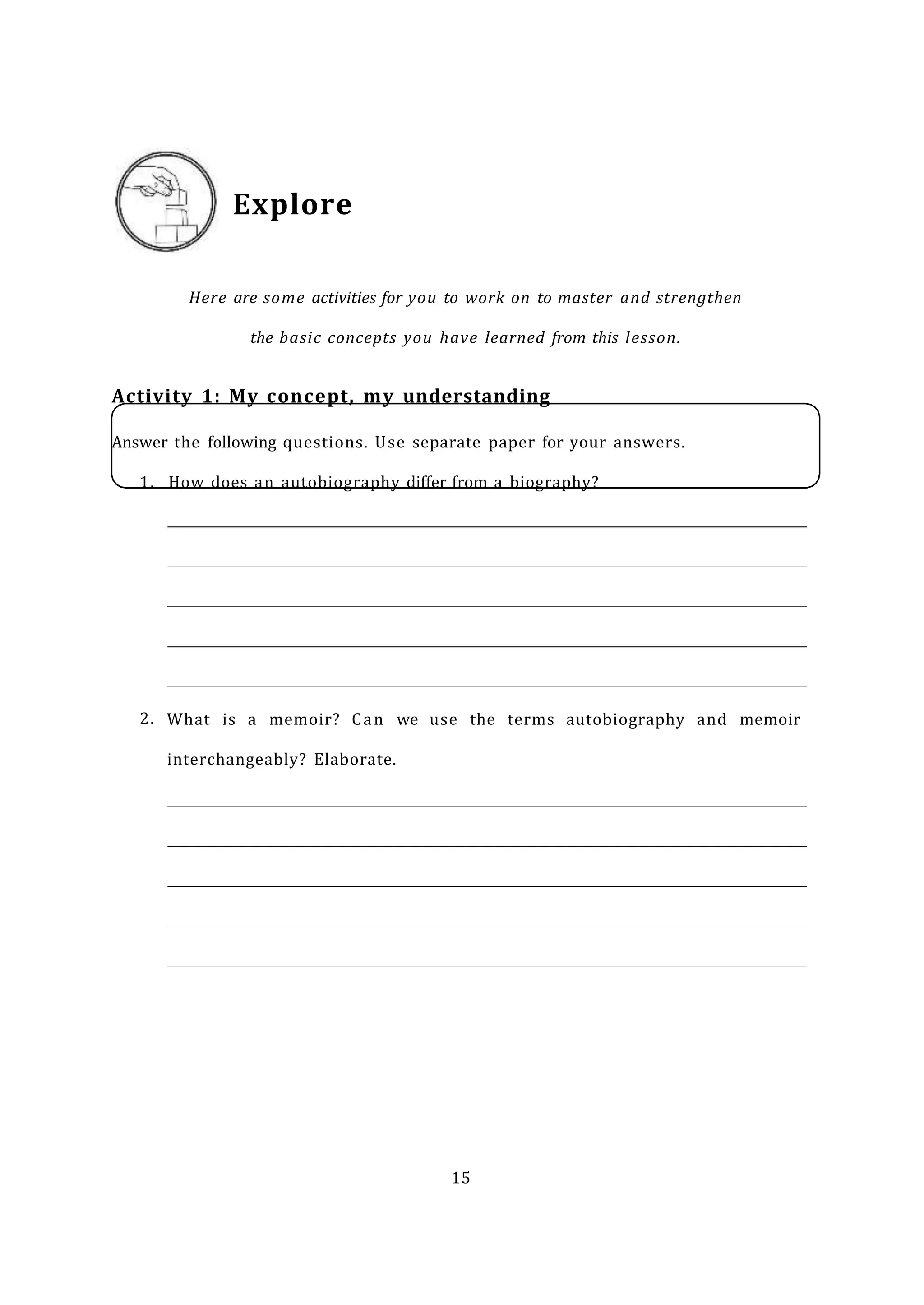
2. What is a memoir? Can we use the terms autobiography and memoir
interchangeably? Elaborate.
Explore
15
Here are some activities for you to work on to master and strengthen
the basic concepts you have learned from this lesson.
Activity 1: My concept, my understanding
Answer the following questions. Use separate paper for your answers.
1. How does an autobiography differ from a biography?
Assessment Activity 1: Focusing the Lens
Reliving Memories through Photographs
Task: Look for any printed picture that you have. Recall the events or memories
behind the scene in the picture. Apply the steps and guidelines in autobiographical
writing. WRITE YOUR ANSWER ON A PIECE OF INTERMEDIATE PAPER TO BE
SUBMITTED DURING MODULE RETRIEVAL.
Enrichment Activity 2 : My Six Word Memoir
What does it mean to leave a legacy? It could mean transferring knowledge,
passing on values and life lessons, or simply leaving a lasting impression for
stories to be told and memories to be shared about you. What legacy will you leave
at school or in life? You could answer these through writing your memoir.
A memoir is a written collection of memories about moments or events,
public or private, that took place in your life. A memoir is a story about your life,
important moments that you want to share with others that tell about what’s
important to you, what you value, and what you want others to know.
Once asked to write a full story in six words, legend has it that novelist
Ernest Hemingway responded: "For Sale: baby shoes, never worn."
Below are some other examples of 6 word memoirs from famous people:
"Life is one big editorial meeting" - Activist Gloria Steinem
"The miserable childhood leads to royalties" - Author Frank McCourt
"Acting is not all I am" - Actress Molly Ringwald
Let’s see if you can tell a story of your life in 6 words! Whether it’s
humorous, or profound, or somewhere in between, this exercise will give you an
idea of events or memories or emotions that have some type of meaning in your
life. Have fun!
Great job! You have
17
erstood the lesson.
und
Are you now ready to summarize?
What you have to do
Write a 6-word memoir. Try the following techniques to help you out. WRITE
YOUR ANSWER ON A PIECE OF INTERMEDIATE PAPER TO BE SUBMITTED
DURING MODULE RETRIEVAL
1) Create a “you” list – fill the page: List as many words as you can about yourself –
things you like, feelings you have. Don’t cross out, change, or rewrite anything.
Don’t worry about spelling – just write. You are going for quantity, so write as
much as you can for at least 3 minutes.
2) Circle 3 items that inspire you to say more: Pick words from your list that, if heard
aloud, would make you think about something that happened in your life, a story or
an idea, or something that was important to you.
3)From those items you circled, select one: “Free write” about it for at least 2
minutes. “Free write” means you just start writing about that idea, object, role or
event. The only rule is: don’t stop writing for at least two minutes. Whatever comes
to mind is fair game. Then, synthesize. Develop a 6-word phrase/ sentence that
captures the essence of what your topic means to you.
Deepen
18
How to Start Off a Memoir: Everyone’s Story Is Different
At this point, there isn’t one right way to write a memoir because everyone’s
life story and creative process are unique. Read the following memoir to give you a
hint how.
Driving Lessons
By N.G. Ayeng
My father is smiling now. I have just shifted to fifth gear and our car is cruising
at 80 kph along suburban highway. His smile radiates silent pride as he watches me
behind the wheel, confident and totally in control of the machine at last.
He had waited long enough for this moment. For several years, he exhibited
endless patience in teaching me how to drive. I was a lousy student driver. I would
recklessly overtake even when there were four cars coming from the back of the car
in front of us. I would even choke the car’s engine with gasoline by abruptly stopping
when a gorgeous guy crossed the street. I was simply a total headache the moment I
turned on the ignition.
Through it all my father stayed with me. From his front seat, he would point
out my mistakes and reprimand me for them but he never left my side. For a while
I even thought the only thing he ever taught me was how to drive. He is too stiff to
talk about love and too dry to talk about life. It took several years of driving lessons
under him to make me realize that I was wrong, completely wrong.
Now it’s my turn to smile. Pressing harder on the gas pedal, I remember how
my father’s driving instructions would keep coming back in some difficult times
19
during my undergraduate years. It was easy for a girl from the province to get
intimidated by the near-death experience of entering the University of the
Philippines. However, without knowing it at first, I had a survival weapon with me.
In every desperate situation I got myself into, my father’s voice would come back to
save me. And always it was framed as driving instructions.
During my first year in college, I was forever tormented by homesickness. It
came to a point when I seriously considered throwing a lasso at every plane that was
flying by so that I could get a ride home. Amid this terrible aloneness, I heard my
father’s voice saying. “Never let the machine control you. You must control the
machine.” Immediately, I’d stop sulking. And in time I resolved to be ready to take
on life as it comes, I had to be in control.
Wrestling with my academics was my next problem. When full-blown research
papers, long examinations, and teachers of the terrorist kind threatened to drive
me crazy, I looked for reasons to justify giving the whole thing up. But then my
father’s instructions again came back to strengthen me. When I felt overloaded with
academic requirements, I would remember him saying, “The trick is in the approach.
When you see bumps, be ready to move sideways.”
When I thought of rebelling against some teachers who were blissfully
power-tripping, I would hear him say, “Just be extra cautious at night and during
rain. Your vision is limited and the roads are slippery.”
When I feel like crawling under the chair because my classmates were so
naturally brilliant and my insecurities were eating me up, I would hear him say,
“It’s a matter of shifting your gears at the right time.”
As I tried to survive an oppressive atmosphere, I got to meet all kinds of
people with all kinds of attitude. My father’s instructions was: “Don’t be a
20
headache to other drivers. Always stick to your lane. Follow every one-way sign.
Don’t box in other cars when you park.”
I did exactly as he told me, and most of the persons I met thanked me for
the respect and consideration I gave them. I made a lot of good friends along the
way.
In my last year as an undergraduate as I was working on my thesis, I heard my
father’s voice again, “Check everything before you start the engine,” he was saying.
I did, and I was able to answer all the questions my adviser threw at me.
Soon, the dark and dreary thesis nights started to deprive me of good times
in dreamland. I was staring at the computer screen 24 hours a day. I was close to
a nervous breakdown when I heard my father say, “It is very important for you to
know where the brakes are.” Well, I found them, I went to see a movie for the first
time in so many months since I started working on my thesis. Afterwards, I never felt
so relaxed in my whole life.
Time flew swiftly and I graduated from the university. When I look back at
those trying times, I fondly remember the special instruction my father gave me when
he let me drive alone for the first time. It never failed to lift up my spirit no matter
how confused or downhearted I felt. “If worst comes to worst,” he said. “Leave
the car and find your way home.” He told me I was more important than any
machine ever will be.
In my last year as an undergraduate as I was working on my thesis, I heard
my father’s voice again, “Check everything before you start the engine,” he was
saying. I did, and I was able to answer all the questions my adviser threw at me.
I know now why this instruction is a very special one. The unfathomable
parental love that comes with it has made the driving lessons he gave me unique.
21
His instructions I will always recall to mind. His love, I will forever hold in my
heart.
My father’s smile and mine have become full. Our car is still breezing along
at 80 KPH and we are enjoying the ride. It’s like his final instruction: “Relax while
driving.” Indeed, the only thing my father taught me was how to drive. But the
lessons that came with it were innumerable.
Billows of dust rail our car as I glance at the rearview mirror to check on the
distance I have traveled. I have gone quite a long way.
I step on the gas pedal a little bit harder, and the car hit 90 kph. How did that
song go again? “Magda-drive ako hanggang sa buwan….” (I will drive until I get to
the moon) With all my father taught me, I can drive much farther!
Source: Ayeng, N. G. (1996). Young Blood, Philippine Daily Inquirer.
What to do
Write your own memoir. Your memoir should focus on the aspects of your
life that is meaningful to you. The following topics and ideas may help you get
started.
1. The Most Interesting Thing that Ever Happened to You
We all have some event or events in our lives that have stayed in our memory.
It could be that these events are those that define us, or changed our
understanding of ourselves. Maybe it was a road trip you took, the time you saved
someone's life, or someone saved yours. Look at what you consider the most
interesting or influential experience in your life. Did you learn something from it?
Do you have regrets about it? How did this event define you? How did it impact
your view of yourself or others?
22
2. Major Life Events
Think about the milestones in your life you have crossed. Explore the ways that these
major events have shaped your life. Have they changed your perspectives? If so, how?
If not, why?
3. What Makes You, You
Another angle to take to formulate ideas for your memoir is to think about the way
you define yourself. Imagine you were going to write a character sketch of yourself.
Think not just of your physical appearance, but the aspects of your personality. When
you try to define yourself, what comes to mind? Your family? Your friends? What, if
anything, do they tell you about yourself?
4. In Your Dreams
Have you ever found yourself revisiting some place from your past in your dreams?
Maybe you remember the sights, the smells, and the people you associated with
that time. Is this a time in your life that is still relevant to your present, or is it a time
you never thought about until you dreamt it? Use vivid descriptive language to
recount this time and what you take from it.
Requirements:
 A well-written 3-6 paragraph memoir with a strong lead and a strong
conclusion.
 Typed in 12 point Arial or Tahoma font, double-spaced. If you don’t
have a computer at home you can write it legibly on a piece of bond
paper.
 A creative and reflective title centered at the top of your paper with your name,
grade level and section centered under the title.
 Imagery and figurative language throughout your memoir should be
present.
 Review the requirements listed on your
rubric.
23
4- Excellent 3- Very Good 2-Satisfactory 1-Needs
Improvement
Organization *Well-focused *Generally *Somewhat *Not focused
on the topic focused on the focused on the on the topic
*Logical topic topic *No clear
organization *Some lapses *Poor organization
*Excellent in organization *No transitions
transitions organization *Few *Difficult to
*Easy to follow *Some transitions impossible to
transitions
*Usually easy
to follow
*Difficult to
follow
follow
Introduction Introductory Introductory Introductory No attempt is
made to state
the subject of
the essay in an
introductory
paragraph.
paragraph paragraph paragraph
clearly states states subject attempts to
subject of essay
and captures
reader's
attention.
of essay but is
not
particularly
inviting to the
reader.
state subject of
essay but does
not capture
reader's
attention.
Word Choice *Precise, vivid *Fairly *Vague, *Very limited
and interesting precise, mundane word choices
word choices interesting word choices *Wording is
*Wide variety of and somewhat *Wording is bland and not
word choices varied word sometimes descriptive
choices repetitive
*Wording *More
could be more descriptive
specific words are
needed
Sensory Essay includes Includes Includes Includes no
Detail details that details that details that details that
appeal to at appeal to appeal to only appeal to one
least three of fewer than one of the five of the five
the five senses three of the senses. senses.
(taste, touch,
sound, sight,
smell).
five senses.
Figurative Writer Writer uses Writer may try
to use simile,
metaphor, and
personification
but does so
incorrectly.
Writer does not
include simile,
metaphor, or
personification
in essay.
Language effectively uses one example
simile, of simile,
metaphor, and metaphor, or
personification personification
to describe the
subject.
to describe the
subject.
Sentence *Uses complete *Uses *Occasional *Frequent use
Fluency sentences complete sentence of sentence
*Varying sentences fragment or fragments or
sentence *Generally run-on run-on
structure and simple sentences sentences
lengths sentence *Simple *Sentences are
structures sentence difficult to
structure is understand
used
repeatedly
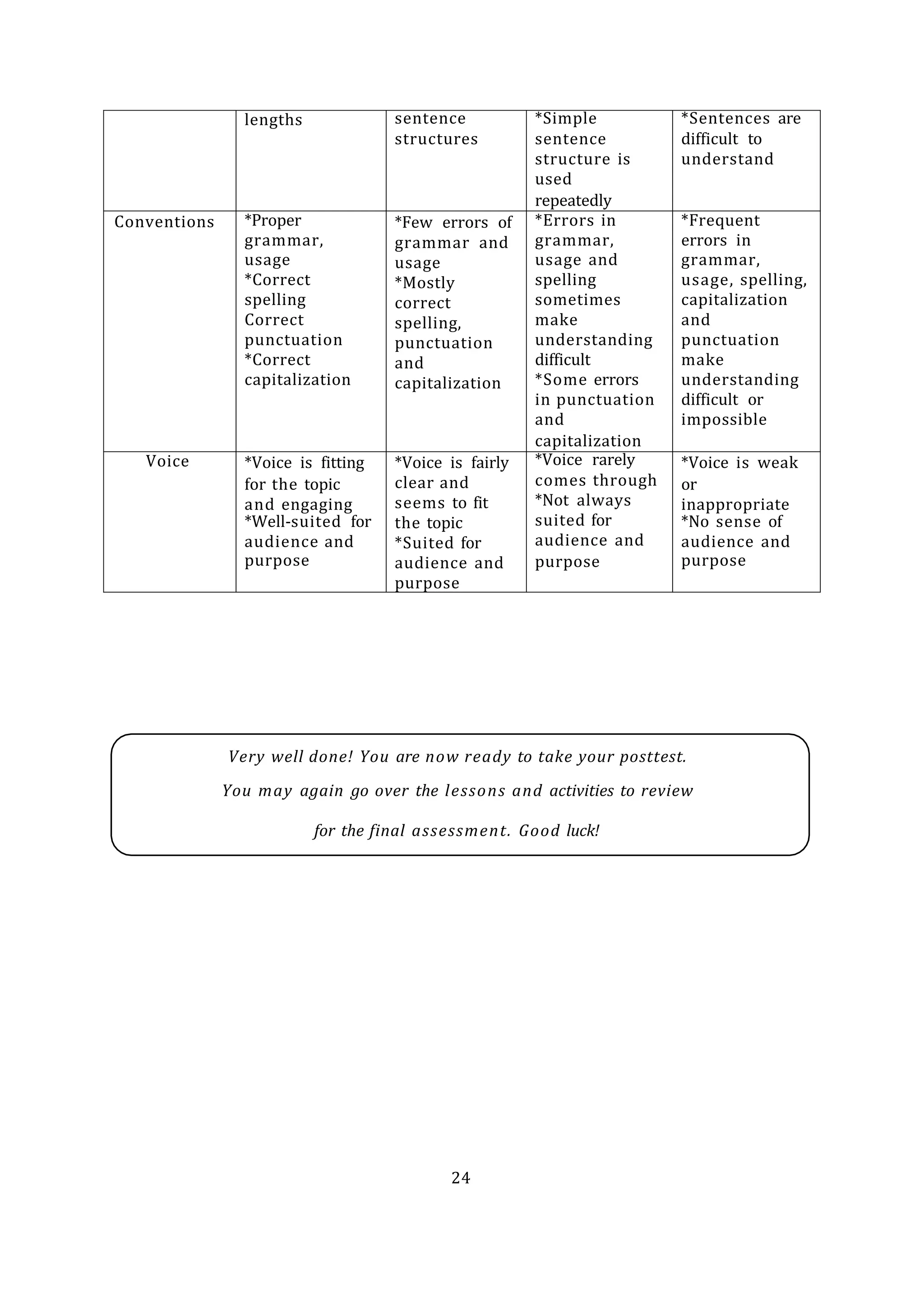
Conventions *Proper *Few errors of
grammar and
usage
*Mostly
correct
spelling,
punctuation
and
capitalization
*Errors in *Frequent
grammar, grammar, errors in
usage usage and grammar,
*Correct spelling usage, spelling,
spelling sometimes capitalization
Correct make and
punctuation understanding punctuation
*Correct difficult make
capitalization *Some errors understanding
in punctuation difficult or
and impossible
capitalization
Voice *Voice is fitting
for the topic
and engaging
*Well-suited for
audience and
purpose
*Voice is fairly
clear and
seems to fit
the topic
*Suited for
audience and
purpose
*Voice rarely *Voice is weak
or
inappropriate
*No sense of
audience and
purpose
comes through
*Not always
suited for
audience and
purpose
24
Very well done! You are now ready to take your posttest.
You may again go over the lessons and activities to review
for the final assessment. Good luck!
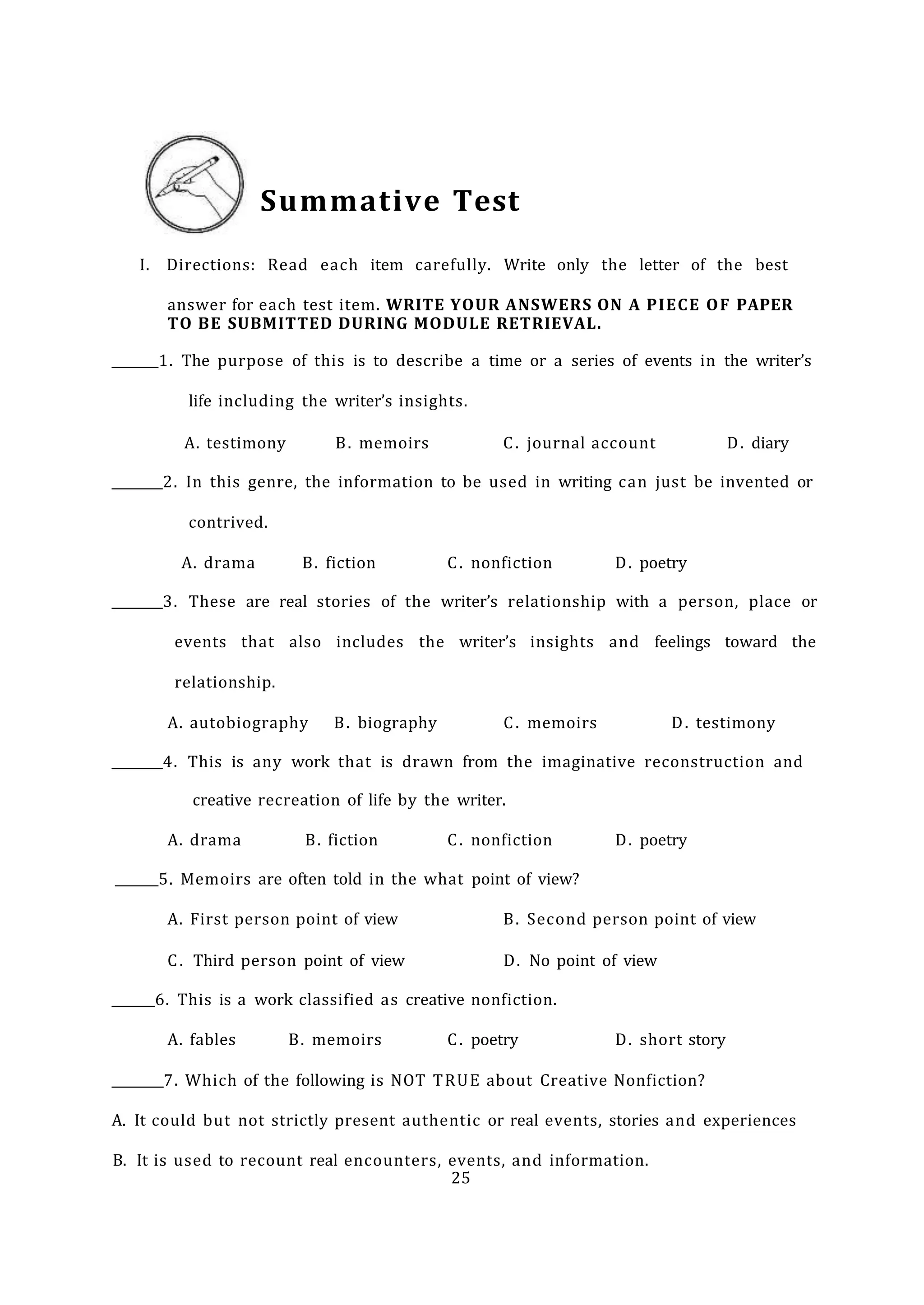
Summative Test
25
I. Directions: Read each item carefully. Write only the letter of the best
answer for each test item. WRITE YOUR ANSWERS ON A PIECE OF PAPER
TO BE SUBMITTED DURING MODULE RETRIEVAL.
1. The purpose of this is to describe a time or a series of events in the writer’s
life including the writer’s insights.
A. testimony B. memoirs C. journal account D. diary
2. In this genre, the information to be used in writing can just be invented or
contrived.
A. drama B. fiction C. nonfiction D. poetry
3. These are real stories of the writer’s relationship with a person, place or
events that also includes the writer’s insights and feelings toward the
relationship.
A. autobiography B. biography C. memoirs D. testimony
4. This is any work that is drawn from the imaginative reconstruction and
creative recreation of life by the writer.
A. drama B. fiction C. nonfiction
5. Memoirs are often told in the what point of view?
D. poetry
A. First person point of view B. Second person point of view
C. Third person point of view D. No point of view
6. This is a work classified as creative nonfiction.
A. fables B. memoirs C. poetry D. short story
7. Which of the following is NOT TRUE about Creative Nonfiction?
A. It could but not strictly present authentic or real events, stories and experiences
B. It is used to recount real encounters, events, and information.
26
C. It is a written work that is classified to be products of authentic experiences and
events
D. It may or may not be detailed and engaging ( but does need to be funny, or sad,
or controversial).
8. Which of the following is TRUE about Creative Nonfiction?
A. Creative nonfiction texts are written for a singular reason--- to inform.
B. Creative nonfiction writing avoids the application of literary writing methods.
C.In creative nonfiction, the information to be used in writing can be just be
created
D. Nonfiction heavily deals with the truth.
9. This is the imaginative recreation and reconstruction of life.
A. drama B. fiction C. nonfiction D. poetry
10. This include the writer’s contemplation or realization on his/her
experience.
A. Autobiography B. Memoirs C .Personal essays D. Reflective essays
II. Directions: Read and evaluate the following excerpts/statements carefully.
Write C if the item provides accurate description for Creative Nonfiction
and D if the statement contains irrelevant description.
1. Considers “true stories” as its subject
2. Employs the technique in literary writing
3. Contains fictitious or contrived ideas
4. Creative in “Creative Nonfiction” means the invention of information and
details which did not transpire.
5. It is just similar to academic and technical writing.
6. It can add conversation between characters in a literary work.
7. It includes research reports like theses and dissertations.
8. One of the goal of creative nonfiction is to provide and to present authentic
information.
9. Creative Nonfiction is as old as the traditional genres of poetry and fiction.
10. This genre employs the writing aesthetics found in literary prose and
poetic forms.
27
Great job! You are almost done with this module.
28
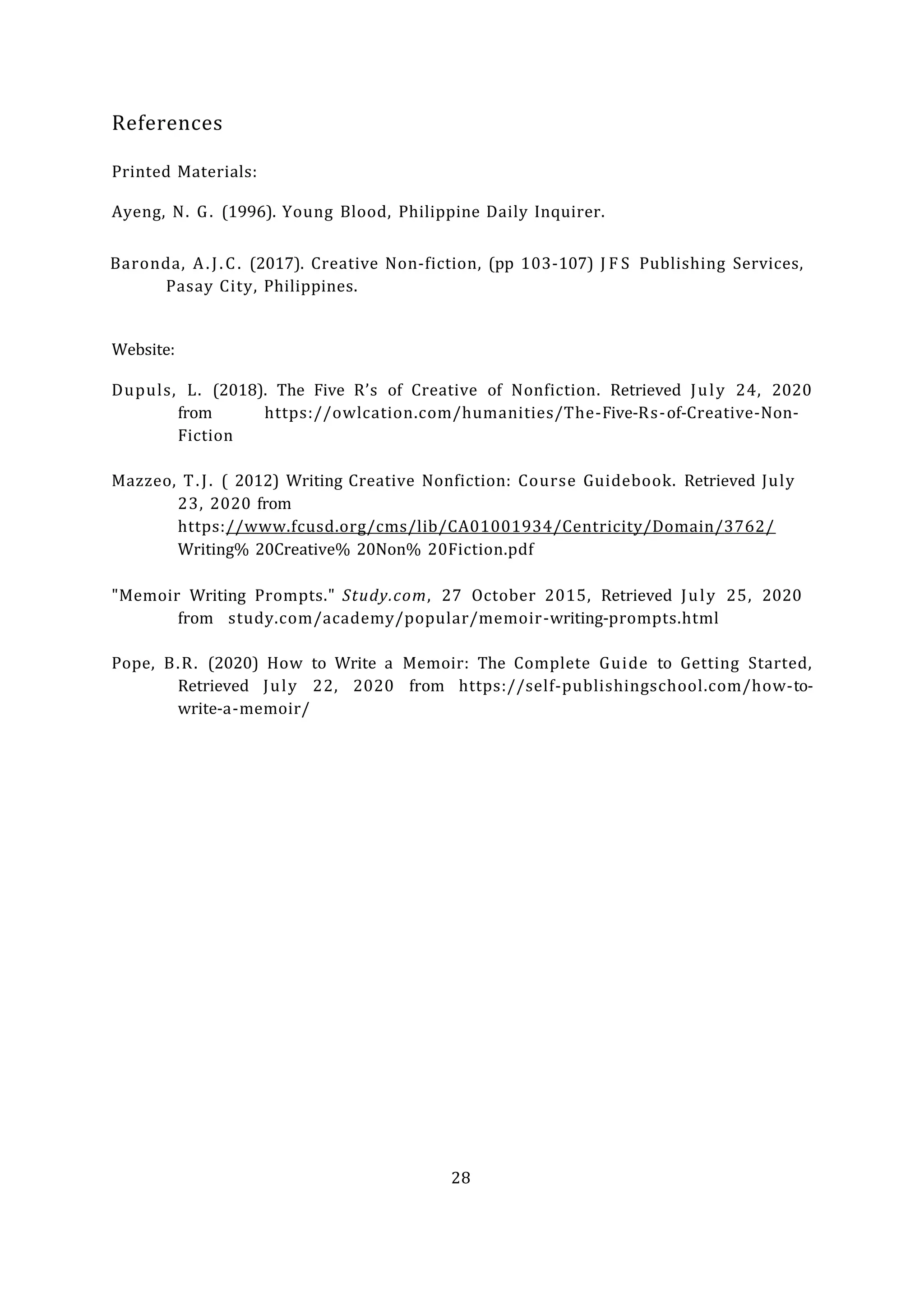
References
Printed Materials:
Ayeng, N. G. (1996). Young Blood, Philippine Daily Inquirer.
Baronda, A.J.C. (2017). Creative Non-fiction, (pp 103-107) J F S Publishing Services,
Pasay City, Philippines.
Website:
Dupuls, L. (2018). The Five R’s of Creative of Nonfiction. Retrieved July 24, 2020
from https://owlcation.com/humanities/The-Five-Rs-of-Creative-Non-
Fiction
Mazzeo, T.J. ( 2012) Writing Creative Nonfiction: Course Guidebook. Retrieved July
23, 2020 from
https://www.fcusd.org/cms/lib/CA01001934/Centricity/Domain/3762/
Writing% 20Creative% 20Non% 20Fiction.pdf
"Memoir Writing Prompts." Study.com, 27 October 2015, Retrieved July 25, 2020
from study.com/academy/popular/memoir-writing-prompts.html
Pope, B.R. (2020) How to Write a Memoir: The Complete Guide to Getting Started,
Retrieved July 22, 2020 from https://self-publishingschool.com/how-to-
write-a-memoir/

creative-nonfiction-quarter-4-module-2.pptx

  • 1.
    SENIOR HIGH SCHOOL CreativeNonfiction QUARTER4–M O D U L E2 WRITINgADRAFTOFACREATIVENONFICTIONPIECE Department of Education ● Republic of the Philippines GRADE 11 1
  • 2.
    2 This module willprovide you with essential guides and techniques on how to write a draft of creative nonfiction piece based on memorable real-life experience. After completing this module, you are expected to: 1. demonstrate prior knowledge on drafting, 2. write a draft of creative nonfiction piece based on memorable real-life experience (HUMSS_CNF11/12-IIg-j-20); and 3. revise the draft of creative nonfiction piece to produce a finished work. WEEKLY HOME LEARNING PLAN in CREATIVE NON-FICTION Quarter 4 – Module 2 l June 8 – June 18, 2021 Day & Time Learning Competency Learning Tasks 9:00 AM–11:00 AM 11:00 AM– 12:00 NN 1:00-3:00 PM 1.Demonstrate prior knowledge on drafting, 2.Writeadraftofcreative nonfiction piece basedon memorable real-life experience (HUMSS_CNF11/12-IIg-j-20) 3.Revisethedraft of creative nonfiction piece to produceafinished work; ReadandunderstandJUMPSTARTActivity 1: ReadMe!UnderstandMe!Then answer thequestions thatfollow.Write your answer onyour Creative Nonfiction Notebook. ReadDISCOVER and learn about the5R’s ofCreative Nonfictionthat will help you write acreative nonfiction piece. Answerthequestions in EXPLOREActivity1: Myconcept, my understanding.Writeyouranswer on yourCreative Nonfictionnotebook. Answerthe Assessment Activity1: Focusingthe Lens:Reliving Memoriesthrough Photographs. Writean autobiographical piece basedon old printed picture that you have by applying thestepsandguidelines you havelearned.WRITEYOURANSWERONAPIECEOFPAPERTOBE SUBMITTED DURINGMODULERETRIEVAL.  AnswerEnrichmentActivity2:MySixWordMemoir.Writea6-word memoir byfollowing thetechniquesin this module.WRITEYOURANSWER ONAPIECEOFPAPERTOBESUBMITTEDDURINGMODULE RETRIEVAL. ReadthememoirbyN.G.Ayeng “DrivingLessons” to give youahint on howtowrite amemoir. Writeyour ownmemoirfocusingontheaspectsof your life that is meaningful to you. 4topics aresuggestedto hepyou getstarted. Don’tforgetthe requirements:3-6paragraph with astronglead andastrongconclusion,a title,imageryand figurative language.WRITEYOURANSWERONAPIECE OFPAPERTOBESUBMITTEDDURINGMODULERETRIEVAL. Review therequirements listed in therubric and reviseyour draftto produce a finished work. Answer theSUMMATIVETEST.WRITEYOURANSWERONAPIECEOF PAPERTOBESUBMITTEDDURINGMODULERETRIEVAL. ~~ FORDIGITIZEDSTUDENTS:Alinkwillbeposted inourGroupChatfor submission. FORPRINTED STUDENTS: Yourparentswillhand-inyour outputto the teacher intheidentifiedareas.
  • 3.
    Module 2 Writing aDraft The peculiar qualities and appeal of creative nonfiction texts truly inspire and energize human mind and spirit. Such genre provides useful information and insights in relation to real human experiences. Thus, reading and writing creative nonfiction can also be liberating and amusing. Jumpstart Activity 1: Read Me! Understand Me! Directions: Read the following passage. Answer the questions that follow in a separate sheet of paper. Write the letter of your answer. Use capital letters. How do you start a memoir? Like starting any book, you have to understand why you’re doing it and what you wish to portray with the final product. Starting a memoir includes an outline, key chapters with specific messages, and working on developing a writing habit in order to stick to writing. A memoir is a historical account written with personal knowledge and experience covering the lifetime of an individual, usually with a greater purpose or message within it. How is this different from an autobiography? Aren’t they the same thing? With so many genres and writing terminology out there, knowing the differences between a memoir versus autobiography, can be confusing. They’re both 3
  • 4.
    4 about someone’s lifewritten by themselves, right? Right. But they do differ in a single way that really makes a memoir and an autobiography completely different in terms of their end results. A memoir typically covers one aspect of a writer’s life (or a continuous theme through memories), while an autobiography is a chronological account of the writer’s life. It has to be written with strong description and details, and possibly with dialogue to arouse the interest of the readers. So if you want to write a play-by-play of your entire life from the moment you popped into this world to the very second you started writing, you’d write an autobiography. But if you’re looking to share a profound message with the world through your own real-life experiences, you’ll write a memoir. ( Source: Mazzeo, T.J. ( 2012) Writing Creative Nonfiction: Course Guidebook. Retrieved July 23, 2020 from https://www.fcusd.org/cms/lib/CA01001934/Centricity/Domain/3762/ Writing% 20Creative% 20Non% 20Fiction.pdf) 1. The definition of autobiography is A. a life story made into film by the person him/herself. B. a life story that tells the life of another person. C. a life story written by another person. D. a self-written life story. 2. Autobiographies are important because A. they are a good way to inspire other people. B. they are a way for the person to continue healing. C. they are a way to show others they are not alone in their problems. D. All of the foregoing.
  • 5.
    5 3. A memoiris a type of autobiography, but A. they feature the whole life of the person. B. they focus on one event or time period of the person’s life. C. they focus on other people instead of the author. D. None of the above. 4. When writing an autobiography, the author should remember to A. use academic language and keep the ideas simple. B. use flowery descriptions and a lot of figurative language. C. use other people’s thoughts and feelings to describe him or herself. D. use strong description, provide details, and possibly add dialogue. 5. In order to arouse the interest of the readers, a good creative nonfiction must use A. strong description B. vivid details C. dialogue D. All of the foregoing.
  • 6.
    Discover Creative nonfiction isthe fastest-growing part of the creative writing world because it tries to bring together the imaginative strategies of fiction storytelling and new ways of narrating real-life events. Learning the secrets and techniques of creative nonfiction offers you so much more than just insights into this exciting style of writing. Mastering the art and craft of creative nonfiction can help you write more effectively in a variety of academic and personal situations, provide dynamic new ways for you to preserve life experiences as how they truly occurred or as you felt them, allow you to share your stories in ways that other people are sure to find compelling, and open up new windows on how you think about your own personal history and that of others. Before putting pen to paper, a writer has many decisions to make. One of the most important of these is identifying the kind of work he or she would like to create. While fiction writers choose to rely solely on their imagination and ability to distort reality, nonfiction writers assume the hefty load of research, reportage and accuracy. The 5 R’s of creative nonfiction is a short checklist to refer to when writing a nonfiction work that will ensure your bases are covered. The 5 R's of Creative Nonfiction 1. Write about real life. Remember that you are writing about real people, real places and real events. Visiting the people and the places you are going to write about will give you 6
  • 7.
    the tools necessaryto tell an accurate story with vivid scenery, well-described artifacts and true-to-life personages. Nothing should be fictional or made up. Everything that makes it into your work of creative nonfiction must have happened at some time or another in real life. Never embellish or alter reality. 2. Conduct extensive research. Use every resource available to gather information on your subject. Of course, where you look for information will depend on the subject matter, but some great starting places are: The library Newspaper archives The Internet Interviews Public records Books and magazines Photographs Immersion (visiting the place you are writing about) It is also apparent to ensure your sources are accurate and reputable. If not, your integrity is at stake. Even worse, a creative nonfiction writer who doesn't conduct sufficient research is liable to have their name scourged by readers. 3. Write a narrative. Use the storytelling elements of fiction to create a compelling story with the factual information you’ve gathered. You could craft your story this way using the standard pattern: Inciting incident Conflict (internal or external) Climax or turning point 7
  • 8.
    Resolution End of story 4.Include personal touch. The “creative” in “creative nonfiction” comes with the author’s unique voice and opinion on the matters being related on the page. You, the author, are the human connection between the subject matter and the reader. In this sense, creative nonfiction relies much more on the personality of the author than fiction. You must befriend your reader, make them trust you, and proceed with your storytelling. 5. Learn by reading. The creative nonfiction writer should read autobiographies, newspapers, magazines, articles and other nonfiction books to get a taste for how theirs should be formatted and written. With these tips, you are more than halfway to creating a great work of creative nonfiction. Once you’ve collected your information, plotted your story and taken a unique angle on the subject, you are ready to begin the hardest part of the process: writing the story. Happy writing! 8 Familiarizing Autobiographical Writing One of the forms of creative nonfiction that you could create based on a memorable real life experience is writing autobiography. This is a written account of the life of a person written by that person himself or herself. Here under are some important things that you need to understand about autobiographical writing, or the writing of events in the life of a person written by that person himself or herself. 1. Recounts the story focusing on a person or event in the life of the writer
  • 9.
    2. Shares writer’slife 3. Involves a definite sequence of events experienced or witnessed by the writer 4. Vivifies details for portraying people and places 5.Highlights a problem, conflict, or contrast between viewpoints of past and present Forms of Autobiographical Writing Below are some forms of autobiographical writing:  Autobiography --- Etymologically, the word autobiography is composed of the Greek words auto meaning “self”, bio, bios meaning “life”, and gráphō, graphien meaning “write.” Thus, autobiography is a written account of the life of a person written by that person himself or herself.  Memoirs --- This covers your life’s events in a more story-like structure with an overarching theme or messaged written in. These are also real stories of the writer’s relationship with a person, place, or even animals. It also includes the writer’s insights and feelings towards the relationship.  Personal narrative--- This is also known as autobiographical incidents. Texts of this form focus on and highlight a specific event in the life of the writer.  Autobiographical sketches/ narratives --- The purpose of this is to describe a time or a series of events in the writer’s life including insights about them.  Reflective Essay--- This recalls and recounts an experience. Insights on an experience are also expressed. 9
  • 10.
    Steps in AutobiographicalWriting To create an autobiographical piece, there are several steps and strategies that can be considered as definite guides: 1. Prewriting Selecting a topic In this phase, the writer explores and chooses a possible topic or subject for writing. It is important that the writer select an interesting topic based on his/her experience like in solving an encountered problem or conflict that captured realizations and insights. There are strategies for generating a topic. The freewriting strategy allows the writer to note down a variety of ideas that come to his/her mind. In this way, the writer has options as to what topic to highlight. It is also necessary to select or to zero in the most interesting idea. Furthermore, the events connected to such idea must be used as an inspiration for the topic. Aside from this, the blueprinting strategy allows the writer to think of places that are perceived to be important to him/her. The writer draws a map and marks different areas. In each location, connected memories are listed. Then, the writer selects a memory from the created list and takes it as the topic from writing. Narrowing the topic After choosing a possible topic, the writer needs to narrow and to set the focus by uncovering what is hidden within the story. Include details and points that enrich the story. 10
  • 11.
    Thinking about theaudience and purpose for writing The writer’s awareness of his/her intended readers or audience the level of language that the writer will utilize. It can be either formal or casual, on the other hand, setting the purpose for writing is also important. An autobiographical text may amuse, inspire or celebrate a person’s one’s life. Purpose Organization Details to Include to recount an amusing, exciting or moving story building the climax suspense, sympathy, humor to share an insight highlight the realizations and lessons the contrast between past and present points-of-view celebrate a person in one’s life show the person’s character and relevant details characteristics of the person Obtaining Details Details give shape to and enrich the writing piece. Obtaining details can be done through listing and itemizing. After making a list, select and highlight the ones that are relevant , valuable and interesting. 2. Drafting Giving shape to the writing piece Conflicts and tensions make stories interesting. These are found in incidents taken from life. Conflict is the opposition of forces that causes a struggle. In the presence of a conflict, a character is prevented from getting anything he/she wants. Elaborating Details 11
  • 12.
    12 Characteristics by providingrelevant details can help readers to visualize and imagine scenes clearly. It is necessary for the writer to help readers to see what the writer sees and to feel what the writer feels. Thus, in that way, the writer connects himself/herself to his/her audience What Qualifies as a Memoir? A memoir is unique in the fact that it covers your life’s events in a more story-like structure with an overarching theme or message written in. Memoirs are very specific in the sense that it accounts for the events of your life with an emphasis on stories and impactful moments that lead to a great purpose. Anyone has the ability and can experience to write a memoir. If you have a story, then you are on your way to writing one. How to Write a Memoir with Meaning and Influence Writing a memoir can not only be a valuable experience for you, but the impact it may have on other people is astounding too. The following tips were put together to help you learn how to start a memoir that’s captivating and intriguing. 1. A strong introduction is everything. Without the ability to hook readers, convincing someone read your work will be a bit harder than anticipated. Let’s draw those readers in! 2. Be relatable. One major mistake many make when writing a memoir is not starting it off in a way that makes the readers connect with them. This is one of the most important aspects of your memoir. Do you really think people will want to read about a person’s life if they can’t relate to them? Did you understand their pain and triumph and hardships? When others relate to you and see themselves in your
  • 13.
    13 journey, they’ll wantto stick around to see how it plays out. And that means they’ll read your whole work and any others you write. 3. Use emotion by showing, not telling. If you want to give a play-by-play of your life with nothing more than a list of experiences you’ve gone through, that’s fine. Just know that doing it that way won’t hook your readers and it certainly won’t keep them. A memoir can be a powerful tool for educating others through your life journeys, but if they’re not intrigued enough to keep reading, it’ll render your memoir pointless. In showing and not telling, you’ll put more emotion into your writing. 4. Make the message clear right away. What is it you’re trying to say through your memoir? Why did you want to start writing one in the first place? Everybody has an interesting life if you look deep enough. What you have to determine is how your life experiences can aid and shape the lives of others. Think about how that will manifest from what you’ve lived through before and make sure your readers know what it is from the start. 5. Write from the heart. Christopher Moss, author of “Hope Over Anxiety” says the best way to write your memoir is to be open about your experiences. He emphasizes to “Write from the heart. Show people your experience. Be as vulnerable and honest as you can. If it scares you a little, what you are writing that’s good. The reader has to feel what you are going through.” 6. Narrow your focus . Your memoir should be written as if the entire piece is a snapshot of one theme of your life. Your memoir is not an autobiography. The difference is that an autobiography spans your entire life, and a memoir focuses on one particular
  • 14.
    14 moment or seriesof moments around a theme. You want your readers to walk away knowing you, and that one experience, on a much deeper level. 7. Tell the truth. One of the best tips for how to write a memoir that’s powerful is to be honest and genuine. It’s important that you tell the truth — even if it makes your journey as an author more difficult. One more note on honesty: Memoirs explore the concept of truth as seen through your eyes. Don’t write in a snarky manner or with a bitter tone. The motivation for writing a memoir shouldn’t be to exact revenge or whine or seek forgiveness; it should simply be to share your experience. Don’t exaggerate or bend the truth in your memoir. Your story, the unique one that you hold and cherish, is enough. There is no need to fabricate or embellish. 8. Employ elements of fiction to bring your story to life. Think of the people in memoirs as characters. A great memoir pulls you into their lives: what they struggle with, what they are successful at and what they wonder about. Many of the best memoir writers focus on a few key characteristics of their characters, allowing the reader to get to know each one in depth. Introduce intriguing setting details and develop a captivating plot from your story. Show your readers the locations you describe and evoke emotions within them. They need to experience your story, almost as if it was their own. While your memoir is a true story, employing these elements of fiction will make it far more powerful and enjoyable for your readers. 9. Create an emotional journey. Take your readers on an emotional journey that motivates them to read the next chapter, wonder about you well after they finish the last page, and tell their friends and colleagues about your book. The best way to evoke these feelings in your readers is to connect your emotions with your writing.
  • 15.
    2. What isa memoir? Can we use the terms autobiography and memoir interchangeably? Elaborate. Explore 15 Here are some activities for you to work on to master and strengthen the basic concepts you have learned from this lesson. Activity 1: My concept, my understanding Answer the following questions. Use separate paper for your answers. 1. How does an autobiography differ from a biography?
  • 16.
    Assessment Activity 1:Focusing the Lens Reliving Memories through Photographs Task: Look for any printed picture that you have. Recall the events or memories behind the scene in the picture. Apply the steps and guidelines in autobiographical writing. WRITE YOUR ANSWER ON A PIECE OF INTERMEDIATE PAPER TO BE SUBMITTED DURING MODULE RETRIEVAL. Enrichment Activity 2 : My Six Word Memoir What does it mean to leave a legacy? It could mean transferring knowledge, passing on values and life lessons, or simply leaving a lasting impression for stories to be told and memories to be shared about you. What legacy will you leave at school or in life? You could answer these through writing your memoir. A memoir is a written collection of memories about moments or events, public or private, that took place in your life. A memoir is a story about your life, important moments that you want to share with others that tell about what’s important to you, what you value, and what you want others to know. Once asked to write a full story in six words, legend has it that novelist Ernest Hemingway responded: "For Sale: baby shoes, never worn." Below are some other examples of 6 word memoirs from famous people: "Life is one big editorial meeting" - Activist Gloria Steinem "The miserable childhood leads to royalties" - Author Frank McCourt "Acting is not all I am" - Actress Molly Ringwald Let’s see if you can tell a story of your life in 6 words! Whether it’s humorous, or profound, or somewhere in between, this exercise will give you an idea of events or memories or emotions that have some type of meaning in your life. Have fun!
  • 17.
    Great job! Youhave 17 erstood the lesson. und Are you now ready to summarize? What you have to do Write a 6-word memoir. Try the following techniques to help you out. WRITE YOUR ANSWER ON A PIECE OF INTERMEDIATE PAPER TO BE SUBMITTED DURING MODULE RETRIEVAL 1) Create a “you” list – fill the page: List as many words as you can about yourself – things you like, feelings you have. Don’t cross out, change, or rewrite anything. Don’t worry about spelling – just write. You are going for quantity, so write as much as you can for at least 3 minutes. 2) Circle 3 items that inspire you to say more: Pick words from your list that, if heard aloud, would make you think about something that happened in your life, a story or an idea, or something that was important to you. 3)From those items you circled, select one: “Free write” about it for at least 2 minutes. “Free write” means you just start writing about that idea, object, role or event. The only rule is: don’t stop writing for at least two minutes. Whatever comes to mind is fair game. Then, synthesize. Develop a 6-word phrase/ sentence that captures the essence of what your topic means to you.
  • 18.
    Deepen 18 How to StartOff a Memoir: Everyone’s Story Is Different At this point, there isn’t one right way to write a memoir because everyone’s life story and creative process are unique. Read the following memoir to give you a hint how. Driving Lessons By N.G. Ayeng My father is smiling now. I have just shifted to fifth gear and our car is cruising at 80 kph along suburban highway. His smile radiates silent pride as he watches me behind the wheel, confident and totally in control of the machine at last. He had waited long enough for this moment. For several years, he exhibited endless patience in teaching me how to drive. I was a lousy student driver. I would recklessly overtake even when there were four cars coming from the back of the car in front of us. I would even choke the car’s engine with gasoline by abruptly stopping when a gorgeous guy crossed the street. I was simply a total headache the moment I turned on the ignition. Through it all my father stayed with me. From his front seat, he would point out my mistakes and reprimand me for them but he never left my side. For a while I even thought the only thing he ever taught me was how to drive. He is too stiff to talk about love and too dry to talk about life. It took several years of driving lessons under him to make me realize that I was wrong, completely wrong. Now it’s my turn to smile. Pressing harder on the gas pedal, I remember how my father’s driving instructions would keep coming back in some difficult times
  • 19.
    19 during my undergraduateyears. It was easy for a girl from the province to get intimidated by the near-death experience of entering the University of the Philippines. However, without knowing it at first, I had a survival weapon with me. In every desperate situation I got myself into, my father’s voice would come back to save me. And always it was framed as driving instructions. During my first year in college, I was forever tormented by homesickness. It came to a point when I seriously considered throwing a lasso at every plane that was flying by so that I could get a ride home. Amid this terrible aloneness, I heard my father’s voice saying. “Never let the machine control you. You must control the machine.” Immediately, I’d stop sulking. And in time I resolved to be ready to take on life as it comes, I had to be in control. Wrestling with my academics was my next problem. When full-blown research papers, long examinations, and teachers of the terrorist kind threatened to drive me crazy, I looked for reasons to justify giving the whole thing up. But then my father’s instructions again came back to strengthen me. When I felt overloaded with academic requirements, I would remember him saying, “The trick is in the approach. When you see bumps, be ready to move sideways.” When I thought of rebelling against some teachers who were blissfully power-tripping, I would hear him say, “Just be extra cautious at night and during rain. Your vision is limited and the roads are slippery.” When I feel like crawling under the chair because my classmates were so naturally brilliant and my insecurities were eating me up, I would hear him say, “It’s a matter of shifting your gears at the right time.” As I tried to survive an oppressive atmosphere, I got to meet all kinds of people with all kinds of attitude. My father’s instructions was: “Don’t be a
  • 20.
    20 headache to otherdrivers. Always stick to your lane. Follow every one-way sign. Don’t box in other cars when you park.” I did exactly as he told me, and most of the persons I met thanked me for the respect and consideration I gave them. I made a lot of good friends along the way. In my last year as an undergraduate as I was working on my thesis, I heard my father’s voice again, “Check everything before you start the engine,” he was saying. I did, and I was able to answer all the questions my adviser threw at me. Soon, the dark and dreary thesis nights started to deprive me of good times in dreamland. I was staring at the computer screen 24 hours a day. I was close to a nervous breakdown when I heard my father say, “It is very important for you to know where the brakes are.” Well, I found them, I went to see a movie for the first time in so many months since I started working on my thesis. Afterwards, I never felt so relaxed in my whole life. Time flew swiftly and I graduated from the university. When I look back at those trying times, I fondly remember the special instruction my father gave me when he let me drive alone for the first time. It never failed to lift up my spirit no matter how confused or downhearted I felt. “If worst comes to worst,” he said. “Leave the car and find your way home.” He told me I was more important than any machine ever will be. In my last year as an undergraduate as I was working on my thesis, I heard my father’s voice again, “Check everything before you start the engine,” he was saying. I did, and I was able to answer all the questions my adviser threw at me. I know now why this instruction is a very special one. The unfathomable parental love that comes with it has made the driving lessons he gave me unique.
  • 21.
    21 His instructions Iwill always recall to mind. His love, I will forever hold in my heart. My father’s smile and mine have become full. Our car is still breezing along at 80 KPH and we are enjoying the ride. It’s like his final instruction: “Relax while driving.” Indeed, the only thing my father taught me was how to drive. But the lessons that came with it were innumerable. Billows of dust rail our car as I glance at the rearview mirror to check on the distance I have traveled. I have gone quite a long way. I step on the gas pedal a little bit harder, and the car hit 90 kph. How did that song go again? “Magda-drive ako hanggang sa buwan….” (I will drive until I get to the moon) With all my father taught me, I can drive much farther! Source: Ayeng, N. G. (1996). Young Blood, Philippine Daily Inquirer. What to do Write your own memoir. Your memoir should focus on the aspects of your life that is meaningful to you. The following topics and ideas may help you get started. 1. The Most Interesting Thing that Ever Happened to You We all have some event or events in our lives that have stayed in our memory. It could be that these events are those that define us, or changed our understanding of ourselves. Maybe it was a road trip you took, the time you saved someone's life, or someone saved yours. Look at what you consider the most interesting or influential experience in your life. Did you learn something from it? Do you have regrets about it? How did this event define you? How did it impact your view of yourself or others?
  • 22.
    22 2. Major LifeEvents Think about the milestones in your life you have crossed. Explore the ways that these major events have shaped your life. Have they changed your perspectives? If so, how? If not, why? 3. What Makes You, You Another angle to take to formulate ideas for your memoir is to think about the way you define yourself. Imagine you were going to write a character sketch of yourself. Think not just of your physical appearance, but the aspects of your personality. When you try to define yourself, what comes to mind? Your family? Your friends? What, if anything, do they tell you about yourself? 4. In Your Dreams Have you ever found yourself revisiting some place from your past in your dreams? Maybe you remember the sights, the smells, and the people you associated with that time. Is this a time in your life that is still relevant to your present, or is it a time you never thought about until you dreamt it? Use vivid descriptive language to recount this time and what you take from it. Requirements:  A well-written 3-6 paragraph memoir with a strong lead and a strong conclusion.  Typed in 12 point Arial or Tahoma font, double-spaced. If you don’t have a computer at home you can write it legibly on a piece of bond paper.  A creative and reflective title centered at the top of your paper with your name, grade level and section centered under the title.  Imagery and figurative language throughout your memoir should be present.  Review the requirements listed on your rubric.
  • 23.
    23 4- Excellent 3-Very Good 2-Satisfactory 1-Needs Improvement Organization *Well-focused *Generally *Somewhat *Not focused on the topic focused on the focused on the on the topic *Logical topic topic *No clear organization *Some lapses *Poor organization *Excellent in organization *No transitions transitions organization *Few *Difficult to *Easy to follow *Some transitions impossible to transitions *Usually easy to follow *Difficult to follow follow Introduction Introductory Introductory Introductory No attempt is made to state the subject of the essay in an introductory paragraph. paragraph paragraph paragraph clearly states states subject attempts to subject of essay and captures reader's attention. of essay but is not particularly inviting to the reader. state subject of essay but does not capture reader's attention. Word Choice *Precise, vivid *Fairly *Vague, *Very limited and interesting precise, mundane word choices word choices interesting word choices *Wording is *Wide variety of and somewhat *Wording is bland and not word choices varied word sometimes descriptive choices repetitive *Wording *More could be more descriptive specific words are needed Sensory Essay includes Includes Includes Includes no Detail details that details that details that details that appeal to at appeal to appeal to only appeal to one least three of fewer than one of the five of the five the five senses three of the senses. senses. (taste, touch, sound, sight, smell). five senses. Figurative Writer Writer uses Writer may try to use simile, metaphor, and personification but does so incorrectly. Writer does not include simile, metaphor, or personification in essay. Language effectively uses one example simile, of simile, metaphor, and metaphor, or personification personification to describe the subject. to describe the subject. Sentence *Uses complete *Uses *Occasional *Frequent use Fluency sentences complete sentence of sentence *Varying sentences fragment or fragments or sentence *Generally run-on run-on structure and simple sentences sentences
  • 24.
    lengths sentence *Simple*Sentences are structures sentence difficult to structure is understand used repeatedly Conventions *Proper *Few errors of grammar and usage *Mostly correct spelling, punctuation and capitalization *Errors in *Frequent grammar, grammar, errors in usage usage and grammar, *Correct spelling usage, spelling, spelling sometimes capitalization Correct make and punctuation understanding punctuation *Correct difficult make capitalization *Some errors understanding in punctuation difficult or and impossible capitalization Voice *Voice is fitting for the topic and engaging *Well-suited for audience and purpose *Voice is fairly clear and seems to fit the topic *Suited for audience and purpose *Voice rarely *Voice is weak or inappropriate *No sense of audience and purpose comes through *Not always suited for audience and purpose 24 Very well done! You are now ready to take your posttest. You may again go over the lessons and activities to review for the final assessment. Good luck!
  • 25.
    Summative Test 25 I. Directions:Read each item carefully. Write only the letter of the best answer for each test item. WRITE YOUR ANSWERS ON A PIECE OF PAPER TO BE SUBMITTED DURING MODULE RETRIEVAL. 1. The purpose of this is to describe a time or a series of events in the writer’s life including the writer’s insights. A. testimony B. memoirs C. journal account D. diary 2. In this genre, the information to be used in writing can just be invented or contrived. A. drama B. fiction C. nonfiction D. poetry 3. These are real stories of the writer’s relationship with a person, place or events that also includes the writer’s insights and feelings toward the relationship. A. autobiography B. biography C. memoirs D. testimony 4. This is any work that is drawn from the imaginative reconstruction and creative recreation of life by the writer. A. drama B. fiction C. nonfiction 5. Memoirs are often told in the what point of view? D. poetry A. First person point of view B. Second person point of view C. Third person point of view D. No point of view 6. This is a work classified as creative nonfiction. A. fables B. memoirs C. poetry D. short story 7. Which of the following is NOT TRUE about Creative Nonfiction? A. It could but not strictly present authentic or real events, stories and experiences B. It is used to recount real encounters, events, and information.
  • 26.
    26 C. It isa written work that is classified to be products of authentic experiences and events D. It may or may not be detailed and engaging ( but does need to be funny, or sad, or controversial). 8. Which of the following is TRUE about Creative Nonfiction? A. Creative nonfiction texts are written for a singular reason--- to inform. B. Creative nonfiction writing avoids the application of literary writing methods. C.In creative nonfiction, the information to be used in writing can be just be created D. Nonfiction heavily deals with the truth. 9. This is the imaginative recreation and reconstruction of life. A. drama B. fiction C. nonfiction D. poetry 10. This include the writer’s contemplation or realization on his/her experience. A. Autobiography B. Memoirs C .Personal essays D. Reflective essays II. Directions: Read and evaluate the following excerpts/statements carefully. Write C if the item provides accurate description for Creative Nonfiction and D if the statement contains irrelevant description. 1. Considers “true stories” as its subject 2. Employs the technique in literary writing 3. Contains fictitious or contrived ideas 4. Creative in “Creative Nonfiction” means the invention of information and details which did not transpire. 5. It is just similar to academic and technical writing. 6. It can add conversation between characters in a literary work.
  • 27.
    7. It includesresearch reports like theses and dissertations. 8. One of the goal of creative nonfiction is to provide and to present authentic information. 9. Creative Nonfiction is as old as the traditional genres of poetry and fiction. 10. This genre employs the writing aesthetics found in literary prose and poetic forms. 27 Great job! You are almost done with this module.
  • 28.
    28 References Printed Materials: Ayeng, N.G. (1996). Young Blood, Philippine Daily Inquirer. Baronda, A.J.C. (2017). Creative Non-fiction, (pp 103-107) J F S Publishing Services, Pasay City, Philippines. Website: Dupuls, L. (2018). The Five R’s of Creative of Nonfiction. Retrieved July 24, 2020 from https://owlcation.com/humanities/The-Five-Rs-of-Creative-Non- Fiction Mazzeo, T.J. ( 2012) Writing Creative Nonfiction: Course Guidebook. Retrieved July 23, 2020 from https://www.fcusd.org/cms/lib/CA01001934/Centricity/Domain/3762/ Writing% 20Creative% 20Non% 20Fiction.pdf "Memoir Writing Prompts." Study.com, 27 October 2015, Retrieved July 25, 2020 from study.com/academy/popular/memoir-writing-prompts.html Pope, B.R. (2020) How to Write a Memoir: The Complete Guide to Getting Started, Retrieved July 22, 2020 from https://self-publishingschool.com/how-to- write-a-memoir/