Identifying Thesis
Statement and outlining
Reading Texts
1. Thesis Statement
- this clearly identifies the topic being discussed, includes the
points discussed in the paper and is written for a specific
audience.
2. Academic Text
- Academic text is defined as critical, objective, specialized texts
written by experts or professionals in a given field using formal
language.
3. Academic text
- it is defined as critical, objective, specialized texts written by
experts or professionals in a given field using formal
THESIS STATEMENT
- single clear, focused sentenced that
communicates your paper’s central focus or
argument.
- gives quick and easy-to follow idea of your
position on the topic of the paper.
- offers guide to how your paper is organized
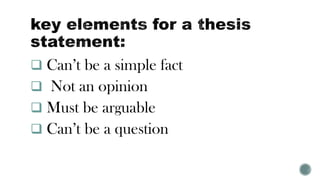
❑ Can’t be a simple fact
❑ Not an opinion
❑ Must be arguable
❑ Can’t be a question
WHAT MAKES A
GOOD THESIS
STATEMENT?
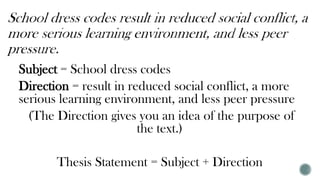
Subject = School dress codes
Direction = result in reduced social conflict, a more
serious learning environment, and less peer pressure
(The Direction gives you an idea of the purpose of
the text.)
Thesis Statement = Subject + Direction
Qualities of a Good Thesis
Statement
▪1. It’s declarative
- simple sentence
- never phrase your thesis statement as a question
- declare it as your position where you’ll explore
and make a case for throughout the duration of the
piece.
ex. School dress code
▪2. It completely conveys the topic.
- All the reader needs to be sufficiently
informed about what you’re going to
discuss, and it should be covered by the
thesis statement. No more, no less.
3. It conveys something interesting
- the reader should want to read
about the topic you’re writing about.
- A lot of this will depend on the
reader ( know your audience)
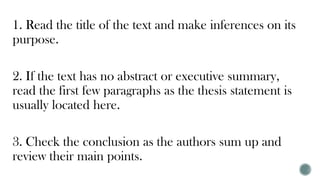
1. Read the title of the text and make inferences on its
purpose.
2. If the text has no abstract or executive summary,
read the first few paragraphs as the thesis statement is
usually located here.
3. Check the conclusion as the authors sum up and
review their main points.
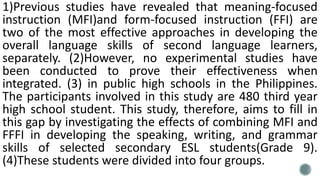
1)Previous studies have revealed that meaning-focused
instruction (MFI)and form-focused instruction (FFI) are
two of the most effective approaches in developing the
overall language skills of second language learners,
separately. (2)However, no experimental studies have
been conducted to prove their effectiveness when
integrated. (3) in public high schools in the Philippines.
The participants involved in this study are 480 third year
high school student. This study, therefore, aims to fill in
this gap by investigating the effects of combining MFI and
FFFI in developing the speaking, writing, and grammar
skills of selected secondary ESL students(Grade 9).
(4)These students were divided into four groups.
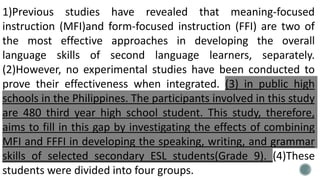
1)Previous studies have revealed that meaning-focused
instruction (MFI)and form-focused instruction (FFI) are two of
the most effective approaches in developing the overall
language skills of second language learners, separately.
(2)However, no experimental studies have been conducted to
prove their effectiveness when integrated. (3) in public high
schools in the Philippines. The participants involved in this study
are 480 third year high school student. This study, therefore,
aims to fill in this gap by investigating the effects of combining
MFI and FFFI in developing the speaking, writing, and grammar
skills of selected secondary ESL students(Grade 9). (4)These
students were divided into four groups.
Outline/Outlining
Outline
- shows the framework of a text through division
and subdivision of ideas.
- another way of determining a text structure
- traditional outline starts with a thesis statement ( one-sentence statement of
the main idea of the article then the body of the article is divided and subdivided )
a. Main Ideas are labelled with Roman Numerals
b. Supporting ideas developing the main ideas are labeled with capital letters,
and indented.
c. details developing the supporting ideas are labeled with Arabic Numbers and
indented.
d. Minor details developing the details are labels with small letters and
indented.
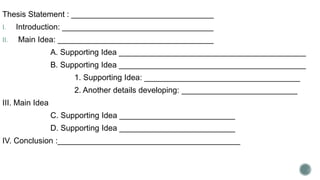
Thesis Statement : ________________________________
I. Introduction: __________________________________
II. Main Idea: ___________________________________
A. Supporting Idea __________________________________________
B. Supporting Idea __________________________________________
1. Supporting Idea: ___________________________________
2. Another details developing: __________________________
III. Main Idea
C. Supporting Idea __________________________
D. Supporting Idea __________________________
IV. Conclusion :_________________________________________
1. SENTENCE OUTLINE
- the heading of each level is one sentence
I. There are two types of sports fan.
A. The first type is the spectator.
B. The second type is the analyst.
II. Sports fans express their involvement in the game in several ways.
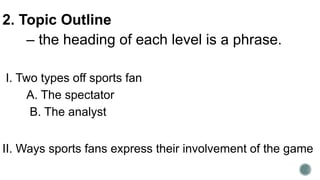
2. Topic Outline
– the heading of each level is a phrase.
I. Two types off sports fan
A. The spectator
B. The analyst
II. Ways sports fans express their involvement of the game
Identifying-Thesis-Statement-and-outlining-Reading-Texts.pdf

Identifying-Thesis-Statement-and-outlining-Reading-Texts.pdf

  • 1.
    Identifying Thesis Statement andoutlining Reading Texts
  • 4.
    1. Thesis Statement -this clearly identifies the topic being discussed, includes the points discussed in the paper and is written for a specific audience. 2. Academic Text - Academic text is defined as critical, objective, specialized texts written by experts or professionals in a given field using formal language. 3. Academic text - it is defined as critical, objective, specialized texts written by experts or professionals in a given field using formal
  • 5.
    THESIS STATEMENT - singleclear, focused sentenced that communicates your paper’s central focus or argument. - gives quick and easy-to follow idea of your position on the topic of the paper. - offers guide to how your paper is organized
  • 6.
    ❑ Can’t bea simple fact ❑ Not an opinion ❑ Must be arguable ❑ Can’t be a question
  • 7.
    WHAT MAKES A GOODTHESIS STATEMENT?
  • 8.
    Subject = Schooldress codes Direction = result in reduced social conflict, a more serious learning environment, and less peer pressure (The Direction gives you an idea of the purpose of the text.) Thesis Statement = Subject + Direction
  • 9.
    Qualities of aGood Thesis Statement
  • 10.
    ▪1. It’s declarative -simple sentence - never phrase your thesis statement as a question - declare it as your position where you’ll explore and make a case for throughout the duration of the piece. ex. School dress code
  • 11.
    ▪2. It completelyconveys the topic. - All the reader needs to be sufficiently informed about what you’re going to discuss, and it should be covered by the thesis statement. No more, no less.
  • 12.
    3. It conveyssomething interesting - the reader should want to read about the topic you’re writing about. - A lot of this will depend on the reader ( know your audience)
  • 14.
    1. Read thetitle of the text and make inferences on its purpose. 2. If the text has no abstract or executive summary, read the first few paragraphs as the thesis statement is usually located here. 3. Check the conclusion as the authors sum up and review their main points.
  • 15.
    1)Previous studies haverevealed that meaning-focused instruction (MFI)and form-focused instruction (FFI) are two of the most effective approaches in developing the overall language skills of second language learners, separately. (2)However, no experimental studies have been conducted to prove their effectiveness when integrated. (3) in public high schools in the Philippines. The participants involved in this study are 480 third year high school student. This study, therefore, aims to fill in this gap by investigating the effects of combining MFI and FFFI in developing the speaking, writing, and grammar skills of selected secondary ESL students(Grade 9). (4)These students were divided into four groups.
  • 16.
    1)Previous studies haverevealed that meaning-focused instruction (MFI)and form-focused instruction (FFI) are two of the most effective approaches in developing the overall language skills of second language learners, separately. (2)However, no experimental studies have been conducted to prove their effectiveness when integrated. (3) in public high schools in the Philippines. The participants involved in this study are 480 third year high school student. This study, therefore, aims to fill in this gap by investigating the effects of combining MFI and FFFI in developing the speaking, writing, and grammar skills of selected secondary ESL students(Grade 9). (4)These students were divided into four groups.
  • 17.
  • 18.
    Outline - shows theframework of a text through division and subdivision of ideas. - another way of determining a text structure
  • 19.
    - traditional outlinestarts with a thesis statement ( one-sentence statement of the main idea of the article then the body of the article is divided and subdivided ) a. Main Ideas are labelled with Roman Numerals b. Supporting ideas developing the main ideas are labeled with capital letters, and indented. c. details developing the supporting ideas are labeled with Arabic Numbers and indented. d. Minor details developing the details are labels with small letters and indented.
  • 20.
    Thesis Statement :________________________________ I. Introduction: __________________________________ II. Main Idea: ___________________________________ A. Supporting Idea __________________________________________ B. Supporting Idea __________________________________________ 1. Supporting Idea: ___________________________________ 2. Another details developing: __________________________ III. Main Idea C. Supporting Idea __________________________ D. Supporting Idea __________________________ IV. Conclusion :_________________________________________
  • 21.
    1. SENTENCE OUTLINE -the heading of each level is one sentence I. There are two types of sports fan. A. The first type is the spectator. B. The second type is the analyst. II. Sports fans express their involvement in the game in several ways.
  • 22.
    2. Topic Outline –the heading of each level is a phrase. I. Two types off sports fan A. The spectator B. The analyst II. Ways sports fans express their involvement of the game